Phonon-driven nodal surface superconductivity of Fermi arcs
Pith reviewed 2026-06-28 12:10 UTC · model grok-4.3
The pith
Phonon interactions with surface and bulk modes produce nodal superconductivity on disconnected Fermi arcs when Coulomb screening is weak.
A machine-rendered reading of the paper's core claim, the machinery that carries it, and where it could break.
Core claim
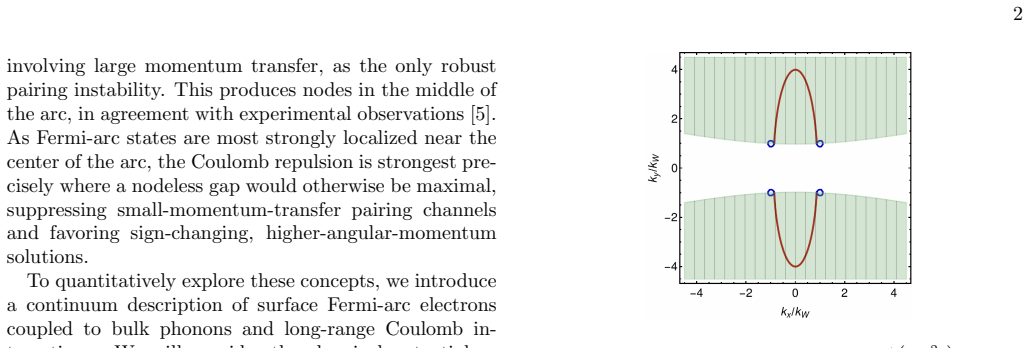
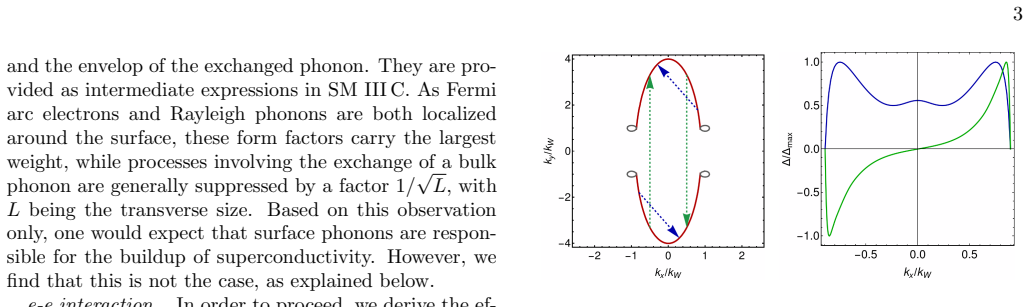
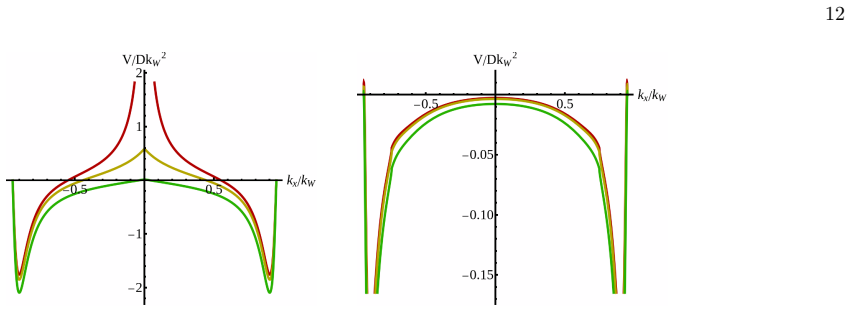
In time-reversal-invariant Weyl semimetals the superconducting gap on Fermi arcs is generated by electron-phonon coupling to both surface and bulk phonons. Intra-arc and inter-arc pairing channels compete; their balance is controlled by the efficiency of Coulomb screening at the surface. Because the arcs are topologically disconnected and screening is inefficient, the gap acquires nodes whose locations and symmetry match the recent observations on PtBi2.
What carries the argument
Competition between intra-arc and inter-arc pairing channels whose relative strength is set by surface Coulomb screening efficiency.
If this is right
- Surface superconductivity appears without bulk superconductivity.
- Nodes form in the gap because arcs are disconnected and screening is weak.
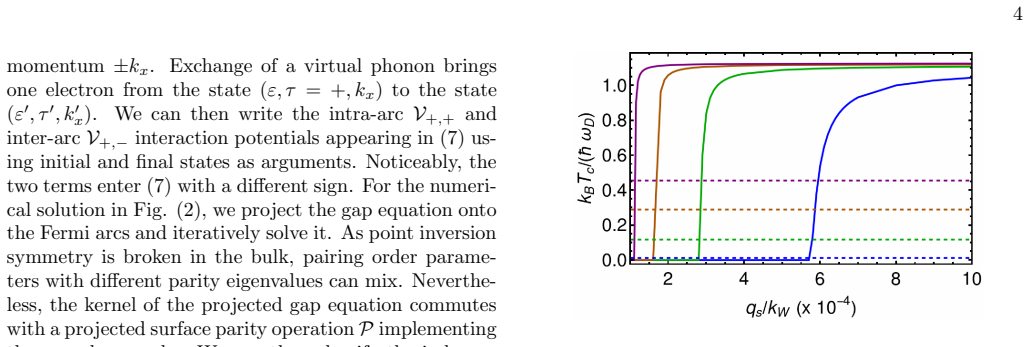
- Coating the surface to change screening can raise or lower the critical temperature.
- The size and symmetry of the surface gap become experimentally tunable.
Where Pith is reading between the lines
- The same phonon-driven nodal mechanism may appear in other materials whose surface states are topologically disconnected.
- If screening can be tuned continuously, the nodal-to-nodeless transition itself becomes a measurable signature of the pairing-channel competition.
Load-bearing premise
Phonon-mediated pairing dominates over other possible mechanisms and the relative strength of the two channels is controlled solely by screening efficiency.
What would settle it
If the gap nodes disappear when a surface coating is added that improves Coulomb screening while leaving phonon spectra unchanged, the proposed mechanism is falsified.
Figures
read the original abstract
According to recent observations, the topological surface states of Weyl semimetals may develop a superconducting gap, while bulk superconductivity remains absent. What drives the formation of this novel superconducting state is an open question. Here, we show that this phenomenon can arise from the interaction of Fermi arc electrons with both surface and bulk phonons in time-reversal-invariant Weyl semimetals. We identify two competing pairing channels, intra-arc and inter-arc, whose relative strength is governed by the efficiency of Coulomb screening at the surface. The combined effect of the Fermi arcs being disconnected and the weak screening of the Coulomb repulsion at the system's surface causes nodes to appear in the superconducting gap, as observed recently by photoelectron spectroscopy experiments on PtBi2. This suggests manipulation of the Coulomb screening, e.g. by a surface layer coating, as a pathway to engineer the critical temperature, as well as size and symmetry of the surface superconducting gap.
Editorial analysis
A structured set of objections, weighed in public.
Referee Report
Summary. The manuscript proposes that in time-reversal-invariant Weyl semimetals, electron-phonon coupling to both surface and bulk phonons can induce superconductivity on the Fermi arcs even when the bulk remains normal. Two competing channels (intra-arc and inter-arc pairing) are identified whose relative strength is controlled by the efficiency of surface Coulomb screening; the combination of disconnected arcs and weak screening is argued to produce nodes in the surface gap, consistent with recent ARPES data on PtBi2. Manipulation of screening (e.g., via surface coating) is suggested as a route to engineer Tc and gap symmetry.
Significance. If the central mechanism is rigorously established, the work would supply a concrete phonon-mediated route to surface-only superconductivity in Weyl semimetals and would link the nodal structure directly to the topology of the arcs plus surface dielectric response. The suggestion that screening can be tuned externally is potentially useful for experiment. However, the absence of an explicit evaluation of the screened Coulomb matrix elements leaves the key competition between channels as an assumption rather than a derived result.
major comments (2)
- [Sections describing the pairing channels and screening (around the discussion of intra- vs. inter-arc competition)] The central claim that weak surface screening preferentially suppresses the repulsive inter-arc channel relative to the attractive intra-arc channel (thereby producing nodes) is stated without a derivation or numerical evaluation of the momentum-dependent screened Coulomb interaction between arc states. No surface RPA calculation, first-principles dielectric function, or explicit matrix-element evaluation for PtBi2 is presented; the nodal outcome therefore rests on an input assumption about screening efficiency rather than emerging from the phonon-interaction calculation.
- [Model Hamiltonian and interaction terms] The model assumes that phonon-mediated pairing dominates over other mechanisms and that the surface/bulk phonon spectrum can be treated with a single effective coupling strength. No quantitative estimate or comparison is given showing that the phonon contribution exceeds residual Coulomb or other interactions once realistic screening is included.
minor comments (2)
- [Introduction and model section] Notation for the screening-efficiency parameter should be defined explicitly at first use and its relation to the dielectric function clarified.
- [Abstract and discussion] The abstract states that nodes appear 'as observed recently by photoelectron spectroscopy experiments on PtBi2'; a brief comparison of the predicted nodal positions or symmetry with the cited experimental data would strengthen the manuscript.
Simulated Author's Rebuttal
We thank the referee for the careful reading of our manuscript and the constructive comments. We address each major point below and will revise the text to improve clarity on the assumptions made.
read point-by-point responses
-
Referee: [Sections describing the pairing channels and screening (around the discussion of intra- vs. inter-arc competition)] The central claim that weak surface screening preferentially suppresses the repulsive inter-arc channel relative to the attractive intra-arc channel (thereby producing nodes) is stated without a derivation or numerical evaluation of the momentum-dependent screened Coulomb interaction between arc states. No surface RPA calculation, first-principles dielectric function, or explicit matrix-element evaluation for PtBi2 is presented; the nodal outcome therefore rests on an input assumption about screening efficiency rather than emerging from the phonon-interaction calculation.
Authors: We agree that the relative strength of the channels is argued on the basis of general physical considerations of surface dielectric response rather than an explicit computation. The manuscript emphasizes that weak surface screening (a standard feature of reduced-dimensional systems) combined with the disconnected nature of the arcs leads to nodes; this is presented as a qualitative mechanism consistent with PtBi2 ARPES data. An explicit surface RPA or first-principles evaluation for PtBi2 lies outside the scope of the present work, which focuses on the phonon-mediated pairing channels. We will revise the relevant sections to state this assumption more explicitly and to highlight the suggested experimental route of tuning screening via surface coating. revision: partial
-
Referee: [Model Hamiltonian and interaction terms] The model assumes that phonon-mediated pairing dominates over other mechanisms and that the surface/bulk phonon spectrum can be treated with a single effective coupling strength. No quantitative estimate or comparison is given showing that the phonon contribution exceeds residual Coulomb or other interactions once realistic screening is included.
Authors: The work is framed as a phonon-driven mechanism, as stated in the title and abstract, motivated by the experimental observation of surface superconductivity without bulk order. The effective coupling is introduced as a minimal model capturing both surface and bulk phonons. We acknowledge that no direct quantitative comparison to residual Coulomb interactions (after screening) is provided. Such a comparison would require extensive ab initio work beyond the present theoretical proposal. We will add a brief discussion of this modeling assumption in the revised manuscript. revision: partial
Circularity Check
No significant circularity; derivation remains self-contained
full rationale
The paper proposes that phonon interactions with surface and bulk modes drive surface superconductivity on Fermi arcs, with nodes arising from the interplay between disconnected arcs and the relative strength of intra-arc versus inter-arc pairing channels as governed by surface Coulomb screening efficiency. No quoted equations or text in the abstract or described full manuscript demonstrate a self-definitional reduction, a fitted parameter renamed as a prediction, or a load-bearing self-citation chain that collapses the nodal outcome to an input by construction. The screening efficiency is invoked as an external physical input rather than derived tautologically from the phonon calculation itself, leaving the central claim with independent content.
Axiom & Free-Parameter Ledger
axioms (1)
- domain assumption Time-reversal-invariant Weyl semimetals host disconnected Fermi arcs on their surfaces.
Reference graph
Works this paper leans on
-
[1]
Veyrat, V
A. Veyrat, V. Labracherie, D. L. Bashlakov, F. Caglieris, J. I. Facio, G. Shipunov, T. Charvin, R. Acharya, Y. Naidyuk, R. Giraud, J. van den Brink, B. B¨ uchner, C. Hess, S. Aswartham, and J. Dufouleur, Berezin- skii–Kosterlitz–Thouless transition in the type-I Weyl semimetal PtBi2, Nano Lett.23, 1229–1235 (2023)
2023
-
[2]
Kuibarov, O
A. Kuibarov, O. Suvorov, R. Vocaturo, A. Fedorov, R. Lou, L. Merkwitz, V. Voroshnin, J. I. Facio, K. Koepernik, A. Yaresko, G. Shipunov, S. Aswartham, J. van den Brink, B. B¨ uchner, and S. Borisenko, Evidence of superconducting fermi arcs, Nature626, 294–299 (2024)
2024
-
[3]
J. A. Moreno, P. G. Talavera, E. Herrera, S. L. Valle, Z. Li, L.-L. Wang, S. Bud’ko, A. I. Buzdin, I. Guillam´ on, P. C. Canfield, and H. Suderow, Robust surface supercon- ductivity and vortex lattice in the weyl semimetalγ-ptbi2 (2025), arXiv:2508.04867 [cond-mat.supr-con]
arXiv 2025
-
[4]
S. Schimmel, Y. Fasano, S. Hoffmann, J. Besproswanny, L. T. Corredor Bohorquez, J. Puig, B.-C. Elshalem, B. Kalisky, G. Shipunov, D. Baumann, S. Aswartham, B. B¨ uchner, and C. Hess, Surface superconductivity in the topological weyl semimetal t-ptbi2, Nature Commu- nications15, 10.1038/s41467-024-54389-6 (2024)
-
[5]
Changdar, O
S. Changdar, O. Suvorov, A. Kuibarov, S. Thirupatha- iah, G. Shipunov, S. Aswartham, S. Wurmehl, I. Ko- valchuk, K. Koepernik, C. Timm, B. B¨ uchner, I. C. Fulga, S. Borisenko, and J. van den Brink, Topological nodali-wave superconductivity in PtBi 2, Nature647, 613–618 (2025)
2025
-
[6]
Shipunov, I
G. Shipunov, I. Kovalchuk, B. R. Piening, V. Labracherie, A. Veyrat, D. Wolf, A. Lubk, S. Subakti, R. Giraud, J. Dufouleur, S. Shokri, F. Caglieris, C. Hess, D. V. Efremov, B. B¨ uchner, and S. Aswartham, Poly- morphic ptbi 2: Growth, structure, and superconducting properties, Phys. Rev. Mater.4, 124202 (2020)
2020
-
[7]
Vocaturo, K
R. Vocaturo, K. Koepernik, J. I. Facio, C. Timm, I. C. Fulga, O. Janson, and J. van den Brink, Electronic structure of the surface-superconducting weyl semimetal ptbi2, Phys. Rev. B110, 054504 (2024)
2024
-
[8]
Hoffmann, S
S. Hoffmann, S. Schimmel, R. Vocaturo, J. Puig, G. Shipunov, O. Janson, S. Aswartham, D. Baumann, B. B¨ uchner, J. van den Brink, Y. Fasano, J. I. Facio, and C. Hess, Fermi arcs dominating the electronic surface properties of trigonal ptbi2, Advanced Physics Research 4, 2400150 (2025)
2025
-
[9]
Zhang, H
H. Zhang, H. Chen, Z. Huang, Z.-A. Wang, G. Han, R. Ma, X. Zhu, W. Ning, C. Shen, Q. Huan, and H.-J. Gao, Atomic visualization of bulk and surface supercon- ductivity in weyl semimetalγ-ptbi2, Chin. Phys. Lett. 42, 120708 (2025)
2025
-
[10]
Nomani and P
A. Nomani and P. Hosur, Intrinsic surface superconduct- ing instability in type-i weyl semimetals, Phys. Rev. B 108, 165144 (2023)
2023
-
[11]
X. Bai, W. LiMing, and T. Zhou, Superconductivity in weyl semimetals with time reversal symmetry, New Jour- nal of Physics27, 013003 (2025)
2025
-
[12]
H. Waje, F. Jakubczyk, J. van den Brink, and C. Timm, Ginzburg-landau theory for unconventional surface su- perconductivity in ptbi 2, Phys. Rev. B112, 144519 (2025)
2025
-
[13]
Trama, V
M. Trama, V. K¨ onye, I. C. Fulga, and J. van den Brink, Self-consistent surface superconductivity in time-reversal symmetric weyl semimetals, Phys. Rev. B112, 064514 (2025)
2025
- [14]
-
[15]
K. Mæland, G. Sangiovanni, and B. Trauzettel, Mech- anism for nodal topological superconductivity on ptbi 2 surface (2025), arXiv:2512.09994 [cond-mat.supr-con]
Pith/arXiv arXiv 2025
-
[16]
N. P. Armitage, E. J. Mele, and A. Vishwanath, Weyl and dirac semimetals in three-dimensional solids, Rev. Mod. Phys.90, 015001 (2018)
2018
-
[17]
X. Wan, A. M. Turner, A. Vishwanath, and S. Y. Savrasov, Topological semimetal and fermi-arc surface states in the electronic structure of pyrochlore iridates, Physical Review B83, 205101 (2011)
2011
-
[18]
E. V. Gorbar, V. A. Miransky, I. A. Shovkovy, and P. O. Sukhachov, Surface fermi arcs in𭟋 2 weyl semimetals A3Bi (a= Na, k, rb), Phys. Rev. B91, 235138 (2015)
2015
-
[19]
E. Witten, Three lectures on topological phases of matter, Nuovo Cimento Rivista Serie39, 313 (2016), arXiv:1510.07698 [cond-mat.mes-hall]
Pith/arXiv arXiv 2016
-
[20]
De Martino, K
A. De Martino, K. Dorn, F. Buccheri, and R. Egger, Phonon-induced magnetoresistivity of weyl semimetal nanowires, Phys. Rev. B104, 155425 (2021)
2021
-
[21]
Landau, E
L. Landau, E. Lifshitz, A. Kosevich, J. Sykes, L. Pitaevskii, and W. Reid,Theory of Elasticity, Course of theoretical physics (Elsevier Science, 1986)
1986
-
[22]
Mahan,Many-Particle Physics, Physics of Solids and Liquids (Springer US, 2000)
G. Mahan,Many-Particle Physics, Physics of Solids and Liquids (Springer US, 2000)
2000
-
[23]
Skinner, Coulomb disorder in three-dimensional dirac systems, Phys
B. Skinner, Coulomb disorder in three-dimensional dirac systems, Phys. Rev. B90, 060202 (2014)
2014
-
[24]
Das Sarma, E
S. Das Sarma, E. H. Hwang, and H. Min, Carrier screen- ing, transport, and relaxation in three-dimensional dirac semimetals, Phys. Rev. B91, 035201 (2015)
2015
-
[25]
Stern, Polarizability of a two-dimensional electron gas, Phys
F. Stern, Polarizability of a two-dimensional electron gas, Phys. Rev. Lett.18, 546 (1967)
1967
-
[26]
Miao, Physical Review A95, 10.1103/phys- reva.95.012103 (2017)
S. Ghosh and C. Timm, Dynamical density and spin response of fermi arcs and their consequences for weyl semimetals, Physical Review B101, 10.1103/phys- revb.101.165402 (2020)
-
[27]
Tinkham,Introduction to Superconductivity, 2nd ed
M. Tinkham,Introduction to Superconductivity, 2nd ed. (Dover Publications, 2004)
2004
-
[28]
C. Timm, Theory of superconductivity - lecture notes, Lecture Notes (2025), version: April 7, 2025; originally for Winter Semester 2017/2018, TU Dresden, Institute of Theoretical Physics
2025
-
[29]
Giwa and P
R. Giwa and P. Hosur, Fermi arc criterion for surface majorana modes in superconducting time-reversal sym- metric weyl semimetals, Phys. Rev. Lett.127, 187002 (2021)
2021
-
[30]
A. C. Potter and P. A. Lee, Topological superconduc- tivity and majorana fermions in metallic surface states, Phys. Rev. B85, 094516 (2012)
2012
-
[31]
S. Park, S. Woo, E. J. Mele, and H. Min, Semiclassical boltzmann transport theory for multi-weyl semimetals, Phys. Rev. B95, 161113 (2017)
2017
-
[32]
Y. Yang, Y. Yang, K. Chen, M. A. Morales, and S. Zhang, Two-dimensional homogeneous electron gas with sym- metric dual-gate screening: Exchange-correlation func- tional and other ground-state properties, Phys. Rev. B 111, 045136 (2025)
2025
-
[33]
Fatemi and J
V. Fatemi and J. Ruhman, Synthesizing coulombic su- perconductivity in van der waals bilayers, Phys. Rev. B 98, 094517 (2018)
2018
-
[34]
Steinke, T
C. Steinke, T. O. Wehling, and M. R¨ osner, Coulomb- engineered heterojunctions and dynamical screening in transition metal dichalcogenide monolayers, Phys. Rev. B102, 115111 (2020)
2020
-
[35]
Khanna, A
U. Khanna, A. Kundu, S. Pradhan, and S. Rao, Proximity-induced superconductivity in weyl semimetals, Phys. Rev. B90, 195430 (2014)
2014
-
[36]
Chen and M
A. Chen and M. Franz, Superconducting proximity ef- fect and majorana flat bands at the surface of a weyl semimetal, Phys. Rev. B93, 201105(R) (2016)
2016
-
[37]
A. Chen, D. I. Pikulin, and M. Franz, Josephson cur- rent signatures of majorana flat bands on the surface of time-reversal-invariant weyl and dirac semimetals, Phys- ical Review B95, 10.1103/physrevb.95.174505 (2017)
-
[38]
Naidyuk, O
Y. Naidyuk, O. Kvitnitskaya, D. Bashlakov, S. Aswartham, I. Morozov, I. Chernyavskii, G. Fuchs, S.-L. Drechsler, R. H¨ uhne, K. Nielsch, B. B¨ uchner, and D. Efremov, Surface superconductivity in the weyl semimetal mote2 detected by point contact spectroscopy, 2D Materials5, 045014 (2018)
2018
-
[39]
Y. Li, Q. Gu, C. Chen, J. Zhang, Q. Liu, X. Hu, J. Liu, Y. Liu, L. Ling, M. Tian, Y. Wang, N. Samarth, S. Li, T. Zhang, J. Feng, and J. Wang, Nontrivial supercon- ductivity in topological mote2 crystals, Proceedings of the National Academy of Sciences115, 9503 (2018)
2018
-
[40]
Bannov, V
N. Bannov, V. Mitin, and M. Stroscio, Confined acoustic phonons in a free-standing quantum well and their inter- action with electrons, physica status solidi (b)183, 131 (1994)
1994
-
[41]
Giraud and R
S. Giraud and R. Egger, Electron-phonon scattering in topological insulators, Phys. Rev. B83, 245322 (2011)
2011
-
[42]
Buccheri, A
F. Buccheri, A. De Martino, R. G. Pereira, P. W. Brouwer, and R. Egger, Phonon-limited transport and fermi arc lifetime in weyl semimetals, Phys. Rev. B105, 085410 (2022)
2022
-
[43]
Liang, Z.-h
Y. Liang, Z.-h. Wang, M. Al-Fahdi, J. Gaytan, A. Ra- jbanshi, A. Alem, W. Farias, A. Bielicki, A. Bansod, A. Teklu, N. Kuthirummal, L. Shi, M. Hu, S. Mu, R. Jin, and Y. Gong, Observation of femtosecond laser-induced coherent acoustic phonon pulse echoes in layered ptbi 2, Phys. Rev. Mater.10, 014001 (2026)
2026
-
[44]
B. A. Auld and R. E. Green, Acoustic Fields and Waves in Solids: Two Volumes, Physics Today27, 63 (1974)
1974
-
[45]
Giraud, A
S. Giraud, A. Kundu, and R. Egger, Electron-phonon scattering in topological insulator thin films, Phys. Rev. B85, 035441 (2012)
2012
-
[46]
Y. Xing, Z. Shao, J. Ge, J. Luo, J. Wang, Z. Zhu, J. Liu, Y. Wang, Z. Zhao, J. Yan, D. Mandrus, B. Yan, X.-J. Liu, M. Pan, and J. Wang, Surface superconductivity in the type ii weyl semimetal tairte4, National Science Review 7, 579 (2019)
2019
-
[47]
L. Xing, R. Chapai, R. Nepal, and R. Jin, Topological behavior and Zeeman splitting in trigonal PtBi2-x single crystals, npj Quantum Materials5, 10 (2020)
2020
-
[48]
D. L. Bashlakov, O. E. Kvitnitskaya, G. Shipunov, S. Aswartham, O. D. Feya, D. V. Efremov, B. B¨ uchner, and Y. G. Naidyuk, Electron-phonon interaction and point contact enhanced superconductivity in trigonal ptbi2, Low Temperature Physics48, 747 (2022)
2022
-
[49]
Burrello, E
M. Burrello, E. Guadagnini, L. Lepori, and M. Mintchev, Field theory approach to the quantum transport in weyl semimetals, Phys. Rev. B100, 155131 (2019)
2019
-
[50]
R. G. Pereira, F. Buccheri, A. De Martino, and R. Egger, Superconductivity from piezoelectric interactions in weyl semimetals, Phys. Rev. B100, 035106 (2019)
2019
-
[51]
C. D. Meyer,Matrix Analysis and Applied Linear Al- gebra(Society for Industrial and Applied Mathematics, Philadelphia, PA, 2000). 7
2000
-
[52]
longitudinal
R. Jentzsch, ¨Uber integralgleichungen mit positivem kern., Journal f¨ ur die reine und angewandte Mathematik 141, 235 (1912). 8 Supplemental Material I. LA TTICE MODEL Starting from a tight-binding model, we derive here the continuum electronic Hamiltonian and the electron-phonon interaction terms used in the main text. Consider a cubic lattice with a to...
1912
discussion (0)
Sign in with ORCID, Apple, or X to comment. Anyone can read and Pith papers without signing in.