Bounds on Nonlocality and Random Access Codes from Extended Information Causality Principle
Pith reviewed 2026-06-28 13:48 UTC · model grok-4.3
The pith
Extended Information Causality produces stronger Bell inequalities and new bounds on random access codes
A machine-rendered reading of the paper's core claim, the machinery that carries it, and where it could break.
Core claim
By extending Information Causality to include correlations among Alice's inputs, the authors derive a family of Bell inequalities that strengthen previous constraints on quantum correlations. These are used to obtain an improved analytical bound for the Collins-Gisin family. Application to entanglement-assisted random access codes produces new theory-independent bounds on the winning probability, but the extension does not tighten them beyond the original Information Causality bounds.
What carries the argument
The extended Information Causality principle allowing correlations among Alice's inputs
If this is right
- Stronger constraints apply to nonlocal correlations in Bell scenarios with more than binary inputs and outputs.
- An improved analytical upper bound holds for the quantum value of the Collins-Gisin family of Bell inequalities.
- New theory-independent analytical bounds exist on the winning probability of entanglement-assisted random access codes.
- The original Information Causality principle already achieves optimal bounds for the class of binary random access codes considered.
Where Pith is reading between the lines
- The optimality for random access codes suggests that further refinements of the principle may be needed to constrain quantum correlations more tightly in communication tasks.
- Applying the extended principle to other nonlocality scenarios could uncover additional bounds not captured by the original formulation.
- Experimental tests of the new Bell inequalities could distinguish whether the extension correctly describes physical correlations.
Load-bearing premise
The extended Information Causality principle correctly describes a valid constraint on physical nonlocal correlations.
What would settle it
A quantum correlation that violates one of the new Bell inequalities derived from the extended principle while satisfying all known quantum bounds would falsify the claim that the principle constrains quantum theory.
Figures
read the original abstract
Information Causality was introduced as a physical principle for constraining the set of nonlocal correlations. In recent work, we proposed an extension of Information Causality that allows correlations among Alice's inputs. This extended principle yields tighter constraints than the original formulation and recovers part of the quantum boundary in certain Bell scenarios. In this work, we further investigate the implications of extended Information Causality and apply it to scenarios beyond binary inputs and outputs. We derive a family of quantum Bell inequalities that strengthen previously known constraints on quantum correlations. Using these inequalities, we obtain an improved analytical bound for the Collins-Gisin family of Bell inequalities. We also apply Information Causality to entanglement-assisted random access codes and derive new theory-independent analytical bounds on the winning probability. For this latter task, we prove that, despite being stronger in general, the extended principle does not improve the bounds obtained from the original Information Causality principle. This suggests that the existing Information Causality bounds are optimal for this class of random access codes.
Editorial analysis
A structured set of objections, weighed in public.
Referee Report
Summary. The manuscript extends the Information Causality principle to allow correlations among Alice's inputs. It derives a family of quantum Bell inequalities that strengthen previously known constraints, obtains an improved analytical bound for the Collins-Gisin family, and applies the principle to entanglement-assisted random access codes to derive new theory-independent bounds on winning probability. It proves that the extended principle yields no improvement over the original for this class of random access codes.
Significance. If the derivations and proof hold, the work strengthens theory-independent bounds on nonlocal correlations in Bell scenarios and establishes optimality of existing Information Causality bounds for entanglement-assisted random access codes. The explicit derivations of the extended bounds and the proof that the extension does not tighten the RAC results are strengths that advance the program of using physical principles to constrain quantum correlations.
minor comments (1)
- The comparison between the original and extended Information Causality principles in the introduction would benefit from an explicit side-by-side equation or table to highlight the modification allowing input correlations.
Simulated Author's Rebuttal
We thank the referee for the positive assessment and recommendation to accept the manuscript. The referee's summary correctly identifies the main results on the extended Information Causality principle, the strengthened Bell inequalities, the improved bound for the Collins-Gisin family, and the proof that the extension yields no further tightening for entanglement-assisted random access codes.
Circularity Check
Minor self-citation to prior definition of extended principle; all new derivations are explicit and non-reductive
full rationale
The manuscript cites the authors' own recent work solely to introduce the definition of the extended Information Causality principle (allowing input correlations). All subsequent steps—deriving a family of strengthened Bell inequalities, obtaining an improved analytical bound on the Collins-Gisin family, and proving that the extension yields no tighter RAC bounds—are presented as direct, explicit computations from the stated principle. No equation reduces a claimed prediction to a fitted parameter, no uniqueness theorem is imported from self-citation, and no ansatz is smuggled via citation. The self-citation is therefore not load-bearing for the new results and does not create circularity.
Axiom & Free-Parameter Ledger
axioms (1)
- domain assumption Information Causality (original and extended) is a valid physical principle that constrains nonlocal correlations
Reference graph
Works this paper leans on
-
[1]
isotropic
and compute the joint distribution of Alice’s bits and Bob’s guess. From this distribution, we obtain the guess- ing probability for each bit and then evaluate the mutual information terms in Eq. (5). To extract quadratic in- equalities from these mutual-information terms, we use the technique outlined in [16]. In the limit in which the capacity of the cl...
-
[2]
The same argument extends naturally to dits
Thus, by using the algorithm as described in [16], we 6 get a bound on the bias and thus, the associated winning probability in the case of perfect transmission is e2 ≤ 1 n ⇒p≤ 1 2 1 + 1√n .(18) Thus, we have re-derived the well known bound on (n(2),1, p) EARAC winning probability [22, 23]. The same argument extends naturally to dits. We consider theunifo...
-
[3]
Heree j,i := 2P(A=B|α=j, β=i)−1, for all i, j∈[n], andk i denotes thei-th component of then-dimensional binary vector ⃗k
Details onnn22inequalities from the extended IC principle Theorem 1.Any non-signaling theory satisfying the extended IC principle complies with the following inequalities n−1X i=0 2iX kj<i X ki (−1)ki X kj>i (−1)h(⃗k)ef(⃗k),i 2 ≤4 n,(6) for any functionsf:{0,1} n →[n]andh:{0,1} n → {0,1}. Heree j,i := 2P(A=B|α=j, β=i)−1, for all i, j∈[n], andk i de...
-
[4]
Note that there are still other classes of protocols that one can consider for thenn22 scenario
= 1+ec 2 . Note that there are still other classes of protocols that one can consider for thenn22 scenario. However, we leave the analysis of such protocols for future investigations. We denote byA i ={a 0, . . . , ai−1}the set of firstiinput bits. The extended IC statement is given by n−1X i=0 I(g;a i|Ai, b=i)≤ C.(A2) We expand each term in the summation...
-
[5]
Details ofI nn22 upper bound from the extended IC statement In this section, we derive an improved analytical upper bound on the quantum value of theI nn22 expression [25] for an arbitraryn, using the inequalities in Theorem 6. We consider the case of NS-boxes with uniformly distributed marginals, in which case theI nn22 Bell inequality takes the form, In...
-
[6]
Alternatively, one could have used the IC statement itself, i.e., the logarithmic inequality, as a constraint to derive a bound
On the bounding power of the extended IC statement and the derived inequalities In the previous section, we used the quadratic inequalities derived from the extended IC statement to bound the Inn22 expression. Alternatively, one could have used the IC statement itself, i.e., the logarithmic inequality, as a constraint to derive a bound. In principle, this...
-
[7]
We reproduce below the probability distributions for Alice’s inputs, the channel and the NS-box from Eq
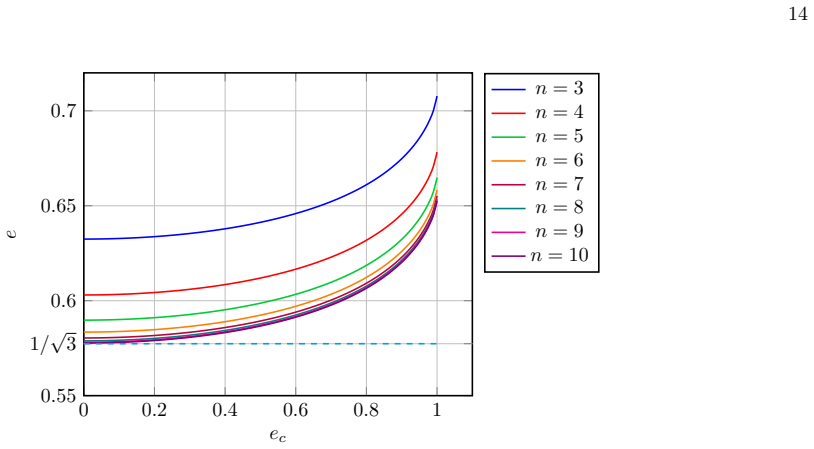
Details ofd2ddinequalities In this section, we provide additional details and the proof of Theorem 3. We reproduce below the probability distributions for Alice’s inputs, the channel and the NS-box from Eq. (8) as follows, P(a0 =k, a 1 =l) = 1 +q kl d2 P(x′ =x⊕m) = 1 + (d−1)e m c d P(A⊕B=k|α=i, β=j) = 1 + (d−1)e k ij d .(B1) 14 0 0.2 0.4 0.6 0.8 10.55 0.6...
-
[8]
unbiased errors case
Details of the correlation slice We provide the details of the inequalities and the correlation slice used for the comparison in Fig. 2. We first reproduce the original IC inequalities from [14, 16]. Theorem 7(From [14]).In thed2ddscenario, the following family of inequalities follows from the Information Causality principle: 1X i=0 d−1X j=0 d−1X k=0 ˜ei·...
-
[9]
We work in the standard scenario where Alice and Bob use the generalized van Dam protocol
Proof of Theorem 4 We choose an isotropic family of PR-boxes with biases defined by ek ij = [k=i·j]e−[k̸=i·j] e d−1 .(D1) We assume Alice has an input distribution of the form P(a 0 =k, a 1 =l) = 1+ϵqkl d2 . We work in the standard scenario where Alice and Bob use the generalized van Dam protocol. We then compute the joint distribution and some relevant m...
-
[10]
We begin by writing down the explicit form of the IC inequality for the uncorrelated case as a function of the box biases and the channel parameters i.e
Proof of Theorem 5 We will now prove that the optimum bound oneoccurs for a uniform error channel. We begin by writing down the explicit form of the IC inequality for the uncorrelated case as a function of the box biases and the channel parameters i.e. we definef(e,{e i c}d−1 i=0 ) :=I 0(e,{e i c}d−1 i=0 )− Cas follows, f(e,{e i c}d−1 i=0 ) = 1 dlog 2 d−1...
-
[11]
J. S. Bell, On the einstein podolsky rosen paradox, Physics Physique Fizika1, 195 (1964)
1964
-
[12]
Brunner, D
N. Brunner, D. Cavalcanti, S. Pironio, V. Scarani, and S. Wehner, Bell nonlocality, Reviews of Modern Physics 86, 419 (2014)
2014
-
[13]
L. K. Shalm, E. Meyer-Scott, B. G. Christensen, P. Bier- horst, M. A. Wayne, M. J. Stevens, T. Gerrits, S. Glancy, D. R. Hamel, M. S. Allman, K. J. Coakley, S. D. Dyer, C. Hodge, A. E. Lita, V. B. Verma, C. Lam- brocco, E. Tortorici, A. L. Migdall, Y. Zhang, D. R. Kumor, W. H. Farr, F. Marsili, M. D. Shaw, J. A. Stern, C. Abell´ an, W. Amaya, V. Pruneri, ...
2015
-
[14]
Giustina, M
M. Giustina, M. A. M. Versteegh, S. Wengerowsky, J. Handsteiner, A. Hochrainer, K. Phelan, F. Steinlech- ner, J. Kofler, J.-A. Larsson, C. Abell´ an, W. Amaya, V. Pruneri, M. W. Mitchell, J. Beyer, T. Gerrits, A. E. Lita, L. K. Shalm, S. W. Nam, T. Scheidl, R. Ursin, B. Wittmann, and A. Zeilinger, Significant-loophole-free test of bell’s theorem with enta...
2015
-
[15]
Hensen, H
B. Hensen, H. Bernien, A. E. Dr´ eau, A. Reiserer, N. Kalb, M. S. Blok, J. Ruitenberg, R. F. L. Vermeulen, R. N. Schouten, C. Abell´ an, W. Amaya, V. Pruneri, M. W. Mitchell, M. Markham, D. J. Twitchen, D. Elkouss, S. Wehner, T. H. Taminiau, and R. Hanson, Loophole- free bell inequality violation using electron spins sepa- rated by 1.3 kilometres, Nature5...
2015
-
[16]
Popescu and D
S. Popescu and D. Rohrlich, Quantum nonlocality as an axiom, Foundations of Physics24, 379 (1994)
1994
-
[17]
Navascu´ es, S
M. Navascu´ es, S. Pironio, and A. Ac´ ın, Bounding the set of quantum correlations, Physical Review Letters98, 010401 (2007)
2007
-
[18]
Fritz, A
T. Fritz, A. B. Sainz, R. Augusiak, J. B. Brask, R. Chaves, A. Leverrier, and A. Ac´ ın, Local orthogonal- ity as a multipartite principle for quantum correlations, Nature Communications4, 2263 (2013)
2013
-
[19]
Brassard, H
G. Brassard, H. Buhrman, N. Linden, A. A. M´ ethot, A. Tapp, and F. Unger, Limit on nonlocality in any world in which communication complexity is not trivial, Phys- ical Review Letters96, 250401 (2006)
2006
-
[20]
M. Navascu´ es, Y. Guryanova, M. J. Hoban, and A. Ac´ ın, Almost quantum correlations, Nature Communications 6, 10.1038/ncomms7288 (2015)
-
[21]
Paw lowski, T
M. Paw lowski, T. Paterek, D. Kaszlikowski, V. Scarani, A. Winter, and M. ˙Zukowski, Information causality as a physical principle, Nature461, 1101 (2009)
2009
-
[22]
J. F. Clauser, M. A. Horne, A. Shimony, and R. A. Holt, Proposed experiment to test local hidden-variable theo- ries, Physical Review Letters23, 880 (1969)
1969
-
[23]
Uffink, Quadratic Bell inequalities as tests for mul- tipartite entanglement, Physical Review Letters88, 230406 (2002)
J. Uffink, Quadratic Bell inequalities as tests for mul- tipartite entanglement, Physical Review Letters88, 230406 (2002)
2002
-
[24]
Gachechiladze, B
M. Gachechiladze, B. Bak, M. Paw lowski, and N. Miklin, Quantum Bell inequalities from information causality– tight for macroscopic locality, Quantum6, 717 (2022)
2022
-
[25]
Miklin and M
N. Miklin and M. Paw lowski, Information causality with- out concatenation, Physical Review Letters126, 220403 (2021)
2021
-
[26]
P. Jain, M. Gachechiladze, and N. Miklin, Information causality as a tool for bounding the set of quantum cor- relations, Phys. Rev. Lett.133, 160201 (2024)
2024
- [27]
-
[28]
B. S. Cirel’son, Quantum generalizations of Bell’s in- equality, Letters in Mathematical Physics4, 93 (1980)
1980
-
[29]
L. J. Landau, Empirical two-point correlation functions, Foundations of Physics18, 449 (1988)
1988
-
[30]
L. Masanes, Necessary and sufficient condition for quantum-generated correlations, arXiv preprint quant- ph/0309137 (2003)
arXiv 2003
-
[31]
L. Pollyceno, D. Freudenheim, J. Nogueira, A. Chaturvedi, R. Rabelo, and M. Paw lowski, Communication-constrained nonlocal correlations (2026), arXiv:2603.08610 [quant-ph]
arXiv 2026
-
[32]
A. Ambainis, D. Leung, L. Mancinska, and M. Ozols, Quantum random access codes with shared randomness (2009), arXiv:0810.2937 [quant-ph]
Pith/arXiv arXiv 2009
-
[33]
Paw lowski and M
M. Paw lowski and M. ˙Zukowski, Entanglement-assisted random access codes, Phys. Rev. A81, 042326 (2010)
2010
-
[34]
Ac´ ın, N
A. Ac´ ın, N. Brunner, N. Gisin, S. Massar, S. Pironio, and V. Scarani, Device-independent security of quantum cryptography against collective attacks, Physical Review Letters98, 230501 (2007)
2007
-
[35]
Collins and N
D. Collins and N. Gisin, A relevant two qubit Bell in- equality inequivalent to the CHSH inequality, Journal of Physics A: Mathematical and General37, 1775 (2004)
2004
-
[36]
W. van Dam, Implausible consequences of superstrong nonlocality (2005), arXiv:quant-ph/0501159 [quant-ph]
Pith/arXiv arXiv 2005
-
[37]
Navascu´ es and H
M. Navascu´ es and H. Wunderlich, A glance beyond the quantum model, Proceedings of the Royal Society A: Mathematical, Physical and Engineering Sciences466, 881 (2010)
2010
-
[38]
Cavalcanti, A
D. Cavalcanti, A. Salles, and V. Scarani, Macroscopically local correlations can violate information causality, Na- ture communications1, 136 (2010)
2010
-
[39]
Ambainis, D
A. Ambainis, D. Kravchenko, S. Sazim, J. Bae, and A. Rai, Quantum advantages in random access codes, New Journal of Physics26, 123023 (2024)
2024
-
[40]
J. I. de Vicente, A general bound for the dimension of quantum behaviours in the prepare-and-measure sce- nario, Journal of Physics A: Mathematical and Theoret- ical52, 095304 (2019)
2019
-
[41]
hyperbits
M. Paw lowski and A. Winter, “hyperbits”: The informa- tion quasiparticles, Phys. Rev. A85, 022331 (2012)
2012
-
[42]
T˘ an˘ asescu, V.-F
A. T˘ an˘ asescu, V.-F. Iliescu, and P. G. Popescu, Opti- mal entanglement-assisted almost-random access codes, Phys. Rev. A101, 042309 (2020)
2020
-
[43]
Hameedi, D
A. Hameedi, D. Saha, P. Mironowicz, M. Paw lowski, and M. Bourennane, Complementarity between entanglement-assisted and quantum distributed random access code, Phys. Rev. A95, 052345 (2017)
2017
-
[44]
Tavakoli, B
A. Tavakoli, B. Marques, M. Paw lowski, and M. Bouren- nane, Spatial versus sequential correlations for random access coding, Phys. Rev. A93, 032336 (2016)
2016
-
[45]
Farkas, N
M. Farkas, N. Miklin, and A. Tavakoli, Simple and gen- eral bounds on quantum random access codes, Quantum 9, 1643 (2025)
2025
-
[46]
Prabhav, Extended IC algorithm,https://github
J. Prabhav, Extended IC algorithm,https://github. 23 com/jprabhav/extended-ic-algorithm(2026), gitHub repository
2026
discussion (0)
Sign in with ORCID, Apple, or X to comment. Anyone can read and Pith papers without signing in.