Suppression of p-Wave Altermagnetism by Localized 4f Electrons in CeNiAsO
Pith reviewed 2026-06-28 12:46 UTC · model grok-4.3
The pith
Localized Ce 4f electrons suppress observable p-wave altermagnetic splitting in CeNiAsO
A machine-rendered reading of the paper's core claim, the machinery that carries it, and where it could break.
Core claim
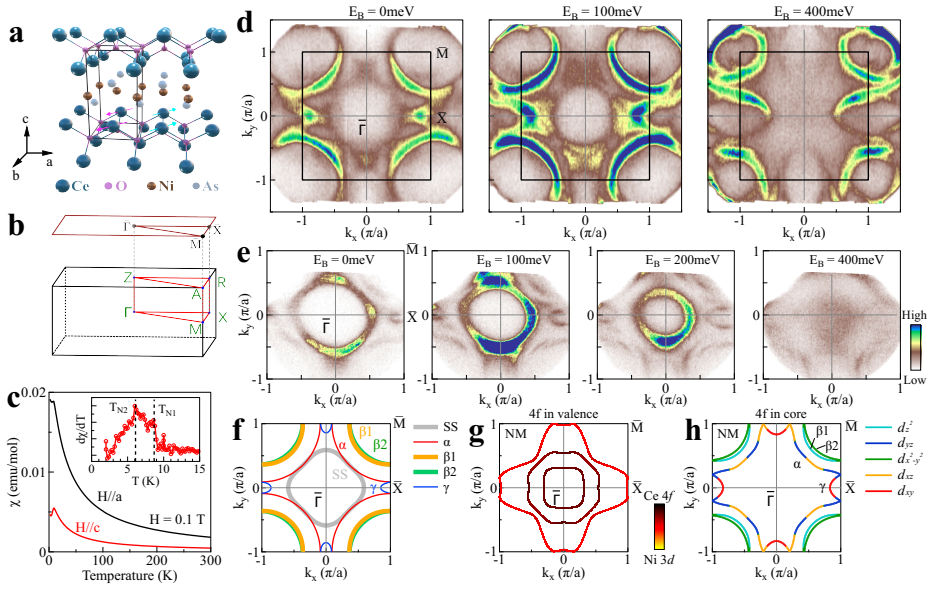
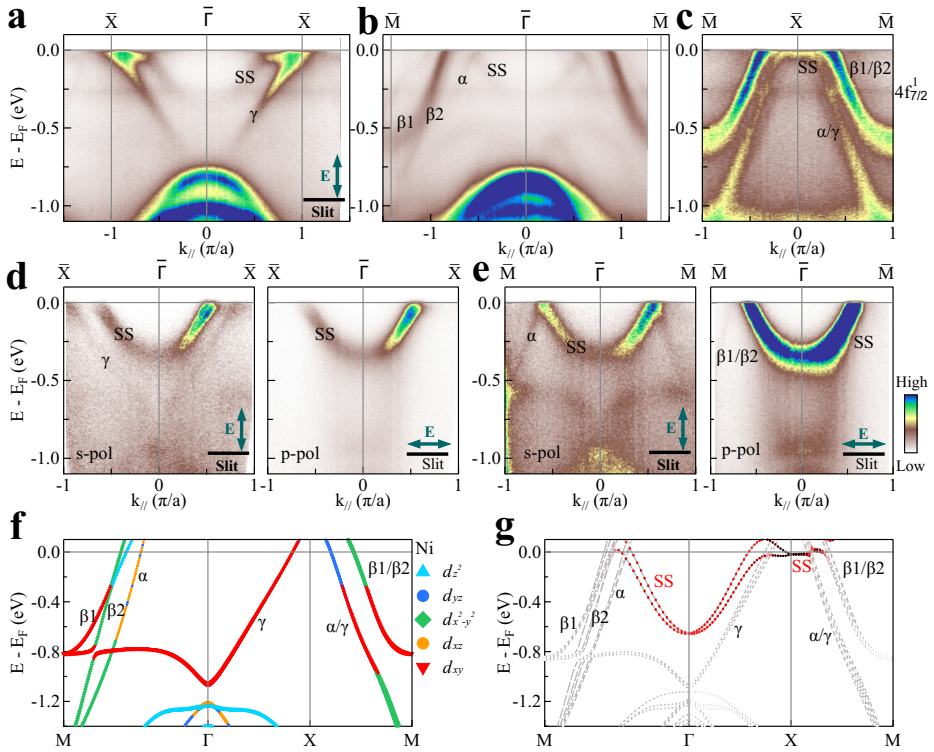
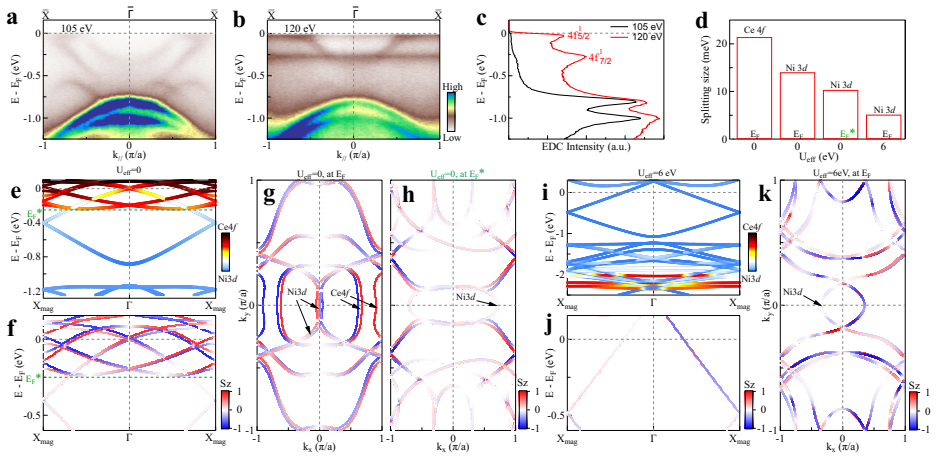
The magnetic symmetry of CeNiAsO permits p-wave-like band splitting, but ARPES detects none on the itinerant Ni 3d bands. Itinerant-4f calculations predict sizable splitting, while localized-4f calculations shift Ce 4f weight away from the Fermi level and reduce the Ni 3d splitting to the few-meV scale. Localized 4f electrons therefore strongly suppress the observable itinerant single-particle signature of p-wave altermagnetism.
What carries the argument
Localized Ce 4f character in band-structure calculations, which shifts itinerant Ce 4f band weight away from the Fermi level and reduces p-wave-like splitting on the Ni 3d-derived bands to the few-meV scale.
If this is right
- The experimentally observed itinerant bands are mainly derived from Ni 3d orbitals.
- Resonant photoemission shows Ce 4f states remain predominantly localized with residual c-f hybridization.
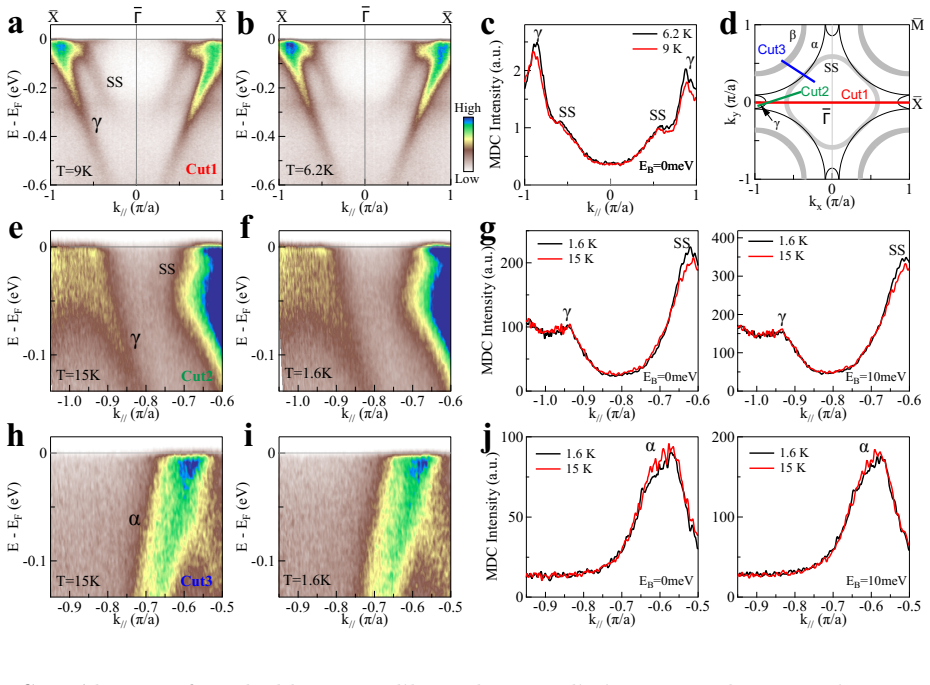
- No resolvable p-wave-like exchange splitting appears across successive antiferromagnetic transitions.
- The suppression cannot be captured by an itinerant-4f description.
Where Pith is reading between the lines
- Similar localization effects may suppress altermagnetic signatures in other heavy-fermion compounds.
- Higher-resolution probes could still detect the residual few-meV splitting predicted by the localized model.
- The competition between Kondo screening and magnetic order in f-electron systems can mask symmetry-allowed band splittings.
Load-bearing premise
The assumption that treating the Ce 4f electrons as localized in band-structure calculations correctly reproduces the observed suppression of splitting.
What would settle it
Detection of a p-wave-like splitting significantly larger than a few meV on the Ni 3d-derived bands in ARPES would contradict the conclusion that localized 4f electrons suppress the splitting to that scale.
Figures
read the original abstract
Altermagnetism, characterized by momentum-dependent spin splitting and zero net magnetization, has so far been explored mainly in weakly or moderately correlated d-electron systems. How symmetry-allowed altermagnetic band splitting manifests in heavy-fermion materials, where magnetic exchange competes with Kondo correlations, remains unclear. Here we use high-resolution angle-resolved photoemission spectroscopy (ARPES) to investigate CeNiAsO, a Kondo-lattice system that was predicted to be a candidate for p-wave altermagnetism. Fermi surface mapping and polarization-dependent ARPES show that the experimentally observed itinerant bands are mainly derived from Ni 3d orbitals, while resonant photoemission reveals that the Ce 4f states remain predominantly localized with residual c-f hybridization. Ultra-low-temperature measurements reveal no resolvable near-Fermi-level p-wave-like exchange splitting on the Ni 3d-derived conduction bands across the successive antiferromagnetic transitions. These experimental observations cannot be captured by an itinerant-4f band-structure description, which predicts a sizable p-wave splitting in the itinerant bands. When the localized Ce 4f character is incorporated, our band structure calculations indicate that the itinerant Ce 4f band weight is shifted away from the Fermi level and the p-wave-like splitting on the Ni 3d-derived bands is reduced to the few-meV scale. These results establish CeNiAsO as a strongly correlated f-electron setting in which the magnetic symmetry allows p-wave-like band splitting, but localized 4f electrons strongly suppress its observable itinerant single-particle signature.
Editorial analysis
A structured set of objections, weighed in public.
Referee Report
Summary. The paper reports high-resolution ARPES and resonant photoemission data on the Kondo-lattice compound CeNiAsO, showing that the near-EF itinerant bands are Ni 3d-derived, Ce 4f states are predominantly localized with residual c-f hybridization, and no resolvable p-wave-like exchange splitting appears on the conduction bands across antiferromagnetic transitions. It contrasts this with DFT calculations: an itinerant-4f treatment predicts sizable splitting, while incorporating localized 4f character shifts 4f weight away from EF and reduces the Ni 3d splitting to the few-meV scale.
Significance. If the central claim holds, the work provides a concrete example of how strong 4f localization in a heavy-fermion setting can suppress the single-particle signature of symmetry-allowed p-wave altermagnetism that would otherwise appear in an itinerant description. The combination of polarization-dependent ARPES, resonant photoemission, and comparative band-structure calculations offers a useful benchmark for the interplay between Kondo screening and altermagnetic order in f-electron materials.
major comments (2)
- [calculations section / abstract] The description of the band-structure calculations that incorporate localized Ce 4f character (abstract and the calculations section) does not specify the implementation details, including the value of Hubbard U, the double-counting correction scheme, or whether a static mean-field or more advanced treatment is used. This modeling step is load-bearing for the claim that localization reduces the p-wave-like splitting on Ni 3d bands to the few-meV scale.
- [ARPES results section] In the ultra-low-temperature ARPES results, the assertion of 'no resolvable' near-EF p-wave-like splitting lacks explicit quantification of energy resolution, momentum resolution, data exclusion criteria, and error analysis that would rigorously support suppression below the few-meV scale (reader note on soundness).
minor comments (1)
- [abstract] The abstract refers to 'successive antiferromagnetic transitions' without citing the specific transition temperatures or prior literature; the main text should make this explicit for context.
Simulated Author's Rebuttal
We thank the referee for the careful reading of our manuscript and the constructive comments. We address each major comment below and will revise the manuscript to incorporate the requested clarifications.
read point-by-point responses
-
Referee: [calculations section / abstract] The description of the band-structure calculations that incorporate localized Ce 4f character (abstract and the calculations section) does not specify the implementation details, including the value of Hubbard U, the double-counting correction scheme, or whether a static mean-field or more advanced treatment is used. This modeling step is load-bearing for the claim that localization reduces the p-wave-like splitting on Ni 3d bands to the few-meV scale.
Authors: We agree that the implementation details for the localized-4f calculations require explicit specification to support the central claim. In the revised manuscript we will expand the calculations section (and update the abstract if needed) to state the Hubbard U value, the double-counting correction scheme, and confirm the use of a static mean-field DFT+U treatment. These additions will make the modeling step fully transparent while preserving the reported reduction of the Ni 3d splitting to the few-meV scale. revision: yes
-
Referee: [ARPES results section] In the ultra-low-temperature ARPES results, the assertion of 'no resolvable' near-EF p-wave-like splitting lacks explicit quantification of energy resolution, momentum resolution, data exclusion criteria, and error analysis that would rigorously support suppression below the few-meV scale (reader note on soundness).
Authors: We acknowledge that the current text does not provide the quantitative details needed to rigorously substantiate the 'no resolvable' claim. In the revised manuscript we will add explicit values for the energy and momentum resolutions of the ultra-low-temperature ARPES data, describe the data exclusion criteria, and include an error analysis demonstrating that any p-wave-like splitting lies below the few-meV scale. This will strengthen the soundness of the experimental conclusion. revision: yes
Circularity Check
No circularity; claims rest on independent ARPES data and standard DFT comparisons
full rationale
The derivation proceeds from measured ARPES spectra (no resolvable splitting on Ni 3d bands) to comparison against two classes of band-structure calculations (itinerant-4f vs localized-4f). Neither the experimental spectra nor the standard DFT treatment of localized 4f electrons (via Hubbard U or similar) is defined in terms of the target splitting result; the calculations are external benchmarks whose output is compared to data rather than fitted to it. No self-citation chain, ansatz smuggling, or renaming of known results is load-bearing for the central claim.
Axiom & Free-Parameter Ledger
Reference graph
Works this paper leans on
-
[1]
ˇSmejkal, J
L. ˇSmejkal, J. Sinova, and T. Jungwirth, Beyond conventional ferromagnetism and antiferro- magnetism: A phase with nonrelativistic spin and crystal rotation symmetry, Physical Review 14 X12, 031042 (2022)
2022
-
[2]
ˇSmejkal, J
L. ˇSmejkal, J. Sinova, and T. Jungwirth, Emerging research landscape of altermagnetism, Physical Review X12, 040501 (2022)
2022
-
[3]
Mazin and The PRX Editors, Editorial: Altermagnetism — a new punch line of fundamental magnetism, Physical Review X12, 040002 (2022)
I. Mazin and The PRX Editors, Editorial: Altermagnetism — a new punch line of fundamental magnetism, Physical Review X12, 040002 (2022)
2022
-
[4]
Jungwirth, J
T. Jungwirth, J. Sinova, R. M. Fernandes, Q. Liu, H. Watanabe, S. Murakami, S. Nakatsuji, and L. ˇSmejkal, Symmetry, microscopy and spectroscopy signatures of altermagnetism, Nature 649, 837 (2026)
2026
-
[5]
Y. Liu, X. Chen, Y. Yu, J. Etxebarria, J. M. Perez-Mato, and Q. Liu, Symmetry classification of magnetic orders using oriented spin space groups, Nature652, 869 (2026)
2026
-
[6]
T. Jungwirth, J. Sinova, P. Wadley, D. Kriegner, H. Reichlov´ a, F. Kˇ r´ ıˇ zek, H. Ohno, and L. ˇSmejkal, Altermagnetic spintronics, arXiv:2508.09748 (2025)
arXiv 2025
-
[7]
Li, J.-X
C. Li, J.-X. Hou, F.-C. Zhang, S.-B. Zhang, and L.-H. Hu, Spin-polarized Josephson super- current in nodeless altermagnets, Physical Review Letters136, 116701 (2026)
2026
-
[8]
Krempask´ y, L.ˇSmejkal, S
J. Krempask´ y, L.ˇSmejkal, S. W. D’Souza, M. Hajlaoui, G. Springholz, K. Uhl´ ıˇ rov´ a, F. Alarab, P. C. Constantinou, V. N. Strocov, D. Usanov, W. R. Pudelko, R. Gonz´ alez-Hern´ andez, A. B. Hellenes, Z. Jansa, H. Reichlov´ a, Z.ˇSob´ aˇ n, R. D. Gonzalez Betancourt, P. Wadley, J. Sinova, D. Kriegner, J. Min´ ar, J. H. Dil, and T. Jungwirth, Altermagn...
2024
-
[9]
S. Lee, S. Lee, S. Jung, J. Jung, D. Kim, Y. Lee, B. Seok, J. Kim, B. G. Park, L. ˇSmejkal, C.-J. Kang, and C. Kim, Broken Kramers degeneracy in altermagnetic MnTe, Physical Review Letters132, 036702 (2024)
2024
-
[10]
L.-D. Yuan, Z. Wang, J.-W. Luo, and A. Zunger, Prediction of low-Z collinear and noncollinear antiferromagnetic compounds having momentum-dependent spin splitting even without spin- orbit coupling, Physical Review Materials5, 014409 (2021)
2021
-
[11]
Y.-P. Zhu, X. Chen, X.-R. Liu, Y. Liu, P. Liu, H. Zha, G. Qu, C. Hong, J. Li, Z. Jiang, X.-M. Ma, Y.-J. Hao, M.-Y. Zhu, W. Liu, M. Zeng, S. Jayaram, M. Lenger, J. Ding, S. Mo, K. Tanaka, M. Arita, Z. Liu, M. Ye, D. Shen, J. Wrachtrup, Y. Huang, R.-H. He, S. Qiao, Q. Liu, and C. Liu, Observation of plaid-like spin splitting in a noncoplanar antiferromagnet...
2024
-
[12]
Reimers, L
S. Reimers, L. Odenbreit, L. ˇSmejkal, V. N. Strocov, P. Constantinou, A. B. Hellenes, 15 R. Jaeschke Ubiergo, W. H. Campos, V. K. Bharadwaj, A. Chakraborty, T. Denneulin, W. Shi, R. E. Dunin-Borkowski, S. Das, M. Kl¨ aui, J. Sinova, and M. Jourdan, Direct observation of altermagnetic band splitting in CrSb thin films, Nature Communications15, 2116 (2024)
2024
-
[13]
Santhosh, P
S. Santhosh, P. Corbae, W. J. Y´ anez-Parre˜ no, S. Ghosh, C. J. Jensen, A. V. Fedorov, M. Hashimoto, D. Lu, J. A. Borchers, A. J. Grutter, T. R. Charlton, S. Islam, D. Golo- vanova, Y. Zhao, A. Tauraso, A. Richardella, B. Yan, K. A. Mkhoyan, C. J. Palmstrøm, Y. Ou, and N. Samarth, Altermagnetic band splitting in 10 nm epitaxial CrSb thin films, Advanced ...
2025
-
[14]
G. Yang, Z. Li, S. Yang, J. Li, H. Zheng, W. Zhu, Z. Pan, Y. Xu, S. Cao, W. Zhao, A. Jana, J. Zhang, M. Ye, Y. Song, L.-H. Hu, L. Yang, J. Fujii, I. Vobornik, M. Shi, H. Yuan, Y. Zhang, Y. Xu, and Y. Liu, Three-dimensional mapping of the altermagnetic spin splitting in CrSb, Nature Communications16, 1442 (2025)
2025
-
[15]
Fedchenko, J
O. Fedchenko, J. Min´ ar, A. Akashdeep, S. W. D’Souza, D. Vasilyev, O. Tkach, L. Odenbreit, Q. Nguyen, D. Kutnyakhov, N. Wind, L. Wenthaus, M. Scholz, K. Rossnagel, M. Hoesch, M. Aeschlimann, B. Stadtm¨ uller, M. Kl¨ aui, G. Sch¨ onhense, T. Jungwirth, A. B. Hellenes, G. Jakob, L. ˇSmejkal, J. Sinova, and H.-J. Elmers, Observation of time-reversal symmetr...
2024
-
[16]
J. Liu, J. Zhan, T. Li, J. Liu, S. Cheng, Y. Shi, L. Deng, M. Zhang, C. Li, J. Ding, Q. Jiang, M. Ye, Z. Liu, Z. Jiang, S. Wang, Q. Li, Y. Xie, Y. Wang, S. Qiao, J. Wen, Y. Sun, and D. Shen, Absence of altermagnetic spin splitting character in rutile oxide RuO 2, Physical Review Letters133, 176401 (2024)
2024
-
[17]
Jiang, M
B. Jiang, M. Hu, J. Bai, Z. Song, C. Mu, G. Qu, W. Li, W. Zhu, H. Pi, Z. Wei, Y.-J. Sun, Y. Huang, X. Zheng, Y. Peng, L. He, S. Li, J. Luo, Z. Li, G. Chen, H. Li, H. Weng, and T. Qian, A metallic room-temperatured-wave altermagnet, Nature Physics21, 754 (2025)
2025
-
[18]
Zhang, X
F. Zhang, X. Cheng, Z. Yin, C. Liu, L. Deng, Y. Qiao, Z. Shi, S. Zhang, J. Lin, Z. Liu, M. Ye, Y. Huang, X. Meng, C. Zhang, T. Okuda, K. Shimada, S. Cui, Y. Zhao, G.-H. Cao, S. Qiao, J. Liu, and C. Chen, Crystal-symmetry-paired spin–valley locking in a layered room- temperature metallic altermagnet candidate, Nature Physics21, 760 (2025)
2025
-
[19]
Q. Song, S. Stavri´ c, P. Barone, A. Droghetti, D. S. Antonenko, J. W. F. Venderbos, C. A. Occhialini, B. Ilyas, E. Erge¸ cen, N. Gedik, S.-W. Cheong, R. M. Fernandes, S. Picozzi, and R. Comin, Electrical switching of ap-wave magnet, Nature642, 64 (2025). 16
2025
-
[20]
Yamada, M
R. Yamada, M. T. Birch, P. R. Baral, S. Okumura, R. Nakano, S. Gao, M. Ezawa, T. Nomoto, J. Masell, Y. Ishihara, K. K. Kolincio, I. Belopolski, H. Sagayama, H. Nakao, K. Ohishi, T. Ohhara, R. Kiyanagi, T. Nakajima, Y. Tokura, T.-h. Arima, Y. Motome, M. M. Hirschmann, and M. Hirschberger, A metallicp-wave magnet with commensurate spin helix, Nature646, 837 (2025)
2025
-
[21]
Doniach, The Kondo lattice and weak antiferromagnetism, Physica B+C91, 231 (1977)
S. Doniach, The Kondo lattice and weak antiferromagnetism, Physica B+C91, 231 (1977)
1977
-
[22]
Si and F
Q. Si and F. Steglich, Heavy fermions and quantum phase transitions, Science329, 1161 (2010)
2010
-
[23]
Y. Luo, H. Han, H. Tan, X. Lin, Y. Li, S. Jiang, C. Feng, J. Dai, G. Cao, Z. Xu, and S. Li, CeNiAsO: An antiferromagnetic dense Kondo lattice, Journal of Physics: Condensed Matter 23, 175701 (2011)
2011
-
[24]
Y. Luo, L. Pourovskii, S. E. Rowley, Y. Li, C. Feng, A. Georges, J. Dai, G. Cao, Z. Xu, Q. Si, and N. P. Ong, Heavy-fermion quantum criticality and destruction of the Kondo effect in a nickel oxypnictide, Nature Materials13, 777 (2014)
2014
-
[25]
S. Wu, W. A. Phelan, L. Liu, J. R. Morey, J. A. Tutmaher, J. C. Neuefeind, A. Huq, M. B. Stone, M. Feygenson, D. W. Tam, B. A. Frandsen, B. Trump, C. Wan, S. R. Dunsiger, T. M. McQueen, Y. J. Uemura, and C. L. Broholm, Incommensurate magnetism near quantum criticality in CeNiAsO, Physical Review Letters122, 197203 (2019)
2019
-
[26]
A. B. Hellenes, T. Jungwirth, R. Jaeschke-Ubiergo, A. Chakraborty, J. Sinova, and L.ˇSmejkal, P-wave magnets, arXiv:2309.01607 (2024)
Pith/arXiv arXiv 2024
-
[27]
Chakraborty, A
A. Chakraborty, A. B. Hellenes, R. Jaeschke-Ubiergo, T. Jungwirth, L. ˇSmejkal, and J. Sinova, Highly efficient non-relativistic Edelstein effect in nodalp-wave magnets, Nature Communi- cations16, 7270 (2025)
2025
-
[28]
H. Zhou, M. Wang, X. Ma, G. Li, D.-F. Shao, B. Liu, and S. Li, Anisotropic resistivity of a p-wave magnet candidate CeNiAsO, arXiv:2509.07351 (2025)
Pith/arXiv arXiv 2025
-
[29]
Fujimori, A
S.-i. Fujimori, A. Fujimori, K. Shimada, T. Narimura, K. Kobayashi, H. Namatame, M. Taniguchi, H. Harima, H. Shishido, S. Ikeda, D. Aoki, Y. Tokiwa, Y. Haga, and Y. ¯Onuki, Direct observation of a quasiparticle band in CeIrIn 5: An angle-resolved photoemission spec- troscopy study, Physical Review B73, 224517 (2006)
2006
-
[30]
Patil, A
S. Patil, A. V. Generalov, M. G¨ uttler, P. Kushwaha, A. Chikina, K. Kummer, T. C. R¨ odel, A. F. Santander-Syro, N. Caroca-Canales, C. Geibel, S. Danzenb¨ acher, Yu. Kucherenko, 17 C. Laubschat, J. W. Allen, and D. V. Vyalikh, ARPES view on surface and bulk hybridiza- tion phenomena in the antiferromagnetic Kondo lattice CeRh2Si2, Nature Communications7,...
2016
-
[31]
Q. Y. Chen, D. F. Xu, X. H. Niu, J. Jiang, R. Peng, H. C. Xu, C. H. P. Wen, Z. F. Ding, K. Huang, L. Shu, Y.-J. Zhang, H. Lee, V. N. Strocov, M. Shi, F. Bisti, T. Schmitt, Y. B. Huang, P. Dudin, X. C. Lai, S. Kirchner, H.-Q. Yuan, and D. L. Feng, Direct observation of how the heavy-fermion state develops in CeCoIn 5, Physical Review B96, 045107 (2017)
2017
-
[32]
G. Liu, G. Wang, Y. Zhu, H. Zhang, G. Zhang, X. Wang, Y. Zhou, W. Zhang, H. Liu, L. Zhao, et al., Development of a vacuum ultraviolet laser-based angle-resolved photoemission system with a superhigh energy resolution better than 1meV, Review of Scientific Instruments79, 023105 (2008)
2008
-
[33]
X. J. Zhou, S. He, G. Liu, L. Zhao, L. Yu, and W. Zhang, New developments in laser-based photoemission spectroscopy and its scientific applications: a key issues review, Reports on Progress in Physics81, 062101 (2018)
2018
-
[34]
T. Miao, Y. Xu, B. Liang, W. Zhu, N. Cai, M. Xu, D. Wu, H. Gu, W. Mao, S. Zhang, F. Zhang, F. Yang, Z. Wang, Q. Peng, Z. Xu, Z. Zhu, X. Li, H. Mao, L. Zhao, G. Liu, and X. J. Zhou, Expansion of momentum space and full 2πsolid angle photoelectron collection in laser-based angle-resolved photoemission spectroscopy by applying sample bias, Review of Scientif...
2026
-
[35]
Yang, Z.-T
Y.-C. Yang, Z.-T. Liu, J.-S. Liu, Z.-H. Liu, W.-L. Liu, X.-L. Lu, H.-P. Mei, A. Li, M. Ye, S. Qiao, and D.-W. Shen, High-resolution ARPES endstation for in situ electronic structure investigations at SSRF, Nuclear Science and Techniques32, 31 (2021). 18 -101ky (π/ a)-101kx (π/ a) 0.020.010χ (emu/mol) 3002001000Temperature (K) dχ/dT 151050T (K) -101ky (π/ ...
2021
discussion (0)
Sign in with ORCID, Apple, or X to comment. Anyone can read and Pith papers without signing in.