Spectral Audit of In-Context Operator Networks
Pith reviewed 2026-06-28 13:33 UTC · model grok-4.3
The pith
Neural operators can match solution outputs while learning incorrect local PDE structure.
A machine-rendered reading of the paper's core claim, the machinery that carries it, and where it could break.
Core claim
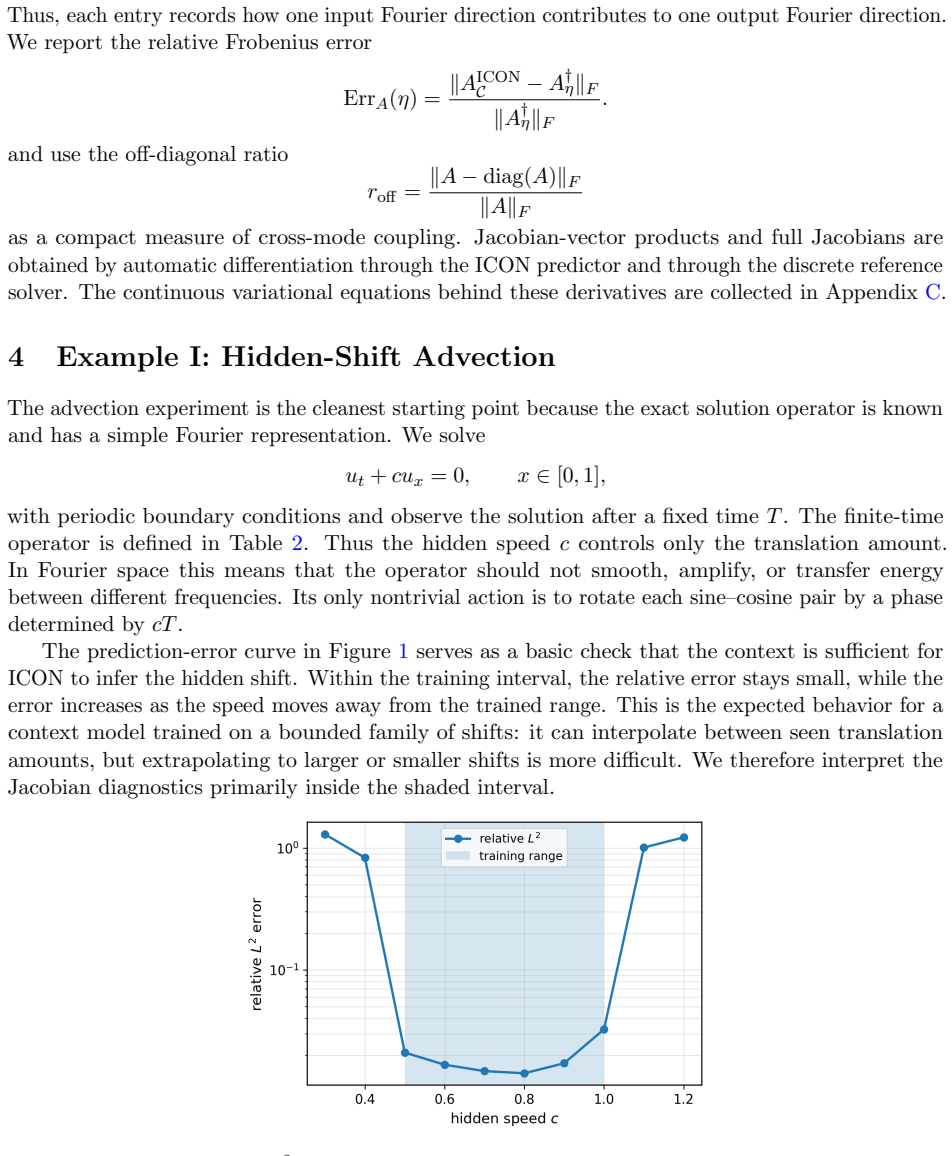
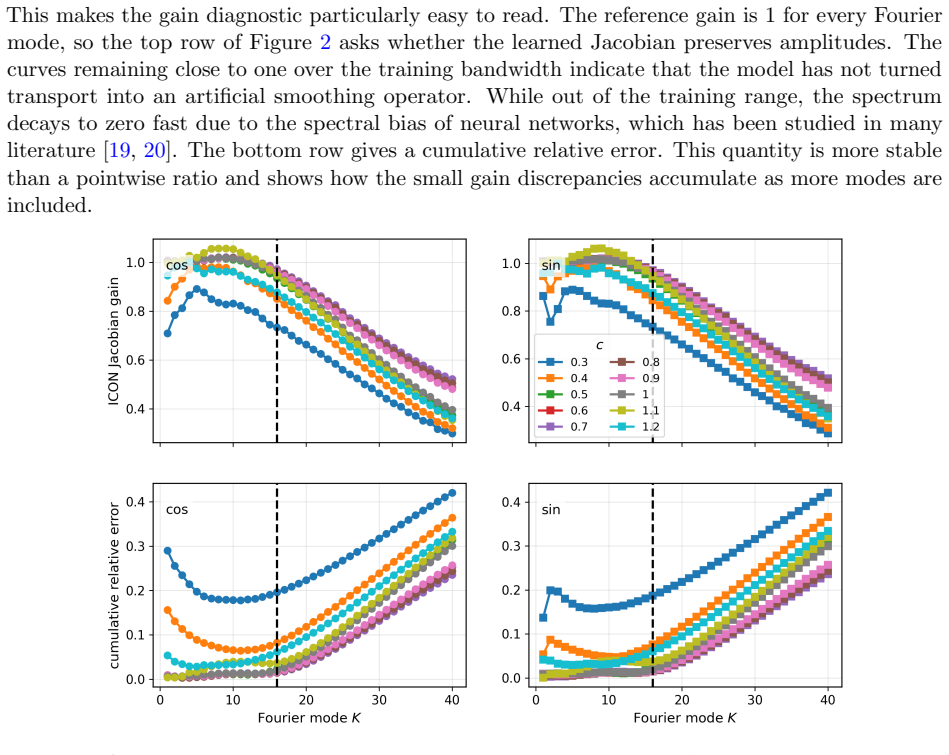
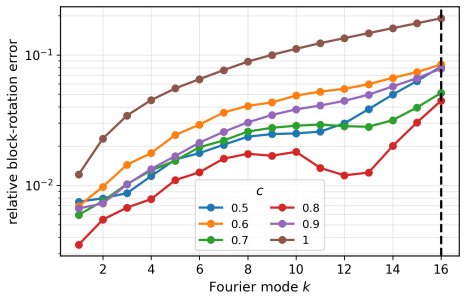
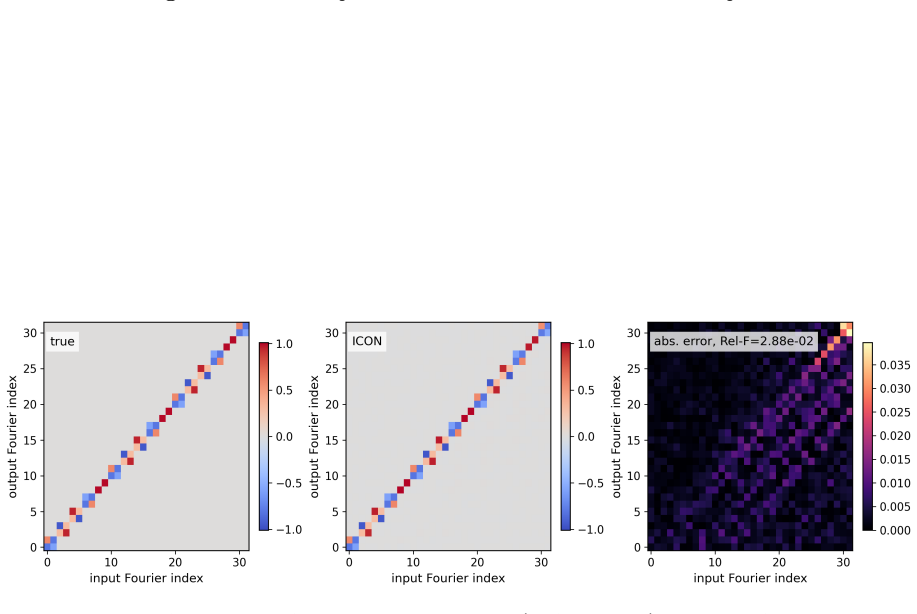
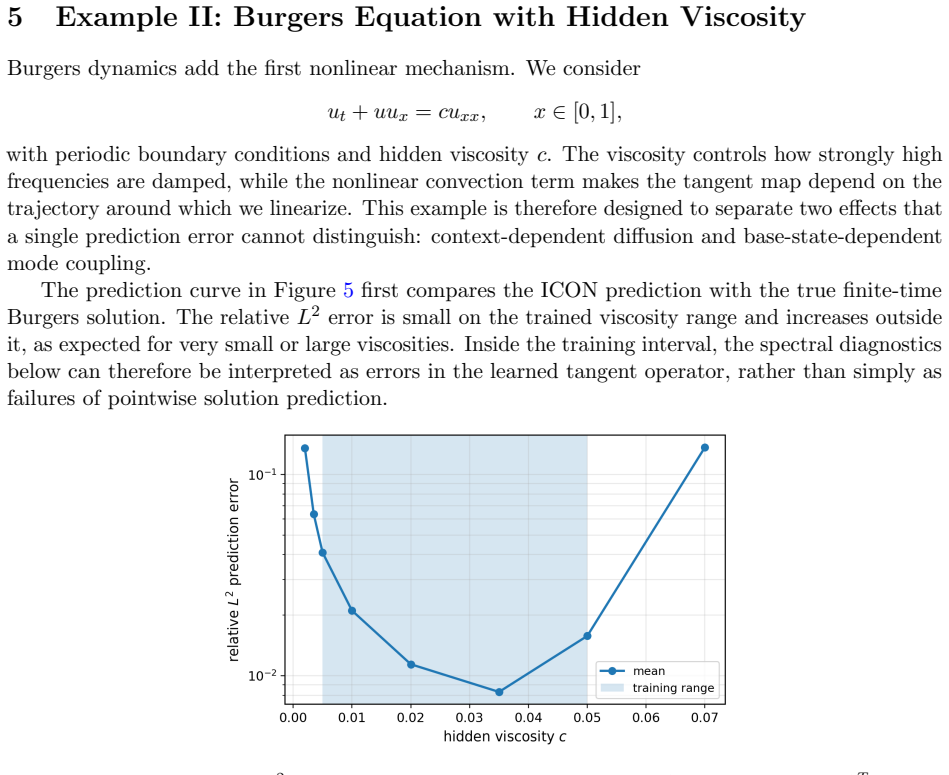
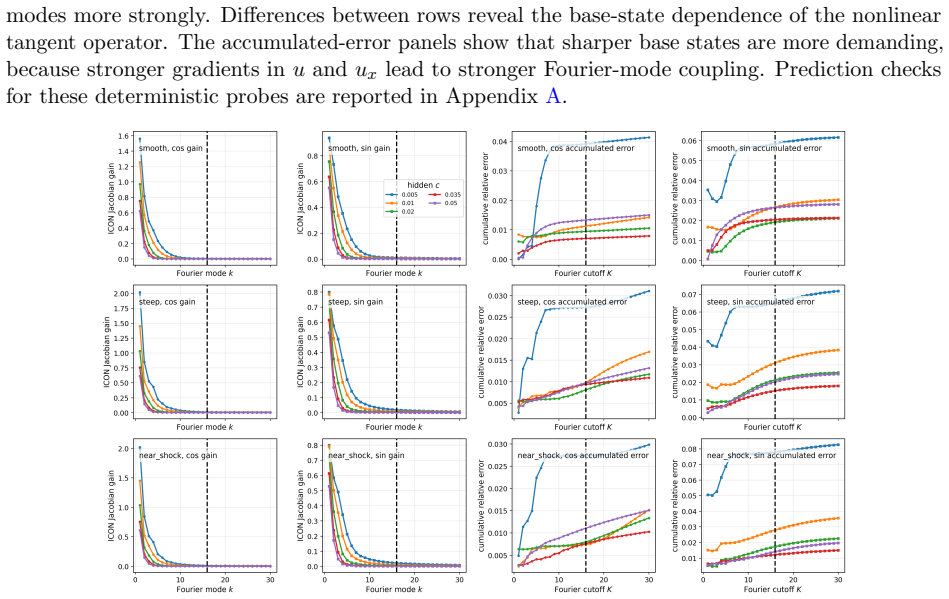
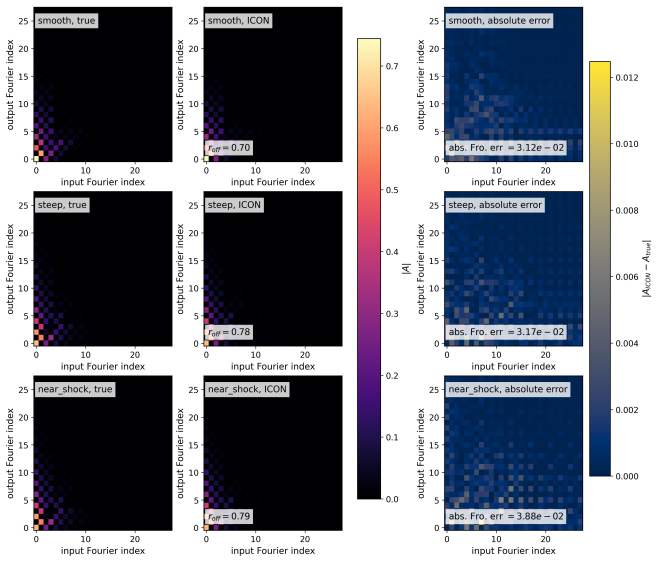
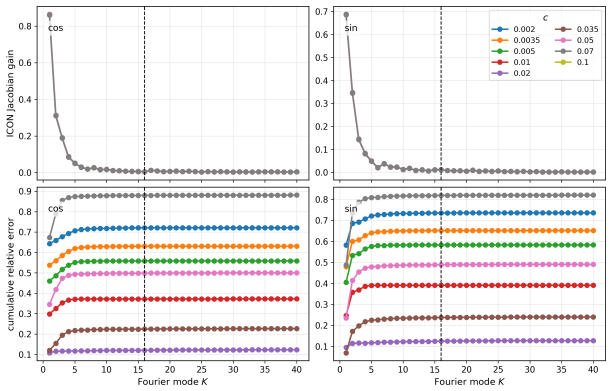
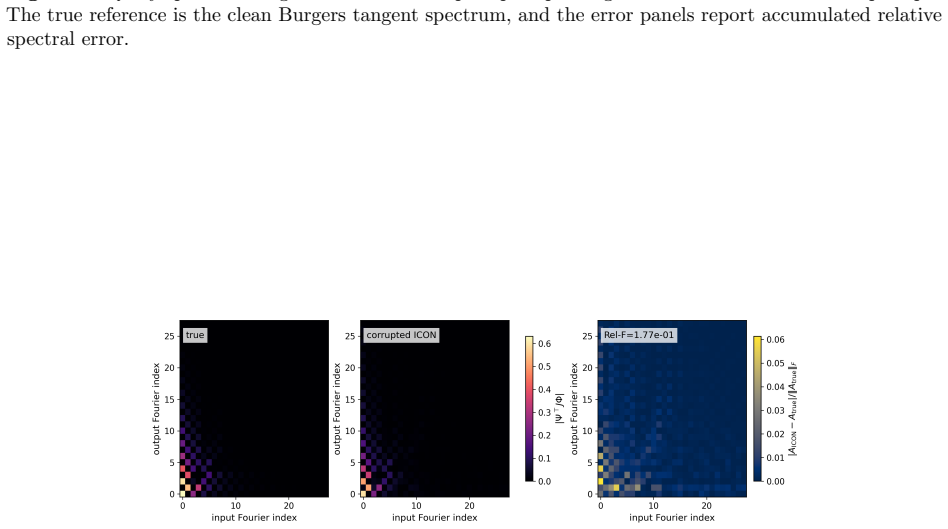
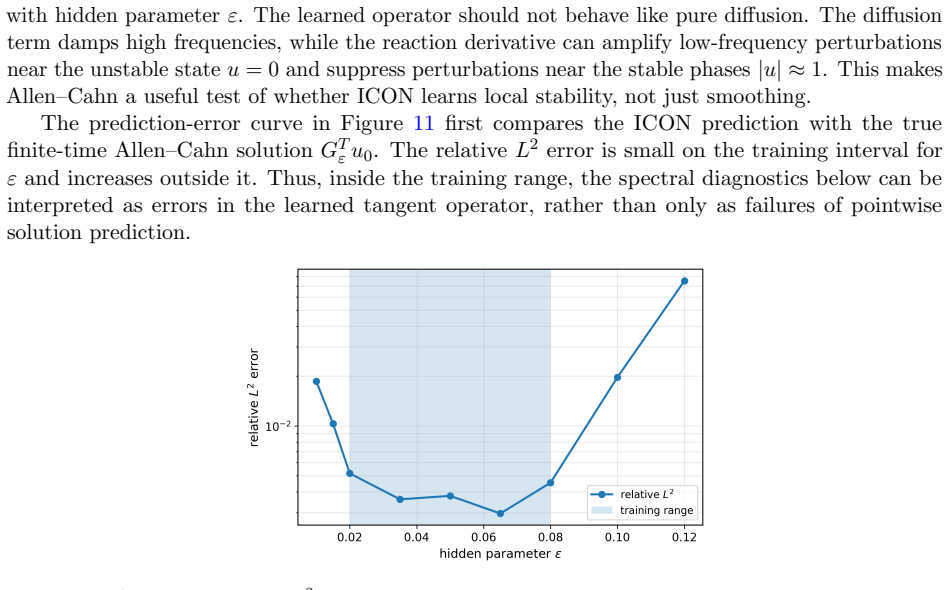
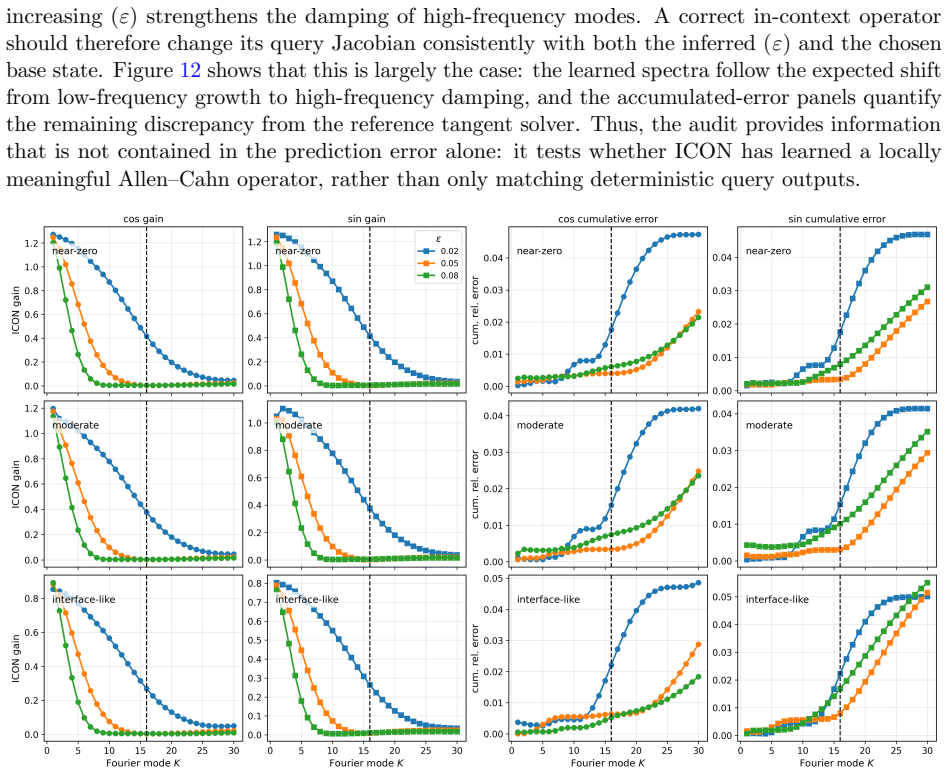
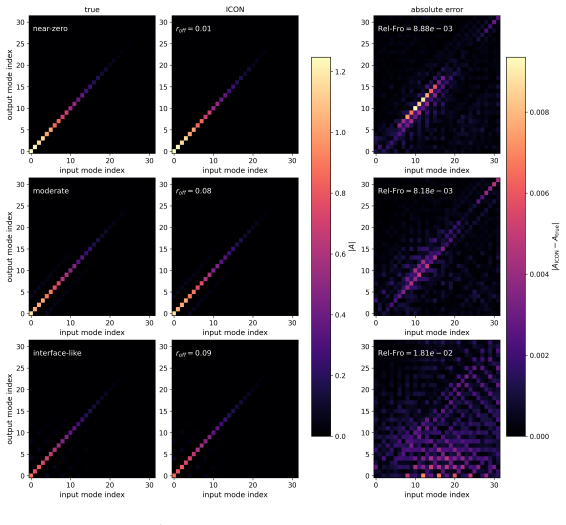
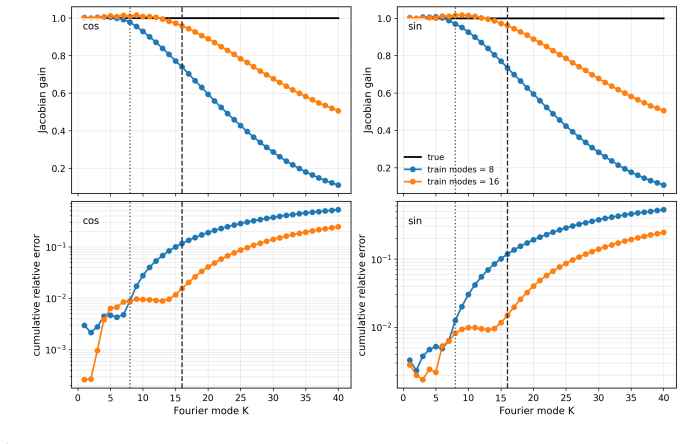
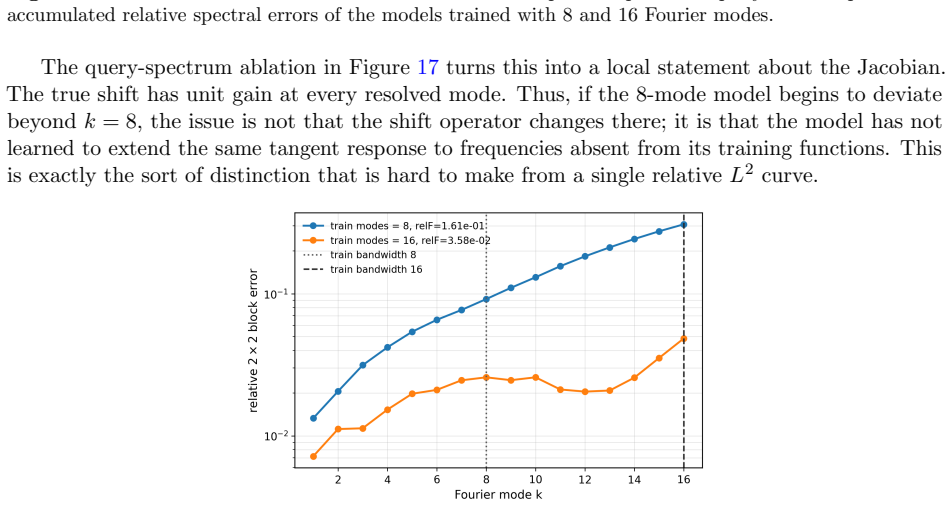
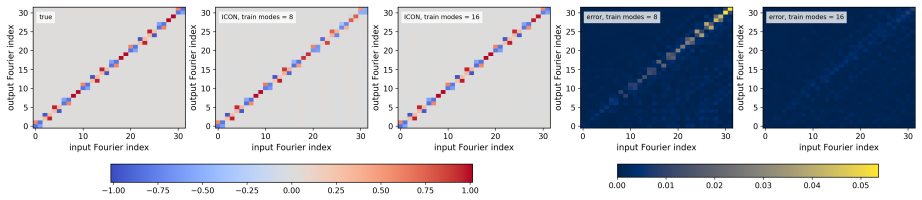
Differentiating an in-context operator network output with respect to the query function produces a Jacobian that, when projected onto Fourier modes, yields a local spectral characterization of the inferred tangent operator, including frequency-dependent gains, phase structure, and cross-mode coupling. Across benchmarks the resulting audit detects phase transport, viscosity-dependent damping, nonlinear mode coupling, and reaction-diffusion stability features while also identifying high-frequency degradation, incorrect phase recovery, and prompt-operator inconsistencies that prediction-error metrics leave partially hidden.
What carries the argument
The Jacobian of the network output with respect to the query function, interpreted as a learned tangent operator and projected onto Fourier modes to obtain frequency gains, phases, and coupling coefficients.
If this is right
- Prediction error alone cannot certify that a learned operator reproduces the correct local PDE mechanisms.
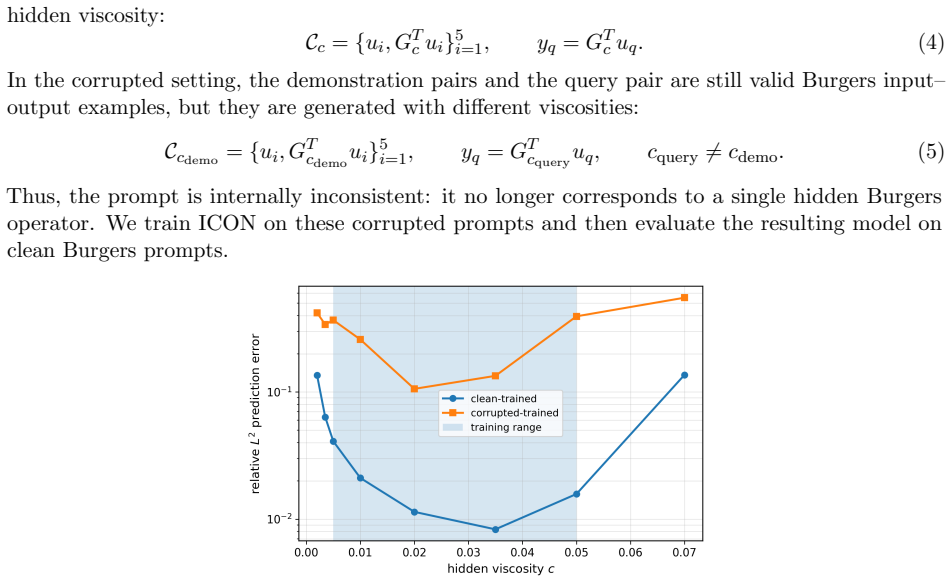
- Corrupted or inconsistent prompts produce degraded tangent-operator structure even when pointwise predictions remain partially accurate.
- The audit can detect high-frequency degradation and incorrect phase recovery that standard metrics miss.
- Operator fidelity must be assessed separately from solution accuracy whenever stability or sensitivity information is required.
Where Pith is reading between the lines
- Training objectives for in-context operator networks could incorporate spectral penalties on the Jacobian to enforce local fidelity in addition to output matching.
- The audit extends naturally to time-evolving or multi-physics operators where local linearization can reveal stability boundaries not visible in static error plots.
- Prompt construction in in-context learning may need to optimize for consistency of the inferred tangent operator rather than example accuracy alone.
Load-bearing premise
The finite-difference or automatic-differentiation Jacobian computed from the network output accurately represents the tangent operator of the true PDE at the operating point set by the prompt.
What would settle it
On a linear PDE with known exact Fourier multiplier, compute the audited Jacobian spectrum from the trained network and check whether it systematically deviates from the true multiplier while prediction error on solution outputs remains low.
Figures
read the original abstract
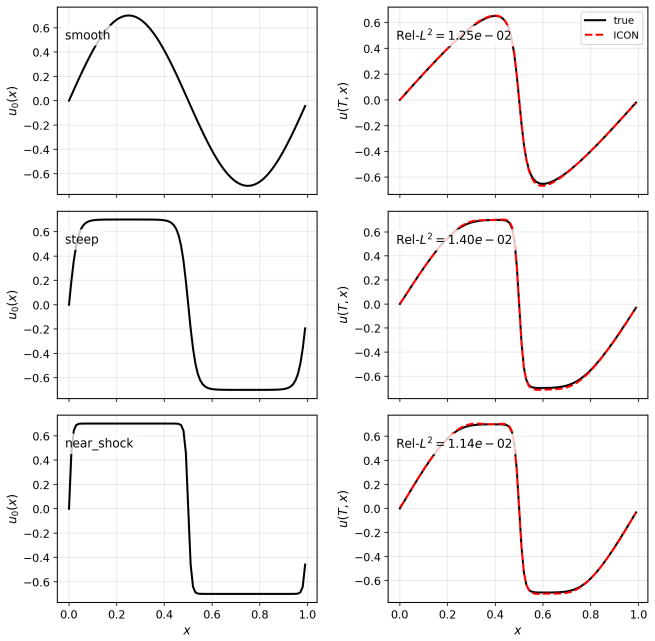
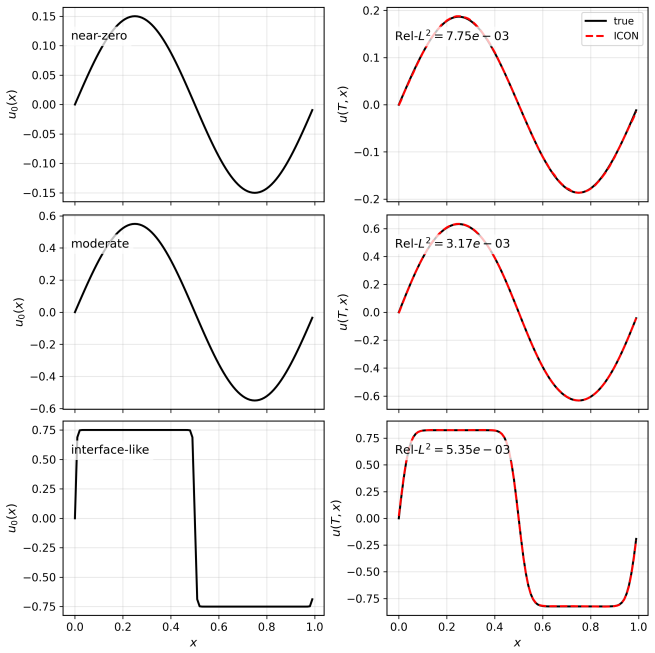
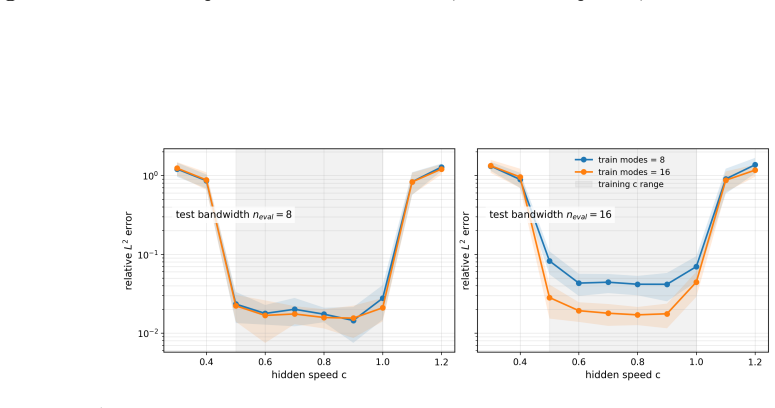
Existing evaluations of neural operators and in-context operator learning rely primarily on prediction error, but accurate output prediction does not guarantee the correct local dynamical structure. A model may match solutions while exhibiting incorrect sensitivities, distorted frequency response, spurious mode coupling, or unstable tangent behavior. We introduce a Jacobian-based spectral audit for in-context operator learning. For a fixed prompt, we differentiate the network output with respect to the query function and view the resulting Jacobian as a learned tangent operator. Projecting it onto Fourier modes, we obtain a local spectral characterization of the inferred operator, including frequency-dependent gains, phase structure, and cross-mode coupling. The audit complements standard prediction metrics by testing whether the model reproduces local mechanisms of the underlying PDE operator rather than only outputs. Across benchmarks, the audit reveals distinct operator-level phenomena, including phase transport, viscosity-dependent damping, nonlinear mode coupling, and reaction--diffusion stability structure. It also detects failures partially hidden by prediction-error metrics, including high-frequency degradation, incorrect phase recovery, and prompt--operator inconsistencies. Corrupted or internally inconsistent prompts lead to degraded tangent-operator structure even when pointwise predictions remain partially accurate. Our results suggest that prediction accuracy and local operator fidelity are distinct properties of learned neural operators. Our framework also provides a diagnostic for stability, sensitivity, and operator consistency.
Editorial analysis
A structured set of objections, weighed in public.
Referee Report
Summary. The paper introduces a Jacobian-based spectral audit for in-context operator networks. For a fixed prompt, the network output is differentiated with respect to the query function to obtain a Jacobian viewed as a learned tangent operator; this is projected onto Fourier modes to yield a local spectral characterization (frequency-dependent gains, phase, cross-mode coupling). The audit is positioned as complementary to prediction-error metrics, revealing phenomena such as phase transport, viscosity-dependent damping, nonlinear mode coupling, and reaction-diffusion stability, while detecting failures (high-frequency degradation, incorrect phase recovery, prompt-operator inconsistencies) that prediction accuracy alone misses. The central conclusion is that prediction accuracy and local operator fidelity are distinct properties of learned neural operators.
Significance. If the Jacobian obtained via finite differences or automatic differentiation accurately recovers the Fréchet derivative of the underlying PDE solution operator, the spectral audit supplies a new diagnostic that can expose structural mismatches invisible to pointwise error metrics. This would be a useful addition to evaluation practices for neural operators in scientific computing, particularly for assessing stability, sensitivity, and consistency in in-context settings. The framework is parameter-free in its core construction and directly falsifiable via comparison against known linearizations of benchmark PDEs.
major comments (2)
- [Abstract] The central claim that the audit detects incorrect local dynamical structure (phase transport, mode coupling, stability) rests on the unverified assumption that the network Jacobian coincides with the tangent operator of the fixed PDE at the prompt-defined operating point rather than an artifact of prompt construction, discretization, or the network's own approximation error. No quantitative verification, error bars, or ablation on the Jacobian approximation itself is supplied.
- [Abstract] The distinction between prediction accuracy and local operator fidelity is asserted on the basis of benchmark results, yet the manuscript supplies no concrete quantitative evidence (e.g., tables of prediction error versus spectral-audit metrics, or cases where one is good and the other poor) to substantiate that the two properties are in fact separable.
Simulated Author's Rebuttal
We thank the referee for the constructive report and the recommendation for major revision. We address each major comment below, agreeing that additional quantitative support will strengthen the claims. Revisions will be incorporated in the next version.
read point-by-point responses
-
Referee: [Abstract] The central claim that the audit detects incorrect local dynamical structure (phase transport, mode coupling, stability) rests on the unverified assumption that the network Jacobian coincides with the tangent operator of the fixed PDE at the prompt-defined operating point rather than an artifact of prompt construction, discretization, or the network's own approximation error. No quantitative verification, error bars, or ablation on the Jacobian approximation itself is supplied.
Authors: We agree that explicit verification of the Jacobian approximation is needed to confirm it recovers the Fréchet derivative rather than artifacts. In the revised manuscript we will add a dedicated verification subsection for linear benchmark PDEs (e.g., heat and wave equations) where the exact tangent operator is known analytically. This will include direct comparisons of the computed Jacobian against the analytic linearization, with L2 error norms, error bars over multiple discretizations, and ablations on finite-difference step size and prompt length. These additions will quantify the fidelity of the Jacobian step and rule out the listed artifacts for the reported cases. revision: yes
-
Referee: [Abstract] The distinction between prediction accuracy and local operator fidelity is asserted on the basis of benchmark results, yet the manuscript supplies no concrete quantitative evidence (e.g., tables of prediction error versus spectral-audit metrics, or cases where one is good and the other poor) to substantiate that the two properties are in fact separable.
Authors: The current manuscript illustrates separability through qualitative examples (e.g., low prediction error yet incorrect phase recovery or high-frequency degradation). To provide the requested concrete evidence we will add a summary table in the results section that reports, for each model-prompt pair, both relative L2 prediction error and key spectral-audit quantities (maximum gain deviation, phase error at dominant frequencies, and cross-mode coupling strength). Rows will highlight instances where prediction error remains below 5% while spectral metrics exceed acceptable thresholds, thereby quantifying the claimed distinction. revision: yes
Circularity Check
No significant circularity in the spectral audit definition or claims
full rationale
The paper introduces a Jacobian-based spectral audit as a new diagnostic tool defined directly by differentiating the network output w.r.t. the query function and projecting onto Fourier modes. This construction is presented as a method to complement prediction error, with no load-bearing step that reduces a claimed prediction or first-principles result to a fitted parameter, self-citation chain, or definitional tautology. The distinction between prediction accuracy and operator fidelity is demonstrated empirically across benchmarks rather than derived by construction from the audit inputs themselves. No self-definitional, fitted-input, or uniqueness-imported patterns appear in the provided abstract or described framework.
Axiom & Free-Parameter Ledger
axioms (2)
- domain assumption The Jacobian of the network output with respect to the query function equals the tangent operator of the underlying PDE at the prompt point.
- domain assumption Fourier-mode projection extracts the relevant frequency-dependent gains, phase, and cross-mode coupling.
Forward citations
Cited by 1 Pith paper
-
A Diagnostic Software Suite for Auditing Learned PDE Simulators
Introduces an architecture-independent diagnostic software suite for auditing learned PDE simulators via checks like semigroup consistency and energy behavior, validated on five benchmark PDE tasks where L2 error alon...
Reference graph
Works this paper leans on
-
[1]
Learning nonlinear operators via deeponet based on the universal approximation theorem of operators
Lu Lu, Pengzhan Jin, Guofei Pang, Zhongqiang Zhang, and George Em Karniadakis. Learning nonlinear operators via deeponet based on the universal approximation theorem of operators. Nature machine intelligence, 3(3):218–229, 2021
2021
-
[2]
Neural operator: Learning maps between function spaces with applications to pdes.Journal of Machine Learning Research, 24(89):1–97, 2023
Nikola Kovachki, Zongyi Li, Burigede Liu, Kamyar Azizzadenesheli, Kaushik Bhattacharya, Andrew Stuart, and Anima Anandkumar. Neural operator: Learning maps between function spaces with applications to pdes.Journal of Machine Learning Research, 24(89):1–97, 2023
2023
-
[3]
Laplace neural operator for solving differential equations.Nature Machine Intelligence, 6(6):631–640, 2024
Qianying Cao, Somdatta Goswami, and George Em Karniadakis. Laplace neural operator for solving differential equations.Nature Machine Intelligence, 6(6):631–640, 2024
2024
-
[4]
Tapas Tripura and Souvik Chakraborty. Wavelet neural operator: a neural operator for parametric partial differential equations.arXiv preprint arXiv:2205.02191, 2022
arXiv 2022
-
[5]
Zhiping Mao, Lu Lu, Olaf Marxen, Tamer A Zaki, and George Em Karniadakis. Deepm&mnet for hypersonics: Predicting the coupled flow and finite-rate chemistry behind a normal shock using neural-network approximation of operators.Journal of computational physics, 447:110698, 2021
2021
-
[6]
Kamaljyoti Nath, Varun Kumar, Daniel J Smith, and George Em Karniadakis. A digital twin for diesel engines: Operator-infused physics-informed neural networks with transfer learning for engine health monitoring.Engineering Applications of Artificial Intelligence, 170:114052, 2026
2026
-
[7]
A foundation model for the earth system.Nature, 641(8065):1180–1187, 2025
Cristian Bodnar, Wessel P Bruinsma, Ana Lucic, Megan Stanley, Anna Allen, Johannes Brandstetter, Patrick Garvan, Maik Riechert, Jonathan A Weyn, Haiyu Dong, et al. A foundation model for the earth system.Nature, 641(8065):1180–1187, 2025
2025
-
[8]
In-context operator learning with data prompts for differential equation problems.Proceedings of the National Academy of Sciences, 120(39):e2310142120, 2023
Liu Yang, Siting Liu, Tingwei Meng, and Stanley J Osher. In-context operator learning with data prompts for differential equation problems.Proceedings of the National Academy of Sciences, 120(39):e2310142120, 2023
2023
-
[9]
Pde generalization of in-context operator networks: A study on 1d scalar nonlinear conservation laws.Journal of Computational Physics, 519:113379, 2024
Liu Yang and Stanley J Osher. Pde generalization of in-context operator networks: A study on 1d scalar nonlinear conservation laws.Journal of Computational Physics, 519:113379, 2024
2024
-
[10]
Maziar Raissi, Paris Perdikaris, and George E Karniadakis. Physics-informed neural networks: A deep learning framework for solving forward and inverse problems involving nonlinear partial differential equations.Journal of Computational physics, 378:686–707, 2019
2019
-
[11]
Dgm: A deep learning algorithm for solving partial differential equations.Journal of computational physics, 375:1339–1364, 2018
Justin Sirignano and Konstantinos Spiliopoulos. Dgm: A deep learning algorithm for solving partial differential equations.Journal of computational physics, 375:1339–1364, 2018
2018
-
[12]
Physics-informed machine learning.Nature Reviews Physics, 3(6):422–440, 2021
George Em Karniadakis, Ioannis G Kevrekidis, Lu Lu, Paris Perdikaris, Sifan Wang, and Liu Yang. Physics-informed machine learning.Nature Reviews Physics, 3(6):422–440, 2021
2021
-
[13]
Discovering governing equations from data by sparse identification of nonlinear dynamical systems.Proceedings of the national academy of sciences, 113(15):3932–3937, 2016
Steven L Brunton, Joshua L Proctor, and J Nathan Kutz. Discovering governing equations from data by sparse identification of nonlinear dynamical systems.Proceedings of the national academy of sciences, 113(15):3932–3937, 2016
2016
-
[14]
Data-driven discovery of partial differential equations.Science advances, 3(4):e1602614, 2017
Samuel H Rudy, Steven L Brunton, Joshua L Proctor, and J Nathan Kutz. Data-driven discovery of partial differential equations.Science advances, 3(4):e1602614, 2017. 22
2017
-
[15]
Abdolmehdi Behroozi, Chaopeng Shen, and Daniel Kifer. Sensitivity-constrained fourier neural operators for forward and inverse problems in parametric differential equations.arXiv preprint arXiv:2505.08740, 2025
arXiv 2025
-
[16]
Lennon Shikhman. Forcing and diagnosing failure modes of fourier neural operators across diverse pde families.arXiv preprint arXiv:2601.11428, 2026
Pith/arXiv arXiv 2026
-
[17]
Attention is all you need.Advances in neural information processing systems, 30, 2017
Ashish Vaswani, Noam Shazeer, Niki Parmar, Jakob Uszkoreit, Llion Jones, Aidan N Gomez, Lukasz Kaiser, and Illia Polosukhin. Attention is all you need.Advances in neural information processing systems, 30, 2017
2017
-
[18]
Decoupled weight decay regularization.arXiv preprint arXiv:1711.05101, 2017
Ilya Loshchilov and Frank Hutter. Decoupled weight decay regularization.arXiv preprint arXiv:1711.05101, 2017
Pith/arXiv arXiv 2017
-
[19]
On the spectral bias of neural networks
Nasim Rahaman, Aristide Baratin, Devansh Arpit, Felix Draxler, Min Lin, Fred Hamprecht, Yoshua Bengio, and Aaron Courville. On the spectral bias of neural networks. InInternational conference on machine learning, pages 5301–5310. PMLR, 2019
2019
-
[20]
Siavash Khodakarami, Vivek Oommen, Nazanin Ahmadi Daryakenari, Maxim Beekenkamp, and George Em Karniadakis. Spectral bias in physics-informed and operator learning: Analysis and mitigation guidelines.arXiv preprint arXiv:2602.19265, 2026
arXiv 2026
-
[21]
A microscopic theory for antiphase boundary motion and its application to antiphase domain coarsening.Acta metallurgica, 27(6):1085–1095, 1979
Samuel M Allen and John W Cahn. A microscopic theory for antiphase boundary motion and its application to antiphase domain coarsening.Acta metallurgica, 27(6):1085–1095, 1979
1979
-
[22]
Free energy of a nonuniform system
John W Cahn and John E Hilliard. Free energy of a nonuniform system. i. interfacial free energy.The Journal of chemical physics, 28(2):258–267, 1958
1958
-
[23]
Conditional neural processes
Marta Garnelo, Dan Rosenbaum, Christopher Maddison, Tiago Ramalho, David Saxton, Murray Shanahan, Yee Whye Teh, Danilo Rezende, and SM Ali Eslami. Conditional neural processes. InInternational conference on machine learning, pages 1704–1713. PMLR, 2018
2018
-
[24]
Neural ordinary differential equations.Advances in neural information processing systems, 31, 2018
Ricky TQ Chen, Yulia Rubanova, Jesse Bettencourt, and David K Duvenaud. Neural ordinary differential equations.Advances in neural information processing systems, 31, 2018. 23
2018
discussion (0)
Sign in with ORCID, Apple, or X to comment. Anyone can read and Pith papers without signing in.