A Biconvex Formulation for Stable Transport of Mixture Models with a Unique Solution
Pith reviewed 2026-06-28 15:21 UTC · model grok-4.3
The pith
Optimal Mixture Transport reformulates transport between mixture models as a strictly biconvex optimization with a unique global minimizer and stability guarantees.
A machine-rendered reading of the paper's core claim, the machinery that carries it, and where it could break.
Core claim
By modeling probability distributions as mixtures of exponential-family subpopulations, the optimal transport problem between two such mixtures can be rewritten as a strictly biconvex objective whose unique global minimizer defines a stable transport map; bounded changes to either mixture produce bounded changes to the map, and computational cost scales only with the number of mixture components.
What carries the argument
The strictly biconvex objective for Optimal Mixture Transport (OMT) between exponential-family mixture models, which supplies the unique minimizer and the stability property.
If this is right
- Runtime complexity depends only on the number of mixture components.
- The transport map remains stable under bounded perturbations of the input distributions.
- The formulation applies to any exponential-family subpopulation representation.
- The method produces transport plans that can be computed and interpreted at the subpopulation level rather than the individual-sample level.
Where Pith is reading between the lines
- The subpopulation-level view may make transport plans more directly usable in tasks that already operate on clusters or topics.
- Similar convexity arguments could be tested on other parametric families if the biconvex structure can be preserved.
- The stability result suggests the map could serve as a regularizer in downstream models that ingest distribution-valued inputs.
Load-bearing premise
The optimal transport problem between two mixture models admits a strictly biconvex objective with a unique global minimizer when the subpopulations are exponential-family distributions.
What would settle it
A concrete pair of mixture models for which the biconvex objective has more than one global minimizer or for which a small continuous perturbation of one mixture produces a discontinuous jump in the recovered transport plan.
Figures
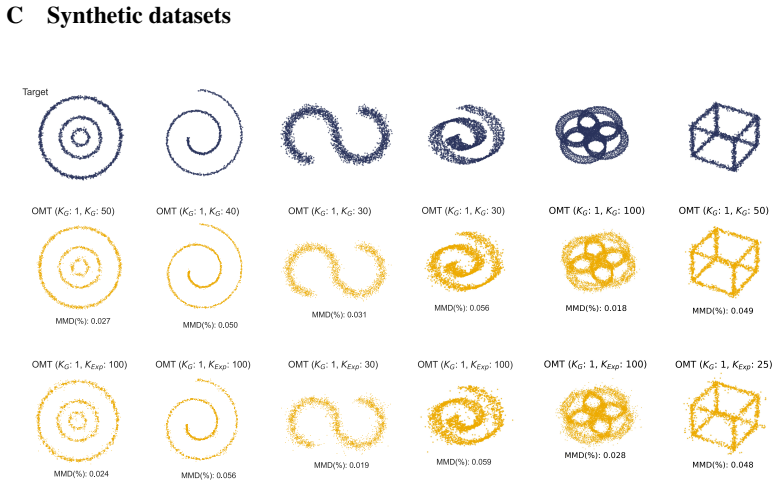
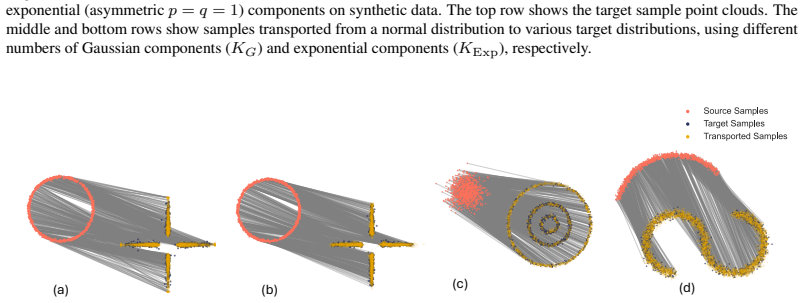
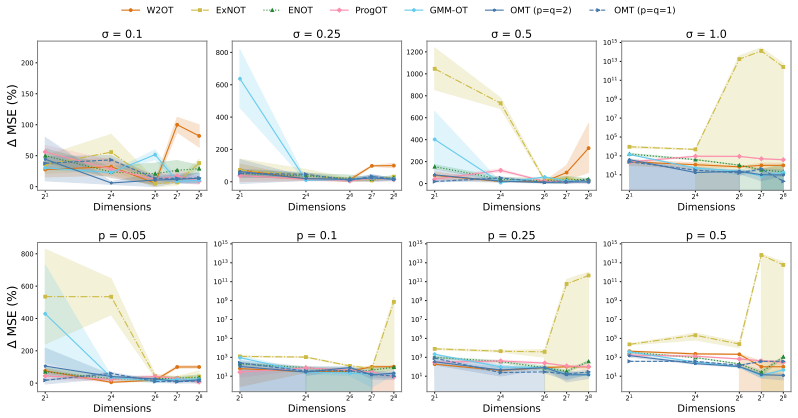
read the original abstract
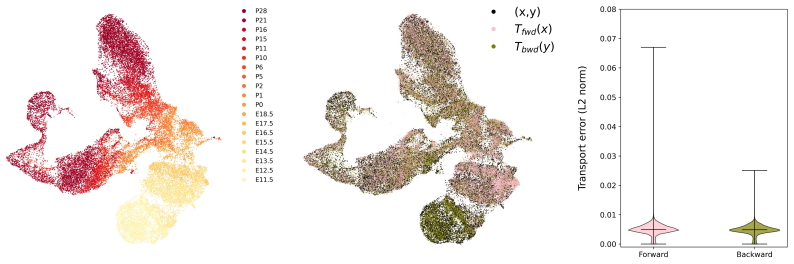
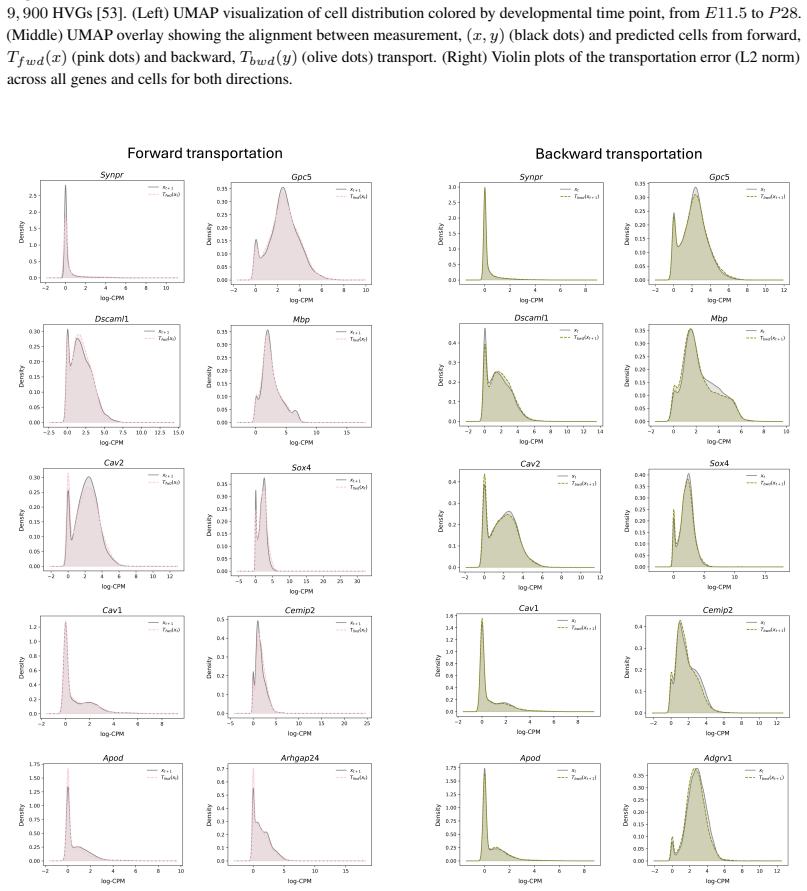
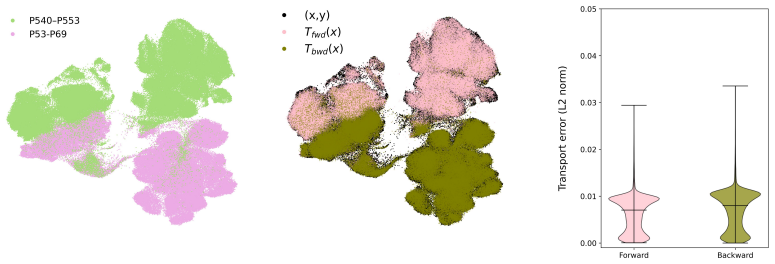
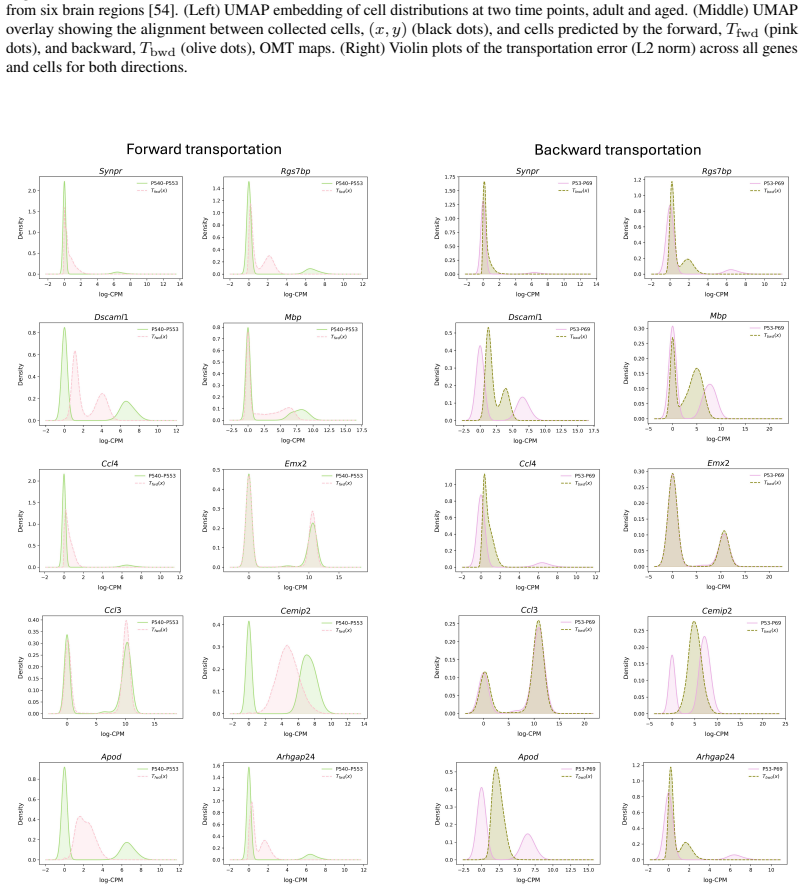
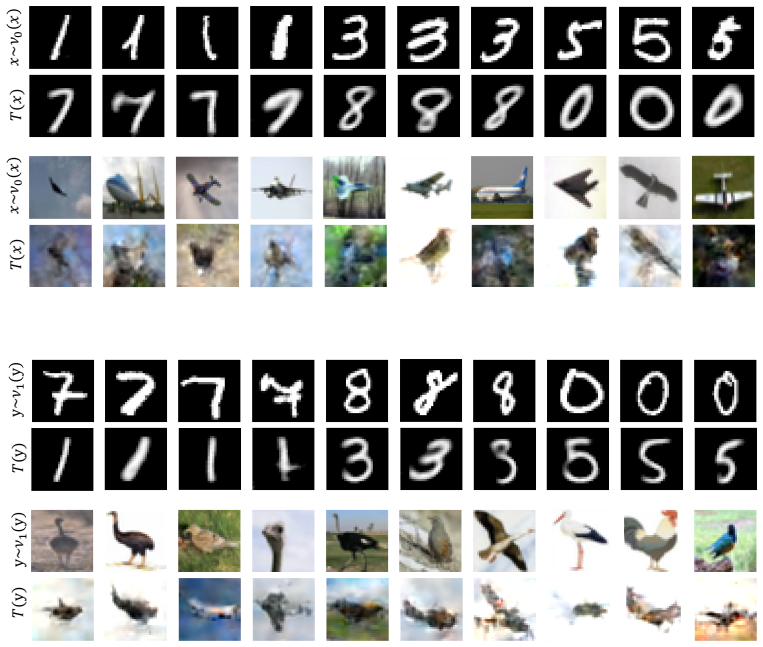
Optimal transport (OT) provides a principled framework for mapping between probability distributions. Despite extensive progress, applying OT to large-scale data remains computationally demanding, and the resulting pointwise transport plans are often difficult to interpret. We introduce Optimal Mixture Transport (OMT), a scalable framework that shifts the transport paradigm from individual samples to mixtures of subpopulations, reformulating the transport problem as a strictly biconvex optimization with a unique global minimizer. We further establish theoretical guarantees on the stability of the OMT map, showing that bounded perturbations of the underlying distributions lead to bounded changes in the transport plan. By formulating subpopulations as exponential-family distributions, OMT decouples computational complexity from the sample size, scaling solely with the number of mixture components. We demonstrate the effectiveness and practicality of OMT on a wide range of synthetic benchmarks and real-world datasets, including image data and large-scale single-cell RNA sequencing measurements.
Editorial analysis
A structured set of objections, weighed in public.
Referee Report
Summary. The paper introduces Optimal Mixture Transport (OMT), a framework that reformulates optimal transport between two mixture models (with subpopulations as exponential-family distributions) as a strictly biconvex optimization problem possessing a unique global minimizer. It claims theoretical stability guarantees showing that bounded perturbations in the input distributions induce bounded changes in the transport plan, and demonstrates that the approach decouples computational cost from sample size, scaling only with the number of mixture components. Experiments on synthetic benchmarks and real data (images, large-scale scRNA-seq) are presented to illustrate practicality.
Significance. If the biconvexity, uniqueness, and stability results can be rigorously established, OMT would supply a scalable, subpopulation-level alternative to classical OT that remains interpretable and stable, with potential utility for high-dimensional mixture data where pointwise plans are intractable.
major comments (2)
- [Abstract, §2] Abstract and §2 (formulation): the central claim that the OT problem between exponential-family mixtures admits a strictly biconvex objective with a unique global minimizer is asserted without any derivation, explicit objective function, or conditions on the exponential families that would guarantee strict biconvexity. This property is load-bearing for the scalability, uniqueness, and stability results that follow.
- [§3] §3 (stability): the stability theorem is stated but the proof sketch or argument establishing that bounded perturbations of the mixture parameters yield bounded changes in the OMT map is not supplied, preventing verification that the claimed Lipschitz-type bound holds independently of the biconvexity step.
minor comments (2)
- [§2] Notation for the mixture weights and natural parameters is introduced without a consolidated table; a single reference table would improve readability.
- [Experiments] The experimental section reports runtimes but does not include a direct comparison against standard OT solvers on the same mixture representations, making the claimed decoupling from sample size harder to quantify.
Simulated Author's Rebuttal
We thank the referee for their careful reading and constructive comments. We address each major comment below.
read point-by-point responses
-
Referee: [Abstract, §2] Abstract and §2 (formulation): the central claim that the OT problem between exponential-family mixtures admits a strictly biconvex objective with a unique global minimizer is asserted without any derivation, explicit objective function, or conditions on the exponential families that would guarantee strict biconvexity. This property is load-bearing for the scalability, uniqueness, and stability results that follow.
Authors: We agree that the explicit derivation of the objective, the conditions guaranteeing strict biconvexity, and the uniqueness proof were not presented with sufficient detail in §2. In the revised manuscript we will expand this section to state the objective function explicitly, derive its strict biconvexity under the stated conditions on the exponential families, and prove uniqueness of the global minimizer. revision: yes
-
Referee: [§3] §3 (stability): the stability theorem is stated but the proof sketch or argument establishing that bounded perturbations of the mixture parameters yield bounded changes in the OMT map is not supplied, preventing verification that the claimed Lipschitz-type bound holds independently of the biconvexity step.
Authors: We acknowledge that the proof sketch establishing the stability bound is missing from §3. In the revision we will supply a detailed argument showing that bounded perturbations of the mixture parameters produce bounded changes in the OMT map, with the bound independent of the biconvexity step, thereby allowing verification of the claimed Lipschitz-type guarantee. revision: yes
Circularity Check
No circularity identified from available text
full rationale
The abstract asserts that the transport problem is reformulated as a strictly biconvex optimization with a unique global minimizer and that subpopulations as exponential-family distributions yield scalability and stability guarantees. However, no equations, derivation steps, or self-citations are supplied in the provided text that would allow identification of any reduction to inputs by construction. The full manuscript is referenced but not reproduced here, so no load-bearing claim can be shown to collapse into a fitted parameter, self-definition, or self-citation chain. This is the default honest outcome when no explicit circular step is quotable.
Axiom & Free-Parameter Ledger
axioms (1)
- domain assumption The optimal transport problem between mixture models can be reformulated as a strictly biconvex optimization admitting a unique global minimizer when subpopulations are exponential-family distributions.
invented entities (1)
-
Optimal Mixture Transport (OMT)
no independent evidence
Reference graph
Works this paper leans on
-
[1]
Springer, 2015
Filippo Santambrogio.Optimal transport for applied mathematicians, volume 87. Springer, 2015
2015
-
[2]
Unsupervised alignment of embeddings with wasserstein procrustes
Edouard Grave, Armand Joulin, and Quentin Berthet. Unsupervised alignment of embeddings with wasserstein procrustes. InThe 22nd International Conference on Artificial Intelligence and Statistics, pages 1880–1890. PMLR, 2019
2019
-
[3]
Learning representations that are closed-form monge mapping optimal with application to domain adaptation.Transactions on Machine Learning Research, 2023
Oliver Struckmeier, Ievgen Redko, Anton Mallasto, Karol Arndt, Markus Heinonen, and Ville Kyrki. Learning representations that are closed-form monge mapping optimal with application to domain adaptation.Transactions on Machine Learning Research, 2023
2023
-
[4]
Infoot: Information maximizing optimal transport
Ching-Yao Chuang, Stefanie Jegelka, and David Alvarez-Melis. Infoot: Information maximizing optimal transport. InInternational Conference on Machine Learning, pages 6228–6242. PMLR, 2023
2023
-
[5]
Opti- mal transport for domain adaptation through gaussian mixture models.Transactions on Machine Learning Research, 2025
Eduardo Fernandes Montesuma, Fred Maurice Ngolè Mboula, and Antoine Souloumiac. Opti- mal transport for domain adaptation through gaussian mixture models.Transactions on Machine Learning Research, 2025
2025
-
[6]
Scot: single-cell multi-omics alignment with optimal transport.Journal of computational biology, 29(1):3–18, 2022
Pinar Demetci, Rebecca Santorella, Björn Sandstede, William Stafford Noble, and Ritambhara Singh. Scot: single-cell multi-omics alignment with optimal transport.Journal of computational biology, 29(1):3–18, 2022
2022
-
[7]
Trajecto- rynet: A dynamic optimal transport network for modeling cellular dynamics
Alexander Tong, Jessie Huang, Guy Wolf, David Van Dijk, and Smita Krishnaswamy. Trajecto- rynet: A dynamic optimal transport network for modeling cellular dynamics. InInternational conference on machine learning, pages 9526–9536. PMLR, 2020
2020
-
[8]
Learning single- cell perturbation responses using neural optimal transport.Nature methods, 20(11):1759–1768, 2023
Charlotte Bunne, Stefan G Stark, Gabriele Gut, Jacobo Sarabia Del Castillo, Mitch Levesque, Kjong-Van Lehmann, Lucas Pelkmans, Andreas Krause, and Gunnar Rätsch. Learning single- cell perturbation responses using neural optimal transport.Nature methods, 20(11):1759–1768, 2023
2023
-
[9]
Optimal transport for single-cell and spatial omics.Nature Reviews Methods Primers, 4(1):58, 2024
Charlotte Bunne, Geoffrey Schiebinger, Andreas Krause, Aviv Regev, and Marco Cuturi. Optimal transport for single-cell and spatial omics.Nature Reviews Methods Primers, 4(1):58, 2024
2024
-
[10]
Computational optimal transport: With applications to data science.Foundations and Trends® in Machine Learning, 11(5-6):355–607, 2019
Gabriel Peyré, Marco Cuturi, et al. Computational optimal transport: With applications to data science.Foundations and Trends® in Machine Learning, 11(5-6):355–607, 2019
2019
-
[11]
Springer, 2008
Cédric Villani et al.Optimal transport: old and new, volume 338. Springer, 2008
2008
-
[12]
Sinkhorn distances: Lightspeed computation of optimal transport.Advances in neural information processing systems, 26, 2013
Marco Cuturi. Sinkhorn distances: Lightspeed computation of optimal transport.Advances in neural information processing systems, 26, 2013
2013
-
[13]
Learning generative models with sinkhorn divergences
Aude Genevay, Gabriel Peyré, and Marco Cuturi. Learning generative models with sinkhorn divergences. InInternational Conference on Artificial Intelligence and Statistics, pages 1608–
-
[14]
Kilian Fatras, Younes Zine, Szymon Majewski, Rémi Flamary, Rémi Gribonval, and Nicolas Courty. Minibatch optimal transport distances; analysis and applications.arXiv preprint arXiv:2101.01792, 2021
-
[15]
Unbalanced minibatch optimal transport; applications to domain adaptation
Kilian Fatras, Thibault Séjourné, Rémi Flamary, and Nicolas Courty. Unbalanced minibatch optimal transport; applications to domain adaptation. InInternational conference on machine learning, pages 3186–3197. PMLR, 2021. 10
2021
-
[16]
Progressive entropic optimal transport solvers.Advances in Neural Information Processing Systems, 37:19561–19590, 2024
Parnian Kassraie, Aram-Alexandre Pooladian, Michal Klein, James Thornton, Jonathan Niles- Weed, and Marco Cuturi. Progressive entropic optimal transport solvers.Advances in Neural Information Processing Systems, 37:19561–19590, 2024
2024
-
[17]
Building normalizing flows with stochastic interpolants.International conference on learning representations, 2023
Michael S Albergo and Eric Vanden-Eijnden. Building normalizing flows with stochastic interpolants.International conference on learning representations, 2023
2023
-
[18]
Stochastic interpolants with data-dependent couplings.International conference on machine learning, 2024
Michael S Albergo, Mark Goldstein, Nicholas M Boffi, Rajesh Ranganath, and Eric Vanden- Eijnden. Stochastic interpolants with data-dependent couplings.International conference on machine learning, 2024
2024
-
[19]
Score-based generative neural networks for large- scale optimal transport.Advances in neural information processing systems, 34:12955–12965, 2021
Max Daniels, Tyler Maunu, and Paul Hand. Score-based generative neural networks for large- scale optimal transport.Advances in neural information processing systems, 34:12955–12965, 2021
2021
-
[20]
Building the bridge of schrödinger: A continuous entropic optimal transport benchmark.Advances in Neural Information Processing Systems, 36:18932–18963, 2023
Nikita Gushchin, Alexander Kolesov, Petr Mokrov, Polina Karpikova, Andrei Spiridonov, Evgeny Burnaev, and Alexander Korotin. Building the bridge of schrödinger: A continuous entropic optimal transport benchmark.Advances in Neural Information Processing Systems, 36:18932–18963, 2023
2023
-
[21]
Entropic neural optimal transport via diffusion processes.Advances in Neural Information Processing Systems, 36:75517–75544, 2023
Nikita Gushchin, Alexander Kolesov, Alexander Korotin, Dmitry P Vetrov, and Evgeny Burnaev. Entropic neural optimal transport via diffusion processes.Advances in Neural Information Processing Systems, 36:75517–75544, 2023
2023
-
[22]
A convexity principle for interacting gases.Advances in mathematics, 128(1):153–179, 1997
Robert J McCann. A convexity principle for interacting gases.Advances in mathematics, 128(1):153–179, 1997
1997
-
[23]
Tight stability bounds for entropic brenier maps.International Mathematics Research Notices, 2025(7):rnaf078, 2025
Vincent Divol, Jonathan Niles-Weed, and Aram-Alexandre Pooladian. Tight stability bounds for entropic brenier maps.International Mathematics Research Notices, 2025(7):rnaf078, 2025
2025
-
[24]
Low-rank sinkhorn factorization
Meyer Scetbon, Marco Cuturi, and Gabriel Peyré. Low-rank sinkhorn factorization. In International Conference on Machine Learning, pages 9344–9354. PMLR, 2021
2021
-
[25]
Peter Halmos, Julian Gold, Xinhao Liu, and Benjamin J Raphael. Hierarchical refinement: Optimal transport to infinity and beyond.arXiv preprint arXiv:2503.03025, 2025
-
[26]
Low-rank matrix factorization under general mixture noise distributions
Xiangyong Cao, Yang Chen, Qian Zhao, Deyu Meng, Yao Wang, Dong Wang, and Zongben Xu. Low-rank matrix factorization under general mixture noise distributions. InProceedings of the IEEE international conference on computer vision, pages 1493–1501, 2015
2015
-
[27]
Estimation of non-normalized statistical models by score matching.Journal of Machine Learning Research, 6(4), 2005
Aapo Hyvärinen and Peter Dayan. Estimation of non-normalized statistical models by score matching.Journal of Machine Learning Research, 6(4), 2005
2005
-
[28]
Entropic optimal transport between unbalanced gaussian measures has a closed form.Advances in neural information processing systems, 33:10468–10479, 2020
Hicham Janati, Boris Muzellec, Gabriel Peyré, and Marco Cuturi. Entropic optimal transport between unbalanced gaussian measures has a closed form.Advances in neural information processing systems, 33:10468–10479, 2020
2020
-
[29]
Aggregated wasserstein distance and state registration for hidden markov models.IEEE transactions on pattern analysis and machine intelligence, 42(9):2133–2147, 2019
Yukun Chen, Jianbo Ye, and Jia Li. Aggregated wasserstein distance and state registration for hidden markov models.IEEE transactions on pattern analysis and machine intelligence, 42(9):2133–2147, 2019
2019
-
[30]
A global optimization algorithm (gop) for certain classes of nonconvex nlps—i
Christodoulos A Floudas and Viswanathan Visweswaran. A global optimization algorithm (gop) for certain classes of nonconvex nlps—i. theory.Computers & chemical engineering, 14(12):1397–1417, 1990
1990
-
[31]
Biconvex sets and optimization with biconvex functions: a survey and extensions.Mathematical methods of operations research, 66(3):373–407, 2007
Jochen Gorski, Frank Pfeuffer, and Kathrin Klamroth. Biconvex sets and optimization with biconvex functions: a survey and extensions.Mathematical methods of operations research, 66(3):373–407, 2007
2007
-
[32]
Localization schemes: A framework for proving mixing bounds for markov chains
Yuansi Chen and Ronen Eldan. Localization schemes: A framework for proving mixing bounds for markov chains. In2022 IEEE 63rd Annual Symposium on Foundations of Computer Science (FOCS), pages 110–122. IEEE, 2022
2022
-
[33]
Stochastic dynamics and the polchinski equation: an introduction.Probability Surveys, 21:200–290, 2024
Roland Bauerschmidt, Thierry Bodineau, and Benoit Dagallier. Stochastic dynamics and the polchinski equation: an introduction.Probability Surveys, 21:200–290, 2024. 11
2024
-
[34]
Sliced and radon wasser- stein barycenters of measures.Journal of Mathematical Imaging and Vision, 51(1):22–45, 2015
Nicolas Bonneel, Julien Rabin, Gabriel Peyré, and Hanspeter Pfister. Sliced and radon wasser- stein barycenters of measures.Journal of Mathematical Imaging and Vision, 51(1):22–45, 2015
2015
-
[35]
American Mathematical Soc., 2021
Cédric Villani.Topics in optimal transportation, volume 58. American Mathematical Soc., 2021
2021
-
[36]
Optimal transport mapping via input convex neural networks
Ashok Makkuva, Amirhossein Taghvaei, Sewoong Oh, and Jason Lee. Optimal transport mapping via input convex neural networks. InInternational Conference on Machine Learning, pages 6672–6681. PMLR, 2020
2020
-
[37]
Neural optimal transport
Alexander Korotin, Daniil Selikhanovych, and Evgeny Burnaev. Neural optimal transport. International conference on learning representations, 2023
2023
-
[38]
Expectile regularization for fast and accurate training of neural optimal transport.Advances in Neural Information Processing Systems, 37:119811–119837, 2024
Nazar Buzun, Maksim Bobrin, and Dmitry V Dylov. Expectile regularization for fast and accurate training of neural optimal transport.Advances in Neural Information Processing Systems, 37:119811–119837, 2024
2024
-
[39]
Diffusion schrödinger bridge with applications to score-based generative modeling.Advances in neural information processing systems, 34:17695–17709, 2021
Valentin De Bortoli, James Thornton, Jeremy Heng, and Arnaud Doucet. Diffusion schrödinger bridge with applications to score-based generative modeling.Advances in neural information processing systems, 34:17695–17709, 2021
2021
-
[40]
Diffusion schrödinger bridge matching.Advances in Neural Information Processing Systems, 36:62183–62223, 2023
Yuyang Shi, Valentin De Bortoli, Andrew Campbell, and Arnaud Doucet. Diffusion schrödinger bridge matching.Advances in Neural Information Processing Systems, 36:62183–62223, 2023
2023
-
[41]
Entropic neural optimal transport via diffusion processes.Advances in Neural Information Processing Systems, 36, 2024
Nikita Gushchin, Alexander Kolesov, Alexander Korotin, Dmitry P Vetrov, and Evgeny Burnaev. Entropic neural optimal transport via diffusion processes.Advances in Neural Information Processing Systems, 36, 2024
2024
-
[42]
Light and optimal schrödinger bridge matching
Nikita Gushchin, Sergei Kholkin, Evgeny Burnaev, and Alexander Korotin. Light and optimal schrödinger bridge matching. InForty-first International Conference on Machine Learning, 2024
2024
- [43]
-
[44]
Low-rank optimal transport: Approximation, statistics and debiasing.Advances in Neural Information Processing Systems, 35:6802–6814, 2022
Meyer Scetbon and Marco Cuturi. Low-rank optimal transport: Approximation, statistics and debiasing.Advances in Neural Information Processing Systems, 35:6802–6814, 2022
2022
-
[45]
Low-rank optimal transport through factor relaxation with latent coupling.Advances in Neural Information Processing Systems, 37:114374–114433, 2024
Peter Halmos, Xinhao Liu, Julian Gold, and Benjamin J Raphael. Low-rank optimal transport through factor relaxation with latent coupling.Advances in Neural Information Processing Systems, 37:114374–114433, 2024
2024
-
[46]
A wasserstein-type distance in the space of gaussian mixture models.SIAM Journal on Imaging Sciences, 13(2):936–970, 2020
Julie Delon and Agnes Desolneux. A wasserstein-type distance in the space of gaussian mixture models.SIAM Journal on Imaging Sciences, 13(2):936–970, 2020
2020
-
[47]
scegot: single-cell trajectory infer- ence framework based on entropic gaussian mixture optimal transport.BMC bioinformatics, 25(1):388, 2024
Toshiaki Yachimura, Hanbo Wang, Yusuke Imoto, Momoko Yoshida, Sohei Tasaki, Yoji Kojima, Yukihiro Yabuta, Mitinori Saitou, and Yasuaki Hiraoka. scegot: single-cell trajectory infer- ence framework based on entropic gaussian mixture optimal transport.BMC bioinformatics, 25(1):388, 2024
2024
-
[48]
Do neural optimal transport solvers work? a continuous wasserstein-2 benchmark.Advances in neural information processing systems, 34:14593–14605, 2021
Alexander Korotin, Lingxiao Li, Aude Genevay, Justin M Solomon, Alexander Filippov, and Evgeny Burnaev. Do neural optimal transport solvers work? a continuous wasserstein-2 benchmark.Advances in neural information processing systems, 34:14593–14605, 2021
2021
-
[49]
On amortizing convex conjugates for optimal transport.arXiv preprint arXiv:2210.12153, 2022
Brandon Amos. On amortizing convex conjugates for optimal transport.arXiv preprint arXiv:2210.12153, 2022
-
[50]
Nazar Buzun, Maksim Bobrin, and Dmitry V Dylov. Enot: Expectile regularization for fast and accurate training of neural optimal transport.arXiv preprint arXiv:2403.03777, 2024. 12
-
[51]
Massively multiplex chemical transcriptomics at single-cell resolution.Science, 367(6473):45– 51, 2020
Sanjay R Srivatsan, José L McFaline-Figueroa, Vijay Ramani, Lauren Saunders, Junyue Cao, Jonathan Packer, Hannah A Pliner, Dana L Jackson, Riza M Daza, Lena Christiansen, et al. Massively multiplex chemical transcriptomics at single-cell resolution.Science, 367(6473):45– 51, 2020
2020
-
[52]
Monge, bregman and occam: Interpretable optimal transport in high-dimensions with feature-sparse maps.International Conference on Machine Learning, 2023
Marco Cuturi, Michal Klein, and Pierre Ablin. Monge, bregman and occam: Interpretable optimal transport in high-dimensions with feature-sparse maps.International Conference on Machine Learning, 2023
2023
-
[53]
Continu- ous cell-type diversification in mouse visual cortex development.Nature, 647(8088):127–142, 2025
Yuan Gao, Cindy TJ van Velthoven, Changkyu Lee, Emma D Thomas, Rémi Mathieu, Angela P Ayala, Stuard Barta, Darren Bertagnolli, Jazmin Campos, Trangthanh Cardenas, et al. Continu- ous cell-type diversification in mouse visual cortex development.Nature, 647(8088):127–142, 2025
2025
-
[54]
Brain-wide cell-type-specific transcriptomic signatures of healthy ageing in mice.Nature, 638(8049):182– 196, 2025
Kelly Jin, Zizhen Yao, Cindy TJ van Velthoven, Eitan S Kaplan, Katie Glattfelder, Samuel T Bar- low, Gabriella Boyer, Daniel Carey, Tamara Casper, Anish Bhaswanth Chakka, et al. Brain-wide cell-type-specific transcriptomic signatures of healthy ageing in mice.Nature, 638(8049):182– 196, 2025
2025
-
[55]
Oligo- dendrocyte heterogeneity in the mouse juvenile and adult central nervous system.Science, 352(6291):1326–1329, 2016
Sueli Marques, Amit Zeisel, Simone Codeluppi, David Van Bruggen, Ana Mendanha Falcão, Lin Xiao, Huiliang Li, Martin Häring, Hannah Hochgerner, Roman A Romanov, et al. Oligo- dendrocyte heterogeneity in the mouse juvenile and adult central nervous system.Science, 352(6291):1326–1329, 2016
2016
-
[56]
Imagenet: A large- scale hierarchical image database
Jia Deng, Wei Dong, Richard Socher, Li-Jia Li, Kai Li, and Li Fei-Fei. Imagenet: A large- scale hierarchical image database. In2009 IEEE conference on computer vision and pattern recognition, pages 248–255. Ieee, 2009
2009
-
[57]
The mnist database of handwritten digits.http://yann
Yann LeCun. The mnist database of handwritten digits.http://yann. lecun. com/exdb/mnist/, 1998
1998
-
[58]
Cifar-100 and cifar-10 (canadian institute for advanced research).URL http://www
Alex Krizhevsky, Vinod Nair, and Geoffrey Hinton. Cifar-100 and cifar-10 (canadian institute for advanced research).URL http://www. cs. toronto. edu/kriz/cifar. html. MIT License, 2009
2009
-
[59]
Primal-relaxed dual global optimization approach.Journal of Optimization Theory and Applications, 78(2):187–225, 1993
Christodoulos A Floudas and Vishy Visweswaran. Primal-relaxed dual global optimization approach.Journal of Optimization Theory and Applications, 78(2):187–225, 1993
1993
-
[60]
Wasserstein generative adversarial networks
Martin Arjovsky, Soumith Chintala, and Léon Bottou. Wasserstein generative adversarial networks. InInternational conference on machine learning, pages 214–223. PMLR, 2017
2017
-
[61]
Improved training of wasserstein gans.Advances in neural information processing systems, 30, 2017
Ishaan Gulrajani, Faruk Ahmed, Martin Arjovsky, Vincent Dumoulin, and Aaron C Courville. Improved training of wasserstein gans.Advances in neural information processing systems, 30, 2017
2017
-
[62]
Deep residual learning for image recognition
Kaiming He, Xiangyu Zhang, Shaoqing Ren, and Jian Sun. Deep residual learning for image recognition. InProceedings of the IEEE conference on computer vision and pattern recognition, pages 770–778, 2016
2016
-
[63]
Generative modeling through the semi- dual formulation of unbalanced optimal transport.Advances in Neural Information Processing Systems, 36:42433–42455, 2023
Jaemoo Choi, Jaewoong Choi, and Myungjoo Kang. Generative modeling through the semi- dual formulation of unbalanced optimal transport.Advances in Neural Information Processing Systems, 36:42433–42455, 2023
2023
-
[64]
Generative modeling with optimal transport maps.International conference on machine learning, 2022
Litu Rout, Alexander Korotin, and Evgeny Burnaev. Generative modeling with optimal transport maps.International conference on machine learning, 2022
2022
-
[65]
Self sparse generative adversarial networks.arXiv preprint arXiv:2101.10556, 2021
Wenliang Qian, Yang Xu, Wangmeng Zuo, and Hui Li. Self sparse generative adversarial networks.arXiv preprint arXiv:2101.10556, 2021. 13 Appendix A Proofs Lemma 1.For anyε 1, ε2 >0,L ε1,ε2(Ω, P)is strictly biconvex. Proof. A function f:X × Y →R is calledbiconvexif, for fixed x∈ X , the function f(x, y) is convex in y, and for fixed y∈ Y , it is convex in x...
-
[66]
29 Proof
+b 0W1/2 2 (ν0, ν′ 0). 29 Proof. Let (Ω′, P ′) denote the transport weights and the set couplings associated with the OMT betweenν 0 andν ′ 0, whereν ′ 0 denotes the perturbed counterpart ofν 0, for allx,x ′ ∈R d. For brevity, we define T ν0→ν1 OMT :=T ν0 OMT . We begin by quantifying the average norm of deviation between the two optimal transport maps: Z...
-
[67]
105 and 107, we obtain Z ∥T ν0 OMT(x)−T ν′ 0 OMT(x)∥dν0(x)≤(a ′ 0 +L ν′ 0)W2(ν0, ν′
+b ′ 0W1/2 2 (ν0, ν′ 0)(107) Finally, combining the bounds derived in Eqs. 105 and 107, we obtain Z ∥T ν0 OMT(x)−T ν′ 0 OMT(x)∥dν0(x)≤(a ′ 0 +L ν′ 0)W2(ν0, ν′
-
[68]
Σixx Σε1 ij Σε1 T ij Σjyy #! (111) Therefore, the optimal mixture transport policy is itself a GMM, given by: πOMT(x,y) = KX i,j ωijpij(x,y) = X i,j ωijN x y | mix miy ,
+ (b′ 0W2(ν0, ν′ 0))1/2 Settinga 0 :=a ′ 0 +L ν′ 0 <∞andb 0 =b ′ 0 (defined in Eq. 104) completes the proof. A.5 Additional Derivations Consideringx=∥T ρ→ν1 OMT (z)−T ν0→ν1 OMT (x)∥, the inequality in Eq. 100 can be simplified as x2 −bx−c≤0 Therefore x≤b/2 + 1/2 p b2 + 4c Using the property p f2 +g 2 ≤f+g,f≥0, andg≥0: x≤b+c 1/2 . A.6 Gaussian OMT Corollar...
2048
discussion (0)
Sign in with ORCID, Apple, or X to comment. Anyone can read and Pith papers without signing in.