Symmetry-Protected Weyl Nodal Loops in a Triangular Altermagnet
Pith reviewed 2026-06-28 13:22 UTC · model grok-4.3
The pith
Cr₇Se₈ realizes mirror-protected Weyl nodal loops near the Fermi level from its 120° altermagnetic order on the triangular lattice.
A machine-rendered reading of the paper's core claim, the machinery that carries it, and where it could break.
Core claim
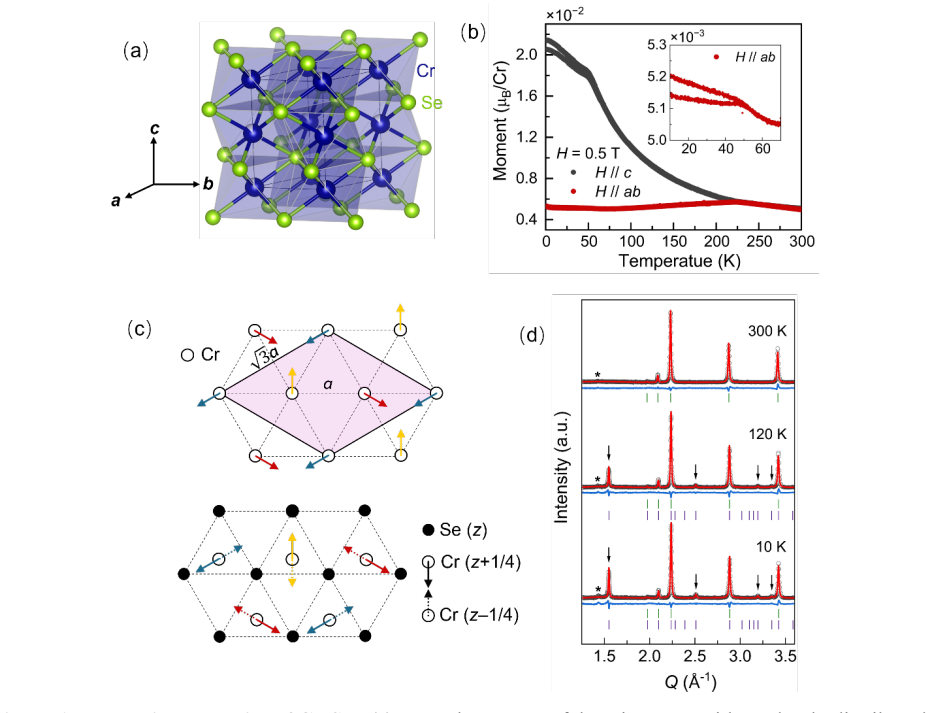
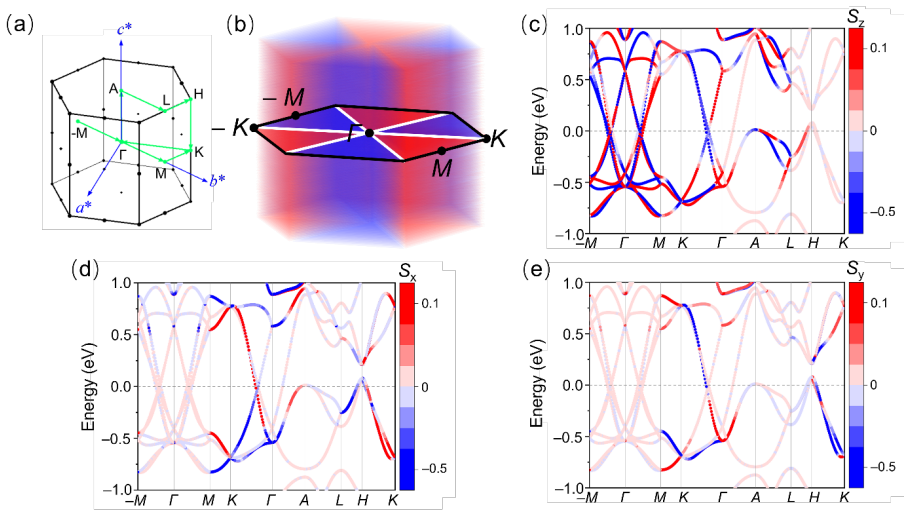
The hexagonal system hosts a coplanar 120° compensated magnetic order on a triangular lattice, which breaks inversion-time-reversal and translation-time-reversal symmetries simultaneously while preserving a crystalline mirror plane. The resulting electronic structure features linearly dispersing nodal loops close to the Fermi level confined to the mirror-invariant kz=0 plane. Along high-symmetry directions the crossings near EF form Dirac-like fourfold degeneracies in the absence of spin-orbit coupling; at generic momenta these crossings split into twofold and form continuous Weyl-like nodal loops protected by mirror symmetry. The momentum-dependent spin polarization exhibits an f-wave-like
What carries the argument
The crystalline mirror plane preserved by the 120° compensated order, which protects the twofold degenerate Weyl-like nodal loops at generic momenta within the kz=0 plane.
If this is right
- The nodal loops remain linearly dispersing and confined to the mirror-invariant kz=0 plane.
- Crossings form fourfold Dirac-like degeneracies along high-symmetry directions without spin-orbit coupling.
- At generic momenta the crossings split into twofold degeneracies forming continuous Weyl-like loops.
- The spin polarization follows a momentum-dependent f-wave-like pattern.
- The features appear in Cr₇Se₈ as shown by neutron diffraction and first-principles calculations.
Where Pith is reading between the lines
- Similar triangular-lattice compounds could be examined for analogous protected nodal structures by varying the magnetic order.
- The mirror protection might allow external fields to tune the position or connectivity of the loops in related materials.
Load-bearing premise
The coplanar 120° compensated magnetic order on the triangular lattice preserves a crystalline mirror plane while breaking the other time-reversal symmetries.
What would settle it
ARPES measurements showing the absence of linearly dispersing crossings near the Fermi level confined to the kz=0 plane would falsify the central claim.
Figures
read the original abstract
Weyl semimetals and altermagnets represent two distinct classes of quantum materials exhibiting nontrivial topological and magnetic order, respectively. Here we report the realization of a Weyl nodal-loop altermagnet in Cr$_7$Se$_8$, combining neutron diffraction and first-principles calculations. The hexagonal system hosts a coplanar $120^\circ$ compensated magnetic order on a triangular lattice, which breaks inversion-time-reversal and translation-time-reversal symmetries simultaneously while preserving a crystalline mirror plane. The resulting electronic structure features linearly dispersing nodal loops close to the Fermi level ($E_F$) confined to the mirror-invariant $k_z=0$ plane. Along high-symmetry directions, the crossings near $E_F$ form Dirac-like fourfold degeneracies in the absence of spin-orbit coupling; at generic momenta, these crossings split into twofold and form continuous Weyl-like nodal loops protected by mirror symmetry. The momentum-dependent spin polarization exhibits an $f$-wave-like pattern characteristic of odd-parity altermagnets.
Editorial analysis
A structured set of objections, weighed in public.
Referee Report
Summary. The manuscript reports Cr₇Se₈ as realizing a Weyl nodal-loop altermagnet. Neutron diffraction establishes a coplanar 120° compensated magnetic order on the triangular lattice that simultaneously breaks PT and TT symmetries while preserving a crystalline mirror plane. First-principles calculations then demonstrate linearly dispersing nodal loops near E_F confined to the k_z=0 plane; these appear as fourfold Dirac-like degeneracies along high-symmetry lines (no SOC) that split into twofold Weyl-like loops at generic momenta, protected by mirror symmetry, with an f-wave spin-polarization texture.
Significance. If substantiated, the result supplies a concrete material platform combining altermagnetism with mirror-protected topological nodal loops, extending the known phenomenology of odd-parity altermagnets. The explicit use of neutron diffraction to fix the magnetic symmetry before computing the electronic structure is a methodological strength that grounds the symmetry analysis in experiment.
major comments (2)
- [Neutron diffraction analysis] The neutron-diffraction section provides no error bars on refined magnetic moments, no goodness-of-fit metrics (R_wp, χ²), and no explicit demonstration that the 120° structure is compatible with the claimed mirror plane. Because the mirror protection of the nodal loops in k_z=0 rests directly on this symmetry, the absence of quantitative validation weakens the central claim.
- [First-principles calculations] The first-principles section does not specify the exchange-correlation functional, any Hubbard U applied to Cr 3d states, k-point sampling, or convergence criteria for the bands near E_F. These choices directly control the location and dispersion of the reported nodal loops and the spin texture; without them the computed electronic structure cannot be independently assessed.
minor comments (2)
- [Abstract] The abstract states that the crossings 'split into twofold' at generic momenta; a brief sentence clarifying that this splitting is a consequence of the lowered symmetry away from high-symmetry lines would improve readability.
- [Figures] Figure captions for the spin-texture plots should explicitly note the momentum range and whether SOC is included, to avoid ambiguity with the no-SOC fourfold-degeneracy statements.
Simulated Author's Rebuttal
We thank the referee for the positive evaluation of the work and for the constructive comments on the neutron diffraction and first-principles sections. We address each point below and have revised the manuscript to incorporate the requested information.
read point-by-point responses
-
Referee: [Neutron diffraction analysis] The neutron-diffraction section provides no error bars on refined magnetic moments, no goodness-of-fit metrics (R_wp, χ²), and no explicit demonstration that the 120° structure is compatible with the claimed mirror plane. Because the mirror protection of the nodal loops in k_z=0 rests directly on this symmetry, the absence of quantitative validation weakens the central claim.
Authors: We agree that the original manuscript omitted quantitative fit metrics and an explicit symmetry check. The revised version now reports error bars on the refined magnetic moments, includes the goodness-of-fit values (R_wp and χ²), and adds a dedicated paragraph demonstrating that the coplanar 120° order is fully compatible with the mirror plane. These additions directly strengthen the experimental grounding of the mirror-protected nodal loops. revision: yes
-
Referee: [First-principles calculations] The first-principles section does not specify the exchange-correlation functional, any Hubbard U applied to Cr 3d states, k-point sampling, or convergence criteria for the bands near E_F. These choices directly control the location and dispersion of the reported nodal loops and the spin texture; without them the computed electronic structure cannot be independently assessed.
Authors: The referee is correct that these methodological details were absent. The revised manuscript now specifies the exchange-correlation functional, the Hubbard U value applied to Cr 3d states (if used), the k-point sampling grid, and the convergence criteria employed for the bands near E_F. These additions allow independent reproduction and assessment of the nodal-loop dispersions and spin texture. revision: yes
Circularity Check
No significant circularity
full rationale
The paper determines the coplanar 120° magnetic order on the triangular lattice via neutron diffraction and computes the electronic band structure and spin texture from first-principles DFT. The mirror-plane protection of the nodal loops in the kz=0 plane follows directly from the symmetries of that experimentally reported order (breaking PT and TT while preserving the mirror), with no fitted parameters, self-definitional loops, or load-bearing self-citations that reduce the central claim to its own inputs. The distinction between fourfold crossings on high-symmetry lines and twofold Weyl loops at generic momenta is a standard consequence of the symmetry analysis applied to the computed bands.
Axiom & Free-Parameter Ledger
axioms (1)
- standard math Standard group-theoretic analysis of magnetic space groups and symmetry operations
Reference graph
Works this paper leans on
-
[1]
Symmetry-Protected Weyl Band Crossings in a Triangular Altermagnet Chao-Chun Wei1, Xiaoyin Li1, Sophia Adams1,2, Jacob Kjeldahl Jensen3, Qiang Zhang4, Jue Liu4, Maxim Avdeev5,6, Dinesh Kumar Yadav7, Vikram V. Deshpande7, Luisa Whittaker-Brooks3, Feng Liu1,*, Huiwen Ji1,* 1Department of Materials Science and Engineering, University of Utah, Salt Lake City,...
2006
-
[2]
Yan and C
B. Yan and C. Felser, Topological Materials: Weyl Semimetals, Annu. Rev. Condens. Matter Phys. 8, 337 (2017)
2017
-
[3]
Šmejkal, J
L. Šmejkal, J. Sinova, and T. Jungwirth, Emerging Research Landscape of Altermagnetism, Phys. Rev. X. 12, 040501 (2022)
2022
-
[4]
Bradlyn, J
B. Bradlyn, J. Cano, Z. Wang, M. G. Vergniory, C. Felser, R. J. Cava, and B. A. Bernevig, Beyond Dirac and Weyl fermions: Unconventional quasiparticles in conventional crystals, Science 353, aaf5037 (2016)
2016
-
[5]
X. Wan, A. M. Turner, A. Vishwanath, and S. Y. Savrasov, Topological semimetal and Fermi-arc surface states in the electronic structure of pyrochlore iridates, Phys. Rev. B. 83, 205101 (2011)
2011
-
[6]
Liu et al., Giant anomalous Hall effect in a ferromagnetic kagome-lattice semimetal, Nat
E. Liu et al., Giant anomalous Hall effect in a ferromagnetic kagome-lattice semimetal, Nat. Phys. 14, 1125 (2018)
2018
-
[7]
Fedchenko et al., Observation of time-reversal symmetry breaking in the band structure of altermagnetic RuO2, Sci
O. Fedchenko et al., Observation of time-reversal symmetry breaking in the band structure of altermagnetic RuO2, Sci. Adv. 10, eadj4883 (2024)
2024
-
[8]
Zhang, J.-X
X. Zhang, J.-X. Xiong, L.-D. Yuan, and A. Zunger, Prototypes of Nonrelativistic Spin Splitting and Polarization in Symmetry Broken Antiferromagnets, Phys. Rev. X. 15, 031076 (2025)
2025
-
[9]
Cheong and F
S.-W. Cheong and F. T. Huang, Altermagnetism classification, npj Quantum Materials 10 (2025)
2025
-
[10]
D. S. Antonenko, R. M. Fernandes, and J. W. F. Venderbos, Mirror Chern Bands and Weyl Nodal Loops in Altermagnets, Phys. Rev. Lett. 134, 096703 (2025)
2025
-
[11]
Li et al., Topological Weyl altermagnetism in CrSb, Commun
C. Li et al., Topological Weyl altermagnetism in CrSb, Commun. Phys. 8, 311 (2025)
2025
-
[12]
L. M. Corliss, N. Elliott, J. M. Hastings, and R. L. Sass, Magnetic Structure of Chromium Selenide, Phys. Rev. 122, 1402 (1961)
1961
-
[14]
L.-D. Yuan, Z. Wang, J.-W. Luo, E. I. Rashba, and A. Zunger, Giant momentum-dependent spin splitting in centrosymmetric low-Z antiferromagnets, Phys. Rev. B. 102, 014422 (2020)
2020
- [15]
-
[17]
G. I. Makovetskii and G. M. Shakhlevich, Magnetic properties of the CrS1–xSex system, Phys. Status Solidi A 47, 219 (1978)
1978
-
[18]
Adachi, M
Y. Adachi, M. Ohashi, T. Kaneko, M. Yuzuri, Y. Yamaguchi, S. Funahashi, and Y. Morii, Magnetic Structure of Rhombohedral Cr2Se3, J. Phys. Soc. Jpn. 63, 1548 (1994)
1994
-
[19]
Wu et al., Magnetotransport and magnetic properties of the layered noncollinear antiferromagnetic Cr2Se3 single crystals, J
J. Wu et al., Magnetotransport and magnetic properties of the layered noncollinear antiferromagnetic Cr2Se3 single crystals, J. Phys. Condens. Matter. 32, 475801 (2020)
2020
-
[20]
Huppertz, H
H. Huppertz, H. Luehmann, and W. Bensch, Non-Stoichiometric Monoclinic Cr5Se8 Prepared at High-Pressure and High-Temperature and the Crystal Structure Refined from Rietveld Data, Chem. Inform. 35 (2004)
2004
-
[21]
Y. Bai, S. Pan, Z. Lu, Y. Gong, G. Xu, and F. Xu, Highly sensitive magnetic properties and large linear magnetoresistance in antiferromagnetic CrxSe(0.875 ≤x ≤ 1)single crystals, J. Alloys Compd. 968, 172080 (2023)
2023
-
[22]
#$%*&$!'#(∙1,)% where '!
T. Kaneko, J. Sugawara, K. Kamigaki, S. Abe, and H. Yoshida, A mictomagnetic behavior of Cr7Se8, J. Appl. Phys. 53, 2223 (1982). Supplemental Material Symmetry-Protected Weyl Nodal Loops in a Triangular Altermagnet Chao-Chun Wei1, Xiaoyin Li1, Sophia Adams1,2, Jacob Kjeldahl Jensen3, Qiang Zhang4, Jue Liu4, Maxim Avdeev5,6, Dinesh Kumar Yadav7, Vikram V ....
1982
-
[23]
B. H. Toby and R. B. V on Dreele, GSAS-II: the genesis of a modern open-source all purpose crystallography software package, J. Appl. Crystallogr. 46, 544 (2013)
2013
-
[24]
Kresse and J
G. Kresse and J. Furthmüller, Efficient iterative schemes for ab initio total-energy calculations using a plane-wave basis set, Phys. Rev. B. 54, 11169 (1996)
1996
-
[25]
P. E. Blöchl, Projector augmented-wave method, Phys. Rev. B. 50, 17953 (1994)
1994
-
[26]
J. P. Perdew, K. Burke, and M. Ernzerhof, Generalized Gradient Approximation Made Simple, Phys. Rev. Lett. 77, 3865 (1996)
1996
-
[27]
Ma and S
P.-W. Ma and S. L. Dudarev, Constrained density functional for noncollinear magnetism, Phys. Rev. B. 91, 054420 (2015)
2015
-
[28]
V . Wang, N. Xu, J.-C. Liu, G. Tang, and W.-T. Geng, V ASPKIT: A user-friendly interface facilitating high-throughput computing and analysis using V ASP code, Comput. Phys. Commun. 267, 108033 (2021)
2021
-
[29]
Virtanen et al., SciPy 1.0: fundamental algorithms for scientific computing in Python, Nat
P. Virtanen et al., SciPy 1.0: fundamental algorithms for scientific computing in Python, Nat. Methods 17, 261 (2020)
2020
-
[30]
Mugiraneza and A
S. Mugiraneza and A. M. Hallas, Tutorial: a beginner’s guide to interpreting magnetic susceptibility data with the Curie-Weiss law, Commun. Phys. 5, 95 (2022)
2022
-
[31]
Y . Bai, S. Pan, Z. Lu, Y . Gong, G. Xu, and F. Xu, Highly sensitive magnetic properties and large linear magnetoresistance in antiferromagnetic CrxSe(0.875 ≤x ≤ 1)single crystals, J. Alloys Compd. 968, 172080 (2023)
2023
-
[32]
Hirone and K
T. Hirone and K. Adachi, On the Magnetic Properties of Nickel-Arsenide Type Crystals, J. Phys. Soc. Jpn. 12, 156 (1957)
1957
-
[33]
Chevreton and F
M. Chevreton and F. Bertaut, Etude de seleniures de chrome, Compt. Rend. Hebd. Seances Acad. Sci. 253, 145 (1961)
1961
-
[34]
Huppertz, H
H. Huppertz, H. Lühmann, and W. Bensch, Non-Stoichiometric Monoclinic Cr5Se8 Prepared at High-Pressure and High-Temperature and the Crystal Structure Refined from Rietveld Data, Z. fur Naturforsch. B 58, 934 (2003)
2003
-
[35]
Wintenberger, G
M. Wintenberger, G. André, and J. Hammann, Composition and temperature dependent magnetic structures of monoclinic chromium selenides Cr3±xSe4, x ≤ 0.2, J. Magn. Magn. Mater. 147, 167 (1995)
1995
discussion (0)
Sign in with ORCID, Apple, or X to comment. Anyone can read and Pith papers without signing in.