A Mid-Infrared Platform Based on Strontium Tweezer Arrays
Pith reviewed 2026-06-28 11:29 UTC · model grok-4.3
The pith
Strontium atoms in optical tweezer arrays access a mid-infrared transition at 2923 nm using a magic trapping wavelength and resolved-sideband cooling.
A machine-rendered reading of the paper's core claim, the machinery that carries it, and where it could break.
Core claim
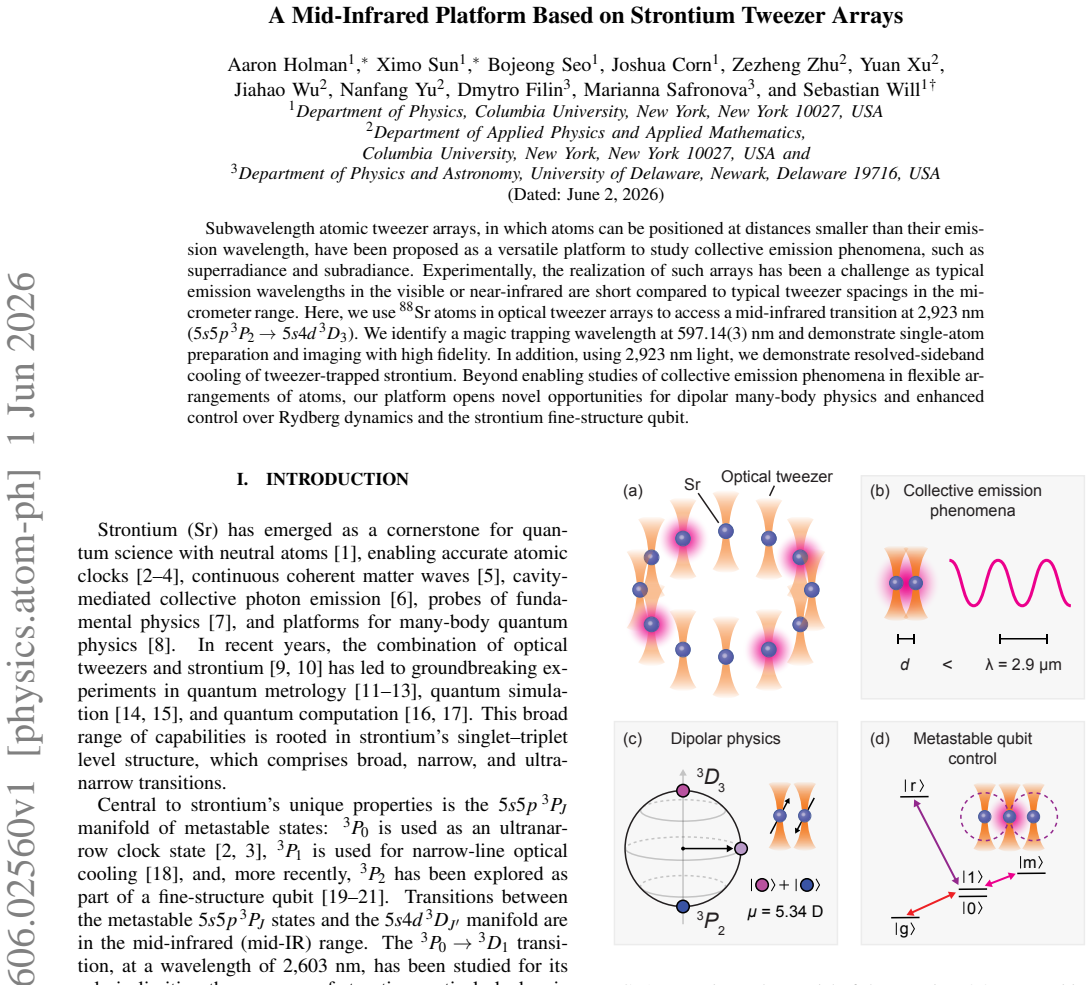
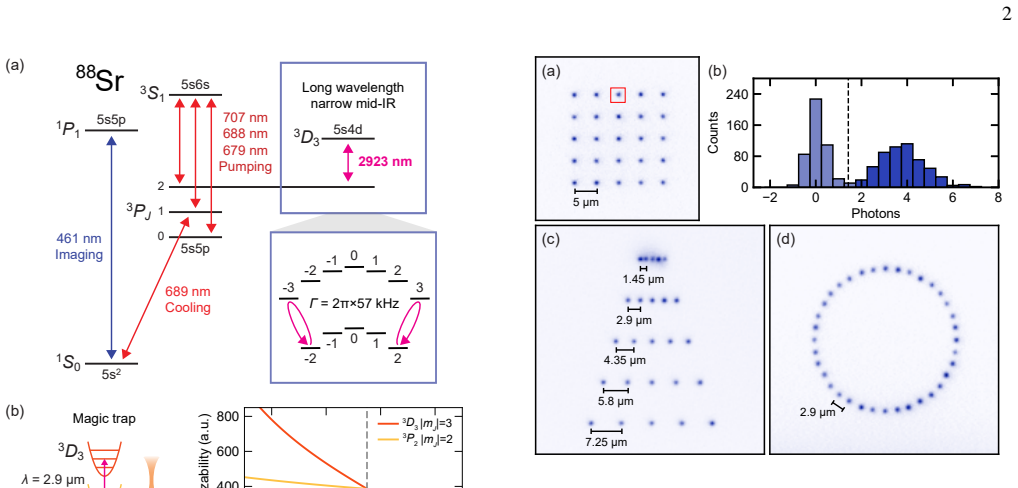
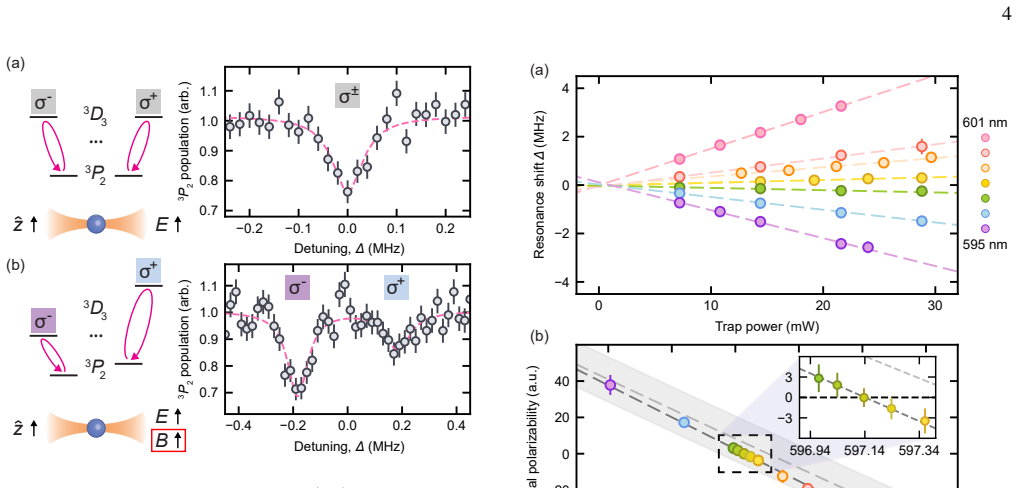
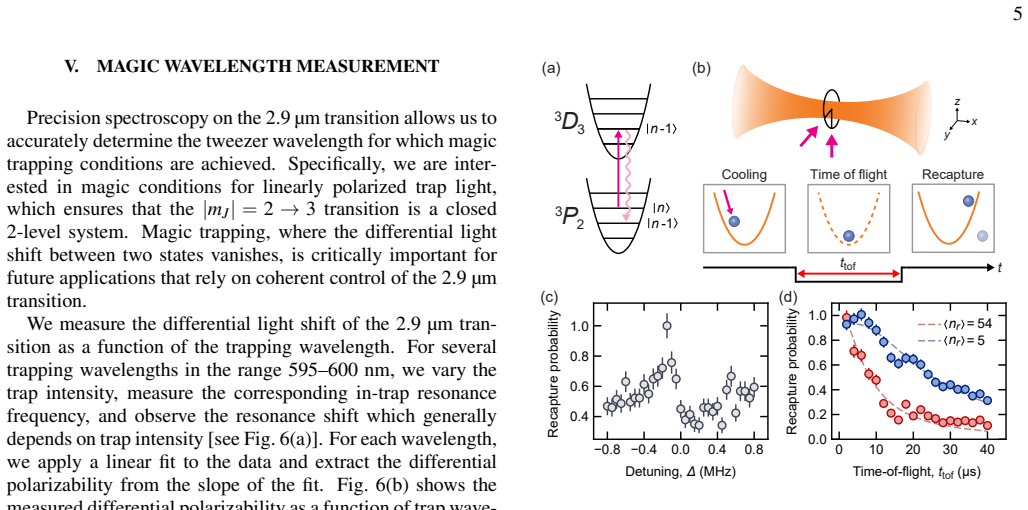
The authors establish that 88Sr atoms in optical tweezer arrays provide access to the mid-infrared transition at 2923 nm (5s5p 3P2 → 5s4d 3D3). They locate a magic trapping wavelength at 597.14(3) nm that minimizes differential AC Stark shifts between the two states. With this wavelength they achieve high-fidelity single-atom preparation and imaging, and they perform resolved-sideband cooling directly with 2923 nm light. The resulting platform supports subwavelength atomic arrangements for collective emission studies as well as dipolar many-body physics and enhanced Rydberg control.
What carries the argument
The magic trapping wavelength at 597.14 nm that cancels differential light shifts between the 5s5p 3P2 and 5s4d 3D3 states inside the optical tweezer potential.
If this is right
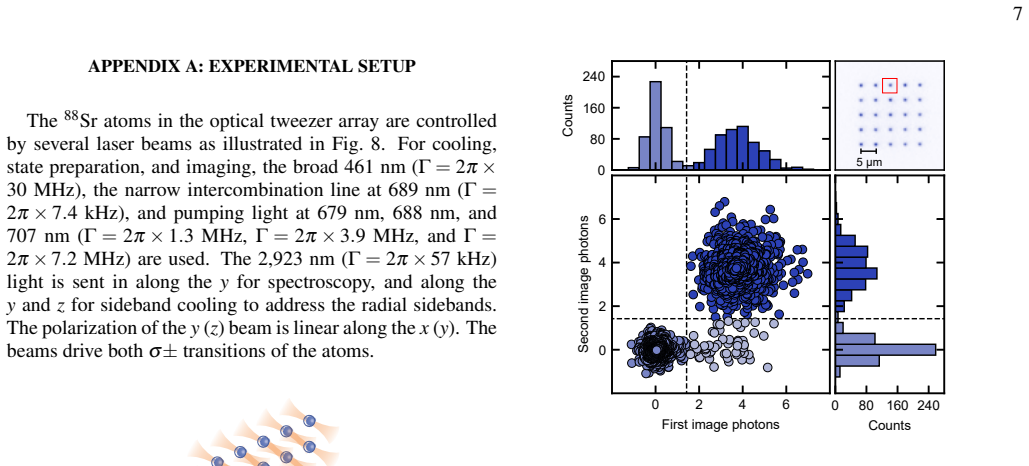
- Single atoms can be prepared and imaged with high fidelity on the mid-infrared transition.
- Resolved sideband cooling becomes available using the 2923 nm light itself.
- Atomic arrays with spacing smaller than the emission wavelength become experimentally accessible.
- Studies of collective emission phenomena, dipolar many-body physics, and fine-structure qubit control become feasible in the same platform.
Where Pith is reading between the lines
- The longer mid-infrared wavelength relaxes the spacing requirement for subwavelength arrays, which could be tested by arranging atoms at distances around 1-2 micrometers and measuring collective decay rates.
- The same magic wavelength and cooling technique might extend to other strontium isotopes or nearby transitions without major changes to the apparatus.
- Larger tweezer arrays prepared this way could be used to explore many-body dipolar interactions whose strength scales with the mid-infrared transition dipole moment.
Load-bearing premise
The identified magic wavelength at 597.14 nm truly cancels differential light shifts between the two states without introducing unaccounted decoherence or loss channels.
What would settle it
A direct measurement showing nonzero differential light shift at 597.14 nm, or an experiment that fails to reach the reported high-fidelity preparation and imaging, would falsify the central claim.
Figures
read the original abstract
Subwavelength atomic tweezer arrays, in which atoms can be positioned at distances smaller than their emission wavelength, have been proposed as a versatile platform to study collective emission phenomena, such as superradiance and subradiance. Experimentally, the realization of such arrays has been a challenge as typical emission wavelengths in the visible or near-infrared are short compared to typical tweezer spacings in the micrometer range. Here, we use $^{88}$Sr atoms in optical tweezer arrays to access a mid-infrared transition at 2,923 nm ($5s5p\:^{3}P_{2} \rightarrow\, 5s4d\:^{3}D_{3}$). We identify a magic trapping wavelength at 597.14(3) nm and demonstrate single-atom preparation and imaging with high fidelity. In addition, using 2,923 nm light, we demonstrate resolved-sideband cooling of tweezer-trapped strontium. Beyond enabling studies of collective emission phenomena in flexible arrangements of atoms, our platform opens novel opportunities for dipolar many-body physics and enhanced control over Rydberg dynamics and the strontium fine-structure qubit.
Editorial analysis
A structured set of objections, weighed in public.
Referee Report
Summary. The manuscript reports an experimental platform using 88Sr atoms in optical tweezer arrays to access the mid-infrared transition at 2923 nm (5s5p 3P2 → 5s4d 3D3). It identifies a magic trapping wavelength of 597.14(3) nm, demonstrates single-atom preparation and imaging with high fidelity, and shows resolved-sideband cooling using 2923 nm light. The work is framed as enabling subwavelength arrays for collective emission studies, dipolar many-body physics, and enhanced Rydberg/fine-structure control.
Significance. If the quantitative claims hold, the platform would be significant for quantum optics because mid-IR wavelengths allow subwavelength tweezer spacings that are difficult at visible/near-IR wavelengths. The magic-wavelength identification and sideband cooling are load-bearing for coherence in the tweezers.
major comments (2)
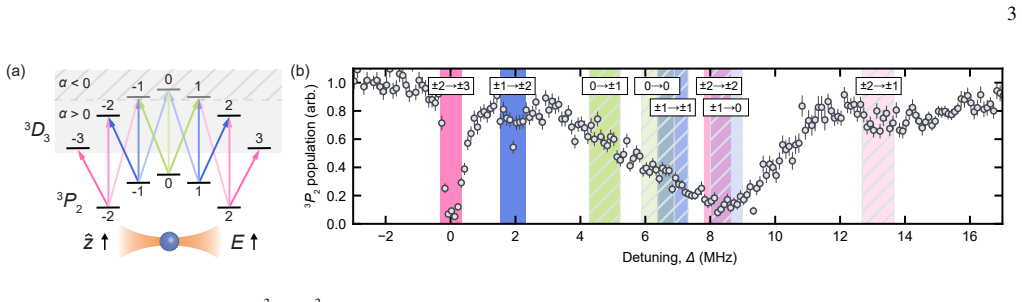
- [Magic wavelength identification] Magic wavelength section: the identification of 597.14(3) nm as magic must explicitly address tensor polarizabilities of the J=2 and J=3 states. The effective differential AC Stark shift depends on the angle between the 597 nm polarization and the quantization axis as well as on the addressed m sublevels; a scalar-only zero-crossing can shift by tens of MHz under changed geometry, introducing position-dependent dephasing that would undermine the claimed high-fidelity preparation, imaging, and resolved-sideband cooling.
- [Experimental demonstrations] Results on imaging and cooling: the central platform claim requires quantitative support (fidelity numbers, error bars, loss rates, heating rates) for the statements of 'high fidelity' single-atom preparation/imaging and resolved-sideband cooling. Without these metrics and exclusion criteria, the support for the claims cannot be verified from the presented data.
minor comments (2)
- Clarify the polarization and magnetic-field geometry used for the magic-wavelength measurement and for the subsequent cooling/imaging experiments.
- Add a table or figure summarizing the measured fidelities, cooling rates, and residual differential shifts with uncertainties.
Simulated Author's Rebuttal
We thank the referee for their detailed review and valuable feedback on our manuscript. We address each major comment below and will update the manuscript to incorporate the suggested improvements.
read point-by-point responses
-
Referee: [Magic wavelength identification] Magic wavelength section: the identification of 597.14(3) nm as magic must explicitly address tensor polarizabilities of the J=2 and J=3 states. The effective differential AC Stark shift depends on the angle between the 597 nm polarization and the quantization axis as well as on the addressed m sublevels; a scalar-only zero-crossing can shift by tens of MHz under changed geometry, introducing position-dependent dephasing that would undermine the claimed high-fidelity preparation, imaging, and resolved-sideband cooling.
Authors: We agree with the referee that tensor polarizabilities must be considered for a robust magic wavelength. Our measurement of the magic wavelength at 597.14(3) nm was performed with the trapping laser polarization aligned to the quantization axis and for the specific magnetic sublevels used in the experiment. To strengthen the manuscript, we will add an explicit discussion of the tensor shift contributions, including estimates of the angular dependence and how it affects the differential shift in our geometry. This will clarify that the reported value is effective for our experimental conditions while acknowledging potential variations in other setups. revision: yes
-
Referee: [Experimental demonstrations] Results on imaging and cooling: the central platform claim requires quantitative support (fidelity numbers, error bars, loss rates, heating rates) for the statements of 'high fidelity' single-atom preparation/imaging and resolved-sideband cooling. Without these metrics and exclusion criteria, the support for the claims cannot be verified from the presented data.
Authors: We appreciate this comment and agree that quantitative metrics are essential. In the revised manuscript, we will provide specific fidelity values (e.g., preparation and imaging fidelities with uncertainties), atom loss rates during the imaging and cooling processes, and heating rates extracted from the sideband cooling spectra. These data are part of our experimental results and will be included with appropriate error bars and details on analysis methods. revision: yes
Circularity Check
No circularity: experimental identification of magic wavelength and demonstrations
full rationale
The paper is an experimental demonstration of a mid-IR platform using 88Sr tweezer arrays. It reports experimental identification of a magic trapping wavelength at 597.14(3) nm, high-fidelity single-atom preparation/imaging, and resolved-sideband cooling with 2923 nm light. No derivation chains, first-principles predictions, fitted parameters renamed as predictions, or self-referential equations appear. The magic wavelength is located experimentally rather than derived from a model that reduces to its own inputs. Self-citations, if present, support prior experimental techniques but are not load-bearing for any claimed derivation. The work is self-contained as an experimental platform paper against external benchmarks.
Axiom & Free-Parameter Ledger
free parameters (1)
- magic trapping wavelength =
597.14(3) nm
axioms (1)
- domain assumption The 2923 nm transition supports resolved-sideband cooling when driven in the tweezer trap
Reference graph
Works this paper leans on
-
[1]
J. Ye, H. J. Kimble, and H. Katori, Quantum state engineering and precision metrology using state-insensitive light traps, Sci- ence320, 1734 (2008)
2008
-
[2]
Takamoto, F.-L
M. Takamoto, F.-L. Hong, R. Higashi, and H. Katori, An optical lattice clock, Nature435, 321 (2005)
2005
-
[3]
B. J. Bloom, T. L. Nicholson, J. R. Williams, S. L. Campbell, M. Bishof, X. Zhang, W. Zhang, S. L. Bromley, and J. Ye, An optical lattice clock with accuracy and stability at the 10 −18 level, Nature506, 71 (2014)
2014
-
[4]
Bothwell, C
T. Bothwell, C. J. Kennedy, A. Aeppli, D. Kedar, J. M. Robin- son, E. Oelker, A. Staron, and J. Ye, Resolving the gravitational redshift across a millimetre-scale atomic sample, Nature602, 420 (2022)
2022
-
[5]
C.-C. Chen, R. González Escudero, J. Miná ˇr, B. Pasquiou, S. Bennetts, and F. Schreck, Continuous Bose-Einstein conden- sation, Nature606, 683 (2022)
2022
-
[6]
M. A. Norcia, R. J. Lewis-Swan, J. R. K. Cline, B. Zhu, A. M. Rey, and J. K. Thompson, Cavity-mediated collective spin- exchange interactions in a strontium superradiant laser, Science 361, 259 (2018)
2018
-
[7]
S. S. Kondov, C.-H. Lee, K. H. Leung, C. Liedl, I. Majewska, R. Moszynski, and T. Zelevinsky, Molecular lattice clock with long vibrational coherence, Nat. Phys.15, 1118 (2019)
2019
-
[8]
S. Buob, J. Höschele, V . Makhalov, A. Rubio-Abadal, and L. Tarruell, A strontium quantum-gas microscope, PRX Quan- tum5, 020316 (2024)
2024
-
[9]
M. A. Norcia, A. W. Young, and A. M. Kaufman, Microscopic control and detection of ultracold strontium in optical-tweezer arrays, Phys. Rev. X8, 041054 (2018)
2018
-
[10]
Cooper, J
A. Cooper, J. P. Covey, I. S. Madjarov, S. G. Porsev, M. S. Safronova, and M. Endres, Alkaline-earth atoms in optical tweezers, Phys. Rev. X8, 041055 (2018)
2018
-
[11]
I. S. Madjarov, A. Cooper, A. L. Shaw, J. P. Covey, V . Schkol- nik, T. H. Yoon, J. R. Williams, and M. Endres, An atomic-array optical clock with single-atom readout, Phys. Rev. X9, 041052 (2019)
2019
-
[12]
A. W. Young, W. J. Eckner, W. R. Milner, D. Kedar, M. A. Norcia, E. Oelker, N. Schine, J. Ye, and A. M. Kaufman, Half- minute-scale atomic coherence and high relative stability in a tweezer clock, Nature588, 408 (2020)
2020
-
[13]
A. L. Shaw, R. Finkelstein, R. B.-S. Tsai, P. Scholl, T. H. Yoon, J. Choi, and M. Endres, Multi-ensemble metrology by program- 9 ming local rotations with atom movements, Nat. Phys.20, 195 (2024)
2024
-
[14]
A. W. Young, W. J. Eckner, N. Schine, A. M. Childs, and A. M. Kaufman, Tweezer-programmable 2D quantum walks in a Hubbard-regime lattice, Science377, 885 (2022)
2022
-
[15]
A. L. Shaw, Z. Chen, J. Choi, D. K. Mark, P. Scholl, R. Finkel- stein, A. Elben, S. Choi, and M. Endres, Benchmarking highly entangled states on a 60-atom analogue quantum simulator, Na- ture628, 71 (2024)
2024
-
[16]
I. S. Madjarov, J. P. Covey, A. L. Shaw, J. Choi, A. Kale, A. Cooper, H. Pichler, V . Schkolnik, J. R. Williams, and M. En- dres, High-fidelity entanglement and detection of alkaline-earth Rydberg atoms, Nat. Phys.16, 857 (2020)
2020
-
[17]
Scholl, A
P. Scholl, A. L. Shaw, R. B.-S. Tsai, R. Finkelstein, J. Choi, and M. Endres, Erasure conversion in a high-fidelity Rydberg quantum simulator, Nature622, 273 (2023)
2023
-
[18]
Katori, T
H. Katori, T. Ido, Y . Isoya, and M. Kuwata-Gonokami, Magneto-optical trapping and cooling of strontium atoms down to the photon recoil temperature, Phys. Rev. Lett.82, 1116 (1999)
1999
-
[19]
Unnikrishnan, P
G. Unnikrishnan, P. Ilzhöfer, A. Scholz, C. Hölzl, A. Götzel- mann, R. K. Gupta, J. Zhao, J. Krauter, S. Weber, N. Makki, H. P. Büchler, T. Pfau, and F. Meinert, Coherent control of the fine-structure qubit in a single alkaline-earth atom, Phys. Rev. Lett.132, 150606 (2024)
2024
-
[20]
Pucher, V
S. Pucher, V . Klüsener, F. Spriestersbach, J. Geiger, A. Schin- dewolf, I. Bloch, and S. Blatt, Fine-structure qubit en- coded in metastable strontium trapped in an optical lattice, Phys. Rev. Lett.132, 150605 (2024)
2024
-
[21]
Ammenwerth, H
M. Ammenwerth, H. Timme, F. Gyger, R. Tao, I. Bloch, and J. Zeiher, Realization of a fast triple-magic all-optical qutrit in 88Sr, Phys. Rev. Lett.135, 143401 (2025)
2025
-
[22]
Nicholson, S
T. Nicholson, S. Campbell, R. Hutson, G. Marti, B. Bloom, R. McNally, W. Zhang, M. Barrett, M. Safronova, G. Strouse, W. Tew, and J. Ye, Systematic evaluation of an atomic clock at 2×10 −18 total uncertainty, Nat. Commun.6, 6896 (2015)
2015
-
[23]
Aeppli, K
A. Aeppli, K. Kim, W. Warfield, M. S. Safronova, and J. Ye, Clock with 8×10 −19 systematic uncertainty, Phys. Rev. Lett. 133, 023401 (2024)
2024
-
[24]
J. E. Sansonetti and G. Nave, Wavelengths, transition probabil- ities, and energy levels for the spectrum of neutral strontium (SrI), J. Phys. Chem. Ref. Data39, 033103 (2010)
2010
-
[25]
Hashiguchi, T
K. Hashiguchi, T. Akatsuka, N. Ohmae, M. Takamoto, and H. Katori, Frequency measurement on the 5s5p 3P2 −5s4d 3D3 transition of 88Sr atoms using the photon-momentum-transfer technique, Phys. Rev. A100, 042513 (2019)
2019
-
[26]
M. S. Safronova, S. G. Porsev, U. I. Safronova, M. G. Kozlov, and C. W. Clark, Blackbody-radiation shift in the Sr optical atomic clock, Phys. Rev. A87, 012509 (2013)
2013
-
[27]
Hobson, W
R. Hobson, W. Bowden, A. Vianello, I. R. Hill, and P. Gill, Midinfrared magneto-optical trap of metastable strontium for an optical lattice clock, Phys. Rev. A101, 013420 (2020)
2020
-
[28]
Akatsuka, K
T. Akatsuka, K. Hashiguchi, T. Takahashi, N. Ohmae, M. Takamoto, and H. Katori, Three-stage laser cooling of Sr atoms using the 5s5p 3P2 metastable state below Doppler tem- peratures, Phys. Rev. A103, 023331 (2021)
2021
-
[29]
C.-C. Chen, R. Takeuchi, S. Okaba, and H. Katori, Narrow- line-mediated Sisyphus cooling in the 3P2 metastable state of strontium, Phys. Rev. Res.7, L022076 (2025)
2025
-
[30]
selective radiance
A. Asenjo-Garcia, M. Moreno-Cardoner, A. Albrecht, H. Kim- ble, and D. Chang, Exponential improvement in photon storage fidelities using subradiance and "selective radiance" in atomic arrays, Phys. Rev. X7, 031024 (2017)
2017
-
[31]
S. J. Masson and A. Asenjo-Garcia, Universality of Dicke su- perradiance in arrays of quantum emitters, Nat. Commun.13, 2285 (2022)
2022
-
[32]
J. Rui, D. Wei, A. Rubio-Abadal, S. Hollerith, J. Zeiher, D. M. Stamper-Kurn, C. Gross, and I. Bloch, A subradiant optical mir- ror formed by a single structured atomic layer, Nature583, 369 (2020)
2020
-
[33]
R. B. Hutson, W. R. Milner, L. Yan, J. Ye, and C. Sanner, Obser- vation of millihertz-level cooperative Lamb shifts in an optical atomic clock, Science383, 384 (2024)
2024
-
[34]
Y .-K. Lu, H. Lin, J. Lyu, Y . K. Lee, V . Fedoseev, and W. Ketterle, Suppression of coherent light scattering in a three- dimensional atomic array, arXiv:2508.10966 (2025)
arXiv 2025
-
[35]
A. Douglas, L. Su, M. Szurek, R. Groth, S. Brandstetter, O. Markovic, O. Rubies-Bigorda, S. Ostermann, S. F. Yelin, and M. Greiner, Many-body super- and subradiance in ordered atomic arrays, arXiv:2604.11795 (2026)
Pith/arXiv arXiv 2026
-
[36]
Olmos, D
B. Olmos, D. Yu, Y . Singh, F. Schreck, K. Bongs, and I. Lesanovsky, Long-range interacting many-body systems with alkaline-earth-metal atoms, Phys. Rev. Lett.110, 143602 (2013)
2013
-
[37]
J. P. Covey, A. Sipahigil, S. Szoke, N. Sinclair, M. Endres, and O. Painter, Telecom-band quantum optics with ytterbium atoms and silicon nanophotonics, Phys. Rev. Appl.11, 034044 (2019)
2019
-
[38]
R. J. Bettles, S. A. Gardiner, and C. S. Adams, Enhanced optical cross section via collective coupling of atomic dipoles in a 2D array, Phys. Rev. Lett.116, 103602 (2016)
2016
-
[39]
Shahmoon, D
E. Shahmoon, D. S. Wild, M. D. Lukin, and S. F. Yelin, Co- operative resonances in light scattering from two-dimensional atomic arrays, Phys. Rev. Lett.118, 113601 (2017)
2017
-
[40]
Perczel, J
J. Perczel, J. Borregaard, D. E. Chang, H. Pichler, S. F. Yelin, P. Zoller, and M. D. Lukin, Topological quantum optics in two-dimensional atomic arrays, Phys. Rev. Lett.119, 023603 (2017)
2017
-
[41]
Bekenstein, I
R. Bekenstein, I. Pikovski, H. Pichler, E. Shahmoon, S. F. Yelin, and M. D. Lukin, Quantum metasurfaces with atom arrays, Nat. Phys.16, 676 (2020)
2020
-
[42]
M. T. Manzoni, M. Moreno-Cardoner, A. Asenjo-Garcia, J. V . Porto, A. V . Gorshkov, and D. E. Chang, Optimization of pho- ton storage fidelity in ordered atomic arrays, New J. Phys.20, 083048 (2018)
2018
-
[43]
K. E. Ballantine and J. Ruostekoski, Quantum single-photon control, storage, and entanglement generation with planar atomic arrays, PRX Quantum2, 040362 (2021)
2021
-
[44]
Rubies-Bigorda, V
O. Rubies-Bigorda, V . Walther, T. L. Patti, and S. F. Yelin, Pho- ton control and coherent interactions via lattice dark states in atomic arrays, Phys. Rev. Res.4, 013110 (2022)
2022
-
[45]
Rubies-Bigorda, R
O. Rubies-Bigorda, R. Holzinger, A. Asenjo-Garcia, O. Romero-Isart, H. Ritsch, S. Ostermann, C. Gonzalez- Ballestero, S. F. Yelin, and C. C. Rusconi, Collectively enhanced ground-state cooling in subwavelength atomic arrays, Phys. Rev. A112, 023714 (2025)
2025
-
[46]
Bigagli, W
N. Bigagli, W. Yuan, S. Zhang, B. Bulatovic, T. Karman, I. Stevenson, and S. Will, Observation of Bose–Einstein con- densation of dipolar molecules, Nature631, 289 (2024)
2024
-
[47]
G. K. Brennen, C. M. Caves, P. S. Jessen, and I. H. Deutsch, Quantum logic gates in optical lattices, Phys. Rev. Lett.82, 1060 (1999)
1999
-
[48]
Srakaew, P
K. Srakaew, P. Weckesser, S. Hollerith, D. Wei, D. Adler, I. Bloch, and J. Zeiher, A subwavelength atomic array switched by a single Rydberg atom, Nat. Phys.19, 714 (2023)
2023
-
[49]
T. M. Graham, M. Kwon, B. Grinkemeyer, Z. Marra, X. Jiang, M. T. Lichtman, Y . Sun, M. Ebert, and M. Saffman, Rydberg- mediated entanglement in a two-dimensional neutral atom qubit array, Phys. Rev. Lett.123, 230501 (2019). 10
2019
-
[50]
Zhang, M
Z. Zhang, M. Yuan, B. Sundar, and K. R. A. Hazzard, Motional decoherence in ultracold-Rydberg-atom quantum simulators of spin models, Phys. Rev. A110, 053321 (2024)
2024
-
[51]
M. Kwon, A. Holman, Q. Gan, C.-W. Liu, M. Molinelli, I. Stevenson, and S. Will, Jet-loaded cold atomic beam source for strontium, Rev. Sci. Instrum.94, 013202 (2023)
2023
-
[52]
Holman, Y
A. Holman, Y . Xu, X. Sun, J. Wu, M. Wang, Z. Zhu, B. Seo, N. Yu, and S. Will, Trapping of single atoms in metasurface optical tweezer arrays, Nature649, 859 (2026)
2026
-
[53]
Huang, W
X. Huang, W. Yuan, A. Holman, M. Kwon, S. J. Masson, R. Gutierrez-Jauregui, A. Asenjo-Garcia, S. Will, and N. Yu, Metasurface holographic optical traps for ultracold atoms, Prog. Quantum Electron.89, 100470 (2023)
2023
-
[54]
Yasuda and H
M. Yasuda and H. Katori, Lifetime measurement of the 3P2 metastable state of strontium atoms, Phys. Rev. Lett.92, 153004 (2004)
2004
-
[55]
Kiruga, C
A. Kiruga, C. Cheung, D. Filin, P. Barakhshan, A. Bhosale, V . Badhan, B. Arora, R. Eigenmann, and M. S. Safronova, Portal for high-precision atomic data and computation, Com- put. Phys. Commun.319, 109951 (2026)
2026
-
[56]
Zelevinsky, M
T. Zelevinsky, M. M. Boyd, A. D. Ludlow, T. Ido, J. Ye, R. Ciuryło, P. Naidon, and P. S. Julienne, Narrow line pho- toassociation in an optical lattice, Phys. Rev. Lett.96, 203201 (2006)
2006
-
[57]
Cheung, M
C. Cheung, M. G. Kozlov, S. G. Porsev, M. S. Safronova, I. I. Tupitsyn, and A. I. Bondarev, pCI: A parallel configuration in- teraction software package for high-precision atomic structure calculations, Comput. Phys. Commun.308, 109463 (2025)
2025
-
[58]
Hofer, D
B. Hofer, D. Bloch, G. Biagioni, N. Bonvalet, A. Browaeys, and I. Ferrier-Barbut, Single-atom resolved collective spectroscopy of a one-dimensional atomic array, PRX Quantum6, 030364 (2025)
2025
-
[59]
S. J. Masson, J. P. Covey, S. Will, and A. Asenjo-Garcia, Dicke superradiance in ordered arrays of multilevel atoms, PRX Quantum5, 010344 (2024)
2024
-
[60]
Alaee, A
R. Alaee, A. Safari, V . Sandoghdar, and R. W. Boyd, Kerker effect, superscattering, and scattering dark states in atomic an- tennas, Phys. Rev. Res.2, 043409 (2020)
2020
-
[61]
Agarwal, A
S. Agarwal, A. P. Orioli, J. Thompson, and A. M. Rey, Entan- glement generation in weakly driven arrays of multilevel atoms via dipolar interactions, Phys. Rev. Lett.133, 233003 (2024)
2024
-
[62]
Holzinger, J
R. Holzinger, J. S. Peter, S. Ostermann, H. Ritsch, and S. Yelin, Harnessing quantum emitter rings for efficient energy transport and trapping, Opt. Quantum2, 57 (2024)
2024
-
[63]
Biagioni, B
G. Biagioni, B. Hofer, N. Bonvalet, D. Bloch, A. Browaeys, and I. Ferrier-Barbut, Narrowline cooling of dysprosium atoms in an optical tweezer array, Phys. Rev. A112, 013316 (2025)
2025
discussion (0)
Sign in with ORCID, Apple, or X to comment. Anyone can read and Pith papers without signing in.