REVIEW 4 major objections 5 minor 44 references
Cost-Aware Query Routing in RAG: Empirical Analysis of Retrieval Depth Tradeoffs
T0 review · 4 major / 5 minor · reviewed 2026-07-13 · grok-4.5
Pith's one-line read Per-query routing over discrete retrieval depths cuts billed tokens 26% versus always-heavy RAG and latency 34% versus always-direct inference, with quality held level.
desk verdict Clean, reproducible micro-study of discrete cost-aware RAG routing; the token/latency savings are real on the toy set, but the quality-parity claim rests on a weak proxy. read the letter →
The pith
A machine-rendered reading of the paper's core claim, the machinery that carries it, and where it could break.
The reading
What carries the argument
Strategy bundles paired with the scalar utility Ub = wQ Q̂b(q) − wL L̂normb − wC Ĉnormb. Each bundle fixes a retrieval depth (k = 0, 3, 5 or 10) and a shared generation profile; the router simply picks the arg-max bundle for every query.
What would settle it
Re-run the identical router and fixed baselines on a public multi-hop QA set (e.g., HotpotQA) with an LLM-as-judge or human quality metric; if the router still shows statistically significant token and latency savings at matched quality, the central claim holds.
Extended reading notes
Core claim
A per-query router that maximises a linear utility over a discrete catalog of retrieval-depth bundles can simultaneously reduce billed tokens by roughly one-quarter relative to always-heavy retrieval and cut mean latency by roughly one-third relative to always-direct inference, while preserving answer quality on the reported benchmark.
Load-bearing premise
The claim of quality parity rests on hand-written quality priors and a simple lexical-overlap proxy evaluated on a 15-sentence, author-written corpus of only 28 queries.
Editorial extensions
If this is right
- Operators can move between latency-first, cost-first and quality-first regimes by changing only three scalar weights, without redesigning retrieval or generation code.
- Token and latency savings are largest on definitional queries, so production systems should pair the router with complexity-aware guardrails or intent classifiers.
- The same discrete-bundle interface can later host richer signals (entity density, retrieval-confidence fallbacks, bandit-updated priors) without changing the routing API.
- Full per-query CSV telemetry makes cost–quality audits and post-hoc recalibration routine rather than ad-hoc.
Reading between the lines
- Because the heuristic complexity signal correlates only weakly with actual cost (r≈0.21), replacing it with an embedding-novelty or intent classifier is likely the highest-leverage next engineering step.
- The bimodal retrieval-confidence distribution already visible in the logs suggests a cheap fallback rule: when max cosine similarity falls below a threshold, force the direct-LLM bundle and avoid poorly grounded generation.
- If the same utility surface is re-calibrated online with a contextual bandit, the hand-specified priors could be retired and the framework would become self-tuning under live traffic.
Editorial analysis
A structured set of objections, weighed in public.
Referee Report
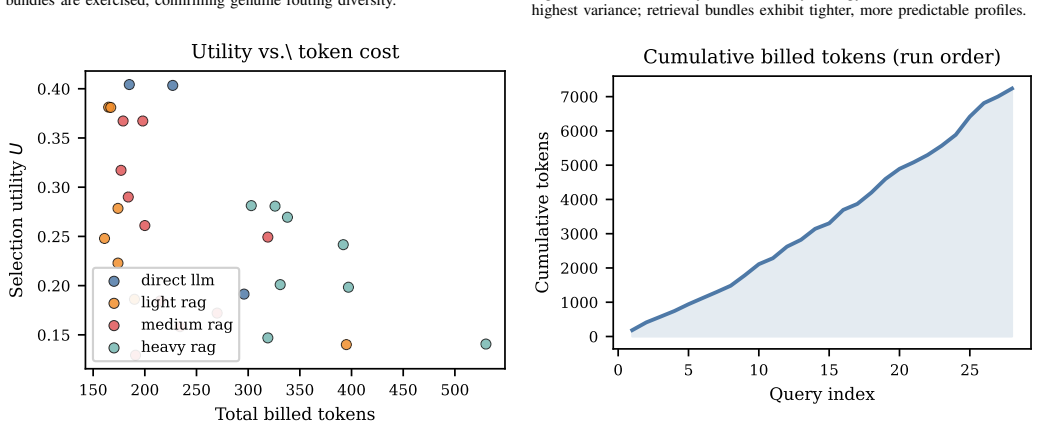
Summary. The paper proposes CA-RAG, a per-query router that selects among four discrete strategy bundles (direct_llm, light_rag, medium_rag, heavy_rag) by maximizing a linear utility (Eq. 1) that combines a hand-specified quality prior with normalized latency and billed-token penalties. Implemented with FAISS dense retrieval and OpenAI APIs, it is evaluated on a 28-query / 15-passage micro-benchmark. The headline result (abstract, Table III) is that the default router uses 26.4% fewer billed tokens than fixed-heavy retrieval and 34.3% lower mean latency than fixed-direct inference while keeping a lexical quality proxy essentially unchanged (0.80 vs 0.81). Supporting analyses cover strategy mix, token decomposition, weight sensitivity, and per-query deltas, all regenerated from logged CSVs.
Significance. If the joint cost–latency–quality claim holds under stronger evaluation, the paper would supply a practical, auditable template for production RAG routing: discrete bundles, explicit utility weights as operator levers, and full token accounting including query embeddings. Strengths that already stand are the transparent utility formulation, complete billing model (Eq. 2), weight-sensitivity demonstration that the same catalog supports multiple operating points, and end-to-end reproducibility from CSV artifacts and CLI commands. Even with the current micro-benchmark, the work is a useful systems-style characterization of retrieval-depth tradeoffs rather than a new retriever architecture. The main significance risk is that the quality-parity half of the claim is not yet measured at a standard that would support the abstract’s joint assertion.
major comments (4)
- [Abstract, Table III, §V.C Eq. (1), Table I, §IX] Abstract and Table III assert “equivalent answer quality” (router 0.80 vs fixed-heavy 0.81) as part of the central joint claim. Quality is operationalized only by (i) hand-specified priors in Table I (0.52/0.66/0.74/0.82) that directly drive arg max selection via Eq. (1), and (ii) a post-hoc lexical token-overlap proxy. Lexical overlap cannot detect grounding failures or hallucinations, and on this corpus a fluent parametric answer can score well without retrieval. The Limitations section acknowledges the proxy, yet the headline still treats quality parity as established. Either replace/augment the proxy with a calibrated LLM judge or human ratings on a held-out set, or substantially soften the quality claim so that the paper reports cost/latency savings under a weak proxy rather than “equivalent quality.”
- [§VI.A, Appendices D–E, Figs. 15–17] The evaluation corpus is a 15-sentence self-description of CA-RAG itself, and the 28 questions are author-written about that same text (Appendices D–E, §VI.A). Definitional queries that drive most token savings (Figs. 15–17, Appendix G) are exactly those for which parametric knowledge of the paper’s own terminology yields high lexical overlap without retrieval. This design cannot falsify the claim that shallow or zero retrieval is quality-preserving for the queries that produce the 26% savings. At minimum, re-run or validate on a standard open-domain set (e.g., Natural Questions / HotpotQA subsets) or an external enterprise corpus, and report quality under a non-lexical metric; otherwise scope all quality statements strictly to this micro-benchmark.
- [Table III, Table V, §IX] With n=28 and high per-query variance (Table V: latency std 1675 ms on mean 2512 ms; cost std 94.5 on mean 258.5), aggregate percentages in the abstract and Table III lack uncertainty quantification. No bootstrap CIs, paired tests, or leave-one-out stability are reported, despite the Limitations section noting that “bootstrap confidence intervals and paired significance tests are warranted.” For a load-bearing 26%/34% claim, add at least paired bootstrap intervals on cost and latency deltas vs fixed-heavy and fixed-direct, and report whether quality-proxy differences are distinguishable from noise.
- [§V.A, Table I, Table VII, Fig. 9] Heuristic complexity c(q) (§V.A) correlates only weakly with billed tokens (r≈0.21–0.22, Table VII / Fig. 9), yet it modulates quality priors and is presented as the main query signal. The paper correctly flags this as a limitation, but the routing story still depends on these free parameters (α, β, Lmax, Kmax) plus the four quality/latency priors. A short ablation—routing with complexity disabled, or with priors set equal—would show how much of the strategy mix and savings is driven by the hand-tuned prior table versus the complexity signal. Without that, it is hard to separate the contribution of the utility framework from prior engineering on this specific 28-query set.
minor comments (5)
- [§VII.D, Table VII] Table VII reports cost–latency r=0.66 and cost–utility r=−0.50, while the prose in §VII.D cites r=0.41 and r=−0.38. Align the text with the table or explain the discrepancy.
- [§VII.B, Fig. 3, Fig. 5] Fig. 3’s claim that direct_llm has the highest latency variance is interesting; a one-sentence note on completion-length statistics (or a small table of mean completion tokens by strategy) would make the explanation fully checkable against Fig. 5.
- [§II] Related work on adaptive retrieval / query routing (beyond bandits) is thin; a short comparison to recent adaptive-RAG or cascade/router papers would help position the discrete-bundle contribution.
- [§V.C Eq. (1)] Notation: ˆLnorm and ˆCnorm are said to be normalized to [0,1] across B, but the exact min–max or z-score procedure is not stated; one sentence would remove ambiguity for reimplementation.
- [§VII.G, Appendix G] Appendix G strategy assignments are useful; cross-referencing a few of them in the per-query delta discussion would help readers map savings to query types without flipping to the appendix.
Circularity Check
No load-bearing circular derivation; empirical token/latency deltas are measured independently of hand-specified priors.
full rationale
CA-RAG is an empirical systems paper, not a first-principles derivation. Bundle selection maximizes the scalar utility of Eq. (1) that combines hand-specified quality/latency/cost priors (Table I) with operator weights; after execution the paper simply logs observed billed tokens (Eq. 2), wall-clock latency, and a separate lexical token-overlap quality proxy, then aggregates them into Table III. Realized utility is post-hoc telemetry substitution, not a forced prediction. No parameters are fitted to the evaluation metrics and then re-reported as predictions; no uniqueness theorems or self-citations underwrite the central 26%/34% claims; the four bundles and the 28-query CSV logs are independent of one another once the priors are fixed. The self-describing 15-sentence corpus (Appendix E) and author-written questions constitute a validity/generalization limitation (explicitly noted in §IX), not a mathematical reduction of the reported deltas to their inputs by construction. Consequently the derivation chain contains no circular step of the kinds enumerated.
Assumptions & free parameters
free parameters (4)
- utility weights (wQ, wL, wC) =
default (0.6, 0.2, 0.2)
- quality priors per bundle =
0.52, 0.66, 0.74, 0.82
- latency priors (ms) =
8, 45, 60, 95
- complexity heuristic coefficients α, β, Lmax, Kmax =
α=0.6, β=0.4, Lmax=20, Kmax=3
assumptions (4)
- domain assumption Linear scalarization of estimated quality, normalized latency and normalized token cost is an adequate decision rule for per-query retrieval-depth selection.
- ad hoc to paper Lexical token-overlap against a reference is a sufficient proxy for answer quality when claiming 'equivalent quality'.
- ad hoc to paper A 15-sentence self-describing corpus and 28 author-written queries isolate routing behavior without corpus-scale confounds.
- domain assumption Four discrete retrieval depths (k=0,3,5,10) with a shared generation profile span the relevant operating surface.
invented entities (2)
-
strategy bundle catalog (direct_llm / light_rag / medium_rag / heavy_rag)
-
heuristic complexity score c(q)
Cite this review
Pith. "Pith review of Cost-Aware Query Routing in RAG: Empirical Analysis of Retrieval Depth Tradeoffs." pith.science (2026). https://pith.science/paper/O5SRPBHE
@misc{pith2026260602581,
  author       = {Pith},
  title        = {Pith review of: Cost-Aware Query Routing in RAG: Empirical Analysis of Retrieval Depth Tradeoffs},
  year         = {2026},
  howpublished = {\url{https://pith.science/paper/O5SRPBHE}},
  note         = {Machine review of arXiv:2606.02581}
}
abstract
Retrieval-augmented generation (RAG) faces a fundamental three-way tension: deeper retrieval improves factual grounding but inflates token costs and end-to-end latency. Static retrieval configurations cannot resolve this tension across heterogeneous query workloads -- simple definitional queries waste budget on unnecessary context, while complex analytical prompts are underserved by shallow retrieval. This paper introduces \emph{Cost-Aware RAG} (CA-RAG), a per-query routing framework that selects from a discrete catalog of \emph{strategy bundles} -- each coupling a retrieval depth (from retrieval-free direct inference to top-$k{=}10$ dense retrieval) with a fixed generation profile -- by maximizing a scalar utility that linearly combines an estimated quality prior with normalized penalties for predicted latency and total billed tokens. CA-RAG is implemented with FAISS-backed dense retrieval and OpenAI chat/embedding APIs, and evaluated on a 28-query benchmark spanning four bundles. The router dynamically exercises all bundles, achieving \textbf{26\% fewer billed tokens} than always-heavy retrieval and \textbf{34\% lower mean latency} than always-direct inference while maintaining equivalent answer quality. Per-query delta analysis reveals that savings are non-uniform and concentrated in simpler queries, motivating complexity-aware guardrails. Sensitivity analysis confirms that the same bundle catalog supports multiple cost-latency-quality operating points through weight adjustment alone. All results are generated directly from logged CSV artifacts for full reproducibility. CA-RAG provides a transparent, auditable foundation for cost-conscious LLM deployments.
Figures


Figures from the paper (7 more)


Reference graph
Works this paper leans on
-
[1]
Retrieval- augmented generation for knowledge-intensive NLP tasks,
P. Lewis, E. Perez, A. Piktus, F. Petroni, V . Karpukhin, N. Goyal, H. K ¨uttler, M. Lewis, W.-t. Yih, T. Rockt ¨aschelet al., “Retrieval- augmented generation for knowledge-intensive NLP tasks,” inAdvances in Neural Information Processing Systems (NeurIPS), vol. 33, 2020, pp. 9459–9474
2020
-
[2]
Retrieval-augmented generation for large language models: A survey,
Y . Gao, Y . Xiong, X. Gao, J. Jia, J. Pan, Y . Bi, Y . Dai, J. Sun, and H. Wang, “Retrieval-augmented generation for large language models: A survey,”arXiv preprint arXiv:2312.10997, 2023
arXiv 2023
-
[3]
Leveraging passage retrieval with gener- ative models for open domain question answering,
G. Izacard and E. Grave, “Leveraging passage retrieval with gener- ative models for open domain question answering,”arXiv preprint arXiv:2007.01282, 2021
arXiv 2007
-
[4]
OpenAI, “GPT-4 technical report,”arXiv preprint arXiv:2303.08774, 2024
arXiv 2024
-
[5]
Dense passage retrieval for open-domain question an- swering,
V . Karpukhin, B. Oguz, S. Min, P. Lewis, L. Wu, S. Edunov, D. Chen, and W.-t. Yih, “Dense passage retrieval for open-domain question an- swering,” inProceedings of the 2020 Conference on Empirical Methods in Natural Language Processing (EMNLP), 2020, pp. 6769–6781
2020
-
[6]
ColBERT: Efficient and effective passage search via contextualized late interaction over BERT,
O. Khattab and M. Zaharia, “ColBERT: Efficient and effective passage search via contextualized late interaction over BERT,” inProceedings of the 43rd International ACM SIGIR Conference on Research and Development in Information Retrieval, 2020, pp. 39–48
2020
-
[7]
REALM: Retrieval-augmented language model pre-training,
K. Guu, K. Lee, Z. Tung, P. Pasupat, and M. Chang, “REALM: Retrieval-augmented language model pre-training,” inProceedings of the 37th International Conference on Machine Learning (ICML), 2020, pp. 3929–3938
2020
-
[8]
The probabilistic relevance framework: BM25 and beyond,
S. Robertson and H. Zaragoza, “The probabilistic relevance framework: BM25 and beyond,”Foundations and Trends in Information Retrieval, vol. 3, no. 4, pp. 333–389, 2009
2009
Show all 44 references
-
[9]
Billion-scale similarity search with GPUs,
J. Johnson, M. Douze, and H. J ´egou, “Billion-scale similarity search with GPUs,”IEEE Transactions on Big Data, vol. 7, no. 3, pp. 535– 547, 2021
2021
-
[10]
A contextual-bandit approach to personalized news article recommendation,
L. Li, W. Chu, J. Langford, and R. E. Schapire, “A contextual-bandit approach to personalized news article recommendation,” inProceedings of the 19th International Conference on World Wide Web (WWW), 2010, pp. 661–670
2010
-
[11]
Lattimore and C
T. Lattimore and C. Szepesv ´ari,Bandit Algorithms. Cambridge University Press, 2020. APPENDIXA ALGORITHMICSUMMARY CA-RAG routing is summarized as a discrete utility-maximization procedure:
2020
-
[12]
Compute query signalss←signals(q)and complexityc∈[0,1]
-
[13]
For each bundleb∈ B, compute estimated utilityU b via Eq. (1)
-
[14]
Selectb ∗ = arg maxb Ub (optionally withϵ-greedy exploration)
-
[15]
Retrieve contextCusing the retrieval specification ofb ∗; generate answerausing the shared generation spec
-
[16]
quality” and “utility
Log(τ billed,latency,quality proxy, ˜U); optionally update telemetry priors. APPENDIXB THREATS TOVALIDITY Internal validity.API timing variance introduces noise in latency measurements. The lexical quality proxy is a weak surrogate for true answer quality; results may differ u...
-
[17]
What is RAG? => direct_llm
-
[18]
Why is token cost important? => direct_llm
-
[19]
How does latency affect AI systems? => light_rag
-
[20]
What is adaptive retrieval? => light_rag
-
[21]
=> medium_rag
Explain cost-aware AI systems. => medium_rag
-
[22]
What is hybrid retrieval? => medium_rag
-
[23]
=> medium_rag
Define utility-based routing. => medium_rag
-
[24]
What is FAISS used for? => heavy_rag
-
[25]
How do strategy bundles work in CA-RAG? => heavy_rag
-
[26]
What is retrieval confidence? => medium_rag
-
[27]
heavy retrieval => medium_rag
Compare light vs. heavy retrieval => medium_rag
-
[28]
Explain how telemetry refines routing estimates => light_rag
-
[29]
Why might a system skip retrieval? => heavy_rag
-
[30]
List tradeoffs between large/small top-k => medium_rag
-
[31]
How do embedding tokens differ from completion? => medium_rag
-
[32]
Describe a municipal RAG use case => medium_rag
-
[33]
What are risks of fixed retrieval depth? => medium_rag
-
[34]
How does CA-RAG combine quality/latency/cost? => heavy_rag
-
[35]
Explain when reranking is worth extra latency => medium_rag
-
[36]
Derive intuitive explanation of discrete bundles=> direct_llm
-
[37]
What operational metrics should teams report? => heavy_rag
-
[38]
How does query length influence complexity? => medium_rag
-
[39]
retrieval-grounded answers => medium_rag
Contrast direct vs. retrieval-grounded answers => medium_rag
-
[40]
Limitations of lexical quality proxies? => medium_rag
-
[41]
How to tune weights for latency-sensitive chat? => medium_rag
-
[42]
Describe experiment protocol for token logging => medium_rag
-
[43]
Role of exploration epsilon in bundle selection => light_rag
-
[44]
Explain RAG for knowledge-intensive tasks => medium_rag APPENDIXH SAMPLECSV ROWS query,strategy,cost,latency,utility,quality_proxy,realized_utility What is RAG?,direct_llm,185,4051.1,0.4043,0.55,-1.2461 How does latency affect AI systems?,light_rag,165,2850.3,0.3813,0.64,-0.35...
Reviewed July 13, 2026 · model on record in the stance chip above.
Discussion (0). Continue with ORCID to comment.