Sensitivity Enhancement of S-Band Rydberg Atom Microwave Receiver Using Resonant Cavity
Pith reviewed 2026-06-28 11:49 UTC · model grok-4.3
The pith
Horn antenna with resonant cavity enhances Rydberg microwave receiver sensitivity by 17.9 dB
A machine-rendered reading of the paper's core claim, the machinery that carries it, and where it could break.
Core claim
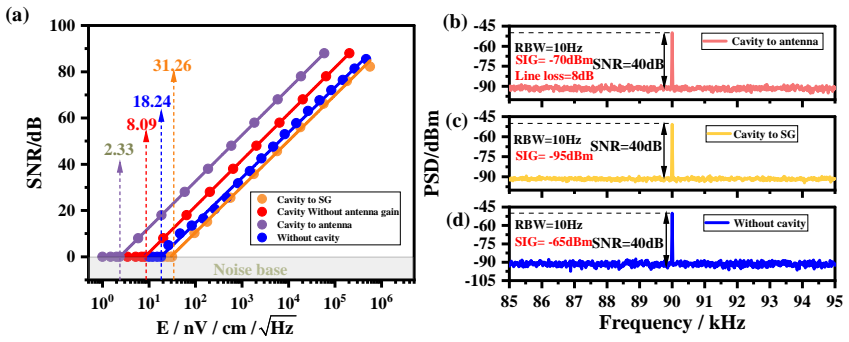
In the antenna-coupled cavity configuration, we achieve an optimal sensitivity of 2.33 nV/cm/√Hz at the receiving antenna, which corresponds to an enhancement of approximately 17.9 dB compared to the optimized bare vapor cell configuration.
What carries the argument
Resonant microwave cavity integrated with horn antenna for improved coupling of free-space S-band signals to Rydberg atoms in cesium vapor cell
If this is right
- Facilitates adoption of Rydberg sensors in real-world microwave metrology.
- Enables reliable detection of weak free-space electric fields in wireless communication.
- Provides a practical method to boost sensitivity of room-temperature Rydberg atomic sensors.
Where Pith is reading between the lines
- The cavity-antenna approach may extend to other frequency bands if similar resonant designs can be realized.
- Further gains might come from optimizing cavity Q-factor or combining with different atom excitation paths.
- This integration could reduce required transmit power in calibration setups for atomic sensors.
Load-bearing premise
The horn antenna captures free-space microwave signals over a 1 m distance without significant loss or interference and the cavity integration improves coupling without introducing new noise sources or distortions in the measurement.
What would settle it
A direct comparison showing no proportional increase in electric field strength at the vapor cell or an equivalent rise in noise when using the antenna-coupled cavity versus the bare cell under the same free-space conditions.
Figures
read the original abstract
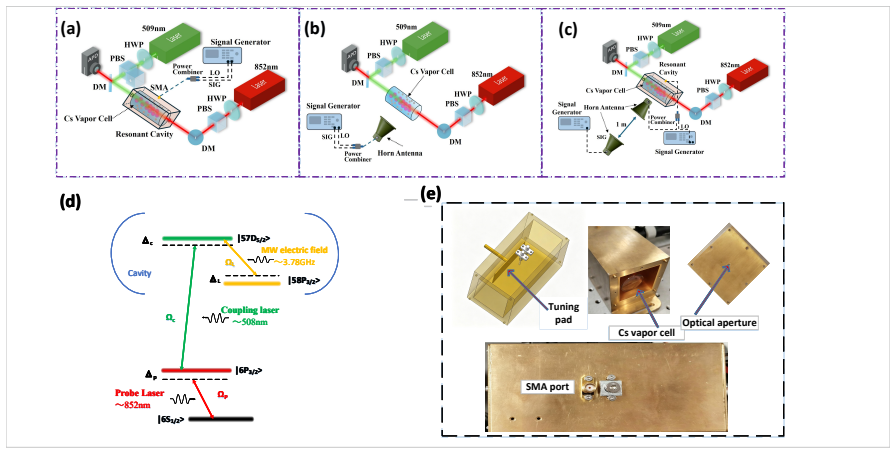
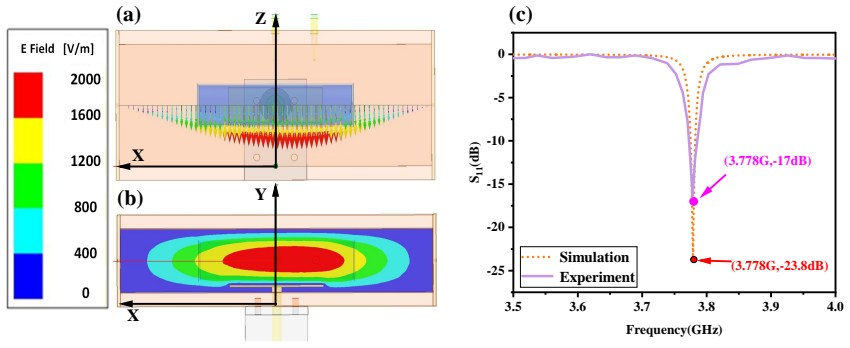
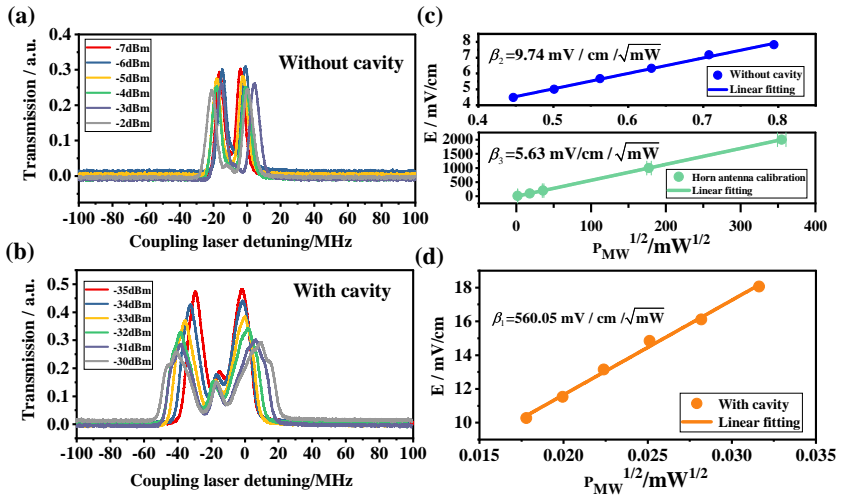
Rydberg atom-based microwave electric field sensing has attracted growing interest owing to its inherent advantages, such as absolute calibration, wideband operability, and compatibility with room-temperature devices. A critical bottleneck that limits sensitivity is the inefficient coupling between the Rydberg atoms and the incident microwave field, particularly when detecting weak signals propagating in free space. Here we propose and experimentally validate a scheme that integrates a horn antenna with a resonant microwave cavity to significantly improve this coupling for free-space signal reception in the S-band. Using a two-photon excitation scheme in a cesium vapor cell, we systematically characterize the sensing performance under three configurations: a bare cell, direct cavity injection, and a cavity coupled to a horn antenna that captures free-space microwave signals over a 1 m distance. In the antenna-coupled cavity configuration, we achieve an optimal sensitivity of 2.33 nV/cm/$\sqrt{\text{Hz}}$ at the receiving antenna, which corresponds to an enhancement of approximately 17.9 dB compared to the optimized bare vapor cell configuration. Our findings offer a practical and effective route to boost the sensitivity of Rydberg atomic sensors, facilitating their adoption in real-world microwave metrology and wireless communication applications where weak free-space electric fields must be reliably measured.
Editorial analysis
A structured set of objections, weighed in public.
Referee Report
Summary. The manuscript experimentally demonstrates sensitivity enhancement for S-band Rydberg-atom microwave sensing by coupling a horn antenna to a resonant cavity. Using two-photon excitation in a cesium vapor cell, the authors compare bare-cell, direct-cavity, and antenna-coupled-cavity configurations and report an optimal sensitivity of 2.33 nV/cm/√Hz (at the receiving antenna) with a claimed 17.9 dB improvement over the optimized bare-cell case.
Significance. If the reported field calibration and enhancement factor are independently verified, the work provides a practical route to improve coupling efficiency for free-space Rydberg receivers, which is relevant for metrology and communications applications. The multi-configuration experimental design is a positive feature.
major comments (2)
- [Abstract] Abstract: the central 17.9 dB enhancement claim equates the quoted sensitivity (2.33 nV/cm/√Hz at the receiving antenna) to an improvement over the bare cell. This numerical factor implicitly requires a calibrated conversion from horn input power to the microwave field amplitude experienced by the atoms, including free-space path loss over 1 m, horn-to-cavity coupling efficiency, cavity mode volume, and atom participation factor. No indication is given that an independent field probe or transmission measurement was used to close this loop.
- [Abstract] The abstract states specific sensitivity values without reference to error bars, statistical uncertainty, or the full experimental protocol (e.g., how the E-field amplitude was extracted from the Rydberg EIT spectrum in each configuration). This limits assessment of whether the reported enhancement is load-bearing or could arise from unaccounted systematics.
minor comments (1)
- Clarify the exact definition of 'at the receiving antenna' versus 'inside the cavity' when quoting sensitivity figures.
Simulated Author's Rebuttal
We thank the referee for their constructive comments on our manuscript. We address each major comment point by point below, agreeing where clarification is needed and outlining the revisions we will make.
read point-by-point responses
-
Referee: [Abstract] Abstract: the central 17.9 dB enhancement claim equates the quoted sensitivity (2.33 nV/cm/√Hz at the receiving antenna) to an improvement over the bare cell. This numerical factor implicitly requires a calibrated conversion from horn input power to the microwave field amplitude experienced by the atoms, including free-space path loss over 1 m, horn-to-cavity coupling efficiency, cavity mode volume, and atom participation factor. No indication is given that an independent field probe or transmission measurement was used to close this loop.
Authors: We acknowledge that a quantitative enhancement claim requires explicit accounting of all relevant factors. In the work, the microwave field amplitude at the atoms is obtained directly from the Autler-Townes splitting observed in the Rydberg EIT spectra for each configuration, providing an absolute, configuration-independent calibration. The sensitivity quoted at the receiving antenna is obtained by referring the minimum detectable atomic field back through the measured cavity enhancement (determined from the ratio of EIT responses in the direct-cavity and antenna-coupled cases) and the known 1 m free-space path loss between horn and cavity. No separate external field probe was used; the atomic sensor itself serves as the primary calibrator. To make this procedure transparent in the abstract, we will add a concise clause stating that the enhancement is derived from direct EIT-based field measurements across configurations. revision: yes
-
Referee: [Abstract] The abstract states specific sensitivity values without reference to error bars, statistical uncertainty, or the full experimental protocol (e.g., how the E-field amplitude was extracted from the Rydberg EIT spectrum in each configuration). This limits assessment of whether the reported enhancement is load-bearing or could arise from unaccounted systematics.
Authors: We agree that the abstract would be improved by indicating how the quoted values were obtained and that uncertainties exist. The E-field amplitude is extracted from the frequency splitting in the EIT spectra using the known transition dipole moments of the cesium Rydberg states; the sensitivity is set by the noise floor in the probe transmission after averaging. Statistical uncertainties (typically ~15 %) are evaluated from repeated spectral acquisitions and are reported in the main text. Because an abstract has strict length limits, we will insert a brief qualifier such as “determined from EIT spectral fits with statistical uncertainties” and will ensure the methods section provides the complete extraction protocol for all three configurations so that readers can assess possible systematics. revision: partial
Circularity Check
No circularity: experimental comparison of measured sensitivities
full rationale
The paper is an experimental report comparing three hardware configurations (bare cell, direct cavity injection, antenna-coupled cavity) and reporting measured sensitivities. The 2.33 nV/cm/√Hz value and the 17.9 dB ratio are direct experimental outcomes, not predictions derived from equations or fitted parameters that reduce to the inputs by construction. No self-citation load-bearing steps, uniqueness theorems, or ansatzes appear in the provided text. The derivation chain is absent; the work is self-contained against external benchmarks via direct measurement.
Axiom & Free-Parameter Ledger
axioms (1)
- domain assumption Two-photon excitation scheme in cesium vapor cell functions as described for Rydberg state preparation.
Reference graph
Works this paper leans on
-
[1]
Rappaport, Shu Sun, Rimma Mayzus, Hang Zhao, Yaniv Azar, Kevin Wang, George N
Theodore S. Rappaport, Shu Sun, Rimma Mayzus, Hang Zhao, Yaniv Azar, Kevin Wang, George N. Wong, Jocelyn K. Schulz, Mathew Samimi, and Felix Gutierrez. Millimeter wave mobile communications for 5g cellular: It will work! IEEE ACCESS , 1:335–349, 2013
2013
-
[2]
A vision of 6g wireless systems: Applications, trends, technologies, and open research problems
Walid Saad, Mehdi Bennis, and Mingzhe Chen. A vision of 6g wireless systems: Applications, trends, technologies, and open research problems. IEEE NETWORK , 34(3):134–142, MAY-JUN 2020
2020
-
[3]
A sentinel-1 sar-based global 1-km resolution soil moisture data product: Algorithm and preliminary assess- ment
Dong Fan, Tianjie Zhao, Xiaoguang Jiang, Almudena Garcia-Garcia, Toni Schmidt, Luis Samaniego, Sabine Attinger, Hua Wu, Yazhen Jiang, Jiancheng Shi, Lei Fan, Bo-Hui Tang, Wolfgang Wagner, Wouter Dorigo, Alexander Gruber, Francesco Mattia, Anna Balenzano, Luca Brocca, Thomas Jagdhuber, Jean-Pierre Wigneron, Carsten Montzka, and Jian Peng. A sentinel-1 sar-...
2025
-
[4]
Carbon- based materials for radar-infrared compatible stealth technology
Xin Tan, Weihua Gu, Zhe Tao, Xiangling Chen, Siyuan Li, Ailin Xia, and Guangbin Ji. Carbon- based materials for radar-infrared compatible stealth technology. CHEMICAL ENGINEERING JOURNAL, 507, MAR 1 2025
2025
-
[5]
Alvarez, Luca Brocca, Shuohao Cai, Rui Cheng, Xinghua Cheng, Jinyang Du, Bassil El Masri, K
Jingyi Huang, Vinit Sehgal, Laura V. Alvarez, Luca Brocca, Shuohao Cai, Rui Cheng, Xinghua Cheng, Jinyang Du, Bassil El Masri, K. Arthur Endsley, Yilin Fang, Jie Hu, Mahesh Jampani, Md Golam Kibria, Gerbrand Koren, Lingcheng Li, Laibao Liu, Jiafu Mao, Hernan A. Moreno, Angela Rigden, Mingjie Shi, Xiaoying Shi, Yaoping Wang, Xi Zhang, and Joshua B. Fisher....
2025
-
[6]
A chip-integrated comb-based microwave oscillator
Wei Sun, Zhiyang Chen, Linze Li, Chen Shen, Kunpeng Yu, Shichang Li, Jinbao Long, Huamin Zheng, Luyu Wang, Tianyu Long, Qiushi Chen, Zhouze Zhang, Baoqi Shi, Lan Gao, Yi-Han Luo, Baile Chen, and Junqiu Liu. A chip-integrated comb-based microwave oscillator. LIGHT- SCIENCE & APPLICATIONS , 14(1), APR 30 2025
2025
-
[7]
Robinson, Nikunjkumar Prajapati, Damir Senic, Matthew T
Amy K. Robinson, Nikunjkumar Prajapati, Damir Senic, Matthew T. Simons, and Christopher L. Holloway. Determining the angle-of-arrival of a radio-frequency source with a rydberg atom-based sensor. APPLIED PHYSICS LETTERS , 118(11), MAR 15 2021. 9
2021
-
[8]
Holloway, Matthew T
Christopher L. Holloway, Matthew T. Simons, Joshua A. Gordon, and David Novotny. Detecting and receiving phase-modulated signals with a rydberg atom-based receiver. IEEE ANTENNAS AND WIRELESS PROPAGATION LETTERS , 18(9):1853–1857, SEP 2019
2019
-
[9]
real-time
Christopher L. Holloway, Matthew T. Simons, Abdulaziz H. Haddab, Carl J. Williams, and Maxwell W. Holloway. A “real-time” guitar recording using rydberg atoms and electromagneti- cally induced transparency: Quantum physics meets music. AIP ADV ANCES, 9(6), JUN 2019
2019
-
[10]
Atom- based receiver for amplitude-modulated baseband signals in high-frequency radio communication
Yuechun Jiao, Xiaoxuan Han, Jiabei Fan, Georg Raithel, Jianming Zhao, and Suotang Jia. Atom- based receiver for amplitude-modulated baseband signals in high-frequency radio communication. APPLIED PHYSICS EXPRESS , 12(12), DEC 1 2019
2019
-
[11]
Meyer, Kevin C
David H. Meyer, Kevin C. Cox, Fredrik K. Fatemi, and Paul D. Kunz. Digital communication with rydberg atoms and amplitude-modulated microwave fields. APPLIED PHYSICS LETTERS , 112(21), MAY 21 2018
2018
-
[12]
Rotunno, Alexandra B
Noah Schlossberger, Nikunjkumar Prajapati, Samuel Berweger, Andrew P. Rotunno, Alexandra B. Artusio-Glimpse, Matthew T. Simons, Abrar A. Sheikh, Eric B. Norrgard, Stephen P. Eckel, and Christopher L. Holloway. Rydberg states of alkali atoms in atomic vapour as si-traceable field probes and communications receivers. NATURE REVIEWS PHYSICS, 6(10):606–620, OCT 2024
2024
-
[13]
Figger, G
H. Figger, G. Leuchs, R. Straubinger, and H. Walther. A photon detector for submillimetre wavelengths using rydberg atoms. Optics Communications , 33(1):37–41, 1980
1980
-
[14]
Robinson, Samuel Berweger, Matthew T
Nikunjkumar Prajapati, Amy K. Robinson, Samuel Berweger, Matthew T. Simons, Alexan- dra B. Artusio-Glimpse, and Christopher L. Holloway. Enhancement of electromagnetically in- duced transparency based rydberg-atom electrometry through population repumping. APPLIED PHYSICS LETTERS , 119(21), NOV 22 2021
2021
-
[15]
Sensitivity improvement and deter- mination of rydberg atom-based microwave sensor
Minghao Cai, Zishan Xu, Shuhang You, and Hongping Liu. Sensitivity improvement and deter- mination of rydberg atom-based microwave sensor. PHOTONICS, 9(4), APR 2022
2022
-
[16]
Continuous wideband microwave-to-optical converter based on room-temperature rydberg atoms
Sebastian Borowka, Uliana Pylypenko, Mateusz Mazelanik, and Michal Parniak. Continuous wideband microwave-to-optical converter based on room-temperature rydberg atoms. NATURE PHOTONICS, 18(1), JAN 2024
2024
-
[17]
Meyer, Paul D
David H. Meyer, Paul D. Kunz, and Kevin C. Cox. Waveguide-coupled rydberg spectrum analyzer from 0 to 20 ghz. PHYSICAL REVIEW APPLIED , 15(1), JAN 27 2021
2021
-
[18]
Local oscillator port embedded field enhancement resonator for rydberg atomic heterodyne technique
Kai Yang, Ruiqi Mao, Li He, Jiawei Yao, Jianbing Li, Zhanshan Sun, and Yunqi Fu. Local oscillator port embedded field enhancement resonator for rydberg atomic heterodyne technique. EPJ QUANTUM TECHNOLOGY , 10(1), DEC 2023
2023
-
[19]
Holloway, Nikunjkumar Prajapati, Alexandra B
Christopher L. Holloway, Nikunjkumar Prajapati, Alexandra B. Artusio-Glimpse, Samuel Berweger, Matthew T. Simons, Yoshiaki Kasahara, Andrea Alu, and Richard W. Ziolkowski. Rydberg atom-based field sensing enhancement using a split-ring resonator. APPLIED PHYSICS LETTERS, 120(20), MAY 16 2022
2022
-
[20]
D. M. Walker, L. L. Brown, and S. D. Hogan. Electrometry of a single resonator mode at a rydberg-atom-superconducting-circuit interface. PHYSICAL REVIEW A , 105(2), FEB 28 2022
2022
-
[21]
S. D. Hogan, J. A. Agner, F. Merkt, T. Thiele, S. Filipp, and A. Wallraff. Driving rydberg-rydberg transitions from a coplanar microwave waveguide. PHYSICAL REVIEW LETTERS , 108(6), FEB 9 2012
2012
-
[22]
A. A. Morgan and S. D. Hogan. Coupling rydberg atoms to microwave fields in a superconducting coplanar waveguide resonator. PHYSICAL REVIEW LETTERS , 124(19), MAY 12 2020
2020
-
[23]
Remote sensing of soil moisture using rydberg atoms and satellite signals of opportunity
Darmindra Arumugam, Jun-Hee Park, Brook Feyissa, Jack Bush, and Srinivas Prasad Mysore Na- garaja. Remote sensing of soil moisture using rydberg atoms and satellite signals of opportunity. SCIENTIFIC REPORTS, 14(1), AUG 4 2024. 10
2024
-
[24]
Satellite microwave detection via cavity-coupled rydberg atomic receiver
Mingwei Lei and Meng Shi. Satellite microwave detection via cavity-coupled rydberg atomic receiver. IEEE Transactions on Quantum Engineering , pages 1–6, 2026
2026
-
[25]
Resonant structures for sensitivity enhancement of rydberg-atom microwave receivers
Georgia Sandidge, Gabriel Santamaria-Botello, Eric Bottomley, Haoquan Fan, and Zoya Popovic. Resonant structures for sensitivity enhancement of rydberg-atom microwave receivers. IEEE TRANSACTIONS ON MICROW A VE THEORY AND TECHNIQUES , 72(4):2057–2066, APR 2024
2057
-
[26]
Cavity-enhanced rydberg atom microwave receiver
Bang Liu, Li-Hua Zhang, Qi-Feng Wang, Yu Ma, Tian-Yu Han, Zong-Kai Liu, Zheng-Yuan Zhang, Shi-Yao Shao, Jun Zhang, Qing Li, Han-Chao Chen, Yu-Long Han, Dong-Sheng Ding, and Bao- Sen Shi. Cavity-enhanced rydberg atom microwave receiver. CHINESE PHYSICS LETTERS , 42(5), MAY 1 2025
2025
-
[27]
Approaching the standard quantum limit of a rydberg- atom microwave electrometer
Hai-Tao Tu, Kai-Yu Liao, Hong-Lei Wang, Yi-Fei Zhu, Si-Yuan Qiu, Hao Jiang, Wei Huang, Wu Bian, Hui Yan, and Shi-Liang Zhu. Approaching the standard quantum limit of a rydberg- atom microwave electrometer. SCIENCE ADV ANCES, 10(51), DEC 20 2024
2024
-
[28]
Sagnac-enhanced rydberg superheterodyne receiver with dual-beam interference
Hongmei Yan, Taisen Gao, Mingyong Jing, Weguang Yang, Hao Zhang, Zongkai Liu, Junyao Xie, Liantuan Xiao, Suotang Jia, and Linjie Zhang. Sagnac-enhanced rydberg superheterodyne receiver with dual-beam interference. CHINESE PHYSICS LETTERS , 42(12), DEC 1 2025
2025
-
[29]
Enhancing sensitivity of atomic microwave receivers based on optimal laser arrays
Bo Wu, Ruiqi Mao, Di Sang, Zhanshan Sun, Yi Liu, Yi Lin, Qiang An, and Yunqi Fu. Enhancing sensitivity of atomic microwave receivers based on optimal laser arrays. IEEE TRANSACTIONS ON ANTENNAS AND PROPAGATION , 73(2):793–806, FEB 2025
2025
-
[30]
Dong-Sheng Ding, Zong-Kai Liu, Bao-Sen Shi, Guang-Can Guo, Klaus Molmer, and Charles S. Adams. Enhanced metrology at the critical point of a many-body rydberg atomic system. NA- TURE PHYSICS , 18(12), DEC 2022
2022
-
[31]
Exceptional point-enhanced rydberg atomic electrometers
Chao Liang, Ce Yang, Wei Huang, and Li You. Exceptional point-enhanced rydberg atomic electrometers. PHYSICAL REVIEW LETTERS , 136(5), FEB 5 2026. 11
2026
discussion (0)
Sign in with ORCID, Apple, or X to comment. Anyone can read and Pith papers without signing in.