NOEMA^rm{3D}: A deep view of cold gas flows in a barred spiral galaxy at zsim1
Pith reviewed 2026-06-28 13:38 UTC · model grok-4.3
The pith
A bar in a z=1.12 spiral galaxy drives molecular gas inflows at 30 solar masses per year, matching the galaxy's star formation rate.
A machine-rendered reading of the paper's core claim, the machinery that carries it, and where it could break.
Core claim
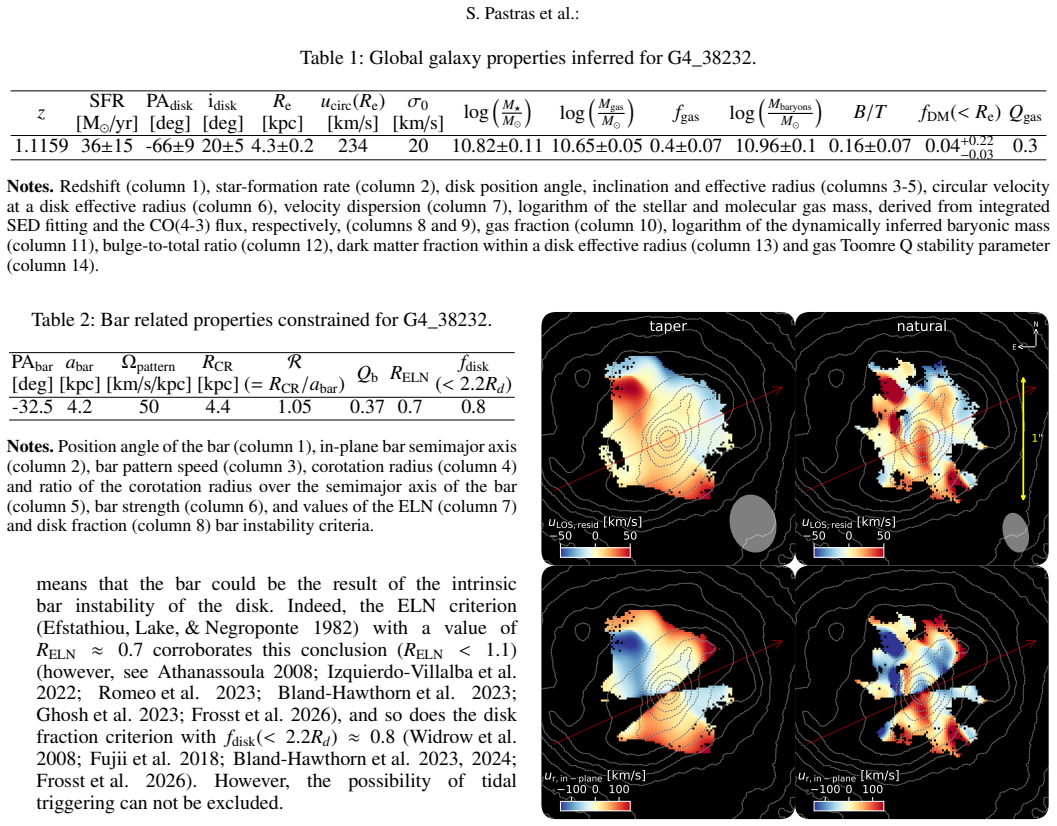
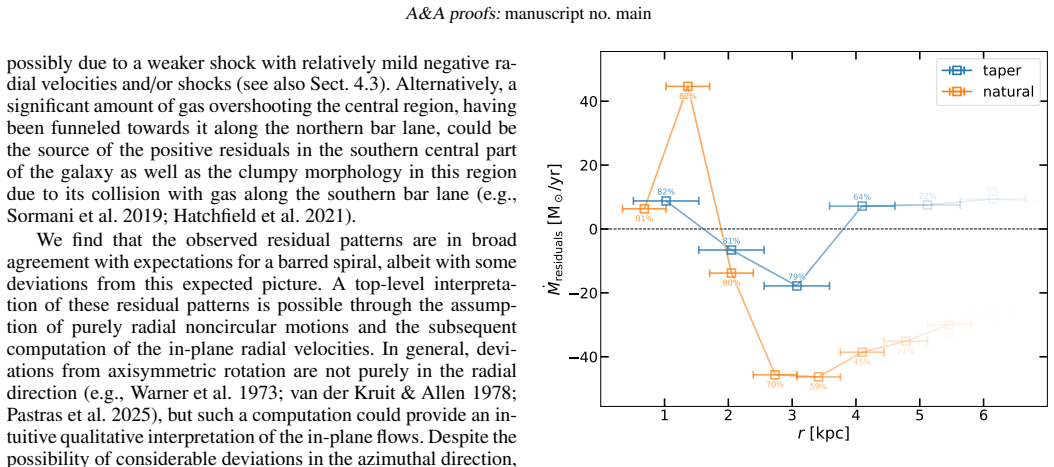
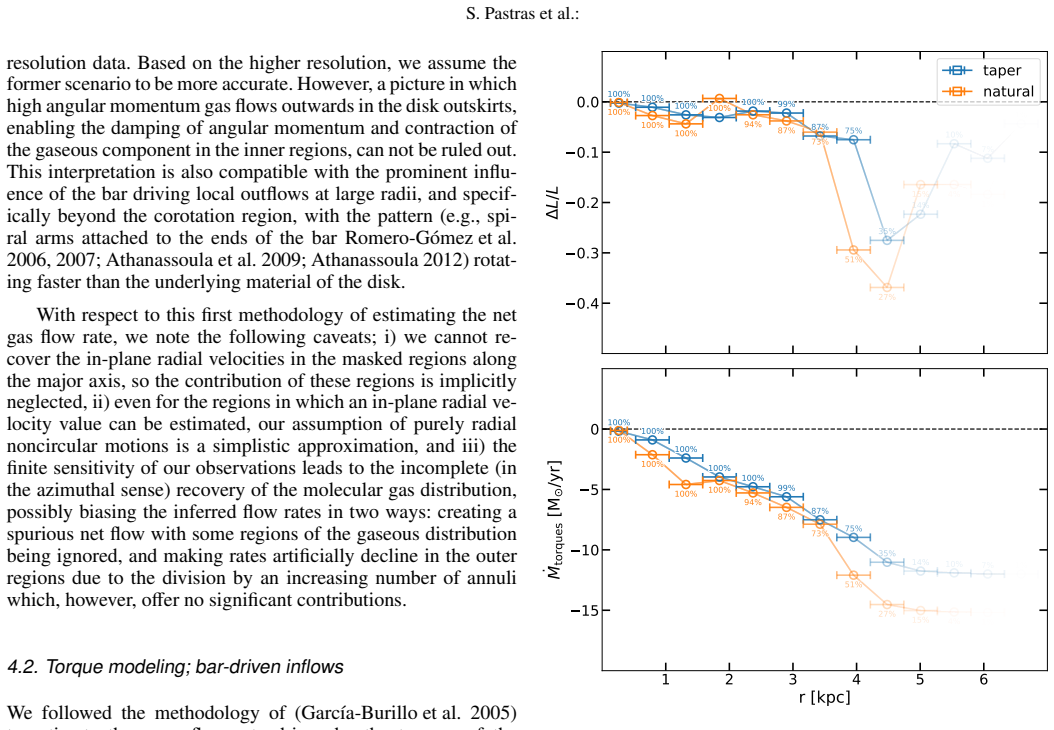
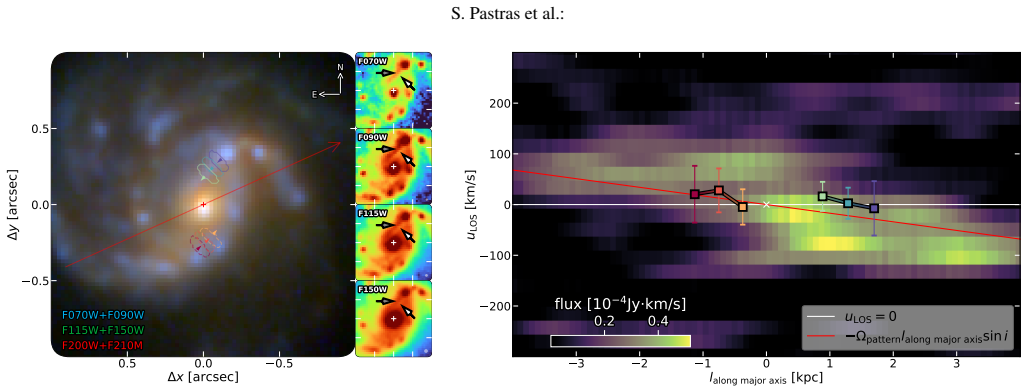
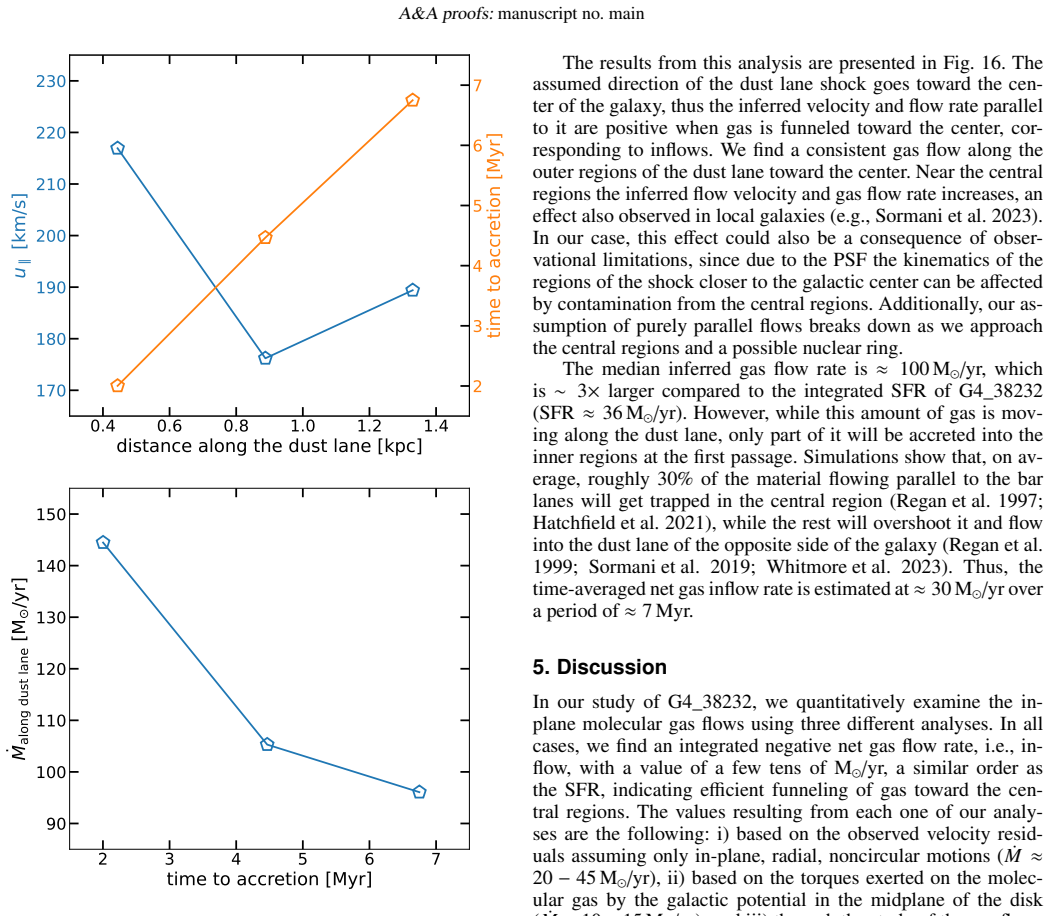
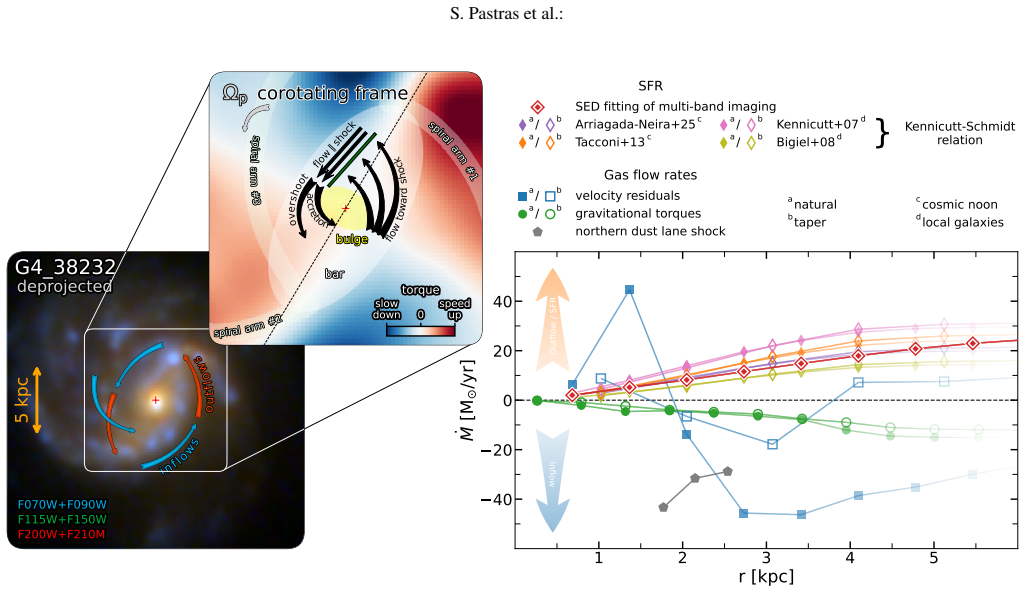
This target is a massive baryon-dominated gas-rich disk hosting a long strong fast bar that rotates at 50 km/s/kpc and drives molecular gas inflows with net rate ~30 M⊙/yr based on three estimates, equal to the SFR of ~36 M⊙/yr, with a well-defined dust lane shock and parallel gas motions confirming bar-driven flow.
What carries the argument
The bar with length 4.2 kpc, strength Qb=0.37, and corotation radius ratio R=1.05, which produces the observed net radial molecular gas inflows and dust lane shock.
If this is right
- Bars can supply gas to maintain star formation rates in massive main-sequence galaxies at cosmic noon.
- Bar-driven inflows of this magnitude may contribute to central mass buildup and bulge growth over time.
- A non-negligible fraction of z~1 galaxies may experience similar bar-driven evolution.
- The low dark matter fraction inside the effective radius indicates the disk is self-gravitating and bar-unstable.
Where Pith is reading between the lines
- If bars are common at this epoch, they could help explain the high gas fractions observed in cosmic noon disks without invoking external accretion alone.
- Detailed kinematic modeling of more high-z barred galaxies would test whether inflow rates systematically match SFRs.
- Comparison with hydrodynamic simulations could reveal how bar pattern speeds and strengths evolve to produce such inflows.
Load-bearing premise
The three inflow rate estimates capture true net radial motion driven by the bar rather than other dynamics or artifacts, and the dust lane is a bar-induced shock.
What would settle it
Higher-resolution kinematic maps showing inflow rates inconsistent across the three methods or gas velocities perpendicular to the dust lane instead of parallel.
Figures
read the original abstract
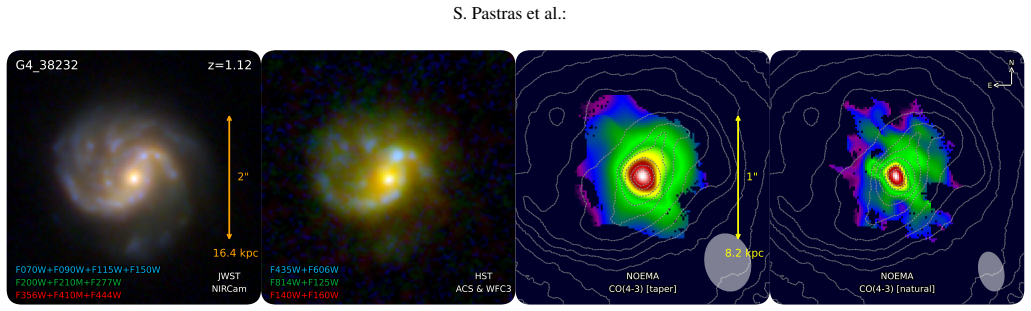
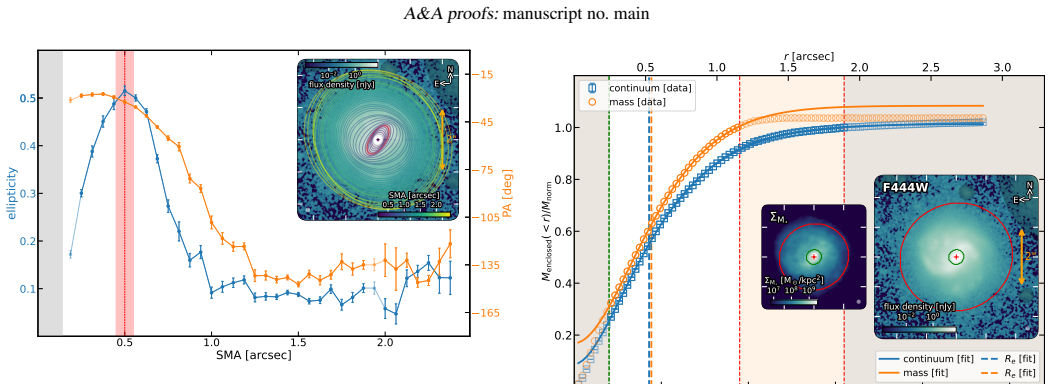
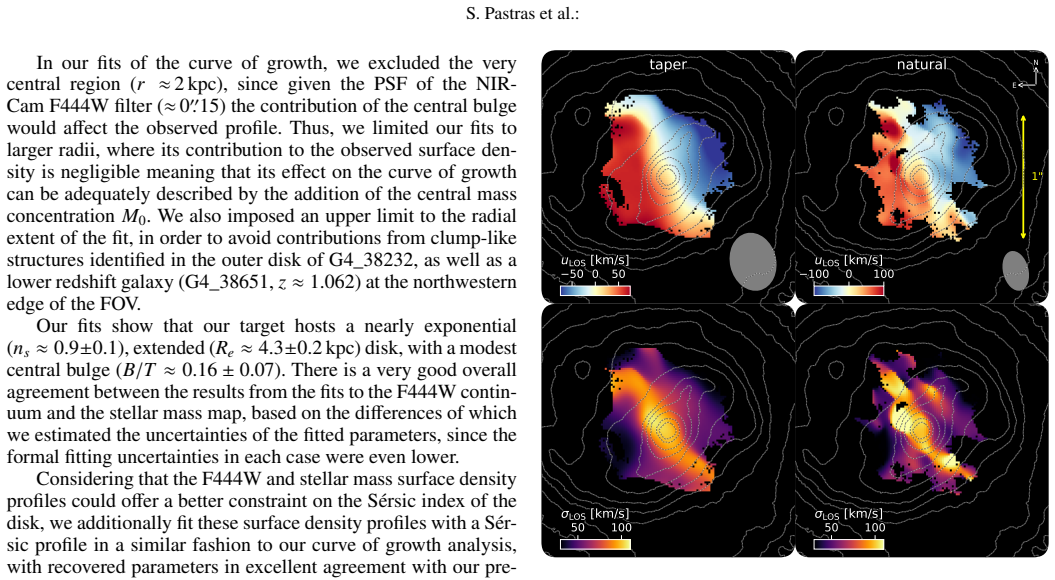
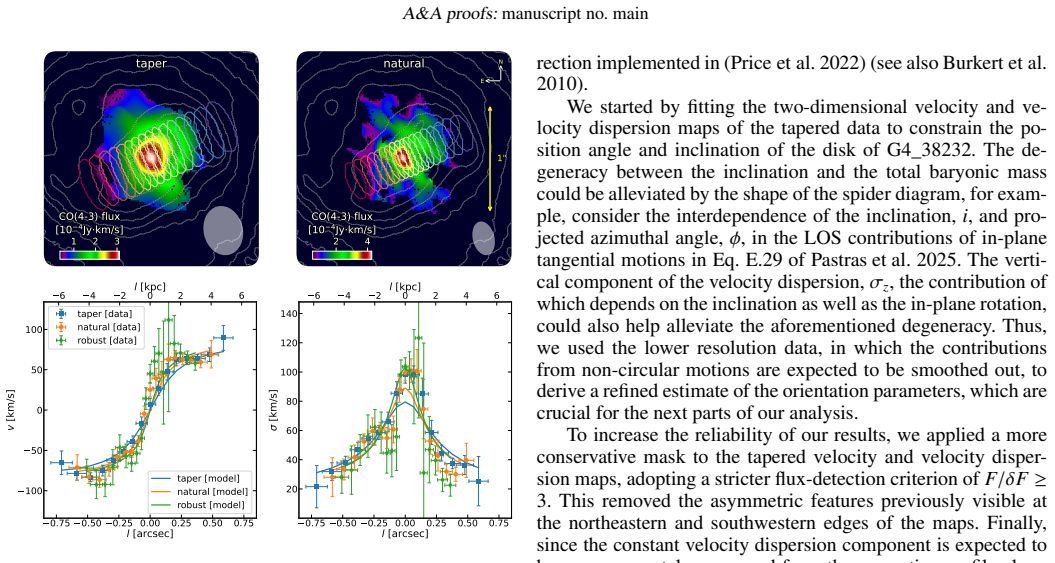
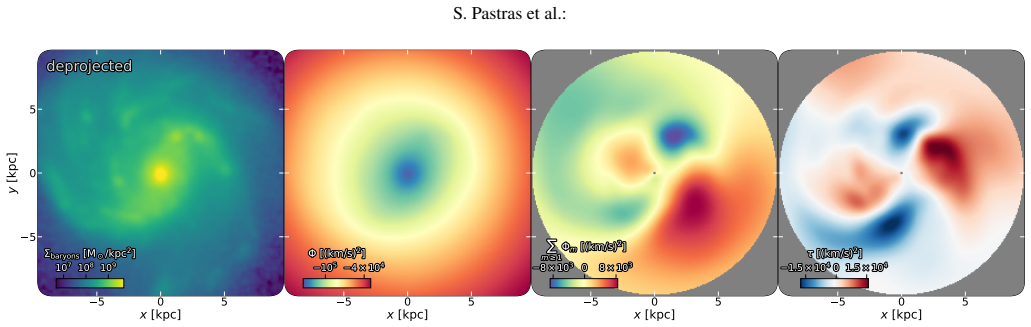
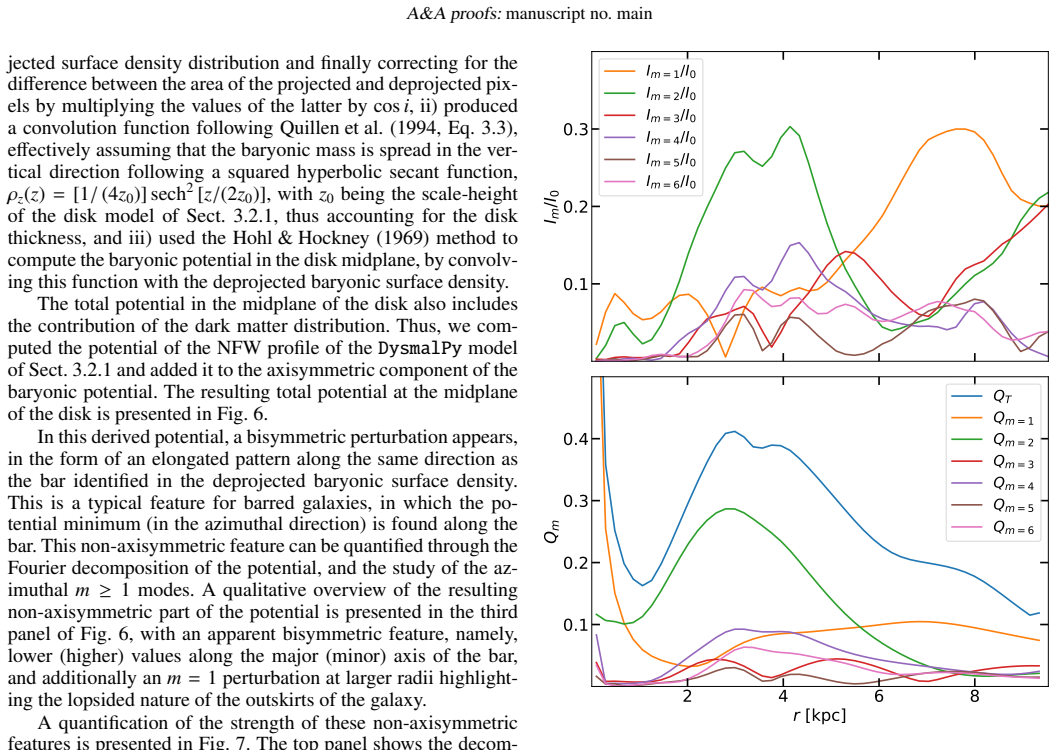
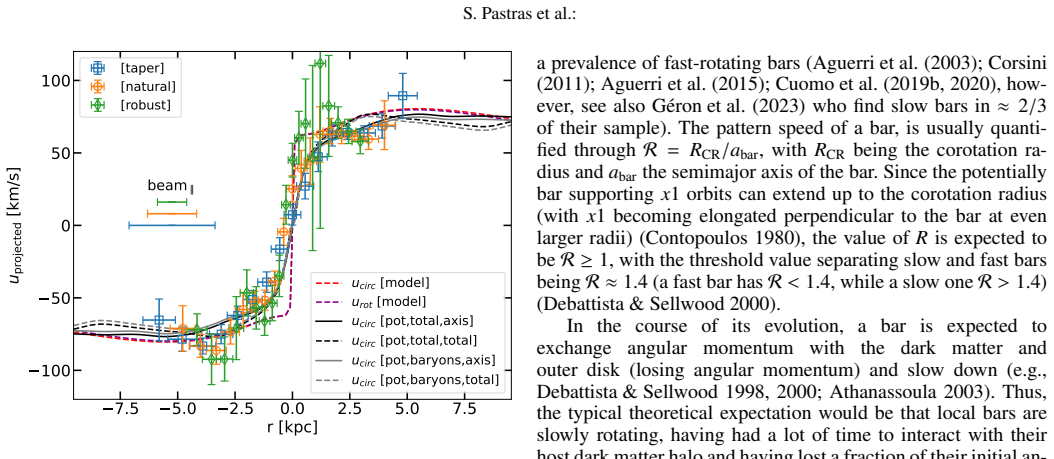
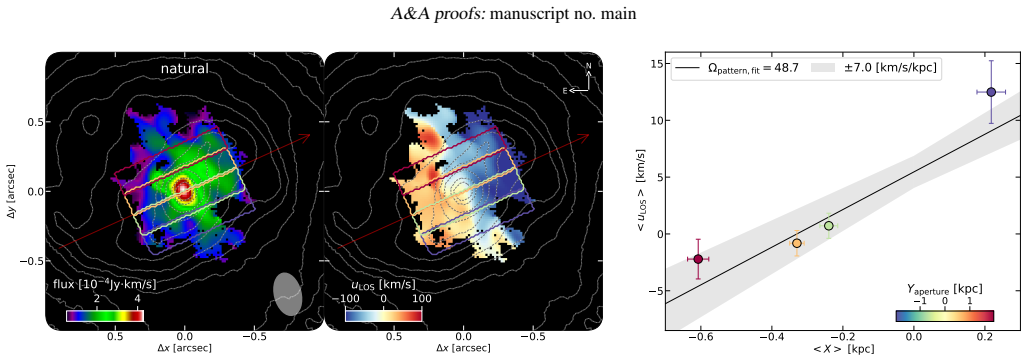
We present a deep, high-resolution CO(4-3) IRAM-NOEMA observation of a main sequence, barred, spiral galaxy at $z\approx1.12$, with an on-source integration time of $\approx37$ hours and a beam FWHM of $\approx0.\!\!^{\prime\prime}3$. We use the molecular gas data in conjunction with the available deep multi-band JWST and HST imaging, covering restframe UV to near-IR wavelengths, to quantitatively study the gas flows in the disk plane of this cosmic noon barred spiral. We find that this target is a massive ($\log(M_{\rm{baryons}}/M_\odot)\approx10.96$), baryon-dominated ($f_{\rm{dm}}(<R_e)=u^2_{\rm{circ,dm}}(R_e)/u^2_{\rm{circ}}(R_e)\sim4\%$), gas-rich ($f_{\rm{gas}}=M_{\rm{gas}}/(M_{\rm{\star}}+M_{\rm{gas}})\approx40\%$) disk, hosting a long ($a_{\rm{bar}}\approx4.2$ kpc), strong ($Q_{\rm{b}}\approx0.37$), and fast ($\mathcal{R}=R_{\rm{CR}}/a_{\rm{bar}}\approx1.05$) bar, which rotates at an angular speed of $\Omega_{\rm{pattern}}\approx$ 50 km/s/kpc. This bar is driving molecular gas inflows with a net inflow rate of $\dot{M}\sim30$ $M_\odot$/yr, based on three estimates, which is of the same order as the galaxy-integrated star formation rate ($\rm{SFR}\approx36$ $M_\odot$/yr). We additionally identify evidence of a well-defined dust lane shock at the northwestern side of the bar, with gas motions parallel to this feature, in agreement with expectations for an established bar-driven flow. Our study highlights the possible role of bars as key drivers of galaxy evolution for a significant fraction of cosmic noon galaxies, offering a detailed picture of well-defined, bar-driven inflows in a high-$z$ barred spiral.
Editorial analysis
A structured set of objections, weighed in public.
Referee Report
Summary. The manuscript presents deep IRAM-NOEMA CO(4-3) observations (37 hours on-source, 0.3″ beam) of a main-sequence barred spiral at z≈1.12, combined with JWST/HST imaging. It characterizes the galaxy as massive (log M_baryons≈10.96), gas-rich (f_gas≈40%), baryon-dominated, and hosting a long (a_bar≈4.2 kpc), strong (Q_b≈0.37), fast (R≈1.05) bar rotating at Ω_pattern≈50 km s⁻¹ kpc⁻¹. The central claim is that this bar drives net molecular gas inflows of ˙M∼30 M⊙ yr⁻¹ (from three estimates), comparable to the integrated SFR≈36 M⊙ yr⁻¹, with supporting evidence of a northwestern dust-lane shock and parallel gas motions.
Significance. If the inflow measurements hold, the work supplies one of the first resolved kinematic views of bar-driven radial flows at cosmic noon, directly linking bar properties to gas transport rates on the order of the SFR and thereby strengthening the case that bars can be important drivers of evolution for a non-negligible fraction of z∼1 disks.
major comments (2)
- [Abstract and inflow-rate derivation section] The three inflow-rate estimates are presented as converging on ∼30 M⊙ yr⁻¹, yet the manuscript supplies neither formal error budgets nor an explicit demonstration that the estimates remain independent of the adopted rotation-curve decomposition and are free of beam-smearing bias at the stated 2.5 kpc resolution (0.3″ beam versus a_bar=4.2 kpc).
- [Kinematic analysis and dust-lane discussion] At the achieved spatial resolution the data only marginally resolve the bar; the attribution of the measured non-circular velocities to net bar-driven radial inflow (rather than projection, streaming, or residual rotation-curve mismatch) therefore rests on an assumption whose robustness is not quantified by any test shown in the text.
minor comments (2)
- The data-reduction steps for the NOEMA visibilities (flagging, weighting, CLEAN parameters) are not described at a level that would allow independent reproduction.
- Notation for the bar strength parameter Q_b and the corotation radius ratio R should be defined at first use and cross-referenced to the equations used to compute them.
Simulated Author's Rebuttal
We thank the referee for their careful and constructive review. The comments highlight important areas where the manuscript can be strengthened with additional quantitative analysis. We address each major comment below and will incorporate the suggested improvements in a revised version.
read point-by-point responses
-
Referee: [Abstract and inflow-rate derivation section] The three inflow-rate estimates are presented as converging on ∼30 M⊙ yr⁻¹, yet the manuscript supplies neither formal error budgets nor an explicit demonstration that the estimates remain independent of the adopted rotation-curve decomposition and are free of beam-smearing bias at the stated 2.5 kpc resolution (0.3″ beam versus a_bar=4.2 kpc).
Authors: We acknowledge that the original manuscript did not include formal error budgets or explicit tests demonstrating independence from the rotation-curve decomposition and robustness against beam-smearing. In the revised version we will add a new subsection that (i) propagates uncertainties from the rotation-curve fit, inclination, and distance into each of the three inflow-rate methods, (ii) repeats the calculations after perturbing the decomposition parameters within their 1σ ranges to show consistency, and (iii) presents beam-smearing tests using both analytic corrections and mock data cubes convolved to the observed resolution. These additions will quantify the robustness of the ∼30 M⊙ yr⁻¹ result. revision: yes
-
Referee: [Kinematic analysis and dust-lane discussion] At the achieved spatial resolution the data only marginally resolve the bar; the attribution of the measured non-circular velocities to net bar-driven radial inflow (rather than projection, streaming, or residual rotation-curve mismatch) therefore rests on an assumption whose robustness is not quantified by any test shown in the text.
Authors: We agree that the bar (a_bar≈4.2 kpc) is only marginally resolved at the 0.3″ beam and that the manuscript lacked quantitative tests isolating the radial-inflow component from projection, streaming, or decomposition residuals. The revised manuscript will include Monte Carlo realizations of the velocity field under varied potential decompositions and projection angles, together with a direct comparison to hydrodynamic simulations of barred galaxies observed at comparable resolution. These tests will provide a statistical assessment of the inflow attribution. The morphological alignment with the northwestern dust-lane shock will be incorporated as an additional, independent constraint. revision: yes
Circularity Check
No significant circularity; inflow estimates derived directly from observations
full rationale
The paper presents an observational analysis of CO(4-3) data and multi-band imaging to measure bar properties (length, strength, pattern speed) and estimate net molecular gas inflow rates via three independent methods based on observed velocities and morphologies. No load-bearing step reduces to a fitted parameter being renamed as a prediction, a self-citation chain, or an ansatz smuggled via prior work. All quantities (e.g., Ω_pattern ≈ 50 km/s/kpc, Ṁ ∼ 30 M⊙/yr) are computed from the current dataset without circular reuse. The central claim remains an empirical measurement rather than a constructed identity.
Axiom & Free-Parameter Ledger
axioms (1)
- domain assumption Standard galactic dynamics relations for bar pattern speed, corotation radius, and inflow rate estimation from velocity fields hold at z≈1.
Forward citations
Cited by 1 Pith paper
-
A massive barred spiral galaxy at z = 5.102 discovered by JWST
Discovery and characterization of the highest-redshift barred spiral galaxy candidate at z=5.102, with bar length ~4.5 kpc, stellar mass 10^10.45 solar masses, SFR 144 solar masses per year, and evidence for AGN and i...
Reference graph
Works this paper leans on
-
[1]
Gasflows in Barred Galaxies with Big Orbital Loops A Comparative Study of Two Hydrocodes. Universe , keywords =. doi:10.3390/universe8050290 , adsurl =
-
[2]
NOEMA ^ 3D : A first kiloparsec resolution study of a z 1.5 main sequence barred galaxy channeling gas into a growing bulge. , keywords =. doi:10.1051/0004-6361/202555430 , archiveprefix =. 2505.07925 , primaryclass =
-
[3]
Morphologies arising from the gas flow in the innermost kiloparsec of barred galaxy models. , keywords =. doi:10.1051/0004-6361/202556733 , archiveprefix =. 2601.04306 , primaryclass =
-
[4]
Galactic Dynamics: Second Edition
-
[5]
Simulating Galaxy Formation with the IllustrisTNG Model
Simulating galaxy formation with the IllustrisTNG model. , keywords =. doi:10.1093/mnras/stx2656 , archiveprefix =. 1703.02970 , primaryclass =
work page internal anchor Pith review Pith/arXiv arXiv doi:10.1093/mnras/stx2656
-
[6]
Simulating galaxy formation with black hole driven thermal and kinetic feedback
Simulating galaxy formation with black hole driven thermal and kinetic feedback. , keywords =. doi:10.1093/mnras/stw2944 , archiveprefix =. 1607.03486 , primaryclass =
work page internal anchor Pith review Pith/arXiv arXiv doi:10.1093/mnras/stw2944
-
[7]
The Auriga Project: the properties and formation mechanisms of disc galaxies across cosmic time
The Auriga Project: the properties and formation mechanisms of disc galaxies across cosmic time. , keywords =. doi:10.1093/mnras/stx071 , archiveprefix =. 1610.01159 , primaryclass =
work page internal anchor Pith review Pith/arXiv arXiv doi:10.1093/mnras/stx071
-
[8]
Tidal tails in cold dark matter cosmologies. , keywords =. doi:10.1046/j.1365-8711.1999.02613.x , archiveprefix =. astro-ph/9807320 , primaryclass =
-
[9]
Modelling feedback from stars and black holes in galaxy mergers. , keywords =. doi:10.1111/j.1365-2966.2005.09238.x , archiveprefix =. astro-ph/0411108 , primaryclass =
-
[10]
Theoretical Challenges in Galaxy Formation
Theoretical Challenges in Galaxy Formation. , keywords =. doi:10.1146/annurev-astro-081913-040019 , archiveprefix =. 1612.06891 , primaryclass =
work page internal anchor Pith review Pith/arXiv arXiv doi:10.1146/annurev-astro-081913-040019
-
[11]
Resolving stellar populations, star formation, and ISM conditions with JWST in a large spiral galaxy at z 2. arXiv e-prints , keywords =. doi:10.48550/arXiv.2510.09820 , archiveprefix =. 2510.09820 , primaryclass =
-
[12]
Mass inflow rate into the Central Molecular Zone: observational determination and evidence of episodic accretion. , keywords =. doi:10.1093/mnras/stz046 , archiveprefix =. 1901.00867 , primaryclass =
work page internal anchor Pith review Pith/arXiv arXiv doi:10.1093/mnras/stz046 1901
-
[13]
The geometry of the gas surrounding the Central Molecular Zone: on the origin of localized molecular clouds with extreme velocity dispersions. , keywords =. doi:10.1093/mnras/stz2054 , archiveprefix =. 1906.10129 , primaryclass =
-
[14]
Evidence for Large-scale, Rapid Gas Inflows in z 2 Star-forming Disks. , keywords =. doi:10.3847/1538-4357/acef1a , archiveprefix =. 2305.02959 , primaryclass =
-
[15]
Radial Transport in High-Redshift Disk Galaxies Dominated by Inflowing Streams. A&A, submitted , keywords =. doi:10.48550/arXiv.2409.01589 , archiveprefix =. 2409.01589 , primaryclass =
-
[16]
arXiv e-prints , keywords =
NOEMA3D: Resolving radial gas flows in disk galaxies at z -0.5ex 1.1-1.6 with high-resolution CO observations. arXiv e-prints , keywords =
-
[17]
The rapid formation a large rotating disk galaxy three billion years after the Big Bang
The rapid formation of a large rotating disk galaxy three billion years after the Big Bang. , keywords =. doi:10.1038/nature05052 , archiveprefix =. astro-ph/0608344 , primaryclass =
work page internal anchor Pith review Pith/arXiv arXiv doi:10.1038/nature05052
-
[18]
The SINS survey: SINFONI Integral Field Spectroscopy of z ~ 2 Star-forming Galaxies
The SINS Survey: SINFONI Integral Field Spectroscopy of z -0.5ex 2 Star-forming Galaxies. , keywords =. doi:10.1088/0004-637X/706/2/1364 , archiveprefix =. 0903.1872 , primaryclass =
work page internal anchor Pith review Pith/arXiv arXiv doi:10.1088/0004-637x/706/2/1364
-
[19]
The Epoch of Disk Settling: z~1 to Now
The Epoch of Disk Settling: z -0.5ex 1 to Now. , keywords =. doi:10.1088/0004-637X/758/2/106 , archiveprefix =. 1207.7072 , primaryclass =
work page internal anchor Pith review Pith/arXiv arXiv doi:10.1088/0004-637x/758/2/106
-
[20]
The Evolution and Origin of Ionized Gas Velocity Dispersion from z 2.6 to z 0.6 with KMOS ^ 3D. , keywords =. doi:10.3847/1538-4357/ab27cc , archiveprefix =. 1906.02737 , primaryclass =
-
[21]
, year = 1959, month = mar, volume =
The Rate of Star Formation. , year = 1959, month = mar, volume =. doi:10.1086/146614 , adsurl =
-
[22]
The Global Schmidt Law in Star Forming Galaxies
The Global Schmidt Law in Star-forming Galaxies. , keywords =. doi:10.1086/305588 , archiveprefix =. astro-ph/9712213 , primaryclass =
work page internal anchor Pith review Pith/arXiv arXiv doi:10.1086/305588
-
[23]
Star Formation in NGC 5194 (M51a). II. The Spatially Resolved Star Formation Law. , keywords =. doi:10.1086/522300 , archiveprefix =. 0708.0922 , primaryclass =
work page internal anchor Pith review Pith/arXiv arXiv doi:10.1086/522300
-
[24]
A complete ^ 12 CO 2-1 map of M 51 with HERA. I. Radial averages of CO, H \, I, and radio continuum. , keywords =. doi:10.1051/0004-6361:20065579 , archiveprefix =. astro-ph/0609670 , primaryclass =
work page internal anchor Pith review Pith/arXiv arXiv doi:10.1051/0004-6361:20065579
-
[25]
The Star Formation Law in Nearby Galaxies on Sub-Kpc Scales
The Star Formation Law in Nearby Galaxies on Sub-Kpc Scales. , keywords =. doi:10.1088/0004-6256/136/6/2846 , archiveprefix =. 0810.2541 , primaryclass =
work page internal anchor Pith review Pith/arXiv arXiv doi:10.1088/0004-6256/136/6/2846
-
[26]
PHIBSS: Unified Scaling Relations of Gas Depletion Time and Molecular Gas Fractions
PHIBSS: Unified Scaling Relations of Gas Depletion Time and Molecular Gas Fractions. , keywords =. doi:10.3847/1538-4357/aaa4b4 , archiveprefix =. 1702.01140 , primaryclass =
work page internal anchor Pith review Pith/arXiv arXiv doi:10.3847/1538-4357/aaa4b4
-
[27]
The Evolution of the Star-Forming Interstellar Medium Across Cosmic Time. , keywords =. doi:10.1146/annurev-astro-082812-141034 , archiveprefix =. 2003.06245 , primaryclass =
-
[28]
Star-Forming Galaxies at Cosmic Noon. , keywords =. doi:10.1146/annurev-astro-032620-021910 , archiveprefix =. 2010.10171 , primaryclass =
-
[29]
2014, ARA&A, 52, 415, doi: 10.1146/annurev-astro-081811-125615
Cosmic Star-Formation History. , keywords =. doi:10.1146/annurev-astro-081811-125615 , archiveprefix =. 1403.0007 , primaryclass =
work page internal anchor Pith review Pith/arXiv arXiv doi:10.1146/annurev-astro-081811-125615
-
[30]
HERACLES: The HERA CO-Line Extragalactic Survey
Heracles: The HERA CO Line Extragalactic Survey. , keywords =. doi:10.1088/0004-6256/137/6/4670 , archiveprefix =. 0905.4742 , primaryclass =
work page internal anchor Pith review Pith/arXiv arXiv doi:10.1088/0004-6256/137/6/4670
-
[31]
Additional planets and stellar models
A study of the gas-star formation relation over cosmic time. , keywords =. doi:10.1111/j.1365-2966.2010.16969.x , archiveprefix =. 1003.5180 , primaryclass =
-
[32]
PHIBSS: molecular gas content and scaling relations in z~1-3 normal star forming galaxies
Phibss: Molecular Gas Content and Scaling Relations in z -0.5ex 1-3 Massive, Main-sequence Star-forming Galaxies. , keywords =. doi:10.1088/0004-637X/768/1/74 , archiveprefix =. 1211.5743 , primaryclass =
work page internal anchor Pith review Pith/arXiv arXiv doi:10.1088/0004-637x/768/1/74
-
[33]
Phibss: Molecular Gas, Extinction, Star Formation, and Kinematics in the z = 1.5 Star-forming Galaxy EGS13011166. , keywords =. doi:10.1088/0004-637X/773/1/68 , archiveprefix =. 1304.0668 , primaryclass =
work page internal anchor Pith review Pith/arXiv arXiv doi:10.1088/0004-637x/773/1/68
-
[34]
Molecular and atomic gas along and across the main sequence of star-forming galaxies
Molecular and atomic gas along and across the main sequence of star-forming galaxies. , keywords =. doi:10.1093/mnras/stw1715 , archiveprefix =. 1607.05289 , primaryclass =
work page internal anchor Pith review Pith/arXiv arXiv doi:10.1093/mnras/stw1715
-
[35]
Deep kiloparsec view of the molecular gas in a massive star-forming galaxy at cosmic noon. , keywords =. doi:10.1051/0004-6361/202452652 , archiveprefix =. 2410.14781 , primaryclass =
-
[36]
The Dust Content and Opacity of Actively Star-Forming Galaxies
The Dust Content and Opacity of Actively Star-forming Galaxies. , keywords =. doi:10.1086/308692 , archiveprefix =. astro-ph/9911459 , primaryclass =
work page internal anchor Pith review Pith/arXiv arXiv doi:10.1086/308692
-
[37]
arXiv e-prints , keywords =
NOEMA3D: Spatially resolved dust, CO, and [C I] in massive star-forming main sequence galaxies at cosmic noon. arXiv e-prints , keywords =
-
[38]
2003, PASP, 115, 763, doi: 10.1086/376392
Galactic Stellar and Substellar Initial Mass Function. , keywords =. doi:10.1086/376392 , archiveprefix =. astro-ph/0304382 , primaryclass =
work page internal anchor Pith review Pith/arXiv arXiv doi:10.1086/376392
-
[39]
2003, MNRAS, 344, 1000, doi: 10.1046/j.1365-8711.2003.06897.x
Stellar population synthesis at the resolution of 2003. , keywords =. doi:10.1046/j.1365-8711.2003.06897.x , archiveprefix =. astro-ph/0309134 , primaryclass =
-
[40]
Formation and Evolution of Galactic Black Holes
Formation and Evolution of Galactic Black Holes. arXiv e-prints , keywords =. doi:10.48550/arXiv.astro-ph/0208113 , archiveprefix =. astro-ph/0208113 , primaryclass =
work page internal anchor Pith review Pith/arXiv arXiv doi:10.48550/arxiv.astro-ph/0208113
-
[41]
Relations Between Central Black Hole Mass and Total Galaxy Stellar Mass in the Local Universe
Relations between Central Black Hole Mass and Total Galaxy Stellar Mass in the Local Universe. , keywords =. doi:10.1088/0004-637X/813/2/82 , archiveprefix =. 1508.06274 , primaryclass =
work page internal anchor Pith review Pith/arXiv arXiv doi:10.1088/0004-637x/813/2/82
-
[42]
Intermediate-Mass Black Holes. , keywords =. doi:10.1146/annurev-astro-032620-021835 , archiveprefix =. 1911.09678 , primaryclass =
work page internal anchor Pith review Pith/arXiv arXiv doi:10.1146/annurev-astro-032620-021835 1911
-
[43]
The fuelling of active galactic nuclei. , keywords =. doi:10.1038/345679a0 , adsurl =
-
[44]
Molecular gas in NUclei of GAlaxies (NUGA). IV. Gravitational torques and AGN feeding. , keywords =. doi:10.1051/0004-6361:20052900 , archiveprefix =. astro-ph/0507070 , primaryclass =
work page internal anchor Pith review Pith/arXiv arXiv doi:10.1051/0004-6361:20052900
-
[45]
ALMA captures feeding and feedback from the active galactic nucleus in NGC 613. , keywords =. doi:10.1051/0004-6361/201935845 , archiveprefix =. 1905.01979 , primaryclass =
-
[46]
Revisiting the role of bars in AGN fuelling with propensity score sample matching. , keywords =. doi:10.1051/0004-6361/202142432 , archiveprefix =. 2203.07794 , primaryclass =
-
[47]
The Molecular and Ionized Gas Phases of an AGN-driven Outflow in a Typical Massive Galaxy at z=2
Molecular and Ionized Gas Phases of an AGN-driven Outflow in a Typical Massive Galaxy at z 2. , keywords =. doi:10.3847/1538-4357/aaf6a7 , archiveprefix =. 1807.07074 , primaryclass =
work page internal anchor Pith review Pith/arXiv arXiv doi:10.3847/1538-4357/aaf6a7
-
[48]
PHIBSS: Searching for Molecular Gas Outflows in Star-forming Galaxies at z = 0.5 2.6. , keywords =. doi:10.3847/1538-4357/addc6f , archiveprefix =. 2502.13226 , primaryclass =
-
[49]
Angular momentum transport and evolution of lopsided galaxies
Angular momentum transport and evolution of lopsided galaxies. , keywords =. doi:10.1093/mnras/stu1414 , archiveprefix =. 1407.3349 , primaryclass =
work page internal anchor Pith review Pith/arXiv arXiv doi:10.1093/mnras/stu1414
-
[50]
Angular momentum evolution of galaxies over the past 10 Gyr: a MUSE and KMOS dynamical survey of 400 star-forming galaxies from z = 0.3 to 1.7. , keywords =. doi:10.1093/mnras/stx201 , archiveprefix =. 1701.07448 , primaryclass =
work page internal anchor Pith review Pith/arXiv arXiv doi:10.1093/mnras/stx201
-
[51]
Gas accretion in disk galaxies
Gas Accretion in Disk Galaxies. Structure and Dynamics of Disk Galaxies , year = 2014, editor =. doi:10.48550/arXiv.1309.1603 , archiveprefix =. 1309.1603 , primaryclass =
work page internal anchor Pith review Pith/arXiv arXiv doi:10.48550/arxiv.1309.1603 2014
-
[52]
How do galaxies get their gas?. , keywords =. doi:10.1111/j.1365-2966.2005.09451.x , archiveprefix =. astro-ph/0407095 , primaryclass =
-
[53]
Cold streams in early massive hot haloes as the main mode of galaxy formation
Cold streams in early massive hot haloes as the main mode of galaxy formation. , keywords =. doi:10.1038/nature07648 , archiveprefix =. 0808.0553 , primaryclass =
work page internal anchor Pith review Pith/arXiv arXiv doi:10.1038/nature07648
-
[54]
The rates and modes of gas accretion on to galaxies and their gaseous haloes. , keywords =. doi:10.1111/j.1365-2966.2011.18565.x , archiveprefix =. 1011.2491 , primaryclass =
-
[55]
Moving mesh cosmology: tracing cosmological gas accretion
Moving mesh cosmology: tracing cosmological gas accretion. , keywords =. doi:10.1093/mnras/sts595 , archiveprefix =. 1301.6753 , primaryclass =
work page internal anchor Pith review Pith/arXiv arXiv doi:10.1093/mnras/sts595
-
[56]
The SINS/zC-SINF survey of z~2 galaxy kinematics: evidence for gravitational quenching
The SINS/zC-SINF Survey of z -0.5ex 2 Galaxy Kinematics: Evidence for Gravitational Quenching. , keywords =. doi:10.1088/0004-637X/785/1/75 , archiveprefix =. 1310.3838 , primaryclass =
work page internal anchor Pith review Pith/arXiv arXiv doi:10.1088/0004-637x/785/1/75
-
[57]
High Redshift Galaxies in the Hubble Deep Field. Color Selection and Star Formation History to z=4
High-redshift galaxies in the Hubble Deep Field: colour selection and star formation history to z -0.5ex 4. , keywords =. doi:10.1093/mnras/283.4.1388 , archiveprefix =. astro-ph/9607172 , primaryclass =
work page internal anchor Pith review Pith/arXiv arXiv doi:10.1093/mnras/283.4.1388
-
[58]
The Evolution of Galaxy Mergers and Morphology at z<1.2 in the Extended Groth Strip
The Evolution of Galaxy Mergers and Morphology at z < 1.2 in the Extended Groth Strip. , keywords =. doi:10.1086/523659 , archiveprefix =. astro-ph/0602088 , primaryclass =
work page internal anchor Pith review Pith/arXiv arXiv doi:10.1086/523659
-
[59]
The Major and Minor Galaxy Merger Rates at z < 1.5
The Major and Minor Galaxy Merger Rates at z < 1.5. , keywords =. doi:10.1088/0004-637X/742/2/103 , archiveprefix =. 1108.2508 , primaryclass =
work page internal anchor Pith review Pith/arXiv arXiv doi:10.1088/0004-637x/742/2/103
-
[60]
The emergence of galactic thin and thick discs across cosmic history. , keywords =. doi:10.1093/mnras/staf604 , archiveprefix =. 2409.15909 , primaryclass =
-
[61]
Galaxy morphologies at cosmic noon with JWST: A foundation for exploring gas transport with bars and spiral arms. , keywords =. doi:10.1051/0004-6361/202554725 , archiveprefix =. 2503.21738 , primaryclass =
-
[62]
The MUSE Extremely Deep Field: Evidence for SFR-induced cores in dark-matter dominated galaxies at z ≃ 1. , keywords =. doi:10.1051/0004-6361/202141762 , archiveprefix =. 2109.07545 , primaryclass =
-
[63]
KURVS: the outer rotation curve shapes and dark matter fractions of z 1.5 star-forming galaxies. , keywords =. doi:10.1093/mnras/stad1966 , archiveprefix =. 2305.04382 , primaryclass =
-
[64]
KMOS^3D: Dynamical constraints on the mass budget in early star-forming disks
KMOS3D: Dynamical Constraints on the Mass Budget in Early Star-forming Disks. , keywords =. doi:10.3847/0004-637X/831/2/149 , archiveprefix =. 1603.03432 , primaryclass =
work page internal anchor Pith review Pith/arXiv arXiv doi:10.3847/0004-637x/831/2/149
-
[65]
Falling Outer Rotation Curves of Star-forming Galaxies at 0.6 z 2.6 Probed with KMOS ^ 3D and SINS/zC-SINF. , keywords =. doi:10.3847/1538-4357/aa6d82 , archiveprefix =. 1703.05491 , primaryclass =
work page internal anchor Pith review Pith/arXiv arXiv doi:10.3847/1538-4357/aa6d82
-
[66]
Strongly baryon-dominated disk galaxies at the peak of galaxy formation ten billion years ago
Strongly baryon-dominated disk galaxies at the peak of galaxy formation ten billion years ago. , keywords =. doi:10.1038/nature21685 , archiveprefix =. 1703.04310 , primaryclass =
work page internal anchor Pith review Pith/arXiv arXiv doi:10.1038/nature21685
-
[67]
Rotation Curves in z 1-2 Star-forming Disks: Evidence for Cored Dark Matter Distributions. , keywords =. doi:10.3847/1538-4357/abb0ea , archiveprefix =. 2006.03046 , primaryclass =
-
[68]
Rotation Curves in z 1-2 Star-forming Disks: Comparison of Dark Matter Fractions and Disk Properties for Different Fitting Methods. , keywords =. doi:10.3847/1538-4357/ac22ad , archiveprefix =. 2109.02659 , primaryclass =
-
[69]
RC100: Rotation Curves of 100 Massive Star-forming Galaxies at z = 0.6-2.5 Reveal Little Dark Matter on Galactic Scales. , keywords =. doi:10.3847/1538-4357/aca9cf , archiveprefix =. 2209.12199 , primaryclass =
-
[70]
The effects of a hot gaseous halo in galaxy major mergers. , keywords =. doi:10.1111/j.1365-2966.2011.18984.x , archiveprefix =. 1104.0246 , primaryclass =
-
[71]
The effects of a hot gaseous halo on disc thickening in galaxy minor mergers. , keywords =. doi:10.1111/j.1365-2966.2012.20915.x , archiveprefix =. 1108.1796 , primaryclass =
-
[72]
High resolution observations of neutral hydrogen in M33 - II. The velocity field. , year = 1973, month = jan, volume =. doi:10.1093/mnras/163.2.163 , adsurl =
-
[73]
The kinematics of spiral and irregular galaxies. , keywords =. doi:10.1146/annurev.aa.16.090178.000535 , adsurl =
-
[74]
Observations of the initial formation and evolution of spiral galaxies at 1 < z < 3 in the CANDELS fields. , keywords =. doi:10.1093/mnras/stac080 , archiveprefix =. 2201.06334 , primaryclass =
-
[75]
Dawes Review 4: Spiral Structures in Disc Galaxies
Dawes Review 4: Spiral Structures in Disc Galaxies. , keywords =. doi:10.1017/pasa.2014.31 , archiveprefix =. 1407.5062 , primaryclass =
work page internal anchor Pith review Pith/arXiv arXiv doi:10.1017/pasa.2014.31 2014
-
[76]
Structure and Evolution of Normal Galaxies , year = 1981, editor =
What amplifies the spirals. Structure and Evolution of Normal Galaxies , year = 1981, editor =
1981
-
[77]
, year = 1971, month = jan, volume =
Preference of Trailing Spiral Waves. , year = 1971, month = jan, volume =. doi:10.1086/150756 , adsurl =
-
[78]
Structure Formation in Gas-Rich Galactic Discs with Finite Thickness: From Discs to Rings
Structure formation in gas-rich galactic discs with finite thickness: from discs to rings. , keywords =. doi:10.1093/mnras/stv027 , archiveprefix =. 1408.5902 , primaryclass =
work page internal anchor Pith review Pith/arXiv arXiv doi:10.1093/mnras/stv027
-
[79]
High-redshift Star-forming Galaxies: Angular Momentum and Baryon Fraction, Turbulent Pressure Effects, and the Origin of Turbulence. , keywords =. doi:10.1088/0004-637X/725/2/2324 , archiveprefix =. 0907.4777 , primaryclass =
work page internal anchor Pith review Pith/arXiv arXiv doi:10.1088/0004-637x/725/2/2324
-
[80]
The Structure of Cold Dark Matter Halos
The Structure of Cold Dark Matter Halos. , keywords =. doi:10.1086/177173 , archiveprefix =. astro-ph/9508025 , primaryclass =
work page internal anchor Pith review Pith/arXiv arXiv doi:10.1086/177173
discussion (0)
Sign in with ORCID, Apple, or X to comment. Anyone can read and Pith papers without signing in.