Accretion of Primordial Black Holes in Stellar Interiors
Pith reviewed 2026-06-28 12:55 UTC · model grok-4.3
The pith
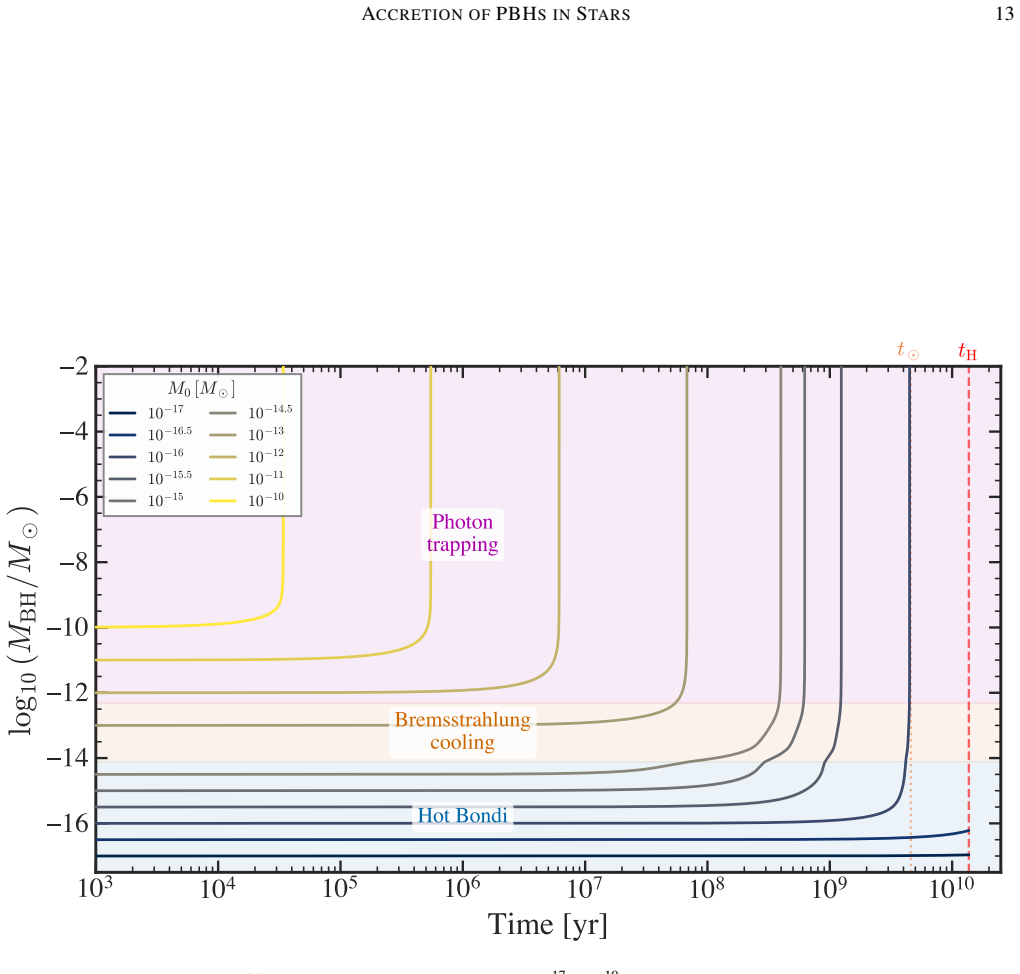
Cooling near the event horizon lets primordial black holes as light as 10^{-16} solar masses consume a solar-mass star within a Hubble time.
A machine-rendered reading of the paper's core claim, the machinery that carries it, and where it could break.
Core claim
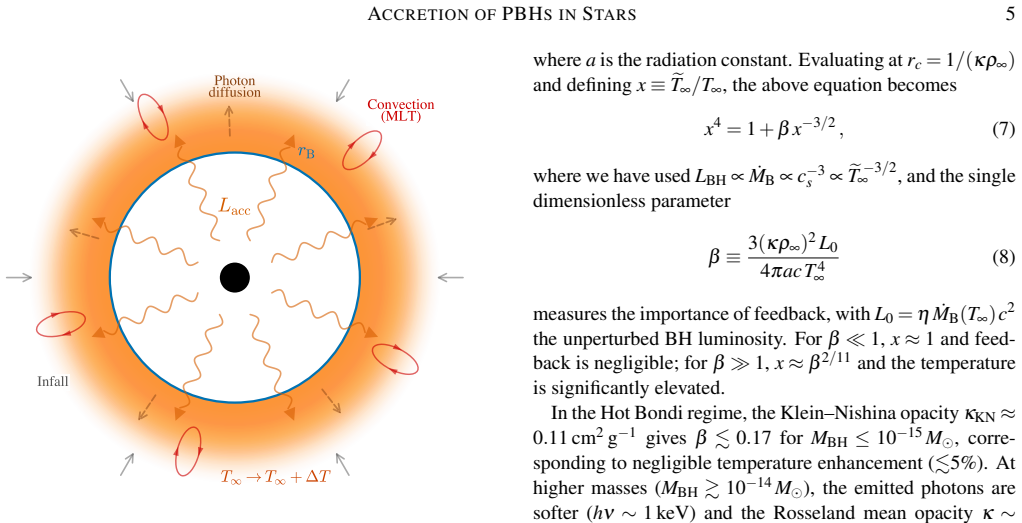
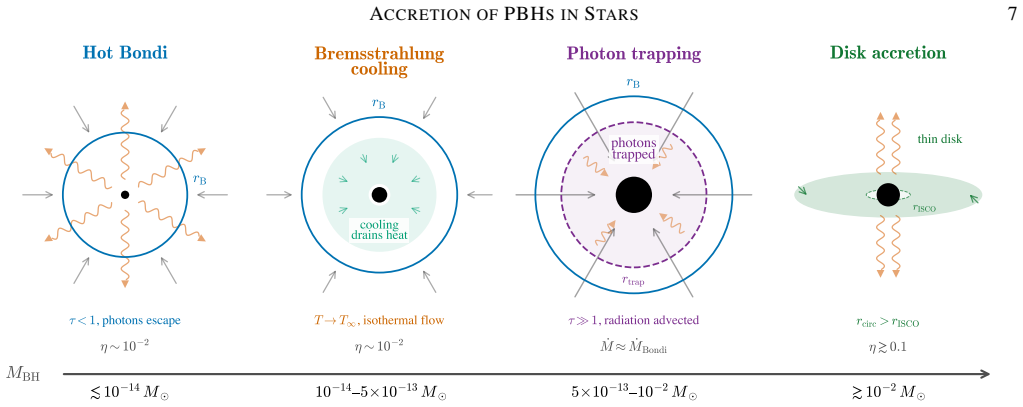
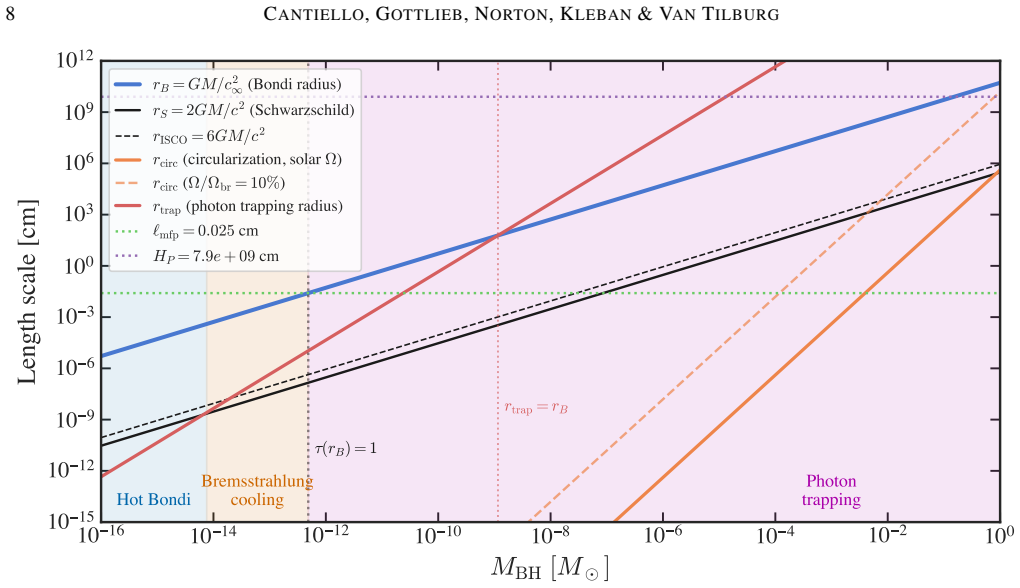
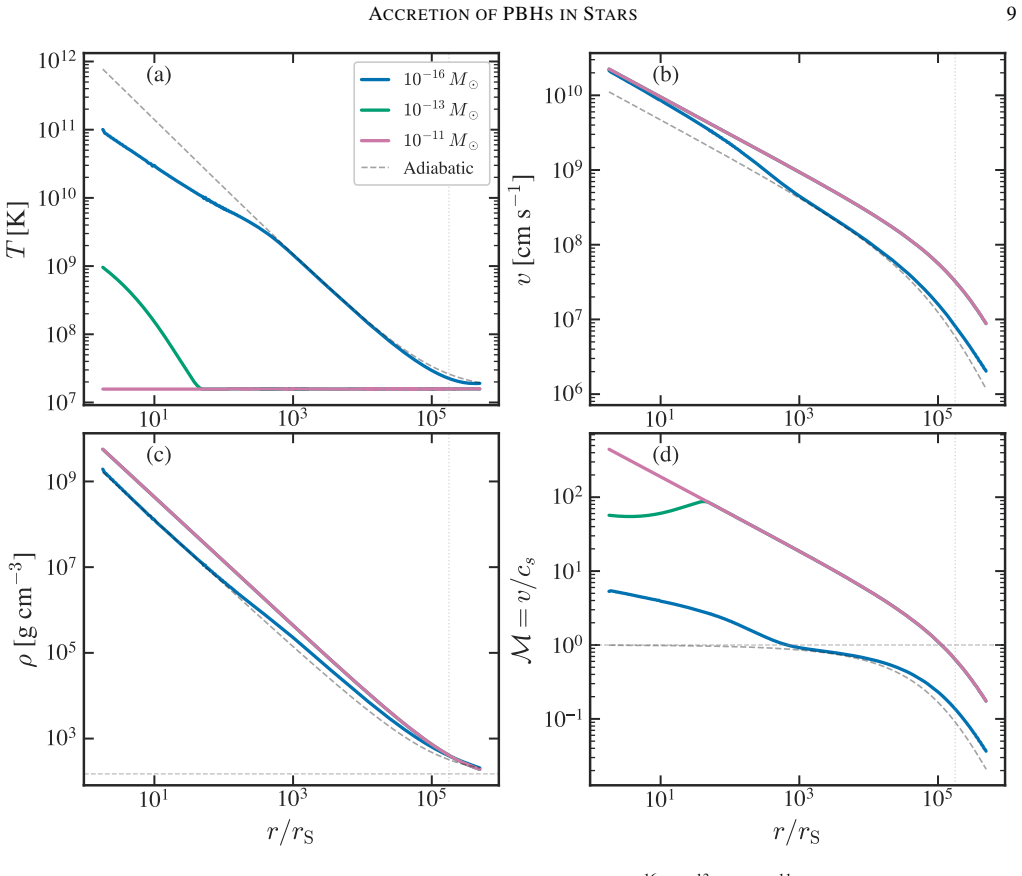
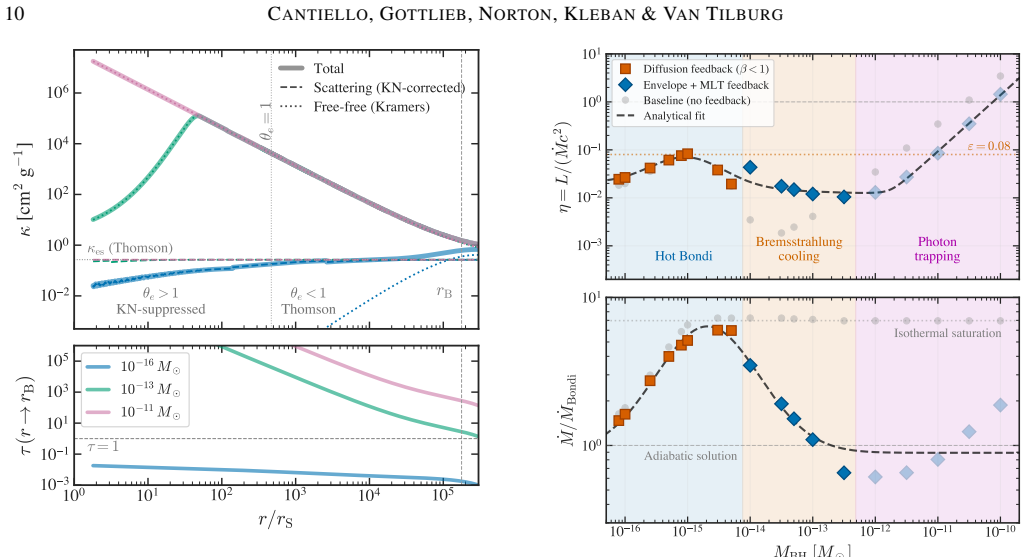
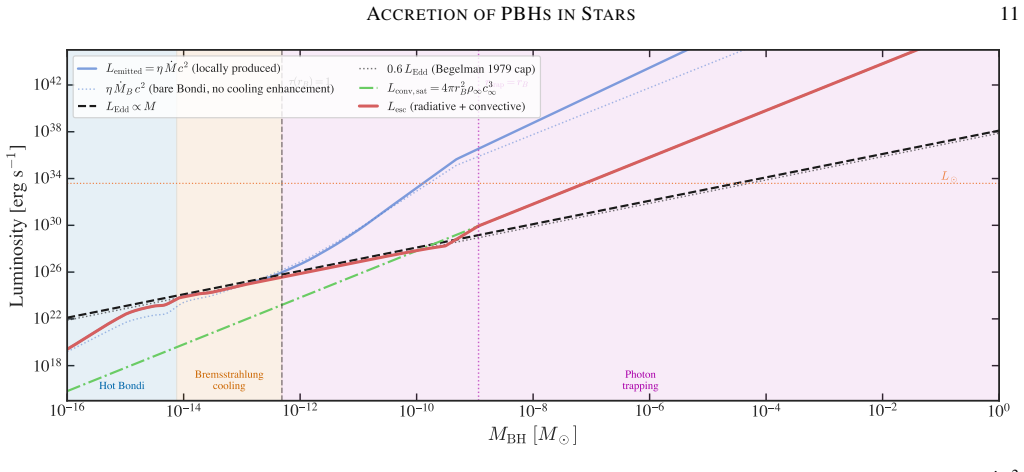
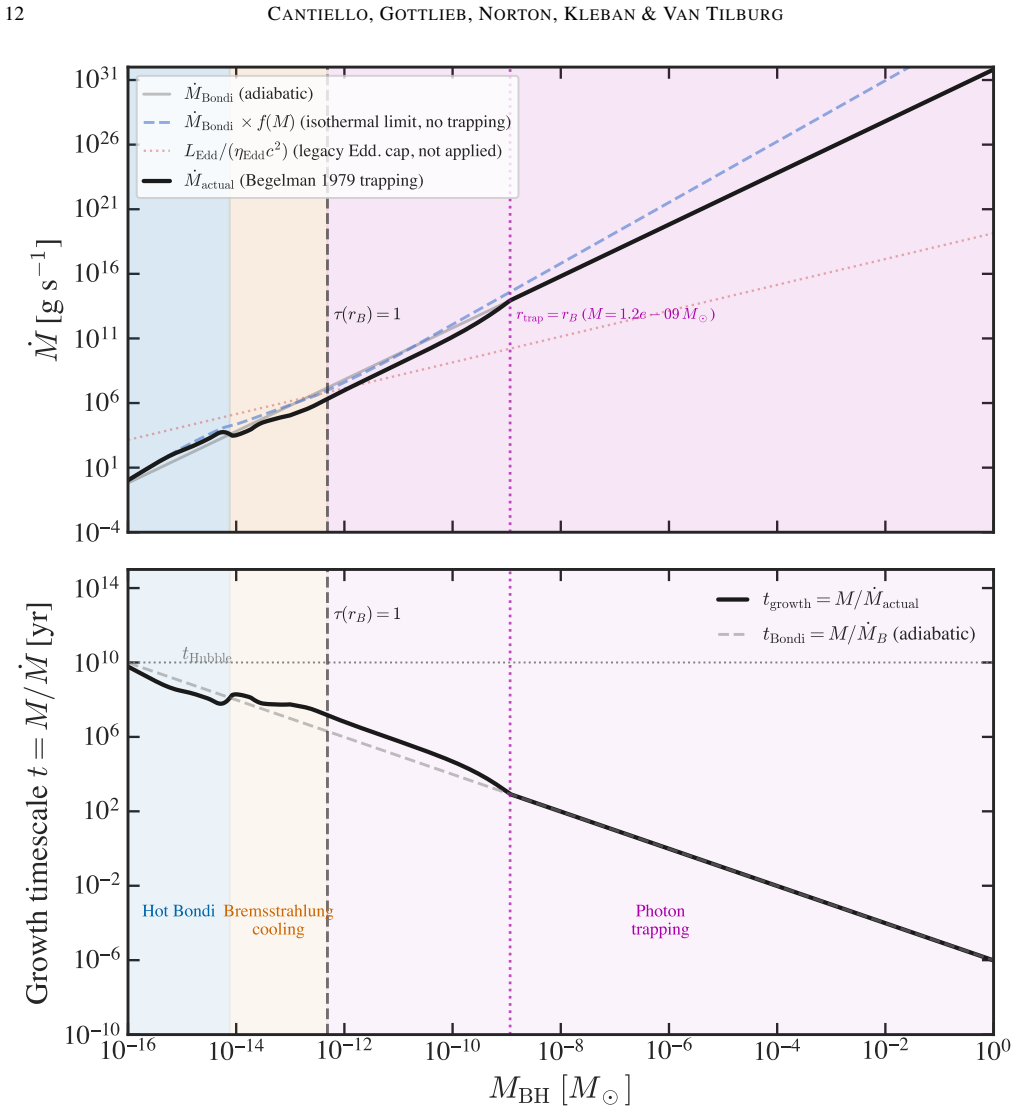
We solve the time-dependent spherical Euler equations with an implicit cooling source term to determine accretion rate, radiative efficiency, and flow structure self-consistently across the optically thin range. This yields three regimes: a Hot Bondi regime below 10^{-14} solar masses where cooling is negligible; a bremsstrahlung-cooling regime from 10^{-14} to 5 times 10^{-13} solar masses that drives the flow toward isothermal with efficiency near 10^{-2}; and a photon-trapping regime above that mass where the Bondi sphere is optically thick and the rate stays near the classical Bondi value. Cooling therefore enhances the accretion rate by a factor of roughly 2-7 throughout the spherical r
What carries the argument
Time-dependent spherical Euler equations with an implicit cooling source term that self-consistently sets the accretion rate and radiative efficiency in three regimes from Hot Bondi through bremsstrahlung cooling to photon trapping.
If this is right
- Growth of the black hole remains super-exponential while the flow stays spherical.
- Radiative efficiency falls to approximately 10^{-2} once bremsstrahlung cooling becomes important.
- Above 5 times 10^{-13} solar masses the accretion rate stays close to the classical Bondi value because of photon trapping.
- The threshold mass for destroying a solar-mass star drops to roughly 10^{-16} solar masses.
Where Pith is reading between the lines
- Stellar lifetimes could place new upper limits on the abundance of primordial black holes if the cooling-enhanced growth holds.
- The same cooling physics might alter accretion estimates for other compact objects embedded in dense gas.
- Observing unusually rapid stellar evolution or sudden disappearance of stars could test the predicted growth rates.
Load-bearing premise
Microphysical cooling at temperatures around 10^{11} K can be captured by an implicit source term in the spherical Euler equations without needing full radiation transport or magnetic fields.
What would settle it
A simulation of the same mass range that includes explicit radiative transfer and shows the accretion rate or efficiency differing by more than a factor of two from the values reported for masses near 10^{-16} solar masses.
Figures
read the original abstract
We study spherical accretion onto primordial black holes (PBHs) embedded in the core of a solar-type star. We compute the radiative efficiency self-consistently for the first time across the optically thin range ($10^{-16.5}$-$10^{-10}M_\odot$) with time-dependent simulations, and follow the growth up to $10^{-2}M_\odot$ using an analytical photon-trapping prescription above $5\times 10^{-13}M_\odot$. Near the Schwarzschild radius ($r_{\rm S}\sim 10^{-11}$cm for a $10^{-16}M_\odot$ PBH), gas compressed to $T\sim 10^{11}$K radiates through microphysical processes that fundamentally alter the classical adiabatic Bondi solution. We solve the time-dependent spherical Euler equations with an implicit cooling source term, determining $\dot M$, $\eta = L/\dot M c^2$, and the flow structure self-consistently. We identify three regimes for spherical accretion: a Hot Bondi regime ($M_{\rm BH}\lesssim 10^{-14}M_\odot$) in which bremsstrahlung cooling is dynamically negligible; a bremsstrahlung-cooling regime ($10^{-14}$-$5\times 10^{-13}M_\odot$) driving the flow toward isothermal with $\eta\approx 10^{-2}$; and a photon-trapping regime above $5\times 10^{-13}M_\odot$, in which the Bondi sphere is optically thick and the accretion rate remains close to the Bondi value. Cooling enhances $\dot M$ by a factor of $\sim$2-7, keeping growth super-exponential throughout the spherical regime. The radiative efficiency is an order of magnitude lower than previously assumed, and the critical initial PBH mass required to consume a solar-mass star within a Hubble time is $M_{\rm 0,crit}\sim 10^{-16}M_\odot$.
Editorial analysis
A structured set of objections, weighed in public.
Referee Report
Summary. The paper studies spherical accretion of primordial black holes (PBHs) in solar-type stellar cores. It solves the time-dependent spherical Euler equations with an implicit cooling source term to compute radiative efficiency self-consistently in the optically thin regime (10^{-16.5} to 10^{-10} M_⊙), then switches to an analytical photon-trapping prescription above 5×10^{-13} M_⊙. The work identifies three regimes (Hot Bondi, bremsstrahlung-cooling, photon-trapping), finds cooling enhances \dot M by a factor of ~2-7 with η≈10^{-2}, and concludes the critical initial PBH mass to consume a solar-mass star in a Hubble time is M_{0,crit}∼10^{-16} M_⊙.
Significance. If the numerical results hold, the self-consistent treatment of cooling and efficiency across regimes strengthens constraints on PBH masses that could disrupt stars, with implications for PBH dark matter searches. The time-dependent simulations determining \dot M and η without post-hoc fitting are a methodological strength relative to prior analytic Bondi assumptions.
major comments (2)
- [description of bremsstrahlung-cooling regime and implicit cooling implementation] The bremsstrahlung-cooling regime (10^{-14} to 5×10^{-13} M_⊙) relies on an implicit cooling source term in the Euler equations to produce the factor of 2-7 enhancement in \dot M and the drop in η to ~10^{-2}; this term replaces full radiation transport near r_S at T~10^{11} K where optical depth nears unity, but the manuscript provides no quantitative test (e.g., comparison to diffusion approximation or optical-depth calculation) showing the net cooling rate is accurate to better than the reported enhancement factor.
- [transition to photon-trapping regime] The switch to the analytical photon-trapping prescription at exactly 5×10^{-13} M_⊙ is presented as the point where the Bondi sphere becomes optically thick, yet this threshold is listed among the free parameters and lacks an explicit derivation from the simulated optical depth or trapping condition; altering it would directly rescale the integrated growth and shift M_{0,crit}.
minor comments (2)
- Notation for the three regimes should be defined once with explicit mass boundaries and referenced consistently when quoting the enhancement factor.
- The abstract states the enhancement keeps growth 'super-exponential throughout the spherical regime'; a brief quantitative comparison of the integrated growth timescale with and without cooling would clarify this claim.
Simulated Author's Rebuttal
We thank the referee for their careful review and for recognizing the methodological value of our time-dependent simulations. We respond to the major comments below and will revise the manuscript to address the identified gaps in validation and derivation.
read point-by-point responses
-
Referee: The bremsstrahlung-cooling regime (10^{-14} to 5×10^{-13} M_⊙) relies on an implicit cooling source term in the Euler equations to produce the factor of 2-7 enhancement in \dot M and the drop in η to ~10^{-2}; this term replaces full radiation transport near r_S at T~10^{11} K where optical depth nears unity, but the manuscript provides no quantitative test (e.g., comparison to diffusion approximation or optical-depth calculation) showing the net cooling rate is accurate to better than the reported enhancement factor.
Authors: We agree that a quantitative validation of the implicit cooling term would strengthen the results. The term is used because the cooling timescale is much shorter than the dynamical timescale in this regime, but we will add to the revised manuscript an explicit optical-depth calculation using the simulated density and temperature profiles near r_S, together with a comparison of the cooling rate to the diffusion approximation. This will confirm that the reported enhancement remains robust. revision: yes
-
Referee: The switch to the analytical photon-trapping prescription at exactly 5×10^{-13} M_⊙ is presented as the point where the Bondi sphere becomes optically thick, yet this threshold is listed among the free parameters and lacks an explicit derivation from the simulated optical depth or trapping condition; altering it would directly rescale the integrated growth and shift M_{0,crit}.
Authors: The threshold marks the mass at which the simulated Bondi sphere reaches optical depth of order unity. While the original text did not include the explicit derivation, the value is physically motivated rather than arbitrary. In revision we will add the optical-depth calculation versus black-hole mass extracted from the simulations to derive the transition point, and we will include a sensitivity test showing the effect of varying the threshold on the integrated growth and on M_{0,crit}. revision: yes
Circularity Check
No significant circularity; central results from self-consistent simulations
full rationale
The paper computes radiative efficiency, accretion rates, and the critical PBH mass M_{0,crit} via time-dependent spherical Euler simulations with an implicit cooling term across the optically thin regime, followed by an analytic photon-trapping model above 5e-13 M_sun. These steps determine \dot M and \eta directly from the equations without any reduction to a fitted parameter defined from the target result, self-citation load-bearing the central claim, or ansatz smuggled via prior work. The derivation chain remains independent of the final M_{0,crit} value.
Axiom & Free-Parameter Ledger
free parameters (2)
- transition mass for photon-trapping prescription
- implicit cooling implementation details
axioms (2)
- domain assumption Spherical symmetry and absence of magnetic fields or angular momentum remain valid throughout the accretion flow
- domain assumption Microphysical radiative processes at T~10^11 K near r_S can be treated as an optically thin cooling term without full radiative transfer
Reference graph
Works this paper leans on
-
[1]
The Internal Constitution of the Stars
-
[2]
, year = 1957, month = jan, volume =
Statistical dynamics and accretion. , year = 1957, month = jan, volume =. doi:10.1093/mnras/117.1.50 , adsurl =
-
[3]
Nearly collisionless spherical accretion. , keywords =. doi:10.1093/mnras/181.2.347 , adsurl =
-
[4]
Improved angular momentum evolution model for solar-like stars
Improved angular momentum evolution model for solar-like stars. , keywords =. doi:10.1051/0004-6361/201321302 , archivePrefix =. 1306.2130 , primaryClass =
work page internal anchor Pith review Pith/arXiv arXiv doi:10.1051/0004-6361/201321302
-
[5]
, year = 1959, month = feb, volume =
Spontaneously Growing Transverse Waves in a Plasma Due to an Anisotropic Velocity Distribution. , year = 1959, month = feb, volume =. doi:10.1103/PhysRevLett.2.83 , adsurl =
-
[6]
Nonadiabatic self-consistent spherical accretion as a model for quasars and active galactic nuclei. , keywords =. doi:10.1086/162175 , adsurl =
-
[7]
, keywords =
Stationary spherical accretion into black holes - The transition from the optically thin to the optically thick regime. , keywords =
-
[8]
Resonant Enhancements in Weakly Interacting Massive Particle Capture by the Earth. , keywords =. doi:10.1086/165653 , adsurl =
-
[9]
Capture by the sun of a galactic population of weakly interacting, massive particles. , keywords =. doi:10.1086/163485 , adsurl =
-
[10]
Accretion of Matter by Condensed Objects. , keywords =. doi:10.1007/BF00649949 , adsurl =
-
[11]
, keywords =
Radiation from spherical accretion onto black holes. , keywords =
-
[12]
, year = 1973, month = mar, volume =
Accretion onto Black Holes: the Emergent Radiation Spectrum. , year = 1973, month = mar, volume =. doi:10.1086/151982 , adsurl =
-
[13]
Super-Eddington Accretion onto Black Holes and Its Application to Fallback Accretion. , keywords =. doi:10.3847/1538-4357/ae30dc , archivePrefix =. 2507.16893 , primaryClass =
-
[14]
Black holes in radiation-dominated gas: an analogue of the Bondi accretion problem. , keywords =. doi:10.1093/mnras/184.1.53 , adsurl =
-
[15]
I - Equations and numerical methods
Optically thick, time-dependent spherical accretion onto a black hole. I - Equations and numerical methods. , keywords =. doi:10.1086/162419 , adsurl =
-
[16]
III Optically thick accretion in particular cases
Stationary spherical accretion into black holes. III Optically thick accretion in particular cases. , keywords =. doi:10.1093/mnras/206.3.589 , adsurl =
-
[17]
Self-consistent Models of Spherical Accretion onto Black Holes. II. Two-Temperature Solutions with Pairs. , keywords =. doi:10.1086/168669 , adsurl =
-
[18]
Spherical Accretion onto Black Holes: A Complete Analysis of Stationary Solutions. , keywords =. doi:10.1086/170781 , adsurl =
-
[19]
Rubin, S. G. and Khlopov, M. Yu. and Sakharov, A. S. Primordial black holes from nonequilibrium second order phase transition. Grav. Cosmol. 2000. arXiv:hep-ph/0005271
Pith/arXiv arXiv 2000
-
[20]
Black holes and the multiverse , volume=
Garriga, Jaume and Vilenkin, Alexander and Zhang, Jun , year=. Black holes and the multiverse , volume=. Journal of Cosmology and Astroparticle Physics , publisher=. doi:10.1088/1475-7516/2016/02/064 , number=
-
[21]
Spontaneous Generation of Density Perturbations in the Early Universe
Crawford, Matt and Schramm, David N. Spontaneous Generation of Density Perturbations in the Early Universe. Nature. 1982. doi:10.1038/298538a0
-
[22]
Monochromatic mass spectrum of primordial black holes
Kleban, Matthew and Norton, Cameron E. Monochromatic mass spectrum of primordial black holes. Phys. Rev. D. 2025. doi:10.1103/PhysRevD.111.023538. arXiv:2310.09898
-
[24]
, year = 1982, month = jul, volume =
Electron-Positron Pair Equilibria in Relativistic Plasmas. , year = 1982, month = jul, volume =. doi:10.1086/160082 , adsurl =
-
[25]
Magnetic Hair and Reconnection in Black Hole Magnetospheres. , keywords =. doi:10.1103/PhysRevLett.127.055101 , archivePrefix =. 2109.14620 , primaryClass =
-
[26]
High resolution schemes for hyperbolic conservation laws , journal =
Ami Harten , abstract =. High resolution schemes for hyperbolic conservation laws , journal =. 1983 , issn =. doi:https://doi.org/10.1016/0021-9991(83)90136-5 , url =
-
[27]
Numerical fits to important rates in high temperature astrophysical plasmas. , keywords =. doi:10.1093/mnras/204.4.1269 , adsurl =
-
[28]
Radiative processes in astrophysics
-
[29]
Introduction to Stellar Astrophysics
-
[30]
, year = 1974, month = aug, volume =
Black holes in the early Universe. , year = 1974, month = aug, volume =. doi:10.1093/mnras/168.2.399 , adsurl =
-
[31]
The end of the MACHO era- revisited: new limits on MACHO masses from halo wide binaries
The End of the MACHO Era, Revisited: New Limits on MACHO Masses from Halo Wide Binaries. , keywords =. doi:10.1088/0004-637X/790/2/159 , archivePrefix =. 1406.5169 , primaryClass =
work page internal anchor Pith review Pith/arXiv arXiv doi:10.1088/0004-637x/790/2/159
-
[32]
Massive black holes in galactic halos ?. , keywords =. doi:10.1086/163729 , adsurl =
-
[33]
Constraints on MACHO Dark Matter from Compact Stellar Systems in Ultra-Faint Dwarf Galaxies
Constraints on MACHO Dark Matter from Compact Stellar Systems in Ultra-faint Dwarf Galaxies. , keywords =. doi:10.3847/2041-8205/824/2/L31 , archivePrefix =. 1605.03665 , primaryClass =
work page internal anchor Pith review Pith/arXiv arXiv doi:10.3847/2041-8205/824/2/l31 2041
-
[34]
Black Holes in the Era of Gravitational-Wave Astronomy , year = 2024, editor =
Primordial black holes. Black Holes in the Era of Gravitational-Wave Astronomy , year = 2024, editor =. doi:10.1016/B978-0-32-395636-9.00012-8 , adsurl =
-
[35]
Primordial Black Holes - Perspectives in Gravitational Wave Astronomy -
Primordial black holes perspectives in gravitational wave astronomy. Classical and Quantum Gravity , keywords =. doi:10.1088/1361-6382/aaa7b4 , archivePrefix =. 1801.05235 , primaryClass =
work page internal anchor Pith review Pith/arXiv arXiv doi:10.1088/1361-6382/aaa7b4
-
[36]
, year = 1931, month = jul, volume =
The Maximum Mass of Ideal White Dwarfs. , year = 1931, month = jul, volume =. doi:10.1086/143324 , adsurl =
-
[37]
Revisiting constraints on asteroid-mass primordial black holes as dark matter candidates. , keywords =. doi:10.1088/1475-7516/2019/08/031 , archivePrefix =. 1906.05950 , primaryClass =
-
[38]
Primordial black holes capture by stars and induced collapse to low-mass stellar black holes. , keywords =. doi:10.1093/mnras/stac2647 , archivePrefix =. 2205.13003 , primaryClass =
-
[39]
Dark matter capture in celestial objects: improved treatment of multiple scattering and updated constraints from white dwarfs. , keywords =. doi:10.1088/1475-7516/2019/08/018 , archivePrefix =. 1906.04204 , primaryClass =
-
[40]
Dark Matter Triggers of Supernovae
Dark matter triggers of supernovae. , keywords =. doi:10.1103/PhysRevD.92.063007 , archivePrefix =. 1505.04444 , primaryClass =
work page internal anchor Pith review Pith/arXiv arXiv doi:10.1103/physrevd.92.063007
-
[41]
Primordial black holes captured by neutron stars: Simulations in general relativity. , keywords =. doi:10.1103/PhysRevD.110.023021 , archivePrefix =. 2405.10365 , primaryClass =
-
[42]
Primordial black holes captured by neutron stars: Relativistic point-mass treatment. , keywords =. doi:10.1103/PhysRevD.109.123012 , archivePrefix =. 2404.08735 , primaryClass =
-
[43]
Fate of a neutron star with an endoparasitic black hole and implications for dark matter. , keywords =. doi:10.1103/PhysRevD.100.124026 , archivePrefix =. 1909.07968 , primaryClass =
-
[44]
Accretion onto black holes inside neutron stars with piecewise-polytropic equations of state: Analytic and numerical treatments. , keywords =. doi:10.1103/PhysRevD.104.123021 , archivePrefix =. 2110.08285 , primaryClass =
-
[45]
Accretion onto a small black hole at the center of a neutron star. , keywords =. doi:10.1103/PhysRevD.103.104009 , archivePrefix =. 2102.09574 , primaryClass =
-
[46]
Neutron stars harboring a primordial black hole: Maximum survival time. , keywords =. doi:10.1103/PhysRevD.103.L081303 , archivePrefix =. 2101.12220 , primaryClass =
-
[47]
Growth of Black Holes in the interior of Rotating Neutron Stars
Growth of black holes in the interior of rotating neutron stars. , keywords =. doi:10.1103/PhysRevD.90.043512 , archivePrefix =. 1312.3764 , primaryClass =
work page internal anchor Pith review Pith/arXiv arXiv doi:10.1103/physrevd.90.043512
-
[48]
Evolution of a primordial black hole inside a rotating solar-type star. , keywords =. doi:10.1093/mnras/277.1.25 , adsurl =
-
[49]
Mind the Gap: The Location of the Lower Edge of the Pair-instability Supernova Black Hole Mass Gap. , keywords =. doi:10.3847/1538-4357/ab518b , archivePrefix =. 1910.12874 , primaryClass =
-
[50]
Fragmentation in Gravitationally Unstable Collapsar Disks and Subsolar Neutron Star Mergers. , keywords =. doi:10.3847/2041-8213/ad6990 , archivePrefix =. 2407.07955 , primaryClass =
-
[51]
Black hole growth through hierarchical black hole mergers in dense star clusters: implications for gravitational wave detections. , keywords =. doi:10.1093/mnras/stz1149 , archivePrefix =. 1811.03640 , primaryClass =
work page internal anchor Pith review Pith/arXiv arXiv doi:10.1093/mnras/stz1149
-
[52]
Black holes: The next generation repeated mergers in dense star clusters and their gravitational-wave properties. , keywords =. doi:10.1103/PhysRevD.100.043027 , archivePrefix =. 1906.10260 , primaryClass =
-
[53]
Spinning into the Gap: Direct-horizon Collapse as the Origin of GW231123 from End-to-end General-relativistic Magnetohydrodynamic Simulations. , keywords =. doi:10.3847/2041-8213/ae0d81 , archivePrefix =. 2508.15887 , primaryClass =
-
[54]
Gravitational Waves from Primordial Black Hole Mergers
Gravitational waves from primordial black hole mergers. , keywords =. doi:10.1088/1475-7516/2017/09/037 , archivePrefix =. 1707.01480 , primaryClass =
work page internal anchor Pith review Pith/arXiv arXiv doi:10.1088/1475-7516/2017/09/037 2017
-
[55]
Gravitational Wave signatures of inflationary models from Primordial Black Hole Dark Matter
Gravitational wave signatures of inflationary models from Primordial Black Hole dark matter. , keywords =. doi:10.1088/1475-7516/2017/09/013 , archivePrefix =. 1707.02441 , primaryClass =
work page internal anchor Pith review Pith/arXiv arXiv doi:10.1088/1475-7516/2017/09/013 2017
-
[56]
The clustering of massive Primordial Black Holes as Dark Matter: Measuring their mass distribution with advanced LIGO. Physics of the Dark Universe , keywords =. doi:10.1016/j.dark.2016.10.002 , archivePrefix =. 1603.05234 , primaryClass =
work page internal anchor Pith review Pith/arXiv arXiv doi:10.1016/j.dark.2016.10.002 2016
-
[57]
Consistency of Primordial Black Hole Dark Matter with LIGO/Virgo Merger Rates. , keywords =. doi:10.1103/PhysRevLett.126.051302 , archivePrefix =. 2007.03565 , primaryClass =
-
[58]
, year = 1971, month = jan, volume =
Gravitationally collapsed objects of very low mass. , year = 1971, month = jan, volume =. doi:10.1093/mnras/152.1.75 , adsurl =
-
[59]
Dynamics of dwarf galaxies disfavor stellar-mass black hole dark matter
Dynamics of Dwarf Galaxies Disfavor Stellar-Mass Black Holes as Dark Matter. , keywords =. doi:10.1103/PhysRevLett.119.041102 , archivePrefix =. 1704.01668 , primaryClass =
work page internal anchor Pith review Pith/arXiv arXiv doi:10.1103/physrevlett.119.041102
-
[60]
On the reported death of the MACHO era. , keywords =. doi:10.1111/j.1745-3933.2009.00652.x , archivePrefix =. 0903.1644 , primaryClass =
-
[61]
The End of the MACHO Era: Limits on Halo Dark Matter from Stellar Halo Wide Binaries
The End of the MACHO Era: Limits on Halo Dark Matter from Stellar Halo Wide Binaries. , keywords =. doi:10.1086/380562 , archivePrefix =. astro-ph/0307437 , primaryClass =
work page internal anchor Pith review Pith/arXiv arXiv doi:10.1086/380562
-
[62]
Microlensing constraints on primordial black holes with the Subaru/HSC Andromeda observation
Microlensing constraints on primordial black holes with Subaru/HSC Andromeda observations. Nature Astronomy , keywords =. doi:10.1038/s41550-019-0723-1 , archivePrefix =. 1701.02151 , primaryClass =
work page internal anchor Pith review Pith/arXiv arXiv doi:10.1038/s41550-019-0723-1
-
[63]
Constraints on Earth-mass primordial black holes from OGLE 5-year microlensing events
Constraints on Earth-mass primordial black holes from OGLE 5-year microlensing events. , keywords =. doi:10.1103/PhysRevD.99.083503 , archivePrefix =. 1901.07120 , primaryClass =
work page internal anchor Pith review Pith/arXiv arXiv doi:10.1103/physrevd.99.083503 1901
-
[64]
Microlensing and dynamical constraints on primordial black hole dark matter with an extended mass function. , keywords =. doi:10.1103/PhysRevD.94.063530 , archivePrefix =. 1609.01143 , primaryClass =
work page internal anchor Pith review Pith/arXiv arXiv doi:10.1103/physrevd.94.063530
-
[65]
Communications in Mathematical Physics , year = 1975, month = aug, volume =
Particle creation by black holes. Communications in Mathematical Physics , year = 1975, month = aug, volume =. doi:10.1007/BF02345020 , adsurl =
-
[66]
Gamma rays from primordial black holes. , keywords =. doi:10.1086/154350 , adsurl =
-
[67]
New cosmological constraints on primordial black holes
New cosmological constraints on primordial black holes. , keywords =. doi:10.1103/PhysRevD.81.104019 , archivePrefix =. 0912.5297 , primaryClass =
work page internal anchor Pith review Pith/arXiv arXiv doi:10.1103/physrevd.81.104019
-
[68]
Primordial Black Holes as a dark matter candidate
Primordial black holes as a dark matter candidate. Journal of Physics G Nuclear Physics , keywords =. doi:10.1088/1361-6471/abc534 , archivePrefix =. 2007.10722 , primaryClass =
work page internal anchor Pith review Pith/arXiv arXiv doi:10.1088/1361-6471/abc534 2007
-
[69]
Inflation and primordial black holes as dark matter. , keywords =. doi:10.1103/PhysRevD.50.7173 , adsurl =
-
[70]
Massive Primordial Black Holes from Hybrid Inflation as Dark Matter and the seeds of Galaxies
Massive primordial black holes from hybrid inflation as dark matter and the seeds of galaxies. , keywords =. doi:10.1103/PhysRevD.92.023524 , archivePrefix =. 1501.07565 , primaryClass =
work page internal anchor Pith review Pith/arXiv arXiv doi:10.1103/physrevd.92.023524
-
[71]
Primordial Black Holes as Dark Matter: Recent Developments
Primordial Black Holes as Dark Matter: Recent Developments. Annual Review of Nuclear and Particle Science , keywords =. doi:10.1146/annurev-nucl-050520-125911 , archivePrefix =. 2006.02838 , primaryClass =
work page internal anchor Pith review Pith/arXiv arXiv doi:10.1146/annurev-nucl-050520-125911 2006
-
[72]
Peculiar Relics from Primordial Black Holes in the Inflationary Paradigm
Peculiar relics from Primordial Black Holes in the inflationary paradigm. Annalen der Physik , keywords =. doi:10.1002/andp.200310067 , archivePrefix =. astro-ph/0303330 , primaryClass =
work page internal anchor Pith review Pith/arXiv arXiv doi:10.1002/andp.200310067
-
[73]
The primordial black hole mass spectrum. , keywords =. doi:10.1086/153853 , adsurl =
-
[74]
Constraints on Primordial Black Holes
Constraints on primordial black holes. Reports on Progress in Physics , keywords =. doi:10.1088/1361-6633/ac1e31 , archivePrefix =. 2002.12778 , primaryClass =
work page internal anchor Pith review Pith/arXiv arXiv doi:10.1088/1361-6633/ac1e31 2002
-
[75]
Primordial Black Holes as Dark Matter
Primordial black holes as dark matter. , keywords =. doi:10.1103/PhysRevD.94.083504 , archivePrefix =. 1607.06077 , primaryClass =
work page internal anchor Pith review Pith/arXiv arXiv doi:10.1103/physrevd.94.083504
-
[76]
, year = 1999, month = aug, volume =
A compilation of charged-particle induced thermonuclear reaction rates. , year = 1999, month = aug, volume =. doi:10.1016/S0375-9474(99)00030-5 , adsurl =
-
[77]
1969 , institution =
1969
-
[78]
Rosseland and flux mean opacities for Compton scattering
Rosseland and Flux Mean Opacities for Compton Scattering. , keywords =. doi:10.3847/1538-4357/835/2/119 , archivePrefix =. 1606.09466 , primaryClass =
work page internal anchor Pith review Pith/arXiv arXiv doi:10.3847/1538-4357/835/2/119
-
[79]
arXiv e-prints , keywords =
High Metal Content of Highly Accreting Quasars: Analysis of an Extended Sample. arXiv e-prints , keywords =
-
[80]
Journal of High Energy Physics , keywords =
Orbital dynamics of the solar basin. Journal of High Energy Physics , keywords =. doi:10.1007/JHEP12(2024)007 , archivePrefix =. 2408.16041 , primaryClass =
-
[81]
doi:10.1007/978-3-642-30304-3 , adsurl =
Stellar Structure and Evolution. doi:10.1007/978-3-642-30304-3 , adsurl =
discussion (0)
Sign in with ORCID, Apple, or X to comment. Anyone can read and Pith papers without signing in.