Optoelectronics and Magnetic properties calculation of RE₂MnNiO₆ (RE=La-Lu,Y) using Density Functional Theory
Pith reviewed 2026-06-28 13:19 UTC · model grok-4.3
The pith
4f occupancy and octahedral distortion together determine magnetic moments and optical response across the RE2MnNiO6 double-perovskite series.
A machine-rendered reading of the paper's core claim, the machinery that carries it, and where it could break.
Core claim
Spin-polarised DFT+U calculations on RE2MnNiO6 compounds reveal significant asymmetry between spin channels and magnetic moments as large as 30 μB per formula unit. Treating the RE 4f electrons explicitly in the valence manifold versus as frozen core states isolates their contribution to exchange interactions and the dielectric function. The results demonstrate that 4f occupancy combined with A-site driven octahedral distortion controls the magnetic and optoelectronic characteristics of the entire family.
What carries the argument
DFT+U calculations performed with RE 4f electrons both frozen in the core and treated explicitly in the valence states, to quantify hybridisation effects on band structure and optical properties.
If this is right
- Magnetic moments reach up to 30 μB per formula unit for select members of the series.
- The electronic structure displays pronounced spin-channel asymmetry.
- Octahedral distortion changes systematically with rare-earth ionic radius via the lanthanide contraction.
- Hybridisation between 4f and neighbouring d states affects both magnetic exchange and optical response.
Where Pith is reading between the lines
- The dual-treatment approach supplies a practical template for studying 4f effects in other rare-earth perovskites.
- Predicted optical spectra could be checked against experiment to refine the hybridisation model.
- The link between ionic radius and properties may guide selection of specific RE members for targeted magnetic or optical applications.
Load-bearing premise
That running DFT+U calculations with the 4f electrons treated both as frozen core states and in the valence manifold is enough to separate their contribution to exchange interactions and the dielectric function.
What would settle it
A direct measurement of the magnetic moment or the dielectric function for one compound such as Gd2MnNiO6, compared against the two calculation variants, would test whether the 4f hybridisation picture holds.
Figures
read the original abstract
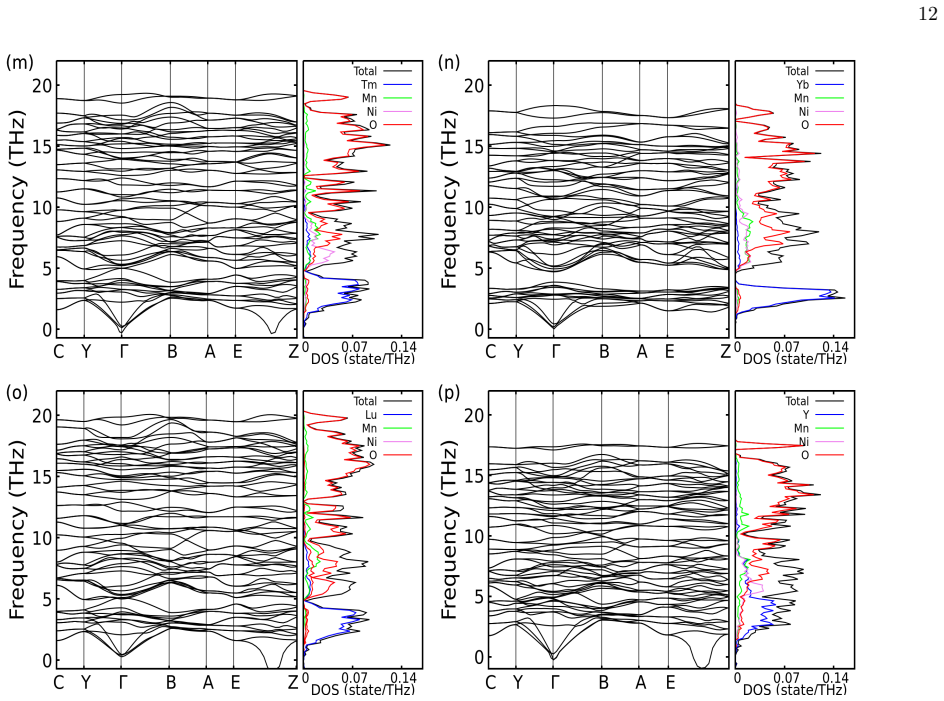
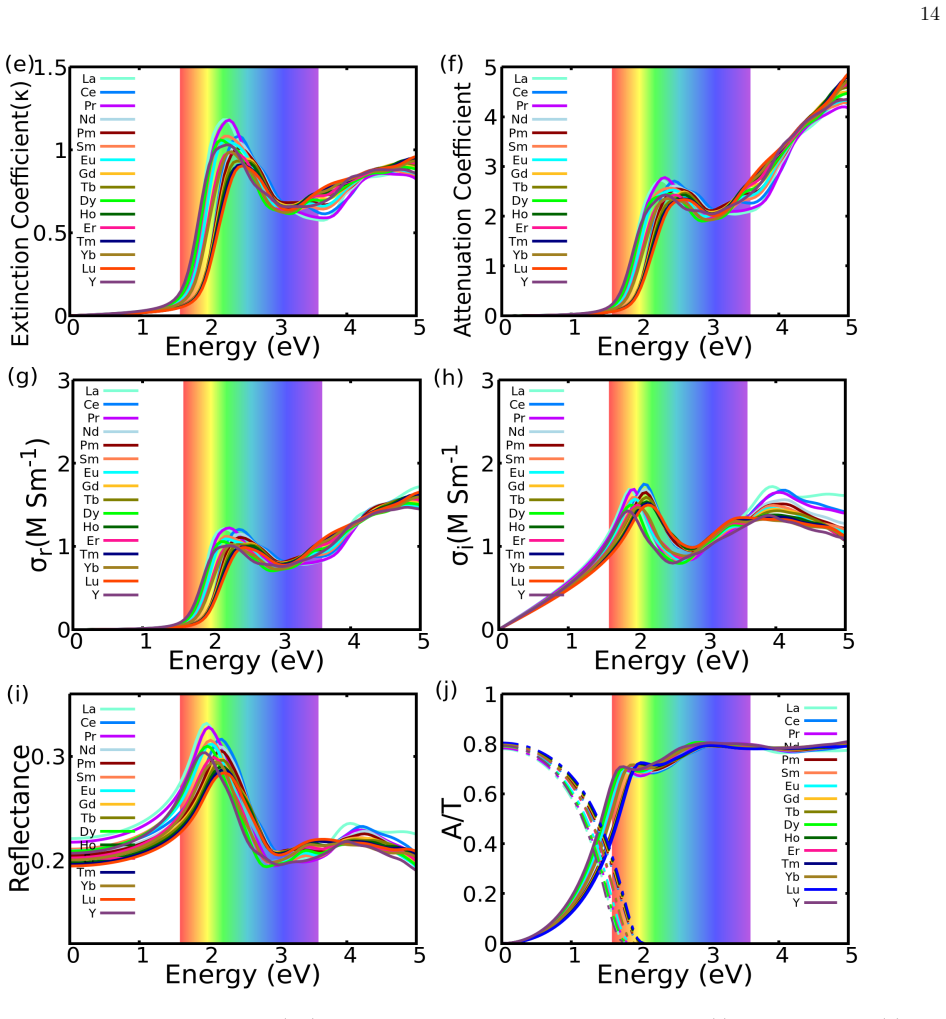
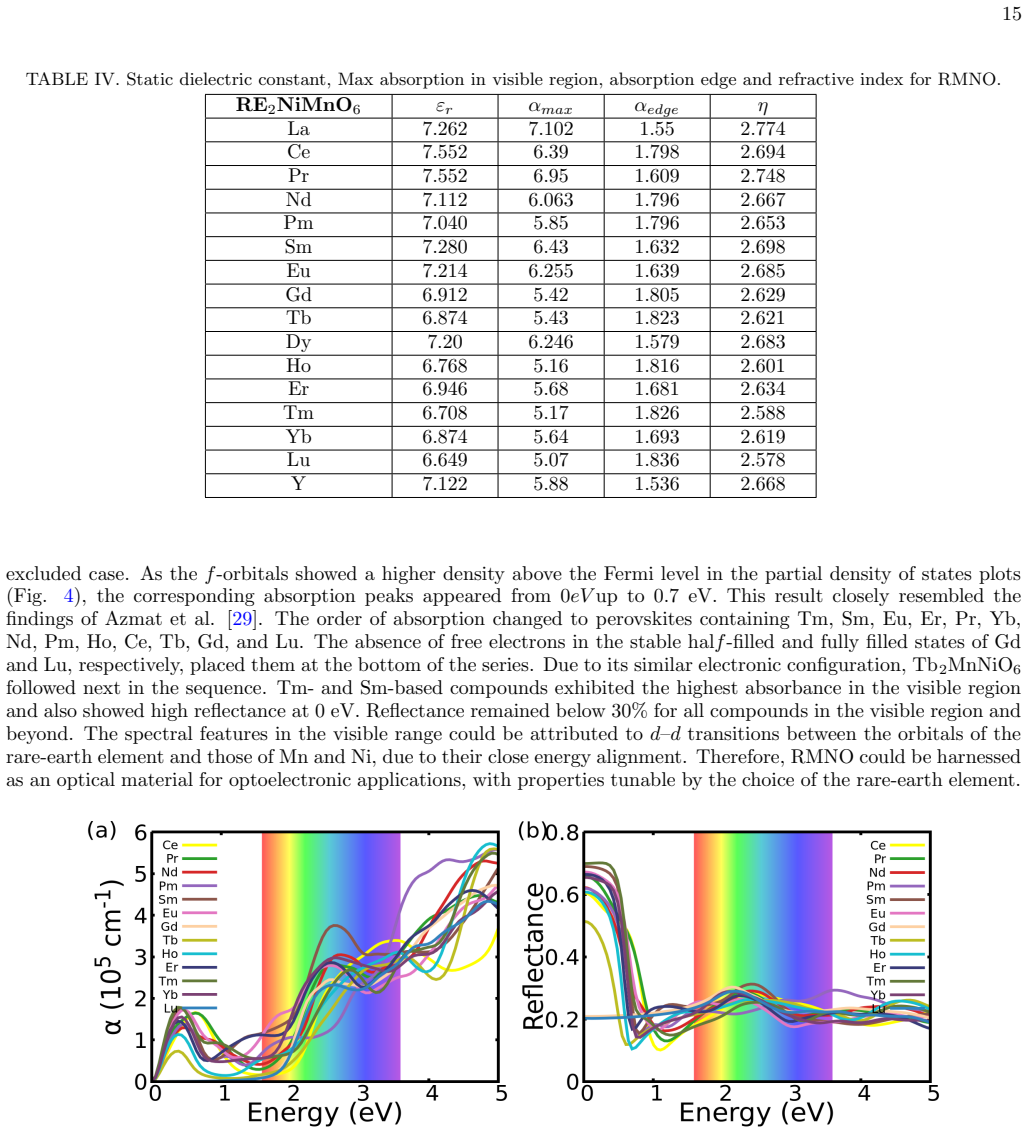
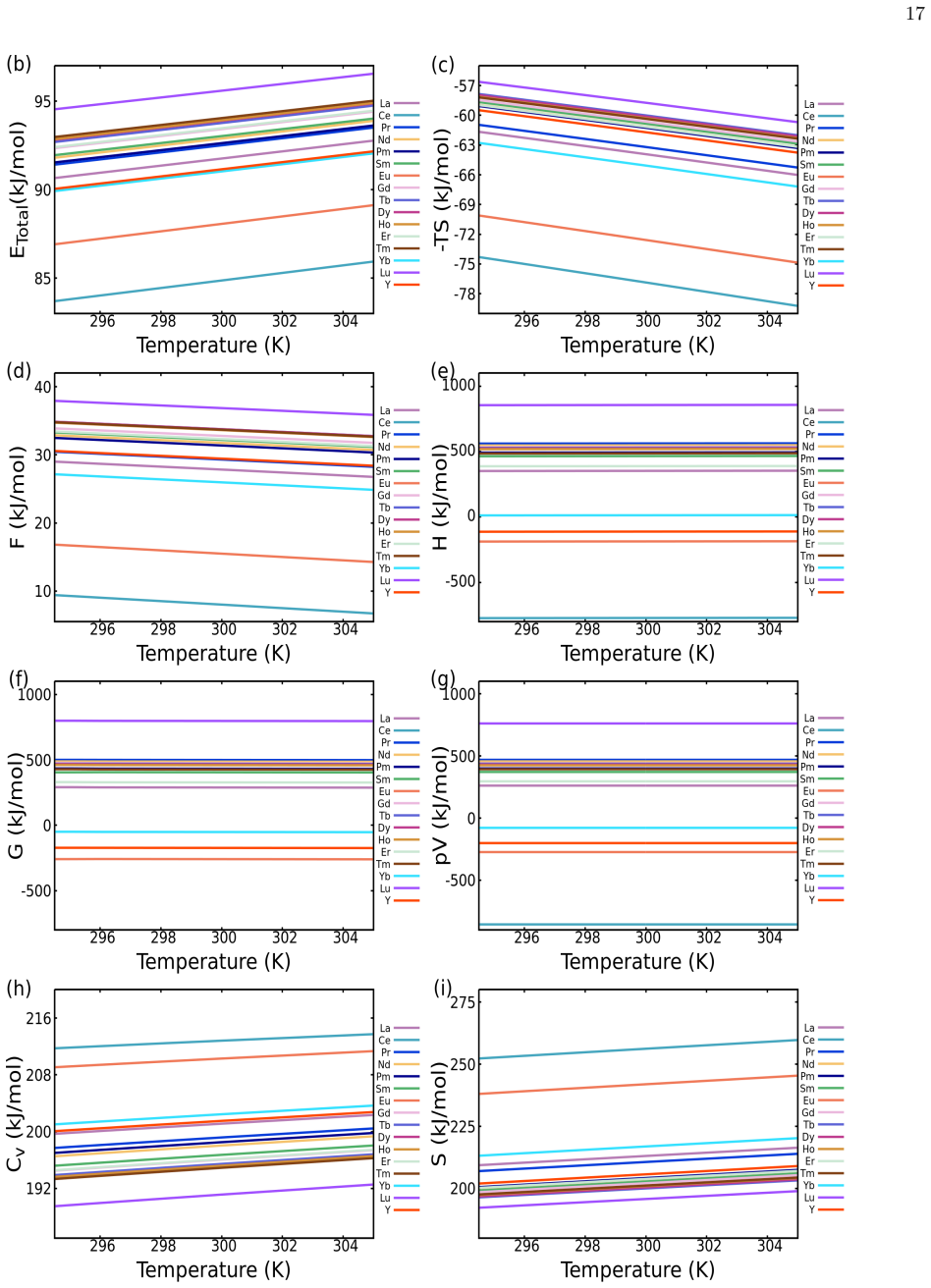
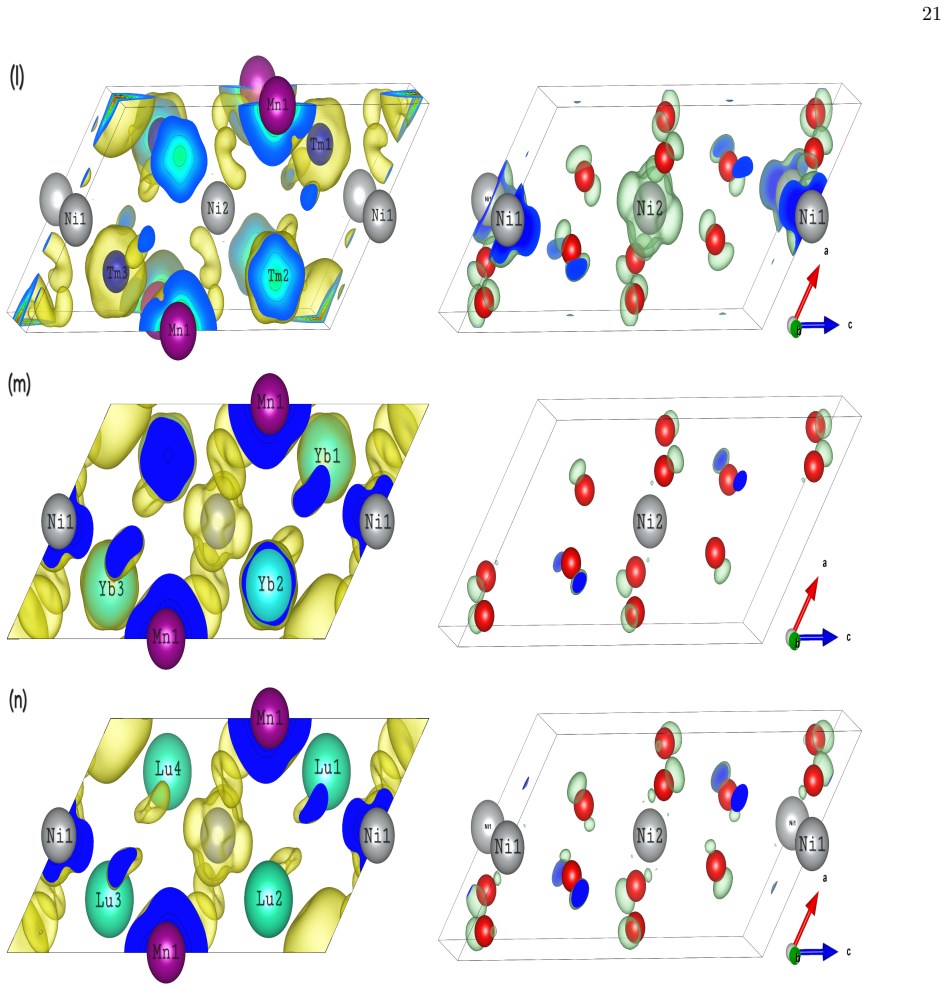
RE$_2$MnNiO$_6$ (RE = La-Lu) family of ordered double-perovskite oxides hosts a corner-sharing network of alternating NiO$_6$ and MnO$_6$ octahedra whose electronic and magnetic ground states are systematically governed by the A-site ionic radius through the lanthanide contraction. The strong localisation of RE 4f electrons poses a fundamental challenge to density-functional treatments, yet the hybridisation between 4f and neighbouring 5d (RE) or 3d (Ni, Mn) states is central to the origin of exchange interactions and optoelectronic response across the series. We present a comprehensive first-principles study of the electronic structure, lattice dynamics, and optical properties of representative RE2NiMnO6 compounds within the DFT+U framework. To disentangle the role of Kondo-type 4f-d hybridisation, calculations are performed with the RE 4f electrons treated both as frozen core states and explicitly in the valence manifold, enabling a direct assessment of their contribution to the band structure, dielectric function, and phonon dispersion. Spin-polarised calculations reveal significant spin-channel asymmetry, with magnetic moments reaching up to 30 $\mu$B per formula unit for select members of the series. The results establish a unified picture of how 4f occupancy and octahedral distortion collectively determine the magnetic and optoelectronic potential of this double-perovskite family.
Editorial analysis
A structured set of objections, weighed in public.
Referee Report
Summary. The manuscript performs spin-polarised DFT+U calculations on the ordered double-perovskite series RE₂MnNiO₆ (RE = La–Lu, Y), comparing two treatments of the RE 4f electrons (frozen core versus explicit valence) to assess their hybridisation with 3d/5d states. It reports significant spin-channel asymmetry, magnetic moments up to 30 μB per formula unit, and a unified picture in which 4f occupancy and octahedral distortion together control the magnetic and optoelectronic properties, including the dielectric function and phonon dispersion.
Significance. If the central methodological separation and numerical results hold after validation, the work would supply a systematic, first-principles map of how lanthanide contraction and 4f–d hybridisation modulate exchange and optical response across an entire double-perovskite family, which could inform targeted synthesis for spintronic or magneto-optical applications.
major comments (3)
- [Abstract] Abstract: the claim that the two DFT+U setups (4f frozen core vs. explicit valence) produce a clean separation of hybridisation effects on exchange interactions and the dielectric function is load-bearing for the 'unified picture,' yet no quantitative differences in band structure, magnetic moments, or ε(ω) between the two treatments are supplied; without these data the attribution to 4f occupancy versus distortion cannot be assessed.
- [Abstract] Abstract: magnetic moments 'reaching up to 30 μB per formula unit' are reported without error bars, convergence tests, or decomposition into Mn, Ni, and RE contributions; for RE₂MnNiO₆ the expected total moment is typically <15 μB/f.u. even with fully polarised 4f shells, so this value requires explicit justification in the results section to rule out an artifact of U choice or double-counting.
- [Abstract] Abstract (paragraph on hybridisation): the Hubbard U values for Mn 3d, Ni 3d, and RE 4f states are free parameters whose choice is known to be decisive for 4f systems; the manuscript must specify the numerical U values, the double-counting scheme, and any sensitivity analysis, because the claimed disentanglement of 4f contributions rests on these choices.
minor comments (2)
- [Abstract] The abstract states that lattice-dynamics results are presented, but supplies no information on the phonon dispersion, imaginary-mode checks, or comparison between the two 4f treatments; this should be clarified in the methods or results.
- No experimental lattice parameters, band gaps, or magnetic ordering temperatures are cited for validation; adding at least one table comparing calculated versus measured quantities would strengthen the manuscript.
Simulated Author's Rebuttal
We thank the referee for the constructive and detailed comments. We address each major comment point by point below, indicating the revisions that will be incorporated to improve clarity and support for the claims.
read point-by-point responses
-
Referee: [Abstract] Abstract: the claim that the two DFT+U setups (4f frozen core vs. explicit valence) produce a clean separation of hybridisation effects on exchange interactions and the dielectric function is load-bearing for the 'unified picture,' yet no quantitative differences in band structure, magnetic moments, or ε(ω) between the two treatments are supplied; without these data the attribution to 4f occupancy versus distortion cannot be assessed.
Authors: We agree that quantitative differences are needed to substantiate the separation of hybridisation effects. In the revised manuscript we will add explicit numerical comparisons (differences in total and site-projected magnetic moments, selected band energies, and key features of ε(ω)) between the frozen-core and explicit-valence calculations, either in the abstract or in a dedicated results paragraph, so that the contribution of 4f–d hybridisation can be directly evaluated. revision: yes
-
Referee: [Abstract] Abstract: magnetic moments 'reaching up to 30 μB per formula unit' are reported without error bars, convergence tests, or decomposition into Mn, Ni, and RE contributions; for RE₂MnNiO₆ the expected total moment is typically <15 μB/f.u. even with fully polarised 4f shells, so this value requires explicit justification in the results section to rule out an artifact of U choice or double-counting.
Authors: The 30 μB values arise when the RE 4f electrons are treated explicitly and fully spin-polarised for selected members of the series. We will revise the results section to include (i) convergence tests with respect to k-mesh and plane-wave cutoff, (ii) atomic-site moment decomposition (Mn, Ni, RE), (iii) estimated uncertainties, and (iv) a short discussion of the chosen U values and double-counting scheme to address possible artifacts and place the numbers in context with literature expectations. revision: yes
-
Referee: [Abstract] Abstract (paragraph on hybridisation): the Hubbard U values for Mn 3d, Ni 3d, and RE 4f states are free parameters whose choice is known to be decisive for 4f systems; the manuscript must specify the numerical U values, the double-counting scheme, and any sensitivity analysis, because the claimed disentanglement of 4f contributions rests on these choices.
Authors: We accept that the specific U parameters, double-counting scheme, and robustness checks must be stated. The revised manuscript will report the numerical U values used for Mn 3d, Ni 3d and RE 4f orbitals, identify the double-counting correction employed, and present a brief sensitivity analysis (U varied by ±1 eV) demonstrating that the main conclusions on hybridisation and property trends remain stable. revision: yes
Circularity Check
No circularity: results presented as direct DFT+U outputs without reduction to fitted inputs or self-citations
full rationale
The provided abstract and description contain no equations, no parameter-fitting statements, and no citations (self or otherwise) that would allow any load-bearing step to reduce to its own inputs by construction. The two 4f treatments are described as alternative computational setups whose outputs are compared, but nothing in the text shows the comparison or the resulting moments/optical properties being forced by the choice of U or by prior self-referential claims. This is a standard first-principles computational study whose central claims rest on the numerical results of the chosen functional rather than on definitional equivalence.
Axiom & Free-Parameter Ledger
free parameters (3)
- Hubbard U for Mn 3d states
- Hubbard U for Ni 3d states
- Hubbard U for RE 4f states
axioms (2)
- domain assumption DFT+U with chosen U values adequately captures the hybridisation between RE 4f and transition-metal 3d states.
- domain assumption The lanthanide contraction produces systematic changes in octahedral distortion that dominate property trends across the series.
Reference graph
Works this paper leans on
-
[1]
Sourcing, refining and recycling of rare-earth magnets,
J. Ormerod, A. Karati, A. P. S. Baghel, D. Prodius, and I. C. Nlebedim, “Sourcing, refining and recycling of rare-earth magnets,”Sustainability, vol. 15, no. 20, p. 14901, 2023
2023
-
[2]
Rare earths and the balance problem: How to deal with changing markets?,
K. Binnemans, P. T. Jones, T. M¨ uller, and L. Yurramendi, “Rare earths and the balance problem: How to deal with changing markets?,”Journal of Sustainable Metallurgy, vol. 4, pp. 126–146, Mar. 2018
2018
-
[3]
Rare earth elements,
S. B. Castor and J. B. Hedrick, “Rare earth elements,” 2006
2006
-
[4]
Rare earth elements
A. Walters and P. Lusty, “Rare earth elements.” Unpublished Item also available for free download from URL above, June 2010
2010
-
[5]
Strong magnetoelectric coupling in mixed ferrimagnetic-multiferroic phases of a double perovskite,
M. K. Kim, J. Y. Moon, S. H. Oh, D. G. Oh, Y. J. Choi, and N. Lee, “Strong magnetoelectric coupling in mixed ferrimagnetic-multiferroic phases of a double perovskite,”Scientific Reports, vol. 9, no. 1, p. 5456, 2019
2019
-
[6]
Multiferroic co-enhancement mechanism in double perovskite thin films through inequivalent chemical modulation,
X. Liu, J. Tu, G. Xi, H. Li, R. Wu, X. Liu, J. Wang, S. Wu, K. Chang, J. He, J. Zhang, F. Zhu, J. Tian, X. Wang, and L. Zhang, “Multiferroic co-enhancement mechanism in double perovskite thin films through inequivalent chemical modulation,”Applied Physics Reviews, vol. 12, p. 031408, 07 2025. 23
2025
-
[7]
Investigation of the electronic structures of organolanthanide sandwich complex anions by photoelectron spectroscopy: 4f orbital contribution in the metal–ligand interaction,
N. Hosoya, K. Yada, T. Masuda, E. Nakajo, S. Yabushita, and A. Nakajima, “Investigation of the electronic structures of organolanthanide sandwich complex anions by photoelectron spectroscopy: 4f orbital contribution in the metal–ligand interaction,”The Journal of Physical Chemistry A, vol. 118, no. 17, pp. 3051–3060, 2014
2014
-
[8]
Systematics of atomic orbital hybridization of coordination polyhedra: Role of f orbitals,
R. B. King, “Systematics of atomic orbital hybridization of coordination polyhedra: Role of f orbitals,”Molecules, vol. 25, no. 14, 2020
2020
-
[9]
Ground state phase diagrams and magnetic properties of the double perovskite la2nimno6,
I. El Housni, S. Idrissi, N. El Mekkaoui, S. Mtougui, R. Khalladi, H. Labrim, S. Ziti, and L. Bahmad, “Ground state phase diagrams and magnetic properties of the double perovskite la2nimno6,”Multidiscipline Modeling in Materials and Structures, vol. 16, pp. 281–292, 10 2019
2019
-
[10]
Kondo hybridization and the origin of metallic states at the (001) surface of smb 6,
E. Frantzeskakis, N. de Jong, B. Zwartsenberg, Y. K. Huang, Y. Pan, X. Zhang, J. X. Zhang, F. X. Zhang, L. H. Bao, O. Tegus, A. Varykhalov, A. de Visser, and M. S. Golden, “Kondo hybridization and the origin of metallic states at the (001) surface of smb 6,”Phys. Rev. X, vol. 3, p. 041024, Dec 2013
2013
-
[11]
Signature of kondo hybridisation with an orbital-selective mott phase in 4d ca 2−xsrxruo4,
M. Kim, J. Kwon, C. H. Kim, Y. Kim, D. Chung, H. Ryu, J. Jung, B. S. Kim, D. Song, J. D. Denlinger, M. Han, Y. Yoshida, T. Mizokawa, W. Kyung, and C. Kim, “Signature of kondo hybridisation with an orbital-selective mott phase in 4d ca 2−xsrxruo4,”npj Quantum Materials, vol. 7, no. 1, p. 59, 2022
2022
-
[12]
The materials project: A materials genome approach to accelerating materials innovation,
A. Jain, S. P. Ong, G. Hautier, W. Chen, W. D. Richards, S. Dacek, S. Cholia, D. Gunter, D. Skinner, G. Ceder, , and K. A. Persson, “The materials project: A materials genome approach to accelerating materials innovation,”APL Materials, vol. 1, p. 011002, 2013
2013
-
[13]
Vesta: A three-dimensional visualization system for electronic and structural analysis,
K. Momma and F. Izumi, “Vesta: A three-dimensional visualization system for electronic and structural analysis,”Journal of Applied Crystallography, vol. 41, p. 653, 2008
2008
-
[14]
Medea 3.8 (materials exploration and design analysis),
M. Design, “Medea 3.8 (materials exploration and design analysis),” tech. rep., Materials Design Inc., San Diego and CA and USA, 2024
2024
-
[15]
Efficient iterative schemes for ab initio total-energy calculations using a plane-wave basis set,
G. Kresse and J. Furthm¨ uller, “Efficient iterative schemes for ab initio total-energy calculations using a plane-wave basis set,”Physical Review B, vol. 54, p. 11169, 1996
1996
-
[16]
Efficiency of ab-initio total energy calculations for metals and semiconductors using a plane-wave basis set,
G. Kresse and J. Furthm¨ uller, “Efficiency of ab-initio total energy calculations for metals and semiconductors using a plane-wave basis set,”Computational Materials Science, vol. 6, p. 15, 1996
1996
-
[17]
From ultrasoft pseudopotentials to the projector augmented-wave method,
G. Kresse and D. Joubert, “From ultrasoft pseudopotentials to the projector augmented-wave method,”Physical Review B, vol. 59, p. 1758, 1999
1999
-
[18]
Role of antisite disorder, rare-earth size, and superexchange angle on band gap, curie temperature, and magnetization of r 2nimno6 double perovskites,
M. Nasir, S. Kumar, N. Patra, D. Bhattacharya, S. N. Jha, D. R. Basaula, S. Bhatt, M. Khan, S.-W. Liu, S. Biring, and S. Sen, “Role of antisite disorder, rare-earth size, and superexchange angle on band gap, curie temperature, and magnetization of r 2nimno6 double perovskites,”ACS Applied Electronic Materials, vol. 1, no. 1, pp. 141–153, 2019
2019
-
[19]
V. M. Goldschmidt,Geochemische Verteilungsgesetze der Elemente. Skrifter Norske Videnskaps-Akademi i Oslo, Matematisk-Naturvidenskapelig Klasse, 1926
1926
-
[20]
New tolerance factor to predict the stability of perovskite oxides and halides,
C. J. Bartel, C. Sutton, B. R. Goldsmith, A. M. Ouyang, M. B. Musgrave, L. M. Ghiringhelli, and M. Scheffler, “New tolerance factor to predict the stability of perovskite oxides and halides,”Sci. Adv., vol. 5, p. eaav0693, 2019
2019
-
[21]
Study of the electronic structure, magnetic and elastic properties and half-metallic stability on variation of lattice constants for cofecrz (z = p, as, sb) heusler alloys,
R. Jain, V. K. Jain, A. R. Chandra, V. Jain, and N. Lakshmi, “Study of the electronic structure, magnetic and elastic properties and half-metallic stability on variation of lattice constants for cofecrz (z = p, as, sb) heusler alloys,”Journal of Superconductivity and Novel Magnetism, vol. 31, no. 8, pp. 2399–2409, 2018
2018
-
[22]
Effects of chemical and hydrostatic pressures on structural, magnetic, and electronic properties ofR 2NiMno6 (r= rare−earth ion) double perovskites,
H. J. Zhao, X. Q. Liu, X. M. Chen, and L. Bellaiche, “Effects of chemical and hydrostatic pressures on structural, magnetic, and electronic properties ofR 2NiMno6 (r= rare−earth ion) double perovskites,”Phys. Rev. B, vol. 90, p. 195147, Nov 2014
2014
-
[23]
Efficient room-temperature cooling with magnets,
M. F. J. Boeije, P. Roy, F. Guillou, H. Yibole, X. F. Miao, L. Caron, D. Banerjee, N. H. van Dijk, R. A. de Groot, and E. Br¨ uck, “Efficient room-temperature cooling with magnets,”Chemistry of Materials, vol. 28, no. 14, pp. 4901–4905, 2016
2016
-
[24]
Kittel,Introduction to Solid State Physics, 6th edition
C. Kittel,Introduction to Solid State Physics, 6th edition. Wiley, New York, 1986
1986
-
[25]
First-principles study of electronic and magnetic properties of two-dimensional hexagonal boron nitride doped with germanium and tin atoms,
D. Adhikari, J. Panthee, S. Lamsal, K. Adhikari, N. P. Adhikari, and N. Pantha, “First-principles study of electronic and magnetic properties of two-dimensional hexagonal boron nitride doped with germanium and tin atoms,”Journal of Institute of Science and Technology, vol. 27, p. 149–158, Aug. 2022
2022
-
[26]
Structural distortions, orbital ordering and physical properties of double perovskite r2comno6 calculated by first-principles,
H. Y. Zhou and X. M. Chen, “Structural distortions, orbital ordering and physical properties of double perovskite r2comno6 calculated by first-principles,”Journal of Physics: Condensed Matter, vol. 29, p. 145701, feb 2017
2017
-
[27]
Mass enhancement and metal-nonmetal transition driven by d-f hybridization in perovskite La 1−xPrxCuo3,
H. Takahashi, M. Ito, J. Fujioka, M. Ochi, S. Sakai, R. Arita, H. Sagayama, Y. Yamasaki, and S. Ishiwata, “Mass enhancement and metal-nonmetal transition driven by d-f hybridization in perovskite La 1−xPrxCuo3,”Phys. Rev. B, vol. 111, p. 085153, Feb 2025
2025
-
[28]
Semiconductor dielectric function, excitons and the penn model,
D. J. Cirilo-Lombardo, “Semiconductor dielectric function, excitons and the penn model,”Philosophical Magazine, vol. 95, no. 9, pp. 1007–1015, 2015
2015
-
[29]
Role of 4f electrons and 3d-4f hybridization in metal-insulator transition in re (la, nd, sm, eu, dy and er)-doped vanadium dioxide for thermochromic applications,
M. Azmat, J. Yang, Q. Li, J. Zhang, J. Haibo, N. Muhammad Kashif, and J. Li, “Role of 4f electrons and 3d-4f hybridization in metal-insulator transition in re (la, nd, sm, eu, dy and er)-doped vanadium dioxide for thermochromic applications,” Ceramics International, vol. 50, no. 7, Part A, pp. 11119–11128, 2024
2024
-
[30]
First-principles phonon calculations in materials science,
A. Togo, “First-principles phonon calculations in materials science,”J. Phys. Soc. Jpn., vol. 92, p. 012001, 2023
2023
-
[31]
First principles phonon calculations in materials science,
A. Togo and I. Tanaka, “First principles phonon calculations in materials science,”Scripta Mater., vol. 108, pp. 1–5, 2015
2015
-
[32]
A first-principles study on the phase stability and physical properties of a b-site ordered nd2crfeo6 double perovskite,
M. D. I. Bhuyan, R. Hossain, F. Ara, and M. A. Basith, “A first-principles study on the phase stability and physical properties of a b-site ordered nd2crfeo6 double perovskite,”Phys. Chem. Chem. Phys., vol. 24, pp. 1569–1579, 2022
2022
discussion (0)
Sign in with ORCID, Apple, or X to comment. Anyone can read and Pith papers without signing in.