RESCAST-100K: A Comprehensive Dataset for Cross-Domain Residential Load and Indoor Temperature Forecasting
Pith reviewed 2026-06-28 15:33 UTC · model grok-4.3
The pith
RESCAST-100K supplies a configuration-driven benchmark of 100,000 homes to evaluate transfer learning and zero-shot forecasting across residential domain shifts.
A machine-rendered reading of the paper's core claim, the machinery that carries it, and where it could break.
Core claim
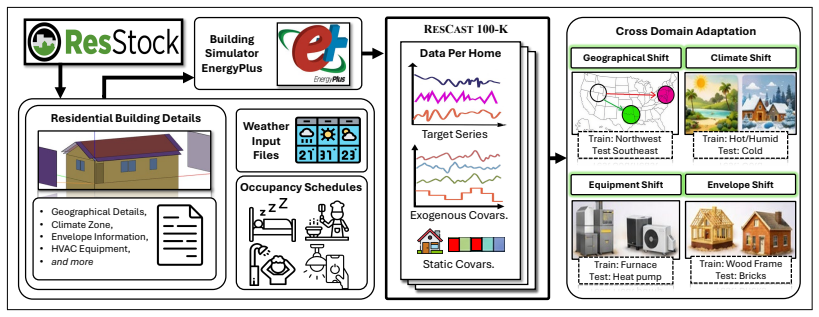
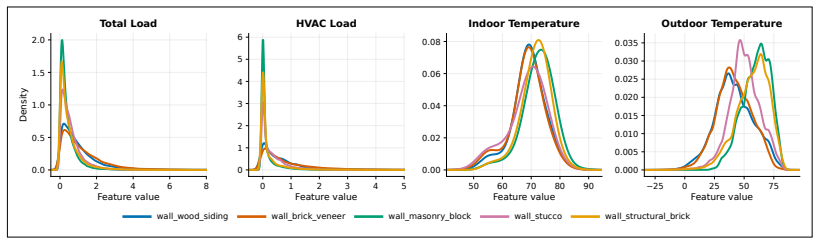
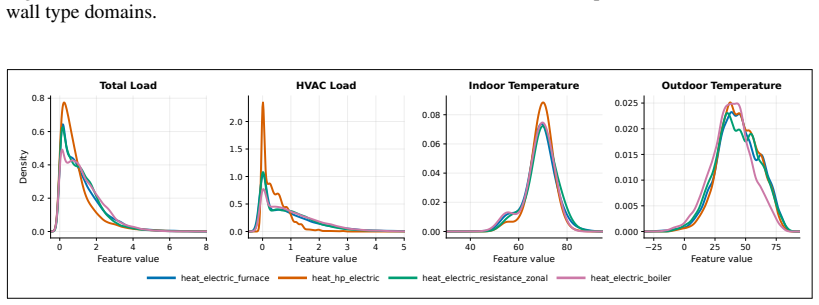
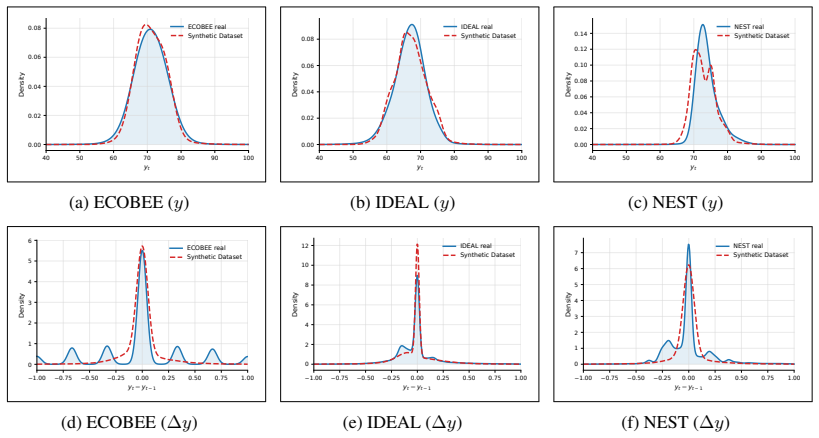
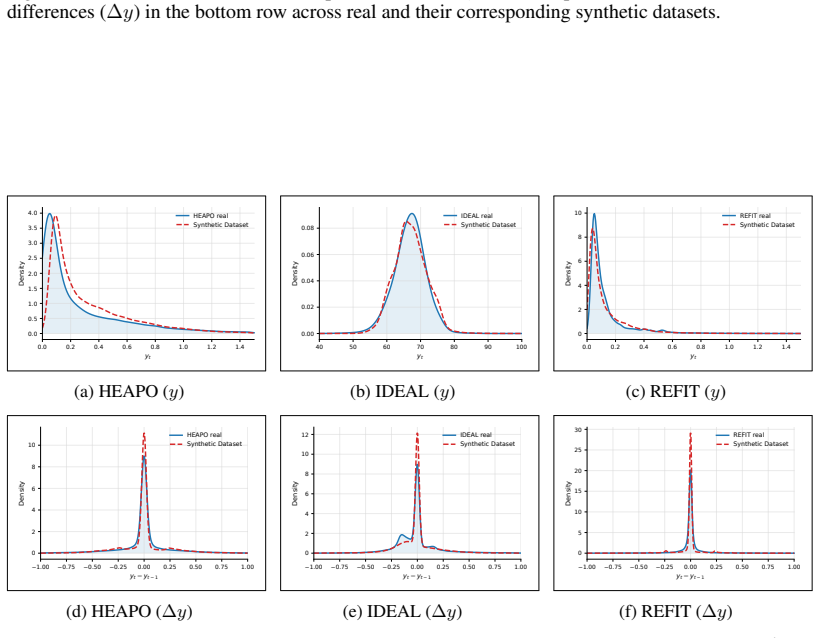
RESCAST-100K provides approximately 100,000 EnergyPlus-simulated U.S. homes derived from ResStock, each with 15-minute time series for total load, HVAC load, and indoor temperature, paired with weather channels, HVAC setpoints, and over 40 static building covariates. It also integrates five real-world residential datasets under a unified schema. The central mechanism is a configuration-driven interface that instantiates source and target domains along interpretable axes including geography, climate zone, wall construction, and heating equipment, enabling systematic evaluation of transfer learning, domain adaptation, and zero-shot generalization under controlled domain shifts. Benchmark resul
What carries the argument
The configuration-driven interface that instantiates source and target domains along interpretable axes including geography, climate zone, wall construction, and heating equipment.
If this is right
- Researchers can now run controlled experiments comparing recurrent, attention-based, and MLP-mixer models for zero-shot performance across domains and missing-input conditions.
- Cross-attention and MLP-mixer models can be expected to deliver higher accuracy than recurrent and classical transformer baselines when domain shifts are present.
- Direct sim-to-real evaluation becomes feasible on the same load and temperature forecasting tasks.
- The benchmark supports studies at home, community, and grid scale by providing consistent data across many domain combinations.
Where Pith is reading between the lines
- Improved zero-shot models developed with this benchmark could allow deployment in new regions with minimal or no local training data.
- The same configuration approach might be extended to test generalization across additional building types or international locations.
- Forecast accuracy gains could feed into optimization routines for home energy management systems that operate under varying climate and equipment conditions.
Load-bearing premise
The simulated homes and integrated real datasets generate domain shifts that are representative of real-world residential variability and that affect forecasting model performance in the intended ways.
What would settle it
An experiment in which models trained on one climate zone or construction type show no measurable drop in accuracy when tested on another zone or type within the benchmark would indicate that the controlled shifts do not produce the expected generalization challenge.
Figures
read the original abstract
Accurate short-term forecasting of residential energy load and indoor temperature is essential for home energy management systems, grid-level demand response, and community energy efficiency efforts. Domain adaptation and transfer learning have shown promise for improving forecasting accuracy under data heterogeneity and scarcity commonly seen in residential settings. However, progress is limited by the lack of comprehensive residential datasets: existing benchmarks are narrow in target coverage and rarely support structured cross-domain evaluation. We introduce RESCAST-100K, a large-scale residential forecasting benchmark for studying cross-domain generalization. It provides a configuration-driven interface that instantiates source and target domains along interpretable axes, including geography, climate zone, wall construction, and heating equipment, enabling systematic evaluation of transfer learning, domain adaptation, and zero-shot generalization under controlled domain shifts. The benchmark covers approximately 100,000 EnergyPlus-simulated U.S. homes derived from ResStock, with 15-minute time series for three coupled targets per home: total load, HVAC load, and indoor temperature. These are paired with weather channels, HVAC setpoints, and over 40 static building covariates. RESCAST-100K also integrates five real-world residential datasets under a unified schema, supporting sim-to-real evaluation on the same tasks. We benchmark recurrent, attention-based, and MLP-mixer architectures for zero-shot performance across domains, missing-input conditions, and forecasting tasks. Cross-attention and MLP-mixer models consistently outperform recurrent and classical transformer baselines under domain shift. RESCAST-100K is intended to aid the machine learning and building analytics communities advance cross-domain residential forecasting at home, community, and grid scale.
Editorial analysis
A structured set of objections, weighed in public.
Referee Report
Summary. The manuscript introduces RESCAST-100K, a large-scale benchmark dataset for cross-domain residential load and indoor temperature forecasting. It comprises ~100k EnergyPlus simulations of U.S. homes derived from ResStock (with 15-minute time series for total load, HVAC load, and indoor temperature, plus weather and >40 static covariates) together with five integrated real-world datasets under a unified schema. A configuration-driven interface allows instantiation of source/target domains along interpretable axes (geography, climate zone, wall construction, heating equipment) to support systematic study of transfer learning, domain adaptation, and zero-shot generalization. The paper also reports benchmarks of recurrent, attention-based, and MLP-mixer architectures, claiming that cross-attention and MLP-mixer models consistently outperform recurrent and classical transformer baselines under domain shift.
Significance. If the simulated domain shifts prove representative of real residential variability and produce the expected systematic effects on forecasting performance, RESCAST-100K would address a clear gap in existing narrow benchmarks and provide a valuable standardized resource for the ML and building analytics communities working on data heterogeneity in residential energy applications.
major comments (2)
- [Abstract] Abstract / dataset description: The central claim that the configuration-driven interface enables 'systematic evaluation of transfer learning, domain adaptation, and zero-shot generalization under controlled domain shifts' is load-bearing for the contribution, yet the manuscript provides no quantitative validation of simulation fidelity, no error analysis comparing EnergyPlus/ResStock outputs to real measurements, and no demonstration that the resulting shifts in load/temperature series degrade model performance in an axis-aligned manner rather than as simulation artifacts.
- [Benchmarks] Benchmarks section: The statement that 'cross-attention and MLP-mixer models consistently outperform recurrent and classical transformer baselines under domain shift' is presented without accompanying performance numbers, tables, or analysis showing performance gaps along the claimed axes (e.g., climate zone or heating equipment); this leaves the utility of the controlled shifts for domain-adaptation research unverified.
minor comments (1)
- [Abstract] The abstract would be strengthened by inclusion of at least one or two key quantitative benchmark results to substantiate the outperformance claims.
Simulated Author's Rebuttal
We thank the referee for their detailed and constructive feedback on the RESCAST-100K manuscript. We address each major comment below and commit to revisions that strengthen the validation of the dataset and benchmarks.
read point-by-point responses
-
Referee: [Abstract] Abstract / dataset description: The central claim that the configuration-driven interface enables 'systematic evaluation of transfer learning, domain adaptation, and zero-shot generalization under controlled domain shifts' is load-bearing for the contribution, yet the manuscript provides no quantitative validation of simulation fidelity, no error analysis comparing EnergyPlus/ResStock outputs to real measurements, and no demonstration that the resulting shifts in load/temperature series degrade model performance in an axis-aligned manner rather than as simulation artifacts.
Authors: We agree that quantitative validation of simulation fidelity is essential to substantiate the controlled domain shifts. Although ResStock/EnergyPlus is a widely used and validated platform in the building science community, the manuscript does not include explicit error metrics against the integrated real-world datasets. In the revised manuscript, we will add a dedicated validation subsection that reports distribution-level comparisons (e.g., Kolmogorov-Smirnov statistics and mean absolute percentage errors) between simulated and measured load/temperature series for overlapping climate zones and building types. We will also include an axis-aligned degradation analysis showing forecasting error increases when shifting along individual covariates (climate zone, heating equipment) while holding others fixed, to distinguish systematic shifts from potential simulation artifacts. revision: yes
-
Referee: [Benchmarks] Benchmarks section: The statement that 'cross-attention and MLP-mixer models consistently outperform recurrent and classical transformer baselines under domain shift' is presented without accompanying performance numbers, tables, or analysis showing performance gaps along the claimed axes (e.g., climate zone or heating equipment); this leaves the utility of the controlled shifts for domain-adaptation research unverified.
Authors: We acknowledge that the benchmarks section as currently written does not provide the detailed numerical results or axis-specific breakdowns needed to fully verify the claims. The revised manuscript will expand the benchmarks section with complete tables reporting MAE, RMSE, and MAPE for all model families across source-target pairs, together with figures that disaggregate performance gaps by climate zone, heating equipment type, and wall construction. These additions will directly demonstrate the utility of the controlled shifts for domain-adaptation studies. revision: yes
Circularity Check
Dataset benchmark paper with no derivations or self-referential claims
full rationale
The manuscript describes the construction of RESCAST-100K from ResStock/EnergyPlus simulations plus five real datasets, a unified schema, and baseline model benchmarks. No equations, fitted parameters, uniqueness theorems, or ansatzes appear in the provided text. The central claim is the existence and utility of the released resource itself; it does not derive any quantity from prior results that could reduce to its own inputs. Self-citations, if present, are not load-bearing for any inference chain. This is the standard non-circular outcome for a data-release paper.
Axiom & Free-Parameter Ledger
Reference graph
Works this paper leans on
-
[1]
URLhttps://www.pecanstreet.org/dataport/
Pecan street dataport, Apr 2025. URLhttps://www.pecanstreet.org/dataport/
2025
-
[2]
Alden, Huangjie Gong, Cristinel Ababei, and Dan M
Rosemary E. Alden, Huangjie Gong, Cristinel Ababei, and Dan M. Ionel. Lstm forecasts for smart home electricity usage. In2020 9th International Conference on Renewable Energy Research and Application (ICRERA), pages 434–438, 2020. doi: 10.1109/ICRERA49962.2020. 9242804
-
[3]
Clue: Safe model-based rl hvac control using epistemic uncertainty estimation
Zhiyu An, Xianzhong Ding, Arya Rathee, and Wan Du. Clue: Safe model-based rl hvac control using epistemic uncertainty estimation. BuildSys ’23, page 149–158, New York, NY , USA, 2023. Association for Computing Machinery. ISBN 9798400702303. doi: 10.1145/3600100.3623742
-
[4]
Hierarchical transfer learning with applications to electricity load forecasting.International Journal of Forecasting, 40(2):641–660, 2024
Anestis Antoniadis, Solenne Gaucher, and Yannig Goude. Hierarchical transfer learning with applications to electricity load forecasting.International Journal of Forecasting, 40(2):641–660, 2024
2024
-
[5]
ANSI/ASHRAE Standard 140-2023: Method of Test for Evaluating Building Performance Simulation Software
ASHRAE. ANSI/ASHRAE Standard 140-2023: Method of Test for Evaluating Building Performance Simulation Software. Technical report, American Society of Heating, Refrigerating and Air-Conditioning Engineers, Atlanta, GA, 2023
2023
-
[6]
A hot dataset: 150,000 buildings for hvac operations transfer research
Anaïs Berkes, Yoshua Bengio, David Rolnick, and Donna Vakalis. A hot dataset: 150,000 buildings for hvac operations transfer research. InProceedings of the 12th ACM International Conference on Systems for Energy-Efficient Buildings, Cities, and Transportation, BuildSys ’25, page 171–180, New York, NY , USA, 2025. Association for Computing Machinery. ISBN ...
-
[7]
Tobias Brudermueller, Elgar Fleisch, Marina González Vayá, and Thorsten Staake. Heapo – an open dataset for heat pump optimization with smart electricity meter data and on-site inspection protocols. InProceedings of the 16th ACM International Conference on Future and Sustainable Energy Systems, E-Energy ’25, page 699–711, New York, NY , USA, 2025. Associa...
-
[8]
Two-layer transfer-learning-based architecture for short-term load forecasting.IEEE Transactions on Industrial Informatics, 16(3):1722–1732, 2019
Long Cai, Jie Gu, and Zhijian Jin. Two-layer transfer-learning-based architecture for short-term load forecasting.IEEE Transactions on Industrial Informatics, 16(3):1722–1732, 2019
2019
-
[9]
Enrico Casella, Simone Silvestri, D. A. Baker, and Sajal K. Das. A human-centered power conservation framework based on reverse auction theory and machine learning.ACM Trans. Cyber-Phys. Syst., 8(3), July 2024. ISSN 2378-962X. doi: 10.1145/3656348
-
[10]
Jianli Chen, Rajendra Adhikari, Eric Wilson, Joseph Robertson, Anthony Fontanini, Ben Polly, and Opeoluwa Olawale. Stochastic simulation of occupant-driven energy use in a bottom-up residential building stock model.Applied Energy, 325:119890, 2022. ISSN 0306-2619. doi: https://doi.org/10.1016/j.apenergy.2022.119890
-
[11]
Yoder, Sercan O
Si-An Chen, Chun-Liang Li, Nathanael C. Yoder, Sercan O. Arik, and Tomas Pfister. Tsmixer: An all-mlp architecture for time series forecasting.Transactions on Machine Learning Research (TMLR), 2023
2023
-
[12]
The impact of extreme weather on peak electricity demand from homes heated by air source heat pumps.Energy Sources, Part B: Economics, Planning, and Policy, 16(8):707–718, 2021
Michael Chesser, Padraic O’Reilly, Padraig Lyons, and Paula Carroll. The impact of extreme weather on peak electricity demand from homes heated by air source heat pumps.Energy Sources, Part B: Economics, Planning, and Policy, 16(8):707–718, 2021. 10
2021
-
[14]
Shijon Das, Mostafa M. Fouda, and Mohammad G. Abdo. Short-term load forecasting using gru-lgbm fusion. In2024 International Conference on Smart Applications, Communications and Networking (SmartNets), pages 1–6, 2024. doi: 10.1109/SmartNets61466.2024.10577637
-
[15]
Hengfang Deng, David Fannon, and Matthew J. Eckelman. Predictive modeling for us commer- cial building energy use: A comparison of existing statistical and machine learning algorithms using cbecs microdata.Energy and Buildings, 163:34–43, 2018. ISSN 0378-7788. doi: https://doi.org/10.1016/j.enbuild.2017.12.031
-
[16]
Dhruva and Simone Silvestri
Jainam J. Dhruva and Simone Silvestri. Surrogate-assisted adaptive evolutionary algorithm for efficient hvac control in home energy management systems.IEEE Access, 14:56010–56025,
-
[17]
doi: 10.1109/ACCESS.2026.3682562
-
[18]
Buildingsbench: A large-scale dataset of 900k buildings and benchmark for short-term load forecasting
Patrick Emami, Abhijeet Sahu, and Peter Graf. Buildingsbench: A large-scale dataset of 900k buildings and benchmark for short-term load forecasting. InThirty-seventh Conference on Neural Information Processing Systems Datasets and Benchmarks Track, 2023
2023
-
[19]
An efficient P300-based brain–computer interface for disabled subjects
Xi Fang, Guangcai Gong, Guannan Li, Liang Chun, Pei Peng, and Xing Shi. Transferability investigation of a sim2real deep transfer learning framework for cross-building energy prediction. Energy and Buildings, 287:112968, 2023. ISSN 0378-7788. doi: https://doi.org/10.1016/j. enbuild.2023.112968
work page doi:10.1016/j 2023
-
[20]
Zhen Fang, Nicolas Crimier, Lisa Scanu, Alphanie Midelet, Amr Alyafi, and Benoit Delinchant. Multi-zone indoor temperature prediction with lstm-based sequence to sequence model.Energy and Buildings, 245:111053, 2021. doi: 10.1016/j.enbuild.2021.111053
-
[21]
Model-agnostic meta-learning for fast adap- tation of deep networks
Chelsea Finn, Pieter Abbeel, and Sergey Levine. Model-agnostic meta-learning for fast adap- tation of deep networks. InInternational conference on machine learning, pages 1126–1135. PMLR, 2017
2017
-
[22]
Steven Firth, Tom Kane, Vanda Dimitriou, Tarek Hassan, Farid Fouchal, Michael Cole- man, and Lynda Webb. REFIT Smart Home dataset. 6 2017. doi: 10.17028/ rd.lboro.2070091.v1. URL https://repository.lboro.ac.uk/articles/dataset/ REFIT_Smart_Home_dataset/2070091
arXiv 2017
-
[23]
Nan Gao, Wei Shao, Mohammad Saiedur Rahaman, Jun Zhai, Klaus David, and Flora D. Salim. Transfer learning for thermal comfort prediction in multiple cities.Building and Environment, 195:107725, 2021. ISSN 0360-1323. doi: https://doi.org/10.1016/j.buildenv.2021.107725
-
[24]
Transfer learning in transformer-based demand forecasting for home energy management system
Gargya Gokhale, Jonas Van Gompel, Bert Claessens, and Chris Develder. Transfer learning in transformer-based demand forecasting for home energy management system. BuildSys ’23, page 458–462, New York, NY , USA, 2023. Association for Computing Machinery. ISBN 9798400702303. doi: 10.1145/3600100.3626635
-
[25]
Yu He, Fengji Luo, and Gianluca Ranzi. Transferrable model-agnostic meta-learning for short-term household load forecasting with limited training data.IEEE Transactions on Power Systems, 37(4):3177–3180, 2022. doi: 10.1109/TPWRS.2022.3169389
-
[26]
UCI Machine Learning Repository (2006), DOI: https://doi.org/10.24432/C58K54
Georges Hebrail and Alice Berard. Individual Household Electric Power Consumption. UCI Machine Learning Repository, 2006. DOI: https://doi.org/10.24432/C58K54
-
[27]
Comprehensive energy demand and usage data for building automation
Philipp Heer, Curdin Derungs, Benjamin Huber, Felix Bünning, Reto Fricker, Sascha Stoller, and Björn Niesen. Comprehensive energy demand and usage data for building automation. Scientific Data, 11(1):469, May 2024. ISSN 2052-4463. doi: 10.1038/s41597-024-03292-2. URLhttps://doi.org/10.1038/s41597-024-03292-2
-
[28]
Sepp Hochreiter and Jürgen Schmidhuber. Long short-term memory.Neural Comput., 9(8): 1735–1780, November 1997. ISSN 0899-7667. doi: 10.1162/neco.1997.9.8.1735
-
[29]
Building performance database
Josh Kace, Travis Walter, and Earth Advantage. Building performance database. Open Energy Data Initiative (OEDI), Office of Energy Efficiency & Renewable En- ergy, https://data.openei.org/submissions/145, 2014. URL https://data.openei.org/ submissions/145. Accessed: 2026-04-29. 11
2014
-
[30]
A synthetic energy dataset for non-intrusive load monitoring in households.Scientific data, 7(1): 108, 2020
Christoph Klemenjak, Christoph Kovatsch, Manuel Herold, and Wilfried Elmenreich. A synthetic energy dataset for non-intrusive load monitoring in households.Scientific data, 7(1): 108, 2020
2020
-
[31]
Stephen J Lee and Cailinn Drouin. Forecasting residential heating and electricity demand with scalable, high-resolution, open-source models.arXiv preprint arXiv:2505.22873, 2025
Pith/arXiv arXiv 2025
-
[32]
Building thermal dynamics modeling with deep learning exploiting large residential smart thermostat dataset
Han Li, Giuseppe Pinto, Alfonso Capozzoli, and Tianzhen Hong. Building thermal dynamics modeling with deep learning exploiting large residential smart thermostat dataset. InProceedings of the 9th ACM International Conference on Systems for Energy-Efficient Buildings, Cities, and Transportation, pages 242–245, 2022
2022
-
[33]
Transfer learning applied to drl-based heat pump control to leverage microgrid energy efficiency.Smart Energy, 3:100044, 2021
Paulo Lissa, Michael Schukat, Marcus Keane, and Enda Barrett. Transfer learning applied to drl-based heat pump control to leverage microgrid energy efficiency.Smart Energy, 3:100044, 2021
2021
-
[34]
Lawrence berkeley national lab building 59, 01 2021
Na Luo and Tianzhen Hong. Lawrence berkeley national lab building 59, 01 2021. URL https://www.osti.gov/biblio/1762808
arXiv 2021
-
[35]
Ecobee donate your data 1,000 homes in 2017, 03 2022
Na Luo and Tianzhen Hong. Ecobee donate your data 1,000 homes in 2017, 03 2022. URL https://www.osti.gov/biblio/1854924
arXiv 2017
-
[36]
Clayton Miller and Forrest Meggers. The building data genome project: An open, public data set from non-residential building electrical meters.Energy Procedia, 122:439 – 444, 2017. ISSN 1876-6102. doi: https://doi.org/10.1016/j.egypro.2017.07.400. {CISBAT} 2017 International ConferenceFuture Buildings & Districts – Energy Efficiency from Nano to Urban Scale
-
[37]
Hobson, Zixiao Shi, and Forrest Meggers
Clayton Miller, Anjukan Kathirgamanathan, Bianca Picchetti, Pandarasamy Arjunan, June Young Park, Zoltan Nagy, Paul Raftery, Brodie W. Hobson, Zixiao Shi, and Forrest Meggers. The building data genome project 2, energy meter data from the ashrae great energy predictor iii competition.Scientific Data, 7(1), Oct 2020. doi: 10.1038/s41597-020-00712-x
-
[38]
Ozan Baris Mulayim, Pengrui Quan, Liying Han, Xiaomin Ouyang, Dezhi Hong, Mario Bergés, and Mani Srivastava. Are time series foundation models ready to revolutionize predictive building analytics? InProceedings of the 11th ACM International Conference on Systems for Energy-Efficient Buildings, Cities, and Transportation, pages 169–173, 2024
2024
-
[39]
Transfer learning and explainable ai for heating load forecasting: A large-scale benchmark with shap-based static features.Energy and AI, page 100722, 2026
Alexander Neubauer, Mengbo Yu, Pedram Babakhani, Stefan Brandt, and Martin Kriegel. Transfer learning and explainable ai for heating load forecasting: A large-scale benchmark with shap-based static features.Energy and AI, page 100722, 2026
2026
-
[40]
Nguyen, Phanwadee Sinthong, and Jayant Kalagnanam
Yuqi Nie, Nam H. Nguyen, Phanwadee Sinthong, and Jayant Kalagnanam. A time series is worth 64 words: Long-term forecasting with transformers. InInternational Conference on Learning Representations (ICLR), 2023
2023
-
[41]
National Renewable Energy Laboratory (NREL). Energyplus™, 09 2017. URL https: //www.osti.gov/biblio/1395882
arXiv 2017
-
[42]
Comstock reference documentation (v.1)
Andrew Parker, Henry Horsey, Matthew Dahlhausen, Marlena Praprost, Christopher CaraDonna, Amy LeBar, and Lauren Klun. Comstock reference documentation (v.1). Technical report, National Renewable Energy Laboratory (NREL), Golden, CO (United States), 03 2023. URL https://www.osti.gov/biblio/1967948
arXiv 2023
-
[43]
Climate-adaptive energy forecasting in green buildings via attention-enhanced seq2seq transfer learning.Scientific Reports, 15(1): 31829, 2025
Fang Peng, Tao Su, Qing Zeng, and Xiaojuan Han. Climate-adaptive energy forecasting in green buildings via attention-enhanced seq2seq transfer learning.Scientific Reports, 15(1): 31829, 2025
2025
-
[44]
Building timeseries dataset: Empowering large-scale building analytics
Arian Prabowo, Xiachong Lin, Imran Razzak, Hao Xue, Emily W Yap, Matthew Amos, and Flora D Salim. Building timeseries dataset: Empowering large-scale building analytics. Advances in Neural Information Processing Systems, 37:133180–133206, 2024
2024
-
[45]
The ideal household energy dataset, electricity, gas, contextual sensor data and survey data for 255 uk homes.Scientific Data, 8(1):146, 2021
Martin Pullinger, Jonathan Kilgour, Nigel Goddard, Niklas Berliner, Lynda Webb, Myroslava Dzikovska, Heather Lovell, Janek Mann, Charles Sutton, Janette Webb, et al. The ideal household energy dataset, electricity, gas, contextual sensor data and survey data for 255 uk homes.Scientific Data, 8(1):146, 2021
2021
-
[46]
Heng Quan and Semiha Ergan. Sim-to-real transfer learning for large-scale short-term building energy forecasting in sustainable cities. BuildSys ’25, page 86–95, New York, NY , USA, 2025. Association for Computing Machinery. ISBN 9798400719455. doi: 10.1145/3736425.3772006. 12
-
[47]
Gentl: A general transfer learning model for building thermal dynamics
Fabian Raisch, Thomas Krug, Christoph Goebel, and Benjamin Tischler. Gentl: A general transfer learning model for building thermal dynamics. InProceedings of the 16th ACM International Conference on Future and Sustainable Energy Systems (E-Energy), 2025. doi: 10.1145/3679240.3734589
-
[48]
Sufiyan Rehman. London Low Carbon Dataset. 8 2025. doi: 10.6084/m9.figshare.29983723. v2. URL https://figshare.com/articles/dataset/London_Low_Carbon_Dataset/ 29983723
-
[49]
Smart building temperature forecasting with probabilistic temporal fusion transformers
Abhinav Sagar. Smart building temperature forecasting with probabilistic temporal fusion transformers. InUrbanAI: Harnessing Artificial Intelligence for Smart Cities, Dec 2025
2025
-
[50]
Franco Scarselli, Marco Gori, Ah Chung Tsoi, Markus Hagenbuchner, and Gabriele Monfardini. The graph neural network model.IEEE Transactions on Neural Networks, 20(1):61–80, 2009. doi: 10.1109/TNN.2008.2005605
-
[51]
Real-e: A foundation benchmark for advancing robust and generalizable electricity forecasting
Chen Shao, Michael Färber, Sebastian Pütz, Benjamin Schäfer, Yue Wang, Tobias Käfer, Zhanbo Huang, and Zhenyi Zhu. Real-e: A foundation benchmark for advancing robust and generalizable electricity forecasting. InProceedings of the 34th ACM International Conference on Information and Knowledge Management, CIKM ’25, page 6523–6527, New York, NY , USA, 2025....
arXiv 2025
-
[52]
Resstock: Annual baseline results with component loads
Andrew Speake, Eric Wilson, Yueyue Zhou, and Scott Horowitz. Resstock: Annual baseline results with component loads. Open Energy Data Initiative (OEDI), National Renewable Energy Lab, https://doi.org/10.25984/2001060, 2023. URL https://data.openei.org/ submissions/5959. Accessed: 2026-04-28
-
[53]
High resolution synthetic residential energy use profiles for the united states.Scientific Data, 10(1):76, 2023
Swapna Thorve, Young Yun Baek, Samarth Swarup, Henning Mortveit, Achla Marathe, Anil Vullikanti, and Madhav Marathe. High resolution synthetic residential energy use profiles for the united states.Scientific Data, 10(1):76, 2023
2023
-
[54]
ElectricityLoadDiagrams20112014
Artur Trindade. ElectricityLoadDiagrams20112014. UCI Machine Learning Repository, 2015. DOI: https://doi.org/10.24432/C58C86
-
[55]
Department of Energy
U.S. Department of Energy. Building america climate-specific guid- ance, n.d. URL https://www.energy.gov/cmei/buildings/ building-america-climate-specific-guidance. Accessed: 2026-05-06
2026
-
[56]
Gomez, Łukasz Kaiser, and Illia Polosukhin
Ashish Vaswani, Noam Shazeer, Niki Parmar, Jakob Uszkoreit, Llion Jones, Aidan N. Gomez, Łukasz Kaiser, and Illia Polosukhin. Attention is all you need. InAdvances in Neural Informa- tion Processing Systems (NeurIPS), 2017
2017
-
[57]
Timexer: Empowering transformers for time series forecasting with exogenous variables
Yuxuan Wang, Haixu Wu, Jiaxiang Dong, Guo Qin, Haoran Zhang, Yong Liu, Yunzhong Qiu, Jianmin Wang, and Mingsheng Long. Timexer: Empowering transformers for time series forecasting with exogenous variables. InAdvances in Neural Information Processing Systems (NeurIPS), 2024
2024
-
[58]
Di Wu and Weixuan Lin. Efficient residential electric load forecasting via transfer learning and graph neural networks.IEEE Transactions on Smart Grid, 14(3):2423–2431, 2023. doi: 10.1109/TSG.2022.3208211
-
[59]
Transfer learning integrating similarity analysis for short-term and long-term building energy consumption prediction.Applied energy, 365:123276, 2024
Zhuoqun Xing, Yiqun Pan, Yiting Yang, Xiaolei Yuan, Yumin Liang, and Zhizhong Huang. Transfer learning integrating similarity analysis for short-term and long-term building energy consumption prediction.Applied energy, 365:123276, 2024
2024
-
[60]
One for many: Transfer learning for building hvac control
Shichao Xu, Yixuan Wang, Yanzhi Wang, Zheng O’Neill, and Qi Zhu. One for many: Transfer learning for building hvac control. BuildSys ’20, page 230–239, New York, NY , USA, 2020. Association for Computing Machinery. ISBN 9781450380614. doi: 10.1145/3408308.3427617
-
[61]
Zack Xuereb Conti, Ruchi Choudhary, and Luca Magri. A physics-based domain adaptation framework for modeling and forecasting building energy systems.Data-Centric Engineering, 4: e10, 2023. doi: 10.1017/dce.2023.8
-
[62]
Yanan Zhang, Gan Zhou, Zhan Liu, Li Huang, and Yucheng Ren. An adaptive transfer learning framework for data-scarce hvac power consumption forecasting.IEEE Transactions on Sustainable Energy, 15(4):2815–2825, 2024. doi: 10.1109/TSTE.2024.3444689. 13
-
[63]
FFN/token dim
Haoyi Zhou, Shanghang Zhang, Jieqi Peng, Shuai Zhang, Jianxin Li, Hui Xiong, and Wancai Zhang. Informer: Beyond efficient transformer for long sequence time-series forecasting. In Proceedings of the AAAI conference on artificial intelligence, volume 35, pages 11106–11115, 2021. Appendix A Static Home Properties Each home in RESCAST-100K is described by a ...
2021
discussion (0)
Sign in with ORCID, Apple, or X to comment. Anyone can read and Pith papers without signing in.