A coupled prediction-correction Hughes' model for congested crowd motion
Pith reviewed 2026-06-28 13:19 UTC · model grok-4.3
The pith
A coupled prediction-correction variant of Hughes' model yields numerical evidence toward well-posedness of the classical version.
A machine-rendered reading of the paper's core claim, the machinery that carries it, and where it could break.
Core claim
The coupled prediction-correction Hughes model, obtained by inserting a prediction step for density evolution before solving the Eikonal equation in the correction step, produces well-behaved numerical solutions that suggest the original Hughes system may admit unique weak solutions.
What carries the argument
The coupled prediction-correction scheme that separates an anticipatory density prediction from an Eikonal-based route correction.
Load-bearing premise
Numerical behavior observed in the coupled system can be taken as reliable evidence for the mathematical well-posedness of the original uncoupled Hughes model.
What would settle it
An explicit example of a density and velocity field that satisfies the classical Hughes equations but violates uniqueness or existence, while the coupled prediction-correction system remains well-posed on the same data.
Figures
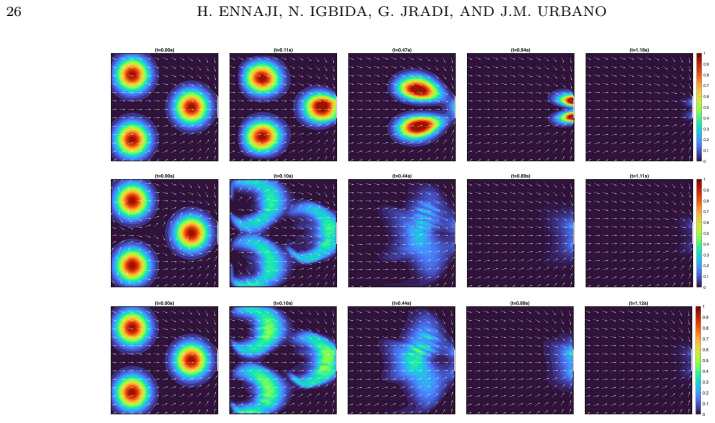
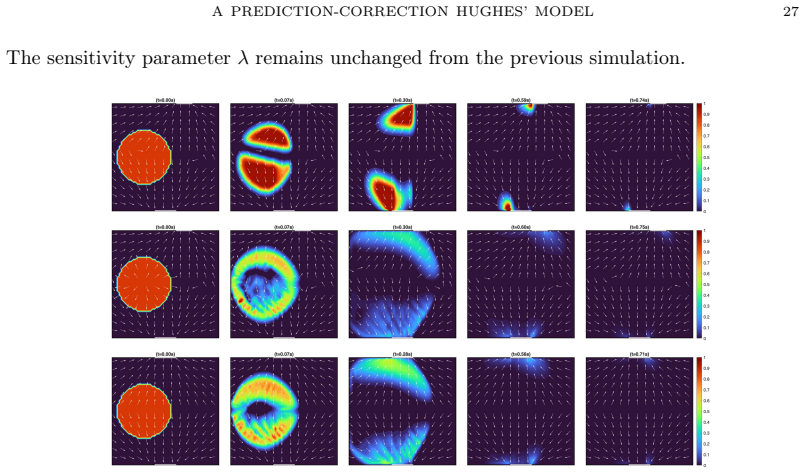
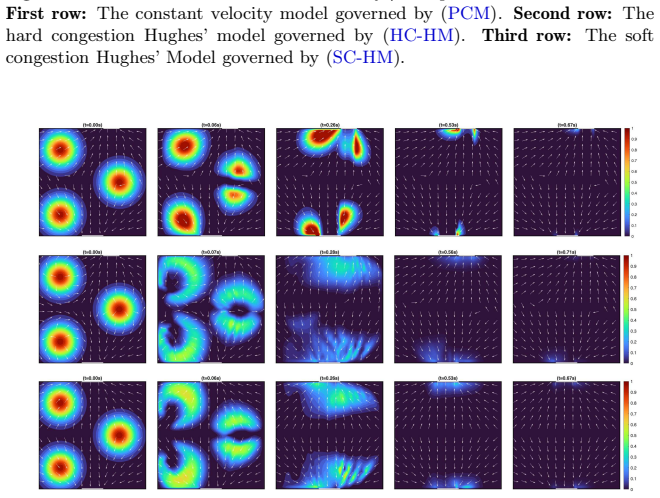
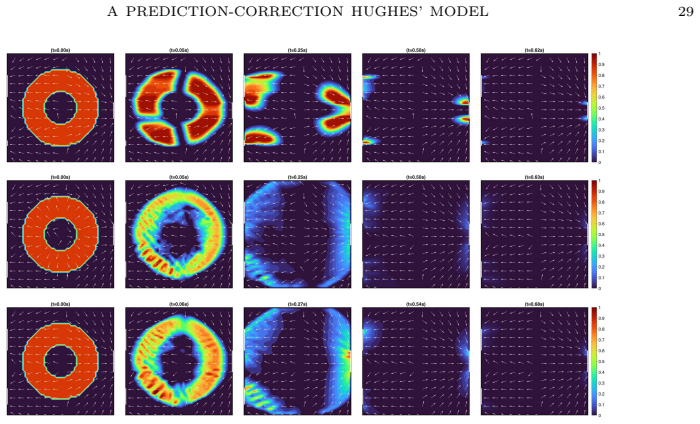
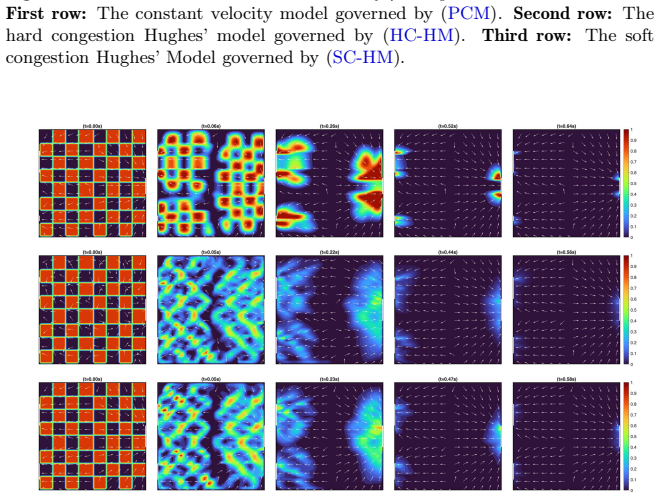
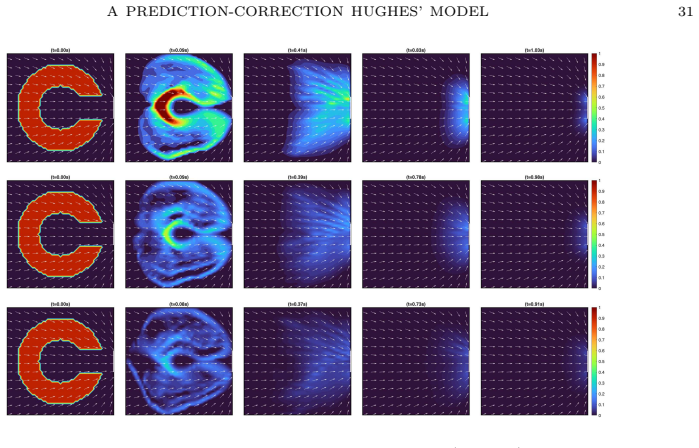
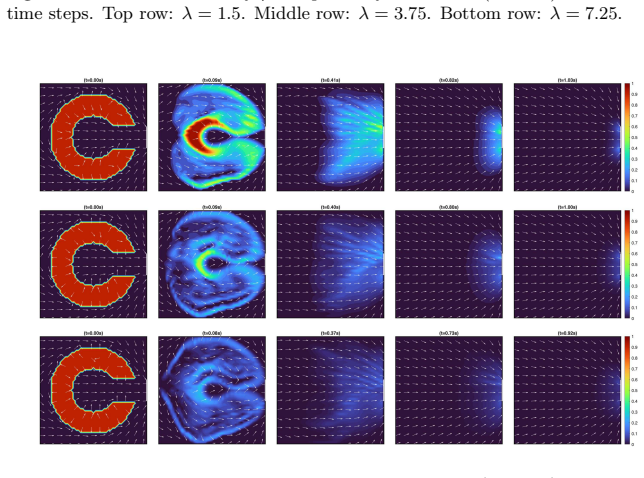
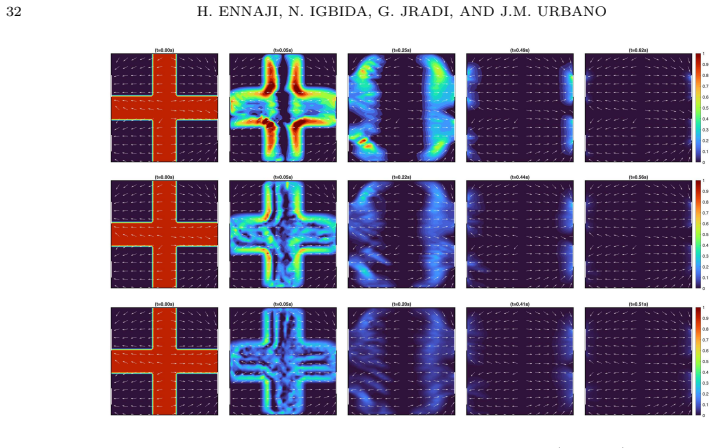
read the original abstract
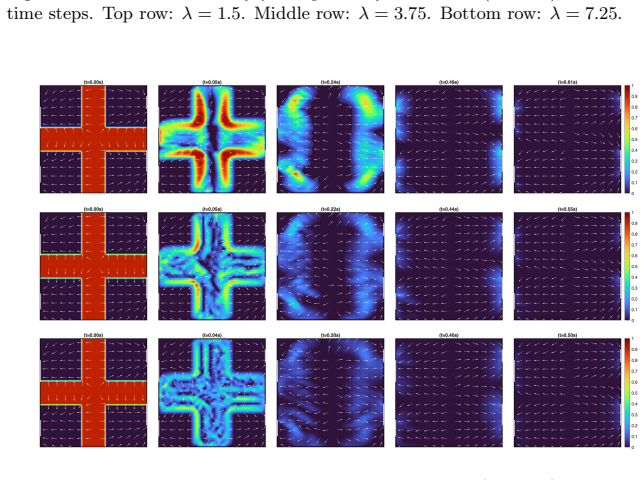
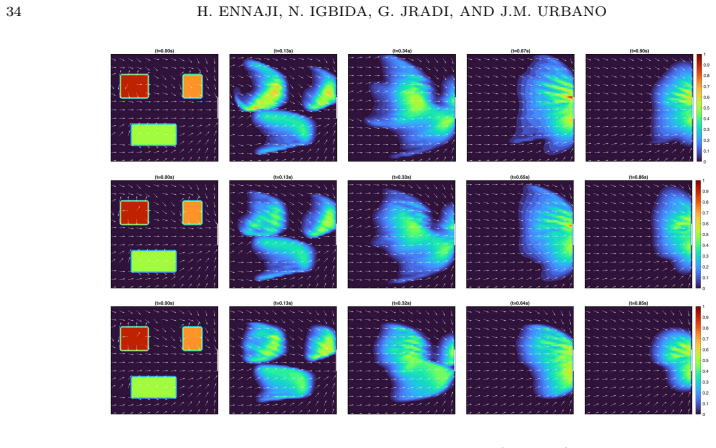
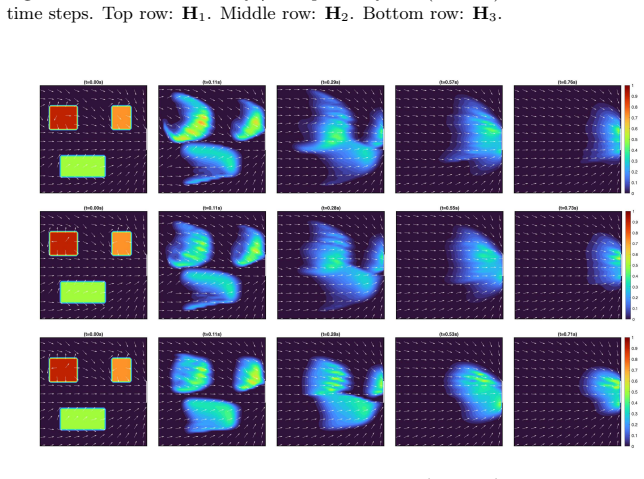
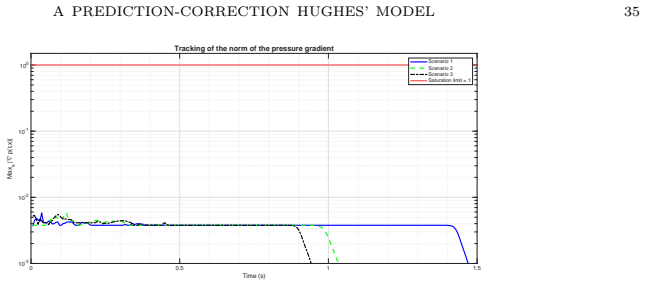
In this work, we introduce a new macroscopic model for crowd motion inspired by the celebrated Hughes' model \cite{Hughes2002, Hughes2003}, which couples a nonlinear conservation law for the pedestrian density with an Eikonal equation describing the shortest path to the target. Our approach can be viewed both as a modification of Hughes' original formulation and as a refinement of the prediction-correction framework proposed in the recent work \cite{ennaji2023prediction}. The resulting model incorporates anticipatory behavior and dynamic route adjustment, offering a more realistic representation of crowd dynamics in complex environments. We present the mathematical formulation of the model, discuss its well-posedness properties, and illustrate its qualitative behavior through numerical simulations. Ultimately, we show, at least from a numerical perspective, that this variant provides a promising avenue towards establishing the well-posedness of the classical Hughes' model, which has remained a challenging open problem for a long time.
Editorial analysis
A structured set of objections, weighed in public.
Referee Report
Summary. The manuscript introduces a coupled prediction-correction variant of Hughes' model for congested crowd motion, obtained by augmenting the classical conservation-law/Eikonal coupling with an explicit anticipatory correction step whose strength is controlled by an additional parameter. It formulates the model, discusses its well-posedness properties, and presents numerical simulations whose qualitative behavior is claimed to supply evidence, at least numerically, that the variant may open a route to proving well-posedness of the original uncoupled Hughes model.
Significance. The classical Hughes model remains a long-standing open problem in mathematical crowd dynamics. A rigorously justified limit argument showing that well-posedness of the coupled system implies well-posedness of the original would be a substantial contribution; the present numerical evidence alone does not yet establish that link.
major comments (2)
- [Abstract] Abstract (final sentence): the assertion that numerical simulations of the coupled system supply evidence for well-posedness of the classical Hughes model is not supported by any singular-limit analysis. No section derives the original Hughes equations as a limit of the coupled system when the correction parameter tends to zero, nor shows that well-posedness persists under that limit.
- [Well-posedness discussion] The well-posedness discussion for the new model (whatever section contains it) cannot be transferred to the classical model without an explicit convergence or stability estimate relating the two systems; the additional regularization introduced by the prediction-correction step may suppress precisely the singularities that render the uncoupled problem open.
minor comments (2)
- Clarify the precise functional setting (spaces, boundary conditions) in which the coupled system is stated to be well-posed.
- Add a short paragraph comparing the new parameter to existing regularizations in the literature on Hughes-type models.
Simulated Author's Rebuttal
We thank the referee for the thorough review and valuable feedback. The comments correctly identify that our claims linking the numerical results to the classical model require careful qualification. We will revise the abstract accordingly and clarify the scope of our well-posedness discussion.
read point-by-point responses
-
Referee: [Abstract] Abstract (final sentence): the assertion that numerical simulations of the coupled system supply evidence for well-posedness of the classical Hughes model is not supported by any singular-limit analysis. No section derives the original Hughes equations as a limit of the coupled system when the correction parameter tends to zero, nor shows that well-posedness persists under that limit.
Authors: We agree that the manuscript lacks a singular-limit analysis relating the coupled system to the classical Hughes model as the correction parameter approaches zero. The numerical simulations are presented to demonstrate the well-posed behavior of the new model and to suggest it as a potential regularization approach. We will revise the abstract's final sentence to indicate that the variant provides a promising avenue for future study of the classical model's well-posedness, rather than claiming that the simulations supply evidence for it. revision: yes
-
Referee: [Well-posedness discussion] The well-posedness discussion for the new model (whatever section contains it) cannot be transferred to the classical model without an explicit convergence or stability estimate relating the two systems; the additional regularization introduced by the prediction-correction step may suppress precisely the singularities that render the uncoupled problem open.
Authors: We acknowledge the validity of this point. The well-posedness analysis in the manuscript applies specifically to the coupled prediction-correction model and does not include convergence estimates to the uncoupled case. The regularization effect of the correction step is indeed a key feature that may address the open issues in the classical model, but we do not claim that the results transfer directly. This observation reinforces the need for future work on the limit process. No changes are needed to the well-posedness section itself. revision: no
Circularity Check
Minor self-citation to authors' prior framework; central numerical suggestion remains independent of inputs.
full rationale
The paper introduces a coupled prediction-correction variant as a refinement of the framework in the authors' prior work <cite{ennaji2023prediction}> and presents numerical simulations as evidence that the variant offers a promising avenue toward well-posedness of the classical Hughes model. This suggestion is an independent observation drawn from the behavior of the new system; no derivation, limit argument, or fitted quantity reduces the claim to the self-citation or to any input by construction. The self-citation supports model construction but is not load-bearing for the well-posedness avenue.
Axiom & Free-Parameter Ledger
Reference graph
Works this paper leans on
-
[1]
Adams and John J
Robert A. Adams and John J. F. Fournier. Sobolev spaces, volume 140 of Pure Appl. Math., Academic Press. New York, NY: Academic Press, 2nd ed. edition, 2003
2003
-
[2]
On the minimizing movement with the 1-W asserstein distance
Martial Agueh, Guillaume Carlier, and Noureddine Igbid a. On the minimizing movement with the 1-W asserstein distance. ESAIM, Control Optim. Calc. Var. , 24(4):1415–1427, 2018. doi:10.1051/cocv/2017055
-
[3]
Quasilinear elli ptic-parabolic differential equations
Hans Wilhelm Alt and Stephan Luckhaus. Quasilinear elli ptic-parabolic differential equations. Math. Z., 183:311–341, 1983. URL: https://eudml.org/doc/173321, doi:10.1007/BF01176474
-
[4]
Rosini, Giovanni Russo, Giu- lia Stivaletta, and Marie-Therese W olfram
Debora Amadori, Boris Andreianov, Marco Di Francesco, S imone Fagioli, Théo Girard, Paola Goatin, Peter Markowich, Jan-Frederik Pietschmann, Massi miliano D. Rosini, Giovanni Russo, Giu- lia Stivaletta, and Marie-Therese W olfram. The mathematic al theory of Hughes’ model: A sur- vey of results. In Nicola Bellomo and Livio Gibelli, editors , Crowd Dynamic...
-
[5]
Debora Amadori and M. Di Francesco. The one-dimensional Hughes model for pedestrian flow: Riemann-type solutions. Acta Math. Sci. Ser. B (Engl. Ed.) , 32(1):259–280, 2012. doi:10.1016/S0252-9602(12)60016-2
-
[6]
Debora Amadori, Paola Goatin, and Massimiliano D. Rosin i. Existence results for Hughes’ model for pedestrian flows. J. Math. Anal. Appl. , 420(1):387–406, 2014. doi:10.1016/j.jmaa.2014.05.072
-
[7]
Boris Andreianov. Time compactness tools for discretiz ed evolution equations and applications to degenerate parabolic PDEs. In Finite volumes for complex applications VI: Problems and pe rspectives. FVCA 6, international symposium, Prague, Czech Republich, Ju ne 6–10, 2011. Vol. 1 and 2. , pages 21–29. Berlin: Springer, 2011. doi:10.1007/978-3-642-20671-9_3
-
[8]
From the microscale to collective crowd dynamics
Nicola Bellomo, Abdelghani Bellouquid, and Damian Knop off. From the microscale to collective crowd dynamics. Multiscale Model. Simul. , 11(3):943–963, 2013. doi:10.1137/130904569
-
[9]
On the modeling of tr affic and crowds: a survey of models, speculations, and perspectives
Nicola Bellomo and Christian Dogbe. On the modeling of tr affic and crowds: a survey of models, speculations, and perspectives. SIAM Rev. , 53(3):409–463, 2011. doi:10.1137/090746677
-
[10]
Victor J. Blue and Jeffrey L. Adler. Emergent fundamenta l pedestrian flows from cellular automata microsimulation. Transportation Research Record , 1644(1):29–36, 1998. arXiv:https://doi.org/10.3141/1644-04, doi:10.3141/1644-04
-
[11]
Victor J. Blue and Jeffrey L. Adler. Modeling four-direc tional pedestrian flows. Transportation Research Record, 1710(1):20–27, 2000. arXiv:https://doi.org/10.3141/1710-03, doi:10.3141/1710-03
-
[12]
Functional analysis, Sobolev spaces and partial differenti al equations
Haim Brezis. Functional analysis, Sobolev spaces and partial differenti al equations . Universitext. New York, NY: Springer, 2011
2011
-
[13]
Simulation of pedestrian dynamics us- ing a two-dimensional cellular automaton
C Burstedde, K Klauck, A Schadschneider, and J Zittartz . Simulation of pedestrian dynamics us- ing a two-dimensional cellular automaton. Physica A: Statistical Mechanics and its Applications , 295(3):507–525, 2001. URL: https://www.sciencedirect.com/science/article/pii/S0378437101001418, doi:10.1016/S0378-4371(01)00141-8 . A PREDICTION-CORRECTION HUGHES’...
-
[14]
Elisabetta Carlini, Adriano Festa, and Francisco J. Si lva. The Hughes model for pedes- trian dynamics and congestion modelling. IF AC-PapersOnLine, 50(1):1655–1660, 2017. 20th IF AC W orld Congress. URL: https://www.sciencedirect.com/science/article/pii/S2405896317306614, doi:10.1016/j.ifacol.2017.08.333
-
[15]
Silva , and Marie-Therese W olfram
Elisabetta Carlini, Adriano Festa, Francisco J. Silva , and Marie-Therese W olfram. A semi-Lagrangian scheme for a modified version of the Hughes’ model for Pedestr ian flow. Dyn. Games Appl. , 7(4):683– 705, 2017. doi:10.1007/s13235-016-0202-6
-
[16]
Carrillo, Stephan Martin, and Marie-Therese W o lfram
Jose A. Carrillo, Stephan Martin, and Marie-Therese W o lfram. An improved version of the Hughes model for pedestrian flow. Math. Models Methods Appl. Sci. , 26(4):671–697, 2016. doi:10.1142/S0218202516500147
-
[17]
A First–Order Primal–Dual Algo- rithm for Convex Problems with Applications to Imaging
Antonin Chambolle and Thomas Pock. A first-order primal -dual algorithm for convex problems with applications to imaging. J. Math. Imaging Vis. , 40(1):120–145, 2011. doi:10.1007/s10851-010-0251-1
-
[18]
Multiscale modeling of pedestrian dynamics , volume 12 of MS&A, Model
Emiliano Cristiani, Benedetto Piccoli, and Andrea Tos in. Multiscale modeling of pedestrian dynamics , volume 12 of MS&A, Model. Simul. Appl. Cham: Springer, 2014. doi:10.1007/978-3-319-06620-2
-
[19]
Vision-based macroscopic pedestrian models
Pierre Degond, Cécile Appert-Rolland, Julien Pettré, and Guy Theraulaz. Vision-based macroscopic pedestrian models. Kinet. Relat. Models , 6(4):809–839, 2013. doi:10.3934/krm.2013.6.809
-
[20]
Markowich, Jan-Frederik P ietschmann, and Marie-Therese W olfram
Marco Di Francesco, Peter A. Markowich, Jan-Frederik P ietschmann, and Marie-Therese W olfram. On the Hughes’ model for pedestrian flow: the one-dimensional c ase. J. Differ. Equations , 250(3):1334– 1362, 2011. doi:10.1016/j.jde.2010.10.015
-
[21]
On the modelling of crowd dynamics by g eneralized kinetic models
Christian Dogbe. On the modelling of crowd dynamics by g eneralized kinetic models. J. Math. Anal. Appl., 387(2):512–532, 2012. doi:10.1016/j.jmaa.2011.09.007
-
[22]
Nader El-Khatib, Paola Goatin, and Massimiliano D. Ros ini. On entropy weak solutions of Hughes’ model for pedestrian motion. Z. Angew. Math. Phys. , 64(2):223–251, 2013. doi:10.1007/s00033-012-0232-x
-
[23]
Pre diction-correction pedestrian flow by means of minimum flow problem
Hamza Ennaji, Noureddine Igbida, and Ghadir Jradi. Pre diction-correction pedestrian flow by means of minimum flow problem. Math. Models Methods Appl. Sci. , 34(3):385–416, 2024. doi:10.1142/S0218202524500052
-
[24]
Augmented Lagrangian methods for degenerate Hamilton-Jacobi equations
Hamza Ennaji, Noureddine Igbida, and Van Thanh Nguyen. Augmented Lagrangian methods for degenerate Hamilton-Jacobi equations. Calc. Var. Partial Differ. Equ. , 60(6):28, 2021. Id/No 238. doi:10.1007/s00526-021-02092-5
-
[25]
A p rimal-dual algorithm for computing Finsler distances and applications
Hamza Ennaji, Yvain Quéau, and Abderrahim Elmoataz. A p rimal-dual algorithm for computing Finsler distances and applications. Calcolo, 61(3):25, 2024. Id/No 53. doi:10.1007/s10092-024-00596-y
-
[26]
Robert Eymard, Thierry Gallouët, and Raphaèle Herbin. Finite volume methods. In P. G. Ciarlet and J.-L. Lions, editors, Handbook of Numerical Analysis , volume 7, pages 713–1020. North-Holland, Amsterdam, 2000. doi:10.1016/S1570-8659(00)07005-8
-
[27]
A fully-discrete-state k inetic theory approach to modeling vehicular traffic
Luisa Fermo and Andrea Tosin. A fully-discrete-state k inetic theory approach to modeling vehicular traffic. SIAM J. Appl. Math. , 73(4):1533–1556, 2013. doi:10.1137/120897110
-
[28]
Knopoff, Jie Liao, and W enbin Ya n
Livio Gibelli, Damián A. Knopoff, Jie Liao, and W enbin Ya n. Macroscopic modeling of social crowds. Math. Models Methods Appl. Sci. , 34(6):1135–1151, 2024. doi:10.1142/S0218202524400098
-
[29]
Henderson
Le Roy F. Henderson. On the fluid mechanics of human crowd motion. Transportation Research, 8:509–515, 1974. URL: https://api.semanticscholar.org/CorpusID:154000285
1974
-
[30]
Optimal control of Hughes’ model for pedestrian flow via local attraction
Roland Herzog, Jan-Frederik Pietschmann, and Max Wink ler. Optimal control of Hughes’ model for pedestrian flow via local attraction. Appl. Math. Optim. , 88(3):44, 2023. Id/No 87. doi:10.1007/s00245-023-10064-8
-
[31]
W ong, Mengping Zhang, Chi-W ang Shu, an d William H.K
Ling Huang, S.C. W ong, Mengping Zhang, Chi-W ang Shu, an d William H.K. Lam. Revisiting Hughes’ dynamic continuum model for pedestrian flow and the developm ent of an efficient solution algorithm. Transportation Research Part B: Methodological , 43(1):127–141, 2009. doi:10.1016/j.trb.2008.06.003
-
[32]
Roger L. Hughes. A continuum theory for the flow of pedest ri- ans. Transportation Research Part B: Methodological , 36(6):507–535,
-
[33]
URL: https://www.sciencedirect.com/science/article/pii/S0191261501000157, doi:10.1016/S0191-2615(01)00015-7
-
[34]
Roger L Hughes. The flow of human crowds. Annu. Rev. Fluid Mech. , 35:169–182, 2003. doi:10.1146/annurev.fluid.35.101101.161136
-
[35]
Equivalent formulations for Monge -Kantorovich equation
Noureddine Igbida. Equivalent formulations for Monge -Kantorovich equation. Nonlinear Anal., Theory Methods Appl., Ser. A, Theory Methods , 71(9):3805–3813, 2009. doi:10.1016/j.na.2009.02.039. 40 H. ENNAJI, N. IGBIDA, G. JRADI, AND J.M. URBANO
-
[36]
Evolution Monge-Kantorovich equa tion
Noureddine Igbida. Evolution Monge-Kantorovich equa tion. J. Differ. Equations , 255(7):1383–1407, 2013. doi:10.1016/j.jde.2013.04.020
-
[37]
A granular mo del for crowd motion and pedestrian flow
Noureddine Igbida and José Miguel Urbano. A granular mo del for crowd motion and pedestrian flow. Journal of the London Mathematical Society , 111(5):e70184, 2025. URL: https://londmathsoc.onlinelibrary.wiley.com/doi/abs/10.1112/jlms.70184, doi:10.1112/jlms.70184
-
[38]
Stanislav N. Kruzhkov. Results concerning the nature o f the continuity of solutions of parabolic equa- tions and some of their applications. Mathematical Notes of the Academy of Sciences of the USSR , 6(1):517–523, 1969. doi:10.1007/BF01450257
-
[39]
Quelques méthodes de résolution des problèmes aux limites n on linéaires
Jacques-Louis Lions. Quelques méthodes de résolution des problèmes aux limites n on linéaires. Dunod; Gauthier-Villars, Paris, 1969
1969
-
[40]
On a nonlinear compactness lemma in Lp(0, T ; B)
Emmanuel Maître. On a nonlinear compactness lemma in Lp(0, T ; B). International Journal of Math- ematics and Mathematical Sciences , 2003(27):1725–1730, 2003. doi:10.1155/S0161171203106175
-
[41]
Prise en compte de la congestion dans le s modèles de mouvements de foules
Bertrand Maury. Prise en compte de la congestion dans le s modèles de mouvements de foules. In Actes des colloques EDP-Normandie, Caen 2010 – Rouen 2011 , pages 7–20. Fédération Normandie- Mathématiques, 2010
2010
-
[42]
A macroscopic crowd mo- tion model of gradient flow type
Bertrand Maury, Aude Roudneff-Chupin, and Filippo Sant ambrogio. A macroscopic crowd mo- tion model of gradient flow type. Math. Models Methods Appl. Sci. , 20(10):1787–1821, 2010. doi:10.1142/S0218202510004799
-
[43]
Handling conges- tion in crowd motion modeling
Bertrand Maury, Aude Roudneff-Chupin, Filippo Santamb rogio, and Juliette Venel. Handling conges- tion in crowd motion modeling. Netw. Heterog. Media, 6(3):485–519, 2011. doi:10.3934/nhm.2011.6.485
-
[44]
A model of the motion of crowds
Bertrand Maury and Juliette Venel. A model of the motion of crowds. ESAIM, Proc. , 18:143–152,
-
[45]
doi:10.1051/proc:071812
-
[46]
A mathematical fram ework for a crowd motion model
Bertrand Maury and Juliette Venel. A mathematical fram ework for a crowd motion model. C. R. Math. Acad. Sci. Paris , 346(23-24):1245–1250, 2008. doi:10.1016/j.crma.2008.10.014
-
[47]
Duality theory and o ptimal transport for sand piles growing in a silos
Luigi De Pascale and Chloé Jimenez. Duality theory and o ptimal transport for sand piles growing in a silos. Advances in Differential Equations , 20(9/10):859 – 886, 2015. doi:10.57262/ade/1435064516
-
[48]
Méthodes de volumes finis pour les fluide s compressibles
Nicolas Seguin. Méthodes de volumes finis pour les fluide s compressibles. Université Pierre et Marie Curie-Paris 6 , 2010. URL: https://seguin.perso.math.cnrs.fr/DOCS/cours.pdf
2010
discussion (0)
Sign in with ORCID, Apple, or X to comment. Anyone can read and Pith papers without signing in.