Interaction Cross Sections as a Structural Probe of the Hypertriton Halo
Pith reviewed 2026-06-28 11:53 UTC · model grok-4.3
The pith
Interaction cross-section measurements can determine the hypertriton matter radius and Lambda separation energy with high precision.
A machine-rendered reading of the paper's core claim, the machinery that carries it, and where it could break.
Core claim
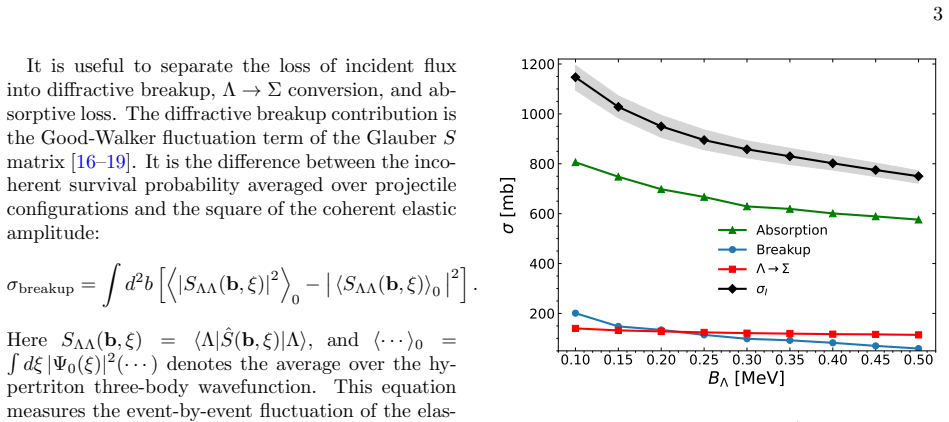
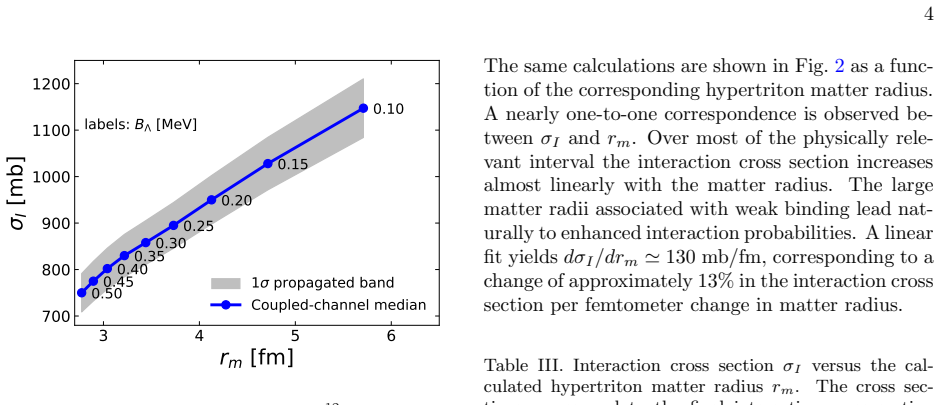
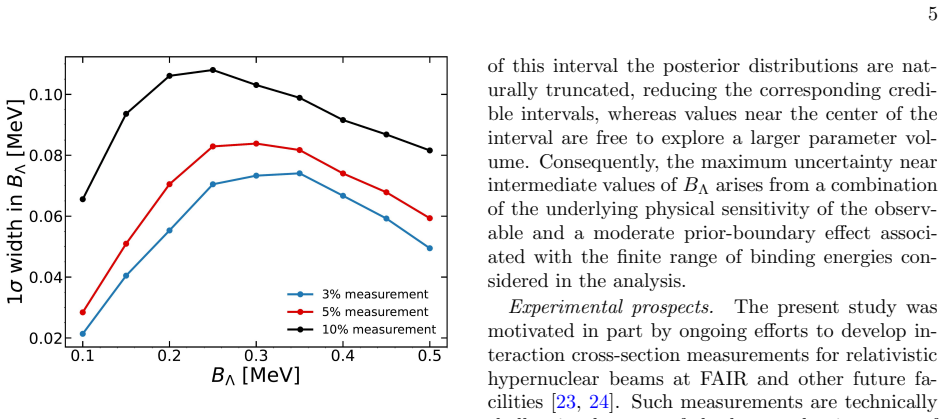
The central claim is that interaction cross-section measurements provide a direct and highly sensitive probe of both the matter radius and the Lambda separation energy of the hypertriton. Using realistic three-body wavefunctions in a coupled-channel Glauber theory that includes proton, neutron, and hyperon densities plus Lambda N to Sigma N coupling, the interaction cross section changes by about 400 mb across the currently allowed range of Lambda separation energies, with theoretical uncertainties below approximately 5%. Bayesian inversion shows that future measurements can determine both quantities with potentially unprecedented precision.
What carries the argument
Realistic three-body hypertriton wavefunctions combined with coupled-channel Glauber theory that incorporates proton, neutron, and hyperon densities together with Lambda N ↔ Sigma N channel coupling.
If this is right
- Future interaction cross-section measurements can determine the hypertriton matter radius and the Lambda separation energy with potentially unprecedented precision via Bayesian inversion.
- The interaction cross section changes by about 400 mb across the currently allowed range of Lambda separation energies.
- Theoretical uncertainties remain below approximately 5% when using the described wavefunctions and theory.
- Interaction cross sections become established as a new structural observable for hypernuclear halo physics.
Where Pith is reading between the lines
- This method could be tested on other weakly bound hypernuclei to check if similar sensitivity holds.
- Precise values extracted this way would help test models of the Lambda-nucleon force in three-body systems.
- It offers a way to cross-check binding energies obtained from decay or production experiments.
Load-bearing premise
The three-body hypertriton wavefunctions are realistic and the coupled-channel Glauber theory accurately captures the interaction cross section without significant missing higher-order effects or normalization uncertainties.
What would settle it
An experimental measurement of the hypertriton interaction cross section that falls outside the predicted 400 mb variation across the allowed Lambda separation energy range or exceeds the stated theoretical uncertainty band of about 5% would challenge the central claim.
Figures
read the original abstract
The hypertriton (${}^{3}_{\Lambda}\mathrm H$) is the most weakly bound known hypernucleus and one of the most spatially extended quantum halo systems observed in nature. Despite decades of experimental and theoretical effort, its matter radius and $\Lambda$ separation energy remain incompletely constrained. We demonstrate theoretically that interaction cross-section measurements provide a direct and highly sensitive probe of both quantities. Realistic three-body hypertriton wavefunctions are combined with a coupled-channel Glauber theory incorporating proton, neutron, and hyperon densities together with $\Lambda N\leftrightarrow\Sigma N$ channel coupling. The resulting interaction cross section changes by about 400 mb across the currently allowed range of $\Lambda$ separation energies while retaining theoretical uncertainties below approximately 5\%. A Bayesian inversion demonstrates that future interaction cross-section measurements can determine both the hypertriton matter radius and the $\Lambda$ separation energy with potentially unprecedented precision. These results establish interaction cross sections as a new structural observable for hypernuclear halo physics.
Editorial analysis
A structured set of objections, weighed in public.
Referee Report
Summary. The manuscript claims that interaction cross sections measured on the hypertriton provide a direct and sensitive probe of both its matter radius and Lambda separation energy. Realistic three-body wavefunctions are combined with coupled-channel Glauber theory (including proton, neutron, and hyperon densities plus Lambda N <-> Sigma N coupling) to show that the cross section varies by ~400 mb across the allowed range of separation energies while theoretical uncertainties remain below ~5%. A Bayesian inversion is then used to argue that future measurements can determine both quantities with high precision.
Significance. If the central numerical claims hold, the work would introduce interaction cross sections as a new structural observable capable of tightening constraints on the hypertriton halo, a system whose radius and binding energy have remained incompletely determined for decades.
major comments (2)
- [Abstract] Abstract (method paragraph): the headline result that theoretical uncertainties remain below ~5% while the cross section changes by 400 mb is load-bearing for the claim of discriminating power, yet the text supplies no explicit error budget, no comparison to exact few-body reaction calculations, and no validation against measured cross sections on analogous halo systems that would bound higher-order multiple-scattering or breakup corrections.
- [Abstract] Abstract (results paragraph): the Bayesian inversion's claimed precision for both radius and separation energy presupposes that the Glauber model output is accurate to the stated 5% level; without a quantitative assessment of missing higher-order effects for the extremely diffuse halo, the inversion's reliability cannot be evaluated.
minor comments (2)
- Specify the precise three-body wavefunctions employed (e.g., which potentials and which literature sources) and whether they are varied within the calculation.
- Clarify the target nucleus and beam energy at which the interaction cross sections are computed, as these enter the Glauber optical limit.
Simulated Author's Rebuttal
We thank the referee for the careful review and constructive criticism. The two major comments correctly identify that the abstract's headline claims on theoretical uncertainty and Bayesian precision require stronger supporting discussion in the manuscript. We address each point below and will revise the text to incorporate additional detail on error sources and model applicability.
read point-by-point responses
-
Referee: [Abstract] Abstract (method paragraph): the headline result that theoretical uncertainties remain below ~5% while the cross section changes by 400 mb is load-bearing for the claim of discriminating power, yet the text supplies no explicit error budget, no comparison to exact few-body reaction calculations, and no validation against measured cross sections on analogous halo systems that would bound higher-order multiple-scattering or breakup corrections.
Authors: The quoted 5% figure is obtained from the variation across the ensemble of realistic three-body wave functions (different λ separation energies and Λ NΣN couplings) used to generate the densities fed into the Glauber calculation. We agree that an explicit error budget is not supplied in the abstract and will add a concise paragraph (or table) in the methods section of the revised manuscript that decomposes the uncertainty into wave-function model spread, density parametrization, and channel-coupling effects. Exact few-body reaction calculations for the hypertriton interaction cross section do not exist in the literature; this is a field-level limitation rather than an omission of the present work. We will insert a short validation subsection referencing Glauber benchmarks on other halo systems (^{11}Li, ^{11}Be) where the model reproduces measured cross sections to within a few percent, thereby bounding the size of higher-order corrections for the hypertriton halo. revision: yes
-
Referee: [Abstract] Abstract (results paragraph): the Bayesian inversion's claimed precision for both radius and separation energy presupposes that the Glauber model output is accurate to the stated 5% level; without a quantitative assessment of missing higher-order effects for the extremely diffuse halo, the inversion's reliability cannot be evaluated.
Authors: We concur that the reliability of the inversion rests on the accuracy of the underlying Glauber cross sections. The manuscript presents the 5% as the internal theoretical uncertainty of the model; however, we acknowledge that an explicit discussion of missing higher-order effects (breakup, multiple scattering) for this extremely diffuse system is not provided. In the revision we will add a quantitative estimate, drawing on published studies of analogous halo nuclei at comparable beam energies, showing that these corrections remain below the quoted 5% level. Should the added assessment indicate larger uncertainties, the Bayesian precision claims will be moderated accordingly. revision: yes
Circularity Check
No significant circularity in derivation of cross-section sensitivity
full rationale
The paper computes interaction cross sections from realistic three-body hypertriton wavefunctions (varied over Lambda separation energies) fed into a coupled-channel Glauber model with explicit densities and channel coupling. The reported 400 mb variation and <5% uncertainty bound are outputs of this forward calculation rather than inputs redefined as results. No quoted step reduces the central claim to a self-definition, a fitted parameter renamed as prediction, or a load-bearing self-citation chain. The derivation remains independent of the enumerated circularity patterns.
Axiom & Free-Parameter Ledger
axioms (2)
- domain assumption Realistic three-body hypertriton wavefunctions accurately represent the system across the allowed Lambda separation energy range
- domain assumption Coupled-channel Glauber theory with proton, neutron, and hyperon densities plus Lambda N <-> Sigma N coupling suffices to compute interaction cross sections to <5% accuracy
Reference graph
Works this paper leans on
-
[1]
M. Juricet al., Nucl. Phys. B52, 1 (1973).doi: 10.1016/0550-3213(73)90084-9
-
[2]
D. H. Davis, Nucl. Phys. A754, 3c (2005).doi: 10.1016/j.nuclphysa.2005.01.002
-
[3]
Hammer, C
H.-W. Hammer, C. Ji, and D. R. Phillips, Effective field theory description of halo nuclei, J. Phys. G: Nucl. Part. Phys.44, 103002 (2017).doi:10.1088/ 1361-6471/aa83db
2017
-
[4]
C. Ji, D. R. Phillips, and L. Platter, Ann. Phys.327, 1803 (2012).doi:10.1016/j.aop.2012.02.010
-
[5]
F. Hildenbrand, and H.-W. Hammer, Phys. Rev. C 100, 034002 (2019).doi:10.1103/PhysRevC.100. 034002
-
[6]
Adamet al.(STAR Collaboration), Phys
J. Adamet al.(STAR Collaboration), Phys. Rev. C 102, 064905 (2020).doi:10.1103/PhysRevC.102. 064905
-
[7]
H., de Pater, I., Asay-Davis, X., Marcus, P
S. Acharyaet al.(ALICE Collaboration), Phys. Lett. B797, 134905 (2019).doi:10.1016/j. physletb.2019.134905
work page doi:10.1016/j 2019
-
[8]
C. Rappoldet al., Phys. Rev. C88, 041001(R) (2013).doi:10.1103/PhysRevC.88.041001
-
[9]
J. Adamczewski-Muschet al., Phys. Rev. C95, 015207 (2017).doi:10.1103/PhysRevC.95.015207
-
[10]
J. Steinheimeret al., Phys. Lett. B714, 85 (2012). doi:10.1016/j.physletb.2012.06.069
-
[11]
Acharyaet al.(ALICE Collaboration), Phys
S. Acharyaet al.(ALICE Collaboration), Phys. Rev. Lett.128, 252003 (2022)doi:10.1103/ PhysRevLett.128.252003
2022
-
[12]
R. Scheibl and U. Heinz, Phys. Rev. C59, 1585 (1999).doi:10.1103/PhysRevC.59.1585
-
[13]
A. S. Botvina, K. K. Gudima, J. Steinheimer, M. Bleicher, and J. Pochodzalla, Phys. Rev. C95, 014902 (2017).doi:10.1103/PhysRevC.95.014902
-
[14]
Hiyama, Y
E. Hiyama, Y. Kino, and M. Kamimura, Prog. Part. Nucl. Phys.51, 223 (2003).doi:10.1016/ S0146-6410(03)90015-9
2003
-
[15]
Suzuki and K
Y. Suzuki and K. Varga, Stochastic Varia- tional Approach to Quantum-Mechanical Few- Body Problems, Springer (1998).doi:10.1007/ 3-540-49541-X
1998
-
[16]
M.L. Good, W.D. Walker, Phys. Rev.120, 1857 (1960).doi:10.1103/PhysRev.120.1857
-
[17]
C. A. Bertulani, P. Danielewicz,Introduction to Nuclear Reactions, IOP Publishing, Bristol (2004). doi:10.1201/9780429331060
-
[18]
R. J. Glauber, inLectures in Theoretical Physics, edited by W. E. Brittin and L. G. Dunham (Inter- science, New York, 1959), Vol. 1, p. 315
1959
-
[19]
C. A. Bertulani and A. Gade, Comp. Phys. Comm. 175, 372 (2006)doi:10.1016/j.cpc.2006.04.006
-
[20]
I. Tanihataet al., Phys. Rev. Lett.55, 2676 (1985). doi:10.1103/PhysRevLett.55.2676
-
[21]
A. Ozawa, T. Suzuki, and I. Tanihata, Nucl. Phys. A693, 32 (2001).doi:10.1016/S0375-9474(01) 01152-7
-
[22]
E. A. Teixeira, T. Aumann, C.A. Bertulani, and B.V. Carlson, Eur. Phys. J. A58, 205 (2022).doi: 10.1140/epja/s10050-022-00849-w
-
[23]
Matter radius of the hyperhalo candidate 3 ΛH from interaction cross-section mea- surements
A. Obertelliet al., “Matter radius of the hyperhalo candidate 3 ΛH from interaction cross-section mea- surements” GSI/FAIR Experimental Proposal G- 22-00073 (2022). 7
2022
-
[24]
Method to evidence hyper- nuclear halos from a two-target interaction cross sec- tion measurement
Simone Velarditaet al., “Method to evidence hyper- nuclear halos from a two-target interaction cross sec- tion measurement”, Eur. Phys. J. A 59, 139, (2023). doi:10.1140/epja/s10050-023-01050-3
-
[25]
Wave-Function Femtometry: Hypertriton - The Ultimate Halo Nucleus
“Wave-Function Femtometry: Hypertriton - The Ultimate Halo Nucleus”, ALICE Collaboration, arXiv:2604.07949v1 (2026).doi:10.48550/arXiv. 2604.07949 8 Supplemental Material Uncertainty budget The dominant contribution to the uncertainty of the total interaction cross section comes from the absorption channel. In the Monte Carlo propaga- tion, the absorption...
work page internal anchor Pith review Pith/arXiv arXiv doi:10.48550/arxiv 2026
discussion (0)
Sign in with ORCID, Apple, or X to comment. Anyone can read and Pith papers without signing in.