Maximizing Information Flow in Three-Coin Quantum Walk: from Initial Entanglement to Integrated Photonic Implementation
Pith reviewed 2026-06-28 13:38 UTC · model grok-4.3
The pith
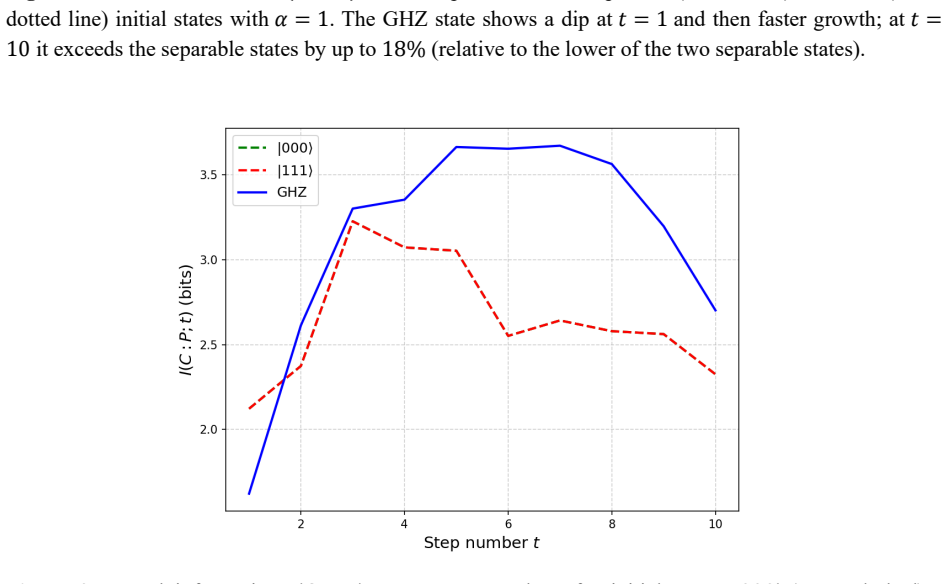
Initial three-partite entanglement accelerates mutual information growth by up to 18% after ten steps in a three-coin quantum walk.
A machine-rendered reading of the paper's core claim, the machinery that carries it, and where it could break.
Core claim
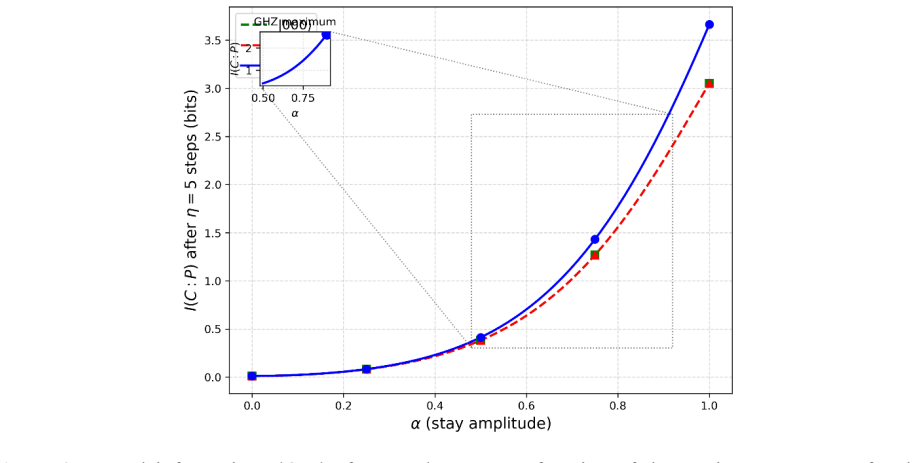
The results show that initial three-partite entanglement accelerates the growth of mutual information by up to 18% after ten steps (when compared to the lower of the two separable states), although it exhibits short-term non-monotonic dynamics due to quantum interference. For the first time, we introduce a tunable parameter alpha (amplitude of non-displacement states) and show that the GHZ state reaches a maximum of mutual information at alpha approximately 0.71 - a key finding for optimal control of information flow.
What carries the argument
The restriction that the walker displaces only on fully agreeing coin outcomes (HHH or TTT), which couples the eight-dimensional coin space to position, together with the initial GHZ state and the tunable alpha amplitude for non-displacing components.
If this is right
- Three-partite entanglement functions as a controllable resource that increases the rate at which coin-position correlations develop.
- The alpha parameter supplies a direct handle for maximizing information flow at a specific operating point near 0.71 for GHZ inputs.
- The photonic circuit proposal translates the model into hardware where alpha can be adjusted via nonlinear or electro-optic elements.
- The observed short-term non-monotonicity indicates that interference must be accounted for when designing short-time protocols.
- Applications listed include quantum state transfer, entanglement-assisted sensing, and programmable photonic processors.
Where Pith is reading between the lines
- The same coupling rule might be applied to walks with more than three coins to test whether multipartite entanglement continues to accelerate information growth.
- The non-monotonic early dynamics could be exploited in protocols that require temporary suppression of information flow before a later increase.
- Numerical checks up to t=5 steps are already provided; extending the supplied Python framework to t=10 would directly test the 18 percent figure.
Load-bearing premise
The walker moves exclusively when all three coins agree on heads or tails, and von Neumann entropy of reduced subsystems correctly measures the information flow of interest.
What would settle it
Compute mutual information after exactly ten steps for a GHZ initial state versus the lower separable state at the same alpha and check whether the reported 18 percent acceleration appears; separately verify whether mutual information for the GHZ state indeed peaks near alpha equals 0.71.
Figures
read the original abstract
Discrete-time quantum walks are powerful platforms for simulating quantum transport and information processing. Here we introduce a walker on a one-dimensional lattice whose motion is controlled by three entangled coins, each initialized with the Hadamard gate, aiming to maximize information flow. The walker moves only when all three coins yield the same outcome (HHH or TTT), thus coupling the 8-dimensional coin Hilbert space to the position degree of freedom. By analyzing fully separable, fully entangled (GHZ-type) and intermediate initial states, and using the von Neumann entropy of reduced subsystems, we compute the mutual information $I(C;P;t)$ between coin and position. The results show that initial three-partite entanglement accelerates the growth of mutual information by up to 18\% after ten steps (when compared to the lower of the two separable states), although it exhibits short-term non-monotonic dynamics due to quantum interference. For the first time, we introduce a tunable parameter $\alpha$ (amplitude of non-displacement states) and show that the GHZ state reaches a maximum of mutual information at $\alpha \approx 0.71$ - a key finding for optimal control of information flow. Finally, an integrated photonic implementation using polarization, spatial modes and time bins is proposed, where $\alpha$ can be tuned with nonlinear or electro-optic elements. A scalable numerical framework (Python code) for simulations up to $t = 5$ steps is provided. Our findings establish three-partite entanglement as a dynamical resource for maximizing information flow and spatial spreading, with direct applications in quantum state transfer, entanglement-assisted sensing and programmable photonic quantum processors.
Editorial analysis
A structured set of objections, weighed in public.
Referee Report
Summary. The manuscript introduces a discrete-time quantum walk whose position shift is triggered exclusively by the coin outcomes HHH or TTT, thereby coupling an 8-dimensional coin space to the walker position. It computes the mutual information I(C;P;t) via reduced von Neumann entropies for fully separable, intermediate, and GHZ-type initial coin states (each coin prepared with a Hadamard gate), reporting that initial three-partite entanglement accelerates mutual-information growth by up to 18 % after ten steps relative to the lower separable baseline and that the GHZ state is maximized at a tunable amplitude parameter α ≈ 0.71. An integrated photonic realization using polarization, spatial modes and time bins is outlined, and Python code for simulations up to t = 5 is supplied.
Significance. If the numerical results hold, the work positions multipartite entanglement as a tunable dynamical resource for controlling information flow and spatial spreading in quantum walks, with direct relevance to quantum state transfer and programmable photonic processors. A clear strength is the provision of reproducible Python code, which permits independent verification of the reported 18 % figure and the α optimization.
minor comments (3)
- Abstract: the quantitative claims (18 % acceleration after ten steps and α ≈ 0.71) are stated without an accompanying equation for the reduced density matrices or the explicit optimization procedure; relocating these details to a dedicated results or methods section would improve verifiability.
- The physical interpretation of the tunable parameter α as the “amplitude of non-displacement states” is introduced only in the abstract; a concise definition of the corresponding initial-state vector in the main text would clarify how α enters the coin-space preparation.
- The short-term non-monotonic behavior attributed to quantum interference is noted but not illustrated; adding a supplementary plot of I(C;P;t) for the first few steps would make the interference effect concrete for readers.
Simulated Author's Rebuttal
We thank the referee for the positive assessment of our manuscript, the recognition of its significance in positioning multipartite entanglement as a tunable resource for information flow in quantum walks, and the recommendation for minor revision. We are particularly pleased that the provision of reproducible Python code is highlighted as a strength. No major comments were raised in the report.
Circularity Check
No significant circularity; derivation is self-contained numerical evaluation
full rationale
The paper explicitly defines a restricted shift operator (only HHH/TTT trigger displacement) as the model under study, computes I(C;P;t) via standard von Neumann entropies on the resulting pure-state density matrices, and numerically optimizes the explicitly introduced tunable parameter α. These steps follow directly from the stated dynamics and standard information-theoretic definitions without reduction to inputs by construction, self-citation chains, or smuggled ansatzes. The 18% acceleration and α≈0.71 optimum are simulation outputs for the chosen initial states, not forced equivalences.
Axiom & Free-Parameter Ledger
free parameters (1)
- α =
≈0.71
axioms (1)
- standard math Standard quantum mechanics, discrete-time unitary evolution, and von Neumann entropy of reduced density matrices
Reference graph
Works this paper leans on
-
[1]
Aharonov, Y ., Davidovich, L. & Zagury, N. Quantum random walks. Phys. Rev. A 48, 1687 (1993). https://doi.org/10.1103/PhysRevA.48.1687
-
[2]
Kempe, J. Quantum random walks: An introductory overview. Contemp. Phys. 44, 307 (2003). https://doi.org/10.1080/00107151031000110776
-
[3]
Venegas-Andraca, S. E. Quantum walks: a comprehensive review. Quantum Inf. Process . 11, 1015 (2012). https://doi.org/10.1007/s11128-012-0432-5
-
[4]
Quantum Walks and Search Algorithms (Springer, 2018)
Portugal, R. Quantum Walks and Search Algorithms (Springer, 2018). https://doi.org/10.1007/978-3-319-97813-6
-
[5]
Childs, A. M., Farhi, E. & Gutmann, S. An example of the difference between quantum and classical random walks. Quantum Inf. Process. 1, 35 (2002). https://doi.org/10.1023/A:1019609420309
-
[6]
Shenvi, N., Kempe, J. & Whaley, K. B. Quantum random -walk search algorithm. Phys. Rev. A 67, 052307 (2003). https://doi.org/10.1103/PhysRevA.67.052307
-
[7]
Brun, T. A., Carteret, H. A. & Ambainis, A. Quantum random walks with decoherent coins. Phys. Rev. A 67, 032304 (2003). https://doi.org/10.1103/PhysRevA.67.032304
-
[8]
Bhattacharya, S., Ghosh, S. & Chakrabarti, R. Multi-coin quantum walks: Entanglement generation and correlation spreading. Phys. Rev. A 105, 032434 (2022). https://doi.org/10.1103/PhysRevA.105.032434
-
[9]
Liu, C. & Sanders, B. C. Mutual information dynamics in multipartite quantum walks. J. Phys. A: Math. Theor. 53, 365301 (2020). https://doi.org/10.1088/1751-8121/ab9f2a
-
[10]
Kurzyński, P. & Wójcik, A. Quantum walks with conditional displacement: a framework for controllable quantum transport. New J. Phys. 25, 013045 (2023). https://doi.org/10.1088/1367-2630/acb0f2
-
[11]
Goyal, S. K. & Konrad, T. Hilbert space partitioning and multi-coin quantum walks: a framework for high-dimensional state engineering. Quantum Sci. Technol. 8, 025015 (2023). https://doi.org/10.1088/2058-9565/acb8a7
-
[12]
Schaeff, C. et al. Scalable fiber integrated quantum walk. Optica 2, 1013 (2015). https://doi.org/10.1364/OPTICA.2.001013
-
[13]
Carolan, J. et al. Universal linear optics. Science 349, 711 (2015). https://doi.org/10.1126/science.aab3642
-
[14]
Wang, K. & Manouchehri, K. Spatiotemporal correlations and mutual information in quantum walks with multiple walkers and coins. Phys. Rev. A 106, 042412 (2022). https://doi.org/10.1103/PhysRevA.106.042412
-
[15]
Crespi, A. et al. Anderson localization of entangled photons in an integrated quantum walk. Nat. Photon. 7, 322 (2013). https://doi.org/10.1038/nphoton.2013.26
-
[16]
Moosavi Khansari, S. M. (2026). 'Entanglement -Enhanced Information Dynamics in Triple -Coin Discrete-Time Quantum Walks', Journal of Interfaces, Thin Films, and Low dimensional systems. https://doi.org/10.22051/jitl.2026.53494.1136
discussion (0)
Sign in with ORCID, Apple, or X to comment. Anyone can read and Pith papers without signing in.