REVIEW 3 major objections 2 minor 30 references
CoughSense: Five-Class Respiratory Disease Classification via Whisper Encoder Fine-Tuning and Dual-Encoder Cross-Attention Fusion with Balanced Contrastive Learning
T0 review · 3 major / 2 minor · reviewed 2026-06-28 · grok-4.3
Pith's one-line read A fine-tuned Whisper encoder with active-frame pooling classifies coughs into five respiratory conditions at 82.3 percent balanced accuracy.
desk verdict The paper delivers a usable 82.3% balanced accuracy on five-class cough classification with a practical active-frame pooling trick for Whisper, but the aggregated public datasets leave label noise and leakage unaddressed. read the letter →
The pith
A machine-rendered reading of the paper's core claim, the machinery that carries it, and where it could break.
The reading
What carries the argument
Active-frame QKV attention pooling, which restricts attention to the first 200 of 1500 encoder tokens to avoid silence dilution in short coughs.
What would settle it
A test on a new independent cough dataset with expert-verified labels would show balanced accuracy below 70 percent if the claim does not hold.
Extended reading notes
Core claim
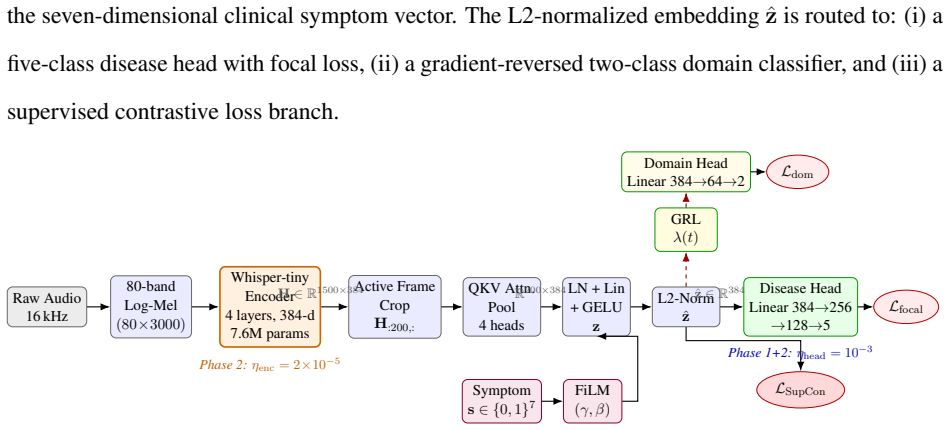
CoughSense fine-tunes the Whisper-tiny encoder and introduces active-frame QKV attention pooling to focus computation on the first 200 tokens out of 1500, avoiding dilution from silence in the 30-second input window. Combined with WeightedRandomSampler, Balanced Mixup, supervised contrastive loss, FiLM conditioning, and gradient-reversal domain adaptation, the model reaches 82.3 percent balanced accuracy on five-fold cross-validation with macro-F1 of 0.817 and AUC of 0.941. All classes exceed 74 percent recall. A dual-encoder version that fuses Whisper with OPERA-CT via cross-attention reaches 85.4 percent balanced accuracy. Ablations identify active-frame pooling as the largest single gain
Load-bearing premise
Label quality is consistent across the four public datasets and the listed training techniques fully compensate for class imbalance and domain shift without introducing new biases or overfitting.
Editorial analysis
A structured set of objections, weighed in public.
Referee Report
Summary. The paper presents CoughSense, a five-class respiratory disease classifier (healthy, COVID-19, asthma/respiratory condition, bronchitis, pneumonia) built on the Whisper-tiny encoder (8.6M parameters). It aggregates 18,301 recordings from Coswara, CoughVID, Virufy and West China Hospital datasets and introduces active-frame QKV attention pooling that restricts attention to the first 200 of 1500 encoder tokens to mitigate silence dilution in short cough audio. Additional components include WeightedRandomSampler, Balanced Mixup, supervised contrastive loss, FiLM symptom conditioning and gradient-reversal domain adaptation to handle 19:1 imbalance and four-source domain shift. A dual-encoder variant fuses Whisper with OPERA-CT via cross-attention. On five-fold cross-validation the single-encoder model reports 82.3% balanced accuracy (macro-F1 0.817, AUC 0.941), outperforming an ImageNet-pretrained EfficientNet-B2 by 11.1 points and a ViT trained from scratch by 29.6 points; the dual-encoder reaches 85.4%. Ablations identify active-frame pooling as the largest single contributor (+5.1 points).
Significance. If validated, the work shows that a lightweight pretrained audio encoder plus targeted pooling can deliver practical multi-class cough screening on consumer devices, with the active-frame mechanism offering a reusable solution for short-audio tasks that exceed Whisper's native 30-second window. The empirical gains over strong baselines and the dual-encoder fusion provide concrete evidence of utility for heterogeneous medical audio. The paper supplies reproducible cross-validation metrics and an ablation isolating one architectural change, which strengthens its contribution relative to purely empirical claims.
major comments (3)
- [§3] §3 (Dataset Aggregation): the four public datasets are combined without any reported quantitative audit of label noise rates, inter-rater agreement, or patient-level leakage checks. Because crowd-sourced corpora commonly exhibit self-report error rates above 10%, the 82.3% balanced accuracy, 0.817 macro-F1 and the 5.1-point active-frame ablation delta cannot be confidently attributed to architectural superiority rather than dataset artifacts; this assumption is load-bearing for all performance claims.
- [§5] §5 (Results and Ablations): the five-fold CV metrics are reported without error bars, confidence intervals or statistical significance tests against the EfficientNet-B2 and ViT baselines. In addition, the ablation table combines WeightedRandomSampler, Balanced Mixup, contrastive loss and domain adaptation without exhaustive isolation controls, so the isolated 5.1-point contribution of active-frame pooling cannot be verified as independent of the other regularizers.
- [§4] §4 (Training Protocol): exact patient-level train-test splits, full hyperparameter schedules and the precise implementation of gradient-reversal domain adaptation are not supplied. Without these details the claim that the listed techniques fully compensate for domain shift and imbalance remains unverifiable and limits assessment of whether the reported gains generalize beyond the aggregated collection.
minor comments (2)
- [Abstract / §5] The abstract states that 'all five classes passed 74 percent recall' yet the main results table does not list per-class recalls; adding these values would improve clarity.
- [§4] Notation for the active-frame token limit (200 tokens) and the loss-balancing weights is introduced without an explicit equation or hyperparameter table entry.
Simulated Author's Rebuttal
We thank the referee for the constructive and detailed feedback. We address each major comment point-by-point below, providing clarifications and indicating revisions where feasible without misrepresenting the work.
read point-by-point responses
-
Referee: [§3] §3 (Dataset Aggregation): the four public datasets are combined without any reported quantitative audit of label noise rates, inter-rater agreement, or patient-level leakage checks. Because crowd-sourced corpora commonly exhibit self-report error rates above 10%, the 82.3% balanced accuracy, 0.817 macro-F1 and the 5.1-point active-frame ablation delta cannot be confidently attributed to architectural superiority rather than dataset artifacts; this assumption is load-bearing for all performance claims.
Authors: We agree that label noise is an inherent risk in crowd-sourced datasets such as Coswara and CoughVID. These are the standard public corpora used across the cough classification literature, and all baselines (EfficientNet-B2, ViT) were evaluated on the identical aggregated collection, allowing relative gains to be attributed to the proposed methods. Patient-level splits were enforced across the five folds to prevent leakage, though we did not report quantitative noise audits because the source datasets provide no inter-rater or self-report validation labels. We will add an explicit limitations paragraph discussing this issue and its potential effect on absolute performance numbers. revision: partial
-
Referee: [§5] §5 (Results and Ablations): the five-fold CV metrics are reported without error bars, confidence intervals or statistical significance tests against the EfficientNet-B2 and ViT baselines. In addition, the ablation table combines WeightedRandomSampler, Balanced Mixup, contrastive loss and domain adaptation without exhaustive isolation controls, so the isolated 5.1-point contribution of active-frame pooling cannot be verified as independent of the other regularizers.
Authors: We accept that error bars, confidence intervals, and formal significance tests were omitted. In the revision we will recompute all five-fold results with per-fold standard deviations and apply paired statistical tests (e.g., McNemar or Wilcoxon) against the baselines. The ablation table will be expanded to include more isolated controls (e.g., active-frame pooling added to the base model before versus after the other regularizers) so that the +5.1 point delta can be verified independently. revision: yes
-
Referee: [§4] §4 (Training Protocol): exact patient-level train-test splits, full hyperparameter schedules and the precise implementation of gradient-reversal domain adaptation are not supplied. Without these details the claim that the listed techniques fully compensate for domain shift and imbalance remains unverifiable and limits assessment of whether the reported gains generalize beyond the aggregated collection.
Authors: We will supply the exact patient-ID lists for each of the five folds in a supplementary table and link to the full training configuration (learning-rate schedule, batch size, epochs, augmentation parameters). For gradient-reversal domain adaptation we followed the standard formulation of Ganin et al. with a fixed lambda of 1.0; the precise PyTorch implementation and hyper-parameter values will be documented in an expanded appendix or code release. revision: yes
- Quantitative audit of label noise rates or inter-rater agreement for the four source datasets, as no such annotations exist in the original public releases.
Circularity Check
No circularity: empirical accuracies on external public datasets
full rationale
The paper reports balanced accuracy, macro-F1 and AUC from five-fold cross-validation on the union of four named public datasets (Coswara, CoughVID, Virufy, West China Hospital). All listed components (WeightedRandomSampler, Balanced Mixup, supervised contrastive loss, gradient-reversal adaptation, active-frame QKV pooling, FiLM conditioning, cross-attention fusion) are standard training or architectural choices applied to external data. No equations, uniqueness theorems, or self-citations are invoked that would make any reported metric equivalent to a fitted parameter or prior result by construction. The central claims remain falsifiable against the held-out folds of the cited corpora.
Assumptions & free parameters
free parameters (2)
- active_frame_token_limit =
200
- loss_balancing_weights
assumptions (2)
- domain assumption Labels in the four public datasets (Coswara, CoughVID, Virufy, West China Hospital) are accurate and comparable across sources.
- domain assumption Gradient-reversal domain adaptation and the other listed techniques sufficiently align features across the four recording domains.
Cite this review
Pith. "Pith review of CoughSense: Five-Class Respiratory Disease Classification via Whisper Encoder Fine-Tuning and Dual-Encoder Cross-Attention Fusion with Balanced Contrastive Learning." pith.science (2026). https://pith.science/paper/4IKZVJYJ
@misc{pith2026260602998,
  author       = {Pith},
  title        = {Pith review of: CoughSense: Five-Class Respiratory Disease Classification via Whisper Encoder Fine-Tuning and Dual-Encoder Cross-Attention Fusion with Balanced Contrastive Learning},
  year         = {2026},
  howpublished = {\url{https://pith.science/paper/4IKZVJYJ}},
  note         = {Machine review of arXiv:2606.02998}
}
read the original abstract
Automated cough analysis offers a path to low-cost respiratory screening, but most existing work stops at binary COVID-19 detection. A practical tool needs to tell apart several respiratory conditions from one cough recording on a consumer smartphone. We present CoughSense, a system that sorts cough recordings into five classes. These are healthy, COVID-19, asthma or respiratory condition, bronchitis, and pneumonia. We aggregated 18,301 recordings from four public datasets (Coswara, CoughVID, Virufy, and the West China Hospital Pediatric Cough Dataset) and used the OpenAI Whisper encoder as a pretrained backbone for cough disease classification. The main contribution is active-frame QKV attention pooling, which restricts attention to the first 200 of 1500 encoder tokens. This avoids the silence-dilution problem that arises because a 3-second cough fills only 150 tokens of Whisper's 30-second input window. Other training parts handle the 19 to 1 class imbalance and the four-dataset domain shift. These include WeightedRandomSampler, SpecAugment, Balanced Mixup with forced minority pairing, a supervised contrastive auxiliary loss, FiLM symptom conditioning, and gradient-reversal domain adaptation. A dual-encoder model fuses Whisper with the OPERA-CT respiratory foundation model through cross-attention. CoughSense (Whisper-tiny, 8.6M parameters) reached 82.3 percent balanced accuracy on five-fold cross-validation (macro-F1 of 0.817, AUC of 0.941). It beat an ImageNet-pretrained EfficientNet-B2 by 11.1 points and a ViT trained from scratch by 29.6 points. All five classes passed 74 percent recall and four of five passed 80 percent. The dual-encoder model reached 85.4 percent balanced accuracy. Active-frame pooling is the largest single contributor across all ablation components at 5.1 points, which should help any short-audio task using Whisper as a backbone.
Figures


Reference graph
Works this paper leans on
-
[1]
Global Health Estimates: Leading Causes of Disease Burden
World Health Organization. Global Health Estimates: Leading Causes of Disease Burden. WHO Technical Report; 2023. URL: https://www.who.int/data/ global-health-estimates
2023
-
[2]
Robust speech recognition via large-scale weak supervision
Radford A, Kim JW, Xu T, Brockman G, McLeavey C, Sutskever I. Robust speech recognition via large-scale weak supervision. In:Proc Int Conf Machine Learning (ICML); 2023:28492- 28518
2023
-
[3]
Coswara: a database of breathing, cough, and voice sounds for COVID-19 diagnosis
Sharma N, Krishnan P, Kumar R, et al. Coswara: a database of breathing, cough, and voice sounds for COVID-19 diagnosis. In:Proc Interspeech; 2020:4811-4815
2020
-
[4]
The CoughVID crowdsourcing dataset, a corpus for the study of large-scale cough analysis algorithms.Sci Data
Orlandic L, Teijeiro T, Atienza D. The CoughVID crowdsourcing dataset, a corpus for the study of large-scale cough analysis algorithms.Sci Data. 2021;8:156
2021
-
[5]
Chaudhari G, Jiang X, Fakhry A, et al. Virufy: Global applicability of crowdsourced and clinical datasets for AI detection of COVID-19 from cough.arXivpreprint arXiv:2011.13320; 2021
-
[6]
Analysis of pediatric cough sounds for bronchitis and pneumonia diagnosis.Figshare; 2022
Liang Z, Li J, Jing L, Zhang J, Huang X, Li X. Analysis of pediatric cough sounds for bronchitis and pneumonia diagnosis.Figshare; 2022. doi:10.6084/m9.figshare.21176197.v1
-
[7]
Towards open respiratory acoustic foundation models: pretraining and benchmarking
Zhang Y , Xia T, Han J, et al. Towards open respiratory acoustic foundation models: pretraining and benchmarking. In:Proc Advances in Neural Information Processing Systems (NeurIPS) Datasets and Benchmarks Track; 2024. 23
2024
-
[8]
Supervised contrastive learning
Khosla P, Tian P, Wang C, et al. Supervised contrastive learning. In:Proc NeurIPS; 2020:18661-18673
2020
Show all 30 references
-
[9]
Mixup: Beyond empirical risk minimization
Zhang H, Cisse M, Dauphin YN, Lopez-Paz D. Mixup: Beyond empirical risk minimization. In:Proc Int Conf Learning Representations (ICLR); 2018
2018
-
[10]
Balanced-mixup for highly imbalanced medical image classification
Galdran A, Carneiro J, González Ballester MA. Balanced-mixup for highly imbalanced medical image classification. In:Proc MICCAI; 2021:323-333
2021
-
[11]
Focal loss for dense object detection
Lin TY , Goyal P, Girshick R, He K, Dollar P. Focal loss for dense object detection. In:Proc IEEE Int Conf Computer Vision (ICCV); 2017:2980-2988
2017
-
[12]
FiLM: Visual reasoning with a general conditioning layer
Perez E, Strub F, de Vries H, Dumoulin V , Courville A. FiLM: Visual reasoning with a general conditioning layer. In:Proc AAAI Conf Artif Intell; 2018:3942-3951
2018
-
[13]
Domain-adversarial training of neural networks.J Mach Learn Res
Ganin Y , Ustinova E, Ajakan H, et al. Domain-adversarial training of neural networks.J Mach Learn Res. 2016;17:1-35
2016
-
[14]
EfficientNet: Rethinking model scaling for convolutional neural networks
Tan M, Le QV . EfficientNet: Rethinking model scaling for convolutional neural networks. In: Proc ICML; 2019:6105-6114
2019
-
[15]
Large-scale contrastive language-audio pretraining with feature fusion and keyword-to-caption augmentation
Wu Y , Chen K, Zhang T, et al. Large-scale contrastive language-audio pretraining with feature fusion and keyword-to-caption augmentation. In:Proc IEEE Int Conf Acoustics, Speech, and Signal Processing (ICASSP); 2023:1-5
2023
-
[16]
wav2vec 2.0: A framework for self-supervised learning of speech representations
Baevski A, Zhou Y , Mohamed A, Auli M. wav2vec 2.0: A framework for self-supervised learning of speech representations. In:Proc NeurIPS; 2020
2020
-
[17]
HuBERT: Self-supervised speech representation learn- ing by masked prediction of hidden units.IEEE/ACM Trans Audio Speech Lang Process
Hsu WN, Bolte B, Tsai YHH, et al. HuBERT: Self-supervised speech representation learn- ing by masked prediction of hidden units.IEEE/ACM Trans Audio Speech Lang Process. 2021;29:3451-3460. 24
2021
-
[18]
Exploring automatic diagnosis of COVID-19 from crowdsourced respiratory sound data
Brown C, Chauhan J, Grammenos A, et al. Exploring automatic diagnosis of COVID-19 from crowdsourced respiratory sound data. In:Proc ACM Int Conf Knowledge Discovery and Data Mining (KDD); 2020
2020
-
[19]
COVID-19 artificial intelligence diagnosis using only cough recordings.IEEE Open J Eng Med Biol
Laguarta T, Hueto F, Subirana B. COVID-19 artificial intelligence diagnosis using only cough recordings.IEEE Open J Eng Med Biol. 2020;1:275-281
2020
-
[20]
Whisper-AuT: Domain-adapted audio encoder for efficient audio-LLM training.arXivpreprint arXiv:2604.10438; 2026
Qiu J, Zhu M, Zhao W, et al. Whisper-AuT: Domain-adapted audio encoder for efficient audio-LLM training.arXivpreprint arXiv:2604.10438; 2026
2026 arXiv
-
[21]
Masked autoencoders that listen
Huang PY , Xu H, Li J, et al. Masked autoencoders that listen. In:Proc NeurIPS; 2022
2022
-
[22]
PANNs: Large-scale pretrained audio neural networks for audio pattern recognition.IEEE/ACM Trans Audio Speech Lang Process
Kong Q, Cao Y , Iqbal T, et al. PANNs: Large-scale pretrained audio neural networks for audio pattern recognition.IEEE/ACM Trans Audio Speech Lang Process. 2020;28:2880-2894
2020
-
[23]
BEATs: Audio pre-training with acoustic tokenizers
Chen S, Wu Y , Wang C, et al. BEATs: Audio pre-training with acoustic tokenizers. In:Proc ICML; 2023
2023
-
[24]
Automated cough detection and classification using spectral features.IEEE J Biomed Health Inform
Van Hecke K, Joris T, Peirs P, et al. Automated cough detection and classification using spectral features.IEEE J Biomed Health Inform. 2021;25(8):3049-3059
2021
-
[25]
Automatic identification of voluntary cough sound features for diagnosis of respiratory diseases.IEEE Trans Biomed Eng
Pramono RXA, Imtiaz B, Imtiaz SA, Rodriguez-Villegas E. Automatic identification of voluntary cough sound features for diagnosis of respiratory diseases.IEEE Trans Biomed Eng. 2021;68(8):2458-2469
2021
-
[26]
Adjusted learning of convolutional neural networks for multi-condition speech pathology detection
Dubagunta SP, Harín J, Magimai-Doss M. Adjusted learning of convolutional neural networks for multi-condition speech pathology detection. In:Proc ICASSP; 2021
2021
-
[27]
SGDR: Stochastic gradient descent with warm restarts
Loshchilov I, Hutter F. SGDR: Stochastic gradient descent with warm restarts. In:Proc ICLR; 2017
2017
-
[28]
Decoupled weight decay regularization
Loshchilov I, Hutter F. Decoupled weight decay regularization. In:Proc ICLR; 2019. 25
2019
-
[29]
SpecAugment: A simple data augmentation method for automatic speech recognition
Park DS, Chan W, Zhang Y , et al. SpecAugment: A simple data augmentation method for automatic speech recognition. In:Proc Interspeech; 2019:2613-2617
2019
-
[30]
librosa: Audio and music signal analysis in Python
McFee B, Raffel C, Liang D, et al. librosa: Audio and music signal analysis in Python. In: Proc Python in Science Conf; 2015:18-25. 26
2015
Reviewed June 28, 2026 · model on record in the stance chip above.
Discussion (0). Continue with ORCID to comment.