Capability Advertisement as a Market for Lemons: A Trust Layer for Heterogeneous Agent Networks
Pith reviewed 2026-06-28 08:11 UTC · model grok-4.3
The pith
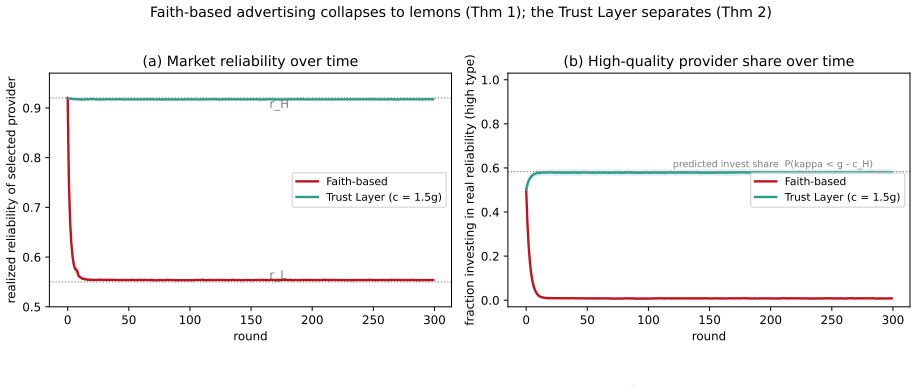
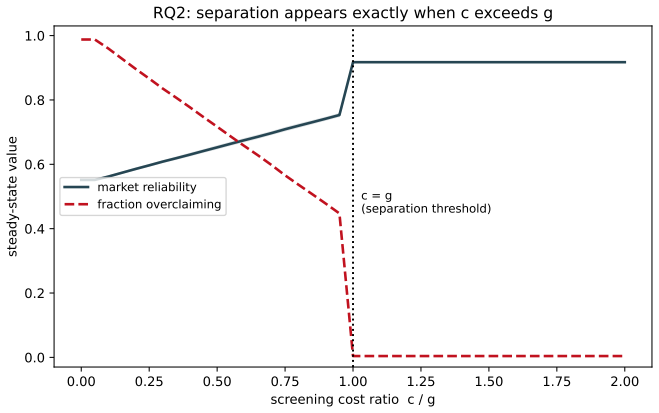
A thin Trust Layer above existing agent protocols admits a separating equilibrium when overclaim costs exceed gains.
A machine-rendered reading of the paper's core claim, the machinery that carries it, and where it could break.
Core claim
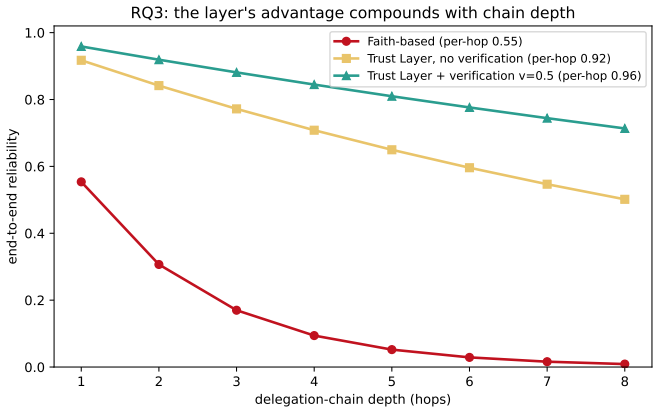
The Trust Layer is a protocol-agnostic thin layer placed above MCP and A2A that adds probabilistic capability descriptors, screening, and reputation; it admits a separating equilibrium whenever the cost of sustaining an overclaim exceeds the gain from it, and it supplies a reliability-composition bound for delegation chains together with an end-to-end placement argument.
What carries the argument
The Trust Layer, a thin narrow waist that inserts probabilistic capability descriptors, screening, and reputation into existing agent advertisement protocols.
If this is right
- Delegation chains obtain a concrete end-to-end reliability bound once the Trust Layer is present.
- Honest agents become distinguishable from overclaimers and are preferentially selected by callers.
- The market avoids convergence to its lowest-quality participants.
- Existing MCP and A2A registries can adopt the layer without retraining underlying models.
- The system continues to function, albeit at lower trust, when its reputation anchors are absent or corrupted.
Where Pith is reading between the lines
- The same cost-gain separation logic could be tested in simulated heterogeneous agent populations to measure the minimum reputation weight needed for equilibrium separation.
- Public agent registries that adopt the layer would create observable data on which capability categories separate most cleanly.
- The end-to-end placement argument suggests that reliability guarantees can be localized at the caller rather than distributed across every hop.
Load-bearing premise
Probabilistic capability descriptors and reputation mechanisms can be implemented such that the cost of sustaining an overclaim reliably exceeds the gain from it.
What would settle it
Observe, in a deployed agent network using the Trust Layer, whether agents that maintain high capability claims but deliver low performance are systematically screened out or lose reputation while honest agents retain high placement.
Figures
read the original abstract
Large language model (LLM) agents have begun to delegate work to one another. Protocols such as the Model Context Protocol (MCP) and the Agent2Agent protocol (A2A) let an agent publish what it can do and let others call it, and public registries of such agents are already appearing. These protocols assume an advertised capability is a static, truthful fact. A real agent is none of these things: its competence is probabilistic, varies with input, drifts when the underlying model is updated, and, because the agent is itself a language model, it can describe itself with complete confidence and be wrong. A caller therefore sees what an agent claims to do, not what it can do, with no principled way to tell a reliable provider from a fluent impostor. We argue these difficulties share one cause: the market for lemons. When quality is hidden and claims are cheap, good and bad providers become indistinguishable, honest reliability goes unrewarded, and the market decays toward its worst participants. Economics offers three remedies, signaling, screening, and reputation, and none are present in today's agent protocols. We make four contributions: (1) a failure taxonomy that names confident-wrong as a non-adversarial, correlated subclass of Byzantine faults that classical fault-tolerance mismodels; (2) a market-for-lemons model showing that faith-based protocols admit only a low-trust equilibrium; (3) the Trust Layer, a thin, protocol-agnostic narrow waist above MCP and A2A that adds probabilistic capability descriptors, screening, and reputation, and admits a separating equilibrium when the cost of sustaining an overclaim exceeds the gain from it; and (4) a reliability-composition bound for delegation chains with an end-to-end placement argument. The design needs no model retraining and degrades gracefully when its trust anchors are absent or corrupt.
Editorial analysis
A structured set of objections, weighed in public.
Referee Report
Summary. The manuscript argues that capability advertisement protocols for LLM agents (e.g., MCP, A2A) suffer from a market-for-lemons problem because advertised capabilities are probabilistic, drift, and can be confidently misstated. It contributes (1) a failure taxonomy classifying confident-wrong outputs as a non-adversarial correlated subclass of Byzantine faults, (2) a market-for-lemons model demonstrating that faith-based protocols admit only a low-trust equilibrium, (3) a thin Trust Layer adding probabilistic capability descriptors, screening, and reputation that admits a separating equilibrium precisely when the cost of sustaining an overclaim exceeds the gain from it, and (4) a reliability-composition bound for delegation chains together with an end-to-end placement argument. The design requires no model retraining and degrades gracefully in the absence of trust anchors.
Significance. If the central claims hold, the work identifies a timely structural problem in emerging multi-agent protocols and supplies an economic framing plus a protocol-level remedy that could inform the design of future agent registries and delegation mechanisms. The explicit statement that the approach needs no retraining and no new trust anchors is a practical strength. However, the absence of any derivation, formal model, or validation for the separating-equilibrium condition and the reliability bound substantially reduces the immediate technical contribution.
major comments (2)
- [Contribution (3)] Contribution (3) states that the Trust Layer admits a separating equilibrium when the cost of sustaining an overclaim exceeds the gain from it, yet provides no derivation or protocol-level mechanism showing how probabilistic capability descriptors and reputation alone enforce this inequality without model retraining or new trust anchors. This precondition is load-bearing for the claimed equilibrium and for the subsequent reliability-composition bound in contribution (4).
- [Contribution (2)] The market-for-lemons model in contribution (2) is described as showing only the low-trust equilibrium for faith-based protocols, but the manuscript supplies no equations, parameter definitions, or equilibrium analysis that would allow a reader to verify the claimed result or to see how the Trust Layer primitives alter the payoff structure.
minor comments (2)
- [Contribution (1)] The failure taxonomy in contribution (1) would benefit from an explicit comparison table relating confident-wrong faults to standard Byzantine and crash-fault models.
- Notation for probabilistic descriptors and reputation scores is introduced without a consolidated definition section, making it difficult to track how these quantities enter the reliability bound.
Simulated Author's Rebuttal
We thank the referee for the constructive comments, which correctly identify that the formal details of the market-for-lemons model and the separating-equilibrium condition require expansion to allow verification. We address each point below and will revise accordingly.
read point-by-point responses
-
Referee: [Contribution (3)] Contribution (3) states that the Trust Layer admits a separating equilibrium when the cost of sustaining an overclaim exceeds the gain from it, yet provides no derivation or protocol-level mechanism showing how probabilistic capability descriptors and reputation alone enforce this inequality without model retraining or new trust anchors. This precondition is load-bearing for the claimed equilibrium and for the subsequent reliability-composition bound in contribution (4).
Authors: We agree that the manuscript states the equilibrium condition at a conceptual level without supplying an explicit derivation or payoff analysis. The Trust Layer description relies on the primitives altering incentives via probabilistic descriptors and reputation, but no formal mechanism is derived. In revision we will add a game-theoretic section that defines the relevant payoffs and shows how the added primitives enforce the cost-gain inequality at the protocol layer, without retraining or new anchors. revision: yes
-
Referee: [Contribution (2)] The market-for-lemons model in contribution (2) is described as showing only the low-trust equilibrium for faith-based protocols, but the manuscript supplies no equations, parameter definitions, or equilibrium analysis that would allow a reader to verify the claimed result or to see how the Trust Layer primitives alter the payoff structure.
Authors: The manuscript presents the market-for-lemons argument descriptively to motivate the problem. We acknowledge that it contains no explicit equations, parameter definitions, or equilibrium analysis. The revised version will introduce a formal model with defined parameters (quality distribution, claim cost, verification cost, reputation update rule) and derive the low-trust equilibrium for faith-based protocols as well as the change in payoff structure induced by the Trust Layer primitives. revision: yes
Circularity Check
No circularity; claims rest on explicit conditional assumption without reduction to inputs
full rationale
The paper's core result (Trust Layer admits separating equilibrium when cost of overclaim exceeds gain) is stated as conditional on that inequality rather than derived as a theorem from the probabilistic descriptors and reputation primitives alone. The market-for-lemons model is presented separately as showing only the low-trust equilibrium for faith-based protocols. No equations, fitted parameters renamed as predictions, or self-citation chains appear in the abstract or contribution list that would make any result equivalent to its inputs by construction. The design is described as protocol-agnostic and requiring no retraining, but the equilibrium claim is not shown to follow mechanically from those elements, leaving it as a modeling assumption rather than a circular derivation.
Axiom & Free-Parameter Ledger
axioms (1)
- domain assumption Quality of agent capabilities is hidden and claims are cheap to make
invented entities (1)
-
Trust Layer
no independent evidence
Reference graph
Works this paper leans on
-
[1]
Akerlof, G. A. (1970). The Market for ``Lemons'': Quality Uncertainty and the Market Mechanism. Quarterly Journal of Economics, 84(3), 488--500
1970
-
[2]
Introducing the Model Context Protocol
Anthropic (2024). Introducing the Model Context Protocol. November 2024. https://modelcontextprotocol.io
2024
-
[3]
Avizienis, A., Laprie, J.-C., Randell, B., Landwehr, C. (2004). Basic Concepts and Taxonomy of Dependable and Secure Computing. IEEE Transactions on Dependable and Secure Computing, 1(1), 11--33
2004
-
[4]
Bellifemine, F., Caire, G., Greenwood, D. (2007). Developing Multi-Agent Systems with JADE. Wiley
2007
-
[5]
Cho, I.-K., Kreps, D. (1987). Signaling Games and Stable Equilibria. Quarterly Journal of Economics, 102(2), 179--221
1987
-
[6]
Clark, D. (1988). The Design Philosophy of the DARPA Internet Protocols. ACM SIGCOMM, 109--114
1988
-
[7]
P., Sobel, J
Crawford, V. P., Sobel, J. (1982). Strategic Information Transmission. Econometrica, 50(6), 1431--1451
1982
- [8]
-
[9]
Announcing the Agent2Agent (A2A) Protocol
Google (2025). Announcing the Agent2Agent (A2A) Protocol. Google Developers Blog, April 2025. https://github.com/a2aproject/A2A
2025
-
[10]
Gu, J., et al. (2024). A Survey on LLM-as-a-Judge. arXiv:2411.15594
work page internal anchor Pith review Pith/arXiv arXiv 2024
-
[11]
Hou, X., Zhao, Y., Wang, S., Wang, H. (2025). Model Context Protocol (MCP): Landscape, Security Threats, and Future Research Directions. arXiv:2503.23278
work page internal anchor Pith review Pith/arXiv arXiv 2025
-
[12]
Kamvar, S., Schlosser, M., Garcia-Molina, H. (2003). The EigenTrust Algorithm for Reputation Management in P2P Networks. In Proc. 12th International Conference on World Wide Web (WWW), 640--651
2003
-
[13]
Lamport, L., Shostak, R., Pease, M. (1982). The Byzantine Generals Problem. ACM Transactions on Programming Languages and Systems, 4(3), 382--401
1982
-
[14]
Laurie, B., Langley, A., Kasper, E. (2013). Certificate Transparency. RFC 6962
2013
-
[15]
Liang, P., et al. (2022). Holistic Evaluation of Language Models (HELM). arXiv:2211.09110; published in Transactions on Machine Learning Research (2023)
work page internal anchor Pith review Pith/arXiv arXiv 2022
-
[16]
Liu, X., et al. (2023). AgentBench: Evaluating LLMs as Agents. arXiv:2308.03688; ICLR 2024
work page internal anchor Pith review Pith/arXiv arXiv 2023
-
[17]
Mirrlees, J. A. (1971). An Exploration in the Theory of Optimum Income Taxation. Review of Economic Studies, 38(2), 175--208
1971
-
[18]
Mitchell, M., et al. (2019). Model Cards for Model Reporting. In Proc. Conference on Fairness, Accountability, and Transparency (FAT*). (The conference was renamed FAccT in 2020.)
2019
-
[19]
Qin, Y., et al. (2023). ToolLLM: Facilitating Large Language Models to Master 16000+ Real-World APIs. arXiv:2307.16789; ICLR 2024
work page internal anchor Pith review Pith/arXiv arXiv 2023
-
[20]
Rao, A., Georgeff, M. (1995). BDI Agents: From Theory to Practice. In Proc. First International Conference on Multiagent Systems (ICMAS), AAAI Press, 312--319
1995
-
[21]
Resnick, P., Kuwabara, K., Zeckhauser, R., Friedman, E. (2000). Reputation Systems. Communications of the ACM, 43(12), 45--48
2000
-
[22]
Riley, J. (1979). Informational Equilibrium. Econometrica, 47(2), 331--359
1979
-
[23]
Rothschild, M., Stiglitz, J. (1976). Equilibrium in Competitive Insurance Markets: An Essay on the Economics of Imperfect Information. Quarterly Journal of Economics, 90(4), 629--649
1976
-
[24]
Saltzer, J., Reed, D., Clark, D. (1984). End-to-End Arguments in System Design. ACM Transactions on Computer Systems, 2(4), 277--288
1984
-
[25]
Smith, R. G. (1980). The Contract Net Protocol: High-Level Communication and Control in a Distributed Problem Solver. IEEE Transactions on Computers, C-29(12), 1104--1113
1980
-
[26]
Spence, M. (1973). Job Market Signaling. Quarterly Journal of Economics, 87(3), 355--374
1973
- [27]
discussion (0)
Sign in with ORCID, Apple, or X to comment. Anyone can read and Pith papers without signing in.