Multiferroicity in the two-dimensional limit in hexagonal LuFeO3 films
Pith reviewed 2026-06-28 09:44 UTC · model grok-4.3
The pith
Hexagonal LuFeO3 films retain coupled ferroelectricity and magnetism down to 1.5 unit cells.
A machine-rendered reading of the paper's core claim, the machinery that carries it, and where it could break.
Core claim
Hexagonal LuFeO3 retains genuine multiferroicity at the two-dimensional limit of one and a half unit cells, with room-temperature ferroelectric polarization comparable to bulk, low-temperature long-range magnetism, and persistent magnetoelectric coupling, enabled by the stability of the K3 phonon mode that mediates the orders.
What carries the argument
The K3 phonon mode, which mediates the coupling between ferroelectric polarization and magnetic order in the hexagonal LuFeO3 structure and remains stable at one and a half unit cells.
If this is right
- Oxide multiferroics can be engineered to operate at atomic thicknesses without the loss of either order.
- The magnetoelectric coupling mechanism remains functional when the material is thinned to the 2D regime.
- Hexagonal LuFeO3 provides an experimental platform for studying coupled ferroic orders at the single-unit-cell scale.
- The persistence of the K3 mode implies that structural distortions responsible for multiferroicity are robust against dimensionality reduction.
Where Pith is reading between the lines
- Similar hexagonal rare-earth ferrites may also preserve multiferroicity at the 2D limit if their K3 modes prove equally stable.
- Device concepts that require simultaneous electric and magnetic control at the nanoscale become feasible with this material class.
- Room-temperature magnetism would further strengthen the case for practical 2D multiferroic applications if it can be achieved in related compounds.
Load-bearing premise
The ferroelectric and magnetic signals measured in the ultrathin films arise from the intrinsic properties of the LuFeO3 itself rather than from substrate interactions or defects.
What would settle it
Independent measurements on suspended films or on films grown on a second substrate showing either the disappearance of room-temperature ferroelectric hysteresis or the absence of long-range magnetic order below a few kelvin would falsify the central claim.
Figures
read the original abstract
Multiferroic oxides, which combine coupled ferroelectric and magnetic orders, are central to understanding correlated quantum phenomena. Yet, as thickness approaches the two-dimensional (2D) limit, both ferroelectricity and magnetism are conventionally expected to vanish due to depolarization fields and finite-size effects, respectively. Here, we demonstrate that hexagonal LuFeO3 (h-LuFeO3) retains coupled ferroelectricity and magnetism at the 2D limit, with a thickness of just one and a half unit cells. Remarkably, the ferroelectric polarization remains comparable to bulk values at room temperature, while long-range magnetism and magnetoelectric coupling persist at low temperatures. We further show that the K3 phonon mode, which mediates the polarization-magnetism coupling, is stable down to the 2D limit. Our results establish h-LuFeO3 as the first oxide system to exhibit genuine 2D-limit multiferroicity, providing a fundamental breakthrough in the long-standing quest to understand and control coupled ferroic orders at the atomic scale.
Editorial analysis
A structured set of objections, weighed in public.
Referee Report
Summary. The manuscript claims that hexagonal LuFeO3 films retain coupled ferroelectricity and magnetism at the two-dimensional limit (1.5 unit cells), with room-temperature ferroelectric polarization comparable to bulk values, persistence of long-range magnetism and magnetoelectric coupling at low temperatures, and stability of the K3 phonon mode mediating the coupling; this is presented as the first oxide system showing genuine 2D-limit multiferroicity.
Significance. If substantiated with rigorous controls, the result would establish a new benchmark for 2D multiferroics in oxides by demonstrating that depolarization fields and finite-size effects do not suppress the orders as conventionally expected, with potential implications for atomic-scale control of coupled ferroic phenomena.
major comments (3)
- [Abstract] The central attribution of PFM and magnetometry signals to intrinsic 1.5 u.c. film properties (rather than substrate piezoelectricity, interface moments, or artifacts) is load-bearing for the 2D-limit claim, yet the abstract provides no quantitative null controls such as bare-substrate PFM loops, dead-layer subtraction in thickness series, or element-specific XMCD confirming Fe-only magnetism.
- [Abstract] No thickness calibration data, error analysis, or signal-to-background ratios are supplied to support the assertion that polarization remains comparable to bulk at 1.5 u.c.; this omission prevents evaluation of whether the ferroelectric signal is statistically distinguishable from substrate contributions.
- [Abstract] The claim that the K3 phonon mode is stable down to the 2D limit requires explicit spectroscopic or structural data (e.g., Raman or XRD) with controls for substrate modes; absence of such details in the abstract leaves the mediation of polarization-magnetism coupling unverified at this thickness.
minor comments (1)
- Clarify notation for unit-cell thickness (e.g., consistent use of 'u.c.' vs. 'unit cells') throughout.
Simulated Author's Rebuttal
We thank the referee for their careful reading of our manuscript and the constructive comments provided. We respond to each major comment below and indicate the revisions we will make to address the concerns raised.
read point-by-point responses
-
Referee: [Abstract] The central attribution of PFM and magnetometry signals to intrinsic 1.5 u.c. film properties (rather than substrate piezoelectricity, interface moments, or artifacts) is load-bearing for the 2D-limit claim, yet the abstract provides no quantitative null controls such as bare-substrate PFM loops, dead-layer subtraction in thickness series, or element-specific XMCD confirming Fe-only magnetism.
Authors: The abstract is necessarily concise, but we acknowledge the importance of highlighting controls. The full manuscript includes quantitative null controls: bare-substrate PFM loops with no ferroelectric signal, dead-layer subtraction showing no significant contribution at 1.5 u.c., and XMCD data isolating Fe magnetism. We will revise the abstract to incorporate a reference to these controls, such as noting 'with rigorous controls excluding substrate and interface artifacts'. revision: yes
-
Referee: [Abstract] No thickness calibration data, error analysis, or signal-to-background ratios are supplied to support the assertion that polarization remains comparable to bulk at 1.5 u.c.; this omission prevents evaluation of whether the ferroelectric signal is statistically distinguishable from substrate contributions.
Authors: Thickness calibration is detailed in the methods and results sections using X-ray reflectivity with error analysis, and polarization measurements include signal-to-background ratios and statistical comparisons to bulk values. The ferroelectric signal at 1.5 u.c. is distinguishable. We will add to the abstract: 'polarization remains comparable to bulk values with calibrated thickness and error analysis'. revision: yes
-
Referee: [Abstract] The claim that the K3 phonon mode is stable down to the 2D limit requires explicit spectroscopic or structural data (e.g., Raman or XRD) with controls for substrate modes; absence of such details in the abstract leaves the mediation of polarization-magnetism coupling unverified at this thickness.
Authors: The stability of the K3 mode is demonstrated in the main text via Raman spectroscopy with substrate mode controls and supported by XRD. We will revise the abstract to state 'with the K3 phonon mode confirmed stable by Raman spectroscopy' to verify the coupling mediation. revision: yes
Circularity Check
No derivation chain; purely experimental claims
full rationale
The paper reports experimental measurements of ferroelectric polarization, magnetism, and magnetoelectric coupling in ultrathin h-LuFeO3 films. No equations, first-principles derivations, fitted parameters presented as predictions, or theoretical models are described in the provided abstract or claimed strongest results. The central claims rest on direct observations (PFM, magnetometry, phonon modes) rather than any chain that could reduce to self-definition, fitted inputs, or self-citation. Self-citations, if present in the full text, are not load-bearing for any derivation. This is the expected outcome for an experimental materials-science report without theoretical modeling.
Axiom & Free-Parameter Ledger
Reference graph
Works this paper leans on
-
[1]
Fiebig, T
M. Fiebig, T. Lottermoser, D. Meier and M. Trassin, The evolution of multiferroics, Nat Rev Mater 1, 14, 16046 (2016)
2016
-
[2]
S. Dong, H. Xiang and E. Dagotto, Magnetoelectricity in multiferroics: a theoretical perspective, Natl. Sci. Rev. 6, 629 (2019)
2019
-
[3]
S. Dong, J. M. Liu, S. W. Cheong and Z. F. Ren, Multiferroic materials and magnetoelectric physics: symmetry, entanglement, excitation, and topology, Adv. Phys. 64, 519 (2015)
2015
-
[4]
N. A. Spaldin and R. Ramesh, Advances in magnetoelectric multiferroics, Nat. Mater. 18, 203 (2019)
2019
-
[5]
Junquera and P
J. Junquera and P. Ghosez, Critical thickness fo r ferroelectricity in perovskite ultrathin films, Nature 422, 506 (2003)
2003
-
[6]
Henkel, S
M. Henkel, S. Andrieu, P. Bauer and M. Piecuch, Finite-size sealing in thin Fe/Ir(100) layers, Phys. Rev. Lett. 80, 4783 (1998)
1998
-
[7]
R. J. Zhang and R. F. Willi s, Thickness-dependent Curie temp eratures of ultrathin magnetic films: Effect of the range of spin-spin interactions, Phys. Rev. Lett. 86, 2665 (2001)
2001
-
[8]
Q. Song, C. A. Occhialini, E. Ergecen, B. Ilyas, D. Amoroso et al., Evidence for a single-layer van der Waals multiferroic, Nature 602, 601 (2022)
2022
-
[9]
Z. Sun, Y . Su, A. Zhi, Z. Gao, X. Han et al. , Evidence for multiferroicity in single-layer CuCrSe2, Nat. Commun. 15, 4252 (2024)
2024
-
[10]
L. Song, Y . Zhao, B. Xu, R. Du, H. Li et al. , Robust multiferroic in interfacial modulation synthesized wafer-scale one-unit-cell of chromium sulfide, Nat Commun 15, 721 (2024)
2024
-
[11]
Abate, D
Y . Abate, D. Akinwande, S. Gamage, H. Wang, M. Snure et al., Recent Progress on Stability and Passivation of Black Phosphorus, Adv. Mater. 30, 13, 1704749 (2018)
2018
-
[12]
L. Lin, H. L. Peng and Z. F. Liu, Synthesis challenges for graphene industry, Nat. Mater. 18, 520 (2019)
2019
-
[13]
A. Fert, R. Ramesh, V . Garcia, F. Casanova and M. Bibes, Electrical control of magnetism by electric field and current-induced torques, Rev. Mod. Phys. 96, 78, 015005 (2024)
2024
-
[14]
Ortega, A
N. Ortega, A. Kumar, J. F. Scott and R. S. Katiyar, Multifunctional magnetoelectric materials for device applications, J. Phys.-Condes. Matter 27, 23, 504002 (2015)
2015
-
[15]
M. M. V opson, Fundamentals of Multiferroic Materials and Their Possible Applications, Crit Rev Solid State 40, 223 (2015)
2015
-
[16]
S. S. Cheema, N. Shanker, S. L. Hsu, Y . Rho, C. H. Hsu et al., Emergent ferroelectricity in subnanometer binary oxide films on silicon, Science 376, 648 (2022)
2022
-
[17]
S. S. Cheema, D. Kwon, N. Shanker, R. Dos Reis, S. L. Hsu et al., Enhanced ferroelectricity in ultrathin films grown directly on silicon, Nature 580, 478 (2020)
2020
-
[18]
Q. Q. Yang, J. C. Hu, Y . W. Fang, Y . Y . Jia, R. Yang et al., Ferroelectricity in layered bismuth oxide down to 1 nanometer, Science 379, 1218 (2023)
2023
-
[19]
Y . Yun, P. Buragohain, A. S. Thind, Y . W. Yin, X. Li et al. , Spontaneous Polarization in an Ultrathin Improper-Ferroelectric/Dielectric Bi layer in a Capacitor Structure at Cryogenic Temperatures, Phys Rev Appl 18, 7, 034071 (2022)
2022
-
[20]
Nordlander, M
J. Nordlander, M. Campanini, M. D. Rossell, R. Erni, Q. N. Meier et al., The ultrathin limit of improper ferroelectricity, Nat. Commun. 10, 7, 5591 (2019)
2019
-
[21]
D. Ji, S. Cai, T. R. Paudel, H. Sun, C. Zhang et al., Freestanding crystalline oxide perovskites down to the monolayer limit, Nature 570, 87 (2019)
2019
-
[22]
Dufour, A
P. Dufour, A. Abdelsamie, J. Fischer, A. Finco, A. Haykal et al., Onset of Multiferroicity in Prototypical Single-Spin Cycloid BiFeO 3 Thin Films, Nano Lett 23, 9073 (2023). 8
2023
-
[23]
Sando, F
D. Sando, F. Appert, O. Paull, S. Yasui, D. Bessas et al. , Finite Size Effects in Antiferromagnetic Highly Strained BiFeO3 Multiferroic Films, Adv Phys Res-Us, 10 (2024)
2024
-
[24]
X. Li, Y . Yun and X. S. Xu, Improper ferroe lectricity in ultrathin hexagonal ferrites films, Appl Phys Lett 122, 182901 (2023)
2023
-
[25]
N. Sai, C. J. Fennie and A. A. Demkov, Absence of critical thickness in an ultrathin improper ferroelectric film, Phys. Rev. Lett. 102, 107601 (2009)
2009
-
[26]
W. Wang, J. Zhao, W. Wang, Z. Gai, N. Balke et al., Room-temperature multiferroic hexagonal LuFeO 3 films, Phys. Rev. Lett. 110, 237601 (2013)
2013
-
[27]
W. B. Wang, Z. Gai, M. F. Chi, J. D. Fowlkes, J. Y . Yi et al., Growth diagram and magnetic properties of hexagonal LuFe2O4 thin films, Phys. Rev. B 85, 155411 (2012)
2012
-
[28]
S. Cao, X. Z. Zhang, K. Sinha, W. B. Wang, J. Wang et al., Phase separation in LuFeO3 films, Appl Phys Lett 108, 202903 (2016)
2016
-
[29]
S. Cao, T. R. Paudel, K. Sinha, X. Jiang, W. Wang et al., The stability and surface termination of hexagonal LuFeO3, J Phys Condens Matter 27, 175004 (2015)
2015
-
[30]
Xu and W
X. Xu and W. Wang, Multiferroic hexagonal ferrites (h-RFeO 3, R=Y ,Dy-Lu): a brief experimental review, Modern Physics Letters B 28, 1430008 (2014)
2014
-
[31]
F. L. Liu, Y . Q. Hao, J. Y . Ni, Y . S. Zhao, D. Z. Zhang et al., Pressure-induced charge orders and their postulated coupling to ma gnetism in hexagonal multiferroic LuFe 2O4, npj Quantum Mater. 8, 7 (2023)
2023
-
[32]
S. M. Disseler, J. A. Borchers, C. M. Brooks, J. A. Mundy, J. A. Moyer et al. , Magnetic structure and ordering of multiferroic hexagonal LuFeO3, Phys. Rev. Lett. 114, 217602 (2015)
2015
-
[33]
S. Cao, X. Zhang, T. R. Paudel, K. Sinha, X. Wang et al., On the structural origin of the single- ion magnetic anisotropy in LuFeO3, J Phys Condens Matter 28, 156001 (2016)
2016
-
[34]
F. L. Liu, C. S. Xu, S. D. Shen, N. N. Li, H. W. Guo et al., Pressure-induced large enhancement of Neel temperature and electric polarization in the hexagonal multiferroic Lu 0.5Sc0.5FeO3, Phys. Rev. B 100, 214408 (2019)
2019
-
[35]
H. Wang, I. V . Solovyev, W. Wang, X. Wang, P . J. Ryan et al., Structural and electronic origin of the magnetic structures in hexagonal LuFeO3, Phys. Rev. B 90, 014436 (2014)
2014
-
[36]
See Supplemental Material at (URL will be inserted by publisher) for more information on the fabrication, structural characterization, and ferroelectric or magnetic measurement methods of thin films
-
[37]
S. Deng, J. Li, D. R. Smabraten, S. Shen, W. Wang et al., Critical Role of Sc Substitution in Modulating Ferroelectricity in Multiferroic LuFeO 3, Nano Lett 21, 6648 (2021)
2021
-
[38]
S. Deng, C. Xu, S. Cheng, W. Wang, J. Zhu et al. , Self‐Assembled LuFeO 3/LuFe2O4 Heterostructure with Emergent Ferroic Orderings, Advanced Functional Materials 32, 2206050 (2022)
2022
-
[39]
J. Y . Jo, D. J. Kim, Y . S. Kim, S. B. Choe, T. K. Song et al., Polarization switching dynamics governed by the thermodynamic nucleation process in ultrathin ferroelectric films, Phys. Rev. Lett. 97, 247602 (2006)
2006
-
[40]
D. J. Kim, J. Y . Jo, Y . S. Kim, Y . J. Chang, J. S. Lee et al., Polarization relaxation induced by a depolarization field in ultrathin ferroelectric capacitors, Phys. Rev. Lett. 95, 237602 (2005)
2005
-
[41]
Shimizu, K
S. Shimizu, K. S. Takahashi, T. Hatano, M. Kawasaki, Y . Tokura et al., Electrically tunable anomalous Hall effect in Pt thin films, Phys. Rev. Lett. 111, 216803 (2013)
2013
-
[42]
Lohmann, T
M. Lohmann, T. Su, B. Niu, Y . Hou, M. Alghamdi et al. , Probing Magnetism in Insulating Cr 2Ge2Te6 by Induced Anomalous Hall Effect in Pt, Nano Lett 19, 2397 (2019)
2019
-
[43]
Ambrose and C
T. Ambrose and C. L. Chien, Finite-size scaling in thin antiferromagnetic CoO layers, Journal of Applied Physics 79, 5920 (1996). 9
1996
-
[44]
J. Xu, H. R. Chen, C. Zhou, D. Shi, G. Chen et al. , Optical imaging of antiferromagnetic domains in ultrathin CoO(001) films, New J Phys 22, 083033 (2020)
2020
-
[45]
Nakayama, M
H. Nakayama, M. Althammer, Y . T. Chen, K. Uchida, Y . Kajiwara et al. , Spin Hall Magnetoresistance Induced by a Nonequilibrium Proximity Effect, Phys. Rev. Lett. 110, 206601 (2013)
2013
-
[46]
Y . N. Geng, N. Lee, Y . J. Choi, S. W. Cheong and W. D. Wu, Collective Magnetism at Multiferroic V ortex Domain Walls, Nano Lett 12, 6055 (2012)
2012
-
[47]
Y . Geng, H. Das, A. L. Wysocki, X. Wang, S. W. Cheong et al. , Direct visualization of magnetoelectric domains, Nat. Mater. 13, 163 (2014)
2014
-
[48]
K. Du, B. Gao, Y . Z. Wang, X. H. Xu, J. Kim et al., V ortex ferroelectric domains, large-loop weak ferromagnetic domains, and their decoupling in hexagonal (Lu, Sc)FeO 3, npj Quantum Mater. 3, 7, 33 (2018)
2018
-
[49]
Giraldo, Q
M. Giraldo, Q. N. Meier, A. Bortis, D. Nowak, N. A. Spaldin et al., Magnetoelectric coupling of domains, domain walls and vortices in a mult iferroic with independent magnetic and electric order, Nature Communications 12, 3093 (2021)
2021
-
[50]
H. Das, A. L. Wysocki, Y . Geng, W. Wu an d C. J. Fennie, Bulk magnetoelectricity in the hexagonal manganites and ferrites, Nat. Commun. 5, 2998 (2014)
2014
-
[51]
Artyukhin, K
S. Artyukhin, K. T. Delaney, N. A. Spaldin and M. Mostovoy, Landau theory of topological defects in multiferroic hexagonal manganites, Nat. Mater. 13, 42 (2014)
2014
-
[52]
X. Li, Y . Yun, A. S. Thind, Y . W. Yin, Q. Li et al., Domain-wall magnetoelectric coupling in multiferroic hexagonal YbFeO3 films, Sci Rep 13, 9, 1755 (2023)
2023
-
[53]
A. Tao, Y . Jiang, S. Chen, Y . Zhang, Y . Cao et al. , Ferroelectric pola rization and magnetic structure at domain walls in a multiferroic film, Nature Communications 15, 6099 (2024)
2024
-
[54]
J. Y . Chauleau, T. Chirac, S. Fusil, V . Garcia, W. Akhtar et al., Electric and antiferromagnetic chiral textures at multiferroic domain walls, Nature Materials 19, 386 (2020)
2020
-
[55]
Mostovoy, Multiferroics: different routes to magnetoelectric coupling, npj Spintronics 2, 18 (2024)
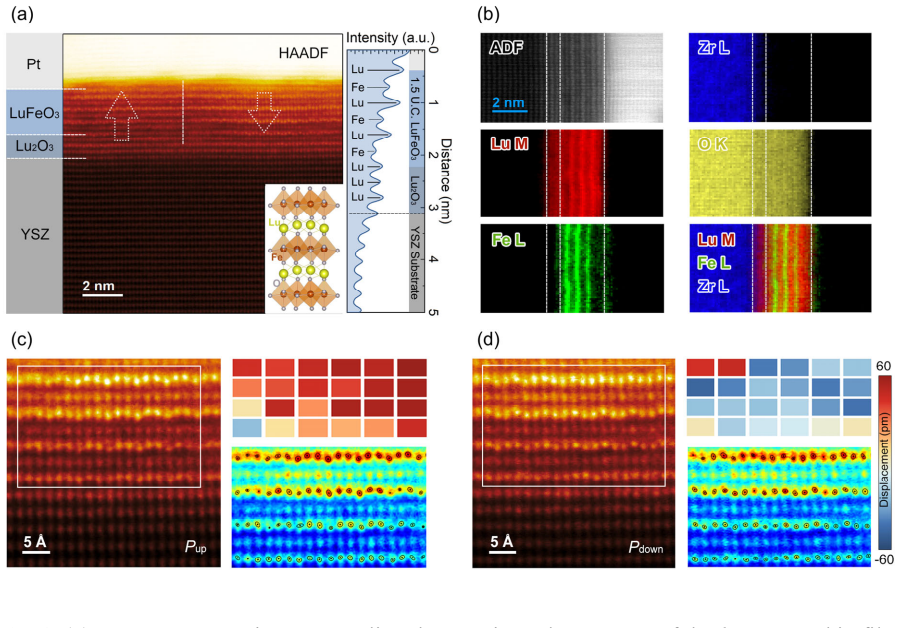
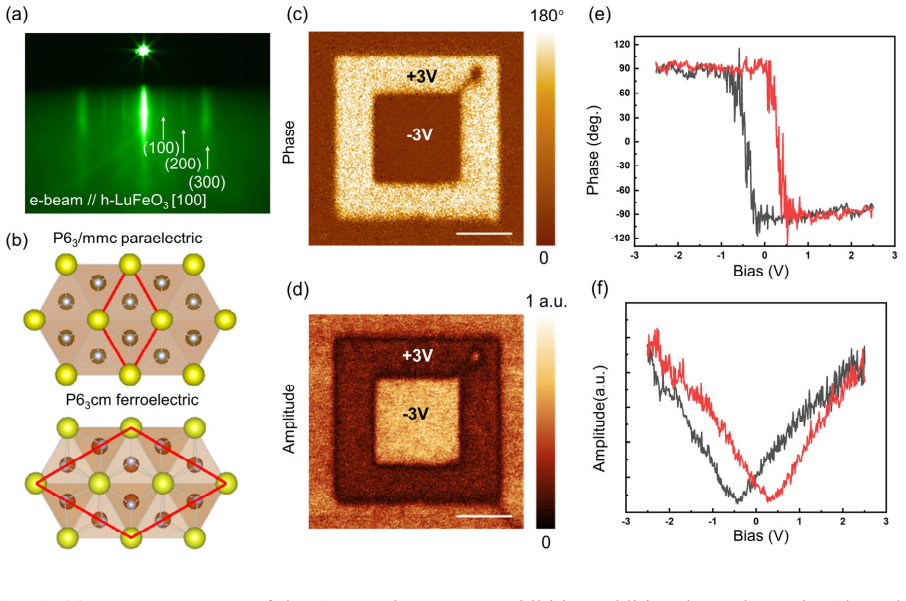
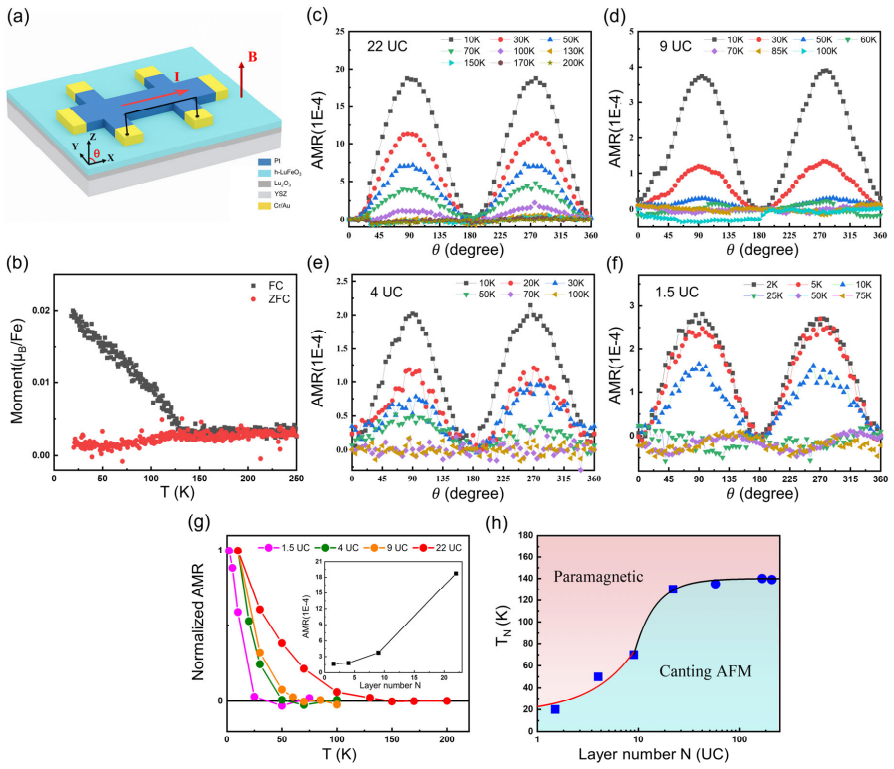
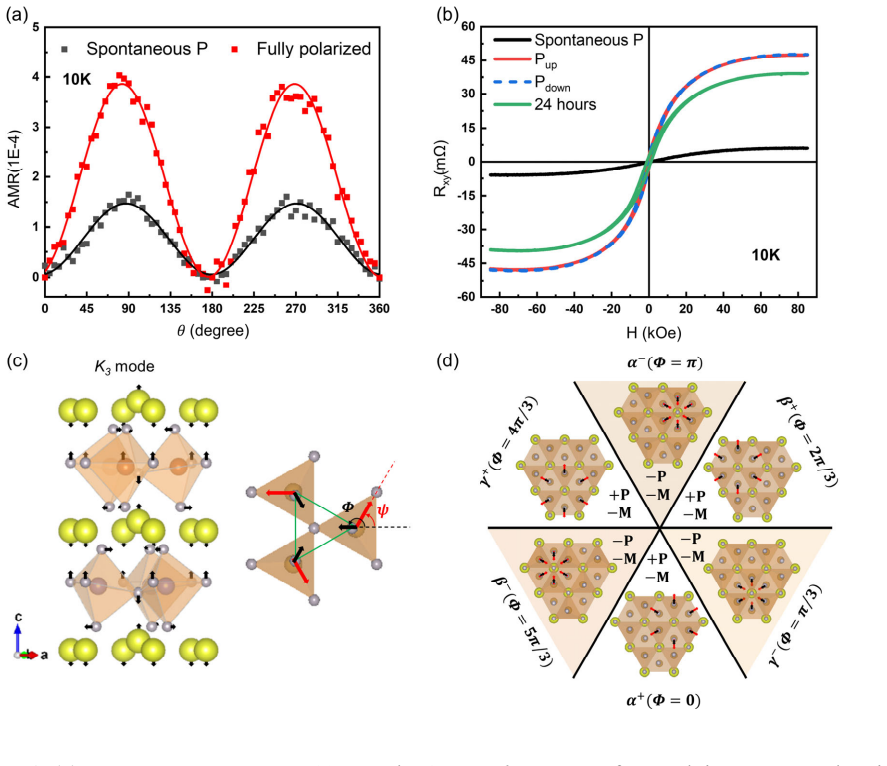
M. Mostovoy, Multiferroics: different routes to magnetoelectric coupling, npj Spintronics 2, 18 (2024). 10 Fig. 1. (a) HAADF-STEM image revealing the atomic-scale structure of the h-LuFeO3 thin film, where both the upward and downward polarization domains are observed. The left schematic illustrates the thin film structure, consisting of a 1.5-unit-cell-t...
2024
discussion (0)
Sign in with ORCID, Apple, or X to comment. Anyone can read and Pith papers without signing in.