REVIEW 2 major objections 1 minor 59 references
CORE: Conflict-Oriented Reasoning for General Multimodal Manipulation Detection
T0 review · 2 major / 1 minor · reviewed 2026-06-28 · grok-4.3
Pith's one-line read Multimodal fake news detection works by training models to identify intrinsic conflicts across image, text, and world knowledge.
desk verdict CORE's conflict corpus and MLLM training is a reasonable shift for generalization in multimodal detection, but the abstract gives no controls to show the conflict labels are what drive the gains rather than generic fine-tuning. read the letter →
The pith
A machine-rendered reading of the paper's core claim, the machinery that carries it, and where it could break.
The reading
What carries the argument
The Conflict Attribution Corpus (CAC), a dataset of fine-grained annotations of conflict factors and sources that supports conflict-oriented representation enhancement and reasoning inside multimodal large language models.
What would settle it
A realistic multimodal manipulation that produces convincing fakes without introducing any semantic, physical, or knowledge-based inconsistencies that the trained model can flag.
Extended reading notes
Core claim
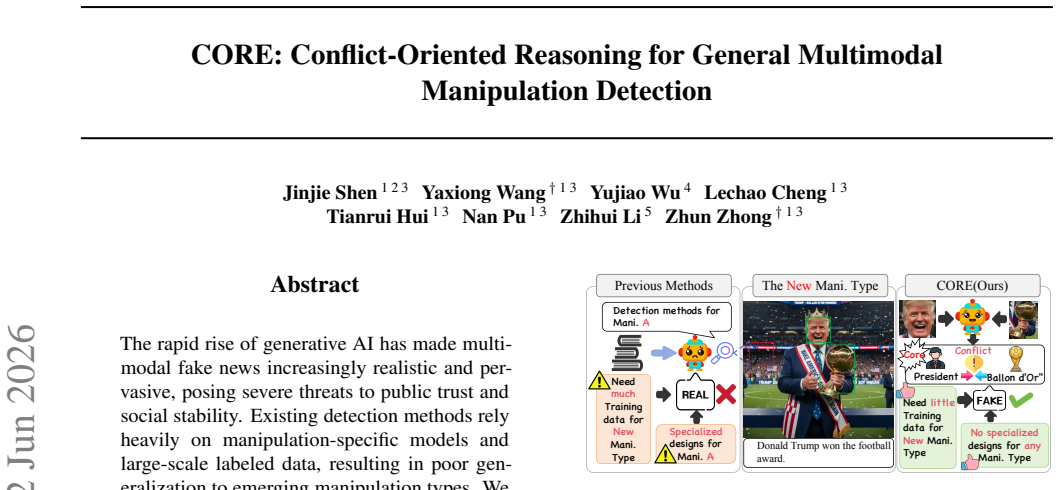
The CORE framework constructs the Conflict Attribution Corpus with fine-grained annotations of conflict factors and sources; conflict-oriented representation enhancement and reasoning on this corpus endows MLLMs with explicit conflict-capturing capability that yields robust and generalizable detection, including rapid adaptation to unseen manipulation types in few-shot or zero-shot regimes.
Load-bearing premise
Manipulated misinformation always contains detectable intrinsic conflicts that can be learned from one fixed corpus and transferred to entirely new manipulation techniques.
Editorial extensions
If this is right
- Detection performance no longer depends on collecting large labeled sets for each new manipulation type.
- Models can adapt to emerging generative techniques using only a handful of examples or none at all.
- The same trained system outperforms prior manipulation-specific detectors across existing benchmarks.
- Explicit conflict attribution becomes available as an interpretable output of the detection process.
Reading between the lines
- The same conflict-labeling approach could be applied to video or audio manipulations by extending the corpus.
- Because the model reasons about specific conflicts rather than overall authenticity, its outputs may be easier to explain to end users.
- If the premise holds, conflict reasoning could serve as a unifying detection strategy across many different media types and editing tools.
Signed reviews
Editorial analysis
A structured set of objections, weighed in public.
Referee Report
Summary. The paper proposes the CORE framework for multimodal manipulation detection. It constructs a Conflict Attribution Corpus (CAC) with fine-grained annotations of conflict factors and sources, then uses conflict-oriented representation enhancement and reasoning to endow MLLMs with explicit conflict-capturing capability. The central claim is that this yields robust generalization to unseen manipulation types in few-shot or zero-shot regimes, outperforming prior SOTA methods; the dataset and code are released publicly.
Significance. If the results hold and the conflict annotations are shown to drive the gains (rather than generic fine-tuning), the work would address a core limitation in the field by moving beyond manipulation-specific detectors toward more transferable conflict reasoning. The public release of CAC and code supports reproducibility and is a clear strength.
major comments (2)
- [Abstract] Abstract: the claim that 'conflict-oriented representation enhancement and reasoning based on CAC' produces transferable conflict-capturing capability (rather than gains from data volume or alignment) is load-bearing for the generalization result, yet the manuscript provides no description of controls that hold data volume, task format, and MLLM backbone fixed while ablating the conflict-specific factor/source labels.
- [Abstract] Abstract: the assertion that CORE 'surpasses state-of-the-art models' and 'effectively and rapidly adapting to unseen manipulation types' cannot be evaluated without reported metrics, baselines, ablation tables, or error bars; the absence of these details in the manuscript leaves the soundness of the central empirical claim unverified.
minor comments (1)
- [Abstract] The abstract states that the dataset and code are publicly available at a GitHub link, which is positive, but the manuscript should include a brief description of CAC construction statistics (e.g., number of samples, conflict types) to allow readers to assess scale.
Simulated Author's Rebuttal
We thank the referee for the constructive feedback. We address each major comment below and will revise the manuscript to strengthen the empirical presentation of our claims.
read point-by-point responses
-
Referee: [Abstract] Abstract: the claim that 'conflict-oriented representation enhancement and reasoning based on CAC' produces transferable conflict-capturing capability (rather than gains from data volume or alignment) is load-bearing for the generalization result, yet the manuscript provides no description of controls that hold data volume, task format, and MLLM backbone fixed while ablating the conflict-specific factor/source labels.
Authors: We agree that explicit controls isolating the contribution of the conflict factor and source labels would strengthen the central claim. In the revised manuscript we will add an ablation that holds data volume, task format, and MLLM backbone fixed while comparing training with versus without the fine-grained conflict annotations from CAC. This will clarify that the observed generalization arises from the conflict-oriented components rather than generic fine-tuning effects. revision: yes
-
Referee: [Abstract] Abstract: the assertion that CORE 'surpasses state-of-the-art models' and 'effectively and rapidly adapting to unseen manipulation types' cannot be evaluated without reported metrics, baselines, ablation tables, or error bars; the absence of these details in the manuscript leaves the soundness of the central empirical claim unverified.
Authors: The full manuscript reports the relevant metrics, SOTA baselines, few-shot/zero-shot results on unseen manipulation types, and ablation tables in the experiments section. To make these claims more immediately verifiable, we will revise the abstract to include key quantitative results and add error bars to all tables in the revised version. revision: yes
Circularity Check
No circularity: derivation grounded in independent corpus construction and experimental validation
full rationale
The paper begins with an empirical observation about intrinsic conflicts in manipulated misinformation, constructs the Conflict Attribution Corpus (CAC) as an independent annotated dataset, and applies conflict-oriented training to MLLMs, with generalization claims resting on reported experimental outcomes rather than any definitional loop, parameter fit renamed as prediction, or self-citation chain. No equations or self-citations appear as load-bearing reductions in the provided text, and the central premise does not reduce to its own inputs by construction.
Assumptions & free parameters
assumptions (1)
- domain assumption The essence of manipulated misinformation lies in its intrinsic conflicts, i.e., semantic or physical inconsistencies either across modalities or with common world knowledge.
Cite this review
Pith. "Pith review of CORE: Conflict-Oriented Reasoning for General Multimodal Manipulation Detection." pith.science (2026). https://pith.science/paper/KG5WMISF
@misc{pith2026260603066,
  author       = {Pith},
  title        = {Pith review of: CORE: Conflict-Oriented Reasoning for General Multimodal Manipulation Detection},
  year         = {2026},
  howpublished = {\url{https://pith.science/paper/KG5WMISF}},
  note         = {Machine review of arXiv:2606.03066}
}
read the original abstract
The rapid rise of generative AI has made multimodal fake news increasingly realistic and pervasive, posing severe threats to public trust and social stability. Existing detection methods rely heavily on manipulation-specific models and large-scale labeled data, resulting in poor generalization to emerging manipulation types. We observed that the essence of manipulated misinformation lies in its intrinsic conflicts, \textbf{i.e.,} semantic or physical inconsistencies either across modalities or with common world knowledge. Inspired by this observation, we propose \textbf{C}onflict-\textbf{O}riented \textbf{RE}asoning (\textbf{CORE}) framework, an effective paradigm that learns to endows multimodal large language models (MLLMs) with explicit conflict-capturing capability. To this end, CORE first constructs the Conflict Attribution Corpus (CAC) with fine-grained annotations of conflict factors and sources, providing essential data support for subsequent conflict perception training. By performing conflict-oriented representation enhancement and reasoning based on CAC, CORE achieves robust and generalizable conflict detection, effectively and rapidly adapting to unseen manipulation types with a few samples or in even zero-shot settings. Extensive experiments demonstrate that CORE surpasses state-of-the-art models. The dataset and code are publicly available at https://github.com/shen8424/CORE.
Figures


Figures from the paper (9 more)


Reference graph
Works this paper leans on
-
[1]
FirstName LastName , title =
-
[2]
FirstName Alpher , title =
-
[3]
Journal of Foo , volume = 13, number = 1, pages =
FirstName Alpher and FirstName Fotheringham-Smythe , title =. Journal of Foo , volume = 13, number = 1, pages =
-
[4]
Journal of Foo , volume = 14, number = 1, pages =
FirstName Alpher and FirstName Fotheringham-Smythe and FirstName Gamow , title =. Journal of Foo , volume = 14, number = 1, pages =
-
[5]
FirstName Alpher and FirstName Gamow , title =
-
[6]
Kilichbek Haydarov and Aashiq Muhamed and Xiaoqian Shen and Jovana Lazarevic and Ivan Skorokhodov and Chamuditha Jayanga Galappaththige and Mohamed Elhoseiny , title =
-
[7]
Zhengqi Li and Richard Tucker and Noah Snavely and Aleksander Holynski , title =
-
[8]
Sahar Abdelnabi and Rakibul Hasan and Mario Fritz , title =
Show all 59 references
-
[9]
Seeing is not always believing: Benchmarking Human and Model Perception of AI-Generated Images , booktitle = NIPS, year =
Zeyu Lu and Di Huang and Lei Bai and Jingjing Qu and Chengyue Wu and Xihui Liu and Wanli Ouyang , editor =. Seeing is not always believing: Benchmarking Human and Model Perception of AI-Generated Images , booktitle = NIPS, year =
-
[10]
2024 , pages =
Fanghua Yu and Jinjin Gu and Zheyuan Li and Jinfan Hu and Xiangtao Kong and Xintao Wang and Jingwen He and Yu Qiao and Chao Dong , title =. 2024 , pages =
2024
-
[11]
2024 , pages =
Kilichbek Haydarov and Aashiq Muhamed and Xiaoqian Shen and Jovana Lazarevic and Ivan Skorokhodov and Chamuditha Jayanga Galappaththige and Mohamed Elhoseiny , title =. 2024 , pages =
2024
-
[12]
2020 , pages =
Liming Jiang and Ren Li and Wayne Wu and Chen Qian and Chen Change Loy , title =. 2020 , pages =
2020
-
[13]
2020 , pages =
Yuezun Li and Xin Yang and Pu Sun and Honggang Qi and Siwei Lyu , title =. 2020 , pages =
2020
-
[14]
Rui Shao and Tianxing Wu and Ziwei Liu , title =
-
[15]
2017 , pages =
Kai Shu and Amy Sliva and Suhang Wang and Jiliang Tang and Huan Liu , title =. 2017 , pages =
2017
-
[16]
MMFakeBench:
Xuannan Liu and Zekun Li and Pei. MMFakeBench:
-
[17]
Beyond Artificial Misalignment: Detecting and Grounding Semantic-Coordinated Multimodal Manipulations , author =
-
[18]
CoRR , year =
Yuchen Zhang and Yaxiong Wang and Yujiao Wu and Lianwei Wu and Li Zhu , title =. CoRR , year =
-
[19]
Liming Jiang and Ren Li and Wayne Wu and Chen Qian and Chen Change Loy , title =
-
[20]
Yuezun Li and Xin Yang and Pu Sun and Honggang Qi and Siwei Lyu , title =
-
[21]
Xuannan Liu and Peipei Li and Huaibo Huang and Zekun Li and Xing Cui and Jiahao Liang and Lixiong Qin and Weihong Deng and Zhaofeng He , title =
-
[22]
CoRR , volume =
Yijun Bei and Hengrui Lou and Jinsong Geng and Erteng Liu and Lechao Cheng and Jie Song and Mingli Song and Zunlei Feng , title =. CoRR , volume =. 2024 , url =. doi:10.48550/ARXIV.2406.09181 , eprinttype =. 2406.09181 , timestamp =
2024 doi
-
[23]
Rui Shao and Tianxing Wu and Jianlong Wu and Liqiang Nie and Ziwei Liu , title =
-
[24]
Qwen2.5-VL Technical Report , journal =
Shuai Bai and Keqin Chen and Xuejing Liu and Jialin Wang and Wenbin Ge and Sibo Song and Kai Dang and Peng Wang and Shijie Wang and Jun Tang and Humen Zhong and Yuanzhi Zhu and Ming. Qwen2.5-VL Technical Report , journal =
-
[25]
CoRR , year =
Gemma Team , title =. CoRR , year =
-
[26]
CoRR , year =
Llama Team , title =. CoRR , year =
-
[27]
CoRR , year =
Dong Guo and Faming Wu and Feida Zhu and Fuxing Leng and Guang Shi and Haobin Chen and Haoqi Fan and Jian Wang and Jianyu Jiang and Jiawei Wang and Jingji Chen and Jingjia Huang and Kang Lei and Liping Yuan and Lishu Luo and Pengfei Liu and Qinghao Ye and Rui Qian and Shen Yan...
-
[28]
Zhenxing Zhang and Yaxiong Wang and Lechao Cheng and Zhun Zhong and Dan Guo and Meng Wang , booktitle = CVPR , pages =
-
[29]
Sniffer: Multimodal Large Language Model for Explainable Out-of-Context Misinformation Detection , booktitle = CVPR, pages =
Peng Qi and Zehong Yan and Wynne Hsu and Mong. Sniffer: Multimodal Large Language Model for Explainable Out-of-Context Misinformation Detection , booktitle = CVPR, pages =
-
[30]
Alec Radford and Jong Wook Kim and Chris Hallacy and Aditya Ramesh and Gabriel Goh and Sandhini Agarwal and Girish Sastry and Amanda Askell and Pamela Mishkin and Jack Clark and Gretchen Krueger and Ilya Sutskever , title =
-
[31]
Selvaraju and Akhilesh Gotmare and Shafiq R
Junnan Li and Ramprasaath R. Selvaraju and Akhilesh Gotmare and Shafiq R. Joty and Caiming Xiong and Steven Chu. Align before Fuse: Vision and Language Representation Learning with Momentum Distillation , booktitle = NIPS, pages =
-
[32]
Visualizing Data using t-SNE , journal =
Laurens. Visualizing Data using t-SNE , journal =
-
[33]
2025 , url =
Google Search. 2025 , url =
2025
-
[34]
CoRR , year =
GPT-4o Team , title =. CoRR , year =
-
[35]
CoRR , year =
Jinze Bai and Shuai Bai and Shusheng Yang and Shijie Wang and Sinan Tan and Peng Wang and Junyang Lin and Chang Zhou and Jingren Zhou , title =. CoRR , year =
-
[36]
CoRR , year =
Gemini Team , title =. CoRR , year =
-
[37]
Chunyu Xie and Bin Wang and Fanjing Kong and Jincheng Li and Dawei Liang and Gengshen Zhang and Dawei Leng and Yuhui Yin , title =
-
[38]
Gomez and Lukasz Kaiser and Illia Polosukhin , title =
Ashish Vaswani and Noam Shazeer and Niki Parmar and Jakob Uszkoreit and Llion Jones and Aidan N. Gomez and Lukasz Kaiser and Illia Polosukhin , title =
-
[39]
Chaoya Jiang and Haiyang Xu and Mengfan Dong and Jiaxing Chen and Wei Ye and Ming Yan and Qinghao Ye and Ji Zhang and Fei Huang and Shikun Zhang , title =
-
[40]
Xiaohua Zhai and Basil Mustafa and Alexander Kolesnikov and Lucas Beyer , title =
-
[41]
Lawrence Zitnick and Devi Parikh , title =
Stanislaw Antol and Aishwarya Agrawal and Jiasen Lu and Margaret Mitchell and Dhruv Batra and C. Lawrence Zitnick and Devi Parikh , title =
-
[42]
Hu and Yelong Shen and Phillip Wallis and Zeyuan Allen
Edward J. Hu and Yelong Shen and Phillip Wallis and Zeyuan Allen. LoRA: Low-Rank Adaptation of Large Language Models , booktitle = ICLR, year =
-
[43]
Grace Luo and Trevor Darrell and Anna Rohrbach , title =
-
[44]
Kaiming He and Georgia Gkioxari and Piotr Doll. Mask
-
[45]
Girshick , title =
Kaiming He and Haoqi Fan and Yuxin Wu and Saining Xie and Ross B. Girshick , title =
-
[46]
2020 , pages =
Renwang Chen and Xuanhong Chen and Bingbing Ni and Yanhao Ge , title =. 2020 , pages =
2020
-
[47]
2021 , pages =
Gege Gao and Huaibo Huang and Chaoyou Fu and Zhaoyang Li and Ran He , title =. 2021 , pages =
2021
-
[48]
2022 , pages =
Tengfei Wang and Yong Zhang and Yanbo Fan and Jue Wang and Qifeng Chen , title =. 2022 , pages =
2022
-
[49]
2021 , pages =
Or Patashnik and Zongze Wu and Eli Shechtman and Daniel Cohen-Or and Dani Lischinski , title =. 2021 , pages =
2021
-
[50]
Tom B. Brown and Benjamin Mann and Nick Ryder and Melanie Subbiah and Jared Kaplan and Prafulla Dhariwal and Arvind Neelakantan and Pranav Shyam and Girish Sastry and Amanda Askell and Sandhini Agarwal and Ariel Herbert. Language Models are Few-Shot Learners , booktitle = NIPS, year =
-
[51]
Language Models with Image Descriptors are Strong Few-Shot Video-Language Learners , booktitle = NIPS, year =
Zhenhailong Wang and Manling Li and Ruochen Xu and Luowei Zhou and Jie Lei and Xudong Lin and Shuohang Wang and Ziyi Yang and Chenguang Zhu and Derek Hoiem and Shih. Language Models with Image Descriptors are Strong Few-Shot Video-Language Learners , booktitle = NIPS, year =
-
[52]
Aman Madaan and Shuyan Zhou and Uri Alon and Yiming Yang and Graham Neubig , title =
-
[53]
Zhenxing Zhang and Yaxiong Wang and Lechao Cheng and Zhun Zhong and Dan Guo and Meng Wang , title =
-
[54]
Cultivating Forensic Reasoning for Generalizable Multimodal Manipulation Detection , author=
-
[55]
Generating Attribution Reports for Manipulated Facial Images: A Dataset and Baseline , author=
-
[56]
Discrete to continuous: Generating smooth transition poses from sign language observations , author=
-
[57]
IEEE Transactions on Multimedia , volume=
Graph-based multimodal sequential embedding for sign language translation , author=. IEEE Transactions on Multimedia , volume=
-
[58]
Sign-idd: Iconicity disentangled diffusion for sign language production , author=
-
[59]
DCP: Dual-Cue Pruning for Efficient Large Vision-Language Models , author=
Reviewed June 28, 2026 · model on record in the stance chip above.
Discussion (0). Continue with ORCID to comment.