Hierarchical Federated Learning with Dynamic Clustering and Adaptive Regularization for Robust Infrastructure Inspection
Pith reviewed 2026-06-28 10:57 UTC · model grok-4.3
The pith
A hierarchical federated learning system uses gradient-based clustering and adaptive regularization to neutralize double heterogeneity in infrastructure inspection.
A machine-rendered reading of the paper's core claim, the machinery that carries it, and where it could break.
Core claim
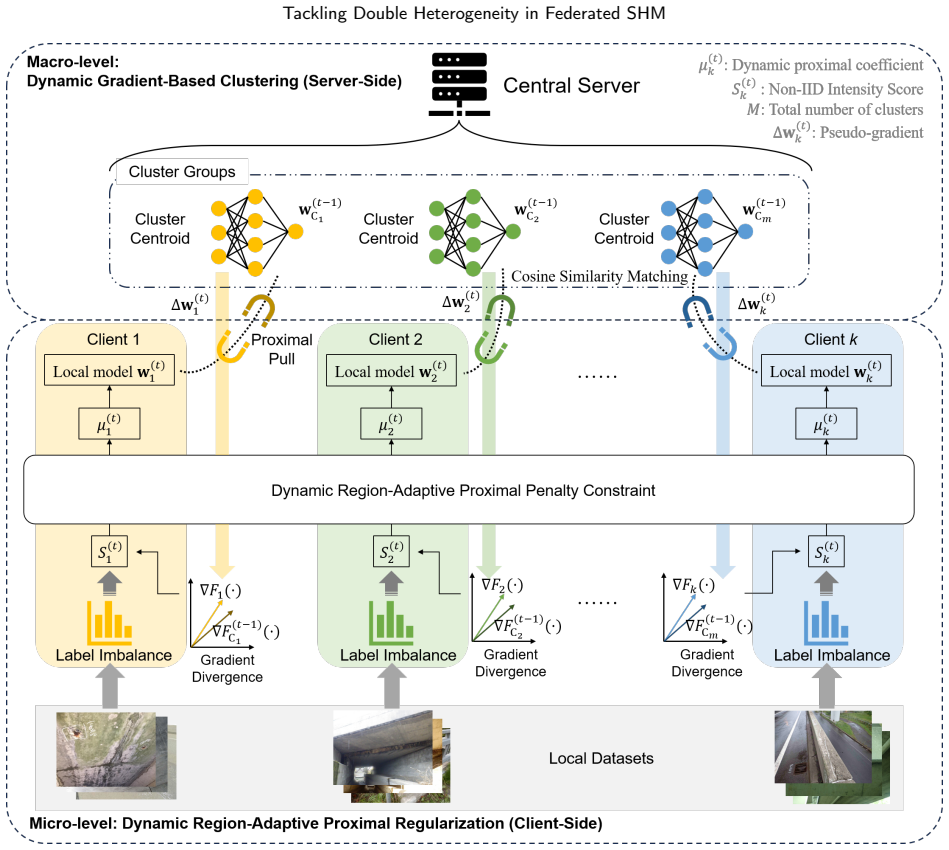
The framework orchestrates a synergistic two-tier optimization strategy. At the macro-level, a dynamic gradient-based clustering mechanism autonomously aggregates distributed clients into specialized expert groups based on their structural degradation trajectories, circumventing the need for prior geographical metadata. Concurrently, at the micro-level, an intra-cluster Dynamic Region-Adaptive Proximal Regularization (DRAPR) module computes a real-time statistical Non-IID Intensity Score for each client. By adaptively modulating a proximal penalty based on local label skewness and gradient divergence, DRAPR effectively calibrates local updates, mitigates client drift, and prevents the catast
What carries the argument
Dynamic gradient-based clustering at the macro level combined with Dynamic Region-Adaptive Proximal Regularization (DRAPR) that computes a Non-IID Intensity Score to modulate the proximal penalty at the micro level.
If this is right
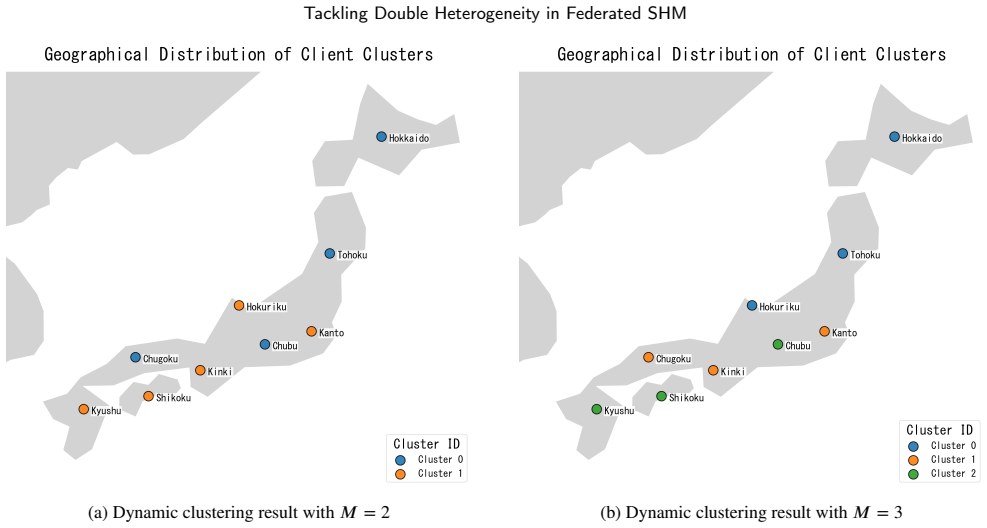
- Expert groups form autonomously based on degradation patterns without needing geographical metadata.
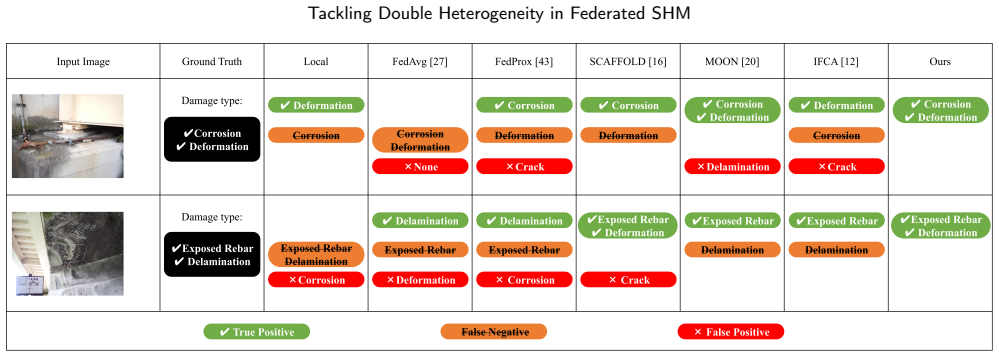
- Local updates are calibrated to mitigate client drift and preserve minority damage classes.
- Specialized diagnostic models emerge for different structural types while sharing knowledge within clusters.
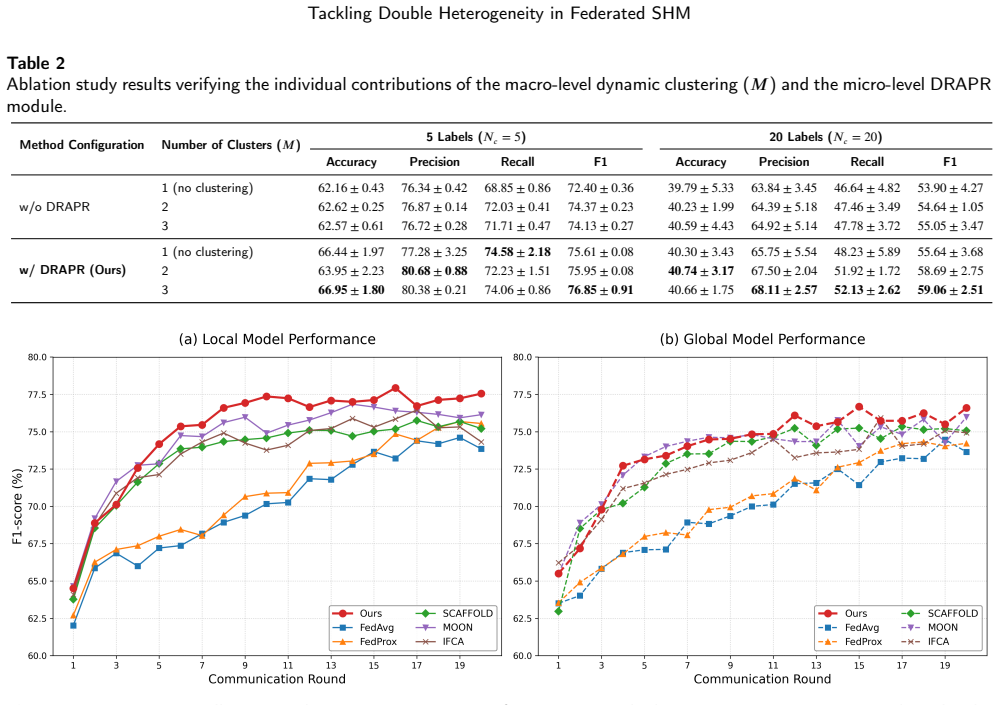
- Overall performance improves on real-world heterogeneous inspection datasets compared to standard federated learning.
Where Pith is reading between the lines
- The approach could extend to other privacy-sensitive domains with similar multi-level heterogeneity, such as medical imaging across different hospital equipment types.
- Removing reliance on metadata could simplify large-scale deployment in sensor networks where location data is unavailable or restricted.
- Testing clustering stability over sequential data arrivals would check whether groups remain consistent as inspection records evolve.
Load-bearing premise
Gradient trajectories alone are sufficient to form stable expert clusters across physically divergent structural types without geographic or metadata supervision, and the real-time Non-IID Intensity Score will reliably prevent client drift and catastrophic forgetting on minority damage classes.
What would settle it
Run the clustering on a dataset where clients from different structural types are engineered to produce similar gradients and check if they are grouped together, or measure accuracy on minority damage classes before and after DRAPR to see if forgetting is prevented.
Figures
read the original abstract
The deployment of data-driven computer vision models for structural health monitoring (SHM) is heavily constrained by the data silo dilemma due to stringent privacy and security regulations. While federated learning (FL) offers a privacy-preserving collaborative alternative, its application to nationwide infrastructure networks is severely hindered by the challenge of ``double heterogeneity'': macro-level physical divergence across disparate structural types and micro-level statistical imbalances within local datasets. To overcome this challenge, this paper proposes a novel hierarchical federated learning framework. The framework orchestrates a synergistic two-tier optimization strategy. At the macro-level, a dynamic gradient-based clustering mechanism autonomously aggregates distributed clients into specialized expert groups based on their structural degradation trajectories, circumventing the need for prior geographical metadata. Concurrently, at the micro-level, an intra-cluster Dynamic Region-Adaptive Proximal Regularization (DRAPR) module computes a real-time statistical Non-IID Intensity Score for each client. By adaptively modulating a proximal penalty based on local label skewness and gradient divergence, DRAPR effectively calibrates local updates, mitigates client drift, and prevents the catastrophic forgetting of minority damage classes. Comprehensive evaluations on a large-scale, real-world structural inspection dataset demonstrate that the hierarchical integration of macro-clustering and micro-regularization successfully neutralizes dual-level heterogeneity, yielding highly robust and specialized diagnostic models for complex infrastructure inspection.
Editorial analysis
A structured set of objections, weighed in public.
Referee Report
Summary. The manuscript proposes a hierarchical federated learning framework to address 'double heterogeneity' in structural health monitoring (SHM) applications: macro-level physical divergence across structural types and micro-level statistical imbalances within local datasets. At the macro level, a dynamic gradient-based clustering mechanism groups clients into specialized expert groups based solely on structural degradation trajectories, without geographic metadata. At the micro level, an intra-cluster Dynamic Region-Adaptive Proximal Regularization (DRAPR) module computes a real-time Non-IID Intensity Score from label skewness and gradient divergence to adaptively modulate a proximal penalty, mitigating client drift and catastrophic forgetting on minority damage classes. Comprehensive evaluations on a large-scale real-world structural inspection dataset are claimed to demonstrate that the combined approach yields highly robust and specialized diagnostic models.
Significance. If the central claims hold, the work would offer a practical template for applying federated learning to privacy-constrained, geographically distributed infrastructure networks where both structural diversity and local data skew are present. The gradient-only clustering design and the adaptive proximal term tied to a Non-IID Intensity Score are distinctive technical choices that could generalize beyond SHM if they prove stable and physically meaningful.
major comments (2)
- [Abstract] Abstract: The central claim that 'the hierarchical integration of macro-clustering and micro-regularization successfully neutralizes dual-level heterogeneity' rests on an unreviewed dataset evaluation. No details are supplied on exclusion criteria, baseline implementations, statistical tests, or error-bar reporting, rendering the strength of the supporting evidence impossible to assess.
- [Abstract] Clustering mechanism (abstract description): The load-bearing premise that gradient trajectories alone produce stable, physically meaningful expert clusters that reflect real structural divergence (rather than transient artifacts) is asserted without any described ablation, alignment check against structural categories, or sensitivity analysis to gradient noise; this directly underpins the claim of circumventing geographic metadata.
minor comments (2)
- [Abstract] The abstract uses several compound terms (Non-IID Intensity Score, DRAPR) whose precise definitions and update rules are not expanded; a methods section should supply the exact formulas and pseudocode.
- [Abstract] No mention is made of how the dynamic clustering is triggered or re-run (e.g., frequency, convergence criterion), which affects reproducibility.
Simulated Author's Rebuttal
We thank the referee for the constructive feedback on our manuscript. We address each major comment point by point below and outline the revisions we will make.
read point-by-point responses
-
Referee: [Abstract] Abstract: The central claim that 'the hierarchical integration of macro-clustering and micro-regularization successfully neutralizes dual-level heterogeneity' rests on an unreviewed dataset evaluation. No details are supplied on exclusion criteria, baseline implementations, statistical tests, or error-bar reporting, rendering the strength of the supporting evidence impossible to assess.
Authors: The abstract provides a high-level summary of the claims, while the full experimental details—including dataset description, baseline implementations, and evaluation protocol—are presented in Section 4 of the manuscript. We agree that the current presentation would benefit from greater transparency. In the revision we will expand Section 4 to explicitly report exclusion criteria for the real-world structural inspection dataset, full baseline implementation details, results with error bars (mean ± std over multiple random seeds), and statistical significance tests (e.g., paired t-tests) for all reported improvements. revision: yes
-
Referee: [Abstract] Clustering mechanism (abstract description): The load-bearing premise that gradient trajectories alone produce stable, physically meaningful expert clusters that reflect real structural divergence (rather than transient artifacts) is asserted without any described ablation, alignment check against structural categories, or sensitivity analysis to gradient noise; this directly underpins the claim of circumventing geographic metadata.
Authors: Section 3.2 details the gradient-based dynamic clustering procedure and its motivation for operating without geographic metadata. We acknowledge that additional empirical validation would strengthen the claim. The revised manuscript will include (i) an ablation comparing the proposed clustering against random and static baselines, (ii) an alignment analysis between obtained clusters and available structural-type labels on a held-out validation subset, and (iii) a sensitivity study that injects controlled gradient noise and measures cluster stability over training rounds. revision: yes
Circularity Check
No circularity in derivation; abstract describes framework without equations or self-referential reductions
full rationale
The provided text consists solely of the abstract, which outlines a hierarchical FL approach using gradient-based clustering and DRAPR with a Non-IID Intensity Score but contains no equations, parameter-fitting procedures, or derivation chains. No load-bearing step is exhibited that reduces by construction to its own inputs (e.g., no fitted quantity renamed as prediction, no self-citation justifying uniqueness, no ansatz smuggled via prior work). The description remains at the level of high-level claims about neutralizing heterogeneity, which are independent of any visible circular construction. This is the expected honest non-finding when no specific mathematical steps are available to inspect.
Axiom & Free-Parameter Ledger
Reference graph
Works this paper leans on
-
[1]
Personalised fed- erated learning framework for damage detection in structural health monitoring
Anaissi, A., Suleiman, B., Alyassine, W., 2023. Personalised fed- erated learning framework for damage detection in structural health monitoring. Journal of Civil Structural Health Monitoring 13, 295– 308
2023
-
[2]
Intelligent structural damage detection: a federated learning approach, in: International Symposium on Intelligent Data Analysis, pp
Anaissi, A., Suleiman, B., Naji, M., 2021. Intelligent structural damage detection: a federated learning approach, in: International Symposium on Intelligent Data Analysis, pp. 155–170
2021
-
[3]
Thestateof theartofdatascienceandengineeringinstructuralhealthmonitoring
Bao,Y.,Chen,Z.,Wei,S.,Xu,Y.,Tang,Z.,Li,H.,2019. Thestateof theartofdatascienceandengineeringinstructuralhealthmonitoring. Engineering 5, 234–242
2019
-
[4]
Federated learning with hierarchical clustering of local updates to improve training on non- iid data, in: 2020 international joint conference on neural networks (IJCNN), pp
Briggs, C., Fan, Z., Andras, P., 2020. Federated learning with hierarchical clustering of local updates to improve training on non- iid data, in: 2020 international joint conference on neural networks (IJCNN), pp. 1–9
2020
-
[5]
Structural health monitoring and reliability estimation: Long span truss bridge appli- cation with environmental monitoring data
Catbas, F.N., Susoy, M., Frangopol, D.M., 2008. Structural health monitoring and reliability estimation: Long span truss bridge appli- cation with environmental monitoring data. Engineering structures 30, 2347–2359
2008
-
[6]
Clus- tered federated learning for population-based structural health moni- toring
Cheema, M.A., Sarwar, M.Z., Cantero, D., Rossi, P.S., 2025. Clus- tered federated learning for population-based structural health moni- toring. IEEE Internet of Things Journal
2025
-
[7]
Classifier clus- tering and feature alignment for federated learning under distributed concept drift
Chen, J., Xue, J., Wang, Y., Liu, Z., Huang, L., 2024. Classifier clus- tering and feature alignment for federated learning under distributed concept drift. Advances in Neural Information Processing Systems 37, 81360–81388
2024
-
[8]
A deep learning-based image captioning method to automatically generate comprehensive explanations of bridge damage
Chun, P.J., Yamane, T., Maemura, Y., 2022. A deep learning-based image captioning method to automatically generate comprehensive explanations of bridge damage. Computer-Aided Civil and Infras- tructure Engineering 37, 1387–1401
2022
-
[9]
Balancing centrali- sationanddecentralisationinfederatedlearningforearthobservation- based agricultural predictions
Cowlishaw, R., Longépé, N., Riccardi, A., 2025. Balancing centrali- sationanddecentralisationinfederatedlearningforearthobservation- based agricultural predictions. Scientific Reports 15, 10454
2025
-
[10]
A review study of intel- ligent road crack detection: Algorithms and systems
El-Din Hemdan, E., Al-Atroush, M., 2025. A review study of intel- ligent road crack detection: Algorithms and systems. International Journal of Pavement Research and Technology , 1–31
2025
-
[11]
An introduction to structural health monitoring
Farrar, C.R., Worden, K., 2007. An introduction to structural health monitoring. Philosophical Transactions of the Royal Society A: Mathematical, Physical and Engineering Sciences 365, 303–315
2007
-
[12]
An efficient framework for clustered federated learning
Ghosh, A., Chung, J., Yin, D., Ramchandran, K., 2020. An efficient framework for clustered federated learning. Advances in neural information processing systems 33, 19586–19597
2020
-
[13]
Deep learning for structural health monitoring: Data, algorithms, applications, challenges, and trends
Jia, J., Li, Y., 2023. Deep learning for structural health monitoring: Data, algorithms, applications, challenges, and trends. Sensors 23, 8824
2023
-
[14]
Jothimurugesan, E., Hsieh, K., Wang, J., Joshi, G., Gibbons, P.B.,
-
[15]
5834– 5853
Federated learning under distributed concept drift, in: Interna- tional Conference on Artificial Intelligence and Statistics, pp. 5834– 5853
-
[16]
Advances and open problems in federated learning
Kairouz, P., McMahan, H.B., 2021. Advances and open problems in federated learning. Foundations and trends in machine learning 14, 1–210
2021
-
[17]
Scaffold: Stochastic controlled averaging for federated learning,in:Internationalconferenceonmachinelearning,pp.5132– 5143
Karimireddy, S.P., Kale, S., Mohri, M., Reddi, S., Stich, S., Suresh, A.T., 2020. Scaffold: Stochastic controlled averaging for federated learning,in:Internationalconferenceonmachinelearning,pp.5132– 5143
2020
-
[18]
National road struc- ture inspection database, https://road-structures-db.mlit.go.jp
Ministry of Land, Infrastructure, T., Tourism, . National road struc- ture inspection database, https://road-structures-db.mlit.go.jp
-
[19]
The american society of civil engineers’ report card on america’s infrastructure, in: Women in infrastructure, pp
Lehman, M., 2022. The american society of civil engineers’ report card on america’s infrastructure, in: Women in infrastructure, pp. 5– 21
2022
-
[20]
Areviewofapplicationsin federatedlearning
Li,L.,Fan,Y.,Tse,M.,Lin,K.Y.,2020a. Areviewofapplicationsin federatedlearning. Computers&IndustrialEngineering149,106854
-
[21]
Model-contrastive federated learning, in: Proceedings of the conference on Computer Vision and Pattern Recognition, pp
Li, Q.,He, B., Song,D., 2021. Model-contrastive federated learning, in: Proceedings of the conference on Computer Vision and Pattern Recognition, pp. 10713–10722
2021
-
[22]
Federated optimization in heterogeneous networks
Li, T., Sahu, A.K., Zaheer, M., Sanjabi, M., Talwalkar, A., Smith, V., 2020b. Federated optimization in heterogeneous networks. Proceed- ings of Machine learning and systems 2, 429–450
-
[23]
Federated learning with non-iid data: A survey
Lu, Z., Pan, H., Dai, Y., Si, X., Zhang, Y., 2024. Federated learning with non-iid data: A survey. IEEE Internet of Things Journal 11, 19188–19209
2024
-
[24]
Damage- level classification considering both correlation between image and textdataandconfidenceofattentionmap
Maeda, K., Ogawa, N., Ogawa, T., Haseyama, M., 2024. Damage- level classification considering both correlation between image and textdataandconfidenceofattentionmap. Computer-AidedCiviland Infrastructure Engineering 40, 764–781
2024
-
[25]
Con- volutional sparse coding-based deep random vector functional link networkfordistressclassificationofroadstructures
Maeda, K., Takahashi, S., Ogawa, T., Haseyama, M., 2019. Con- volutional sparse coding-based deep random vector functional link networkfordistressclassificationofroadstructures. Computer-Aided Civil and Infrastructure Engineering 34, 654–676
2019
-
[26]
Alargelanguagemodel-drivenframe- work for automated bridge specification generation and simulation validation
Maharjan,S.,Chun,P.j.,2026. Alargelanguagemodel-drivenframe- work for automated bridge specification generation and simulation validation. Computer-Aided Civil and Infrastructure Engineering , 100014
2026
-
[27]
Navigatingthecomplexityofmacro-tasks: Federated learning as a catalyst for effective crowd coordination, in: Handbook on Federated Learning, pp
Mayakannan, S., Krishnamurthy, N., Devi, K.V., Deepalakshmi, R., Rani,S.,Jose,A.A.,2023. Navigatingthecomplexityofmacro-tasks: Federated learning as a catalyst for effective crowd coordination, in: Handbook on Federated Learning, pp. 308–332
2023
-
[28]
McMahan, B., Moore, E., Ramage, D., Hampson, S., y Arcas, B.A.,
-
[29]
1273– 1282
Communication-efficient learning of deep networks from decentralized data, in: Artificial intelligence and statistics, pp. 1273– 1282
-
[30]
Advancements in smart nondestructive evaluation of industrial ma- chines:Acomprehensivereviewofcomputervisionandaitechniques for infrastructure maintenance
Mohammadi, S., Sattarpanah Karganroudi, S., Rahmanian, V., 2024. Advancements in smart nondestructive evaluation of industrial ma- chines:Acomprehensivereviewofcomputervisionandaitechniques for infrastructure maintenance. Machines 13, 11
2024
-
[31]
Snow- or ice-covered road detection in winter road surface conditions using deep neural networks
Moroto, Y., Maeda, K., Ogawa, T., Haseyama, M., 2024. Snow- or ice-covered road detection in winter road surface conditions using deep neural networks. Computer-Aided Civil and Infrastructure Engineering 39, 2935–2950. Y.H. Feng et al.:Preprint submitted to ElsevierPage 12 of 13 Tackling Double Heterogeneity in Federated SHM
2024
-
[32]
Moshawrab, M., Adda, M., Bouzouane, A., Ibrahim, H., Raad, A.,
-
[33]
Electronics 12, 2287
Reviewing federated learning aggregation algorithms; strate- gies, contributions, limitations and future perspectives. Electronics 12, 2287
-
[34]
Pan, Y., 2025. A study on the application of artificial intelligence in digital twin monitoring of building structural health, in: Proceedings of the 2025 International Conference on Artificial Intelligence and Smart Manufacturing, pp. 833–837
2025
-
[35]
Image-based structural health monitoring: A systematic review
Payawal, J.M.G., Kim, D.K., 2023. Image-based structural health monitoring: A systematic review. Applied Sciences 13, 968
2023
-
[36]
Robust aggregation for federated learning
Pillutla, K., Kakade, S.M., Harchaoui, Z., 2022. Robust aggregation for federated learning. IEEE Transactions on Signal Processing 70, 1142–1154
2022
-
[37]
Ai in structural health monitoring for infrastructure maintenance and safety
Plevris, V., Papazafeiropoulos, G., 2024. Ai in structural health monitoring for infrastructure maintenance and safety. Infrastructures 9, 225
2024
-
[38]
Per- sonalizedfederated dartsforelectricity loadforecastingof individual buildings
Qin, D., Wang, C., Wen, Q., Chen, W., Sun, L., Wang, Y., 2023. Per- sonalizedfederated dartsforelectricity loadforecastingof individual buildings. IEEE Transactions on Smart Grid 14, 4888–4901
2023
-
[39]
Clusteredfederatedlearn- ing:Model-agnosticdistributedmultitaskoptimizationunderprivacy constraints
Sattler,F.,Müller,K.R.,Samek,W.,2020. Clusteredfederatedlearn- ing:Model-agnosticdistributedmultitaskoptimizationunderprivacy constraints. IEEE transactions on neural networks and learning systems 32, 3710–3722
2020
-
[40]
Machine learning for structural health monitoring of aerospace structures: A review
Scarselli, G., Nicassio, F., 2025. Machine learning for structural health monitoring of aerospace structures: A review. Sensors 25, 6136
2025
-
[41]
A review of structural health monitoring literature: 1996–2001
Sohn,H.,Farrar,C.R.,Hemez,F.M.,Shunk,D.D.,Stinemates,D.W., Nadler, B.R., Czarnecki, J.J., 2003. A review of structural health monitoring literature: 1996–2001. Los Alamos National Laboratory, USA 1, 10–12989
2003
-
[42]
Recording of bridge damage areas by 3d integration of multiple images and reductionofthevariabilityindetectedresults
Yamane, T., Chun, P.j., Dang, J., Honda, R., 2023. Recording of bridge damage areas by 3d integration of multiple images and reductionofthevariabilityindetectedresults. Computer-AidedCivil and Infrastructure Engineering 38, 2391–2407
2023
-
[43]
A privacy-preserving framework using federated learning for structural health monitoring with miter gates application
YANG, Y., LIN, H., QIAN, G., HU, Z., TODD, M.D., 2025. A privacy-preserving framework using federated learning for structural health monitoring with miter gates application. STRUCTURAL HEALTH MONITORING 2025
2025
-
[44]
A survey on federated learning
Zhang, C., Xie, Y., Bai, H., Yu, B., Li, W., Gao, Y., 2021. A survey on federated learning. Knowledge-Based Systems 216, 106775
2021
-
[45]
Deeplearning- based automatic classification of three-level surface information in bridgeinspection.Computer-AidedCivilandInfrastructureEngineer- ing 39, 1431–1451
Zhang,H.,Shen,Z.,Lin,Z.,Quan,L.,Sun,L.,2024. Deeplearning- based automatic classification of three-level surface information in bridgeinspection.Computer-AidedCivilandInfrastructureEngineer- ing 39, 1431–1451
2024
-
[46]
Federated Learning with Non-IID Data
Zhao,Y.,Li,M.,Lai,L.,Suda,N.,Civin,D.,Chandra,V.,2018. Fed- erated learning with non-iid data. arXiv preprint arXiv:1806.00582 . (Graduate Student Member,IEEE) received the B.S. degree in Communication Engineering from Central South University, China, in 2020, and the M.S. degree in Information Science from Hokkaido University, Japan, in 2024. He is cur- ...
work page internal anchor Pith review Pith/arXiv arXiv 2018
discussion (0)
Sign in with ORCID, Apple, or X to comment. Anyone can read and Pith papers without signing in.