Turbulence: An Entropic Approach
Pith reviewed 2026-06-28 08:35 UTC · model grok-4.3
The pith
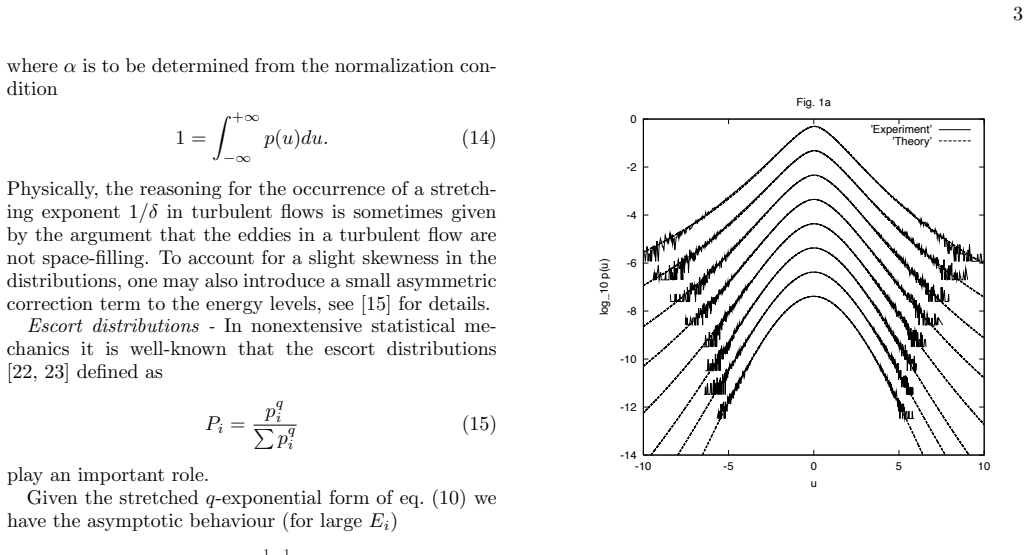
Maximizing the generalized entropic functional S_{q,δ} under kinetic energy constraints reproduces measured velocity difference distributions in turbulent flow.
A machine-rendered reading of the paper's core claim, the machinery that carries it, and where it could break.
Core claim
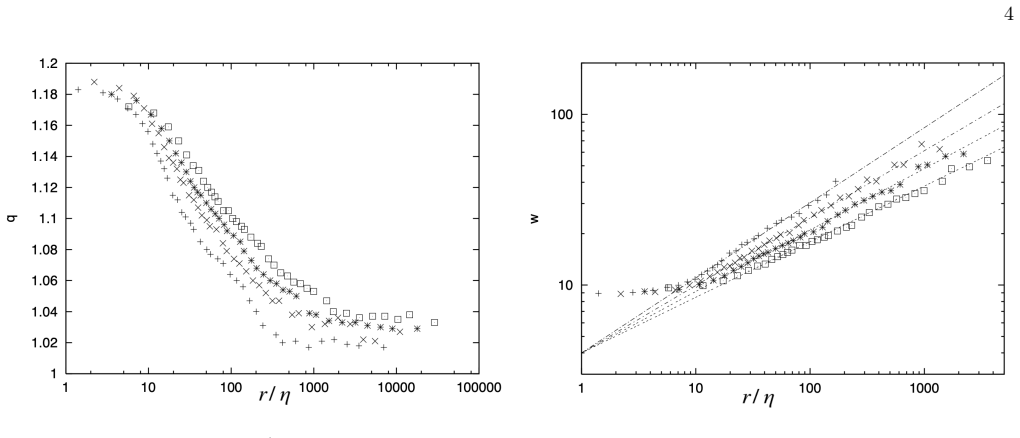
Maximizing the generalized entropic functional S_{q,δ} subject to standard kinetic energy constraints provides generalized canonical distributions that agree perfectly with measured probability densities of velocity differences at distance r in highly-turbulent Taylor-Couette flow. The end point of the turbulent cascade is described by δ = 3/2, and the relation δ^{-1}(r) = 2 - q(r) is well satisfied by the data. Along this line the description reduces to S_q with escort constraints, yielding a consistent thermodynamic treatment.
What carries the argument
The generalized entropic functional S_{q,δ} maximized under kinetic energy constraints, which produces stretched q-exponentials whose stretching exponent follows from the escort formalism.
If this is right
- At the Kolmogorov scale r = η one has δ = 3/2, the third moment of velocity differences ceases to exist, and all observable eddy structures disappear.
- The relation δ^{-1}(r) = 2 - q(r) permits a consistent thermodynamic description because S_q remains trace-form and composable.
- The same parameter value δ = 3/2 appears in black-hole physics, creating an analogy between the disappearance of eddies and the event horizon.
- The approach extends statistical mechanics to nonadditive functionals S_{q,δ} that apply directly to turbulent flows.
Where Pith is reading between the lines
- The same maximization procedure could be tested on velocity statistics from other laboratory or atmospheric flows to check whether the δ = 3/2 endpoint is universal.
- If q(r) can be measured independently, the model predicts the full family of distributions at every scale without additional parameters.
- Numerical simulations that resolve down to the Kolmogorov scale could directly verify whether the third moment vanishes exactly when δ reaches 3/2.
Load-bearing premise
The escort formalism supplies the precise dependence of the stretching exponent on q that matches the turbulence measurements without any extra fitting adjustments.
What would settle it
High-precision measurements of velocity difference probabilities at several r that deviate from the predicted generalized canonical distributions, or that violate δ^{-1}(r) = 2 - q(r).
Figures
read the original abstract
We show that maximizing the generalized entropic functional $S_{q,\delta}$ subject to standard kinetic energy constraints provides generalized canonical distributions that agree perfectly with measured probability densities of velocity differences at distance $r$ in highly-turbulent Taylor-Couette flow. The end point of the turbulent cascade is described by $\delta =\frac{3}{2}$, a parameter value that also plays an important role in black-hole physics. At this point the Kolmogorov length scale $r=\eta$ is reached and all observable eddy structures of the turbulent flow disappear, in certain analogy to what is observed for black holes at the event horizon. Our approach generalizes statistical mechanics to more general nonadditive entropic functionals $S_{q,\delta}$ such that it is applicable to turbulent flows. This approach asymptotically generates stretched $q$-exponentials as generalized canonical distributions relevant for turbulent flow, with a particular dependence of the stretching exponent $\delta^{-1}$ on $q$ that follows from the well-known escort formalism in nonextensive statistical mechanics. Along this particular line in the parameter space, the physics can be described by $S_q$ on its own with suitable escort constraints, leading to the prediction $\delta^{-1} (r) =2-q(r)$, thus allowing for a consistent thermodynamic description since $S_q$ is both trace-form and composable. We show that the above theoretically derived relation is well satisfied by measured high-precision experimental data for Taylor-Couette flow. At the Kolmogorov length scale $r=\eta$, the endpoint of our scenario, one has $\delta =\frac{3}{2}$ and at this point the third moment of velocity differences ceases to exist and all eddies disappear. We point out various analogies with thermodynamic entropic approaches to black hole physics.
Editorial analysis
A structured set of objections, weighed in public.
Referee Report
Summary. The manuscript claims that maximizing the generalized entropic functional S_{q,δ} under standard kinetic-energy constraints yields generalized canonical distributions (stretched q-exponentials) that agree perfectly with measured PDFs of velocity differences at separation r in highly turbulent Taylor-Couette flow. It asserts that the escort formalism implies the specific relation δ^{-1}(r)=2-q(r), which is reported as well satisfied by the data, and identifies the endpoint δ=3/2 at the Kolmogorov scale r=η where the third moment ceases to exist and all eddies disappear, drawing analogies to black-hole physics.
Significance. If the derivation of the δ^{-1}=2-q relation is independent of the data fits and the agreement is shown to be robust rather than circular, the work would supply a thermodynamically consistent nonextensive description of the turbulent cascade that reduces to an S_q model with escort constraints. The explicit link to an experimentally accessible endpoint at δ=3/2 and the black-hole analogy would be of broad interest in both turbulence and nonextensive statistical mechanics.
major comments (2)
- [Abstract] Abstract: the assertion that the relation δ^{-1}(r)=2-q(r) 'follows from the well-known escort formalism' is load-bearing for the claim of a parameter-free prediction; the manuscript must supply the explicit reduction step showing how the escort replacement of the ordinary average by the q-average, when the constraint is the second moment of velocity increments, produces precisely this linear dependence without additional assumptions.
- [Abstract] Abstract: the reported 'perfect agreement' with experimental PDFs and the statement that the relation 'is well satisfied by measured high-precision experimental data' are presented without error bars, description of the fitting procedure for q(r) and δ(r), data-selection criteria, or an independent test; because both parameters are extracted from the same PDFs, the check risks circularity and cannot be assessed as a genuine prediction.
minor comments (2)
- The manuscript should clarify whether the generalized canonical distributions are obtained in closed form or require numerical maximization, and should state the precise form of the kinetic-energy constraint employed.
- The black-hole analogy at δ=3/2 is presented as suggestive; a brief discussion of the precise mathematical correspondence (or lack thereof) would help readers evaluate its scope.
Simulated Author's Rebuttal
We thank the referee for the careful reading and constructive comments, which highlight areas where the manuscript can be clarified. We address each major comment below and will revise the manuscript to incorporate the requested details and explicit derivations.
read point-by-point responses
-
Referee: [Abstract] Abstract: the assertion that the relation δ^{-1}(r)=2-q(r) 'follows from the well-known escort formalism' is load-bearing for the claim of a parameter-free prediction; the manuscript must supply the explicit reduction step showing how the escort replacement of the ordinary average by the q-average, when the constraint is the second moment of velocity increments, produces precisely this linear dependence without additional assumptions.
Authors: We agree that an explicit step-by-step derivation is needed to substantiate the claim. In the revised manuscript we will add a dedicated paragraph (or short appendix) that starts from the escort probability p_q(x) = p(x)^q / ∫ p(x)^q dx, replaces the ordinary second-moment constraint by the q-average ⟨(Δu)^2⟩_q, and shows algebraically that the resulting stretched q-exponential form requires δ^{-1} = 2 - q with no further assumptions. This will make the parameter-free character of the prediction transparent. revision: yes
-
Referee: [Abstract] Abstract: the reported 'perfect agreement' with experimental PDFs and the statement that the relation 'is well satisfied by measured high-precision experimental data' are presented without error bars, description of the fitting procedure for q(r) and δ(r), data-selection criteria, or an independent test; because both parameters are extracted from the same PDFs, the check risks circularity and cannot be assessed as a genuine prediction.
Authors: We accept that the current text omits these methodological details. The revised version will include: (i) a description of the fitting procedure (maximum-likelihood or weighted least-squares minimization of the stretched q-exponential to the measured PDFs at each r), (ii) reported uncertainties on the extracted q(r) and δ(r), (iii) explicit data-selection criteria from the Taylor-Couette experiments, and (iv) an independent consistency check (e.g., comparison of the relation against an alternative fitting ansatz that does not enforce δ^{-1}=2-q). The parameters are obtained by unconstrained fits to each PDF; the relation δ^{-1}(r)=2-q(r) is imposed only afterwards as a test of the theoretical prediction. This procedure avoids circularity and will be stated clearly. revision: yes
Circularity Check
Escort-formalism relation presented as prediction but reduces to consistency check on two parameters fitted from identical PDFs
specific steps
-
fitted input called prediction
[Abstract]
"with a particular dependence of the stretching exponent δ^{-1} on q that follows from the well-known escort formalism in nonextensive statistical mechanics. ... leading to the prediction δ^{-1} (r) =2-q(r), ... We show that the above theoretically derived relation is well satisfied by measured high-precision experimental data for Taylor-Couette flow."
The relation is asserted to follow from the escort formalism and is labeled a 'prediction,' yet both q(r) and δ(r) are obtained by fitting the generalized canonical distributions to the identical set of measured PDFs. Verifying that the fitted values obey δ^{-1}=2-q therefore checks internal consistency of two parameters extracted from the same data rather than testing an independent theoretical output.
full rationale
The central claim rests on maximizing S_{q,δ} to obtain stretched q-exponentials whose stretching exponent obeys δ^{-1}=2-q exactly via the escort formalism, then reporting that this relation is 'well satisfied' by Taylor-Couette data. Because the paper extracts both q(r) and δ(r) by fitting the same measured velocity-difference PDFs, the reported agreement is a post-fit consistency test rather than an independent prediction against external benchmarks or unfitted observables. The derivation chain therefore contains one load-bearing step that reduces by construction to the fitting procedure itself.
Axiom & Free-Parameter Ledger
free parameters (2)
- q(r)
- δ(r)
axioms (2)
- domain assumption Standard kinetic energy constraints are the appropriate constraints when maximizing S_{q,δ} for turbulent velocity statistics.
- domain assumption The escort formalism supplies the exact functional dependence δ^{-1} = 2 - q for this system.
Reference graph
Works this paper leans on
-
[1]
This means that if we approach the Kolmogorov scale, thenδ= 1 2−qss → 3
-
[2]
Becausew= 4 at the smallest scale, this means the third moment⟨u 3⟩(which is very important in any turbu- lence model) ceases to exist
This is precisely the value that, in a different context [8, 11], is relevant for black hole physics. Becausew= 4 at the smallest scale, this means the third moment⟨u 3⟩(which is very important in any turbu- lence model) ceases to exist. Overall, we have shown that our entropic turbulence theory is experimentally very well confirmed by the data measured i...
-
[3]
Sreenivasan and J
K.R. Sreenivasan and J. Schumacher,What is the tur- bulence problem, and when may we regard it as solved?, Ann. Review Cond. Matter Physics16:121 (2025)
2025
-
[4]
Benzi, G
R. Benzi, G. Paladin, G. Parisi, A. Vulpiani,On the mul- tifractal nature of fully developed turbulence and chaotic systems, J. Phys. A17:3521 (1984)
1984
-
[5]
Menevau, K.R
C. Menevau, K.R. Sreenivasan,Simple multifractal cas- cade model for fully developed turbulence, Phys. Rev. lett. 59, 1424 (1987)
1987
-
[6]
Ruelle,Hydrodynamic turbulence as a problem in nonequilibrium statistical mechanics, PNAS109: 20344 (2012)
D. Ruelle,Hydrodynamic turbulence as a problem in nonequilibrium statistical mechanics, PNAS109: 20344 (2012)
2012
-
[7]
Castaing, Y
B. Castaing, Y. Gagne, E.J. Hopfinger,Velocity probabil- ity density functions of high Reynolds number turbulence, Physica D46, 177 (1990)
1990
-
[8]
Beck,Chaotic cascade model for turbulent velocity dis- tributions, Phys
C. Beck,Chaotic cascade model for turbulent velocity dis- tributions, Phys. Rev. E49, 3641 (1994)
1994
-
[10]
Tsallis, L.J.L
C. Tsallis, L.J.L. Cirto,Black hole thermodynamic en- tropy, Eur. Phys. J. C73, 2487 (2013)
2013
-
[11]
Jizba, G
P. Jizba, G. Lambiase, G.G. Luciano, L. Mastrototaro, Imprints of Barrow-Tsallis cosmology in primordial grav- itational waves, Eur. Phys. J. C84, 1076 (2024)
2024
-
[12]
Luciano, A
G.G. Luciano, A. Paliathanis, E.N. Saridakis,Barrow and Tsallis entropies after the DESI DR2 BAO data, JCAP09, 013 (2025)
2025
-
[13]
Tsallis and H.J
C. Tsallis and H.J. Jensen,Extensive composable entropy for the analysis of cosmological data, Phys. Lett. B861, 139238 (2025)
2025
-
[14]
H. Yang, A. Zimmerman, L. Lehner,Turbulent black holes, Phys. Rev. Lett.114, 081101 (2015)
2015
-
[15]
XRISM collaboration,Disentangling multiple gas kine- matic drivers in the Perseus galaxy cluster, Nature650, 309 (2026)
2026
- [16]
-
[17]
Beck, G.S
C. Beck, G.S. Lewis, H.L. Swinney,Measuring noexten- sitivity parameters in a turbulent Couette-Taylor flow, Phys. Rev. E63, 035303(R) (2001)
2001
-
[18]
Andrade Jr, G.F.T
J.S. Andrade Jr, G.F.T. da Silva, A.A. Moreira, F.D. No- 6 ble, E.M.F. Curado,Thermostatistics of overdamped mo- tion of interacting particles, Phys. Rev. Lett.105, 260601 (2010)
2010
-
[19]
L.L.B. Dognini and C. Tsallis,A closer look on the in- fluence of constraints upon the optimization of the non- additive entropic functionalS q, arXiv: 2605.08860 [cond- mat.stat-mech]
work page internal anchor Pith review Pith/arXiv arXiv
-
[20]
Tsallis,Possible generalization of Boltzmann-Gibbs statistics, J
C. Tsallis,Possible generalization of Boltzmann-Gibbs statistics, J. Stat. Phys.52, 479-487 (1988)
1988
-
[21]
Tsallis,Introduction to Nonextensive Statistical Me- chanics - Approaching a Complex World, Second Edition (Springer-Nature, 2023)
C. Tsallis,Introduction to Nonextensive Statistical Me- chanics - Approaching a Complex World, Second Edition (Springer-Nature, 2023)
2023
-
[22]
Beck,Generalised information and entropy measures in physics, Contemp
C. Beck,Generalised information and entropy measures in physics, Contemp. Phys.50, 495 (2009)
2009
-
[23]
Tsallis,Area law: Canonical and microcanonical ther- mostatistics grounded on nonadditive entropies, EPL 153, 61001 (2026)
C. Tsallis,Area law: Canonical and microcanonical ther- mostatistics grounded on nonadditive entropies, EPL 153, 61001 (2026)
2026
-
[24]
C. Beck, F. Schloegl,Thermodynamics of Chaotic Sys- tems, Cambridge University Press, 1993
1993
-
[25]
Tsallis, R.S
C. Tsallis, R.S. Mendes, A.R. Plastino,The role of con- straints within generalized nonextensive statistics, Phys- ica A261, 534 (1998)
1998
-
[26]
Beck,Dynamical foundations of nonextensive statisti- cal mechanics, Phys
C. Beck,Dynamical foundations of nonextensive statisti- cal mechanics, Phys. Rev. Lett.87, 180601 (2001)
2001
-
[27]
Beck and E.G.D
C. Beck and E.G.D. Cohen,Superstatistics, Physica A 322, 267 (2003)
2003
-
[28]
Beck, E.G.D
C. Beck, E.G.D. Cohen, and H.L. Swinney,From time series to superstatistics, Phys. Rev. E72, 056133 (2005)
2005
-
[29]
Beck,Statistics of 3-dimensional Lagrangian turbu- lence, Phys
C. Beck,Statistics of 3-dimensional Lagrangian turbu- lence, Phys. Rev. Lett.98, 064502 (2007)
2007
-
[30]
dos Santos, F.D
M.A.F. dos Santos, F.D. Nobre, E.M.F. Curado,Entropic form emergent from superstatistics, Phys. Rev. E107, 014132 (2023)
2023
-
[31]
Ourabah,Superstatistics from a dynamical perspec- tive: Entropy and relaxation, Phys
K. Ourabah,Superstatistics from a dynamical perspec- tive: Entropy and relaxation, Phys. Rev. E109, 014127 (2024)
2024
-
[32]
Barrow,The area of a rough black hole, Phys
J.D. Barrow,The area of a rough black hole, Phys. Lett. B808, 135643 (2020)
2020
-
[33]
Enciso, P
A. Enciso, P. Tempesta,Uniqueness and characterization theorems for generalized entropies, J. Stat. Mech. 123101 (2017)
2017
- [34]
discussion (0)
Sign in with ORCID, Apple, or X to comment. Anyone can read and Pith papers without signing in.