Spin-Dependent Electron Transport through Bacterial Cell Surface Multiheme Electron Conduits
Pith reviewed 2026-06-28 08:16 UTC · model grok-4.3
The pith
Electron transport through bacterial multiheme cytochromes on cell surfaces is spin-selective.
A machine-rendered reading of the paper's core claim, the machinery that carries it, and where it could break.
Core claim
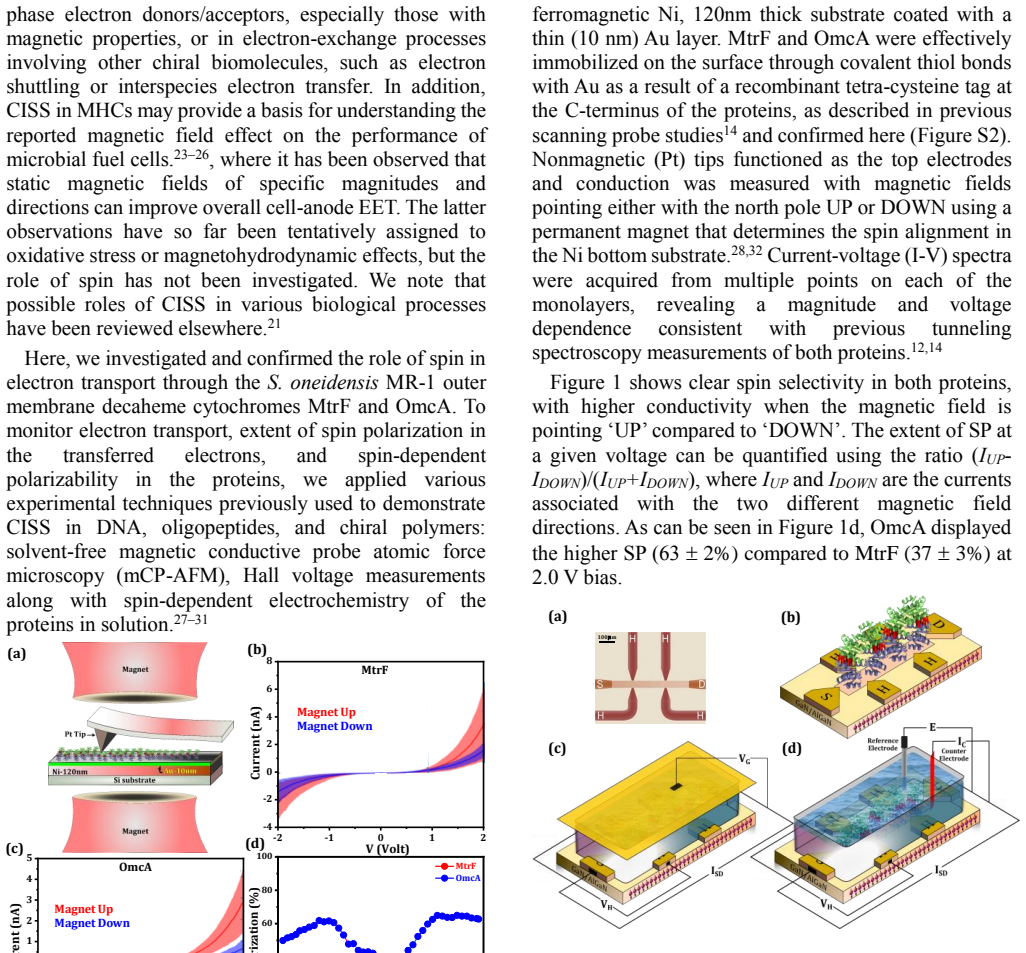
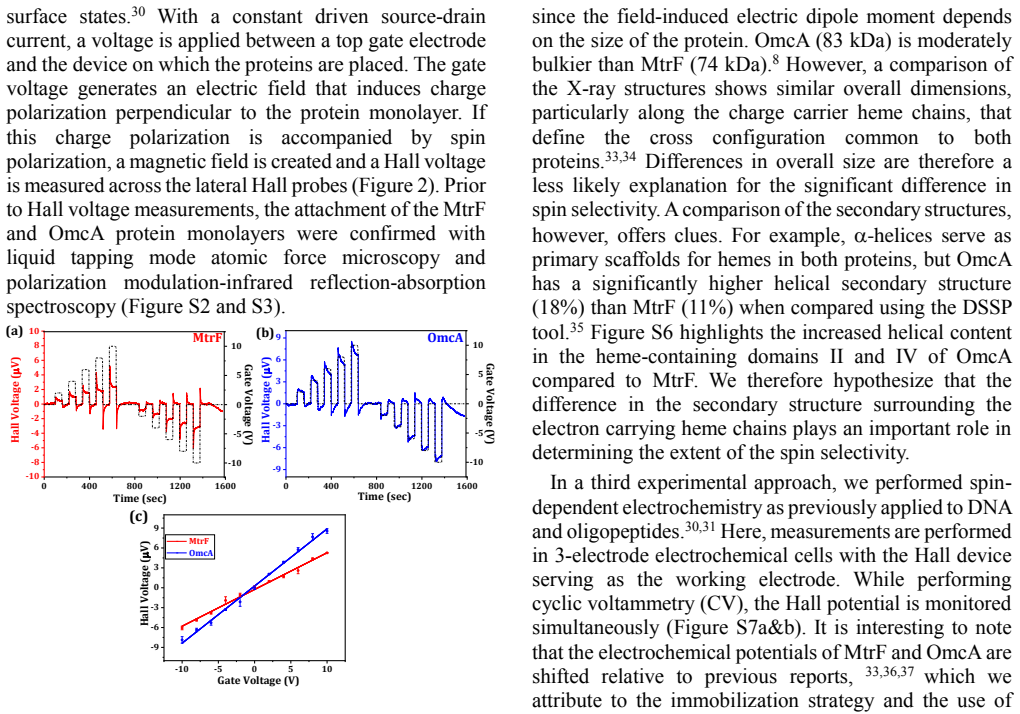
Using magnetic conductive probe atomic force microscopy, Hall voltage measurements, and spin-dependent electrochemistry on the decaheme cytochromes MtrF and OmcA from Shewanella oneidensis MR-1, the paper shows that electron transport through these extracellular conduits is spin-selective.
What carries the argument
Spin selectivity arising in the multiheme cytochromes that form the long-distance extracellular electron conduits.
If this is right
- Spin selectivity can influence electron transfer rates across biotic-abiotic interfaces in natural mineral respiration.
- Magnetic fields may modulate the efficiency of bacterial extracellular electron transport.
- Spin-dependent effects could be harnessed when wiring bacterial cells to electrodes in bioelectrochemical devices.
- The same spin preference may appear in other multiheme proteins involved in long-range electron conduction.
Where Pith is reading between the lines
- The spin selectivity might allow bacteria to respond to weak magnetic fields in their environment during mineral respiration.
- Engineering the heme chain geometry could tune spin selectivity for specific bioelectronic applications.
- Similar measurements on other extracellular electron conduits would test whether spin selectivity is a general feature of multiheme proteins.
Load-bearing premise
The recorded magnetic and spin-dependent signals come specifically from spin preference inside the cytochromes and not from cell-surface structures, electrode interfaces, or other magnetic effects.
What would settle it
Repeating the magnetic probe, Hall, and electrochemistry measurements on the same cytochromes after disrupting their chiral structure or removing the heme chain while keeping other cell components intact and observing loss of the spin preference would falsify the claim.
Figures
read the original abstract
Multiheme cytochromes, located on the bacterial cell surface, function as long-distance (> 10 nm) electron conduits linking intracellular reactions to external surfaces. This extracellular electron transfer process, which allows microorganisms to gain energy by respiring solid redox-active minerals, also facilitates the wiring of cells to electrodes. While recent studies suggested that a chiral induced spin selectivity effect is linked to efficient electron transmission through biomolecules, this phenomenon has not been investigated in the extracellular electron conduits. Using magnetic conductive probe atomic force microscopy, Hall voltage measurements, and spin-dependent electrochemistry of the decaheme cytochromes MtrF and OmcA from the metal-reducing bacterium Shewanella oneidensis MR-1, we show that electron transport through these extracellular conduits is spin-selective. Our study has implications for understanding how spin-dependent interactions and magnetic fields may control electron transport across biotic-abiotic interfaces in both natural and biotechnological systems. Electron
Editorial analysis
A structured set of objections, weighed in public.
Referee Report
Summary. The manuscript reports that electron transport through the extracellular decaheme cytochromes MtrF and OmcA on Shewanella oneidensis MR-1 is spin-selective. This conclusion is based on three experimental approaches: magnetic conductive probe atomic force microscopy, Hall voltage measurements, and spin-dependent electrochemistry. The work extends the chiral-induced spin selectivity (CISS) effect to microbial long-distance electron conduits and discusses implications for biotic-abiotic interfaces.
Significance. If the attribution of the observed signals to spin selectivity within the cytochromes is robustly supported, the result would be of interest to the fields of bioelectrochemistry and spintronics. It would provide a concrete biological example of CISS operating over >10 nm distances in a native extracellular matrix and could motivate studies on magnetic-field modulation of microbial respiration or electrode performance. The use of multiple orthogonal techniques is a positive feature.
major comments (2)
- [Results (all three techniques)] The central claim requires that the recorded signals (magnetic AFM currents, Hall voltages, and spin-dependent electrochemical currents) originate specifically from spin selectivity inside the decaheme cytochromes rather than from cell-surface architecture, electrode interfaces, or non-spin magnetic effects. The manuscript must supply explicit controls (e.g., measurements on cytochrome deletion mutants, purified proteins versus whole cells, or non-chiral reference surfaces) and quantitative comparison of signal magnitudes with and without these controls; without such data the attribution remains unverified.
- [Abstract and Methods/Results] No raw data, error bars, replicate numbers, or statistical analysis are referenced in the abstract or described in sufficient detail to allow evaluation of the claimed spin selectivity. The manuscript must include representative raw traces, signal-to-noise ratios, and statistical tests for each method.
minor comments (1)
- [Abstract] The abstract is truncated mid-sentence; the final sentence should be completed.
Simulated Author's Rebuttal
We thank the referee for the constructive and detailed review. The comments highlight important aspects of data attribution and presentation that we address point by point below. We will revise the manuscript to improve clarity and strengthen the supporting evidence where feasible.
read point-by-point responses
-
Referee: [Results (all three techniques)] The central claim requires that the recorded signals (magnetic AFM currents, Hall voltages, and spin-dependent electrochemical currents) originate specifically from spin selectivity inside the decaheme cytochromes rather than from cell-surface architecture, electrode interfaces, or non-spin magnetic effects. The manuscript must supply explicit controls (e.g., measurements on cytochrome deletion mutants, purified proteins versus whole cells, or non-chiral reference surfaces) and quantitative comparison of signal magnitudes with and without these controls; without such data the attribution remains unverified.
Authors: We agree that specific attribution to the decaheme cytochromes is essential. The spin-dependent electrochemistry experiments were conducted on purified MtrF and OmcA proteins, while the magnetic AFM and Hall measurements used whole cells where these cytochromes are the dominant extracellular electron conduits. The three orthogonal techniques yield consistent spin selectivity, which would be unlikely if the signals arose primarily from non-specific cell-surface or interface effects. We will add to the revised manuscript a dedicated discussion of alternative explanations, including quantitative comparisons of signal magnitudes between purified proteins and whole cells, and references to control measurements on non-chiral surfaces. Although cytochrome deletion mutant data are not available in the current study, the existing controls and cross-technique agreement support the cytochrome-specific interpretation; we will explicitly note the value of future mutant studies. revision: partial
-
Referee: [Abstract and Methods/Results] No raw data, error bars, replicate numbers, or statistical analysis are referenced in the abstract or described in sufficient detail to allow evaluation of the claimed spin selectivity. The manuscript must include representative raw traces, signal-to-noise ratios, and statistical tests for each method.
Authors: We acknowledge that the current manuscript lacks sufficient detail on data presentation. In the revised version we will expand the Methods and Results sections to include representative raw traces for each of the three techniques, error bars on all quantitative values, replicate numbers (n ≥ 3 for Hall measurements and n ≥ 5 for AFM and electrochemistry), signal-to-noise ratios, and appropriate statistical tests (e.g., paired t-tests for spin-dependent current differences). The abstract will be updated to reference the statistical robustness of the reported effects. revision: yes
Circularity Check
No significant circularity; purely experimental report
full rationale
The paper reports experimental measurements (magnetic conductive probe AFM, Hall voltage, spin-dependent electrochemistry) on decaheme cytochromes to demonstrate spin-selective electron transport. No derivation chain, equations, fitted parameters, or self-citations are present that reduce any claim to its own inputs by construction. The result is data-driven rather than derived from prior definitions or ansatzes within the work.
Axiom & Free-Parameter Ledger
Reference graph
Works this paper leans on
-
[1]
https://doi.org/10.1017/S0033583503003913. (2) Beratan, D. N.; Liu, C. R.; Migliore, A.; Polizzi, N. F.; Skourtis, S. S.; Zhang, P.; Zhang, Y. Q. Charge Transfer in Dynamical Biosystems, or The Treachery of (Static) Images. Accounts Chem Res 2015, 48 (2), 474–481. https://doi.org/10.1021/ar500271d. (3) Shi, L.; Dong, H. L.; Reguera, G.; Beyenal, H.; Lu, A...
-
[2]
https://doi.org/10.1128/Jb.00925-09. (12) Wigginton, N. S.; Rosso, K. M.; Hochella, M. F. Mechanisms of Electron Transfer in Two Decaheme Cytochromes from a Metal -Reducing Bacterium. J Phys Chem B 2007, 111 (44), 12857–12864. https://doi.org/10.1021/jp0718698. (13) White, G. F.; Shi, Z.; Shi, L.; Wang, Z. M.; Dohnalkova, A. C.; Marshall, M. J.; Fredricks...
-
[3]
(20) Garg, K.; Ghosh, M.; Eliash, T.; van Wonderen, J
https://doi.org/10.1002/anie.201800294. (20) Garg, K.; Ghosh, M.; Eliash, T.; van Wonderen, J. H.; Butt, J. N.; Shi, L.; Jiang, X. Y.; Zdenek, F.; Blumberger, J.; Pecht, I.; Sheves, M.; Cahen, D. Direct Evidence for Heme -Assisted Solid-State Electronic Conduction in Multi -Heme c -Type Cytochromes. Chem Sci 2018, 9 (37). https://doi.org/10.1039/c8sc01716...
-
[4]
(31) Kumar, A.; Capua, E.; Vankayala, K.; Fontanesi, C.; Naaman, R
https://doi.org/10.1021/jacs.8b12014. (31) Kumar, A.; Capua, E.; Vankayala, K.; Fontanesi, C.; Naaman, R. Magnetless Device for Conducting Three -Dimensional Spin -Specific Electrochemistry. Angew. Chem. 2017, 129 (46), 14779–14782. https://doi.org/10.1002/ange.201708829. (32) Nogues, C.; R. Cohen, S.; S. Daube, S.; Naaman, R. Electrical Properties of Sho...
discussion (0)
Sign in with ORCID, Apple, or X to comment. Anyone can read and Pith papers without signing in.