Fifty years of primordial helium abundances: A statistical reanalysis
Pith reviewed 2026-06-28 09:14 UTC · model grok-4.3
The pith
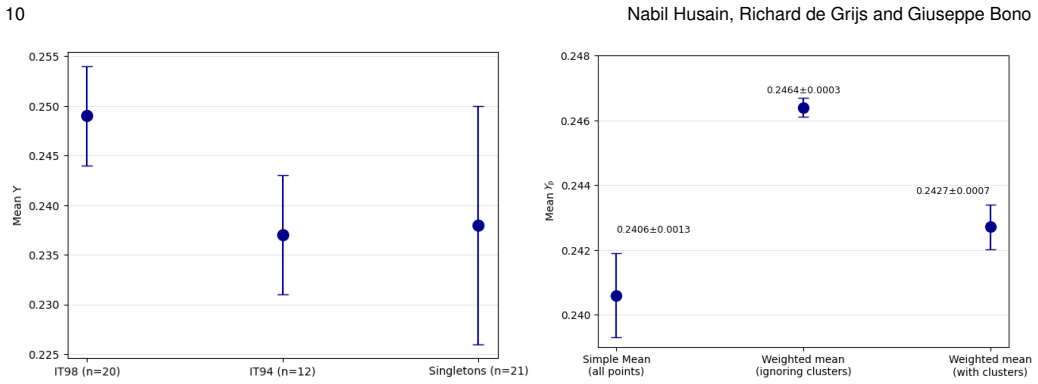
A reanalysis of 143 published Y_p values shows long-term convergence in primordial helium abundances, interrupted by change points, with many measurements sharing underlying observational datasets.
A machine-rendered reading of the paper's core claim, the machinery that carries it, and where it could break.
Core claim
Compilation of 143 published Y_p determinations reveals statistically significant long-term convergence punctuated by change points in the mid-2000s and early 2010s; many extragalactic H II-region values are not fully independent because they rely on re-analyses or partial reuse of a limited number of observational datasets, thereby lowering the effective number of independent constraints while leaving the overall consistency with standard cosmology intact.
What carries the argument
The compiled time series of 143 Y_p values together with change-point detection applied to that series.
If this is right
- The effective number of independent Y_p constraints is lower than the raw count of published papers.
- Recent high-precision results must be interpreted with explicit allowance for shared data provenance.
- Any meta-analysis that treats each published value as statistically independent will overstate the combined precision.
- Methodological homogeneity across re-analyses contributes to the observed tightening of the reported values.
Where Pith is reading between the lines
- Future campaigns aiming to tighten cosmological constraints will need to secure genuinely new spectra rather than reprocess existing ones.
- The same dependence issue likely affects other primordial abundance tracers that draw from overlapping H II-region samples.
- Change-point locations may mark the adoption of particular atomic data or calibration pipelines rather than purely statistical fluctuations.
Load-bearing premise
The assembled list of 143 values captures every relevant published determination without selection bias and the change-point algorithm correctly flags genuine shifts rather than artifacts of the chosen statistical model.
What would settle it
Publication of a sizable set of new Y_p measurements drawn from completely distinct observational datasets that fall outside the narrow range established by the post-2010s cluster.
Figures
read the original abstract
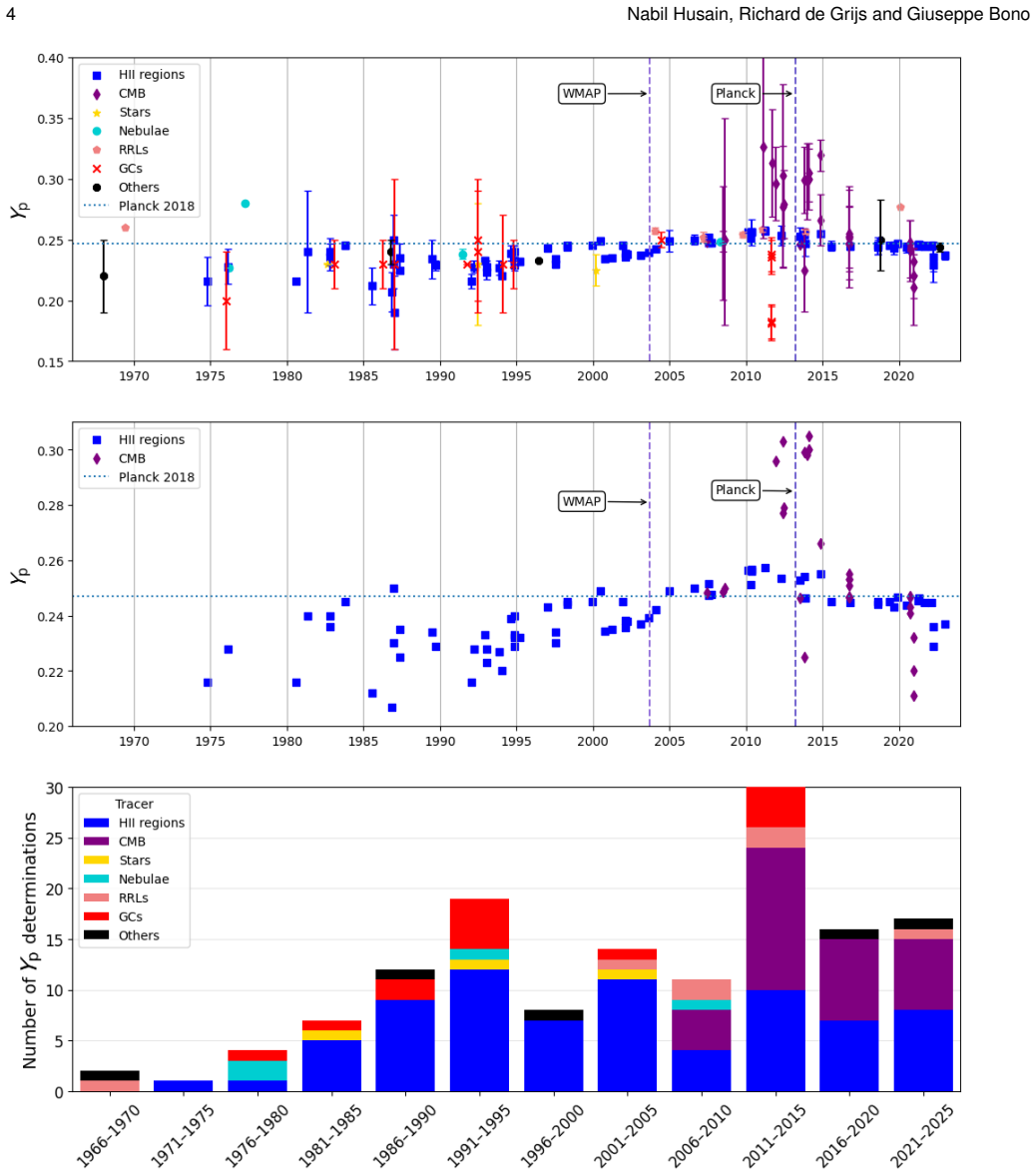
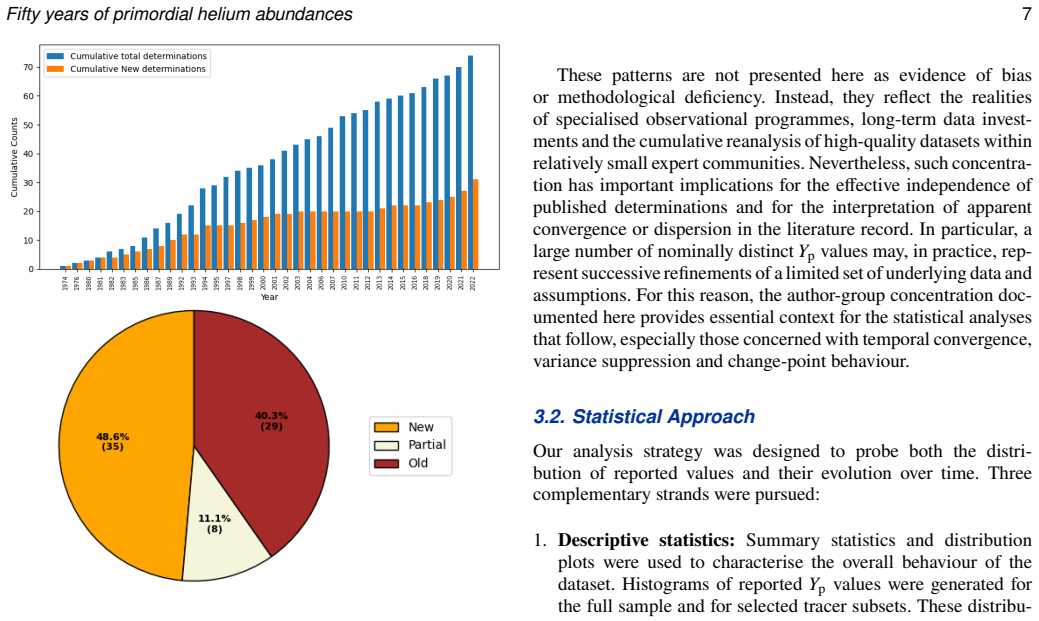
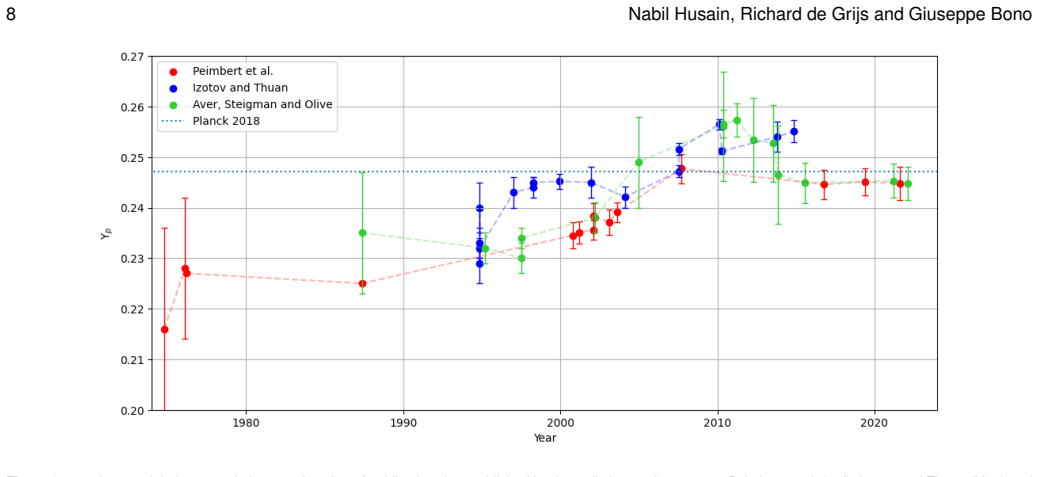
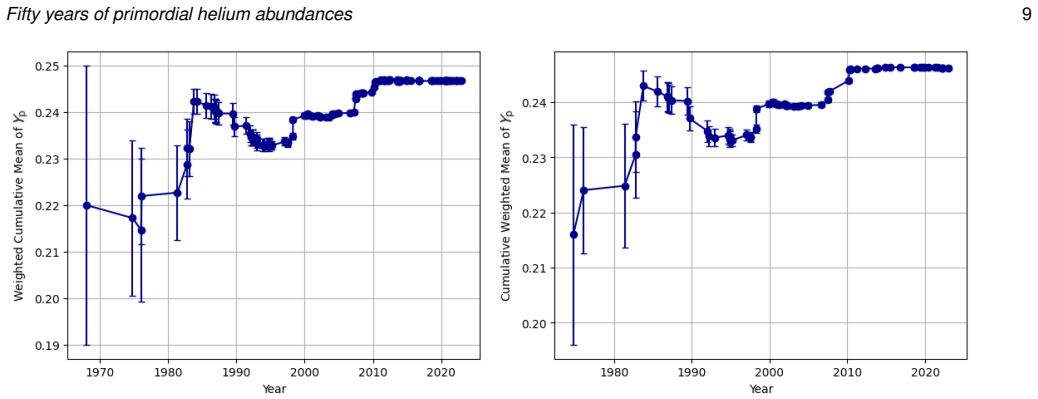
The primordial helium mass fraction, $Y_\mathrm{p}$, is a key observational pillar of Big Bang nucleosynthesis and a sensitive probe of early-Universe physics. Over the past several decades, numerous observational $Y_\mathrm{p}$ determinations have been published using a wide range of astrophysical tracers and cosmological techniques. Although recent measurements exhibit striking convergence and increasingly small uncertainties, the statistical and historical context of this consensus has not been examined systematically. Here, we compile and analyse a comprehensive dataset of observational $Y_\mathrm{p}$ determinations published between the late-1960s and 2022. The final sample comprises 143 reported values spanning multiple tracers. We find clear evidence for long-term convergence in published $Y_\mathrm{p}$ values, punctuated by statistically significant change points in the mid-2000s and early 2010s. Careful examination reveals that many extragalactic H{\sc ii}-region determinations are not fully independent, relying on re-analyses or partial reuse of a limited number of observational datasets. This reduces the effective number of independent constraints and provides important context for interpreting the precision of recent results. Our findings do not challenge the overall consistency of modern $Y_\mathrm{p}$ determinations with standard cosmology, but they underscore the importance of accounting for data dependence, methodological homogeneity and historical evolution when synthesising measurements.
Editorial analysis
A structured set of objections, weighed in public.
Referee Report
Summary. The paper compiles a dataset of 143 published observational determinations of the primordial helium mass fraction Y_p from the late 1960s to 2022 across multiple tracers. It reports clear long-term convergence in the values, interrupted by statistically significant change points in the mid-2000s and early 2010s, and documents that many extragalactic H II-region measurements are not fully independent due to re-analyses or reuse of a limited set of underlying observational datasets, thereby reducing the effective number of independent constraints.
Significance. If the change-point results and independence assessment prove robust, the work supplies useful historical and statistical context for interpreting the apparent precision of modern Y_p measurements and for properly weighting constraints in Big Bang nucleosynthesis analyses. The emphasis on data dependence is a constructive contribution to the field.
major comments (3)
- [Statistical analysis / change-point section] The change-point detection procedure is not described: no algorithm, handling of uncertainties, priors on variance, or robustness checks (alternative algorithms, leave-one-dataset-out tests, or sensitivity to exclusion criteria) are provided. This is load-bearing for the central claim of statistically significant change points in the mid-2000s and early 2010s.
- [Dataset construction section] The compilation rules for the 143-value sample are unspecified (search strategy, inclusion/exclusion criteria, handling of updates or re-analyses). Without this, it is impossible to assess whether the sample is exhaustive or free of selection effects, which directly affects the convergence and change-point results.
- [Independence / H II-region analysis section] The independence analysis notes reuse of a limited number of observational datasets but provides no quantitative estimate of effective independent sample size nor demonstrates how this dependence propagates into the reported convergence or change-point statistics.
minor comments (2)
- [Abstract] The abstract would be strengthened by a one-sentence description of the change-point method and the criteria used to identify non-independence.
- [Figures and tables] Figure captions and table legends should explicitly state how uncertainties are displayed and whether points are weighted by reported errors.
Simulated Author's Rebuttal
We thank the referee for their constructive report and for recognizing the potential value of the historical and statistical context provided by our compilation. We address each major comment below and commit to revisions that strengthen the methodological transparency without altering the core findings.
read point-by-point responses
-
Referee: [Statistical analysis / change-point section] The change-point detection procedure is not described: no algorithm, handling of uncertainties, priors on variance, or robustness checks (alternative algorithms, leave-one-dataset-out tests, or sensitivity to exclusion criteria) are provided. This is load-bearing for the central claim of statistically significant change points in the mid-2000s and early 2010s.
Authors: We agree that the change-point section requires substantially more detail. The manuscript currently states the existence of the change points but does not fully specify the detection algorithm, uncertainty propagation, or prior choices. We will expand this section to describe the exact procedure (including the statistical model employed), how measurement uncertainties are incorporated, the priors used, and the results of robustness tests such as alternative algorithms and leave-one-out analyses. These additions will be placed in a dedicated subsection with accompanying code or pseudocode where appropriate. revision: yes
-
Referee: [Dataset construction section] The compilation rules for the 143-value sample are unspecified (search strategy, inclusion/exclusion criteria, handling of updates or re-analyses). Without this, it is impossible to assess whether the sample is exhaustive or free of selection effects, which directly affects the convergence and change-point results.
Authors: The referee is correct that the current text does not provide an explicit account of the literature search and selection protocol. We will add a new subsection detailing the search strategy (databases, keywords, date range), the precise inclusion and exclusion criteria, and the procedure for handling duplicate or updated measurements. This will allow readers to evaluate potential selection effects and to reproduce the sample construction. revision: yes
-
Referee: [Independence / H II-region analysis section] The independence analysis notes reuse of a limited number of observational datasets but provides no quantitative estimate of effective independent sample size nor demonstrates how this dependence propagates into the reported convergence or change-point statistics.
Authors: We acknowledge that the independence discussion remains qualitative. While the manuscript identifies the reuse of underlying datasets, it does not quantify the effective number of independent measurements or propagate the dependence into the convergence and change-point results. We will revise this section to include a quantitative estimate (e.g., by counting unique observational datasets and deriving an effective sample size) and will discuss the implications for the reported statistics, including any sensitivity analyses that account for the dependence structure. revision: yes
Circularity Check
No circularity: direct statistical analysis of external published values
full rationale
The paper compiles a dataset of 143 externally published Y_p determinations spanning 1960s-2022 and applies standard statistical procedures (change-point detection, independence assessment) to identify convergence trends. No equations or derivations reduce the reported change points or convergence to quantities fitted from the same dataset by construction. The analysis treats the input values as given observations from the literature; results are outputs of applying external methods to independent data, with no self-definitional loops, fitted-input predictions, or load-bearing self-citations that collapse the central claims. This is a self-contained meta-analysis against external benchmarks.
Axiom & Free-Parameter Ledger
axioms (1)
- domain assumption Published Y_p values form a suitable time series for change-point analysis without systematic publication bias dominating the detected shifts
Reference graph
Works this paper leans on
-
[1]
Peebles, P. J. E. , title = ". , year =
-
[2]
Wagoner, Robert V. and Fowler, William A. and Hoyle, F. , title = ". , year = 1967, month = apr, volume =. doi:10.1086/149126 , adsurl =
-
[3]
Big Bang Nucleosynthesis: 2015
Cyburt, Richard H. and Fields, Brian D. and Olive, Keith A. and Yeh, Tsung-Han , title = ". Reviews of Modern Physics , year = 2016, month = jan, volume =. doi:10.1103/RevModPhys.88.015004 , archivePrefix =. 1505.01076 , primaryClass =
work page internal anchor Pith review Pith/arXiv arXiv doi:10.1103/revmodphys.88.015004 2016
-
[4]
Annual Review of Nuclear and Particle Science , year = 2007, month = nov, volume =
Steigman, Gary , title = ". Annual Review of Nuclear and Particle Science , year = 2007, month = nov, volume =. doi:10.1146/annurev.nucl.56.080805.140437 , archivePrefix =. 0712.1100 , primaryClass =
-
[5]
Pitrou, Cyril and Coc, Alain and Uzan, Jean-Philippe and Vangioni, Elisabeth , title = ". Phys. Rep. , year = 2018, month = sep, volume =. doi:10.1016/j.physrep.2018.04.005 , archivePrefix =. 1801.08023 , primaryClass =
-
[6]
Fields, Brian D. and Olive, Keith A. and Yeh, Tsung-Han and Young, Charles , title = ". , year = 2020, month = mar, volume =. doi:10.1088/1475-7516/2020/03/010 , archivePrefix =. 1912.01132 , primaryClass =
-
[7]
One percent determination of the primordial deuterium abundance
Cooke, Ryan J. and Pettini, Max and Steidel, Charles C. , title = ". , year = 2018, month = mar, volume =. doi:10.3847/1538-4357/aaab53 , archivePrefix =. 1710.11129 , primaryClass =
work page internal anchor Pith review Pith/arXiv arXiv doi:10.3847/1538-4357/aaab53 2018
-
[8]
and Costero, R
Peimbert, M. and Costero, R. , title = ". Boletin de los Observatorios Tonantzintla y Tacubaya , year = 1969, month = may, volume =
1969
-
[9]
Pagel, B. E. J. and Simonson, E. A. and Terlevich, R. J. and Edmunds, M. G. , title = ". , year = 1992, month = mar, volume =. doi:10.1093/mnras/255.2.325 , adsurl =
-
[10]
Improving Predictions for Helium Emission Lines
Benjamin, Robert A. and Skillman, Evan D. and Smits, Derck P. , title = ". , year = 1999, month = mar, volume =. doi:10.1086/306923 , archivePrefix =. astro-ph/9810087 , primaryClass =
work page internal anchor Pith review Pith/arXiv arXiv doi:10.1086/306923 1999
-
[11]
Porter, R. L. and Ferland, G. J. and Storey, P. J. and Detisch, M. J. , title = ". , year = 2012, month = sep, volume =. doi:10.1111/j.1745-3933.2012.01300.x , archivePrefix =. 1206.4115 , primaryClass =
-
[12]
Olive, Keith A. and Skillman, Evan D. , title = ". , year = 2004, month = dec, volume =. doi:10.1086/425170 , archivePrefix =. astro-ph/0405588 , primaryClass =
work page internal anchor Pith review Pith/arXiv arXiv doi:10.1086/425170 2004
-
[13]
Revised Primordial Helium Abundance Based on New Atomic Data
Revised Primordial Helium Abundance Based on New Atomic Data. , year = 2007, month = sep, volume =. doi:10.1086/520571 , archivePrefix =. astro-ph/0701580 , primaryClass =
work page internal anchor Pith review Pith/arXiv arXiv doi:10.1086/520571 2007
-
[14]
The primordial abundance of 4He: evidence for non-standard big bang nucleosynthesis
The Primordial Abundance of ^ 4 He: Evidence for Non-Standard Big Bang Nucleosynthesis. , year = 2010, month = feb, volume =. doi:10.1088/2041-8205/710/1/L67 , archivePrefix =. 1001.4440 , primaryClass =
work page internal anchor Pith review Pith/arXiv arXiv doi:10.1088/2041-8205/710/1/l67 2010
-
[15]
The effects of He I 10830 on helium abundance determinations
The effects of He I 10830 on helium abundance determinations. , year = 2015, month = jul, volume =. doi:10.1088/1475-7516/2015/07/011 , archivePrefix =. 1503.08146 , primaryClass =
work page internal anchor Pith review Pith/arXiv arXiv doi:10.1088/1475-7516/2015/07/011 2015
-
[16]
, title =
Steigman, G. , title =. Advances in High Energy Physics , volume =
-
[17]
Ioannidis, J. P. A. , title =. PLoS Medicine , volume =
-
[18]
, title =
Fanelli, D. , title =. Scientometrics , volume =
-
[19]
and Fischhoff, B
Henrion, M. and Fischhoff, B. , title =. American Journal of Physics , volume =
-
[20]
A Distance Framework out to 100 Mpc
Clustering of Local Group Distances: Publication Bias or Correlated Measurements? VII. A Distance Framework out to 100 Mpc. , year = 2020, month = may, volume =. doi:10.3847/1538-4365/ab8562 , archivePrefix =. 2004.00114 , primaryClass =
-
[21]
Extending to Virgo Cluster Distances
Clustering of Local Group Distances: Publication Bias or Correlated Measurements? VI. Extending to Virgo Cluster Distances. , year = 2020, month = jan, volume =. doi:10.3847/1538-4365/ab5711 , archivePrefix =. 1911.04312 , primaryClass =
-
[22]
Clustering of Local Group Distances: Publication Bias or Correlated Measurements? V. Galactic Rotation Constants. , year = 2017, month = oct, volume =. doi:10.3847/1538-4365/aa8b71 , archivePrefix =. 1709.02501 , primaryClass =
work page internal anchor Pith review Pith/arXiv arXiv doi:10.3847/1538-4365/aa8b71 2017
-
[23]
Clustering of Local Group Distances: Publication Bias or Correlated Measurements? IV. The Galactic Center. , year = 2016, month = nov, volume =. doi:10.3847/0067-0049/227/1/5 , archivePrefix =. 1610.02457 , primaryClass =
work page internal anchor Pith review Pith/arXiv arXiv doi:10.3847/0067-0049/227/1/5 2016
-
[24]
Clustering of Local Group Distances: Publication Bias or Correlated Measurements? III. The Small Magellanic Cloud. , year = 2015, month = jun, volume =. doi:10.1088/0004-6256/149/6/179 , archivePrefix =. 1504.00417 , primaryClass =
work page internal anchor Pith review Pith/arXiv arXiv doi:10.1088/0004-6256/149/6/179 2015
-
[25]
Clustering of Local Group distances: publication bias or correlated measurements? II. M31 and beyond
Clustering of Local Group Distances: Publication Bias or Correlated Measurements? II. M31 and Beyond. , keywords =. doi:10.1088/0004-6256/148/1/17 , archivePrefix =. 1405.2124 , primaryClass =
work page internal anchor Pith review Pith/arXiv arXiv doi:10.1088/0004-6256/148/1/17
-
[26]
Clustering of Local Group Distances: Publication Bias or Correlated Measurements? I. The Large Magellanic Cloud. , keywords =. doi:10.1088/0004-6256/147/5/122 , archivePrefix =. 1403.3141 , primaryClass =
work page internal anchor Pith review Pith/arXiv arXiv doi:10.1088/0004-6256/147/5/122
-
[27]
Planck 2018 results. VI. Cosmological parameters. , keywords =. doi:10.1051/0004-6361/201833910 , archivePrefix =. 1807.06209 , primaryClass =
work page internal anchor Pith review Pith/arXiv arXiv doi:10.1051/0004-6361/201833910 2018
-
[28]
Planck 2015 results. XIII. Cosmological parameters. , keywords =. doi:10.1051/0004-6361/201525830 , archivePrefix =. 1502.01589 , primaryClass =
work page internal anchor Pith review Pith/arXiv arXiv doi:10.1051/0004-6361/201525830 2015
-
[29]
Cosmological parameters from CMB and other data: a Monte-Carlo approach
Cosmological parameters from CMB and other data: A Monte Carlo approach. , keywords =. doi:10.1103/PhysRevD.66.103511 , archivePrefix =. astro-ph/0205436 , primaryClass =
work page internal anchor Pith review Pith/arXiv arXiv doi:10.1103/physrevd.66.103511
-
[30]
Conservative constraints on early cosmology with MONTE PYTHON. , keywords =. doi:10.1088/1475-7516/2013/02/001 , archivePrefix =. 1210.7183 , primaryClass =
work page internal anchor Pith review Pith/arXiv arXiv doi:10.1088/1475-7516/2013/02/001 2013
-
[31]
Corrigendum: Improved He~I Emissivities in the Case B Approximation
Erratum: `Improved He I emissivities in the Case B approximation'. , keywords =. doi:10.1093/mnrasl/slt049 , archivePrefix =. 1303.5115 , primaryClass =
work page internal anchor Pith review Pith/arXiv arXiv doi:10.1093/mnrasl/slt049
-
[32]
Primordial ^ 4 He abundance: a determination based on the largest sample of H II regions with a methodology tested on model H II regions. , keywords =. doi:10.1051/0004-6361/201220782 , archivePrefix =. 1308.2100 , primaryClass =
-
[33]
A new determination of the primordial He abundance using the He I 10830 A emission line: cosmological implications. , keywords =. doi:10.1093/mnras/stu1771 , archivePrefix =. 1408.6953 , primaryClass =
-
[34]
EMPRESS. VIII. A New Determination of Primordial He Abundance with Extremely Metal-poor Galaxies: A Suggestion of the Lepton Asymmetry and Implications for the Hubble Tension. , keywords =. doi:10.3847/1538-4357/ac9ea1 , archivePrefix =. 2203.09617 , primaryClass =
-
[35]
A comprehensive chemical abundance analysis of the extremely metal poor Leoncino Dwarf galaxy (AGC 198691). , keywords =. doi:10.1093/mnras/stab3226 , archivePrefix =. 2109.00178 , primaryClass =
-
[36]
Memorie della Societa Astronomica Italiana Supplementi , keywords =
The primordial helium abundance: no problem. Memorie della Societa Astronomica Italiana Supplementi , keywords =
-
[37]
A new determination of the primordial helium abundance using the analyses of H II region spectra from SDSS. , keywords =. doi:10.1093/mnras/stab215 , archivePrefix =. 2101.09127 , primaryClass =
-
[38]
Mass measurements of the components of MU Cas. , keywords =. doi:10.1086/113534 , adsurl =
-
[39]
Five-Year Wilkinson Microwave Anisotropy Probe Observations: Likelihoods and Parameters from the WMAP Data. , keywords =. doi:10.1088/0067-0049/180/2/306 , archivePrefix =. 0803.0586 , primaryClass =
work page internal anchor Pith review Pith/arXiv arXiv doi:10.1088/0067-0049/180/2/306
-
[40]
Blinding multiprobe cosmological experiments. , keywords =. doi:10.1093/mnras/staa965 , archivePrefix =. 1911.05929 , primaryClass =
-
[41]
Dark energy survey year 3 results: likelihood-free, simulation-based wCDM inference with neural compression of weak-lensing map statistics. , keywords =. doi:10.1093/mnras/stae2629 , archivePrefix =. 2403.02314 , primaryClass =
-
[42]
Cosmology from Planck CMB Lensing and DESI DR1 Quasar Tomography
Cosmology from Planck CMB lensing and DESI DR1 quasar tomography. , keywords =. doi:10.1088/1475-7516/2025/10/077 , archivePrefix =. 2506.22416 , primaryClass =
work page internal anchor Pith review Pith/arXiv arXiv doi:10.1088/1475-7516/2025/10/077 2025
-
[43]
Primordial helium abundance determination using sulphur as metallicity tracer
Primordial helium abundance determination using sulphur as metallicity tracer. , keywords =. doi:10.1093/mnras/sty1206 , archivePrefix =. 1804.10701 , primaryClass =
work page internal anchor Pith review Pith/arXiv arXiv doi:10.1093/mnras/sty1206
-
[44]
Determination of the Primordial Helium Abundance Based on NGC 346, an H II Region of the Small Magellanic Cloud. , keywords =. doi:10.3847/1538-4357/ab14e4 , archivePrefix =. 1904.01594 , primaryClass =
work page internal anchor Pith review Pith/arXiv arXiv doi:10.3847/1538-4357/ab14e4 1904
-
[45]
The PHLEK Survey: A New Determination of the Primordial Helium Abundance. , keywords =. doi:10.3847/1538-4357/ab91af , archivePrefix =. 2005.12290 , primaryClass =
-
[46]
Improving helium abundance determinations with Leo P as a case study. , keywords =. doi:10.1088/1475-7516/2021/03/027 , archivePrefix =. 2010.04180 , primaryClass =
-
[47]
Chemical abundances in seven metal-poor H II regions and a determination of the primordial helium abundance. , keywords =. doi:10.1093/mnras/stab1543 , archivePrefix =. 2105.12260 , primaryClass =
-
[48]
Chemical abundances in Seyfert galaxies - IX. Helium abundance estimates. , keywords =. doi:10.1093/mnras/stac1722 , archivePrefix =. 2206.09836 , primaryClass =
-
[49]
The Primordial Abundance of ^ 4 He Revisited. , keywords =. doi:10.1086/305698 , adsurl =
-
[50]
Astrophys
Mixing in the Sun and Neutrino Fluxes. Astrophys. Lett. , year = 1968, month = jan, volume =
1968
-
[51]
, year = 1969, month = jun, volume =
Determinations of Helium Abundance from Radiofrequency Recombination Lines. , year = 1969, month = jun, volume =. doi:10.1086/150022 , adsurl =
-
[52]
Chemical composition of H II regions in the Large Magellanic Cloud and its cosmological implications. , keywords =. doi:10.1086/153166 , adsurl =
-
[53]
Semiconvection in Halo Stars and the Primordial Helium Abundance
-
[54]
Chemical composition of H II regions in the Small Magellanic Cloud and the pregalactic helium abundance. , keywords =. doi:10.1086/154114 , adsurl =
-
[55]
, keywords =
Pregalactic helium abundance and abundance gradients across our Galaxy from planetary nebulae. , keywords =
-
[56]
Chemical abundances of a new halo planetary nebula. , keywords =. doi:10.1086/155171 , adsurl =
-
[57]
Galaxies with the spectra of giant H II regions. , keywords =. doi:10.1086/158205 , adsurl =
-
[58]
Star formation and abundances in the nearby irregular galaxy VII ZW 403. , keywords =. doi:10.1086/158896 , adsurl =
-
[59]
Data on an unusual Wolf-Rayet star in the nearby Galaxy IC 1613. , keywords =. doi:10.1086/131034 , adsurl =
-
[60]
Philosophical Transactions of the Royal Society of London Series A , keywords =
Constraints on the Primordial Helium Abundance from the Optical Emission Spectra of Dwarf Galaxies. Philosophical Transactions of the Royal Society of London Series A , keywords =. doi:10.1098/rsta.1982.0098 , adsurl =
-
[61]
Primordial Helium , year = 1983, editor =
Helium content in globular clusters - The R-method. Primordial Helium , year = 1983, editor =
1983
-
[62]
Spectrophotometry of 12 metal-poor galaxies : implications for the primordial helium abundance. , keywords =. doi:10.1086/161350 , adsurl =
-
[63]
Primordial helium, spectrophotometric technique and I Zwicky 18. , keywords =. doi:10.1086/191044 , adsurl =
-
[64]
CCD photometry in globular clusters. I. The age of NGC 6752. , keywords =
-
[65]
The primordial helium abundance determination from metal-poor galaxies. , keywords =. doi:10.1086/131856 , adsurl =
-
[66]
Collisional Effects in the Helium Triplets, and the Primordial Helium Abundance. , keywords =. doi:10.1086/184783 , adsurl =
-
[67]
Reassessing the primordial helium abundance : new observations of NGC4861 and CG 1116+51. , keywords =. doi:10.1086/164753 , adsurl =
-
[68]
, keywords =
Some inferences on chemical evolution from a study of irregular and blue compact galaxies. , keywords =
-
[69]
CCD photometry in globular clusters. II. NGC 7492. , keywords =
-
[70]
, year = 1987, month = may, volume =
In Search of Primordial Helium. , year = 1987, month = may, volume =
1987
-
[71]
Collisional excitation effects on He I line intensities
Chemical composition of Type I planetary nebulae. Collisional excitation effects on He I line intensities. , year = 1987, month = may, volume =
1987
-
[72]
High-Resolution Spectroscopy and Direct Imaging of the Dwarf Galaxy I ZW 18. , keywords =. doi:10.1086/115100 , adsurl =
-
[73]
, keywords =
Helium in three H II galaxies and the primordial helium abundance. , keywords =
-
[74]
Physical Conditions in the Orion Nebula and an Assessment of Its Helium Abundance. , keywords =. doi:10.1086/170146 , adsurl =
-
[75]
CCD-photometry of galactic globular clusters - III. NGC 6171. , keywords =. doi:10.1093/mnras/252.3.357 , adsurl =
-
[76]
, keywords =
The metal-poor HII galaxy SBS 0335-052 and the primordial helium abundance. , keywords =
-
[77]
A Measurement of the Primordial Helium Abundance Using MU Cassiopeiae. , keywords =. doi:10.1086/171415 , adsurl =
-
[78]
The galactic globular cluster NGC 5897 and its population of blue stragglers. , keywords =. doi:10.1093/mnras/256.3.376 , adsurl =
-
[79]
On Determining the Primordial Helium Abundance from the Spectra of H II Galaxies. , keywords =. doi:10.1086/172049 , adsurl =
-
[80]
Chemical Evolution of Irregular Galaxies and the Primordial 4He Abundance. , keywords =. doi:10.1086/172183 , adsurl =
discussion (0)
Sign in with ORCID, Apple, or X to comment. Anyone can read and Pith papers without signing in.