Learning Temporal Causal Structure via Smooth Differentiable Optimization
Pith reviewed 2026-06-28 11:16 UTC · model grok-4.3
The pith
Learning a differentiable permutation via Gumbel-Sinkhorn converts acyclicity into a parameterization for unified gradient-based optimization of SVAR causal models.
A machine-rendered reading of the paper's core claim, the machinery that carries it, and where it could break.
Core claim
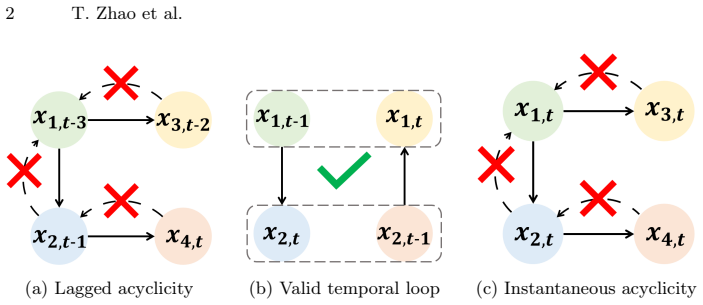
The central claim is that a differentiable permutation of the observed variables, obtained from the Gumbel-Sinkhorn operator, can be used to triangularize the instantaneous coefficient matrix of an SVAR model; the resulting parameterization keeps the matrix acyclic by construction and thereby replaces the usual hard acyclicity constraint with a continuous, gradient-friendly representation that supports end-to-end learning of the full temporal causal structure.
What carries the argument
Gumbel-Sinkhorn operator that produces a differentiable permutation used to triangularize the instantaneous coefficient matrix of an SVAR model
If this is right
- Acyclicity is maintained automatically throughout optimization rather than enforced by an external penalty.
- The entire causal discovery task becomes a single differentiable program amenable to standard gradient methods.
- Empirical results show the best combined accuracy and runtime among twelve baselines on three real-world time-series benchmarks.
- On the largest benchmark the method delivers more than a 6x reduction in computation time while preserving discovery quality.
Where Pith is reading between the lines
- The same permutation parameterization could be tested on nonlinear instantaneous effects by replacing the linear SVAR coefficients with a neural-network block that respects the learned order.
- Because the ordering is learned continuously rather than searched discretely, the approach may tolerate moderate amounts of missing observations better than combinatorial alternatives.
- The technique supplies a template for converting other combinatorial constraints (for example, sparsity patterns or topological orders) into differentiable parameterizations in related structured prediction tasks.
Load-bearing premise
The permutation obtained from the Gumbel-Sinkhorn operator will continue to yield a valid acyclic triangularization of the instantaneous coefficient matrix at every point during gradient-based optimization.
What would settle it
If, after convergence, the triangularized instantaneous coefficient matrix still contains a cycle or the method fails to match or exceed the reported accuracy and 6x speedup on the three benchmarks, the central claim would be falsified.
Figures
read the original abstract
Causal discovery with instantaneous effects in multivariate time series is challenging, as the instantaneous structure must be acyclic. Prior methods enforce this by either separating instantaneous and lagged estimation into multi-stage pipelines or imposing algebraic acyclicity constraints via complex augmented Lagrangian optimization, both of which incur high computational cost. In this work, we propose a different approach: we learn a differentiable permutation of variables using the Gumbel--Sinkhorn operator and triangularize the instantaneous coefficient matrix of a Structural Vector Autoregressive (SVAR) model in the learned order. This converts acyclicity from a hard constraint into a parameterization and keeps it valid throughout optimization. In doing so, our method enables unified, continuous optimization with gradient-based learning, leading to improved efficiency in time--series causal discovery. Across three real-world benchmarks, our method achieves the best overall performance compared with 12 baselines in both discovery accuracy and efficiency. On the large-scale benchmark, it further demonstrates strong scalability, achieving more than a 6x speedup over competing methods.
Editorial analysis
A structured set of objections, weighed in public.
Referee Report
Summary. The paper proposes learning a differentiable permutation of variables via the Gumbel-Sinkhorn operator to triangularize the instantaneous coefficient matrix in an SVAR model for time-series causal discovery. This is presented as converting the acyclicity requirement from a hard constraint (e.g., via augmented Lagrangian) into a parameterization that remains valid throughout gradient-based optimization, enabling unified continuous optimization. The method is claimed to outperform 12 baselines in accuracy and efficiency across three real-world benchmarks, with >6x speedup on a large-scale benchmark.
Significance. If the central parameterization indeed maintains strict acyclicity throughout training and the reported gains are reproducible with proper controls, the approach could simplify and accelerate causal discovery for SVAR models by avoiding multi-stage pipelines or complex constrained optimization. The efficiency claims on large-scale data would be particularly notable if supported by ablations and statistical tests.
major comments (1)
- [Abstract] Abstract: the claim that the Gumbel-Sinkhorn parameterization 'converts acyclicity from a hard constraint into a parameterization and keeps it valid throughout optimization' is not obviously supported by the construction. The Gumbel-Sinkhorn operator produces a soft (doubly-stochastic) matrix during training; only in the zero-temperature limit does it approach a hard permutation. Consequently the reordered instantaneous matrix is only approximately triangular for most of gradient descent, so cycles may persist and the acyclicity guarantee is not strict. This directly affects the central methodological contribution and requires either a formal argument that the soft relaxation preserves acyclicity in the limit or empirical verification that the implied graph remains acyclic at convergence.
minor comments (2)
- [Abstract] Abstract: performance claims (best overall vs. 12 baselines, 6x speedup) are stated without dataset descriptions, error bars, statistical significance tests, or ablation studies on the temperature schedule or permutation quality; these details are needed to assess reproducibility.
- The manuscript should clarify how the learned soft permutation is converted to a hard triangularization at inference time and whether any post-processing is required to enforce acyclicity.
Simulated Author's Rebuttal
We thank the referee for the detailed and constructive comment on the acyclicity claim. We address the point directly below and outline revisions to improve clarity.
read point-by-point responses
-
Referee: [Abstract] Abstract: the claim that the Gumbel-Sinkhorn parameterization 'converts acyclicity from a hard constraint into a parameterization and keeps it valid throughout optimization' is not obviously supported by the construction. The Gumbel-Sinkhorn operator produces a soft (doubly-stochastic) matrix during training; only in the zero-temperature limit does it approach a hard permutation. Consequently the reordered instantaneous matrix is only approximately triangular for most of gradient descent, so cycles may persist and the acyclicity guarantee is not strict. This directly affects the central methodological contribution and requires either a formal argument that the soft relaxation preserves acyclicity in the limit or empirical verification that the implied graph remains acyclic at convergence.
Authors: We agree the original abstract wording is imprecise and could suggest a strict guarantee at every optimization step. The Gumbel-Sinkhorn operator parameterizes the space of permutations; the instantaneous matrix is reordered and triangularized by construction under this (soft) permutation. Strict acyclicity therefore holds exactly only upon convergence to a hard permutation matrix (zero-temperature limit). During training the structure is a continuous relaxation, which still removes the need for explicit algebraic constraints or multi-stage pipelines. We will revise the abstract to state that the parameterization converts acyclicity into a search over permutations with the guarantee holding at convergence. We will also add a short methods subsection on the relaxation, including the temperature annealing schedule, and report empirical verification that the final estimated graphs satisfy acyclicity (e.g., via the standard NOTEARS acyclicity function evaluated on the converged hard permutation). These changes clarify the contribution without altering the algorithm. revision: partial
Circularity Check
No circularity in derivation chain
full rationale
The paper proposes a new parameterization of acyclicity via Gumbel-Sinkhorn permutation learning to triangularize the SVAR instantaneous matrix, presented as converting a hard constraint into a differentiable form. No self-definitional reductions, fitted inputs renamed as predictions, or load-bearing self-citations appear in the abstract or described method. The central claim is an independent algorithmic contribution whose validity rests on the properties of the operator and optimization, not on re-deriving its own inputs.
Axiom & Free-Parameter Ledger
axioms (1)
- domain assumption Instantaneous effects in the SVAR model admit a permutation that renders the coefficient matrix acyclic (triangular).
Reference graph
Works this paper leans on
-
[1]
In: The History and Development of Search Methods for Causal StructureWorkshopatthe39thConferenceonUncertaintyinArtificialIntelligence (2023)
Aıt-Bachir, A., Assaad, C.K., de Bignicourt, C., Devijver, E., Ferreira, S., Gaussier, E., Mohanna, H., Zan, L.: Case studies of causal discovery from it monitoring time series, 2023. In: The History and Development of Search Methods for Causal StructureWorkshopatthe39thConferenceonUncertaintyinArtificialIntelligence (2023)
2023
-
[2]
Advances in Neural Information Processing Systems36, 1738–1763 (2023)
Annadani, Y., Pawlowski, N., Jennings, J., Bauer, S., Zhang, C., Gong, W.: Bayes- dag: Gradient-based posterior inference for causal discovery. Advances in Neural Information Processing Systems36, 1738–1763 (2023)
2023
-
[3]
Learning Directed Acyclic Graphs with Penalized Neighbourhood Regression
Aragam, B., Amini, A.A., Zhou, Q.: Learning directed acyclic graphs with penal- ized neighbourhood regression. arXiv preprint arXiv:1511.08963 (2015)
work page internal anchor Pith review Pith/arXiv arXiv 2015
-
[4]
In: Uncertainty in Artificial Intelligence
Assaad, C.K., Devijver, E., Gaussier, E.: Discovery of extended summary graphs in time series. In: Uncertainty in Artificial Intelligence. pp. 96–106. Pmlr (2022)
2022
-
[5]
Journal of Artificial Intelligence Research73, 767–819 (2022)
Assaad, C.K., Devijver, E., Gaussier, E.: Survey and evaluation of causal discovery methods for time series. Journal of Artificial Intelligence Research73, 767–819 (2022)
2022
-
[6]
Journal of neuroscience methods223, 50–68 (2014)
Barnett, L., Seth, A.K.: The mvgc multivariate granger causality toolbox: a new approach to granger-causal inference. Journal of neuroscience methods223, 50–68 (2014)
2014
-
[7]
Physical Review E—Statistical, Nonlinear, and Soft Matter Physics 81(4), 041907 (2010)
Barrett, A.B., Barnett, L., Seth, A.K.: Multivariate granger causality and general- ized variance. Physical Review E—Statistical, Nonlinear, and Soft Matter Physics 81(4), 041907 (2010)
2010
-
[8]
In: In- ternational Conference on Learning Representations (2022),https://openreview
Charpentier, B., Kibler, S., Günnemann, S.: Differentiable DAG sampling. In: In- ternational Conference on Learning Representations (2022),https://openreview. net/forum?id=9wOQOgNe-w
2022
-
[9]
Chevalley, M., Mehrjou, A., Schwab, P.: Efficient differentiable discovery of causal order. arXiv preprint arXiv:2410.08787 (2024) Learning Temporal Causal Structure via Smooth Differentiable Optimization 15
-
[10]
Oxford Bulletin of Economics and statistics65, 745–767 (2003)
Demiralp, S., Hoover, K.D.: Searching for the causal structure of a vector autore- gression. Oxford Bulletin of Economics and statistics65, 745–767 (2003)
2003
-
[11]
Prob- abilistic graphical models16(2010)
Entner, D., Hoyer, P.O.: On causal discovery from time series data using fci. Prob- abilistic graphical models16(2010)
2010
-
[12]
Advances in neural information processing systems 33, 12615–12625 (2020)
Gerhardus, A., Runge, J.: High-recall causal discovery for autocorrelated time se- ries with latent confounders. Advances in neural information processing systems 33, 12615–12625 (2020)
2020
-
[13]
In: The Thirteenth In- ternational Conference on Learning Representations (2025),https://openreview
Gideon, S., Maha, S., Jan, B., Niklas, P., Joachim, D.: Causalrivers - scaling up benchmarking of causal discovery for real-world time-series. In: The Thirteenth In- ternational Conference on Learning Representations (2025),https://openreview. net/forum?id=wmV4cIbgl6
2025
-
[14]
ACM Computing Surveys57(4), 1–38 (2024)
Gong,C.,Zhang,C.,Yao,D.,Bi,J.,Li,W.,Xu,Y.:Causaldiscoveryfromtemporal data: An overview and new perspectives. ACM Computing Surveys57(4), 1–38 (2024)
2024
-
[15]
Econometrica: journal of the Econometric Society pp
Granger, C.W.: Investigating causal relations by econometric models and cross- spectral methods. Econometrica: journal of the Econometric Society pp. 424–438 (1969)
1969
-
[16]
In: Proceedings of the 2022 ACM/SIGDA International Symposium on Field-Programmable Gate Arrays
Guo, C., Luk, W.: Accelerating constraint-based causal discovery by shifting speed bottleneck. In: Proceedings of the 2022 ACM/SIGDA International Symposium on Field-Programmable Gate Arrays. pp. 169–179 (2022)
2022
-
[17]
Cambridge University Press (2001)
Hoover, K.D.: Causality in macroeconomics. Cambridge University Press (2001)
2001
-
[18]
Journal of Machine Learning Research11(5) (2010)
Hyvärinen, A., Zhang, K., Shimizu, S., Hoyer, P.O.: Estimation of a structural vector autoregression model using non-gaussianity. Journal of Machine Learning Research11(5) (2010)
2010
-
[19]
In: International conference on machine learning
Jaggi, M.: Revisiting frank-wolfe: Projection-free sparse convex optimization. In: International conference on machine learning. pp. 427–435. PMLR (2013)
2013
-
[20]
Econometric theory 22(5), 961–967 (2006)
Kilian, L.: New introduction to multiple time series analysis. Econometric theory 22(5), 961–967 (2006)
2006
-
[21]
Journal of Econometrics196(2), 288–304 (2017)
Lanne, M., Meitz, M., Saikkonen, P.: Identification and estimation of non-gaussian structural vector autoregressions. Journal of Econometrics196(2), 288–304 (2017)
2017
-
[22]
In: Independent component analysis: Theory and applications, pp
Lee, T.W.: Independent component analysis. In: Independent component analysis: Theory and applications, pp. 27–66. Springer (1998)
1998
-
[23]
arXiv preprint arXiv:2307.14161 (2023)
Maiti, R.R., Adepu, S., Lupu, E.: Iccps: Impact discovery using causal inference for cyber attacks in cpss. arXiv preprint arXiv:2307.14161 (2023)
-
[24]
In: International Conference on Learning Repre- sentations (2018),https://openreview.net/forum?id=Byt3oJ-0W
Mena, G., Belanger, D., Linderman, S., Snoek, J.: Learning latent permutations with gumbel-sinkhorn networks. In: International Conference on Learning Repre- sentations (2018),https://openreview.net/forum?id=Byt3oJ-0W
2018
-
[25]
In: Causal Learning and Reasoning
Mogensen, S.W., Rathsman, K., Nilsson, P.: Causal discovery in a complex indus- trial system: A time series benchmark. In: Causal Learning and Reasoning. pp. 1218–1236. PMLR (2024)
2024
-
[26]
In: 9th Joint International Conference on Information Sciences (JCIS-06)
Moneta, A., Spirtes, P.: Graphical models for the identification of causal struc- tures in multivariate time series models. In: 9th Joint International Conference on Information Sciences (JCIS-06). pp. 613–616. Atlantis press (2006)
2006
-
[27]
In: Pro- ceedings of the 26th annual international conference on machine learning
Mooij, J., Janzing, D., Peters, J., Schölkopf, B.: Regression by dependence mini- mization and its application to causal inference in additive noise models. In: Pro- ceedings of the 26th annual international conference on machine learning. pp. 745– 752 (2009)
2009
-
[28]
Machine Learning and Knowledge Extraction1(1), 19 (2019) 16 T
Nauta, M., Bucur, D., Seifert, C.: Causal discovery with attention-based convo- lutional neural networks. Machine Learning and Knowledge Extraction1(1), 19 (2019) 16 T. Zhao et al
2019
-
[29]
numerical methods for nonlinear continuous op- timization
Nemirovsky, A.: Optimization ii. numerical methods for nonlinear continuous op- timization. Technion–Israel Institute of Technology (1999)
1999
-
[30]
Springer (2006)
Nocedal, J., Wright, S.J.: Numerical optimization. Springer (2006)
2006
-
[31]
In:InternationalConferenceonArtificialIntelligenceandStatistics.pp.1595–1605
Pamfil, R., Sriwattanaworachai, N., Desai, S., Pilgerstorfer, P., Georgatzis, K., Beaumont, P., Aragam, B.: Dynotears: Structure learning from time-series data. In:InternationalConferenceonArtificialIntelligenceandStatistics.pp.1595–1605. Pmlr (2020)
2020
-
[32]
Biometrika101(1), 219–228 (2014)
Peters, J., Bühlmann, P.: Identifiability of gaussian structural equation models with equal error variances. Biometrika101(1), 219–228 (2014)
2014
-
[33]
Advances in neural information processing systems26(2013)
Peters, J., Janzing, D., Scholkopf, B.: Causal inference on time series using re- stricted structural equation models. Advances in neural information processing systems26(2013)
2013
-
[34]
Advances in Neural Information Processing Systems34, 27772–27784 (2021)
Reisach,A.,Seiler,C.,Weichwald,S.:Bewareofthesimulateddag!causaldiscovery benchmarks may be easy to game. Advances in Neural Information Processing Systems34, 27772–27784 (2021)
2021
-
[35]
In: Conference on uncertainty in artificial intelligence
Runge, J.: Discovering contemporaneous and lagged causal relations in autocor- related nonlinear time series datasets. In: Conference on uncertainty in artificial intelligence. pp. 1388–1397. Pmlr (2020)
2020
-
[36]
Nature communications10(1), 2553 (2019)
Runge, J., Bathiany, S., Bollt, E., Camps-Valls, G., Coumou, D., Deyle, E., Gly- mour, C., Kretschmer, M., Mahecha, M.D., Munoz-Mari, J., et al.: Inferring cau- sation from time series in earth system sciences. Nature communications10(1), 2553 (2019)
2019
-
[37]
Science advances5(11), eaau4996 (2019)
Runge, J., Nowack, P., Kretschmer, M., Flaxman, S., Sejdinovic, D.: Detecting and quantifying causal associations in large nonlinear time series datasets. Science advances5(11), eaau4996 (2019)
2019
-
[38]
Journal of Machine Learning Research 7(10) (2006)
Shimizu, S., Hoyer, P.O., Hyvärinen, A., Kerminen, A., Jordan, M.: A linear non- gaussian acyclic model for causal discovery. Journal of Machine Learning Research 7(10) (2006)
2006
-
[39]
Journal of Machine Learning Research-JMLR12(Apr), 1225–1248 (2011)
Shimizu, S., Inazumi, T., Sogawa, Y., Hyvarinen, A., Kawahara, Y., Washio, T., Hoyer, P.O., Bollen, K., Hoyer, P.: Directlingam: A direct method for learning a linear non-gaussian structural equation model. Journal of Machine Learning Research-JMLR12(Apr), 1225–1248 (2011)
2011
-
[40]
Econometrica: journal of the Econometric Society pp
Sims, C.A.: Macroeconomics and reality. Econometrica: journal of the Econometric Society pp. 1–48 (1980)
1980
-
[41]
Journal of the American Statistical Association92(437), 357–367 (1997)
Swanson, N.R., Granger, C.W.: Impulse response functions based on a causal approach to residual orthogonalization in vector autoregressions. Journal of the American Statistical Association92(437), 357–367 (1997)
1997
-
[42]
IEEE Transactions on Pattern Analysis and Machine Intelligence44(8), 4267–4279 (2021)
Tank, A., Covert, I., Foti, N., Shojaie, A., Fox, E.B.: Neural granger causality. IEEE Transactions on Pattern Analysis and Machine Intelligence44(8), 4267–4279 (2021)
2021
-
[43]
In: Meila, M., Zhang, T
Yu, Y., Gao, T., Yin, N., Ji, Q.: Dags with no curl: An efficient dag structure learning approach. In: Meila, M., Zhang, T. (eds.) Proceedings of the 38th Inter- national Conference on Machine Learning. Proceedings of Machine Learning Re- search, vol. 139, pp. 12156–12166 (2021),https://proceedings.mlr.press/v139/ yu21a.html
2021
-
[44]
Zheng, X., Aragam, B., Ravikumar, P.K., Xing, E.P.: Dags with no tears: Continu- ous optimization for structure learning. Advances in neural information processing systems31(2018) Learning Temporal Causal Structure via Smooth Differentiable Optimization 17 A Appendix A.1 Preprocessing For all datasets, we preprocess the raw data by removing timestamps to ...
2018
discussion (0)
Sign in with ORCID, Apple, or X to comment. Anyone can read and Pith papers without signing in.