Valence Ionization Of Water Clusters Formed Inside Helium Nanodroplets
Pith reviewed 2026-06-28 08:14 UTC · model grok-4.3
The pith
Water clusters inside helium nanodroplets fragment less upon valence ionization than free clusters do.
A machine-rendered reading of the paper's core claim, the machinery that carries it, and where it could break.
Core claim
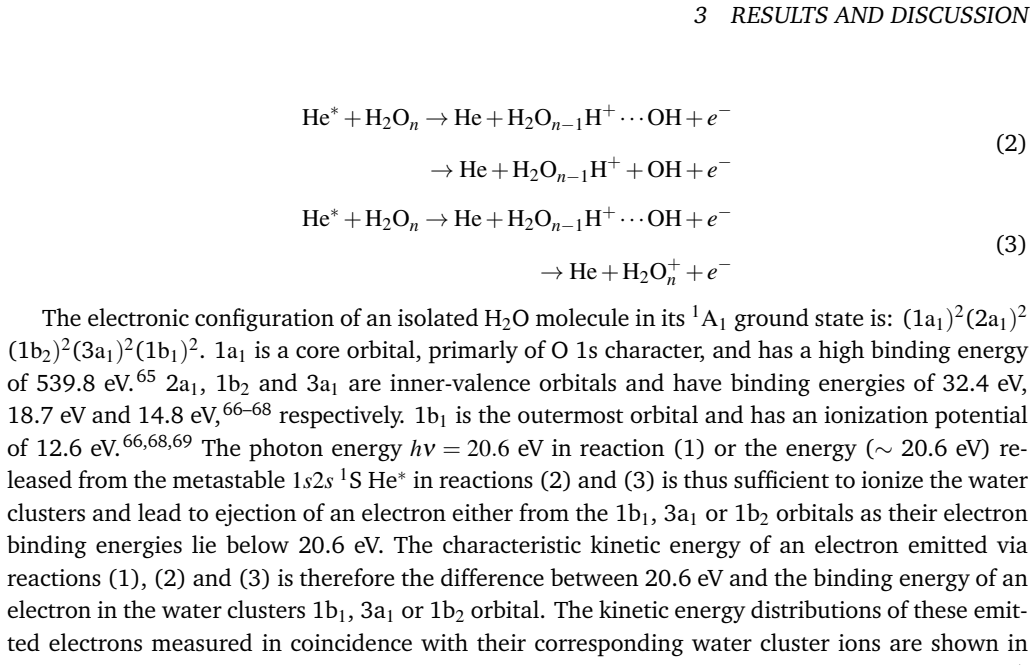
Valence ionization at 21.6 eV of water clusters inside helium nanodroplets produces both protonated (H2O)n-1H+ and unprotonated (H2O)n+ ions with markedly less fragmentation than free clusters ionized at 20.6 eV; Penning ionization electron-ion coincidence spectra confirm the stabilization of intact ions, while quantum chemical calculations indicate that proton-transferred and hemibonded conformers coexist under the cryogenic conditions inside the droplets.
What carries the argument
Penning ionization electron-ion coincidence spectroscopy that correlates emitted electrons with the resulting cluster ions, used together with quantum chemical calculations of cluster conformers.
Load-bearing premise
The observed protonated and unprotonated water cluster ions come from clusters formed inside the helium nanodroplets rather than from surface or gas-phase water.
What would settle it
If free water clusters ionized at exactly 21.6 eV produced the same degree of fragmentation suppression as the embedded clusters, the claim that the helium environment stabilizes the ions would not hold.
Figures
read the original abstract
The ionization mechanisms of small H$_2$O/D$_2$O clusters embedded in helium nanodroplets (HNDs) irradiated with extreme ultraviolet photons of energy $h\nu$ = 21.6 eV are investigated using Penning ionization electron-ion coincidence spectroscopy. Both protonated (H$_2$O)$_{n-1}$H$^{+}$/(D$_2$O)$_{n-1}$D$^{+}$ ($n$ = 3-6) and unprotonated (H$_2$O)$_{n}$$^{+}$/(D$_2$O)$_{n}$$^{+}$ ($n$ = 2-5) cluster ions were observed. Penning ionization electron spectra measured in coincidence with water cluster ions emitted from water clusters doped into both large and small HNDs are analyzed and compared with photoelectron-photoion coincidence spectra measured for free water clusters at $h\nu$ =20.6 eV. The results reveal suppression of fragmentation inside HNDs and stabilization of intact cluster ions. Quantum chemical calculations support the coexistence of proton-transferred and hemibonded conformers under the cryogenic conditions of helium nanodroplets.
Editorial analysis
A structured set of objections, weighed in public.
Referee Report
Summary. The manuscript investigates valence ionization of small water (H2O/D2O) clusters embedded in helium nanodroplets using Penning ionization electron-ion coincidence spectroscopy at hν=21.6 eV. It reports observation of both protonated (H2O)n-1H+ and unprotonated (H2O)n+ cluster ions (n=2-6), analyzes Penning electron spectra in coincidence with cluster ions from large and small HNDs, and compares these to free-cluster PEPICO spectra at 20.6 eV. The central claim is suppression of fragmentation and stabilization of intact cluster ions inside HNDs, with quantum chemical calculations supporting coexistence of proton-transferred and hemibonded conformers under cryogenic conditions.
Significance. If the comparison can be made rigorous and quantitative measures supplied, the work would demonstrate a matrix-induced stabilization effect on ionized water clusters in a cryogenic helium environment. This would be of interest to chemical physics of solvation, radiation-induced processes in clusters, and potentially astrochemistry. The use of coincidence techniques to link electrons and ions is appropriate, and the inclusion of theory to address conformers is a positive step, though the current execution leaves the magnitude and attribution of the effect unclear.
major comments (2)
- [Abstract] Abstract: The statement that 'the results reveal suppression of fragmentation inside HNDs and stabilization of intact cluster ions' is presented without quantitative data (e.g., relative ion yields, branching ratios, or intensity ratios between HND and free-cluster spectra), error bars, or a description of how suppression was quantified. This absence makes the central claim difficult to evaluate.
- [Abstract and experimental comparison] Comparison to free clusters (Abstract and experimental sections): The key evidence for HND-induced suppression rests on contrasting Penning ionization spectra (21.6 eV, via He*) of embedded clusters against direct photoionization PEPICO spectra of free clusters at 20.6 eV. Because ionization mechanism and photon energy both differ, reduced fragmentation cannot be unambiguously attributed to the HND matrix rather than the Penning process or the 1 eV energy offset. The large-vs-small HND comparison addresses cluster origin but does not control for these variables, which is load-bearing for the main conclusion.
minor comments (1)
- [Abstract] Quantum chemical calculations are mentioned without any details on the level of theory, basis sets, or validation procedures used to identify proton-transferred vs hemibonded conformers.
Simulated Author's Rebuttal
We thank the referee for the constructive feedback on our manuscript. We address each major comment below and have revised the manuscript to improve the presentation of quantitative results and to clarify the experimental comparisons.
read point-by-point responses
-
Referee: [Abstract] Abstract: The statement that 'the results reveal suppression of fragmentation inside HNDs and stabilization of intact cluster ions' is presented without quantitative data (e.g., relative ion yields, branching ratios, or intensity ratios between HND and free-cluster spectra), error bars, or a description of how suppression was quantified. This absence makes the central claim difficult to evaluate.
Authors: We agree that the central claim requires quantitative support to be properly evaluated. In the revised manuscript, we have added explicit relative ion yields, branching ratios between protonated and unprotonated species, and intensity ratios comparing HND-embedded versus free-cluster spectra. These are presented with estimated uncertainties derived from counting statistics and background subtraction. A new paragraph in the experimental section describes the quantification procedure, and the abstract has been updated to reference these measures. revision: yes
-
Referee: [Abstract and experimental comparison] Comparison to free clusters (Abstract and experimental sections): The key evidence for HND-induced suppression rests on contrasting Penning ionization spectra (21.6 eV, via He*) of embedded clusters against direct photoionization PEPICO spectra of free clusters at 20.6 eV. Because ionization mechanism and photon energy both differ, reduced fragmentation cannot be unambiguously attributed to the HND matrix rather than the Penning process or the 1 eV energy offset. The large-vs-small HND comparison addresses cluster origin but does not control for these variables, which is load-bearing for the main conclusion.
Authors: We acknowledge that the differing ionization mechanisms (Penning versus direct photoionization) and the 1 eV energy difference represent a limitation in unambiguously attributing the reduced fragmentation solely to the helium matrix. The large-versus-small HND comparison isolates the role of the droplet environment under identical Penning conditions, but does not fully control for the free-cluster benchmark. We have added a dedicated discussion paragraph citing literature on Penning ionization of water clusters, which indicates fragmentation patterns similar to direct ionization near 21 eV. We have also moderated the abstract and conclusion language from 'reveal suppression' to 'suggest a matrix-induced stabilization' and included explicit caveats about the comparison. A fully matched ionization-method control would require new experiments outside the present setup. revision: partial
Circularity Check
No circularity: experimental comparison to independent external spectra
full rationale
The paper reports experimental Penning ionization coincidence spectra of water clusters embedded in HNDs at 21.6 eV, directly compared to separate PEPICO data on free clusters at 20.6 eV plus supporting quantum chemical calculations. No equations, fitted parameters, self-definitional constructs, or load-bearing self-citations appear in the derivation chain; the central claim of suppressed fragmentation rests on external benchmark comparison rather than any reduction to the paper's own inputs by construction. This is the standard case of an experimental study whose validity can be assessed against independent measurements.
Axiom & Free-Parameter Ledger
Reference graph
Works this paper leans on
-
[1]
Falcinelli, F
S. Falcinelli, F. Pirani and F. Vecchiocattivi, Atmosphere, 2015, 6, 299--317
2015
-
[2]
E. F. Van Dishoeck, E. Herbst and D. A. Neufeld, Chemical Reviews, 2013, 113, 9043--9085
2013
-
[3]
Y. Gao, A. D. Skitnevskaya, E. Wang, H. Yuan, X. Ren, H. Lin, Z. Yan, S. Zhang, S. Gu, B. Yang et al., Physical Review X, 2025, 15, 011053
2025
-
[4]
Johny, C
M. Johny, C. A. Schouder, A. Al-Refaie, L. He, J. Wiese, H. Stapelfeldt, S. Trippel and J. K \"u pper, Physical Chemistry Chemical Physics, 2024, 26, 13118--13130
2024
-
[5]
Dutuit, A
O. Dutuit, A. Tabche-Fouhaile, I. Nenner, H. Frohlich and P. Guyon, The Journal of chemical physics, 1985, 83, 584--596
1985
-
[6]
Banna, B
M. Banna, B. McQuaide, R. Malutzki and V. Schmidt, The Journal of chemical physics, 1986, 84, 4739--4744
1986
-
[7]
Truong, A
S. Truong, A. Yencha, A. Juarez, S. Cavanagh, P. Bolognesi and G. King, Chemical Physics, 2009, 355, 183--193
2009
-
[8]
A. Hans, A. Knie, P. Schmidt, L. Ben Ltaief, C. Ozga, P. Rei , H. Huckfeldt, M. F \"o rstel, U. Hergenhahn and A. Ehresmann, Physical Review A, 2015, 92, 032511
2015
-
[9]
A. H. Roos, J. H. D. Eland, J. Andersson, R. J. Squibb and R. Feifel, The Journal of Chemical Physics, 2018, 149, 204307
2018
-
[10]
Mizuse, J.-L
K. Mizuse, J.-L. Kuo and A. Fujii, Chemical Science, 2011, 2, 868--876
2011
-
[11]
Tachikawa, J
H. Tachikawa, J. Phys. Chem. A, 2004, 108, 7853--7862
2004
-
[12]
Schnorr, M
K. Schnorr, M. Belina, S. Augustin, H. Lindenblatt, Y. Liu, S. Meister, T. Pfeifer, G. Schmid, R. Treusch, F. Trost et al., Sci. Adv., 2023, 9, eadg7864
2023
-
[13]
G. H. Gardenier, M. A. Johnson and A. B. McCoy, The Journal of Physical Chemistry A, 2009, 113, 4772--4779
2009
-
[14]
Shiromaru, H
H. Shiromaru, H. Suzuki, H. Sato, S. Nagaoka and K. Kimura, The Journal of Physical Chemistry, 1989, 93, 1832--1835
1989
-
[15]
Shinohara, N
H. Shinohara, N. Nishi and N. Washida, The Journal of chemical physics, 1986, 84, 5561--5567
1986
-
[16]
R. T. Jongma, Y. Huang, S. Shi and A. M. Wodtke, The Journal of Physical Chemistry A, 1998, 102, 8847--8854
1998
-
[17]
Boatwright, C
A. Boatwright, C. Feng, D. Spence, E. Latimer, C. Binns, A. M. Ellis and S. Yang, Faraday Discuss, 2013, 162, 113--124
2013
-
[18]
J. P. Toennies, Molecules in Superfluid Helium Nanodroplets: Spectroscopy, Structure, and Dynamics, Springer International Publishing Cham, 2022, pp. 1--40
2022
-
[19]
Yang and A
S. Yang and A. M. Ellis, Chemical Society Reviews, 2013, 42, 472--484
2013
-
[20]
S. De, A. R. Abid, J. D. Asmussen, L. Ben Ltaief, K. Sishodia, A. Ulmer, H. B. Pedersen, S. R. Krishnan and M. Mudrich, J. Chem. Phys., 2024, 160, 094308
2024
-
[21]
Tiefenthaler, J
L. Tiefenthaler, J. Ameixa, P. Martini, S. Albertini, L. Ballauf, M. Zankl, M. Goulart, F. Laimer, K. von Haeften, F. Zappa and P. Scheier, Review of Scientific Instruments, 2020, 91, 033315
2020
-
[22]
Zunzunegui-Bru, E
E. Zunzunegui-Bru, E. Gruber, T. L \'a zaro, M. Bartolomei, M. I. Hern \'a ndez, J. Campos-Mart \' nez, T. Gonz \'a lez-Lezana, S. Bergmeister, F. Zappa, P. Scheier et al., The journal of physical chemistry letters, 2023, 14, 3126--3131
2023
-
[23]
Foitzik, M
F. Foitzik, M. Bartolomei, J. Campos-Mart \' nez, F. Pirani, S. Bergmeister, L. Ganner, I. Stromberg, F. Zappa, M. Mahmoodi-Darian, T. Gonz \'a lez-Lezana et al., Small Structures, 2025, 6, 2500094
2025
-
[24]
Foitzik, V
F. Foitzik, V. Richardson, C. Maurice, G. Sch \"o pfer, M. On c \'a k and E. Gruber, Journal of the American Chemical Society, 2026
2026
-
[25]
Gupta, S
R. Gupta, S. Singha, D. Mani et al., Physical Chemistry Chemical Physics, 2025, 27, 23865--23879
2025
-
[26]
L. B. Ltaief, M. Shcherbinin, S. Mandal, S. R. Krishnan, R. Richter, T. Pfeifer and M. Mudrich, Journal of Physics B: Atomic, Molecular and Optical Physics, 2020, 53, 204001
2020
-
[27]
Do and N
H. Do and N. A. Besley, J. Phys. Chem. A, 2013, 117, 5385--5391
2013
-
[28]
J. D. Herr, J. Talbot and R. P. Steele, J. Phys. Chem. A, 2015, 119, 752--766
2015
-
[29]
Busch and M
M. Busch and M. Sotoudeh, J. Chem. Phys., 2023, 159, 034303
2023
-
[30]
Iguchi, A
A. Iguchi, A. Singh, S. Bergmeister, A. A. Azhagesan, K. Mizuse, A. Fujii, H. Tanuma, T. Azuma, P. Scheier, S. Kuma et al., The journal of physical chemistry letters, 2023, 14, 8199--8204
2023
-
[31]
Kulig and N
W. Kulig and N. Agmon, The Journal of Physical Chemistry B, 2014, 118, 278--286
2014
-
[32]
Prakash, K
M. Prakash, K. Rudharachari Maiyelvaganan, N. G. Lakshman, M. Mogren Al-Mogren and M. Hochlaf, ChemPhysChem, 2023, 24, e202300267
2023
-
[33]
D. Marx, M. E. Tuckerman, J. Hutter and M. Parrinello, Nature, 1999, 397, 601--604
1999
-
[34]
Belau, K
L. Belau, K. R. Wilson, S. R. Leone and M. Ahmed, J. Phys. Chem. A, 2007, 111, 10885--10886
2007
-
[35]
Lengyel, A
J. Lengyel, A. Pysanenko, V. Poterya, J. Ko c i s ek and M. F \'a rn \' k, Chemical Physics Letters, 2014, 612, 256--261
2014
-
[36]
Hartweg, B
S. Hartweg, B. L. Yoder, G. A. Garcia, L. Nahon and R. Signorell, Physical Review Letters, 2017, 118, 103402
2017
-
[37]
X. Ren, K. Hossen, S. Jia, J. Zhou, X. Xue, T. Pfeifer and A. Dorn, Physical Review A, 2024, 110, 042801
2024
-
[38]
U. Buck, C. C. Pradzynski, T. Zeuch, J. M. Dieterich and B. Hartke, Physical Chemistry Chemical Physics, 2014, 16, 6859--6871
2014
-
[39]
T. E. Gartmann, S. Hartweg, L. Ban, E. Chasovskikh, B. L. Yoder and R. Signorell, Physical Chemistry Chemical Physics, 2018, 20, 16364--16371
2018
-
[40]
Jahnke, H
T. Jahnke, H. Sann, T. Havermeier, K. Kreidi, C. Stuck, M. Meckel, M. Sch \"o ffler, N. Neumann, R. Wallauer, S. Voss et al., Nature Physics, 2010, 6, 139--142
2010
-
[41]
X. Ren, E. Wang, J. Zhou, S. Jia, X. Wang, X. Xue and A. Dorn, Physical Review A, 2023, 108, 052814
2023
-
[42]
M. B. Arfa, G. Le Coz, G. Sinou, A. Le Nadan, F. Tuffin and C. Tannous, Journal of Physics B: Atomic, Molecular and Optical Physics, 1994, 27, 2541
1994
-
[43]
B. Haug, H. Morgner and V. Staemmler, Journal of Physics B: Atomic and Molecular Physics, 1985, 18, 259
1985
-
[44]
D. Yee, A. Hamnett and C. Brion, Journal of Electron Spectroscopy and Related Phenomena, 1976, 8, 291--312
1976
-
[45]
B. G. Brunetti, P. Candori, S. Falcinelli, F. Pirani and F. Vecchiocattivi, The Journal of Chemical Physics, 2013, 139, 164305
2013
-
[46]
Brunetti, P
B. Brunetti, P. Candori, D. Cappelletti, S. Falcinelli, F. Pirani, D. Stranges and F. Vecchiocattivi, Chemical Physics Letters, 2012, 539, 19--23
2012
-
[47]
Buchta, S
D. Buchta, S. R. Krishnan, N. B. Brauer, M. Drabbels, P. O’Keeffe, M. Devetta, M. Di Fraia, C. Callegari, R. Richter, M. Coreno et al., J. Phys. Chem. A, 2013, 117, 4394--4403
2013
-
[48]
Bastian, J
B. Bastian, J. D. Asmussen, L. Ben Ltaief, A. Czasch, N. C. Jones, S. V. Hoffmann, H. B. Pedersen and M. Mudrich, Rev. Sci. Instrum., 2022, 93, 075110
2022
-
[49]
Dick, Physical Chemistry Chemical Physics, 2014, 16, 570--580
B. Dick, Physical Chemistry Chemical Physics, 2014, 16, 570--580
2014
-
[50]
F \"o rstel, M
M. F \"o rstel, M. Neustetter, S. Denifl, F. Lelievre and U. Hergenhahn, Rev. Sci. Instrum., 2015, 86, 073103
2015
-
[51]
Buchta, S
D. Buchta, S. R. Krishnan, N. B. Brauer, M. Drabbels, P. O’Keeffe, M. Devetta, M. Di Fraia, C. Callegari, R. Richter, M. Coreno, K. C. Prince, F. Stienkemeier, J. Ullrich, R. Moshammer and M. Mudrich, The Journal of Chemical Physics, 2013, 139, 084301
2013
-
[52]
Mudrich, A
M. Mudrich, A. LaForge, A. Ciavardini, P. O’Keeffe, C. Callegari, M. Coreno, A. Demidovich, M. Devetta, M. D. Fraia, M. Drabbels et al., Nat. Commun., 2020, 11, 112
2020
-
[53]
LaForge, J
A. LaForge, J. D. Asmussen, B. Bastian, M. Bonanomi, C. Callegari, S. De, M. Di Fraia, L. Gorman, S. Hartweg, S. Krishnan et al., Physical Chemistry Chemical Physics, 2022, 24, 28844--28852
2022
-
[54]
von Haeften, T
K. von Haeften, T. Laarmann, H. Wabnitz, T. M \"o ller and K. Fink, The Journal of Physical Chemistry A, 2011, 115, 7316--7326
2011
-
[55]
Cederbaum, J
L. Cederbaum, J. Zobeley and F. Tarantelli, Physical review letters, 1997, 79, 4778
1997
-
[56]
o rner, U. Fr \
T. Jahnke, U. Hergenhahn, B. Winter, R. D \"o rner, U. Fr \"u hling, P. V. Demekhin, K. Gokhberg, L. S. Cederbaum, A. Ehresmann, A. Knie et al., Chem. Rev., 2020, 120, 11295--11369
2020
-
[57]
Ben Ltaief, M
L. Ben Ltaief, M. Shcherbinin, S. Mandal, S. Krishnan, A. LaForge, R. Richter, S. Turchini, N. Zema, T. Pfeifer, E. Fasshauer et al., J. Phys. Chem. Lett., 2019, 10, 6904--6909
2019
-
[58]
LaForge, L
A. LaForge, L. Ben Ltaief, S. Krishnan, N. Sisourat and M. Mudrich, Reports on Progress in Physics, 2024, 87, 126402
2024
-
[59]
Ben Ltaief, K
L. Ben Ltaief, K. Sishodia, R. Richter, B. Bastian, J. D. Asmussen, S. Mandal, N. Pal, C. Medina, S. R. Krishnan, K. von Haeften et al., Physical Review Research, 2024, 6, 013019
2024
-
[60]
Shcherbinin, A
M. Shcherbinin, A. LaForge, M. Hanif, R. Richter and M. Mudrich, The Journal of Physical Chemistry A, 2018, 122, 1855--1860
2018
-
[61]
J. D. Asmussen, A. R. Abid, A. Sundaralingam, B. Bastian, K. Sishodia, S. De, L. Ben Ltaief, S. Krishnan, H. B. Pedersen and M. Mudrich, Phys. Chem. Chem. Phys., 2023, 25, 24819--24828
2023
-
[62]
S. Sen, S. Mandal, S. De, A. Sen, R. Gopal, L. B. Ltaief, S. Turchini, D. Catone, N. Zema, M. Coreno et al., Journal of Physics B: Atomic, Molecular and Optical Physics, 2024, 57, 015201
2024
-
[63]
Mandal, R
S. Mandal, R. Gopal, M. Shcherbinin, A. D’Elia, H. Srinivas, R. Richter, M. Coreno, B. Bapat, M. Mudrich, S. Krishnan et al., Physical Chemistry Chemical Physics, 2020, 22, 10149--10157
2020
-
[64]
Sankari, M
R. Sankari, M. Ehara, H. Nakatsuji, Y. Senba, K. Hosokawa, H. Yoshida, A. De Fanis, Y. Tamenori, S. Aksela and K. Ueda, Chemical physics letters, 2003, 380, 647--653
2003
-
[65]
C. Ning, B. Hajgat \'o , Y. Huang, S. Zhang, K. Liu, Z. Luo, S. Knippenberg, J. Deng and M. Deleuze, Chemical Physics, 2008, 343, 19--30
2008
-
[66]
Karlsson, L
L. Karlsson, L. Mattsson, R. Jadrny, R. Albridge, S. Pinchas, T. Bergmark and K. Siegbahn, The Journal of Chemical Physics, 1975, 62, 4745--4752
1975
-
[67]
C. C. Wang, O. Kornilov, O. Gessner, J. H. Kim, D. S. Peterka and D. M. Neumark, J. Phys. Chem. A, 2008, 112, 9356--9365
2008
-
[68]
L. B. Ltaief, M. Shcherbinin, S. Mandal, S. Krishnan, R. Richter, S. Turchini, N. Zema and M. Mudrich, Journal of Low Temperature Physics, 2021, 202, 444--455
2021
-
[69]
Loginov, D
E. Loginov, D. Rossi and M. Drabbels, Physical review letters, 2005, 95, 163401
2005
-
[70]
Hartweg, PhD thesis, ETH Zurich, Zurich, Switzerland, 2019
S. Hartweg, PhD thesis, ETH Zurich, Zurich, Switzerland, 2019
2019
-
[71]
Smolarek, N
S. Smolarek, N. B. Brauer, W. J. Buma and M. Drabbels, Journal of the American Chemical Society, 2010, 132, 14086--14091
2010
-
[72]
D. M. Chipman, The Journal of chemical physics, 2005, 122, 044111
2005
-
[73]
Trajmar, W
S. Trajmar, W. Williams and A. Kuppermann, The Journal of Chemical Physics, 1973, 58, 2521--2531
1973
-
[74]
Chutjian, R
A. Chutjian, R. Hall and S. Trajmar, The Journal of Chemical Physics, 1975, 63, 892--898
1975
-
[75]
Khakoo, C
M. Khakoo, C. Winstead and V. McKoy, Physical Review A—Atomic, Molecular, and Optical Physics, 2009, 79, 052711
2009
-
[76]
Seng and F
G. Seng and F. Linder, Journal of Physics B: Atomic and Molecular Physics, 1976, 9, 2539--2551
1976
-
[77]
J. P. Toennies and A. F. Vilesov, Angewandte Chemie International Edition, 2004, 43, 2622--2648
2004
-
[78]
J. K. Christensen, C. E. Petersen, S. H. Albrechtsen, J. Goudot, F. Calvo and H. Stapelfeldt, Nature Communications, 2025
2025
-
[79]
Kamarchik, O
E. Kamarchik, O. Kostko, J. M. Bowman, M. Ahmed and A. I. Krylov, J. Chem. Phys., 2010, 132, 194311
2010
-
[80]
Shiromaru, H
H. Shiromaru, H. Shinohara, N. Washida, H.-S. Yoo and K. Kimura, Chemical physics letters, 1987, 141, 7--11
1987
discussion (0)
Sign in with ORCID, Apple, or X to comment. Anyone can read and Pith papers without signing in.