Magneto-optical evidence for single-crystal-like magnetic switching of epitaxial antiferromagnetic LaFeO3 films
Pith reviewed 2026-06-28 09:29 UTC · model grok-4.3
The pith
Longitudinal MOKE measurements reveal single-crystal-like magnetic switching in epitaxial LaFeO3 films.
A machine-rendered reading of the paper's core claim, the machinery that carries it, and where it could break.
Core claim
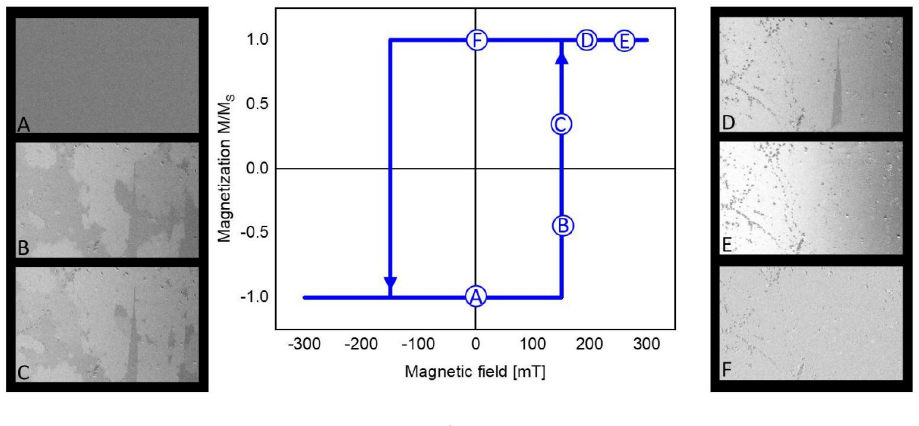
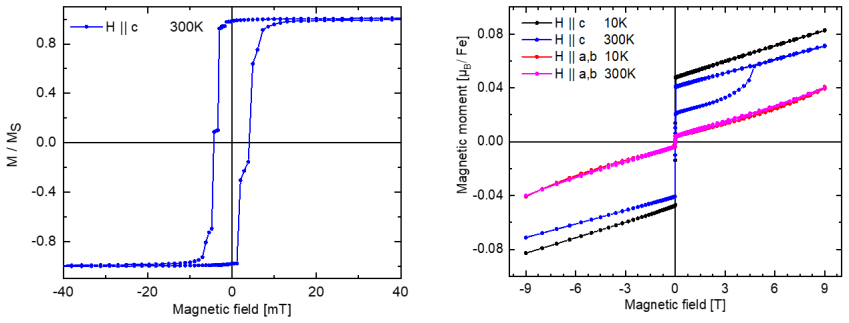
Longitudinal magneto-optical Kerr effect measurements provide a sensitive and direct probe of magnetic switching and domain processes in coherently strained LaFeO3 thin films, yielding rectangular hysteresis loops, single-domain remanence over large areas, and domain-wall-controlled switching that follows the Kondorsky model as in bulk single crystals.
What carries the argument
The weak ferromagnetic moment coupled to the Néel vector, detected through the longitudinal magneto-optical Kerr effect in strain-tuned epitaxial films on orthorhombic substrates.
If this is right
- Different substrate-induced strains control the in-plane orientation of the c-axis and the direction of the magnetization.
- MOKE can serve as a simple optical test to determine orthorhombic axis alignment in these films.
- Domain nucleation and wall motion become accessible for designing magnonic devices based on orthoferrite films.
- Defect pinning sets the coercive field, suggesting routes to engineer switching fields through growth conditions.
Where Pith is reading between the lines
- The same optical approach could be tested on other orthoferrite compositions to map their domain dynamics.
- If single-domain remanence persists in patterned nanostructures, the films could support optical readout in antiferromagnetic memory cells.
- Combining MOKE with electrical control of the Néel vector might allow hybrid magneto-optical antiferromagnetic logic elements.
Load-bearing premise
The Kerr signal originates exclusively from the weak ferromagnetic moment tied to the antiferromagnetic order, with no significant contribution from strain-induced optical anisotropy or substrate effects.
What would settle it
Finding rectangular hysteresis loops or strong Kerr signals in films where the weak ferromagnetic moment is expected to be absent, or finding no signal in compressively strained films that should exhibit it, would falsify the magnetic origin of the observed switching.
Figures
read the original abstract
Strained epitaxial films of the antiferromagnetic orthoferrite LaFeO3 offer a promising platform for antiferromagnetic spintronics, yet their magnetic switching behavior and domain structure have remained largely unexplored due to the small magnitude of the weak ferromagnetic moment. Here, we demonstrate that longitudinal magneto-optical Kerr effect (MOKE) measurements provide a sensitive and direct probe of magnetic switching and domain processes in coherently strained LaFeO3 thin films grown on orthorhombic substrates. By employing DyScO3(110), GdScO3(110), and NdGaO3(110) substrates, we achieve straincontrolled, largely twin-free growth and identify the orientation of the orthorhombic c-axis through the presence or absence of a longitudinal MOKE signal. Compressively strained films exhibit large Kerr signals, rectangular hysteresis loops, and magnetic single-domain remanence over macroscopic areas. Tensile strain on orthorhombic substrates is associated with two competing structural effects on thin film orientation; in-plane magnetization has been identified in some films on GdScO3(110) by MOKE. Angle-dependent MOKE hysteresis follows the Kondorsky model, indicating domain-wall-controlled switching analogous to bulk single crystals. Kerr microscopy reveals abrupt domain nucleation and rapid domain-wall motion, with defects acting as pinning centers and governing the coercive field. Our results establish MOKE as an efficient optical tool for identifying orthorhombic orientation, probing magnetic switching of coupled weak magnetization and Neel vectors, and accessing domain dynamics in LaFeO3 films. This provides a foundation for strain-engineered orthoferrite thin films in antiferromagnetic spintronics and magnonics.
Editorial analysis
A structured set of objections, weighed in public.
Referee Report
Summary. The manuscript claims that longitudinal magneto-optical Kerr effect (MOKE) measurements serve as a sensitive probe of magnetic switching and domain processes in coherently strained epitaxial LaFeO3 thin films on orthorhombic substrates (DyScO3, GdScO3, NdGaO3). Compressively strained films show large Kerr signals, rectangular hysteresis loops, and macroscopic single-domain remanence; c-axis orientation is identified via presence/absence of the signal; angle-dependent loops follow the Kondorsky model; and Kerr microscopy reveals abrupt domain nucleation with defect pinning. Tensile strain cases show competing orientation effects, with some in-plane magnetization identified by MOKE.
Significance. If the MOKE signal is confirmed to originate from the weak ferromagnetic moment, the work would provide a practical, non-invasive optical method for mapping Néel-vector-coupled switching and domain dynamics in LaFeO3 films, extending bulk single-crystal behavior to strain-engineered thin films and supporting antiferromagnetic spintronics applications.
major comments (2)
- [Abstract] Abstract: The central mapping from observed rectangular loops, angle dependence, and single-domain remanence to magnetic domain processes assumes the longitudinal MOKE signal arises exclusively from the weak FM moment coupled to the Néel vector. No controls (temperature dependence across TN, non-magnetic reference films, or polarization analysis) are described to exclude strain-induced birefringence or linear dichroism in coherently strained films on orthorhombic substrates.
- [Abstract] Abstract / Results: The reported experimental outcomes (rectangular loops, Kondorsky-model dependence, abrupt nucleation) lack quantitative values for Kerr rotation angles, error bars, number of samples measured, or statistical criteria for identifying single-domain remanence over macroscopic areas, limiting assessment of reproducibility.
minor comments (1)
- [Abstract] Abstract: Typo 'straincontrolled' should read 'strain-controlled'.
Simulated Author's Rebuttal
We thank the referee for their careful reading of the manuscript and for the constructive comments. We address each major comment below and indicate the revisions that will be made.
read point-by-point responses
-
Referee: [Abstract] Abstract: The central mapping from observed rectangular loops, angle dependence, and single-domain remanence to magnetic domain processes assumes the longitudinal MOKE signal arises exclusively from the weak FM moment coupled to the Néel vector. No controls (temperature dependence across TN, non-magnetic reference films, or polarization analysis) are described to exclude strain-induced birefringence or linear dichroism in coherently strained films on orthorhombic substrates.
Authors: We acknowledge the importance of ruling out non-magnetic optical contributions. The MOKE signal appears only for specific c-axis orientations that align with the expected weak ferromagnetic moment and is absent in orthogonal configurations; the angle-dependent loops also follow the Kondorsky model for domain-wall motion, a dependence that is difficult to reconcile with strain-induced birefringence or dichroism. We will add an explicit discussion of these orientation-specific observations and their consistency with a magnetic origin in the revised manuscript. revision: yes
-
Referee: [Abstract] Abstract / Results: The reported experimental outcomes (rectangular loops, Kondorsky-model dependence, abrupt nucleation) lack quantitative values for Kerr rotation angles, error bars, number of samples measured, or statistical criteria for identifying single-domain remanence over macroscopic areas, limiting assessment of reproducibility.
Authors: We agree that quantitative details improve reproducibility. The revised manuscript will report the observed Kerr rotation angles (with error bars), the number of films and samples measured, and the criteria applied to establish macroscopic single-domain remanence. revision: yes
Circularity Check
No circularity: purely experimental observations with no derivation chain
full rationale
The paper reports longitudinal MOKE measurements on strained LaFeO3 epitaxial films, identifying c-axis orientation via signal presence/absence, rectangular hysteresis, single-domain remanence, and domain dynamics via Kerr microscopy. No equations, fitted parameters, predictions, or mathematical derivations appear in the provided text. Claims are benchmarked directly against known bulk single-crystal behavior rather than internal definitions or self-citations. The central mapping from observed loops to magnetic switching rests on the physical assumption that the Kerr signal is magnetic in origin, but this is an empirical interpretation, not a self-referential reduction by construction. The work is self-contained against external benchmarks with no load-bearing self-citation chains or ansatzes.
Axiom & Free-Parameter Ledger
axioms (2)
- domain assumption Coherent epitaxial strain is achieved and maintained across the film thickness on the listed substrates.
- domain assumption Longitudinal MOKE signal directly tracks the in-plane component of the weak ferromagnetic moment without significant optical artifacts.
Reference graph
Works this paper leans on
-
[1]
F. E. Wührl et al., Ultrafast electron dynamics upon above band-gap excitation in epitaxial LaFeO3(001) thin films, New J. Phys. 28, 013501 (2026)
2026
-
[2]
Vailionis, W
A. Vailionis, W. Simons, G. Koster, Room temperature epitaxial stabilization of a tetragonal phase in ARuO3 (A = Ca and Sr) thin films, Appl. Phys. Lett. 93, 051909 (2008)
2008
-
[3]
Herklotz et al., Magnetism of the tensile-strain-induced tetragonal state of SrRuO3 films, Phys
A. Herklotz et al., Magnetism of the tensile-strain-induced tetragonal state of SrRuO3 films, Phys. Rev. B 88, 144412 (2013)
2013
-
[4]
Chu et al., Nanoscale control of domain architectures in BiFeO3 thin films, Nano Lett
Y.-H. Chu et al., Nanoscale control of domain architectures in BiFeO3 thin films, Nano Lett. 9, 1726 (2009)
2009
discussion (0)
Sign in with ORCID, Apple, or X to comment. Anyone can read and Pith papers without signing in.