Classification of independent sets in signed Johnson graphs and applications to kissing arrangements
Pith reviewed 2026-06-28 08:29 UTC · model grok-4.3
The pith
There are 1579 non-isomorphic maximum independent sets in the signed Johnson graph J±(12,4), each giving a distinct non-isometric kissing arrangement of 840 spheres in 12-dimensional space.
A machine-rendered reading of the paper's core claim, the machinery that carries it, and where it could break.
Core claim
We identify 1579 non-isomorphic maximum independent sets in J±(12,4), all corresponding to non-isometric kissing arrangements of size 840 in R^12. Structurally, 1575 of these independent sets arise from three different constructions, the rest are liftings of one of four (12,4,4)-codes. For n ≡ 2 or 4 mod 6, every maximum independent set arises from a Steiner quadruple system. We also obtain a characterization of the so-called nontrivially self-compatible codes, namely optimal (n,4,4)-codes from which non-classical maximum independent sets can be constructed.
What carries the argument
The signed Johnson graph J±(n,4) whose vertices are vectors with exactly four ±1 entries, with two vertices adjacent when their dot product equals 3; maximum independent sets in this graph define kissing arrangements.
If this is right
- For n ≡ 2 or 4 mod 6 every maximum independent set in J±(n,4) arises from a Steiner quadruple system.
- Non-classical maximum independent sets can be obtained by lifting nontrivially self-compatible optimal (n,4,4)-codes.
- All 1579 independent sets in dimension 12 produce kissing arrangements of exactly 840 spheres that are pairwise non-isometric.
- Complete lists of such sets up to signed-permutation symmetry exist for every n ≤ 12 except n = 11.
Where Pith is reading between the lines
- The observed variety implies that many more locally optimal sphere-kissing configurations exist in 12 dimensions than the handful previously catalogued.
- The three explicit constructions may generalize to produce large families of independent sets in higher dimensions where full enumeration is impossible.
- The characterization of nontrivially self-compatible codes supplies a concrete search criterion for new constant-weight codes with unusual lifting properties.
- Kissing arrangements arising from these sets could be tested for global optimality or for use as seeds in higher-dimensional packing problems.
Load-bearing premise
The custom algorithm correctly enumerates every maximum independent set without omissions or overcounting once symmetry under signed permutations is quotiented out.
What would settle it
An explicit list or construction of one additional maximum independent set in J±(12,4) not isomorphic to any of the 1579 reported ones.
Figures
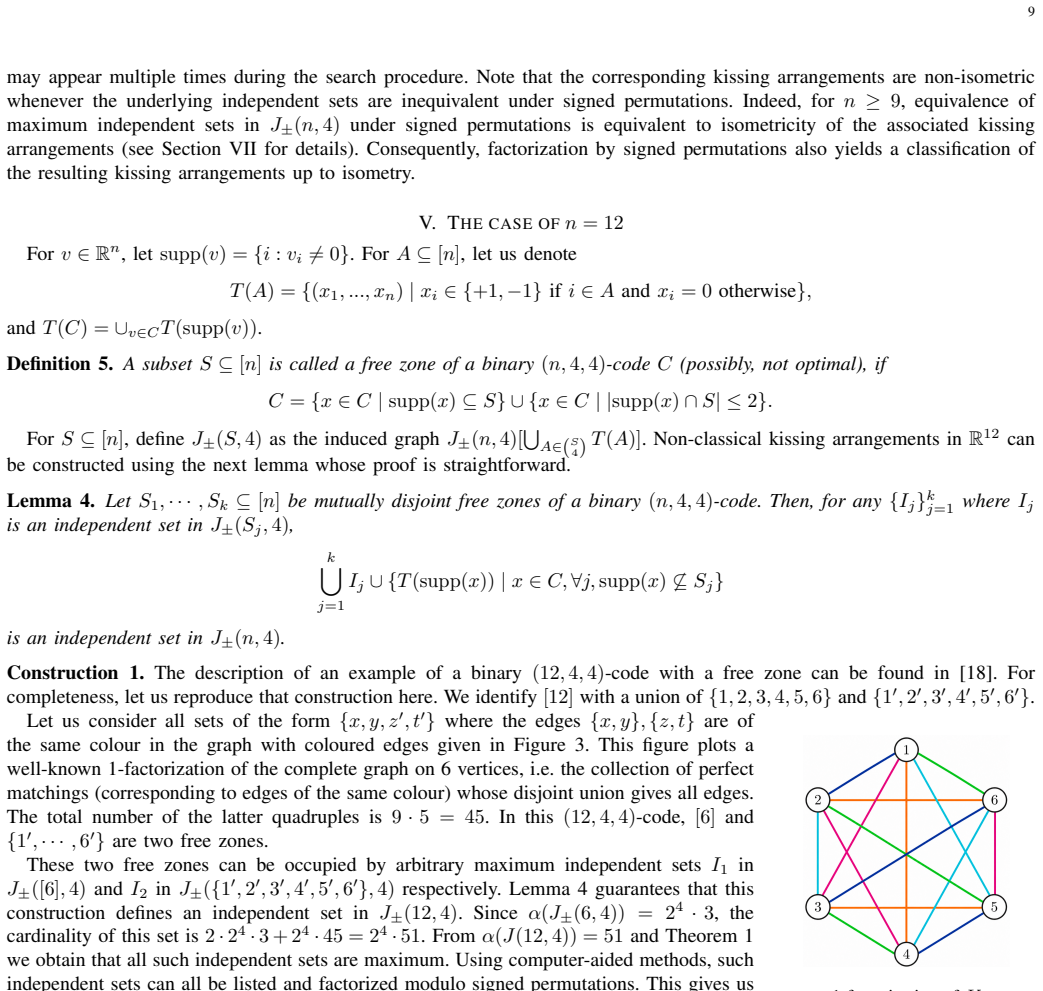
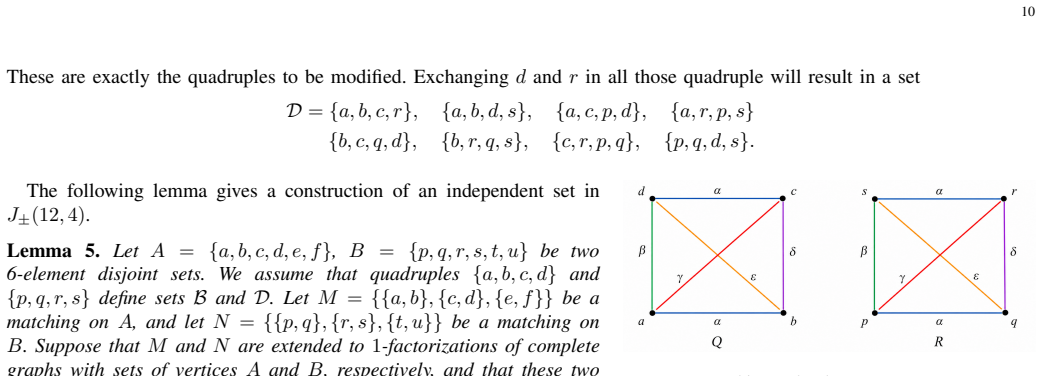
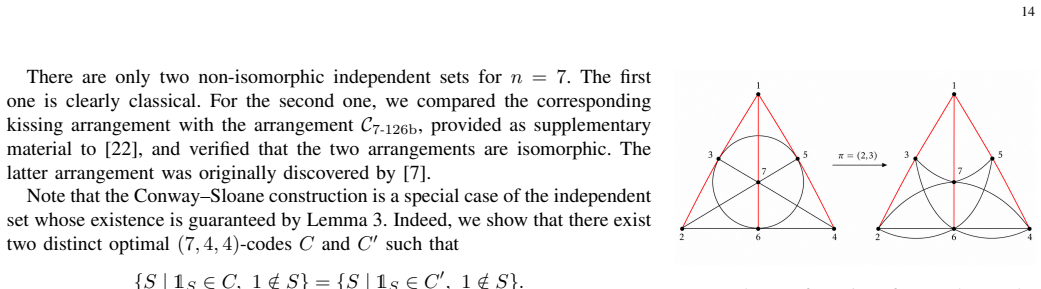
read the original abstract
Johnson graph are a family of graphs that play an important role in the theory of constant-weight codes, extremal combinatorics, and combinatorial geometry. We study signed analogues of classical Johnson graphs, denoted by $J_\pm(n,k)$, whose vertices are vectors of the form $\pm e_{i_1}\pm\cdots\pm e_{i_k}$, where two vertices are adjacent whenever their dot product equals $k-1$. We are particularly interested in maximum independent sets in the case $k=4$. An example of such an independent set in $J_\pm(n,4)$, which we call \emph{classical}, is obtained by lifting an arbitrary optimal $(n,4,4)$-code. Such independent sets naturally define kissing arrangements in ${\mathbb R}^n$. We develop an algorithm that is practical for computing all maximum independent sets in $J_\pm(n,4)$ up to signed permutations for $n\le 12$, $n\ne 11$. In addition to obtaining complete lists, we provide structural characterizations of all types of maximum independent sets in these dimensions, excluding $n=5$ and $n=11$. Our most striking results concern the case $n=12$. We identify $1579$ non-isomorphic maximum independent sets in $J_\pm(12,4)$, all corresponding to non-isometric kissing arrangements of size $840$ in ${\mathbb R}^{12}$. Structurally, $1575$ of these independent sets arise from three different constructions, the rest are liftings of one of four $(12,4,4)$-codes. To our knowledge, this is the first dimension in which such a large diversity of potentially optimal kissing arrangements has been observed. Beyond this finite range, we prove that for $n\equiv 2$ or $4 \pmod 6$, every maximum independent set arises from a Steiner quadruple system. We also obtain a characterization of the so-called \emph{nontrivially self-compatible} codes, namely optimal $(n,4,4)$-codes from which non-classical maximum independent sets can be constructed.
Editorial analysis
A structured set of objections, weighed in public.
Referee Report
Summary. The paper introduces signed Johnson graphs J±(n,4) whose vertices are signed k-subset vectors with adjacency when the dot product is k-1. It develops a custom algorithm to enumerate all maximum independent sets up to signed-permutation symmetry for n≤12 (n≠11), supplies complete lists together with structural characterizations, and proves that for n≡2 or 4 (mod 6) every maximum independent set arises from a Steiner quadruple system. The headline computational result is the identification of 1579 non-isomorphic maximum independent sets in J±(12,4), all yielding non-isometric kissing arrangements of size 840 in R^12; of these, 1575 arise from three explicit constructions and the remaining four are liftings of (12,4,4)-codes. A characterization of nontrivially self-compatible optimal (n,4,4)-codes is also given.
Significance. If the enumeration is correct, the work establishes the first dimension in which a large number of combinatorially distinct, potentially optimal kissing arrangements appear, and supplies explicit constructions and a complete classification for n=12. The analytic proofs for the Steiner-quadruple-system case and the self-compatible-code characterization are parameter-free and therefore constitute a permanent contribution independent of the computational component.
major comments (1)
- [Enumeration algorithm and results for n=12] The section describing the enumeration algorithm and its output for n=12: the claim that there are exactly 1579 non-isomorphic maximum independent sets (1575 from three constructions, 4 from code liftings) is load-bearing for the central assertion of “first dimension with such diversity,” yet the manuscript supplies neither released source code, machine-checked certificates, exhaustive cross-checks on smaller n against known constant-weight-code tables, nor independent verification of the symmetry-quotienting and maximality steps. An undetected orbit or maximality error would directly falsify the reported count and the structural breakdown.
Simulated Author's Rebuttal
We thank the referee for the positive evaluation of the paper's significance and for the constructive comment on verification of the n=12 enumeration. We respond point by point below.
read point-by-point responses
-
Referee: The section describing the enumeration algorithm and its output for n=12: the claim that there are exactly 1579 non-isomorphic maximum independent sets (1575 from three constructions, 4 from code liftings) is load-bearing for the central assertion of “first dimension with such diversity,” yet the manuscript supplies neither released source code, machine-checked certificates, exhaustive cross-checks on smaller n against known constant-weight-code tables, nor independent verification of the symmetry-quotienting and maximality steps. An undetected orbit or maximality error would directly falsify the reported count and the structural breakdown.
Authors: We agree that computational enumerations of this scale require explicit verification to support the headline claim. The algorithm is fully described in the manuscript (including the symmetry-quotienting procedure via signed-permutation group actions and the maximality test via exhaustive neighbor search), and we performed internal consistency checks: the counts for n=6,8,10 recover the known numbers of optimal constant-weight codes and classical independent sets, while the structural partition into three constructions plus four code-liftings is corroborated by the independent analytic characterization of nontrivially self-compatible codes. Nevertheless, the manuscript does not currently include an external code repository or tabulated cross-checks against external tables. In the revised version we will (i) add a dedicated subsection tabulating the smaller-n verifications against the Brouwer–Etzion–Östergård tables and the known Johnson-graph independent-set enumerations, (ii) state the precise orbit-stabilizer and maximality invariants used, and (iii) make the source code (with deterministic random-seed reproduction) available via a public repository upon acceptance. Machine-checked certificates (e.g., Coq or Isabelle formalization of the entire search) lie beyond the scope of the present work but could be pursued separately; the combination of published algorithm, smaller-n cross-checks, and code release will allow independent reproduction and falsification of the 1579 count. revision: yes
Circularity Check
No circularity: enumeration outputs and independent combinatorial proofs
full rationale
The paper's central results consist of (a) complete lists of maximum independent sets in J±(n,4) for n≤12 (n≠11) obtained by running a custom enumeration algorithm up to signed-permutation symmetry, and (b) separate combinatorial proofs that, for n≡2 or 4 (mod 6), every such set arises from a Steiner quadruple system, plus a characterization of nontrivially self-compatible (n,4,4)-codes. Neither the reported count 1579 nor the structural partition (1575 from three constructions, 4 from codes) is obtained by fitting parameters to the same data or by any equation that equates the output to an input by definition. No self-citation is invoked as a load-bearing uniqueness theorem, and the algorithmic results are presented as direct computational outputs rather than predictions derived from prior fitted quantities. The derivation chain is therefore self-contained against external benchmarks.
Axiom & Free-Parameter Ledger
axioms (2)
- domain assumption Two signed k-vectors are adjacent in J±(n,k) precisely when their dot product equals k-1.
- domain assumption Maximum independent sets in J±(n,4) correspond to kissing arrangements of size equal to the independence number in R^n.
Forward citations
Cited by 1 Pith paper
-
Structure of kissing arrangements in ${\mathbb R}^{12}$ and a place for the $841$st sphere
Kissing arrangements of 840 spheres in R^12 admit positive-dimensional families of non-isometric realizations via flexible 48-systems in each 60-point block with fixed bridges, enabling a numerical 841-sphere configur...
Reference graph
Works this paper leans on
-
[1]
Forbidding just one intersection,
P. Frankl and Z. F ¨uredi, “Forbidding just one intersection,”Journal of Combinatorial Theory, Series A, vol. 39, no. 2, pp. 160–176, 1985. [Online]. Available: https://www.sciencedirect.com/science/article/pii/0097316585900354
arXiv 1985
-
[2]
The complete intersection theorem for systems of finite sets,
R. Ahlswede and L. H. Khachatrian, “The complete intersection theorem for systems of finite sets,”European Journal of Combinatorics, vol. 18, no. 2, pp. 125–136, 1997. [Online]. Available: https://www.sciencedirect.com/science/article/pii/S0195669885700923
1997
-
[3]
Intersection theorems with geometric consequences,
P. Frankl and R. M. Wilson, “Intersection theorems with geometric consequences,”Combinatorica, vol. 1, no. 4, pp. 357–368, Dec 1981. [Online]. Available: https://doi.org/10.1007/BF02579457
-
[4]
MacWilliams and N
F. MacWilliams and N. Sloane,The Theory of Error-Correcting Codes, 2nd ed. North-holland Publishing Company, 1978
1978
-
[5]
Classification of binary constant weight codes,
P. R. J. ¨Osterg˚ard, “Classification of binary constant weight codes,”IEEE Trans. Inf. Theor., vol. 56, no. 8, p. 3779–3785, Aug. 2010. [Online]. Available: https://doi.org/10.1109/TIT.2010.2050922
-
[6]
Sphere packings and error-correcting codes,
J. Leech and N. J. A. Sloane, “Sphere packings and error-correcting codes,”Canadian Journal of Mathematics, vol. 23, no. 4, p. 718–745, 1971
1971
-
[7]
What are all the best sphere packings in low dimensions?
J. H. Conway and N. J. A. Sloane, “What are all the best sphere packings in low dimensions?”Discrete & Computational Geometry, vol. 13, no. 3, pp. 383–403, Jun 1995. [Online]. Available: https://doi.org/10.1007/BF02574051
-
[8]
Variations on five-dimensional sphere packings,
H. Cohn and I. Rajagopal, “Variations on five-dimensional sphere packings,” 2026. [Online]. Available: https://arxiv.org/abs/2412.00937
arXiv 2026
-
[9]
Highly symmetric lines,
M. Ganzhinov, “Highly symmetric lines,”Linear Algebra and its Applications, vol. 722, pp. 12–37, 2025. [Online]. Available: https: //www.sciencedirect.com/science/article/pii/S0024379525001946
2025
-
[10]
Alphaevolve: A coding agent for scientific and algorithmic discovery,
A. Novikov, N. V ˜u, M. Eisenberger, E. Dupont, P.-S. Huang, A. Z. Wagner, S. Shirobokov, B. Kozlovskii, F. J. R. Ruiz, A. Mehrabian, M. P. Kumar, A. See, S. Chaudhuri, G. Holland, A. Davies, S. Nowozin, P. Kohli, and M. Balog, “Alphaevolve: A coding agent for scientific and algorithmic discovery,” 2025. [Online]. Available: https://arxiv.org/abs/2506.13131
Pith/arXiv arXiv 2025
-
[11]
Some extreme forms defined in terms of abelian groups,
E. S. Barnes and G. E. Wall, “Some extreme forms defined in terms of abelian groups,”Journal of the Australian Mathematical Society, vol. 1, no. 1, p. 47–63, 1959
1959
-
[12]
Extremal problems for hypergraphs,
G. O. H. Katona, “Extremal problems for hypergraphs,” inCombinatorics, M. Hall and J. H. van Lint, Eds. Dordrecht: Springer Netherlands, 1975, pp. 215–244
1975
-
[13]
Binary codes with minimum distance four,
M. R. Best, “Binary codes with minimum distance four,” Mathematical Centre, Amsterdam, The Netherlands, Tech. Rep. ZW 112/78, 1978
1978
-
[14]
A(11,4,4) = 35 or some new optimal constant weight codes,
M. Best, “A(11,4,4) = 35 or some new optimal constant weight codes,” Jan. 1977
1977
-
[15]
ApS,The MOSEK optimization toolbox for MATLAB manual
M. ApS,The MOSEK optimization toolbox for MATLAB manual. Version 9.0., 2019. [Online]. Available: http://docs.mosek.com/9.0/toolbox/index.html
2019
-
[16]
An automatic method of solving discrete programming problems,
A. H. Land and A. G. Doig, “An automatic method of solving discrete programming problems,”Econometrica, vol. 28, no. 3, pp. 497–520, 1960. [Online]. Available: http://www.jstor.org/stable/1910129
arXiv 1960
-
[17]
A fast algorithm for the maximum clique problem,
P. R. ¨Osterg˚ard, “A fast algorithm for the maximum clique problem,”Discrete Applied Mathematics, vol. 120, no. 1, pp. 197– 207, 2002, special Issue devoted to the 6th Twente Workshop on Graphs and Combinatorial Optimization. [Online]. Available: https: //www.sciencedirect.com/science/article/pii/S0166218X01002906
2002
-
[18]
Maximal and minimal coverings of (k — 1)-tuples by k-tuples,
J. Kalbfleisch and R. Stanton, “Maximal and minimal coverings of (k — 1)-tuples by k-tuples,”Pacific Journal of Mathematics, vol. 26, no. 1, p. 131 – 140, 1968
1968
-
[19]
The igraph software package for complex network research,
G. Cs ´ardi and T. Nepusz, “The igraph software package for complex network research,”InterJournal, vol. Complex Systems, p. 1695, 2006. [Online]. Available: https://igraph.org
2006
-
[20]
Exploring network structure, dynamics, and function using networkx,
A. A. Hagberg, D. A. Schult, and P. J. Swart, “Exploring network structure, dynamics, and function using networkx,” inProceedings of the 7th Python in Science Conference, G. Varoquaux, T. Vaught, and J. Millman, Eds., Pasadena, CA USA, 2008, pp. 11 – 15
2008
-
[21]
Practical graph isomorphism, ii,
B. D. McKay and A. Piperno, “Practical graph isomorphism, ii,”Journal of Symbolic Computation, vol. 60, pp. 94–112, 2014. [Online]. Available: https://www.sciencedirect.com/science/article/pii/S0747717113001193
2014
-
[22]
Rigidity of spherical codes,
H. Cohn, Y . Jiao, A. Kumar, and S. Torquato, “Rigidity of spherical codes,”Geometry & Topology, vol. 15, pp. 2235–2273, 2011
2011
-
[23]
Uniqueness of certain spherical codes,
E. Bannai and N. J. A. Sloane, “Uniqueness of certain spherical codes,”Canadian Journal of Mathematics, vol. 33, no. 2, p. 437–449, 1981
1981
-
[24]
Upper bounds for constant weight error correcting codes,
S. Johnson, “Upper bounds for constant weight error correcting codes,”Discrete Mathematics, vol. 3, no. 1, pp. 109–124, 1972. [Online]. Available: https://www.sciencedirect.com/science/article/pii/0012365X72900271
arXiv 1972
-
[25]
The completion determination of optimal(3,4)-packings,
J. Bao and L. Ji, “The completion determination of optimal(3,4)-packings,”Des. Codes Cryptography, vol. 77, no. 1, p. 217–229, Oct. 2015. [Online]. Available: https://doi.org/10.1007/s10623-014-0001-2
discussion (0)
Sign in with ORCID, Apple, or X to comment. Anyone can read and Pith papers without signing in.