Role of Characteristic Length Scale in Interface Graphitization-Induced Wear Resistance of Diamond and Amorphous Carbon
Pith reviewed 2026-06-28 09:30 UTC · model grok-4.3
The pith
The characteristic length scale of sp2 reconstruction at carbon interfaces dictates wear rates by setting the density of weakly bonded atoms.
A machine-rendered reading of the paper's core claim, the machinery that carries it, and where it could break.
Core claim
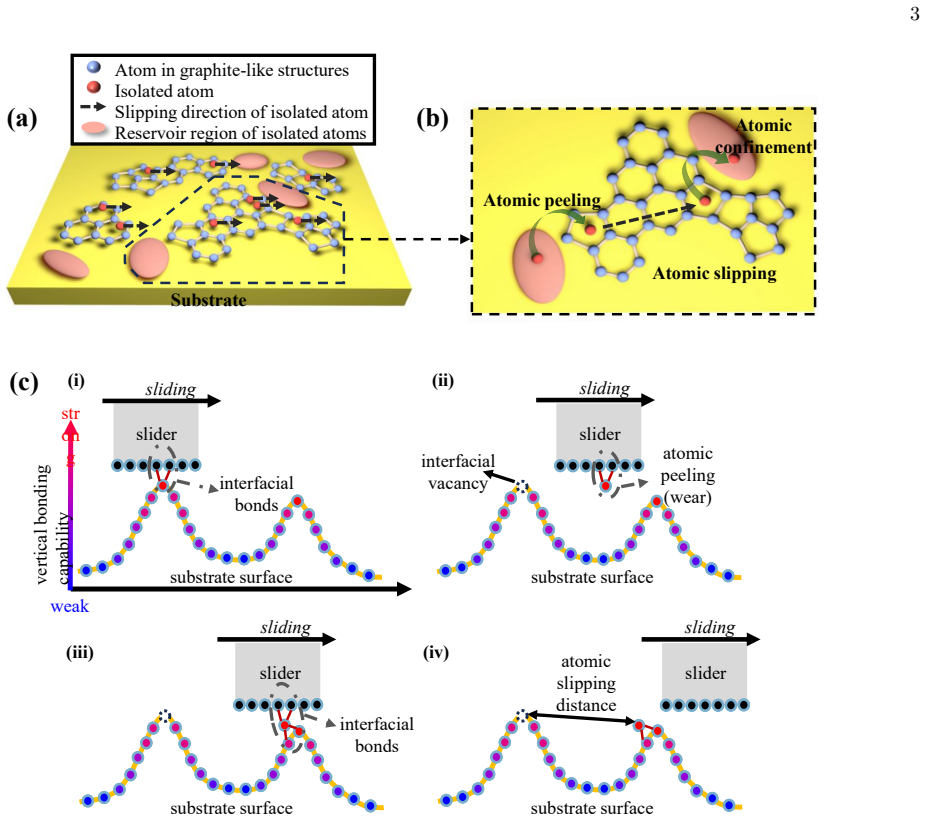
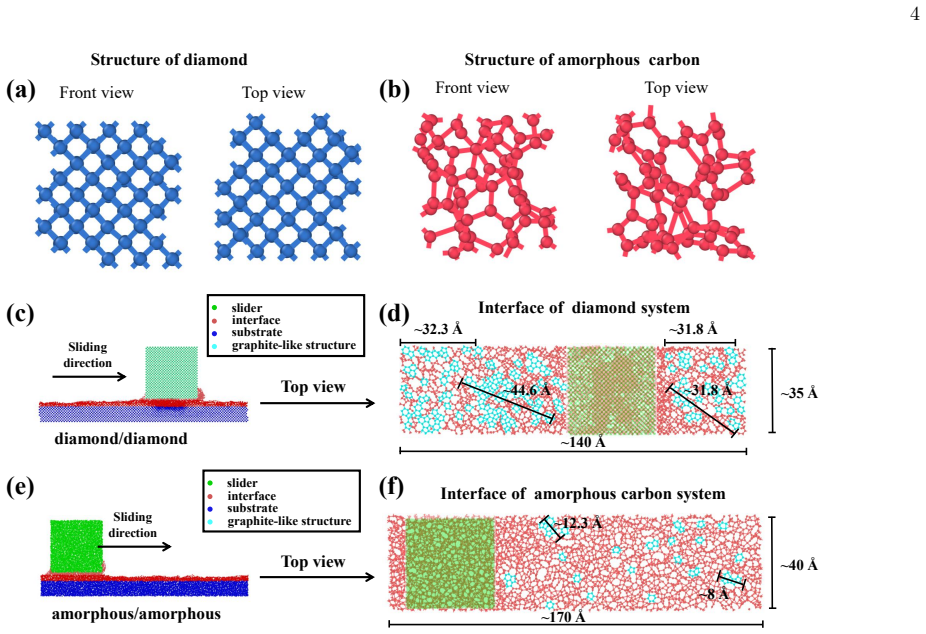
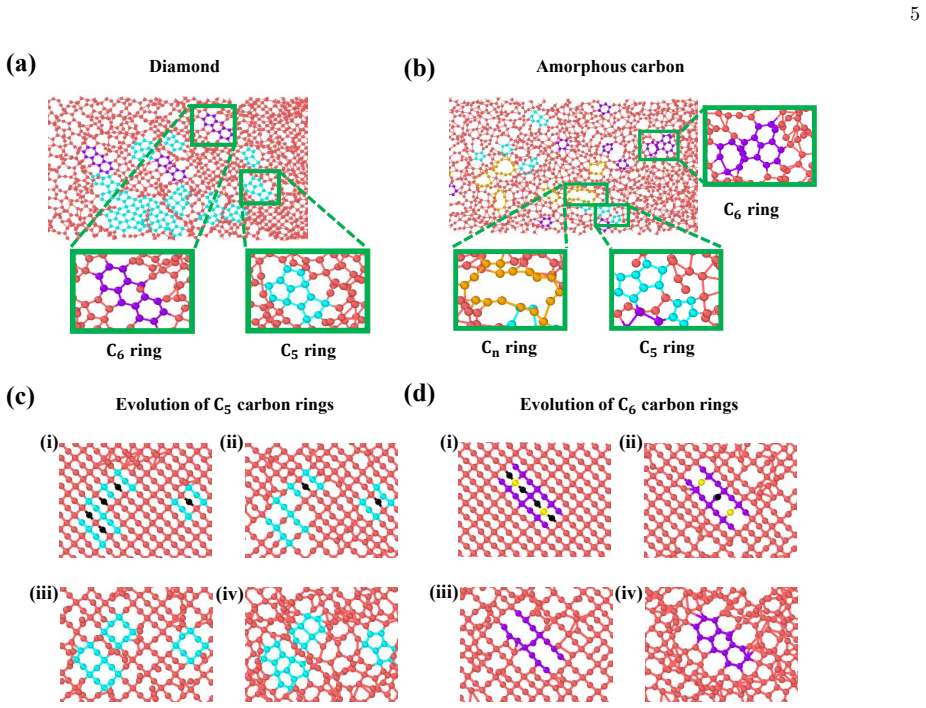
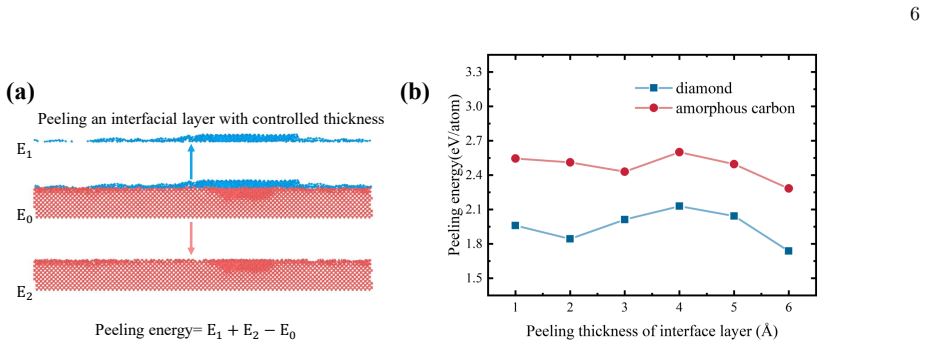
Diamond interfaces develop a laterally continuous sp2 reconstruction layer with a characteristic length of 30--45 Å, while amorphous carbon interfaces form only fully isolated sp2 patches of 8--12 Å. This disparity in characteristic length scale determines the density of weakly bonded interfacial atoms left outside the reconstruction layer, thereby directly dictating the macroscopic wear rate. The authors propose protecting specific crystallographic orientations such as the (111) close-packed planes to regulate friction-induced graphitization in diamond coatings.
What carries the argument
The characteristic length scale of the friction-induced sp2 reconstruction layer, which controls the remaining density of weakly bonded interfacial atoms.
Load-bearing premise
The machine learning potential and molecular dynamics boundary conditions accurately reproduce the real-time formation and stability of sp2 patches under shear without artifacts.
What would settle it
Direct experimental imaging or spectroscopy of sp2 patch sizes at sheared diamond and amorphous carbon interfaces that either matches the simulated 30-45 Å continuous layers versus 8-12 Å isolated patches or shows different sizes.
Figures
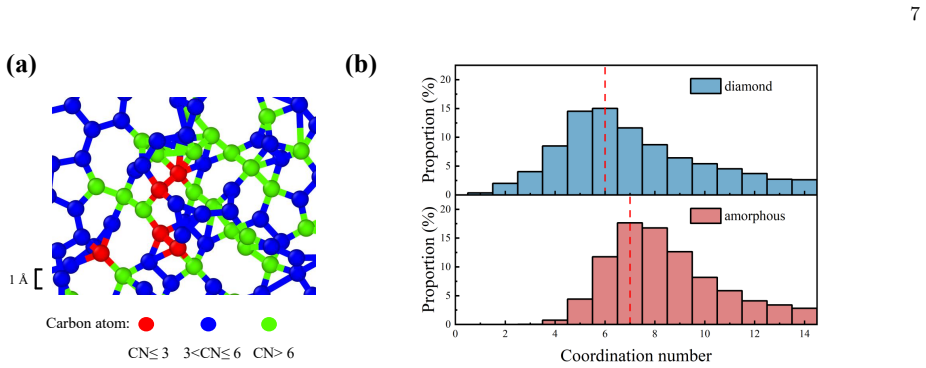
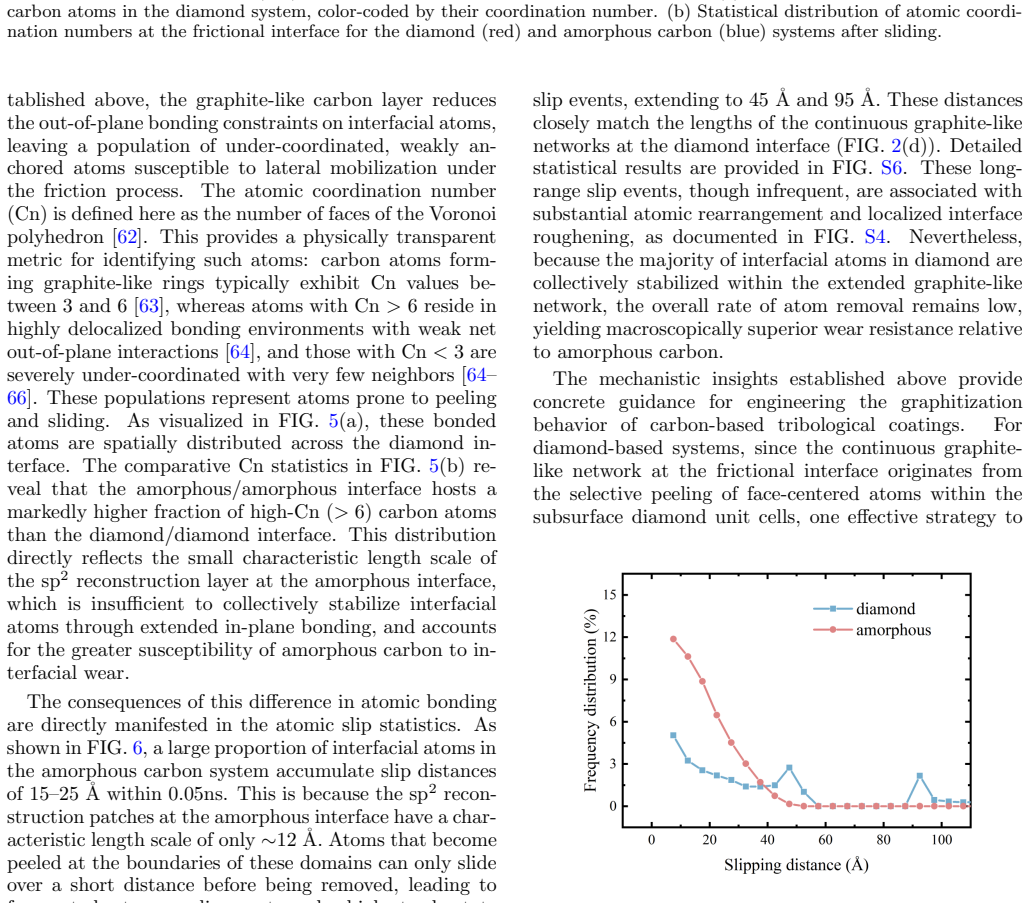
read the original abstract
The evolution of interfacial atomic structures critically influences the friction and wear behavior of carbon-based materials. However, how the characteristic length scale of friction-induced sp\textsuperscript{2} reconstruction governs macroscopic wear remains poorly understood, particularly for diamond and amorphous carbon where the interfacial graphitization modes differ fundamentally. In this work, we develop a machine learning potential for these carbon systems and investigate the structural evolution at interfaces in both diamond/diamond and amorphous/amorphous carbon systems using molecular dynamics simulations. Our results reveal distinct atomic-scale characteristics of graphitization at the two interfaces. Diamond interfaces develop a laterally continuous sp\textsuperscript{2} reconstruction layer with a characteristic length of 30--45~\AA, while amorphous carbon interfaces form only fully isolated sp\textsuperscript{2} patches of 8--12~\AA. This disparity in characteristic length scale determines the density of weakly bonded interfacial atoms left outside the reconstruction layer, thereby directly dictating the macroscopic wear rate. Based on these insights, we propose a strategy to regulate friction-induced graphitization in diamond coatings by protecting specific crystallographic orientations, such as the (111) close-packed planes. This work bridges the gap between atomic-scale interfacial structure and macroscopic tribological performance, offering mechanistic guidelines for the rational design of wear-resistant carbon-based coatings.
Editorial analysis
A structured set of objections, weighed in public.
Referee Report
Summary. The paper develops a machine-learning interatomic potential for carbon and uses it in MD simulations of shear at diamond/diamond and amorphous-carbon/amorphous-carbon interfaces. It reports that diamond interfaces form a laterally continuous sp² reconstruction layer (characteristic length 30–45 Å) while a-C interfaces form only isolated sp² patches (8–12 Å). The authors claim that this length-scale disparity sets the density of weakly bonded interfacial atoms outside the reconstruction layer and thereby directly controls the macroscopic wear rate. They further propose protecting (111) orientations in diamond coatings to regulate graphitization.
Significance. If the simulations faithfully capture the formation and stability of sp² patches under shear, the work supplies a concrete atomic-scale mechanism linking interfacial reconstruction length scale to wear resistance, which could guide the design of carbon-based coatings. The use of an ML potential to access system sizes beyond conventional DFT is a methodological strength, and the two classes of interfaces are compared on independent trajectories.
major comments (2)
- [Abstract] Abstract: the central claim that the observed length-scale disparity 'directly dictates' the macroscopic wear rate is presented without reported wear-rate values, error bars, or quantitative correlation between the measured patch sizes and the number/density of weakly bonded atoms. Because this causal step is load-bearing for the main conclusion, the absence of these data leaves the interpretation vulnerable to post-hoc reasoning.
- [Methods] Methods (ML-potential development and validation subsection): no error metrics on the potential, no coverage statistics for shear-induced sp² formation, and no direct comparison to DFT or experiment are supplied. The reported 30–45 Å versus 8–12 Å disparity and its link to wear therefore rest on an unvalidated assumption that the potential and chosen boundary conditions reproduce the real-time stability and coalescence of sp² patches rather than artifacts of the model or setup.
Simulated Author's Rebuttal
We thank the referee for the constructive feedback on our manuscript. The comments highlight important aspects of how we present the causal link between interfacial length scales and wear, as well as the validation of the machine-learning potential. We address each major comment below and indicate where revisions will be made to strengthen the manuscript.
read point-by-point responses
-
Referee: [Abstract] Abstract: the central claim that the observed length-scale disparity 'directly dictates' the macroscopic wear rate is presented without reported wear-rate values, error bars, or quantitative correlation between the measured patch sizes and the number/density of weakly bonded atoms. Because this causal step is load-bearing for the main conclusion, the absence of these data leaves the interpretation vulnerable to post-hoc reasoning.
Authors: We agree that making the quantitative connection explicit would strengthen the central claim. The manuscript already reports the measured characteristic lengths and the resulting densities of weakly bonded atoms outside the sp² patches; these densities are obtained directly from the MD trajectories by counting atoms with coordination and bonding criteria that indicate weak interfacial attachment. To address the concern, we will add a new figure and accompanying text in the results section that reports wear rates extracted from the simulations (atoms detached per unit area per unit time) with error bars from independent trajectories, together with a direct correlation plot between patch size/density and computed wear rate. This will be referenced from the abstract. revision: yes
-
Referee: [Methods] Methods (ML-potential development and validation subsection): no error metrics on the potential, no coverage statistics for shear-induced sp² formation, and no direct comparison to DFT or experiment are supplied. The reported 30–45 Å versus 8–12 Å disparity and its link to wear therefore rest on an unvalidated assumption that the potential and chosen boundary conditions reproduce the real-time stability and coalescence of sp² patches rather than artifacts of the model or setup.
Authors: The development of the ML potential, including training-set composition and validation against DFT reference data, is described in the supplementary information. However, we acknowledge that the main text does not present the error metrics, coverage statistics for sp² configurations under shear, or side-by-side DFT comparisons in sufficient detail. We will expand the Methods section (and move key validation tables/figures from the SI) to include RMSE values for energies and forces on both training and test sets, statistics on the fraction of shear-induced sp² atoms sampled across trajectories, and direct comparisons of patch formation energetics and stability to available DFT and experimental literature on carbon graphitization. These additions will confirm that the observed length-scale disparity is not an artifact. revision: yes
Circularity Check
No significant circularity identified
full rationale
The paper reports distinct sp2 reconstruction length scales (30–45 Å continuous layer in diamond interfaces vs. 8–12 Å isolated patches in amorphous carbon) from MD trajectories run with a newly developed ML potential. The claim that this disparity sets the density of weakly bonded atoms and thereby dictates macroscopic wear rate is presented as an observed outcome of those simulations, not as a quantity derived by fitting a parameter to wear data or by reducing to a self-citation. No equations, self-definitional steps, or load-bearing self-citations appear in the provided text that would make the central mechanism equivalent to its inputs by construction. The derivation chain remains self-contained against external benchmarks.
Axiom & Free-Parameter Ledger
axioms (2)
- domain assumption Classical molecular dynamics with periodic boundaries and constant shear rate faithfully captures friction-induced graphitization kinetics.
- domain assumption The machine-learned potential reproduces the relative energies and barriers of sp2 versus sp3 bonding under shear.
Reference graph
Works this paper leans on
-
[1]
V. W. Wong and S. C. Tung, Friction4, 1 (2016)
2016
-
[2]
P. J. Blau, Tribol. Int.34, 585 (2001)
2001
-
[3]
Perry and W
S. Perry and W. Tysoe, Tribol. Lett.19, 151 (2005)
2005
-
[4]
N. S. Tambe and B. Bhushan, Appl. Phys. Lett.86, 10.1063/1.1923179 (2005)
-
[5]
N. S. Tambe and B. Bhushan, Appl. Phys. Lett.86, 10.1063/1.1856688 (2005)
-
[6]
Erdemir and J
A. Erdemir and J. M. Martin, Curr. Opin. Solid State Mater. Sci.22, 243 (2018)
2018
-
[7]
D. P. Markov, Friction10, 1859 (2022)
2022
-
[8]
M. H. M¨ user, L. Wenning, and M. O. Robbins, Phys. Rev. Lett.86, 1295 (2001)
2001
-
[9]
Y. Zhou, Z. Chen, T. Zhang, S. Zhang, X. Xing, Q. Yang, and D. Li, Friction11, 1708 (2023)
2023
-
[10]
R. W. Carpick and M. Salmeron, Chem. Rev.97, 1163 (1997)
1997
-
[11]
W. Zhai, L. Bai, R. Zhou, X. Fan, G. Kang, Y. Liu, and K. Zhou, Adv. Sci.8, 2003739 (2021)
2021
-
[12]
Filleter, J
T. Filleter, J. L. McChesney, A. Bostwick, E. Rotenberg, K. V. Emtsev, T. Seyller, K. Horn, and R. Bennewitz, Phys. Rev. Lett.102, 086102 (2009)
2009
-
[13]
Z. Gao, Z. Yuan, Y. Yang, Z. Li, and B. Huang, Ceram. Int.50, 36099 (2024)
2024
-
[14]
Erdemir and C
A. Erdemir and C. Donnet, J. Phys. D: Appl. Phys.39, R311 (2006)
2006
-
[15]
Liang, X
H. Liang, X. Yang, C. Yue, G. Zhao, J. Zhang, and Y. Wang, Tribol. Int.193, 109344 (2024)
2024
-
[16]
X. Li, A. Wang, and K.-R. Lee, Carbon170, 621 (2020)
2020
-
[17]
Z. Lin, G. Shao, W. Liu, Y. Wang, H. Wang, H. Wang, B. Fan, H. Lu, H. Xu, and R. Zhang, Carbon192, 356 (2022)
2022
-
[18]
H. Liu, W. Zong, and X. Cheng, Tribol. Lett.68, 120 (2020)
2020
-
[19]
Pastewka, S
L. Pastewka, S. Moser, P. Gumbsch, and M. Moseler, Nat. Mater.10, 34 (2011)
2011
-
[20]
Erdemir, Surf
A. Erdemir, Surf. Coat. Technol.146, 292 (2001)
2001
-
[21]
Konicek, D
A. Konicek, D. Grierson, A. Sumant, T. Friedmann, J. Sullivan, P. Gilbert, W. Sawyer, and R. W. Carpick, Phys. Rev. B85, 155448 (2012)
2012
-
[22]
Miyoshi, R
K. Miyoshi, R. L. Wu, and A. Garscadden, Surf. Coat. Technol.54, 428 (1992)
1992
-
[23]
Li and I
Z. Li and I. Szlufarska, Phys. Rev. Materials2, 063602 (2018)
2018
-
[24]
Y. Mo, K. T. Turner, and I. Szlufarska, Nature457, 1116 (2009)
2009
-
[25]
J. Wang, K. Zhang, L. Zhang, F. Wang, J. Zhang, and W. Zheng, Appl. Surf. Sci.457, 388 (2018)
2018
-
[26]
Sanchez-Lopez, A
J. Sanchez-Lopez, A. Erdemir, C. Donnet, and T. Rojas, Surf. Coat. Technol.163, 444 (2003)
2003
-
[27]
T. F. Soules, J. Non-Cryst. Solids49, 29 (1982)
1982
-
[28]
Erdemir, Tribol
A. Erdemir, Tribol. Int.37, 1005 (2004)
2004
-
[29]
Kuwahara, P
T. Kuwahara, P. A. Romero, S. Makowski, V. Weih- nacht, G. Moras, and M. Moseler, Nat. Commun.10, 151 (2019)
2019
-
[30]
Ma, Y.-Z
T.-B. Ma, Y.-Z. Hu, and H. Wang, Carbon47, 1953 (2009)
1953
-
[31]
Y. Wang, N. Yamada, J. Xu, J. Zhang, Q. Chen, Y. Ootani, Y. Higuchi, N. Ozawa, M.-I. D. B. Bouchet, and J. M. Martin, Sci. Adv.5, eaax9301 (2019)
2019
-
[32]
Zhang, J
L. Zhang, J. Han, H. Wang, R. Car, and W. E, Phys. Rev. Lett.120, 143001 (2018)
2018
-
[33]
Zhang, D.-Y
L. Zhang, D.-Y. Lin, H. Wang, R. Car, and W. E, Phys. Rev. Materials3, 023804 (2019)
2019
-
[34]
Zhang, H
Y. Zhang, H. Wang, W. Chen, J. Zeng, L. Zhang, and H. Wang, Comput. Phys. Commun.253, 107206 (2020)
2020
-
[35]
Z. Fan, J. Phys. Condens. Matter34, 125902 (2022)
2022
-
[36]
Z. Fan, Z. Zeng, C. Zhang, Y. Wang, K. Song, H. Dong, Y. Chen, and T. Ala-Nissila, Phys. Rev. B104, 104309 (2021)
2021
-
[37]
P. Ying, C. Qian, R. Zhao, Y. Wang, K. Xu, F. Ding, S. Chen, and Z. Fan, Chem. Phys. Rev.6, 10.1063/5.0259061 (2025)
-
[38]
R. Zhao, S. Wang, Z. Kong, Y. Xu, K. Fu, P. Peng, and C. Wu, Mater. Design231, 112012 (2023)
2023
-
[39]
Batatia, D
I. Batatia, D. P. Kovacs, G. Simm, C. Ortner, and G. Cs´ anyi, Adv. Neur. In.35, 11423 (2022)
2022
-
[40]
T. Hu, J. Tian, F. Dai, X. Wang, R. Wen, and S. Xu, JACS145, 1327 (2022)
2022
-
[41]
Tersoff, Phys
J. Tersoff, Phys. Rev. B39, 5566 (1989)
1989
-
[42]
de Tomas, A
C. de Tomas, A. Aghajamali, J. L. Jones, D. J. Lim, M. J. L´ opez, I. Suarez-Martinez, and N. A. Marks, Car- bon155, 624 (2019)
2019
-
[43]
de Tomas, I
C. de Tomas, I. Suarez-Martinez, and N. A. Marks, Car- bon109, 681 (2016)
2016
-
[44]
X. Li, A. Wang, and K.-R. Lee, Comput. Mater. Sci.151, 246 (2018)
2018
-
[45]
Kawarada, H
H. Kawarada, H. Sasaki, and A. Sato, Phys. Rev. B52, 11351 (1995)
1995
-
[46]
Petukhov, A
A. Petukhov, A. Fasolino, D. Passerone, and F. Ercolessi, Phys. Status Solidi A174, 19 (1999)
1999
-
[47]
H. Wu, R. He, Y. Lu, and Z. Zhong, Phys. Rev. B106, 224102 (2022)
2022
-
[48]
Y. Wang, K. Scheerschmidt, and U. G¨ osele, Phys. Rev. B61, 12864 (2000)
2000
-
[49]
Rudenko, F
A. Rudenko, F. Keil, M. Katsnelson, and A. Lichtenstein, Phys. Rev. B83, 045409 (2011)
2011
-
[50]
N. Liu, L. Lei, H. Lu, H. Jiang, Y. Zhang, J. Xiao, J. Zhang, X. Chen, and J. Xu, Int. J. Mech. Sci.287, 109958 (2025)
2025
-
[51]
F. Wu, N. Liu, Y. Ma, X. Zhang, and Y. Han, Diam. Relat. Mater.127, 109153 (2022)
2022
-
[52]
H. Liu, W. Zong, and X. Cheng, Comput. Mater. Sci. 186, 110069 (2021)
2021
-
[53]
B. Yan, N. He, N. Chen, M. Weigold, H. Chen, S. Sun, Y. Wu, S. Fu, L. Li, and E. Abele, Int. J. Extrem. Manuf. 7, 015106 (2024)
2024
-
[54]
C. P. Ewels, X. Rocquefelte, H. W. Kroto, M. J. Rayson, P. R. Briddon, and M. I. Heggie, Proc. Natl. Acad. Sci. 112, 15609 (2015)
2015
-
[55]
Zhang, J
X. Zhang, J. Fan, Z. Cui, T. Cao, J. Shi, F. Zhou, W. Liu, and X. Fan, Friction12, 2004 (2024)
2004
-
[56]
G. Loh and D. Baillargeat, J. Appl. Phys.114, 10.1063/1.4816313 (2013)
-
[57]
X. Wei, N. Du, P. Guo, R. Chen, J. Wu, L. Wang, K.-R. Lee, X. Li, and H. He, Carbon230, 119631 (2024)
2024
-
[58]
Erdemir, C
A. Erdemir, C. Bindal, G. Fenske, C. Zuiker, and P. Wilbur, Surf. Coat. Technol.86, 692 (1996)
1996
-
[59]
Y. Liu, A. Erdemir, and E. Meletis, Surf. Coat. Technol. 82, 48 (1996)
1996
-
[60]
Y. Liu, A. Erdemir, and E. Meletis, Surf. Coat. Technol. 94, 463 (1997)
1997
-
[61]
Ma, Y.-Z
T.-B. Ma, Y.-Z. Hu, L. Xu, L.-F. Wang, and H. Wang, 10 Chem. Phys. Lett.514, 325 (2011)
2011
-
[62]
Tak´ acs, J
L. Tak´ acs, J. Non-Cryst. Solids81, 1 (1986)
1986
-
[63]
Rud and I
A. Rud and I. Kiryan, J. Non-Cryst. Solids386, 1 (2014)
2014
-
[64]
Trindle, Z
C. Trindle, Z. Altun, and E. A. Bleda, Molecules25, 3937 (2020)
2020
-
[65]
Rasul, G
G. Rasul, G. S. Prakash, and G. A. Olah, Chem. Phys. Lett.517, 1 (2011)
2011
-
[66]
L. Sun, Y. Guo, W. Xiang, and W. Xu, Nat. Synth.4, 940 (2025)
2025
-
[67]
Barrio, N
R. Barrio, N. Gonz´ alez, J. C´ arabe, and J. J. Gand´ ıa, Sol. Energy86, 845 (2012)
2012
-
[68]
F. Gao, A. Erdemir, and W. Tysoe, Tribol. Lett.20, 221 (2005)
2005
-
[69]
H. Kim, J. Lince, O. Eryilmaz, and A. Erdemir, Tribol. Lett.21, 51 (2006)
2006
-
[70]
Y. Liu, A. Erdemir, and E. Meletis, Surf. Coat. Technol. 86, 564 (1996). 11 Supplementary Materials: Role of Characteristic Length Scale in Interface Graphitization-Induced Wear Resistance of Diamond and Amorphous Carbon S1. DET AILS OF THE DP MODEL CONSTRUCTION AND TESTING Empirical models of atomic interaction are conventionally used by conventional MD,...
1996
discussion (0)
Sign in with ORCID, Apple, or X to comment. Anyone can read and Pith papers without signing in.