A class of half-BPS boundary conditions for A_(K-1) circular quivers
Pith reviewed 2026-06-28 09:16 UTC · model grok-4.3
The pith
Maximal-winding solution is proposed as S-dual to pure Neumann boundary condition for circular quivers.
A machine-rendered reading of the paper's core claim, the machinery that carries it, and where it could break.
Core claim
The single-pole ansatz reduces the BPS equations for D4-branes ending on D6-branes to a rigid algebraic system whose solutions exhibit a winding phenomenon; the maximal-winding solution is proposed, on the basis of a brane-duality argument, as the S-dual of the pure Neumann boundary condition.
What carries the argument
The single-pole ansatz that converts the BPS equations into an algebraic problem whose solutions carry an integer winding number, together with the brane-duality argument that selects the maximal-winding case.
Load-bearing premise
The single-pole ansatz captures the relevant half-BPS boundary conditions and the brane-duality argument correctly identifies which algebraic solution matches the S-dual of the Neumann condition.
What would settle it
An explicit S-duality transformation applied to the pure Neumann boundary condition that produces a different solution than the maximal-winding one, or a check showing that the algebraic solutions fail to satisfy the original BPS equations outside the ansatz.
Figures
read the original abstract
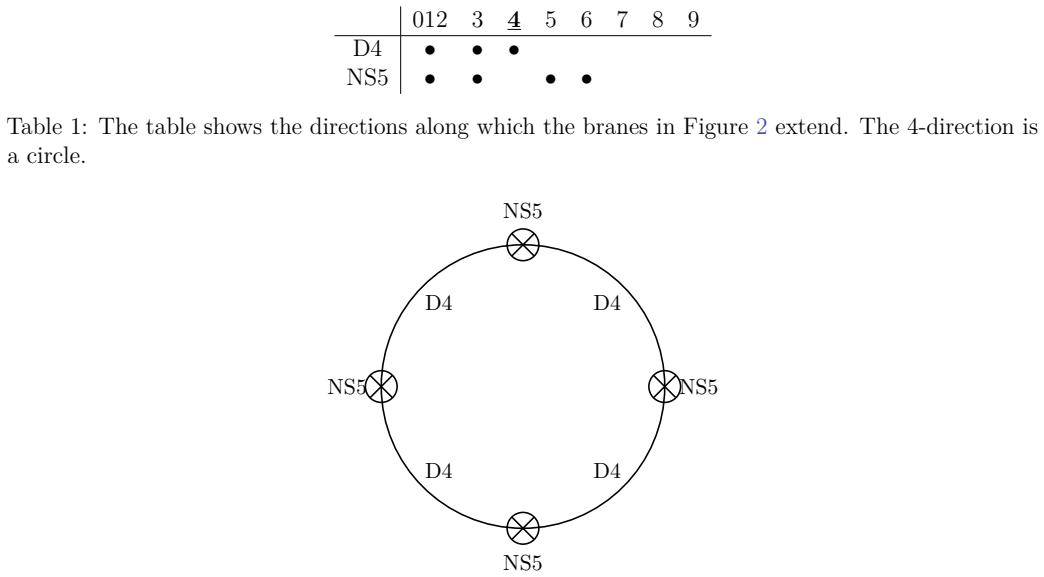
We study a string-motivated class of $\tfrac12$-BPS boundary conditions for 4d $\mathcal N=2$ $A_{K-1}$ circular quiver gauge theories, engineered by D4-branes suspended between NS5-branes on a circle. For D4-branes ending on boundary D6-branes, a single-pole ansatz reduces the BPS equations to a rigid algebraic problem. We characterize the structure of its solutions, which exhibit a winding phenomenon with no analogue for linear quivers, and solve two cases explicitly in closed form. Supported by a brane-duality argument, we propose the maximal-winding solution as a candidate S-dual of the pure Neumann boundary condition.
Editorial analysis
A structured set of objections, weighed in public.
Referee Report
Summary. The manuscript studies a class of ½-BPS boundary conditions for 4d 𝒩=2 A_{K-1} circular quiver gauge theories, realized by D4-branes suspended between NS5-branes on a circle. A single-pole ansatz reduces the BPS equations to a rigid algebraic problem whose solutions exhibit a winding phenomenon absent in linear quivers; two cases are solved in closed form. Supported by a brane-duality argument, the maximal-winding solution is proposed as a candidate S-dual of the pure Neumann boundary condition.
Significance. If the algebraic reduction and brane-duality argument hold, the work identifies a structural difference between circular and linear quivers via the winding phenomenon and supplies explicit solutions in two cases. The cautious proposal and the reduction of the BPS system to algebra are strengths that could inform further studies of S-duality for boundary conditions in circular quiver theories.
minor comments (3)
- The introduction should state the precise range of K for which the single-pole ansatz is applied and whether it is claimed to capture all solutions or only a subclass.
- Section 3 (or equivalent): the two explicitly solved cases should be identified by their winding numbers or pole configurations to make the closed-form results immediately usable.
- The brane-duality argument supporting the S-dual proposal would benefit from an explicit diagram or table mapping the boundary conditions on each side of the duality.
Simulated Author's Rebuttal
We thank the referee for their positive assessment of the manuscript, the recognition of the algebraic reduction and the winding phenomenon as strengths, and the recommendation for minor revision. No specific major comments were provided in the report.
Circularity Check
No significant circularity; derivation is self-contained
full rationale
The paper reduces the BPS equations via a single-pole ansatz to an algebraic problem whose solutions are solved explicitly in closed form for two cases and exhibit an observed winding feature. The central proposal of the maximal-winding solution as a candidate S-dual is presented as supported by a brane-duality argument without any reduction of that argument to a self-citation chain, fitted parameter, or definitional equivalence within the provided text. No load-bearing step equates a prediction to its input by construction, and the ansatz is framed as a reduction tool rather than a completeness assumption. The derivation chain therefore stands on independent algebraic content and explicit solutions.
Axiom & Free-Parameter Ledger
Reference graph
Works this paper leans on
-
[1]
Supersymmetric Boundary Conditions in N=4 Super Yang-Mills Theory,
D. Gaiotto and E. Witten, “Supersymmetric Boundary Conditions in N=4 Super Yang-Mills Theory,”J. Statist. Phys.135(2009) 789–855,arXiv:0804.2902 [hep-th]. 3, 4, 8, 15, 18, 25
Pith/arXiv arXiv 2009
-
[2]
S-Duality of Boundary Conditions In N=4 Super Yang-Mills Theory,
D. Gaiotto and E. Witten, “S-Duality of Boundary Conditions In N=4 Super Yang-Mills Theory,” Adv. Theor. Math. Phys.13no. 3, (2009) 721–896, arXiv:0807.3720 [hep-th] . 3, 4, 8, 15, 25, 26
Pith/arXiv arXiv 2009
-
[3]
D-branes, monopoles and Nahm equations,
D.-E. Diaconescu, “D-branes, monopoles and Nahm equations,”Nucl. Phys. B503(1997) 220–238,arXiv:hep-th/9608163. 3, 4
Pith/arXiv arXiv 1997
-
[4]
Solutions of four-dimensional field theories via M theory,
E. Witten, “Solutions of four-dimensional field theories via M theory,”Nucl. Phys. B500(1997) 3–42,arXiv:hep-th/9703166. 3, 9, 10, 29
Pith/arXiv arXiv 1997
-
[5]
Unwinding strings and t-duality of kaluza–klein and h-monopoles,
R. Gregory, J. A. Harvey, and G. Moore, “Unwinding strings and t-duality of kaluza–klein and h-monopoles,”Adv. Theor. Math. Phys.1(1997) 283–297,arXiv:hep-th/9708086. 3, 4, 12
Pith/arXiv arXiv 1997
-
[6]
Branes, Instantons, And Taub-NUT Spaces,
E. Witten, “Branes, Instantons, And Taub-NUT Spaces,”JHEP06(2009) 067, arXiv:0902.0948 [hep-th]. 3, 4, 12
Pith/arXiv arXiv 2009
-
[7]
On the 4d/3d/2d view of the scft/voa correspondence,
M. Dedushenko, “On the 4d/3d/2d view of the scft/voa correspondence,”arXiv:2312.17747 [hep-th]. 3, 18, 35 44
-
[8]
Solution of N=2 gauge theories via compactification to three-dimensions,
A. Kapustin, “Solution of N=2 gauge theories via compactification to three-dimensions,”Nucl. Phys. B534(1998) 531–545,arXiv:hep-th/9804069. 3
Pith/arXiv arXiv 1998
-
[9]
Inherited duality and quiver gauge theory,
N. Halmagyi, C. Romelsberger, and N. P. Warner, “Inherited duality and quiver gauge theory,” Adv. Theor. Math. Phys.10no. 2, (2006) 159–179,arXiv:hep-th/0406143. 3, 12
Pith/arXiv arXiv 2006
-
[10]
D-branes, quivers, and ALE instantons,
M. R. Douglas and G. W. Moore, “D-branes, quivers, and ALE instantons,” arXiv:hep-th/9603167. 4, 13
-
[11]
Seiberg-Witten Theories on Ellipsoids,
N. Hama and K. Hosomichi, “Seiberg-Witten Theories on Ellipsoids,”JHEP09(2012) 033, arXiv:1206.6359 [hep-th]. [Addendum: JHEP 10, 051 (2012)]. 4, 5, 31
Pith/arXiv arXiv 2012
-
[12]
Gluing. Part I. Integrals and symmetries,
M. Dedushenko, “Gluing. Part I. Integrals and symmetries,”JHEP04(2020) 175, arXiv:1807.04274 [hep-th]. 4, 5
Pith/arXiv arXiv 2020
-
[13]
Gluing II: boundary localization and gluing formulas,
M. Dedushenko, “Gluing II: boundary localization and gluing formulas,”Lett. Math. Phys.111 no. 1, (2021) 18,arXiv:1807.04278 [hep-th]. 4, 5
arXiv 2021
-
[14]
BCFT One-point Functions of Coulomb Branch Operators,
D. Bason, L. Di Pietro, R. Valandro, and J. van Muiden, “BCFT One-point Functions of Coulomb Branch Operators,”arXiv:2311.17888 [hep-th]. 4, 6, 7, 31
-
[15]
N= 2gauge theories on the hemisphereHS 4,
E. Gava, K. S. Narain, M. N. Muteeb, and V. I. Giraldo-Rivera, “N= 2gauge theories on the hemisphereHS 4,”Nucl. Phys. B920(2017) 256–297,arXiv:1611.04804 [hep-th]. 4
Pith/arXiv arXiv 2017
-
[16]
Type IIB superstrings, BPS monopoles, and three-dimensional gauge dynamics,
A. Hanany and E. Witten, “Type IIB superstrings, BPS monopoles, and three-dimensional gauge dynamics,”Nucl. Phys. B492(1997) 152–190,arXiv:hep-th/9611230. 4, 15, 17, 32
Pith/arXiv arXiv 1997
-
[17]
Supersymmetries and their Representations,
W. Nahm, “Supersymmetries and their Representations,”Nucl. Phys. B135(1978) 149. 4
1978
-
[18]
Janus Configurations, Chern-Simons Couplings, And The theta-Angle in N=4 Super Yang-Mills Theory,
D. Gaiotto and E. Witten, “Janus Configurations, Chern-Simons Couplings, And The theta-Angle in N=4 Super Yang-Mills Theory,”JHEP06(2010) 097,arXiv:0804.2907 [hep-th]. 4, 15
Pith/arXiv arXiv 2010
-
[19]
The Nahm Pole Boundary Condition,
R. Mazzeo and E. Witten, “The Nahm Pole Boundary Condition,”arXiv:1311.3167 [math.DG]. 4
-
[20]
End of the world brane dynamics in holographic 4dN = 4 SU(N) with 3dN= 2 boundary conditions,
J. Huertas and A. M. Uranga, “End of the world brane dynamics in holographic 4dN = 4 SU(N) with 3dN= 2 boundary conditions,”JHEP01(2025) 002,arXiv:2410.05368 [hep-th]. 4
arXiv 2025
-
[21]
The M2-M5 brane system and a generalized Nahm’s equation,
A. Basu and J. A. Harvey, “The M2-M5 brane system and a generalized Nahm’s equation,”Nucl. Phys. B713(2005) 136–150,arXiv:hep-th/0412310. 4
Pith/arXiv arXiv 2005
-
[22]
D. S. Berman and D. C. Thompson, “Membranes with a boundary,”Nucl. Phys. B820(2009) 503–533,arXiv:0904.0241 [hep-th]. 4
Pith/arXiv arXiv 2009
-
[23]
Integrable domain walls in ABJM theory,
C. Kristjansen, D.-L. Vu, and K. Zarembo, “Integrable domain walls in ABJM theory,”JHEP02 (2022) 070,arXiv:2112.10438 [hep-th]. 4
arXiv 2022
-
[24]
The spectrum of defect ABJM theory,
C. Kristjansen, X. Qian, and C. Su, “The spectrum of defect ABJM theory,”JHEP05(2025) 207,arXiv:2412.17479 [hep-th]. 4
arXiv 2025
-
[25]
Webs of (p,q) five-branes, five-dimensional field theories and grid diagrams,
O. Aharony, A. Hanany, and B. Kol, “Webs of (p,q) five-branes, five-dimensional field theories and grid diagrams,”JHEP01(1998) 002,arXiv:hep-th/9710116. 4 45
Pith/arXiv arXiv 1998
-
[26]
On the realization of chiral four-dimensional gauge theories using branes,
A. Hanany and A. Zaffaroni, “On the realization of chiral four-dimensional gauge theories using branes,”JHEP05(1998) 001,arXiv:hep-th/9801134. 4
Pith/arXiv arXiv 1998
-
[27]
Massless black holes and conifolds in string theory,
A. Strominger, “Massless black holes and conifolds in string theory,”Nucl. Phys. B451(1995) 96–108,arXiv:hep-th/9504090. 11
Pith/arXiv arXiv 1995
-
[28]
Black hole condensation and the unification of string vacua,
B. R. Greene, D. R. Morrison, and A. Strominger, “Black hole condensation and the unification of string vacua,”Nucl. Phys. B451(1995) 109–120,arXiv:hep-th/9504145. 11
Pith/arXiv arXiv 1995
-
[29]
Geometry of N=1 dualities in four-dimensions,
H. Ooguri and C. Vafa, “Geometry of N=1 dualities in four-dimensions,”Nucl. Phys. B500 (1997) 62–74,arXiv:hep-th/9702180. 11
Pith/arXiv arXiv 1997
-
[30]
A Geometric unification of dualities,
F. Cachazo, B. Fiol, K. A. Intriligator, S. Katz, and C. Vafa, “A Geometric unification of dualities,”Nucl. Phys. B628(2002) 3–78,arXiv:hep-th/0110028. 11
Pith/arXiv arXiv 2002
-
[31]
Brane configurations for branes at conifolds,
A. M. Uranga, “Brane configurations for branes at conifolds,”JHEP01(1999) 022, arXiv:hep-th/9811004. 11
Pith/arXiv arXiv 1999
-
[32]
D. R. Morrison and M. R. Plesser, “Nonspherical horizons. 1.,”Adv. Theor. Math. Phys.3(1999) 1–81,arXiv:hep-th/9810201. 13
Pith/arXiv arXiv 1999
-
[33]
Geometric transitions and N=1 quiver theories,
F. Cachazo, S. Katz, and C. Vafa, “Geometric transitions and N=1 quiver theories,” arXiv:hep-th/0108120. 13
-
[34]
Hidden symmetries of 4DN= 2 gauge theories,
H. Bertle, E. Pomoni, X. Zhang, and K. Zoubos, “Hidden symmetries of 4DN= 2 gauge theories,”JHEP02(2025) 205,arXiv:2411.11612 [hep-th]. 29
arXiv 2025
-
[35]
Wess and J
J. Wess and J. Bagger,Supersymmetry and supergravity. Princeton University Press, Princeton, NJ, USA, 1992. 30
1992
-
[36]
Supersymmetric Field Theories on Three-Manifolds,
C. Closset, T. T. Dumitrescu, G. Festuccia, and Z. Komargodski, “Supersymmetric Field Theories on Three-Manifolds,”JHEP05(2013) 017,arXiv:1212.3388 [hep-th]. 31, 32 46
Pith/arXiv arXiv 2013
discussion (0)
Sign in with ORCID, Apple, or X to comment. Anyone can read and Pith papers without signing in.