AlgoTouch: An Execution-Centered Approach to Incremental Construction of Imperative Programs
Pith reviewed 2026-06-28 09:09 UTC · model grok-4.3
The pith
AlgoTouch builds imperative programs by executing data transformations and deriving control structures from the observed behavior.
A machine-rendered reading of the paper's core claim, the machinery that carries it, and where it could break.
Core claim
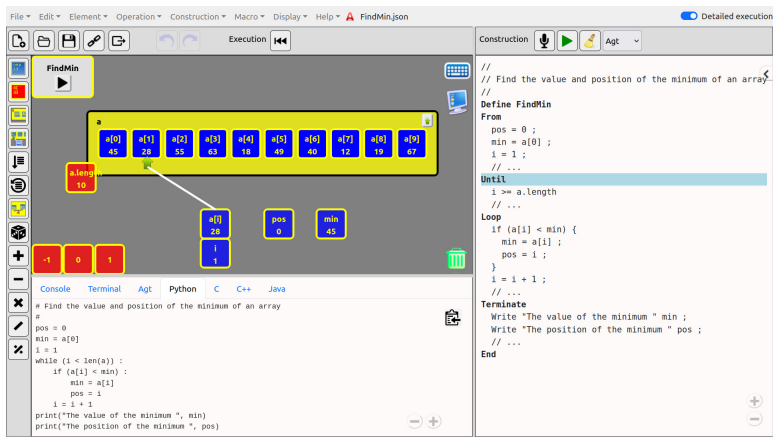
AlgoTouch relies on an explicit notional machine that exposes data storage, computation, and control flow so that execution traces can be mapped deterministically to program structure. Conditional statements are synthesized from observed comparisons, while iterative behaviors are encapsulated in loop macros that support non-linear and incremental construction. Partial and incomplete programs can therefore be executed and refined without loss of semantic consistency. The system then produces correct and readable programs in several mainstream imperative languages, with engineering validation on algorithmic benchmarks confirming correctness, expressiveness, robustness, and language independenc
What carries the argument
Deterministic synthesis of control structures from execution behavior, where comparisons produce conditionals and iterative patterns produce loop macros, all aligned through an explicit notional machine that keeps observed traces and program structure in continuous correspondence.
If this is right
- Partial programs remain executable and can be completed while preserving semantic consistency.
- Correct, readable code is generated automatically for Python, C, C++, and Java.
- Loop macros enable non-linear and incremental construction of iterative behavior.
- Validation on a representative set of algorithmic benchmarks confirms correctness and language independence.
Where Pith is reading between the lines
- Programmers could shift attention from syntax details to intended data transformations during early construction stages.
- The same execution-centered recording might shorten the feedback loop between testing and editing in conventional development environments.
- If the notional machine is extended to additional control-flow patterns, the approach could cover a wider range of imperative algorithms.
- Educational use might let learners discover required control structures by experimenting with data changes rather than by writing code first.
Load-bearing premise
An explicit notional machine can be defined that makes every relevant detail of data storage, computation, and control flow visible, so that any execution trace maps uniquely to the correct control structures.
What would settle it
An algorithmic benchmark in which the observed execution traces admit more than one valid set of control structures or in which the generated code fails to match the intended input-output behavior.
Figures
read the original abstract
Program construction in imperative languages remains largely based on writing textual code that specifies sequences of instructions operating on program data. This approach requires developers to anticipate the effects of instructions on evolving data states, which increases cognitive load and the likelihood of errors during early and incremental development. This paper presents AlgoTouch, an execution-based system for incremental construction of imperative programs through direct manipulation of program data. Rather than assembling syntactic structures, programs are constructed by executing concrete data transformations that are recorded and incorporated into an internal intermediate representation. AlgoTouch relies on an explicit notional machine that exposes data storage, computation, and control flow, enabling continuous alignment between observed execution and program structure. A central contribution of the system lies in its deterministic synthesis of control structures from execution behavior. Conditional statements are derived from observed comparisons, while iterative behaviors are encapsulated in loop macros that support non-linear and incremental construction. This design enables partial and incomplete programs to be executed, refined, and completed while preserving semantic consistency. AlgoTouch automatically generates correct and readable programs in several mainstream imperative languages, including Python, C, C++, and Java. The system is evaluated through engineering-level validation on a representative set of algorithmic benchmarks, demonstrating correctness, expressiveness, robustness, and language independence. By integrating execution, construction, and code generation within a unified architecture, this work introduces an alternative model for interactive program construction and contributes a new class of execution-centered development systems.
Editorial analysis
A structured set of objections, weighed in public.
Referee Report
Summary. The manuscript presents AlgoTouch, an execution-centered system for incremental construction of imperative programs. Instead of writing textual code, developers manipulate concrete data transformations that are recorded into an internal representation. The system relies on an explicit notional machine exposing data storage, computation, and control flow to enable deterministic synthesis of control structures: conditionals are derived from observed comparisons, and iterative behaviors are captured via loop macros. This supports execution and refinement of partial programs while preserving semantics, followed by automatic generation of correct, readable code in Python, C, C++, and Java. Claims of correctness, expressiveness, robustness, and language independence rest on an engineering-level validation over a representative set of algorithmic benchmarks.
Significance. If the notional machine and deterministic synthesis hold, the work offers a substantive alternative model for interactive program construction that could reduce cognitive load during early development and support multi-language code generation. The unified architecture integrating execution traces, partial-program execution, and code synthesis is a clear strength and introduces a distinct class of execution-centered tools. The approach is particularly relevant to software engineering and programming education if the benchmark validation can be made reproducible and quantitative.
major comments (1)
- [Evaluation] Evaluation section: the abstract asserts that the system was evaluated on algorithmic benchmarks demonstrating correctness, expressiveness, robustness, and language independence, yet supplies no benchmark list, no description of the synthesis algorithm or notional machine, no failure cases, no quantitative metrics, and no exclusion criteria. Without these elements the central claim of deterministic, ambiguity-free mapping from execution traces to control structures cannot be assessed.
Simulated Author's Rebuttal
We thank the referee for the positive overall assessment of AlgoTouch and for the detailed feedback on the evaluation. We address the single major comment below and will revise the manuscript accordingly.
read point-by-point responses
-
Referee: [Evaluation] Evaluation section: the abstract asserts that the system was evaluated on algorithmic benchmarks demonstrating correctness, expressiveness, robustness, and language independence, yet supplies no benchmark list, no description of the synthesis algorithm or notional machine, no failure cases, no quantitative metrics, and no exclusion criteria. Without these elements the central claim of deterministic, ambiguity-free mapping from execution traces to control structures cannot be assessed.
Authors: We agree that the current Evaluation section is insufficiently detailed to allow independent assessment of the deterministic synthesis claim. In the revised version we will expand this section to provide: an enumerated list of all algorithmic benchmarks; a precise description of the synthesis algorithm and notional machine (including how comparisons and loop macros are derived); any encountered failure cases or edge conditions; quantitative metrics (e.g., success rate, number of manual interventions required); and explicit exclusion criteria. These additions will directly support evaluation of the mapping from execution traces to control structures. revision: yes
Circularity Check
No circularity; claims rest on architectural description without self-referential derivations
full rationale
The paper presents AlgoTouch as an execution-centered system relying on an explicit notional machine to map traces to control structures. No equations, fitted parameters, or predictions appear. No self-citations are invoked as load-bearing uniqueness theorems. The deterministic synthesis claim is presented as a design property of the architecture rather than derived from prior results or inputs by construction. Evaluation is described at a high level as engineering validation on benchmarks, with no reduction of results to the inputs themselves. This is a standard non-circular systems description.
Axiom & Free-Parameter Ledger
axioms (1)
- domain assumption An explicit notional machine can expose data storage, computation, and control flow in sufficient detail to support deterministic synthesis of conditionals and loops from execution traces.
invented entities (1)
-
Loop macros
no independent evidence
Reference graph
Works this paper leans on
-
[1]
Direct manipulation versus text-based programming: An experiment report
Michel Adam, Moncef Daoud, and Patrice Frison. Direct manipulation versus text-based programming: An experiment report. In Proceedings of the 2019 ACM Conference on Innovation and Technology in Computer Science Education, ITiCSE '19, pages 353--359, New York, NY, USA, 2019. Association for Computing Machinery. ISBN 9781450368957. doi:10.1145/3304221.33197...
-
[2]
Frederick P. Brooks. No silver bullet---essence and accidents of software engineering. Computer, 20 0 (4): 0 10--19, 1987. doi:10.1109/MC.1987.1663532
-
[3]
Programmatic and direct manipulation, together at last
Ravi Chugh, Brian Hempel, Mitchell Spradlin, and Jacob Albers. Programmatic and direct manipulation, together at last. ACM SIGPLAN Notices, 51 0 (6): 0 341--354, 2016
2016
-
[4]
Program synthesis
Sumit Gulwani, Oleksandr Polozov, and Rishabh Singh. Program synthesis. Foundations and Trends in Programming Languages, 4 0 (1--2): 0 1--119, 2017
2017
-
[5]
Philip J. Guo. Online python tutor: embeddable web-based program visualization for cs education. In Proceeding of the 44th ACM Technical Symposium on Computer Science Education, SIGCSE '13, pages 579--584, New York, NY, USA, 2013. Association for Computing Machinery. ISBN 9781450318686. doi:10.1145/2445196.2445368. URL https://doi.org/10.1145/2445196.2445368
-
[6]
Programming by Example
Daniel Halbert. Programming by Example. PhD thesis, University of California, Berkeley, 12 1984
1984
-
[7]
Sketching, manipulating, and synthesizing programs through direct data manipulation
Brian Hempel and Ravi Chugh. Sketching, manipulating, and synthesizing programs through direct data manipulation. In Proceedings of the 2019 ACM SIGPLAN International Symposium on New Ideas, New Paradigms, and Reflections on Programming and Software (Onward! '19), pages 25--40, Athens, Greece, 2019. ACM. doi:10.1145/3358507.3358523
-
[8]
Maniposynth: Bimodal tangible functional programming
Brian Hempel and Ravi Chugh. Maniposynth: Bimodal tangible functional programming. arXiv preprint, 2022
2022
-
[9]
Can direct manipulation lower the barriers to computer programming and promote transfer of training? an experimental study
Christopher D Hundhausen, Sean F Farley, and Jonathan L Brown. Can direct manipulation lower the barriers to computer programming and promote transfer of training? an experimental study. ACM Transactions on Computer-Human Interaction (TOCHI), 16 0 (3): 0 1--40, 2009
2009
-
[10]
Computational making with twoville
Chris Johnson. Computational making with twoville. Journal of Computing Sciences in Colleges, 38 0 (8): 0 39--53, 2023
2023
-
[11]
InProceedings of the International Conference on Software Engineering (ICSE)
Andrew J. Ko, Brad A. Myers, Michael J. Coblenz, and Htet Htet Aung. An exploratory study of how developers seek, relate, and collect relevant information during software maintenance tasks. IEEE Transactions on Software Engineering, 32 0 (12): 0 971--987, 2006. doi:10.1109/TSE.2006.116
-
[12]
The eiffel programming language
Bertrand Meyer. The eiffel programming language. Available online, 1992. URL http://www.eiffel.com
1992
-
[13]
Glenford J. Myers. The Art of Software Testing. Wiley, 1979. ISBN 9780471043287
1979
-
[14]
David L. Parnas. On the criteria to be used in decomposing systems into modules. Communications of the ACM, 15 0 (12): 0 1053--1058, 1972. doi:10.1145/361598.361623
-
[15]
A direct manipulation language for explaining algorithms
Jeremy Scott, Philip J Guo, and Randall Davis. A direct manipulation language for explaining algorithms. In 2014 IEEE Symposium on Visual Languages and Human-Centric Computing (VL/HCC), pages 45--48, Melbourne, Australia, 2014. IEEE, IEEE
2014
-
[16]
Pygmalion: a creative programming environment
David Canfield Smith. Pygmalion: a creative programming environment. PhD thesis, Stanford University, Stanford, CA, USA, 1975
1975
-
[17]
Program synthesis by sketching
Armando Solar-Lezama. Program synthesis by sketching. In Proceedings of the 28th ACM SIGPLAN Conference on Programming Language Design and Implementation, PLDI '08, pages 281--294. ACM, 2008
2008
-
[18]
Software Engineering
Ian Sommerville. Software Engineering. Pearson, 10 edition, 2016. ISBN 9780133943030
2016
-
[19]
GNU Emacs manual, volume 675
Richard Stallman and Howard Gayle. GNU Emacs manual, volume 675. Free Software Foundation, Cambridge, MA, USA, 1993
1993
-
[20]
Comparing cognitive load among undergraduate students programming in python and the visual language algot
Sverrir Thorgeirsson, Theo B Weidmann, Karl-Heinz Weidmann, and Zhendong Su. Comparing cognitive load among undergraduate students programming in python and the visual language algot. In Proceedings of the 55th ACM Technical Symposium on Computer Science Education V. 1, pages 1328--1334, Portland, OR, USA, 2024. ACM
2024
-
[21]
Learnable programming
Bret Victor. Learnable programming. Online essay, 2012. http://worrydream.com/LearnableProgramming/
2012
-
[22]
Why Programs Fail: A Guide to Systematic Debugging
Andreas Zeller. Why Programs Fail: A Guide to Systematic Debugging. Morgan Kaufmann, 2 edition, 2009. ISBN 9780123745156
2009
discussion (0)
Sign in with ORCID, Apple, or X to comment. Anyone can read and Pith papers without signing in.