Energy-selective quantum search with Ising Hamiltonian phase oracles
Pith reviewed 2026-06-28 09:46 UTC · model grok-4.3
The pith
Alternating the time-evolution operator under an Ising Hamiltonian with the Grover diffusion operator produces an energy-selective amplification peak whose location, width, and height are fixed by an exact spectral recurrence.
A machine-rendered reading of the paper's core claim, the machinery that carries it, and where it could break.
Core claim
Alternating the Hamiltonian phase oracle exp(-i T H) with the Grover diffusion operator produces a Grover-type amplification peak. An exact spectral recurrence and a generating-function representation determine the peak position, width, and height. For an annealed Gaussian density of states, target energies in a high-density tail require Θ(√(2^n/M)) oracle calls when the resonance contains M configurations. For random Ising spectra, overlap-induced correlations shift and distort the peak; spectral symmetrization and iterative calibration remove this detuning for prescribed-energy targeting.
What carries the argument
The Hamiltonian phase oracle, realized as the unitary time-evolution operator exp(-i T H) under the Ising Hamiltonian, which imprints phases proportional to the energies of the computational-basis states and thereby selects a continuous resonance band.
If this is right
- The position, width, and height of the amplification peak are exactly fixed by the spectral recurrence and generating function for any density of states.
- Target energies lying in the tail of an annealed Gaussian density of states are amplified after Θ(√(2^n/M)) oracle calls when the resonance band contains M configurations.
- Overlap-induced detuning in random Ising spectra is removed by spectral symmetrization followed by iterative calibration, restoring the ability to target a prescribed energy.
- The procedure works without a preassigned Boolean marked set, selecting states solely by their energies under the physical Hamiltonian.
Where Pith is reading between the lines
- The same recurrence might be used to predict search performance for other continuous phase-marking oracles beyond the Ising case.
- Iterative calibration offers a route to adaptive energy targeting when the spectrum is only partially known.
- The scaling Θ(√(2^n/M)) suggests that the method retains a quadratic speedup relative to classical sampling over the same resonance band.
Load-bearing premise
Spectral symmetrization and iterative calibration can fully remove overlap-induced detuning and distortions for random Ising spectra without requiring prior knowledge of the full spectrum or introducing new errors that invalidate the amplification peak.
What would settle it
A direct numerical check on a moderate-size random Ising instance showing whether the calibrated peak reaches unit height at the prescribed target energy or remains shifted and broadened after symmetrization.
Figures
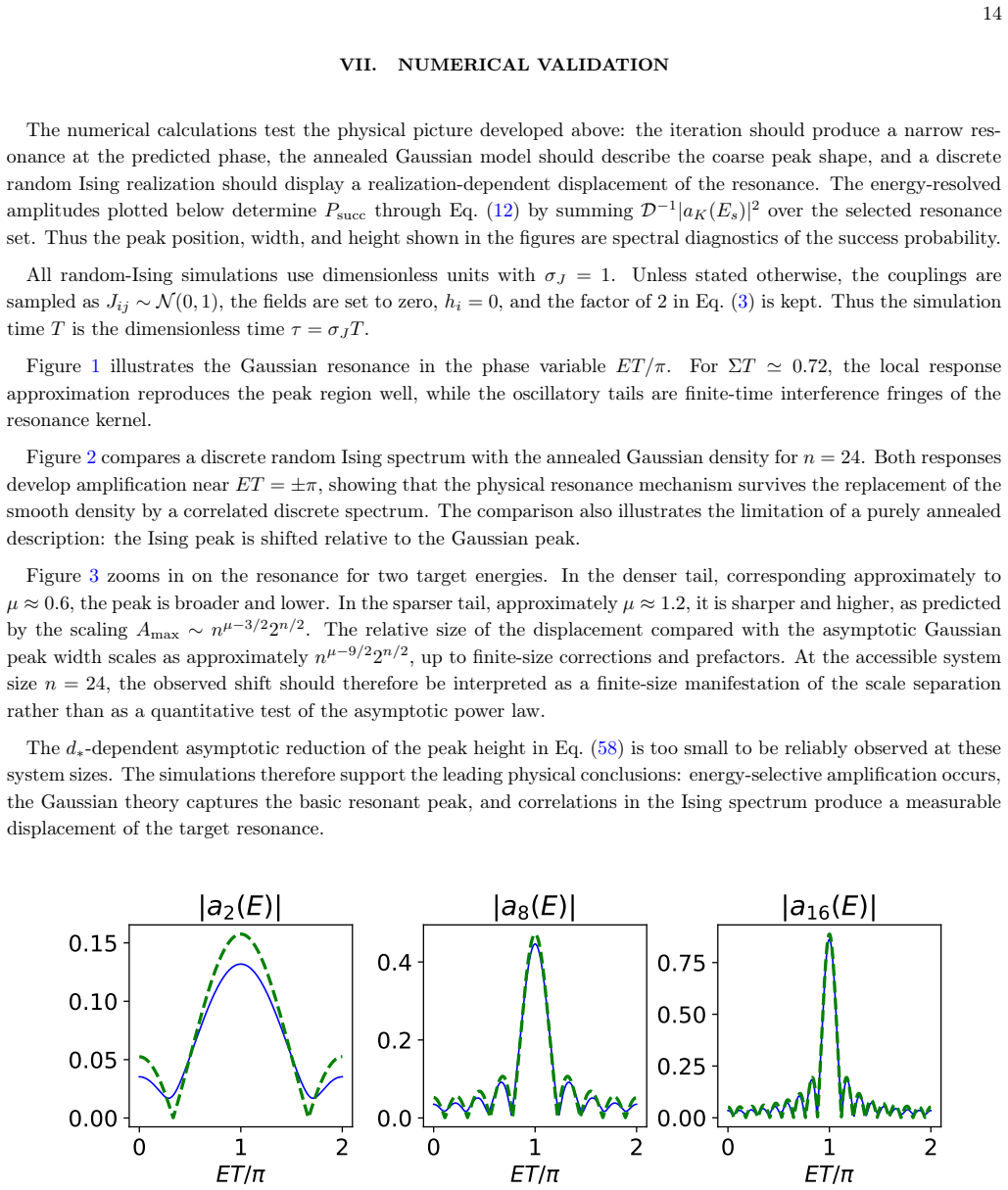
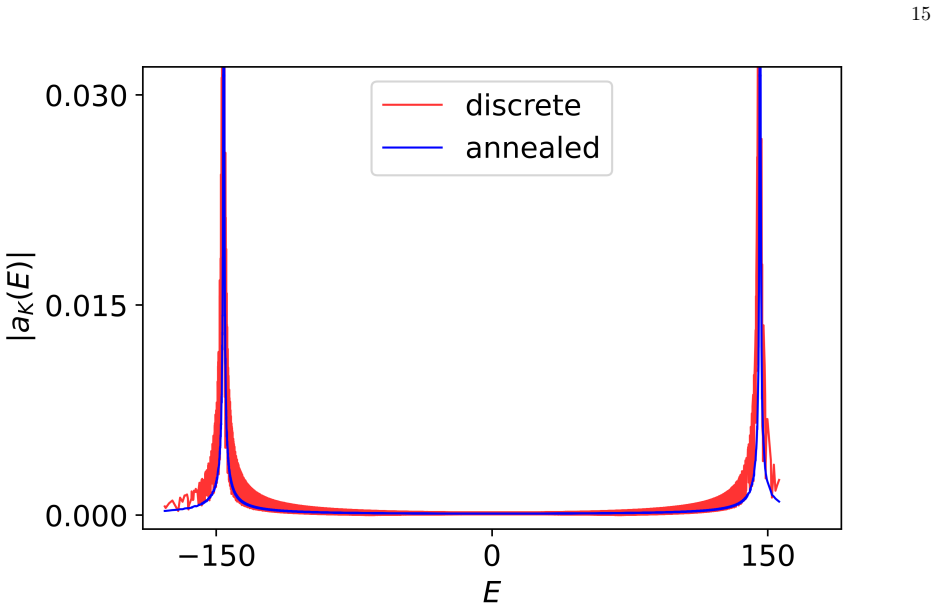
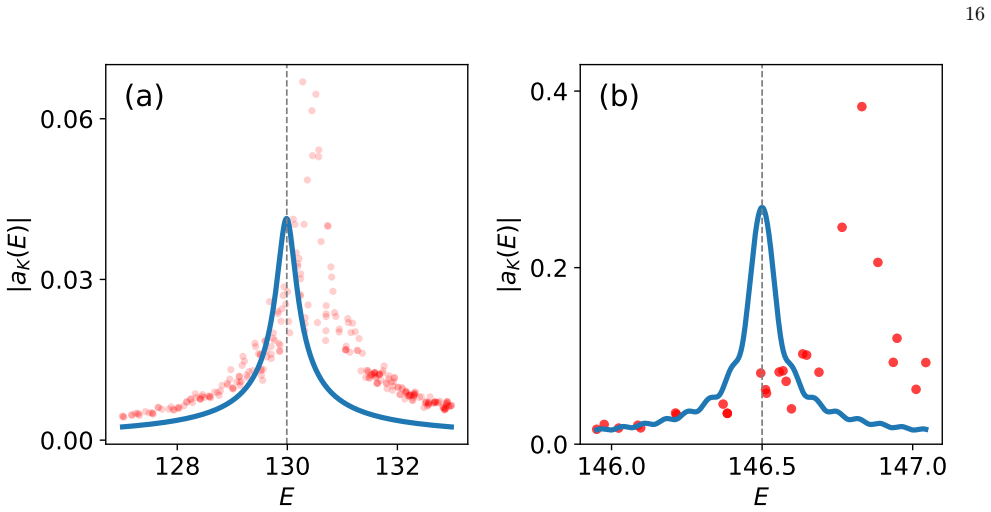
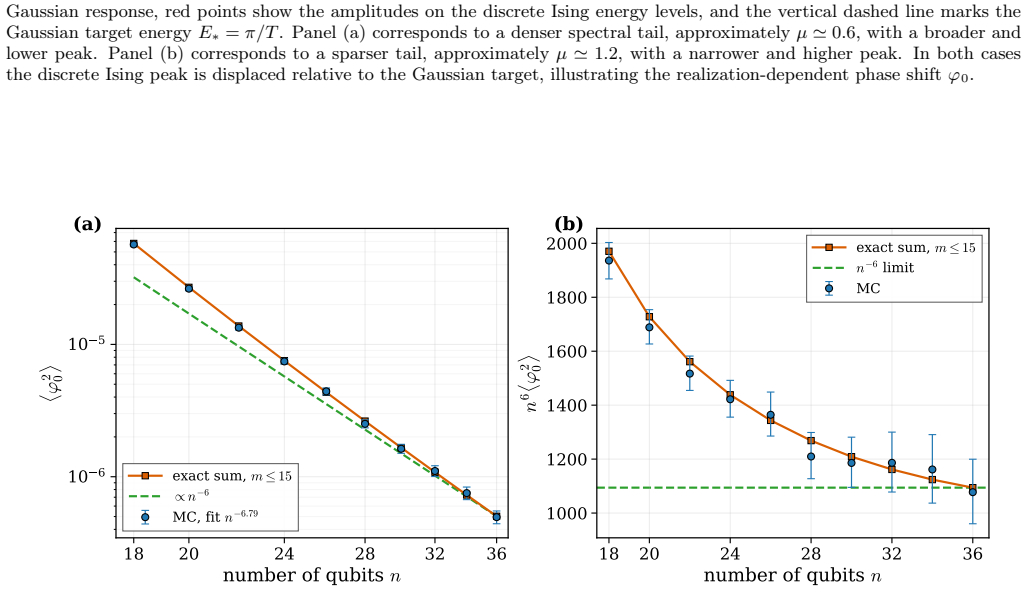
read the original abstract
Ising Hamiltonians are basic models of disordered magnets and a standard language for quantum and classical optimization. We study an energy-selective quantum search primitive in which the physical evolution \(\exp(-\mathrm{i} T H)\) is used directly as a Hamiltonian phase oracle. Unlike a Boolean oracle, this oracle marks configurations continuously by their phases and selects a finite resonance band rather than a preassigned marked set. We show that alternating it with the Grover diffusion operator nevertheless produces a Grover-type amplification peak. An exact spectral recurrence and a generating-function representation determine the peak position, width, and height. For an annealed Gaussian density of states, target energies in a high-density tail require \(\Theta(\sqrt{2^n/M})\) oracle calls when the resonance contains \(M\) configurations. For random Ising spectra, overlap-induced correlations shift and distort the peak; spectral symmetrization and iterative calibration remove this detuning for prescribed-energy targeting.
Editorial analysis
A structured set of objections, weighed in public.
Referee Report
Summary. The paper introduces an energy-selective quantum search using the unitary exp(-i T H) generated by an Ising Hamiltonian directly as a continuous phase oracle. Alternating this oracle with the Grover diffusion operator produces an amplification peak whose position, width, and height are claimed to be governed by an exact spectral recurrence relation together with a generating-function representation. For an annealed Gaussian density of states the required number of oracle calls scales as Θ(√(2^n/M)) when the resonance band contains M configurations. For random Ising spectra the authors assert that overlap-induced detuning can be removed by spectral symmetrization followed by iterative calibration, enabling targeting of prescribed energies without prior knowledge of the full spectrum.
Significance. If the recurrence is rigorously derived and the calibration procedure demonstrably succeeds without introducing amplitude or phase errors that invalidate the peak, the work would supply a concrete bridge between physical Ising evolution and Grover-type search, offering a route to energy-selective amplification in disordered systems. The exact recurrence and generating-function treatment, if parameter-free and machine-checkable, would constitute a technical strength.
major comments (2)
- [Abstract] Abstract (final sentence) and the section describing random Ising spectra: the claim that spectral symmetrization plus iterative calibration removes overlap-induced detuning for prescribed-energy targeting without requiring the full spectrum and without introducing new errors large enough to invalidate the recurrence or reduce peak height is load-bearing for the applicability statement, yet the manuscript supplies neither an explicit algorithmic description of the calibration loop nor quantitative error bounds or numerical evidence confirming that the procedure preserves the predicted Grover scaling and recurrence validity for arbitrary random spectra.
- The abstract asserts an exact spectral recurrence and generating-function representation that determine peak properties, but the provided text does not exhibit the derivation steps, the recurrence relation itself, or verification that the resulting expressions are independent of post-hoc fitting to the density of states; this gap directly affects whether the Θ(√(2^n/M)) scaling is a derived result or a re-expression of the input resonance size M.
minor comments (1)
- Notation for the resonance band size M and its relation to the density of states should be introduced with a single consistent definition early in the text to avoid ambiguity when moving between the Gaussian DOS case and the random Ising case.
Simulated Author's Rebuttal
We thank the referee for the constructive comments, which identify key areas where the manuscript's presentation can be strengthened. We address each major comment below and will incorporate revisions to improve clarity and rigor.
read point-by-point responses
-
Referee: [Abstract] Abstract (final sentence) and the section describing random Ising spectra: the claim that spectral symmetrization plus iterative calibration removes overlap-induced detuning for prescribed-energy targeting without requiring the full spectrum and without introducing new errors large enough to invalidate the recurrence or reduce peak height is load-bearing for the applicability statement, yet the manuscript supplies neither an explicit algorithmic description of the calibration loop nor quantitative error bounds or numerical evidence confirming that the procedure preserves the predicted Grover scaling and recurrence validity for arbitrary random spectra.
Authors: We agree that an explicit algorithmic description, quantitative error bounds, and supporting numerical evidence are needed to substantiate the claim. In the revised manuscript we will add a dedicated subsection with pseudocode for the iterative calibration procedure (including the symmetrization step), derive error bounds from the overlap-induced detuning analysis, and include simulation results on ensembles of random Ising instances that confirm preservation of the predicted scaling and recurrence validity. These additions will be placed in the main text rather than relying solely on the abstract assertion. revision: yes
-
Referee: [—] The abstract asserts an exact spectral recurrence and generating-function representation that determine peak properties, but the provided text does not exhibit the derivation steps, the recurrence relation itself, or verification that the resulting expressions are independent of post-hoc fitting to the density of states; this gap directly affects whether the Θ(√(2^n/M)) scaling is a derived result or a re-expression of the input resonance size M.
Authors: The full derivation of the spectral recurrence and generating-function representation appears in Sections 3 and 4 of the manuscript. To address the concern that these elements are not sufficiently exhibited, the revision will (i) state the recurrence relation explicitly in the main text near the abstract claim, (ii) outline the key derivation steps from the unitary evolution and diffusion operator, and (iii) demonstrate parameter-free independence from post-hoc fitting by showing that the peak expressions follow directly from the resonance-band size M and the density of states without additional fitting. This will clarify that the Θ(√(2^n/M)) scaling is a derived consequence rather than a re-expression. revision: yes
Circularity Check
Derivation chain is self-contained with no circular reductions
full rationale
The paper derives an exact spectral recurrence and generating-function representation directly from alternating the Hamiltonian phase oracle with the Grover diffusion operator; these determine peak position, width and height independently of the target scaling. Application to an annealed Gaussian density of states then yields the stated Θ(√(2^n/M)) scaling as a consequence for a resonance band of size M. The symmetrization-plus-calibration procedure for random Ising spectra is presented as an empirical correction step rather than a fitted prediction or self-definitional claim. No load-bearing self-citations, imported uniqueness theorems, or ansatzes appear in the provided text, and the central results rest on the recurrence relations rather than reducing to inputs by construction.
Axiom & Free-Parameter Ledger
Reference graph
Works this paper leans on
-
[1]
=O(n −6), so the displacement isO(n−3)in root- mean-square. The selected energy is therefore not determined by the naive equationT E=πbut by T E−π−φ 0 = 0.(54) The energy displacement is δEshift = E∗φ0 π =O(n −3/2).(55) This is a physically important scale separation. The displacement is tiny compared with the total spectral width, which isO(n), and even ...
-
[2]
Sherrington and S
D. Sherrington and S. Kirkpatrick, Solvable model of a spin-glass, Phys. Rev. Lett.35, 1792 (1975)
1975
-
[3]
Derrida, Random-energy model: An exactly solvable model of disordered systems, Phys
B. Derrida, Random-energy model: An exactly solvable model of disordered systems, Phys. Rev. B24, 2613 (1981)
1981
-
[4]
Fan and B
C. Fan and B. M. McCoy, One-dimensional Ising model with random exchange energy, Phys. Rev.182, 614 (1969). 21
1969
-
[5]
Lucas, Ising formulations of many NP problems, Front
A. Lucas, Ising formulations of many NP problems, Front. Phys.2, 5 (2014)
2014
-
[6]
Kadowaki and H
T. Kadowaki and H. Nishimori, Quantum annealing in the transverse Ising model, Phys. Rev. E58, 5355 (1998)
1998
-
[7]
Farhi, J
E. Farhi, J. Goldstone, S. Gutmann, J. Lapan, A. Lundgren, and D. Preda, A quantum adiabatic evolution algorithm applied to random instances of an NP-complete problem, Science292, 472 (2001)
2001
-
[8]
Albash and D
T. Albash and D. A. Lidar, Adiabatic quantum computation, Rev. Mod. Phys.90, 015002 (2018)
2018
-
[9]
Mohseni, P
N. Mohseni, P. L. McMahon, and T. Byrnes, Ising machines as hardware solvers of combinatorial optimization problems, Nat. Rev. Phys.4, 363 (2022)
2022
-
[10]
Inagaki, Y
T. Inagaki, Y. Haribara, K. Igarashi, T. Sonobe, S. Tamate, T. Honjo, A. Marandi, P. L. McMahon, T. Umeki, K. Enbutsu, O. Tadanaga, H. Takenouchi, K. Aihara, K.-i. Kawarabayashi, K. Inoue, S. Utsunomiya, and H. Takesue, A coherent Ising machine for 2000-node optimization problems, Science354, 603 (2016)
2000
-
[11]
P. L. McMahon, A. Marandi, Y. Haribara, R. Hamerly, C. Langrock, S. Tamate, T. Inagaki, H. Takesue, S. Utsunomiya, K. Aihara, R. L. Byer, M. M. Fejer, H. Mabuchi, and Y. Yamamoto, A fully programmable 100-spin coherent Ising machine with all-to-all connections, Science354, 614 (2016)
2016
-
[12]
Yamamoto, K
Y. Yamamoto, K. Aihara, T. Leleu, K.-i. Kawarabayashi, S. Kako, M. Fejer, K. Inoue, and H. Takesue, Coherent Ising machines—optical neural networks operating at the quantum limit, npj Quantum Inf.3, 49 (2017)
2017
-
[13]
Honjo, T
T. Honjo, T. Sonobe, K. Inaba, T. Inagaki, T. Ikuta, Y. Yamada, T. Kazama, K. Enbutsu, T. Umeki, R. Kasahara, K.-i. Kawarabayashi, and H. Takesue, 100,000-spin coherent Ising machine, Sci. Adv.7, eabh0952 (2021)
2021
-
[14]
Rah and K
Y. Rah and K. Yu, Physical coherent Ising machines for solving combinatorial optimization problems, Jpn. J. Appl. Phys. 65, 040803 (2026)
2026
-
[15]
E. Farhi, J. Goldstone, and S. Gutmann, A quantum approximate optimization algorithm (2014), arXiv:1411.4028 [quant- ph]
Pith/arXiv arXiv 2014
-
[16]
Hadfield, Z
S. Hadfield, Z. Wang, B. O’Gorman, E. G. Rieffel, D. Venturelli, and R. Biswas, From the quantum approximate opti- mization algorithm to a quantum alternating operator ansatz, Algorithms12, 34 (2019)
2019
-
[17]
Cerezo, A
M. Cerezo, A. Arrasmith, R. Babbush, S. C. Benjamin, S. Endo, K. Fujii, J. R. McClean, K. Mitarai, X. Yuan, L. Cincio, and P. J. Coles, Variational quantum algorithms, Nat. Rev. Phys.3, 625 (2021)
2021
-
[18]
Tilly, H
J. Tilly, H. Chen, S. Cao, D. Picozzi, K. Setia, Y. Li, E. Grant, L. Wossnig, I. Rungger, G. H. Booth, and J. Tennyson, The variational quantum eigensolver: a review of methods and best practices, Phys. Rep.986, 1 (2022)
2022
-
[19]
E. O. Kiktenko, E. V. Krendeleva, and A. K. Fedorov, Applying grover-mixer quantum alternating operator ansatz algo- rithm to high-order unconstrained binary optimization problems (2025), arXiv:2512.23026 [quant-ph]
Pith/arXiv arXiv 2025
-
[20]
Leleu, Y
T. Leleu, Y. Yamamoto, P. L. McMahon, and K. Aihara, Destabilization of local minima in analog spin systems by correction of amplitude heterogeneity, Phys. Rev. Lett.122, 040607 (2019)
2019
-
[21]
Hamerly, T
R. Hamerly, T. Inagaki, P. L. McMahon, D. Venturelli, A. Marandi, T. Onodera, E. Ng, C. Langrock, K. Inaba, T. Honjo, K. Enbutsu, T. Umeki, R. Kasahara, S. Utsunomiya, S. Kako, K.-i. Kawarabayashi, R. L. Byer, M. M. Fejer, H. Mabuchi, D. Englund, E. Rieffel, H. Takesue, and Y. Yamamoto, Experimental investigation of performance differences between coheren...
2019
-
[22]
D. A. Dobrynin, A. Renaudineau, M. Hizzani, D. Strukov, M. Mohseni, and J. P. Strachan, Energy landscapes of combi- natorial optimization in Ising machines, Phys. Rev. E110, 045308 (2024)
2024
-
[23]
S. Zhou, K. Y. M. Wong, J. Wang, D. S. W. Hui, D. Ebler, and J. Sun, Phase analysis of Ising machines and their implications on optimization (2025), arXiv:2507.08533 [cond-mat.dis-nn]
arXiv 2025
-
[24]
L. K. Grover, A fast quantum mechanical algorithm for database search, inProceedings of the Twenty-Eighth Annual ACM Symposium on Theory of Computing, STOC ’96 (Association for Computing Machinery, New York, NY, USA, 1996) pp. 212–219
1996
-
[25]
C. H. Bennett, E. Bernstein, G. Brassard, and U. Vazirani, Strengths and weaknesses of quantum computing, SIAM J. Comput.26, 1510 (1997)
1997
-
[26]
Boyer, G
M. Boyer, G. Brassard, P. Høyer, and A. Tapp, Tight bounds on quantum searching, Fortschr. Phys.46, 493 (1998)
1998
-
[27]
305, edited by S
G.Brassard, P.Høyer, M.Mosca,andA.Tapp,Quantumamplitudeamplificationandestimation,inQuantum Computation and Information, Contemporary Mathematics, Vol. 305, edited by S. J. Lomonaco (American Mathematical Society, Providence, RI, 2002) pp. 53–74
2002
-
[28]
M. A. Nielsen and I. L. Chuang,Quantum Computation and Quantum Information, 10th ed. (Cambridge University Press, Cambridge, 2010)
2010
-
[29]
C. Dürr and P. Høyer, A quantum algorithm for finding the minimum (1996), arXiv:quant-ph/9607014
Pith/arXiv arXiv 1996
-
[30]
Farhi and S
E. Farhi and S. Gutmann, An analog analogue of a digital quantum computation, Phys. Rev. A57, 2403 (1998)
1998
-
[31]
Jiang, E
Z. Jiang, E. G. Rieffel, and Z. Wang, Near-optimal quantum circuit for Grover’s unstructured search using a transverse 22 field, Phys. Rev. A95, 062317 (2017)
2017
-
[32]
Høyer, Arbitrary phases in quantum amplitude amplification, Phys
P. Høyer, Arbitrary phases in quantum amplitude amplification, Phys. Rev. A62, 052304 (2000)
2000
-
[33]
T. J. Yoder, G. H. Low, and I. L. Chuang, Fixed-point quantum search with an optimal number of queries, Phys. Rev. Lett.113, 210501 (2014)
2014
-
[34]
Anikeeva, O
G. Anikeeva, O. Marković, V. Borish, J. A. Hines, S. V. Rajagopal, E. S. Cooper, A. Periwal, A. Safavi-Naeini, E. J. Davis, and M. Schleier-Smith, Number partitioning with Grover’s algorithm in central spin systems, PRX Quantum2, 020319 (2021)
2021
-
[35]
N. A. Sinitsyn and B. Yan, Topologically protected Grover’s oracle for the partition problem, Phys. Rev. A108, 022412 (2023)
2023
-
[36]
Nieman, H
K. Nieman, H. Durand, S. Patel, D. Koch, and P. M. Alsing, Investigating an amplitude amplification-based optimization algorithm for model predictive control, Digit. Chem. Eng.10, 100134 (2024)
2024
-
[37]
D. Koch, M. Cutugno, S. Karlson, S. Patel, L. Wessing, and P. M. Alsing, Gaussian amplitude amplification for quantum pathfinding, Entropy24, 963 (2022)
2022
-
[38]
B. Yan, S. Wei, H. Jiang, H. Wang, Q. Duan, Z. Ma, and G.-L. Long, Fixed-point oblivious quantum amplitude- amplification algorithm, Sci. Rep.12, 14339 (2022)
2022
-
[39]
A. A. Zhukov, A. V. Lebedev, and W. V. Pogosov, Grover’s search meets Ising models: A quantum algorithm for finding low-energy states, Comput. Phys. Commun.313, 109627 (2025)
2025
-
[40]
Mezard, G
M. Mezard, G. Parisi, and M. A. Virasoro,Spin Glass Theory and Beyond(World Scientific, Singapore, 1987)
1987
-
[41]
energy-selective quantum search with ising hamiltonian phase oracles
A. S. Plyashechnik, A. A. Zhukov, A. V. Lebedev, and W. V. Pogosov, Data and code for “energy-selective quantum search with ising hamiltonian phase oracles” (2026)
2026
discussion (0)
Sign in with ORCID, Apple, or X to comment. Anyone can read and Pith papers without signing in.