Shedding Stray Light on Decaying Light Dark Matter: Constraints from NuSTAR X-ray Observations
Pith reviewed 2026-06-28 09:41 UTC · model grok-4.3
The pith
NuSTAR stray-light data yields the strongest indirect bounds on light dark matter decaying into photons for masses between 6 and 70 keV.
A machine-rendered reading of the paper's core claim, the machinery that carries it, and where it could break.
Core claim
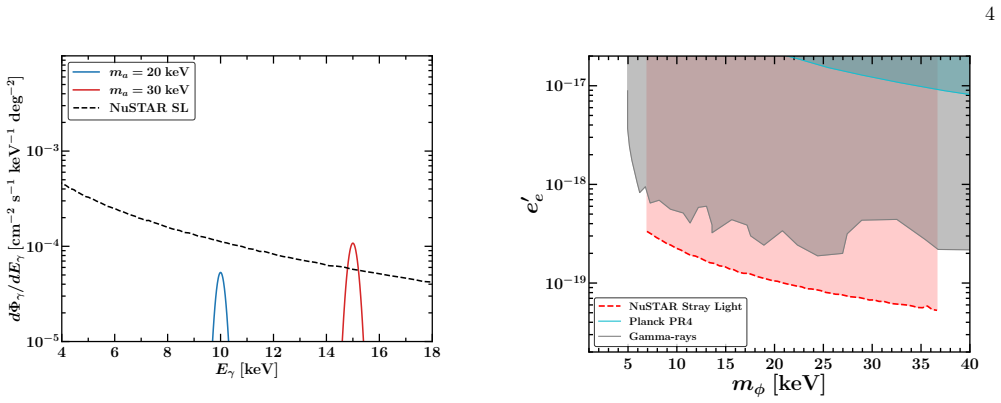
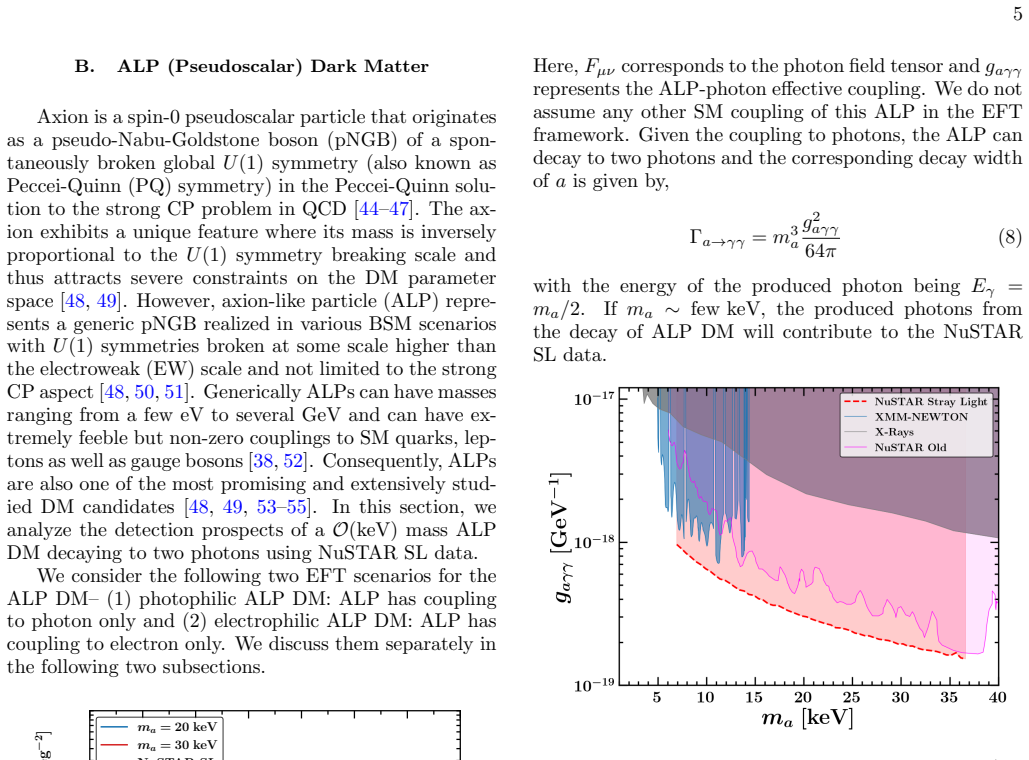
NuSTAR stray-light measurements of diffuse X-ray photons can be compared directly with the predicted photon spectra from galactic-halo decays of electrophilic scalar dark matter, photophilic and electrophilic axion-like particles, and dark-photon dark matter; the resulting comparison produces the strongest existing indirect-detection upper limits on the lifetime in the quoted mass intervals, and likewise the strongest lifetime bounds for inelastic dark matter with the stated mass splittings.
What carries the argument
Comparison of the observed NuSTAR stray-light spectrum against the expected photon flux from dark-matter decay in the galactic halo.
If this is right
- Two-photon decay models are excluded for lifetimes shorter than the NuSTAR-derived values across 6-36 keV.
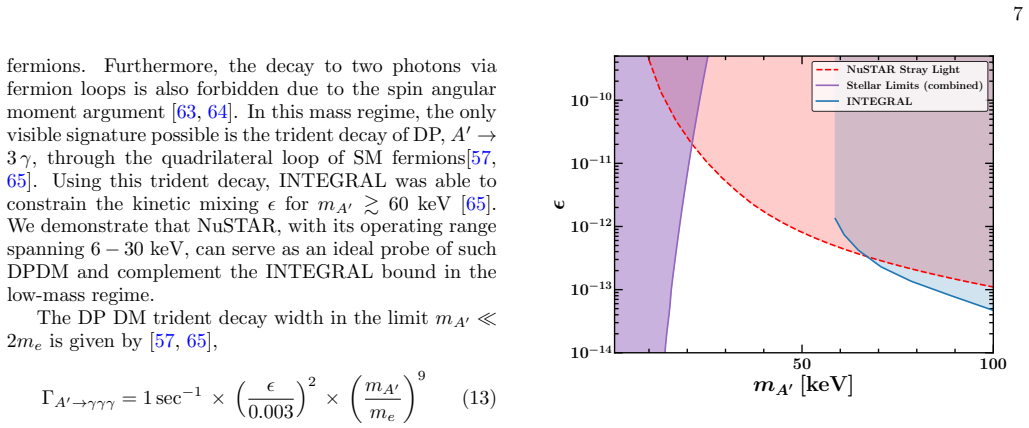
- Dark-photon models face their strongest lifetime constraint from these data in the 20-70 keV window.
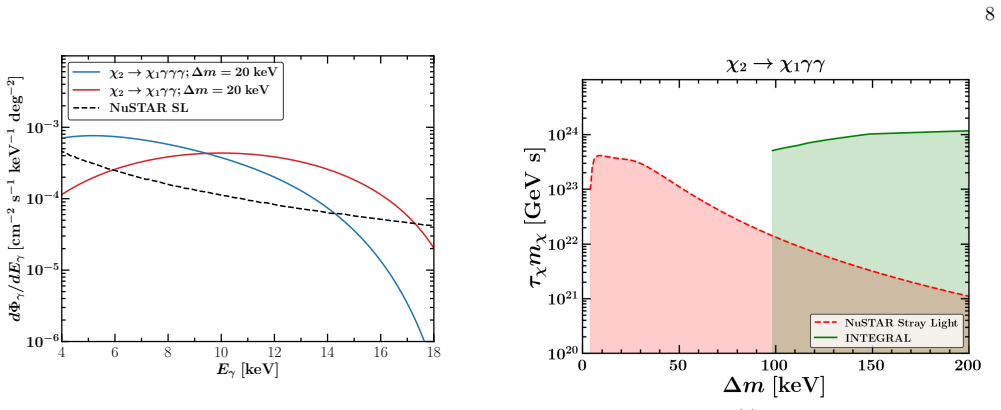
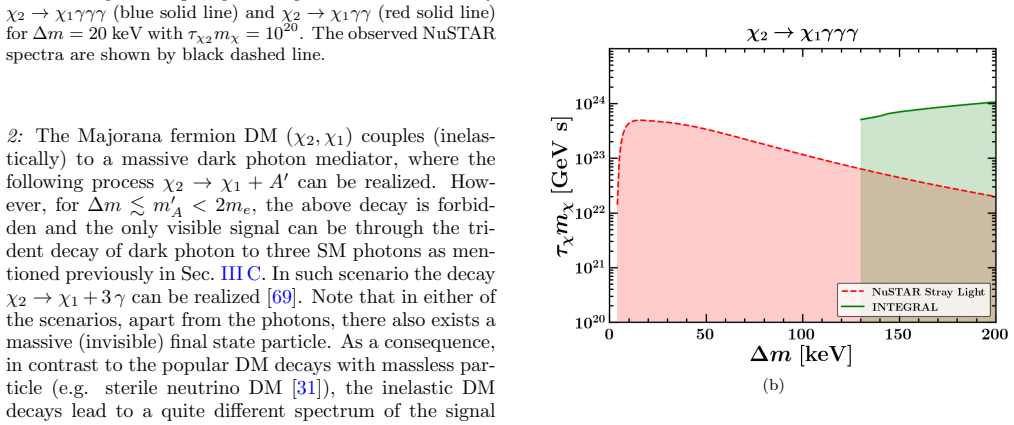
- Inelastic dark-matter models with mass splittings 3-100 keV receive the most stringent lifetime upper limits yet reported.
- X-ray stray-light observations become a competitive channel for light dark-matter searches where other indirect methods are threshold-limited.
Where Pith is reading between the lines
- Future X-ray telescopes with lower backgrounds could extend the same method to still lighter masses or detect a signal.
- The approach could be applied to archival data from other X-ray instruments to cross-check the NuSTAR limits.
- If the bounds are confirmed, they would narrow the viable parameter space for light dark matter explanations of other anomalies.
- The technique highlights the value of using off-axis or stray-light data for diffuse searches that targeted observations miss.
Load-bearing premise
The stray-light spectrum is assumed to contain no unmodeled astrophysical or instrumental backgrounds whose shape could mimic or hide a dark-matter decay signal.
What would settle it
A re-reduction of the NuSTAR stray-light dataset that isolates and subtracts a background component whose energy spectrum matches the shape predicted for the dark-matter signal would remove or substantially weaken the reported bounds.
Figures
read the original abstract
Light dark matter (DM) (mass $\lesssim \mathcal{O}(100)$ keV) remains challenging to detect in several ongoing indirect detection experiments due to threshold limitations. Recent observations of diffuse X-ray photons from the NuSTAR stray-light (SL) data provide a powerful avenue to probe such light DM through its decay signatures in the galactic halo. This work explores the indirect detection prospects of decaying electrophilic scalar DM, electrophilic and photophilic ALP DM, and dark photon DM using the recent NuSTAR SL data. We find that for DM scenarios producing monochromatic two-photon signals, NuSTAR SL data can yield the strongest indirect detection bound in the $\sim6-36$ keV mass range. In contrast, for dark photon (vector) DM featuring a continuous three-photon spectrum, the strongest indirect detection upper bound arises in the $\sim 20-70$ keV mass range. Additionally, we discuss the detection prospects of inelastic DM where the heavier DM decays to a two or three-photon final state along with a massive lighter dark sector particle. By comparing the resulting continuous photon spectra with the NuSTAR SL data, we obtain the most stringent upper bound on the lifetime of such DM for the mass splitting $\Delta m$ in the range $3 ~{\rm keV}- 100$ keV.
Editorial analysis
A structured set of objections, weighed in public.
Referee Report
Summary. The manuscript claims that NuSTAR stray-light (SL) X-ray data can be used to derive competitive indirect-detection constraints on light decaying DM, specifically electrophilic scalar DM, electrophilic/photophilic ALP DM, and dark-photon (vector) DM. For two-photon monochromatic signals the SL data are said to yield the strongest bounds in the ~6-36 keV mass window; for the continuous three-photon spectrum of dark-photon DM the strongest bounds are reported in ~20-70 keV. Additional limits are presented for inelastic DM decays (two- or three-photon final states plus a lighter dark-sector particle) for mass splittings 3-100 keV, obtained by direct comparison of the predicted photon spectra to the published NuSTAR SL counts.
Significance. If the background modeling and spectral comparison are robust, the work would supply new leading constraints on light DM decays in a mass range that is otherwise difficult to probe, thereby strengthening the indirect-detection landscape and demonstrating the scientific value of repurposing NuSTAR SL observations.
major comments (1)
- [§3, §4] §3 and the likelihood construction in §4: the lifetime limits are obtained by comparing predicted DM photon spectra directly to the published SL counts without explicit nuisance-parameter marginalization over possible residual astrophysical or instrumental continuum/line components (e.g., cosmic-ray-induced fluorescence or off-axis CXB leakage). Because this assumption is load-bearing for the “strongest bound” ranking versus existing X-ray/gamma-ray limits, an O(1) shift in the derived limits would alter the headline claims.
minor comments (1)
- [Abstract] Abstract: the statement that bounds are obtained “by comparing continuous photon spectra to data” would be clearer if it briefly indicated the treatment of statistical and systematic uncertainties or the precise exclusion criterion employed.
Simulated Author's Rebuttal
We thank the referee for their thorough review and valuable feedback on our manuscript. We address the major comment point by point below.
read point-by-point responses
-
Referee: [§3, §4] §3 and the likelihood construction in §4: the lifetime limits are obtained by comparing predicted DM photon spectra directly to the published SL counts without explicit nuisance-parameter marginalization over possible residual astrophysical or instrumental continuum/line components (e.g., cosmic-ray-induced fluorescence or off-axis CXB leakage). Because this assumption is load-bearing for the “strongest bound” ranking versus existing X-ray/gamma-ray limits, an O(1) shift in the derived limits would alter the headline claims.
Authors: We agree that a more detailed treatment of background uncertainties would strengthen the analysis. Our current approach uses the published SL counts directly, which is a conservative method as it attributes all counts to potential DM signal without subtracting backgrounds. This makes our derived limits weaker than they would be with background subtraction, yet they still rank as the strongest in the specified ranges. The original NuSTAR SL publications describe the data reduction and background handling. To address the referee's concern, we will revise the manuscript to include an explicit discussion in Section 4 on potential residual components and their impact, along with a sensitivity analysis showing that O(1) variations do not change the headline conclusions. We will also clarify the likelihood construction to note the conservative nature of the direct comparison. revision: partial
Circularity Check
No circularity; bounds derived from external NuSTAR data comparison
full rationale
The paper's central results consist of upper limits on DM lifetimes obtained by comparing predicted decay spectra (monochromatic two-photon or continuous three-photon) directly to published NuSTAR stray-light count data. No step fits a parameter to a subset of the target data and then renames the fit as a prediction, no quantity is defined in terms of itself, and no load-bearing premise reduces to a self-citation chain. The derivation therefore remains self-contained against the external dataset and does not exhibit any of the enumerated circularity patterns.
Axiom & Free-Parameter Ledger
Reference graph
Works this paper leans on
-
[1]
We do not assume any other SM coupling of this ALP in the EFT framework
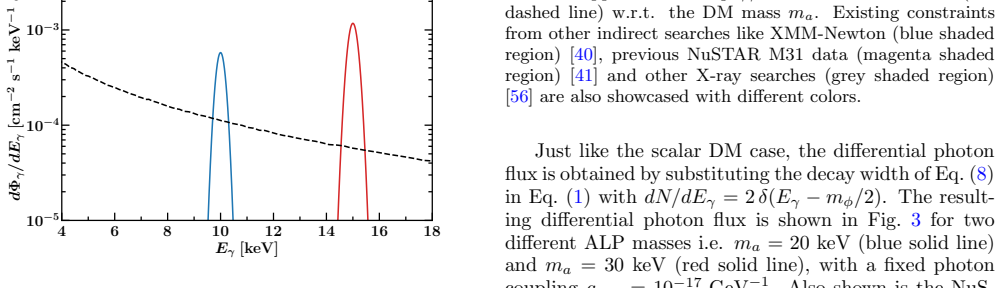
Photophilic ALP Dark Matter We consider an ALP (a) with massm a described by the effective lagrangian, LALP = 1 2 ∂µa∂µa− 1 2 m2 aa2 + gaγγ 4 aF µν ˜Fµν.(7) Here,F µν corresponds to the photon field tensor andgaγγ represents the ALP-photon effective coupling. We do not assume any other SM coupling of this ALP in the EFT framework. Given the coupling to ph...
-
[2]
Just like the scalar DM case, the differential photon flux is obtained by substituting the decay width of Eq
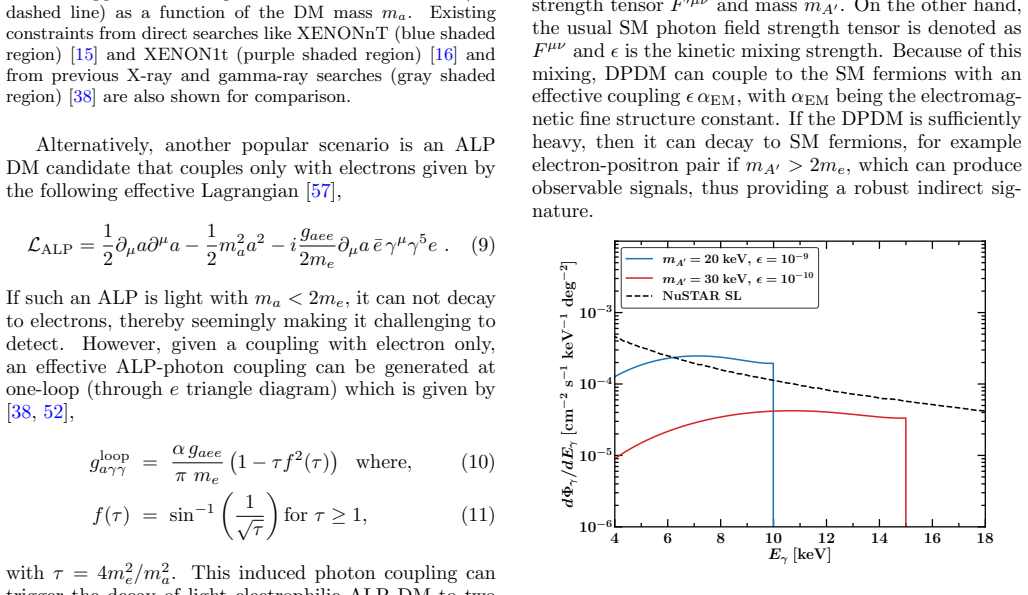
are also showcased with different colors. Just like the scalar DM case, the differential photon flux is obtained by substituting the decay width of Eq. (8) in Eq. (1) withdN/dE γ = 2δ(E γ −m ϕ/2). The result- ing differential photon flux is shown in Fig. 3 for two different ALP masses i.e.m a = 20 keV (blue solid line) andm a = 30 keV (red solid line), wi...
-
[3]
electrophilic
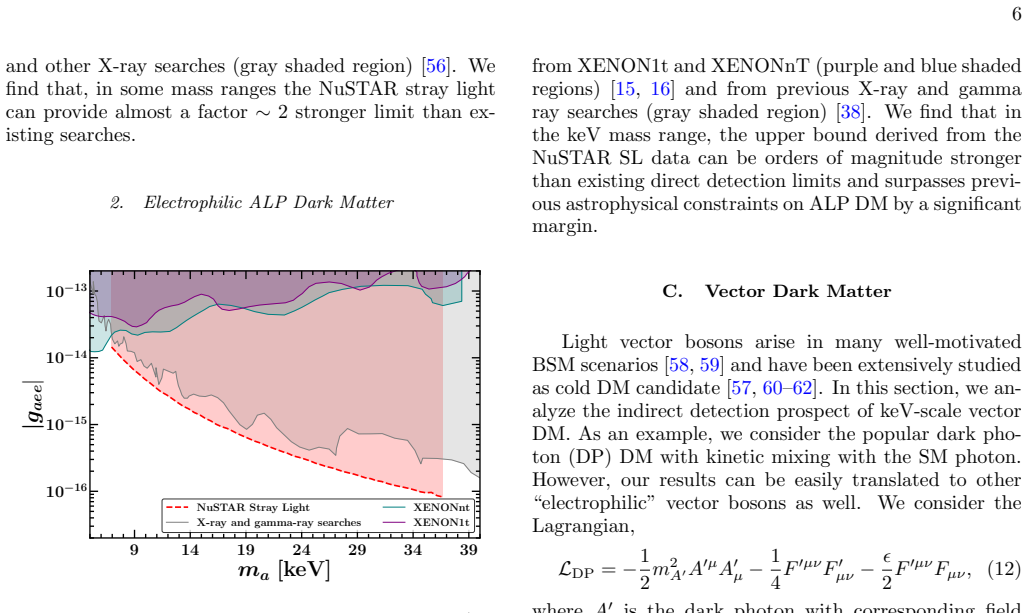
Electrophilic ALP Dark Matter 9 14 19 24 29 34 39 ma [keV] 10□16 10□15 10□14 10□13 |gaee| NuSTAR Stray Light X-ray and gamma-ray searches XENONnt XENON1t FIG. 5. Upper bound ong aee from NuSTAR SL data (red dashed line) as a function of the DM massm a. Existing constraints from direct searches like XENONnT (blue shaded region) [15] and XENON1t (purple sha...
-
[4]
Zwicky, Die Rotverschiebung von extragalaktischen Nebeln, Helv
F. Zwicky, Die Rotverschiebung von extragalaktischen Nebeln, Helv. Phys. Acta6, 110 (1933)
1933
-
[5]
V. C. Rubin and W. K. Ford, Jr., Rotation of the An- dromeda Nebula from a Spectroscopic Survey of Emission Regions, Astrophys. J.159, 379 (1970)
1970
-
[6]
D. Clowe, M. Bradac, A. H. Gonzalez, M. Markevitch, S. W. Randall, C. Jones, and D. Zaritsky, A direct em- pirical proof of the existence of dark matter, Astrophys. J. Lett.648, L109 (2006), arXiv:astro-ph/0608407
Pith/arXiv arXiv 2006
-
[7]
Aghanimet al.(Planck), Planck 2018 results
N. Aghanimet al.(Planck), Planck 2018 results. VI. Cosmological parameters, Astron. Astrophys.641, A6 (2020), [Erratum: Astron.Astrophys. 652, C4 (2021)], arXiv:1807.06209 [astro-ph.CO]. 10
Pith/arXiv arXiv 2018
-
[8]
G. Arcadi, M. Dutra, P. Ghosh, M. Lindner, Y. Mam- brini, M. Pierre, S. Profumo, and F. S. Queiroz, The waning of the WIMP? A review of models, searches, and constraints, Eur. Phys. J. C78, 203 (2018), arXiv:1703.07364 [hep-ph]
Pith/arXiv arXiv 2018
-
[9]
L. Roszkowski, E. M. Sessolo, and S. Trojanowski, WIMP dark matter candidates and searches—current status and future prospects, Rept. Prog. Phys.81, 066201 (2018), arXiv:1707.06277 [hep-ph]
Pith/arXiv arXiv 2018
-
[10]
M. Cirelli, A. Strumia, and J. Zupan, Dark Matter, (2024), arXiv:2406.01705 [hep-ph]
Pith/arXiv arXiv 2024
-
[11]
R. J. Scherrer and M. S. Turner, On the Relic, Cos- mic Abundance of Stable Weakly Interacting Massive Particles, Phys. Rev. D33, 1585 (1986), [Erratum: Phys.Rev.D 34, 3263 (1986)]
1986
-
[12]
Srednicki, R
M. Srednicki, R. Watkins, and K. A. Olive, Calculations of Relic Densities in the Early Universe, Nucl. Phys. B 310, 693 (1988)
1988
-
[13]
M. Aaboudet al.(ATLAS), Search for dark matter and other new phenomena in events with an energetic jet and large missing transverse momentum using the ATLAS detector, JHEP01, 126, arXiv:1711.03301 [hep-ex]
-
[14]
A. M. Sirunyanet al.(CMS), Search for new physics in final states with an energetic jet or a hadronically de- cayingWorZboson and transverse momentum imbal- ance at √s= 13 TeV, Phys. Rev. D97, 092005 (2018), arXiv:1712.02345 [hep-ex]
Pith/arXiv arXiv 2018
-
[15]
Kahlhoefer, Review of LHC Dark Matter Searches, Int
F. Kahlhoefer, Review of LHC Dark Matter Searches, Int. J. Mod. Phys. A32, 1730006 (2017), arXiv:1702.02430 [hep-ph]
Pith/arXiv arXiv 2017
-
[16]
M. Misiaszek and N. Rossi, Direct Detection of Dark Matter: A Critical Review, Symmetry16, 201 (2024), arXiv:2310.20472 [hep-ph]
arXiv 2024
-
[17]
Billardet al., Direct detection of dark mat- ter—APPEC committee report*, Rept
J. Billardet al., Direct detection of dark mat- ter—APPEC committee report*, Rept. Prog. Phys.85, 056201 (2022), arXiv:2104.07634 [hep-ex]
arXiv 2022
-
[18]
Aprileet al.(XENON), Search for New Physics in Electronic Recoil Data from XENONnT, Phys
E. Aprileet al.(XENON), Search for New Physics in Electronic Recoil Data from XENONnT, Phys. Rev. Lett.129, 161805 (2022), arXiv:2207.11330 [hep-ex]
arXiv 2022
-
[19]
Aprileet al.(XENON), Excess electronic recoil events in XENON1T, Phys
E. Aprileet al.(XENON), Excess electronic recoil events in XENON1T, Phys. Rev. D102, 072004 (2020), arXiv:2006.09721 [hep-ex]
arXiv 2020
-
[20]
J. M. Gaskins, A review of indirect searches for par- ticle dark matter, Contemp. Phys.57, 496 (2016), arXiv:1604.00014 [astro-ph.HE]
Pith/arXiv arXiv 2016
-
[21]
C. P´ erez de los Heros, Status, Challenges and Directions in Indirect Dark Matter Searches, Symmetry12, 1648 (2020), arXiv:2008.11561 [astro-ph.HE]
arXiv 2020
-
[22]
E. Charleset al.(Fermi-LAT), Sensitivity Projections for Dark Matter Searches with the Fermi Large Area Telescope, Phys. Rept.636, 1 (2016), arXiv:1605.02016 [astro-ph.HE]
Pith/arXiv arXiv 2016
-
[23]
L. Bergstrom, T. Bringmann, I. Cholis, D. Hooper, and C. Weniger, New Limits on Dark Matter Annihilation from AMS Cosmic Ray Positron Data, Phys. Rev. Lett. 111, 171101 (2013), arXiv:1306.3983 [astro-ph.HE]
Pith/arXiv arXiv 2013
-
[24]
Aguilaret al.(AMS), Towards Understanding the Origin of Cosmic-Ray Electrons, Phys
M. Aguilaret al.(AMS), Towards Understanding the Origin of Cosmic-Ray Electrons, Phys. Rev. Lett.122, 101101 (2019)
2019
-
[25]
Abdallaet al.(H.E.S.S.), Search for Dark Matter An- nihilation Signals in the H.E.S.S
H. Abdallaet al.(H.E.S.S.), Search for Dark Matter An- nihilation Signals in the H.E.S.S. Inner Galaxy Survey, Phys. Rev. Lett.129, 111101 (2022), arXiv:2207.10471 [astro-ph.HE]
arXiv 2022
-
[26]
E. Richardet al.(Super-Kamiokande), Measurements of the atmospheric neutrino flux by Super-Kamiokande: en- ergy spectra, geomagnetic effects, and solar modulation, Phys. Rev. D94, 052001 (2016), arXiv:1510.08127 [hep- ex]
Pith/arXiv arXiv 2016
-
[27]
S. Baur (IceCube), Dark matter searches with the IceCube Upgrade, PoSICRC2019, 506 (2020), arXiv:1908.08236 [astro-ph.HE]
arXiv 2020
-
[28]
C. A. Arg¨ uelles, A. Diaz, A. Kheirandish, A. Olivares- Del-Campo, I. Safa, and A. C. Vincent, Dark matter annihilation to neutrinos, Rev. Mod. Phys.93, 035007 (2021), arXiv:1912.09486 [hep-ph]
arXiv 2021
-
[29]
L. Bouchet, A. W. Strong, T. A. Porter, I. V. Moskalenko, E. Jourdain, and J.-P. Roques, Diffuse emission measurement with INTEGRAL/SPI as indirect probe of cosmic-ray electrons and positrons, Astrophys. J.739, 29 (2011), arXiv:1107.0200 [astro-ph.HE]
Pith/arXiv arXiv 2011
-
[30]
M. Cirelli, N. Fornengo, B. J. Kavanagh, and E. Pinetti, Integral X-ray constraints on sub-GeV Dark Matter, Phys. Rev. D103, 063022 (2021), arXiv:2007.11493 [hep- ph]
arXiv 2021
-
[31]
V. Schoenfelderet al., Instrument Description and Per- formance of the Imaging Gamma-Ray Telescope COMP- TEL aboard the Compton Gamma-Ray Observatory, The Astrophysical Journal Supplement Series86, 657 (1993)
1993
-
[32]
NASA HEASARC, Nustar technical description, https://heasarc.gsfc.nasa.gov/docs/nustar/ nustar_tech_desc.html(2023), accessed: 2026-04- 19
2023
-
[33]
E. I. Zakharov, V. V. Barinov, D. S. Gorbunov, R. A. Krivonos, and A. A. Mukhin, Search for a photon peak from keV-scale dark matter annihilation with NuSTAR: Constraints on⟨σv⟩after 11 years of observations, Phys. Rev. D112, 103037 (2025), arXiv:2509.08506 [astro- ph.HE]
arXiv 2025
-
[34]
R. A. Krivonos, V. V. Barinov, A. A. Mukhin, and D. S. Gorbunov, Strong Limits on keV-Scale Galactic Sterile Neutrino Dark Matter with Stray Light from NuSTAR after 11 Years of Operation, Phys. Rev. Lett.133, 261002 (2024), arXiv:2405.17861 [hep-ph]
arXiv 2024
-
[35]
M. Cautun, A. Benitez-Llambay, A. J. Deason, C. S. Frenk, A. Fattahi, F. A. G´ omez, R. J. J. Grand, K. A. Oman, J. F. Navarro, and C. M. Simpson, The Milky Way total mass profile as inferred from Gaia DR2, Mon. Not. Roy. Astron. Soc.494, 4291 (2020), arXiv:1911.04557 [astro-ph.GA]
arXiv 2020
-
[36]
G. Cowan, K. Cranmer, E. Gross, and O. Vitells, Asymp- totic formulae for likelihood-based tests of new physics, Eur. Phys. J. C71, 1554 (2011), [Erratum: Eur.Phys.J.C 73, 2501 (2013)], arXiv:1007.1727 [physics.data-an]
Pith/arXiv arXiv 2011
-
[37]
S. Knapen, T. Lin, and K. M. Zurek, Light Dark Matter: Models and Constraints, Phys. Rev. D96, 115021 (2017), arXiv:1709.07882 [hep-ph]
Pith/arXiv arXiv 2017
-
[38]
G. Bickendorf and M. Drees, Constraints on light lep- tophilic dark matter mediators from decay experiments, Eur. Phys. J. C82, 1163 (2022), arXiv:2206.05038 [hep- ph]
arXiv 2022
-
[39]
G. Montefalcone, G. Elor, K. K. Boddy, and N. Bel- lomo, CMB constraints on loop-induced decays of lep- tophilic dark matter, Phys. Rev. D112, 023506 (2025), arXiv:2503.00110 [hep-ph]
arXiv 2025
-
[40]
A. Mitridate, T. Trickle, Z. Zhang, and K. M. Zurek, Dark matter absorption via electronic excitations, JHEP 11 09, 123, arXiv:2106.12586 [hep-ph]
-
[41]
R. Z. Ferreira, M. C. D. Marsh, and E. M¨ uller, Do Di- rect Detection Experiments Constrain Axionlike Parti- cles Coupled to Electrons?, Phys. Rev. Lett.128, 221302 (2022), arXiv:2202.08858 [hep-ph]
arXiv 2022
-
[42]
B. Batell, N. Lange, D. McKeen, M. Pospelov, and A. Ritz, Muon anomalous magnetic moment through the leptonic Higgs portal, Phys. Rev. D95, 075003 (2017), arXiv:1606.04943 [hep-ph]
Pith/arXiv arXiv 2017
-
[43]
J. W. Foster, M. Kongsore, C. Dessert, Y. Park, N. L. Rodd, K. Cranmer, and B. R. Safdi, Deep Search for Decaying Dark Matter with XMM-Newton Blank-Sky Observations, Phys. Rev. Lett.127, 051101 (2021), arXiv:2102.02207 [astro-ph.CO]
arXiv 2021
-
[44]
K. C. Y. Ng, B. M. Roach, K. Perez, J. F. Beacom, S. Horiuchi, R. Krivonos, and D. R. Wik, New Con- straints on Sterile Neutrino Dark Matter fromN uST AR M31 Observations, Phys. Rev. D99, 083005 (2019), arXiv:1901.01262 [astro-ph.HE]
Pith/arXiv arXiv 2019
-
[45]
R. Laha, J. B. Mu˜ noz, and T. R. Slatyer, INTE- GRAL constraints on primordial black holes and par- ticle dark matter, Phys. Rev. D101, 123514 (2020), arXiv:2004.00627 [astro-ph.CO]
arXiv 2020
-
[46]
E. Hardy and R. Lasenby, Stellar cooling bounds on new light particles: plasma mixing effects, JHEP02, 033, arXiv:1611.05852 [hep-ph]
-
[47]
R. D. Peccei and H. R. Quinn, CP Conservation in the Presence of Instantons, Phys. Rev. Lett.38, 1440 (1977)
1977
-
[48]
Weinberg, A New Light Boson?, Phys
S. Weinberg, A New Light Boson?, Phys. Rev. Lett.40, 223 (1978)
1978
-
[49]
Wilczek, Problem of StrongPandTInvariance in the Presence of Instantons, Phys
F. Wilczek, Problem of StrongPandTInvariance in the Presence of Instantons, Phys. Rev. Lett.40, 279 (1978)
1978
-
[50]
J. E. Kim and G. Carosi, Axions and the Strong CP Problem, Rev. Mod. Phys.82, 557 (2010), [Erratum: Rev.Mod.Phys. 91, 049902 (2019)], arXiv:0807.3125 [hep- ph]
arXiv 2010
-
[51]
L. Di Luzio, M. Giannotti, E. Nardi, and L. Visinelli, The landscape of QCD axion models, Phys. Rept.870, 1 (2020), arXiv:2003.01100 [hep-ph]
Pith/arXiv arXiv 2020
-
[52]
R. T. Co, L. J. Hall, and K. Harigaya, Axion Kinetic Misalignment Mechanism, Phys. Rev. Lett.124, 251802 (2020), arXiv:1910.14152 [hep-ph]
arXiv 2020
-
[53]
A. Biek¨ otter and K. Mimasu, Axions and Axion-like par- ticles: collider searches (2025) arXiv:2508.19358 [hep- ph]
arXiv 2025
-
[54]
A. Bharucha, F. Br¨ ummer, N. Desai, and S. Mutzel, Axion-like particles as mediators for dark matter: beyond freeze-out, JHEP02, 141, arXiv:2209.03932 [hep-ph]
-
[55]
M. Bauer, M. Neubert, and A. Thamm, Collider Probes of Axion-Like Particles, JHEP12, 044, arXiv:1708.00443 [hep-ph]
-
[56]
Dine and W
M. Dine and W. Fischler, The Not So Harmless Axion, Phys. Lett. B120, 137 (1983)
1983
-
[57]
Preskill, M
J. Preskill, M. B. Wise, and F. Wilczek, Cosmology of the Invisible Axion, Phys. Lett. B120, 127 (1983)
1983
-
[58]
L. F. Abbott and P. Sikivie, A Cosmological Bound on the Invisible Axion, Phys. Lett. B120, 133 (1983)
1983
-
[59]
D. Cadamuro and J. Redondo, Cosmological bounds on pseudo Nambu-Goldstone bosons, JCAP02, 032, arXiv:1110.2895 [hep-ph]
-
[60]
M. Pospelov, A. Ritz, and M. B. Voloshin, Bosonic super- WIMPs as keV-scale dark matter, Phys. Rev. D78, 115012 (2008), arXiv:0807.3279 [hep-ph]
Pith/arXiv arXiv 2008
-
[61]
T. G. Rizzo, Kinetic mixing, dark photons and an extra dimension. Part I, JHEP07, 118, arXiv:1801.08525 [hep- ph]
- [62]
-
[63]
J. Redondo and M. Postma, Massive hidden photons as lukewarm dark matter, JCAP02, 005, arXiv:0811.0326 [hep-ph]
-
[64]
A. E. Nelson and J. Scholtz, Dark Light, Dark Matter and the Misalignment Mechanism, Phys. Rev. D84, 103501 (2011), arXiv:1105.2812 [hep-ph]
Pith/arXiv arXiv 2011
-
[65]
P. Arias, D. Cadamuro, M. Goodsell, J. Jaeckel, J. Re- dondo, and A. Ringwald, WISPy Cold Dark Matter, JCAP06, 013, arXiv:1201.5902 [hep-ph]
-
[66]
L. D. Landau, On the angular momentum of a system of two photons, Dokl. Akad. Nauk SSSR60, 207 (1948)
1948
-
[67]
Yang, Selection Rules for the Dematerialization of a Particle Into Two Photons, Phys
C.-N. Yang, Selection Rules for the Dematerialization of a Particle Into Two Photons, Phys. Rev.77, 242 (1950)
1950
- [68]
-
[69]
H. An, M. Pospelov, and J. Pradler, New stellar con- straints on dark photons, Phys. Lett. B725, 190 (2013), arXiv:1302.3884 [hep-ph]
Pith/arXiv arXiv 2013
-
[70]
M. Giannotti, I. Irastorza, J. Redondo, and A. Ringwald, Cool WISPs for stellar cooling excesses, JCAP05, 057, arXiv:1512.08108 [astro-ph.HE]
-
[71]
E. Aprileet al.(XENON), Emission of single and few electrons in XENON1T and limits on light dark matter, Phys. Rev. D106, 022001 (2022), [Erratum: Phys.Rev.D 110, 109903 (2024)], arXiv:2112.12116 [hep-ex]
arXiv 2022
-
[72]
G. Krnjaic, D. McKeen, R. Mizuta, G. Mohlabeng, D. E. Morrissey, and D. Tuckler, X-rays from inelastic dark matter freeze-in, Phys. Rev. D112, 115039 (2025), arXiv:2509.19428 [hep-ph]
arXiv 2025
discussion (0)
Sign in with ORCID, Apple, or X to comment. Anyone can read and Pith papers without signing in.