Full Extractors for Logical Processing in Hypergraph Product Codes
Pith reviewed 2026-06-28 09:30 UTC · model grok-4.3
The pith
Full extractors assembled from partial ones enable arbitrary logical Pauli measurements on hypergraph product codes.
A machine-rendered reading of the paper's core claim, the machinery that carries it, and where it could break.
Core claim
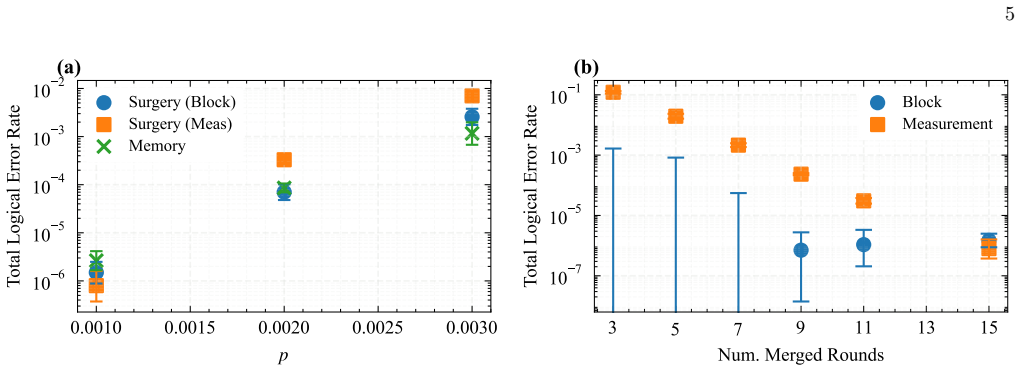
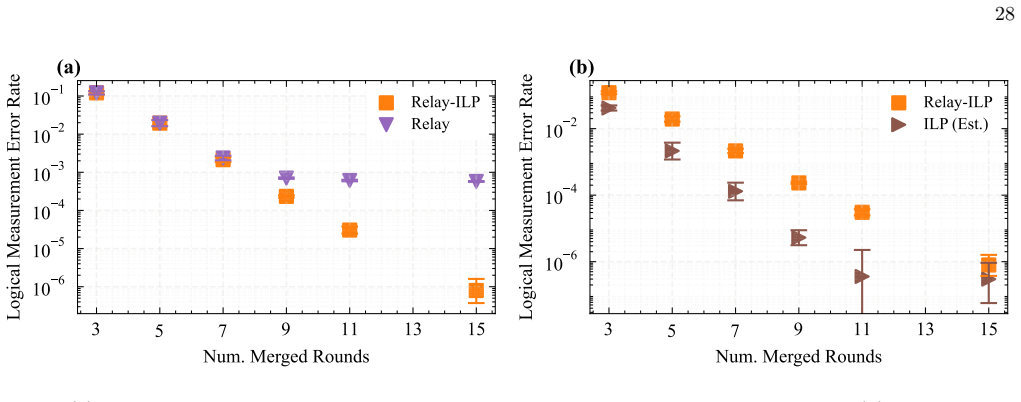
We construct full extractors—surgery systems capable of measuring arbitrary logical Pauli operators on a code block—for several hypergraph product codes. These extractors enable logical processing via Pauli-based computation without compilation overhead. The extractors have sizes between 50% and 80% of the base HGP codes, and the extractor-augmented codes can be supported on fixed connectivity hardware with maximum qubit degree ten. For a distance 10 HGP code, circuit-level noise simulations yield logical measurement error rates of approximately 10^{-6} at a physical error rate of 0.1%.
What carries the argument
The full extractor formed by assembling multiple partial extractors that each carry verifiable fault tolerance, which together allow measurement of any logical Pauli on an HGP code block.
If this is right
- Logical processing via Pauli-based computation becomes possible on HGP codes without compilation overhead.
- Extractor-augmented HGP codes require only 50-80% additional space relative to the base code.
- The augmented codes remain compatible with fixed-connectivity hardware limited to maximum qubit degree ten.
- Logical measurement error rates reach approximately 10^{-6} at 0.1% physical error for distance-10 examples.
- QLDPC codes achieve space efficiency comparable to surface-code PBC architectures without added compilation cost.
Where Pith is reading between the lines
- The fixed-connectivity constraint satisfied by these extractors may allow direct mapping onto superconducting qubit arrays without additional routing layers.
- If the partial-to-full assembly technique generalizes, similar full extractors could be built for other QLDPC families beyond hypergraph products.
- Lower relative size of the extractors could reduce the total qubit count needed for a complete fault-tolerant processor that includes logical operations.
- The reported error rates suggest that logical measurements could be performed at rates comparable to memory operations in scaled systems.
Load-bearing premise
Assembling many partial extractors that have verifiable fault tolerance produces one working full extractor.
What would settle it
A circuit-level simulation of the distance-10 HGP code with its extractor at 0.1% physical error rate that produces logical measurement error rates well above 10^{-6} would falsify the reported performance.
Figures
read the original abstract
Quantum low-density parity-check (QLDPC) codes are promising candidates for practical low-overhead quantum memories. For large-scale fault-tolerant quantum computation, we further need logical processing methods for QLDPC codes. In this work, we construct full extractors -- surgery systems capable of measuring arbitrary logical Pauli operators on a code block -- for several hypergraph product (HGP) codes. These extractors enable logical processing via Pauli-based computation (PBC) without the compilation overhead observed in prior works. Moreover, our extractors have sizes between 50% and 80% of the base HGP codes, and the extractor-augmented codes can be supported on fixed connectivity hardware with maximum qubit degree ten. Our approach involves assembling many partial extractors with verifiable fault-tolerance into a single full extractor. For a distance 10 HGP code, circuit-level noise simulations yield logical measurement error rates of approximately $10^{-6}$ at a physical error rate of 0.1%. These results demonstrate that extractor architectures, when designed in the fixed-connectivity setting, can achieve the space efficiency of QLDPC codes without introducing compilation overhead compared to surface code PBC architectures.
Editorial analysis
A structured set of objections, weighed in public.
Referee Report
Summary. The paper constructs full extractors—surgery systems for measuring arbitrary logical Pauli operators—for several hypergraph product (HGP) codes. These are assembled from many partial extractors with verifiable fault-tolerance, enabling Pauli-based computation (PBC) without compilation overhead. The extractors are 50–80% the size of the base HGP codes, support fixed-connectivity hardware with maximum qubit degree ten, and yield simulated logical measurement error rates of approximately 10^{-6} at 0.1% physical error rate for a distance-10 code.
Significance. If the assembly of partial extractors preserves fault-tolerance and the simulation results hold, the work would supply a concrete route to logical processing in QLDPC codes that retains their space efficiency while avoiding the compilation overhead of prior PBC approaches. The fixed-connectivity constraint and reported sizes are directly relevant to hardware feasibility.
major comments (1)
- [Abstract] Abstract (approach description): the central claim that many partial extractors can be assembled into a single full extractor while preserving verifiable fault-tolerance is load-bearing, yet the abstract supplies no explicit composition rule, no argument that the combined circuit inherits the individual verifiability guarantees, and no verification that the resulting measurement operators remain logically equivalent to the target Pauli strings under the code’s stabilizer group. This is the precise point identified as the weakest assumption.
Simulated Author's Rebuttal
We thank the referee for their careful review and for identifying the need for greater clarity in the abstract regarding the composition of partial extractors. We address the comment below.
read point-by-point responses
-
Referee: [Abstract] Abstract (approach description): the central claim that many partial extractors can be assembled into a single full extractor while preserving verifiable fault-tolerance is load-bearing, yet the abstract supplies no explicit composition rule, no argument that the combined circuit inherits the individual verifiability guarantees, and no verification that the resulting measurement operators remain logically equivalent to the target Pauli strings under the code’s stabilizer group. This is the precise point identified as the weakest assumption.
Authors: The manuscript body (Section 3 and Theorem 2) supplies the explicit composition rule: partial extractors are scheduled so that their support is disjoint in time and each commutes with the code stabilizers, allowing the combined circuit to measure the target logical Pauli string modulo stabilizers. Verifiability is inherited because each partial extractor satisfies the fault-tolerance conditions independently and the scheduling ensures no new error propagation paths are introduced between them. Logical equivalence follows directly from the fact that the measured operators differ from the target Pauli strings only by stabilizer elements, as verified by direct computation in the code lattice. We agree, however, that the abstract is overly concise on this point and will expand it to include a one-sentence statement of the composition rule together with a reference to the relevant theorem. revision: yes
Circularity Check
No circularity: constructions and simulations are independent of inputs
full rationale
The paper presents explicit constructions of full extractors for HGP codes via assembly of partial extractors, supported by circuit-level simulations yielding specific error rates (e.g., ~10^{-6} at 0.1% physical error for distance-10 code). No equations or claims reduce a 'prediction' to a fitted parameter by construction, nor does any load-bearing step rely on self-citation chains that are themselves unverified. The assembly approach is stated as a method with verifiable fault-tolerance, but the central results (sizes 50-80% of base codes, max degree 10, PBC compatibility) are presented as outcomes of the design rather than tautological redefinitions. This is a standard self-contained construction paper with no detected circular steps.
Axiom & Free-Parameter Ledger
Reference graph
Works this paper leans on
-
[1]
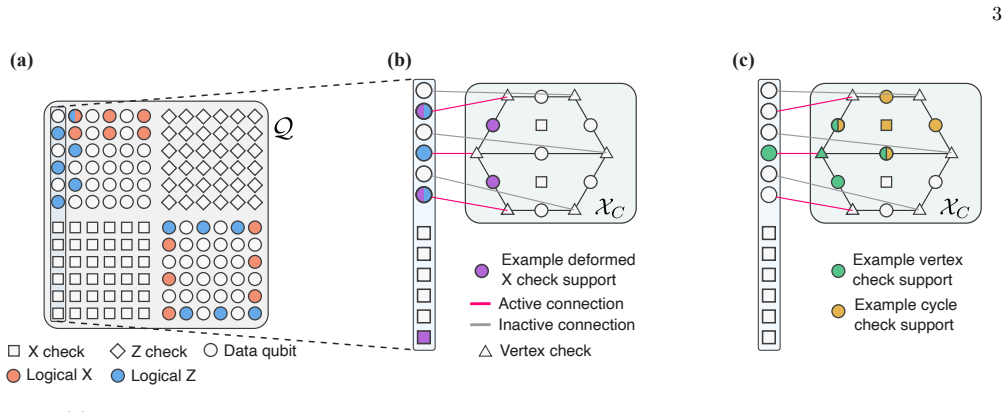
Cyclic HGP Codes All of the constructions listed in Table I use the HGP of classical cyclic codes, first explored in [20], as the base code. More specifically, given a check polynomialh(x), we constructQ= HGP(∂, ∂) where we take∂to be the parity check matrix whose rows consist of all cyclic shifts ofh ∗(x) [64], as opposed to just the firstn−kas shown in ...
1922
-
[2]
high rate
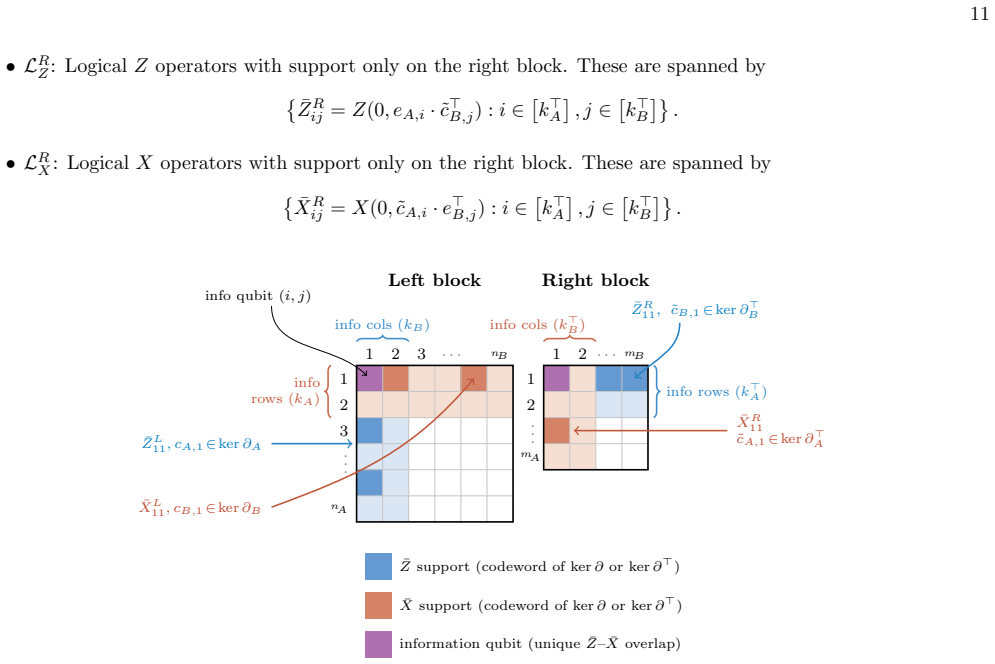
Canonical Basis of Logical Operators Following [66] and [67], we now construct a well-structured symplectic basis of logical operators for HGP(∂ A, ∂B). We begin by explicitly writing out the homology and cohomology groups in terms of∂ x: Hx,1 = ker(∂x)H x,0 =F mx 2 /im(∂x) (D8) H1 x = ker ∂⊤ x H0 x =F nx 2 /im ∂⊤ x .(D9) By equations (D6) and (D7), to fi...
-
[3]
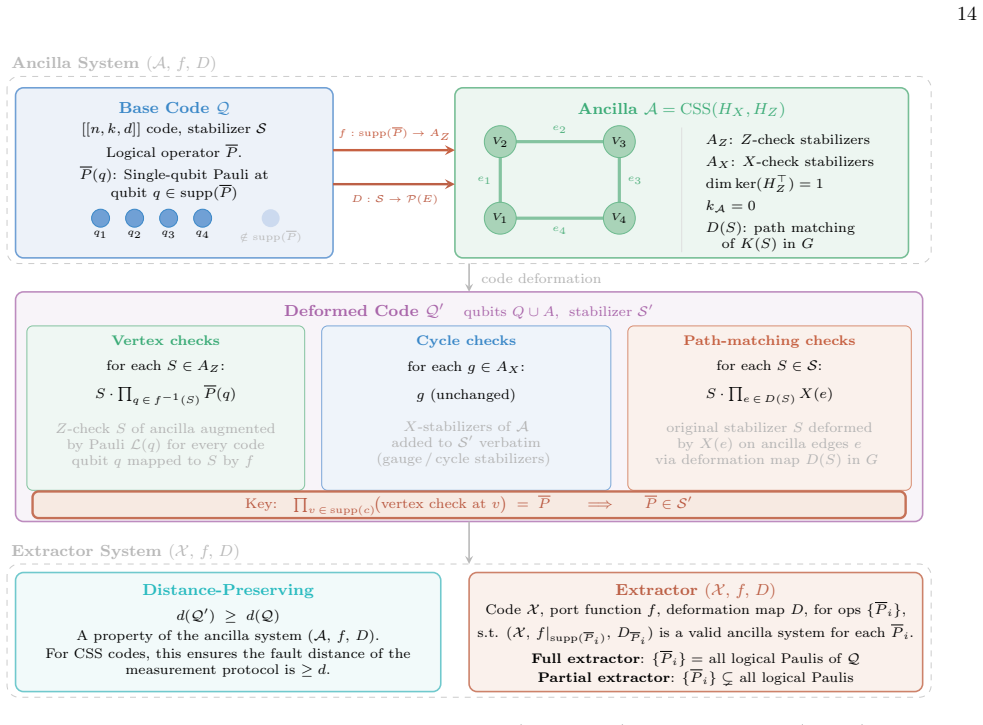
In order to useAto measure P M, we use the following code-deformation protocol:
Measurement Procedure and F ault-Distance LetQbe a code of distancedwith logical operator P M, and ancilla systemAwithk A = 0. In order to useAto measure P M, we use the following code-deformation protocol:
-
[4]
Measure the stabilizers ofQfordrounds
-
[5]
Initialize the edge qubits of the ancilla system in|+⟩
-
[6]
Measure the stabilizers of the merged codeQ ′ fordrounds
-
[7]
Measure the edge qubits of the ancilla system in theXbasis
-
[8]
Measure the stabilizers ofQfordrounds. We take the product of the measurement results of the vertex checks corresponding to supp(c), for 0̸=c∈ker(H ⊤ Z ) from the first round of measurement of step three as the result of the measurement of P M. To analyze the fault tolerance of such a protocol, we follow [4] and consider the phenomenological (or spacetime...
-
[9]
single-column
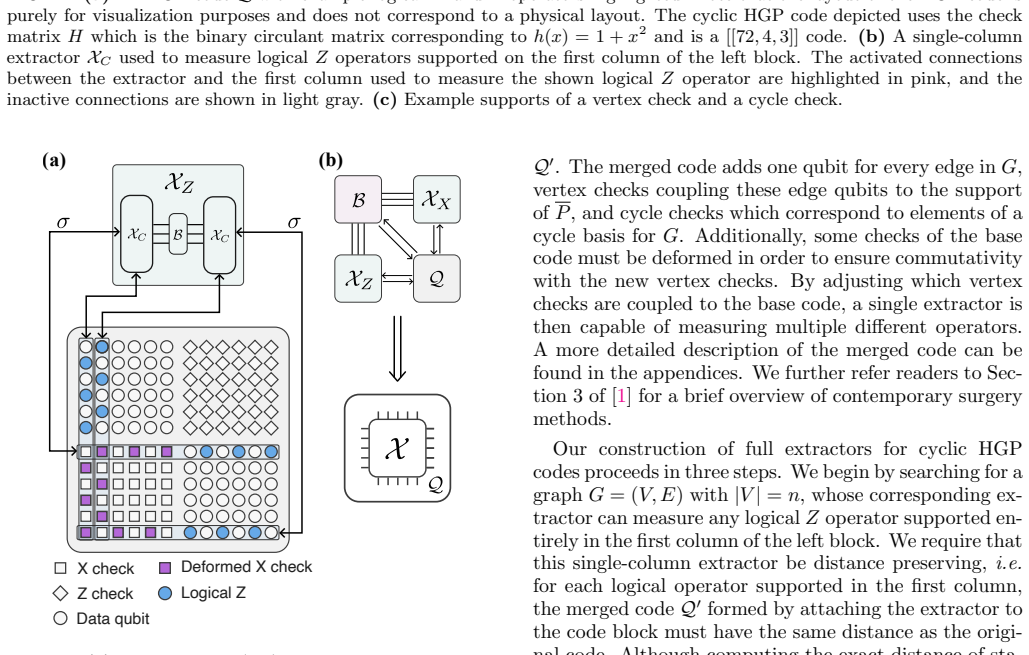
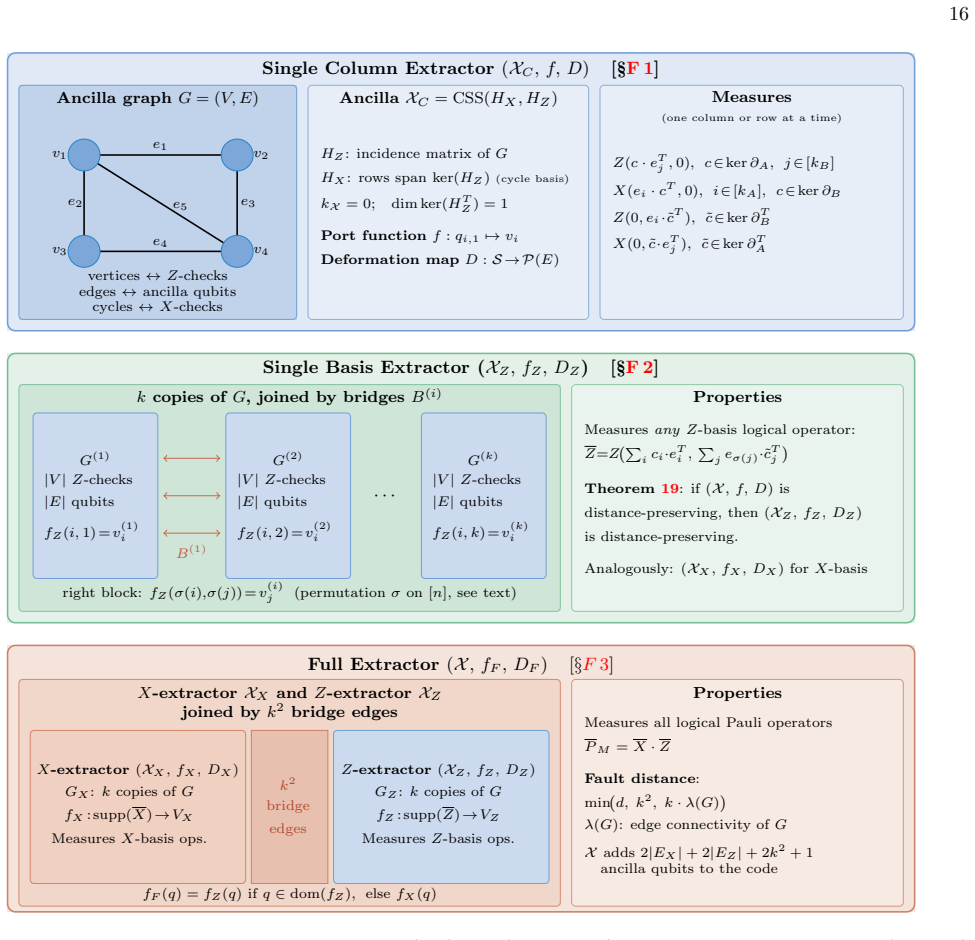
Single Column/Row Extractors The basis of our extractor construction is a “single-column” extractor,i.e.an ancilla system capable of measuring any operator of the forms 1.Z(c·e ⊤ j ,0), forc∈ker∂ A, j∈[k B] 2.X(e i ·c ⊤,0), fori∈[k A], c∈ker∂ B 3.Z(0, e i ·˜c⊤), fori∈[k ⊤ A],˜c∈ker∂ ⊤ B 4.X(0,˜c·e ⊤ j ), for ˜c∈ker∂ ⊤ A , j∈[k ⊤ B]. where the specific set...
-
[10]
For the rest of the appendices, unless otherwise specified, we will only consider cyclic HGP codes (described in Section D 2)
Single Basis Extractors In this section, we show how to combine the single row/column extractors described in the previous section into extractors capable of measuring any logicalXorZoperator, and prove that these constructions are distance preserv- ing. For the rest of the appendices, unless otherwise specified, we will only consider cyclic HGP codes (de...
-
[11]
In this section, we demonstrate how to connect these two extractors to perform non-CSS measurements, thus yielding a full extractor
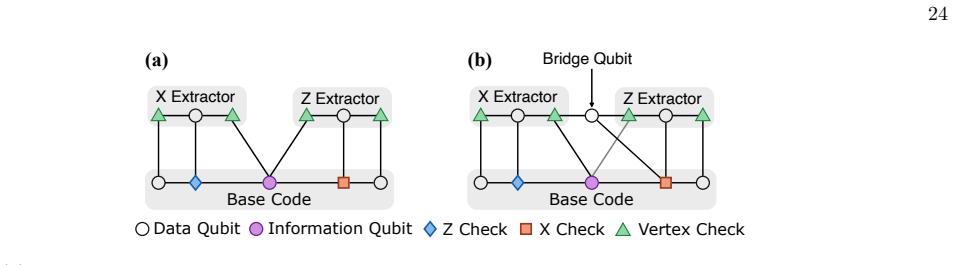
F ull Extractors Now, by using oneXextractor, and oneZextractor as described in the previous section, it is possible to perform any logical CSS measurement. In this section, we demonstrate how to connect these two extractors to perform non-CSS measurements, thus yielding a full extractor. Let (XX , fX , DX) be theXextractor and (X Z, fZ, DZ) be theZextrac...
-
[12]
Fori∈[k−1],j∈[k], the cycle{b (j) i,x, ei,j, ei+1,j, t(i) j,z}wheret (i) j,z is the set of edges in theithZcolumn extractor corresponding to rowjofT
-
[13]
Fori∈[k−1],iodd, the cycle{b (i) k,z, ek,i, ek,i+1, t(k) i,x }wheret (k) i,x is the set of edges in thekthXrow extractor corresponding to rowiofT
-
[14]
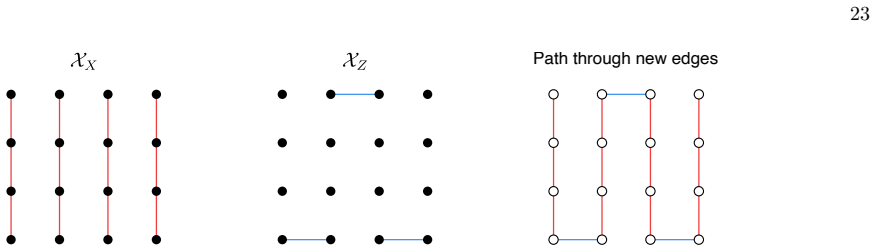
Fori∈[k−1],ieven, the cycle{b (i) 1,z, e1,i, e1,i+1, t(1) i,x }wheret (1) i,x is the set of edges in the firstXrow extractor corresponding to rowiofT The bridge edges present in this set of cycles are shown in Figure 7. Note how the bridge edges together form a path through the information vertices, and we can see thate 1,1 ande k,k will each be contained...
-
[15]
We first consider the spacelike fault distance,i.e.we wish to evaluate the smallest weight operator in the set L∗G. Any operator in this set may be written (up to phase) as X ′ Z ′ XeM M′ (F41) where X ′ and Z ′ areXandZtype logical operators of the base code such that X ′ Z ′ ̸= P M,X e is the product ofX operators on edge qubits of the extractor,M∈ Sand...
-
[16]
Chunked Circuit Construction
Explicit Construction Details In this section we provide additional information about the three extractors listed in Table I; namely, the size of the graph, the edge connectivity of the graph, and the distribution of qubit degrees of the full extractor. We note that each construction contains several qubits of degree greater than ten. In each case, these ...
1922
-
[17]
Z. He, A. Cowtan, D. J. Williamson, and T. J. Yoder, Extractors: QLDPC Architectures for Efficient Pauli-Based Com- putation, arXiv preprint arXiv:2503.10390 (2025)
arXiv 2025
-
[18]
Quantum LDPC (QLDPC) code, inThe Error Correction Zoo, edited by V. V. Albert and P. Faist (2025)
2025
-
[19]
L. Z. Cohen, I. H. Kim, S. D. Bartlett, and B. J. Brown, Low-overhead fault-tolerant quantum computing using long-range connectivity, Science Advances8, 10.1126/sciadv.abn1717 (2022)
- [20]
-
[21]
D. J. Williamson and T. J. Yoder, Low-overhead fault-tolerant quantum computation by gauging logical operators, Nature Physics22, 598 (2026)
2026
-
[22]
B. Ide, M. G. Gowda, P. J. Nadkarni, and G. Dauphinais, Fault-Tolerant Logical Measurements via Homological Measure- ment, Physical Review X15, 10.1103/physrevx.15.021088 (2025)
-
[23]
E. Swaroop, T. Jochym-O’Connor, and T. J. Yoder, Universal Adapters between Quantum Low-Density Parity Check Codes, PRX Quantum7, 10.1103/1g44-jp62 (2026)
-
[24]
S. Bravyi, G. Smith, and J. A. Smolin, Trading Classical and Quantum Computational Resources, Physical Review X6, 10.1103/physrevx.6.021043 (2016)
-
[25]
Litinski, A Game of Surface Codes: Large-Scale Quantum Computing with Lattice Surgery, Quantum3, 128 (2019)
D. Litinski, A Game of Surface Codes: Large-Scale Quantum Computing with Lattice Surgery, Quantum3, 128 (2019)
2019
-
[26]
T. J. Yoder, E. Schoute, P. Rall, E. Pritchett, J. M. Gambetta, A. W. Cross,et al., Tour de gross: A modular quantum computer based on bivariate bicycle codes, arXiv preprint arXiv:2506.03094 (2025). 29
Pith/arXiv arXiv 2025
-
[27]
A. Wills, M. E. Beverland, L. S. Bishop, J. M. Gambetta, P. Rall, V. Siddhu,et al., Concatenating Algebraic Codes over High-Rate Quantum LDPC Codes, arXiv preprint arXiv:2605.21898 (2026)
Pith/arXiv arXiv 2026
-
[28]
P. Webster, L. Berent, O. Chandra, E. T. Hockings, N. Baspin, F. Thomsen,et al., The Pinnacle Architecture: Reducing the cost of breaking RSA-2048 to 100 000 physical qubits using quantum LDPC codes, arXiv preprint arXiv:2602.11457 (2026)
Pith/arXiv arXiv 2048
-
[29]
M. Cain, Q. Xu, R. King, L. R. B. Picard, H. Levine, M. Endres,et al., Shor’s Algorithm Is Possible with as Few as 10,000 Reconfigurable Atomic Qubits, arXiv preprint arXiv:2603.28627 (2026)
Pith/arXiv arXiv 2026
-
[30]
A. C. Yuan, A. Cowtan, Z. He, T.-C. Lin, and D. J. Williamson, Parsimonious Quantum Low-Density Parity-Check Code Surgery, arXiv preprint arXiv:2603.05082 (2026)
arXiv 2026
-
[31]
J. Zhou, A. Javadi-Abhari, and G. Li, GeneCS: Synthesizing Resource-Efficient Code Surgery for Arbitrary Quantum Stabilizer Codes, arXiv preprint arXiv:2605.21746 (2026)
Pith/arXiv arXiv 2026
-
[32]
C. Zhao, C. Duckering, A. Gu, N. Maskara, and H. Zhou, Towards Ultra-High-Rate Quantum Error Correction with Reconfigurable Atom Arrays, arXiv preprint arXiv:2604.16209 (2026)
Pith/arXiv arXiv 2026
-
[33]
fast block
For the numbers in the surface code (fast) row, we assume the “fast block” layout from [9], which requires 2k+ √ 8k+ 1 surface code patches to storeklogical qubits. For ourn tot numbers in this row we ignore the subleading terms in the scaling and assume a fixed 2×overhead. For the numbers in the surface code (compact) row, we assume the “compact block” l...
-
[34]
Tillich and G
J.-P. Tillich and G. Z´ emor, Quantum LDPC Codes With Positive Rate and Minimum Distance Proportional to the Square Root of the Blocklength, IEEE Transactions on Information Theory60, 1193 (2014)
2014
-
[35]
Hypergraph product (HGP) code, inThe Error Correction Zoo, edited by V. V. Albert and P. Faist (2024)
2024
- [36]
-
[37]
Kapshikar and S
U. Kapshikar and S. Kundu, On the Hardness of the Minimum Distance Problem of Quantum Codes, IEEE Trans. Inf. Theor.69, 6293 (2023)
2023
-
[38]
Perron and V
L. Perron and V. Furnon, OR-Tools
-
[39]
Perron and F
L. Perron and F. Didier, CP-SAT
-
[40]
L. W. Beineke and R. J. Wilson,Topics in structural graph theory, Encyclopedia of mathematics and its applications ; 147 (Cambridge University Press, New York, 2013)
2013
-
[41]
T. M¨ uller, T. Alexander, M. E. Beverland, M. B¨ uhler, B. R. Johnson, T. Maurer,et al., Improved belief propagation is sufficient for real-time decoding of quantum memory, arXiv preprint arXiv:2506.01779 (2025)
arXiv 2025
-
[42]
A. J. Landahl, J. T. Anderson, and P. R. Rice, Fault-tolerant quantum computing with color codes, arXiv preprint arXiv:1108.5738 (2011)
Pith/arXiv arXiv 2011
-
[43]
M. Cain, C. Zhao, H. Zhou, N. Meister, J. P. B. Ataides, A. Jaffe,et al., Correlated Decoding of Logical Algorithms with Transversal Gates, Phys. Rev. Lett.133, 240602 (2024)
2024
-
[44]
Gidney, Stim: a fast stabilizer circuit simulator, Quantum5, 497 (2021)
C. Gidney, Stim: a fast stabilizer circuit simulator, Quantum5, 497 (2021)
2021
-
[45]
Preskill, Beyond NISQ: The Megaquop Machine, ACM Transactions on Quantum Computing6, 1–7 (2025)
J. Preskill, Beyond NISQ: The Megaquop Machine, ACM Transactions on Quantum Computing6, 1–7 (2025)
2025
-
[46]
Rosenberg, D
D. Rosenberg, D. Kim, R. Das, D. Yost, S. Gustavsson, D. Hover,et al., 3D Integrated Superconducting Qubits, npj Quantum Information3, 42 (2017)
2017
-
[47]
D. R. W. Yost, M. E. Schwartz, J. Mallek, D. Rosenberg, C. Stull, J. L. Yoder,et al., Solid-State Qubits Integrated with Superconducting through-Silicon Vias, npj Quantum Information6, 59 (2020)
2020
-
[48]
Kosen, H.-X
S. Kosen, H.-X. Li, M. Rommel, D. Shiri, C. Warren, L. Gr¨ onberg,et al., Building blocks of a flip-chip integrated superconducting quantum processor, Quantum Science and Technology7, 035018 (2022)
2022
-
[49]
Marxer, A
F. Marxer, A. Veps¨ al¨ ainen, S. W. Jolin, J. Tuorila, A. Landra, C. Ockeloen-Korppi,et al., Long-Distance Transmon Coupler with cz-Gate Fidelity above 99.8%, PRX Quantum4, 010314 (2023)
2023
-
[50]
H. Xiong, J. Wang, J. Song, J. Yang, Z. Bao, Y. Li, Z.-Y. Mi, H. Zhang, H.-F. Yu, Y. Song, and L. Duan, Scal- able low-overhead superconducting nonlocal coupler for circuit connectivity enhancement, Physical Review Applied25, 10.1103/kfy3-bwgr (2026)
-
[51]
J. Xu, X. Deng, W. Zheng, W. Yan, T. Zhang, Z. Zhang,et al., Tunable hybrid-mode coupler enabling strong interactions between transmons at centimeter-scale distance, Phys. Rev. Appl.25, 014016 (2026)
2026
-
[52]
M. A. Tremblay, N. Delfosse, and M. E. Beverland, Constant-Overhead Quantum Error Correction with Thin Planar Connectivity, Physical Review Letters129, 10.1103/physrevlett.129.050504 (2022)
-
[53]
M. Mathews, L. Pahl, D. Pahl, V. L. Addala, C. Tang, W. D. Oliver,et al., Placing and routing quantum LDPC codes in multilayer superconducting hardware, npj Quantum Information 10.1038/s41534-026-01243-w (2026)
-
[54]
Google Quantum AI, Quantum error correction below the surface code threshold, Nature638, 920 (2024). 30
2024
-
[55]
A. Strikis, D. E. Browne, and M. E. Beverland, High-performance syndrome extraction circuits for quantum codes, arXiv preprint arXiv:2603.05481 (2026)
arXiv 2026
-
[56]
Raveendran and B
N. Raveendran and B. Vasi´ c, Trapping Sets of Quantum LDPC Codes, Quantum5, 562 (2021)
2021
-
[57]
A. A. Kovalev and L. P. Pryadko, Quantum Kronecker sum-product low-density parity-check codes with finite rate, Phys. Rev. A88, 012311 (2013)
2013
-
[58]
Panteleev and G
P. Panteleev and G. Kalachev, Degenerate Quantum LDPC Codes With Good Finite Length Performance, Quantum5, 585 (2021)
2021
-
[59]
Bravyi, A
S. Bravyi, A. W. Cross, J. M. Gambetta, D. Maslov, P. Rall, and T. J. Yoder, High-threshold and low-overhead fault- tolerant quantum memory, Nature627, 778 (2024)
2024
-
[60]
Lin and L
H.-K. Lin and L. P. Pryadko, Quantum two-block group algebra codes, Phys. Rev. A109, 022407 (2024)
2024
-
[61]
Panteleev and G
P. Panteleev and G. Kalachev, Quantum LDPC Codes With Almost Linear Minimum Distance, IEEE Transactions on Information Theory68, 213 (2022)
2022
-
[62]
N. P. Breuckmann and J. N. Eberhardt, Balanced Product Quantum Codes, IEEE Transactions on Information Theory 67, 6653 (2021)
2021
-
[63]
K. Kasai, Breaking the Orthogonality Barrier in Quantum LDPC Codes, arXiv preprint arXiv:2601.08824 (2026)
arXiv 2026
-
[64]
G. Zhang and Y. Li, Time-Efficient Logical Operations on Quantum Low-Density Parity Check Codes, Physical Review Letters134, 10.1103/physrevlett.134.070602 (2025)
-
[65]
A. Cowtan, Z. He, D. J. Williamson, and T. J. Yoder, Parallel Logical Measurements via Quantum Code Surgery, PRX Quantum7, 10.1103/gj8x-n5gg (2026)
- [66]
-
[67]
B. Gu, A. Z. Liu, A. O. Quintavalle, Q. Xu, J. Eisert, and J. Roffe, QGPU: Parallel logic in quantum LDPC codes, arXiv preprint arXiv:2603.05398 (2026)
arXiv 2026
- [68]
- [69]
- [70]
-
[71]
S. Xu, K. Liu, P. Rall, Z. He, and Y. Ding, Distilling magic states in the bicycle architecture, arXiv preprint arXiv:2602.20546 (2026)
Pith/arXiv arXiv 2026
-
[72]
K. Liu, B. Foxman, G.-L. R. Anselmetti, and Y. Ding, Assessing System Capabilities and Bottlenecks of an Early Fault- Tolerant Bicycle Architecture, arXiv preprint arXiv:2604.20013 (2026)
Pith/arXiv arXiv 2026
-
[73]
S. Sethi, S. Khan, A. Awasthi, A. Anand, and J. M. Baker, INJEQT: Improved Magic-State Injection Protocol for Fault- Tolerant Quantum Extractor Architectures, arXiv preprint arXiv:2604.25094 (2026)
Pith/arXiv arXiv 2026
- [74]
-
[75]
S. Khan, S. Sethi, K. Sahay, Y. Lin, J. Alnas, S. Kurapati,et al., Architecting Early Fault Tolerant Neutral Atoms Systems with Quantum Advantage, arXiv preprint arXiv:2604.19735 (2026)
Pith/arXiv arXiv 2026
-
[76]
J. Bendavid, M. D’Alfonso, J. Eysermans, C. Freer, M. Goncharov, M. Heine, L. Lavezzo, M. Moore, C. Paus, X. Shen, D. Walter, and Z. Wang, SubMIT: A Physics Analysis Facility at MIT, arXiv preprint arXiv:2506.01958 (2025)
arXiv 2025
-
[77]
W. C. Huffman and V. Pless,Fundamentals of Error-Correcting Codes(Cambridge University Press, 2003)
2003
-
[78]
A. O. Quintavalle and E. T. Campbell, ReShape: A Decoder for Hypergraph Product Codes, IEEE Transactions on Information Theory68, 6569 (2022)
2022
-
[79]
E. T. Campbell, A Theory of Single-Shot Error Correction for Adversarial Noise, Quantum Sci. Technol.4, 025006 (2019)
2019
-
[80]
Given a degreeapolynomialp(x) =p 0 +xp 1 +· · ·+x apa, the reciprocal polynomialp ∗(x), is obtained by reversing the coefficients,e.g.p ∗(x) =p a +xp a−1 +· · ·+x ap0
discussion (0)
Sign in with ORCID, Apple, or X to comment. Anyone can read and Pith papers without signing in.