Towards Intrusion Detection Systems for RPL-based IoT Networks using Foundation Models
Pith reviewed 2026-06-28 09:30 UTC · model grok-4.3
The pith
A fine-tuned foundation model achieves state-of-the-art performance in detecting and classifying attacks on RPL-based IoT networks.
A machine-rendered reading of the paper's core claim, the machinery that carries it, and where it could break.
Core claim
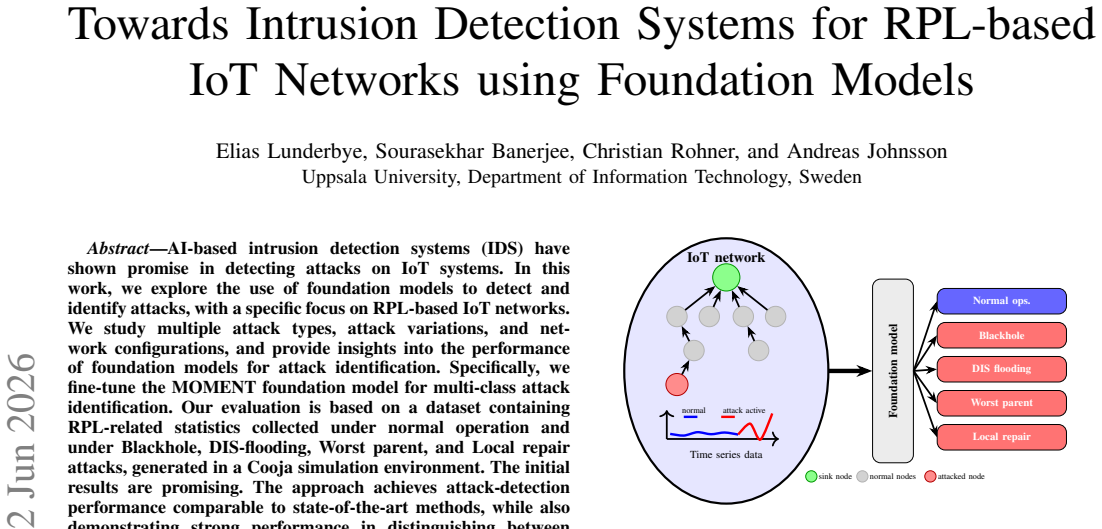
By fine-tuning the MOMENT foundation model on RPL statistics collected in simulation, the approach reaches attack detection accuracy comparable to state-of-the-art specialized systems and additionally performs strongly at identifying which specific attack is occurring among Blackhole, DIS flooding, Worst Parent, and Local Repair.
What carries the argument
The MOMENT foundation model fine-tuned for multi-class classification of RPL network statistics.
If this is right
- The method provides a way to detect attacks without designing attack-specific features.
- It can distinguish between multiple attack types in one model.
- Performance remains stable across variations in network configurations.
- Foundation models offer a reusable base for IDS in IoT settings.
Where Pith is reading between the lines
- If the simulation data proves representative, the same fine-tuning process could be applied to real deployments with limited additional data.
- Similar foundation-model approaches may extend to other IoT protocols beyond RPL.
- Reducing reliance on hand-crafted features could speed up response to new attack variants.
Load-bearing premise
RPL statistics gathered in the Cooja simulator under normal and attack conditions are representative enough of real-world networks for the model to work outside the simulation.
What would settle it
A drop in detection or classification accuracy when the model is evaluated on traces from actual hardware RPL networks instead of Cooja simulations.
Figures


read the original abstract
AI-based intrusion detection systems (IDS) have shown promise in detecting attacks on IoT systems. In this work, we explore the use of foundation models to detect and identify attacks, with a specific focus on RPL-based IoT networks. We study multiple attack types, attack variations, and network configurations, and provide insights into the performance of foundation models for attack identification. Specifically, we fine-tune the MOMENT foundation model for multi-class attack identification. Our evaluation is based on a dataset containing RPL-related statistics collected under normal operation and under Blackhole, DIS flooding, Worst Parent, and Local Repair attacks, generated in a Cooja simulation environment. The initial results are promising. The approach achieves attack-detection performance comparable to state-of-the-art methods, while also demonstrating strong performance in distinguishing between different attack types.
Editorial analysis
A structured set of objections, weighed in public.
Referee Report
Summary. The manuscript explores the use of foundation models for intrusion detection in RPL-based IoT networks. It fine-tunes the MOMENT model on RPL-related statistics collected from Cooja simulations under normal operation and four attack types (Blackhole, DIS flooding, Worst Parent, Local Repair), claiming that the initial results show attack-detection performance comparable to state-of-the-art methods together with strong multi-class distinction between attack types.
Significance. If the performance claims are substantiated with quantitative metrics, baselines, and evidence of generalization beyond simulation, the work could demonstrate the viability of foundation models for RPL-specific IDS in constrained IoT settings and encourage further exploration of transfer learning for protocol-level security.
major comments (3)
- [Abstract and §4 (Evaluation)] Abstract and §4 (Evaluation): the central claim that the fine-tuned MOMENT model achieves attack-detection performance 'comparable to state-of-the-art methods' is unsupported because the section supplies no numerical metrics (accuracy, precision, recall, F1, or confusion matrices), no baseline comparisons, no training hyperparameters, and no error analysis.
- [§4 (Evaluation)] §4 (Evaluation): the entire performance assessment rests on a Cooja-generated dataset; the manuscript contains no real-hardware validation or analysis of how Cooja's abstractions of radio propagation, timing jitter, and external interference affect RPL DODAG formation and attack traces, which directly undermines the claim of applicability to real IoT networks.
- [§3 (Methodology)] §3 (Methodology): the description of the fine-tuning procedure for MOMENT lacks any specification of the loss function, learning-rate schedule, dataset split ratios, handling of class imbalance across the four attacks, or the distinction between binary detection and multi-class identification, preventing assessment of reproducibility or the source of the reported multi-class performance.
minor comments (1)
- [Abstract] The abstract uses the phrase 'initial results are promising' without indicating the scope or limitations of the evaluation; replacing it with a more precise statement would improve clarity.
Simulated Author's Rebuttal
We thank the referee for the constructive and detailed feedback. We address each major comment below, agreeing where revisions are needed to strengthen the manuscript and providing clarifications on simulation-based evaluation.
read point-by-point responses
-
Referee: [Abstract and §4 (Evaluation)] Abstract and §4 (Evaluation): the central claim that the fine-tuned MOMENT model achieves attack-detection performance 'comparable to state-of-the-art methods' is unsupported because the section supplies no numerical metrics (accuracy, precision, recall, F1, or confusion matrices), no baseline comparisons, no training hyperparameters, and no error analysis.
Authors: We agree that the current version lacks these quantitative elements to support the comparability claim. In the revised manuscript, we will add accuracy, precision, recall, F1-scores, and confusion matrices for both detection and identification tasks. We will include baseline comparisons against traditional ML methods and other IDS approaches, specify all training hyperparameters, and provide error analysis to substantiate the performance claims. revision: yes
-
Referee: [§4 (Evaluation)] §4 (Evaluation): the entire performance assessment rests on a Cooja-generated dataset; the manuscript contains no real-hardware validation or analysis of how Cooja's abstractions of radio propagation, timing jitter, and external interference affect RPL DODAG formation and attack traces, which directly undermines the claim of applicability to real IoT networks.
Authors: We acknowledge the evaluation relies exclusively on Cooja simulations, a standard approach in RPL literature for controlled experimentation. We do not claim immediate real-world applicability. In revision, we will expand §4 with an explicit limitations subsection discussing Cooja's modeling of radio propagation, jitter, and interference, and their potential effects on DODAG formation and attack traces. We will frame results as simulation-based insights and identify real-hardware validation as future work. revision: partial
-
Referee: [§3 (Methodology)] §3 (Methodology): the description of the fine-tuning procedure for MOMENT lacks any specification of the loss function, learning-rate schedule, dataset split ratios, handling of class imbalance across the four attacks, or the distinction between binary detection and multi-class identification, preventing assessment of reproducibility or the source of the reported multi-class performance.
Authors: We agree these details are necessary for reproducibility. The revised §3 will specify the loss function (cross-entropy), learning-rate schedule, dataset split ratios, class-imbalance handling (via weighted loss), and clearly separate the binary detection task from the multi-class attack-type identification task, including how each contributes to the reported performance. revision: yes
Circularity Check
No circularity: empirical evaluation on held-out simulation data
full rationale
The paper presents an empirical machine-learning study: fine-tuning the MOMENT foundation model on RPL statistics generated in Cooja under normal and attack conditions, then reporting detection and multi-class identification performance on (presumably held-out) simulation traces. No equations, parameter-fitting steps, or derivation chains are described that would reduce any claimed result to its own inputs by construction. No self-citation load-bearing arguments appear in the provided text. The central performance claims therefore remain independent of the training data in the statistical sense of held-out evaluation, satisfying the default expectation of no significant circularity.
Axiom & Free-Parameter Ledger
Reference graph
Works this paper leans on
-
[1]
Current research on Internet of Things (IoT) security: A survey,
W. H. Hassanet al., “Current research on Internet of Things (IoT) security: A survey,”Computer networks, vol. 148, pp. 283–294, 2019
2019
-
[2]
RPL: IPv6 Routing Protocol for Low-Power and Lossy Networks,
T. Winteret al., “RPL: IPv6 Routing Protocol for Low-Power and Lossy Networks,” RFC 6550, Mar. 2012
2012
-
[3]
Assessing IoT Network Attack Impact and Detection Generalizability using Machine Learning,
D. Bergqvist, “Assessing IoT Network Attack Impact and Detection Generalizability using Machine Learning,”Dissertation, UPTEC IT, 1401-5749, 25004, 2025
2025
-
[4]
A comprehensive survey on deep learning-based intrusion detection systems in Internet of Things (IoT),
Q. A. Al-Haijaet al., “A comprehensive survey on deep learning-based intrusion detection systems in Internet of Things (IoT),”Expert Systems, vol. 42, no. 2, 2025
2025
-
[5]
Factors Influencing LSTM Model Generalizability for IoT Intrusion Detection,
A. Kaveh et al., “Factors Influencing LSTM Model Generalizability for IoT Intrusion Detection,” in11th International Conference on Network Softwarization (NetSoft). IEEE, 2025
2025
-
[6]
Quantifying catastrophic forgetting in iot intrusion detection systems,
S. Banerjee et al., “Quantifying catastrophic forgetting in iot intrusion detection systems,”arXiv preprint arXiv:2603.00363, 2026
-
[7]
Artificial intelligence foundation and pre-trained models: Fundamentals, applications, opportunities, and social impacts,
A. Kolides et al., “Artificial intelligence foundation and pre-trained models: Fundamentals, applications, opportunities, and social impacts,” Simulation Modelling Practice and Theory, vol. 126, p. 102754, 2023
2023
-
[8]
arXiv preprint arXiv:2402.03885 , year=
M. Goswami et al., “Moment: A family of open time-series foundation models,”arXiv preprint arXiv:2402.03885, 2024
-
[9]
Multi-trace: Multi-level data trace generation with the cooja simulator,
N. Finneet al., “Multi-trace: Multi-level data trace generation with the cooja simulator,” in17th International Conference on Distributed Computing in Sensor Systems (DCOSS). IEEE, 2021
2021
-
[10]
Impact of Attack Variations and Topology on IoT Intrusion Detection Model Generalizability,
A. Kavehet al., “Impact of Attack Variations and Topology on IoT Intrusion Detection Model Generalizability,” in21st International Con- ference on Mobile Ad-Hoc and Smart Systems (MASS). IEEE, 2024
2024
-
[11]
IoT-Attacks-IDS,
D. Bergqvist et al., “IoT-Attacks-IDS,” https://github.com/uu-core/ IoT-Attacks-IDS, accessed: 2026-05-27
2026
-
[12]
Moirai-moe: Empowering time series foundation models with sparse mixture of experts,
X. Liu et al., “Moirai-moe: Empowering time series foundation models with sparse mixture of experts,”arXiv preprint arXiv:2410.10469, 2024
-
[13]
arXiv preprint arXiv:2310.03589 , year=
A. Garza et al., “Timegpt-1,”arXiv preprint arXiv:2310.03589, 2023
-
[14]
Chronos: Learning the Language of Time Series
A. F. Ansari et al., “Chronos: Learning the language of time series,” arXiv preprint arXiv:2403.07815, 2024
work page internal anchor Pith review Pith/arXiv arXiv 2024
-
[15]
Tiny time mixers (ttms): Fast pre-trained models for enhanced zero/few-shot forecasting of multivariate time series,
V . Ekambaram et al., “Tiny time mixers (ttms): Fast pre-trained models for enhanced zero/few-shot forecasting of multivariate time series,” Advances in Neural Information Processing Systems, vol. 37, 2024
2024
-
[16]
Traffic-moe: A sparse foundation model for network traffic analysis,
J. Zhou et al., “Traffic-moe: A sparse foundation model for network traffic analysis,”arXiv preprint arXiv:2601.00357, 2026
-
[17]
Foundation models for tabular intrusion detection: Eval- uating tabpfn and llm few-shot classification on iot network security,
P. Garc ´ıa et al., “Foundation models for tabular intrusion detection: Eval- uating tabpfn and llm few-shot classification on iot network security,” in 2025 3rd International Conference on Foundation and Large Language Models (FLLM). IEEE, 2025
2025
discussion (0)
Sign in with ORCID, Apple, or X to comment. Anyone can read and Pith papers without signing in.