Few-Shot Prediction for Pulsar Noise with Long Short-Term Memory Network
Pith reviewed 2026-06-28 08:10 UTC · model grok-4.3
The pith
Meta-learned LSTM predicts pulsar timing residuals accurately after fine-tuning on 10 percent of target data.
A machine-rendered reading of the paper's core claim, the machinery that carries it, and where it could break.
Core claim
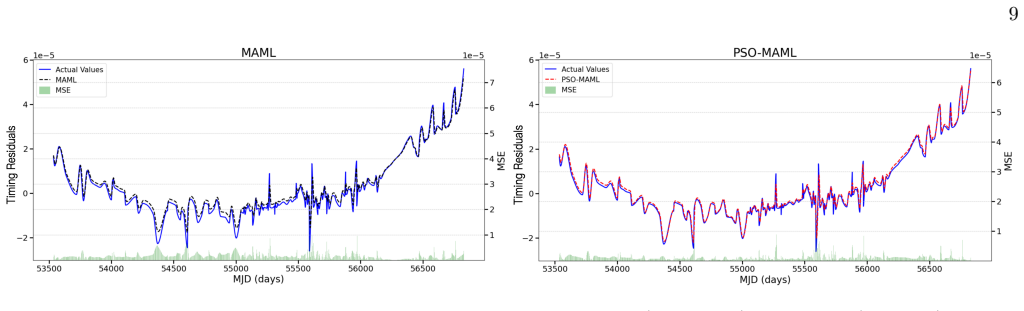
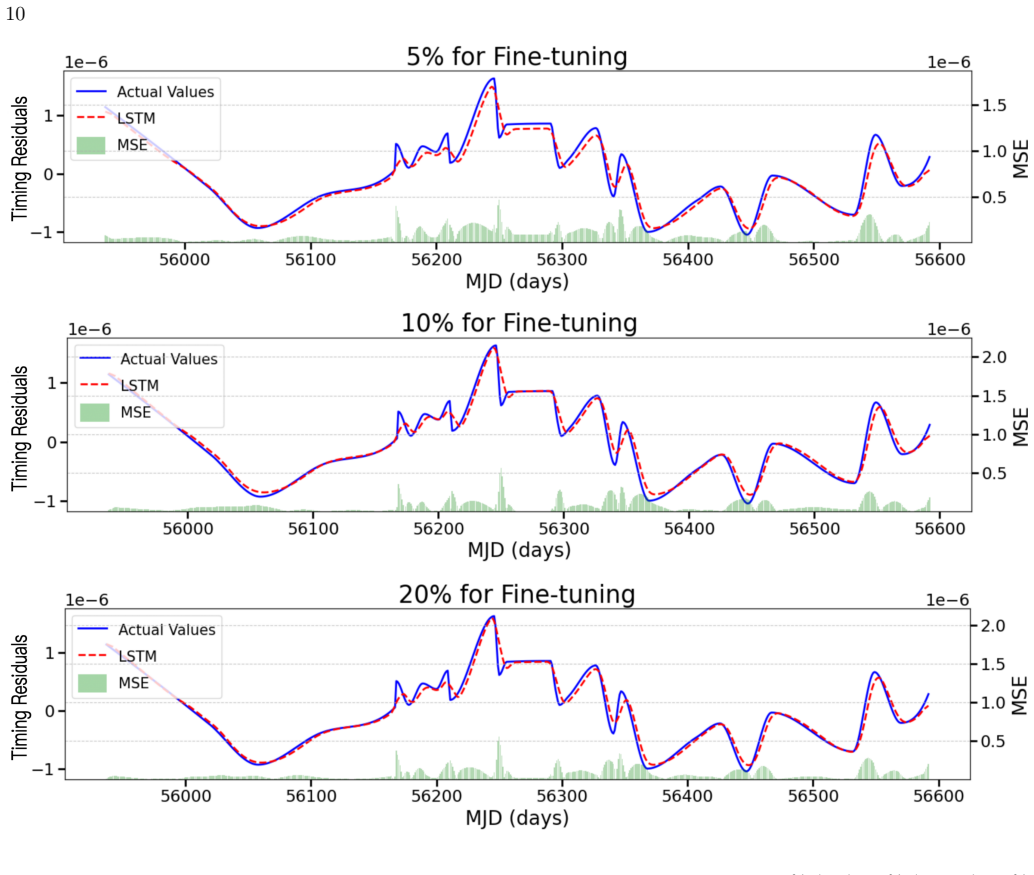
An LSTM network initialized via model-agnostic meta-learning produces accurate few-shot predictions of pulsar timing residuals across high-frequency test domains after fine-tuning on only 10 percent of the residuals from those domains, achieving good results on three metrics while using 16.86 MB CPU memory and 18 milliseconds per single-step prediction.
What carries the argument
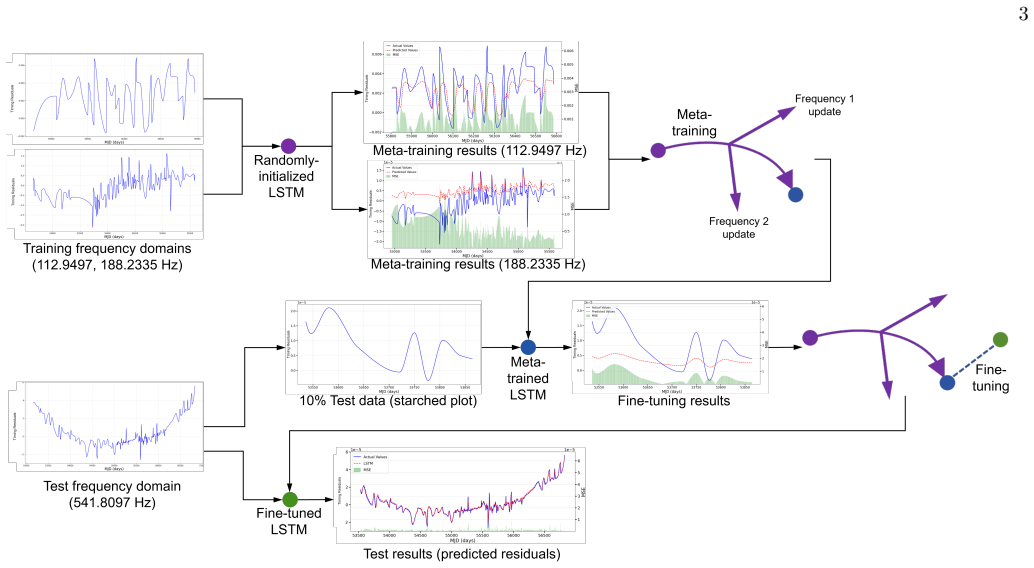
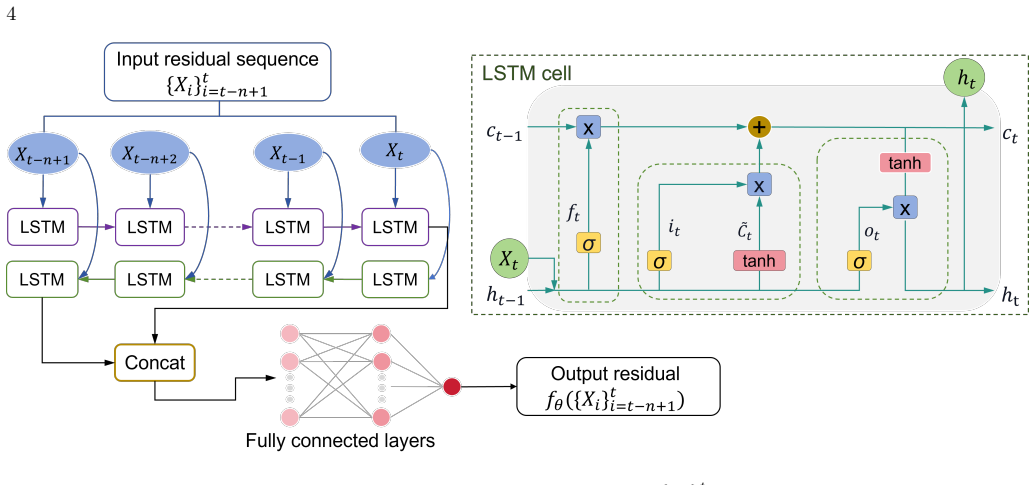
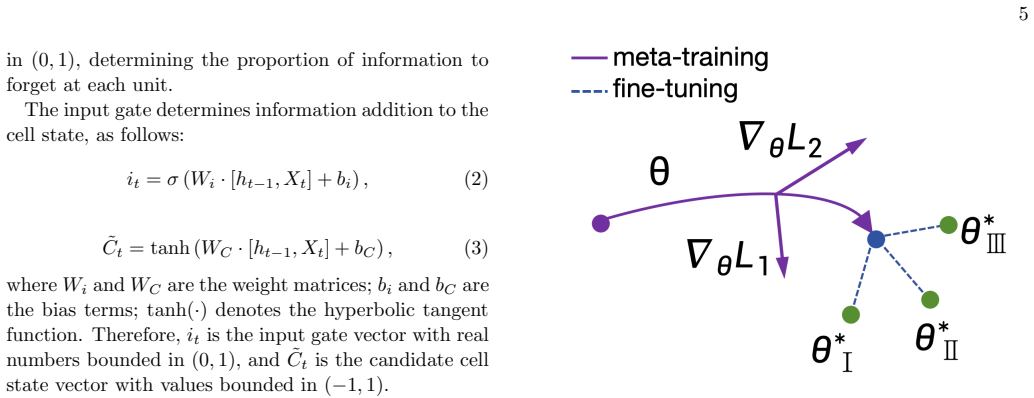
Model-agnostic meta-learning applied to an LSTM network, which searches for an initialization that supports rapid adaptation to new frequency domains with few ground-truth examples.
If this is right
- Accurate predictions hold across three metrics in high-frequency test frequency domains.
- Only 10 percent of timing residuals from the target domains are needed for fine-tuning.
- The network remains lightweight at 16.86 MB CPU memory and 18 ms per prediction step.
- The same initialization supports rapid adaptation to additional new frequency domains.
- Particle swarm optimization improves hyperparameter selection for better accuracy.
Where Pith is reading between the lines
- The method could lower the observational burden needed to build reliable noise models for pulsar timing arrays.
- Similar meta-learning setups might transfer to other sparse time-series tasks where domains differ by frequency content.
- If the shared-structure assumption is only partially true, performance could degrade for pulsars with very different noise characteristics.
- Testing the same pipeline on additional pulsar timing array releases would show whether the 10-percent threshold generalizes.
Load-bearing premise
Timing residuals from different spin-frequency subgroups share enough common statistical structure that meta-learning on some domains yields an initialization that adapts well to others with only a few examples.
What would settle it
The meta-learned LSTM fails to match the reported prediction accuracy on high-frequency domains even after fine-tuning on 10 percent of the residuals, or requires substantially more than 10 percent of the data to reach comparable performance.
Figures
read the original abstract
This work proposes a novel solution to predict pulsar timing residuals with limited data, addressing the critical challenge of data scarcity across spin-frequency subgroups of millisecond pulsars in PTA datasets. The proposed solution applies a Long Short-Term Memory (LSTM) network optimized using the model-agnostic meta-learning algorithm, enabling rapid adaptation to new frequency domain by fine-tuning the LSTM network with only a few-shot of ground truth timing residuals. Particle swarm optimization algorithm is also used for automatic hyperparameter optimization, leading to improved prediction accuracy. Our solution, evaluated on the second data release of the International Pulsar Timing Array (IPTA), demonstrates robust generalization with accurate predictions in three metrics across high-frequency test frequency domains, while requiring only 10% of the timing residuals from these domains for model fine-tuning. Furthermore, our lightweight structure only costs 16.86 MB CPU memory and 18 milliseconds for single-step residual prediction. All these characteristics make our solution highly suitable for real-world applications, where effective and real-time predictions of pulsar timing residuals are essential-particularly in resource-constrained environments with limited computational power, memory, or energy availability.
Editorial analysis
A structured set of objections, weighed in public.
Referee Report
Summary. The manuscript proposes an LSTM network trained via model-agnostic meta-learning (MAML) plus particle-swarm hyperparameter optimization to predict pulsar timing residuals. It claims that the resulting initialization enables accurate few-shot adaptation to high-frequency spin-frequency subgroups in the IPTA DR2 release, achieving good performance in three unspecified metrics after fine-tuning on only 10 % of the target-domain residuals, while remaining lightweight (16.86 MB CPU memory, 18 ms per prediction).
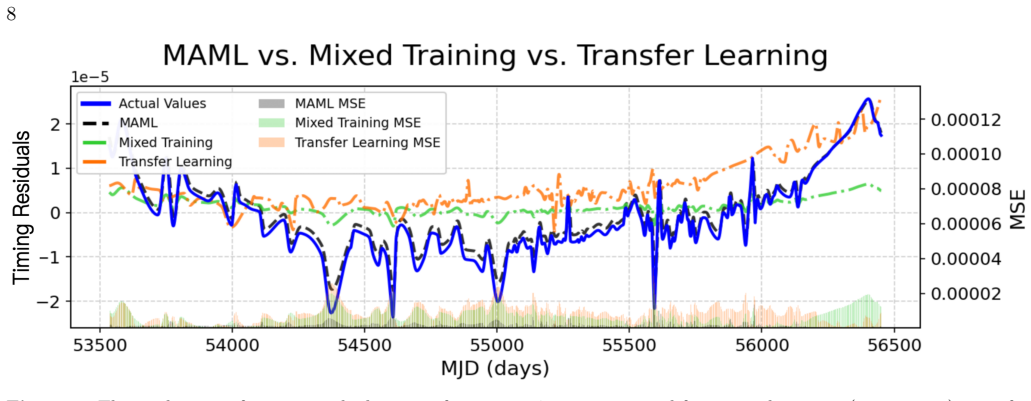
Significance. If the central claim is substantiated with proper controls, the work would address a genuine data-scarcity issue in pulsar-timing-array analyses and could be practically useful in resource-constrained settings. The lightweight footprint is a concrete strength. At present, however, the absence of any baseline, ablation, or cross-subgroup similarity analysis prevents an assessment of whether the reported gains are attributable to meta-learning rather than to the LSTM capacity itself.
major comments (3)
- [Abstract] Abstract: the headline claim of 'robust generalization with accurate predictions in three metrics' is unsupported by any numerical values, error bars, or comparison to non-meta-learning LSTM baselines trained from scratch on the target domains; without these the 10 % fine-tuning result cannot be attributed to the MAML initialization.
- [Abstract] Abstract: the premise that timing residuals across spin-frequency subgroups share sufficient statistical structure for MAML to produce a useful initialization is stated but never tested (no power-spectrum comparison, no autocorrelation analysis, no ablation that removes the meta-learning step). This assumption is load-bearing for the few-shot adaptation claim.
- [Abstract] Abstract: the evaluation protocol (train/test split across frequency subgroups, exact shot count, validation procedure) is not described, preventing verification that the reported generalization is not an artifact of the particular IPTA DR2 partition chosen.
minor comments (2)
- [Abstract] Typo: 'essential-particularly' should read 'essential, particularly'.
- [Abstract] The phrase 'only a few-shot of ground truth timing residuals' is imprecise; the exact number of shots or samples used for fine-tuning should be stated explicitly.
Simulated Author's Rebuttal
We thank the referee for the constructive comments. The points raised highlight important aspects of clarity and substantiation that we will address in the revision. Below we respond to each major comment and indicate the planned changes.
read point-by-point responses
-
Referee: [Abstract] Abstract: the headline claim of 'robust generalization with accurate predictions in three metrics' is unsupported by any numerical values, error bars, or comparison to non-meta-learning LSTM baselines trained from scratch on the target domains; without these the 10 % fine-tuning result cannot be attributed to the MAML initialization.
Authors: We agree that the abstract would be strengthened by including concrete numerical results and baseline comparisons. In the revised manuscript we will update the abstract to report the specific values and standard deviations for the three metrics (MSE, MAE, RMSE) obtained after 10% fine-tuning, and we will add explicit comparisons against LSTM models trained from scratch on the target domains. A new results subsection will present these numbers in tabular form with error bars from repeated runs. revision: yes
-
Referee: [Abstract] Abstract: the premise that timing residuals across spin-frequency subgroups share sufficient statistical structure for MAML to produce a useful initialization is stated but never tested (no power-spectrum comparison, no autocorrelation analysis, no ablation that removes the meta-learning step). This assumption is load-bearing for the few-shot adaptation claim.
Authors: We concur that an explicit test of the shared-structure assumption would improve the paper. We will add an ablation experiment that trains an identical LSTM architecture from random initialization (i.e., without the MAML step) on the same 10% target data and compares performance. We will also include power-spectrum and autocorrelation analyses comparing residuals across the spin-frequency subgroups to document the statistical similarities that MAML exploits. revision: yes
-
Referee: [Abstract] Abstract: the evaluation protocol (train/test split across frequency subgroups, exact shot count, validation procedure) is not described, preventing verification that the reported generalization is not an artifact of the particular IPTA DR2 partition chosen.
Authors: We acknowledge that the current description of the experimental protocol is insufficient for reproducibility. In the revised manuscript we will expand the Methods and Experimental Setup sections to specify the exact partitioning of IPTA DR2 into meta-training and meta-test frequency subgroups, confirm that fine-tuning uses precisely 10% of each target-domain time series, and detail the validation procedure (including any hold-out sets or cross-validation folds) used to guard against partition-specific artifacts. revision: yes
Circularity Check
No circularity: standard LSTM+MAML application on observational data
full rationale
The paper applies a conventional meta-learning pipeline (LSTM optimized by MAML, with PSO for hyperparameters) to predict timing residuals on IPTA DR2 splits. The reported metrics are standard held-out prediction errors (three unspecified metrics on high-frequency domains after 10% fine-tuning). No equations, derivations, or self-citations are presented that define a target quantity in terms of the fitted parameters themselves, nor does any load-bearing step reduce by construction to the training inputs. The central claim is an empirical performance result on external data partitions, which is self-contained against benchmarks and does not invoke uniqueness theorems or ansatzes from prior author work.
Axiom & Free-Parameter Ledger
free parameters (2)
- LSTM architecture and learning rates
- Number of shots for fine-tuning
axioms (1)
- domain assumption Timing residuals in different frequency domains share transferable structure amenable to meta-learning
Reference graph
Works this paper leans on
-
[1]
Journal of Time and Frequency , year =
Zhehao Zhang and Minglei Tong and Chengshi Zhao and others , title =. Journal of Time and Frequency , year =
-
[2]
Shannon, R. M. and Ravi, V. and Lentati, L. T. and et al. , title =. Science , year =
-
[3]
Manchester, R. N. and Hobbs, G. and Bailes, M. and et al. , title =. Publications of the Astronomical Society of Australia , year =
-
[4]
and Kaplan, D
Susobhanan, A. and Kaplan, D. L. and Archibald, A. M. and et al. , title =. The Astrophysical Journal , year =
-
[5]
Hellings, R. W. and Downs, G. S. , title =. Astrophysical Journal, Part 2-Letters to the Editor , year =
-
[6]
Applied Sciences , VOLUME =
Jain, Meetu and Saihjpal, Vibha and Singh, Narinder and Singh, Satya Bir , TITLE =. Applied Sciences , VOLUME =. 2022 , NUMBER =
2022
-
[7]
Applied Physics , volume=
Research Progress on X-ray Pulsar Navigation Detectors , author=. Applied Physics , volume=. 2023 , publisher=
2023
-
[8]
The Astrophysical Journal , volume =
Lynch, R S and Swiggum, J K and Kondratiev, V I and Kaplan, D L and Stovall, K and Fonseca, E and Roberts, M S E and DeCesar, M E and Levin, L and Rosen, R and others , title =. The Astrophysical Journal , volume =. 2018 , month =. doi:10.3847/1538-4357/aabf8a , url =
-
[9]
doi:10.1093/mnras/stz2857 , eprint =
Perera, B B P and DeCesar, M E and Demorest, P B and Kerr, M and Lentati, L and Nice, D J and Os. The International Pulsar Timing Array: second data release , journal =. 2019 , month =. doi:10.1093/mnras/stz2857 , url =
-
[10]
The Astrophysical Journal , volume=
Enhancing Pulsar Candidate Identification with Self-tuning Pseudolabeling Semisupervised Learning , author=. The Astrophysical Journal , volume=. 2024 , publisher=
2024
-
[11]
and Sahoo, Jyoti Prakash , title =
Song, Yisheng and Wang, Ting and Cai, Puyu and Mondal, Subrota K. and Sahoo, Jyoti Prakash , title =. 2023 , issue_date =. doi:10.1145/3582688 , journal =
-
[12]
Machine Learning , volume=
Are LSTMs good few-shot learners? , author=. Machine Learning , volume=. 2023 , publisher=
2023
-
[13]
Monthly Notices of the Royal Astronomical Society , volume =
Vela pulsar: single pulses analysis with machine learning techniques , author =. Monthly Notices of the Royal Astronomical Society , volume =
-
[14]
Neural Computation , volume =
Long short-term memory , author =. Neural Computation , volume =
-
[15]
Supervised sequence labelling with recurrent neural networks , pages=
Long short-term memory , author=. Supervised sequence labelling with recurrent neural networks , pages=. 2012 , publisher=
2012
-
[16]
Soft computing , volume=
Particle swarm optimization algorithm: an overview , author=. Soft computing , volume=. 2018 , publisher=
2018
-
[17]
and Babak, S
Antoniadis, J. and Babak, S. and Nielsen, A. S. B. and. The Second Data Release from the European Pulsar Timing Array: The Dataset and Timing Analysis , journal =. 2023 , volume =
2023
-
[18]
and Brazier, A
Arzoumanian, Z. and Brazier, A. and Burke-Spolaor, S. and. The NANOGrav Nine-year Data Set: Observations, Arrival Time Measurements, and Analysis of 37 Millisecond Pulsars , journal =. 2015 , volume =
2015
-
[19]
Physics (China) , year =
Zhu, Xingjiang , title =. Physics (China) , year =
-
[20]
Proceedings of the 50th annual precise time and time interval systems and applications meeting , pages=
PulChron: A pulsar time scale demonstration for PNT systems , author=. Proceedings of the 50th annual precise time and time interval systems and applications meeting , pages=
-
[21]
The Astrophysical Journal , volume=
An improved wiener filtration method for constructing the ensemble pulsar timescale , author=. The Astrophysical Journal , volume=. 2024 , publisher=
2024
-
[22]
Timing noise, periodic modulation, and proper motion , author=
Timing of young radio pulsars--I. Timing noise, periodic modulation, and proper motion , author=. Monthly Notices of the Royal Astronomical Society , volume=. 2019 , publisher=
2019
-
[23]
The Astrophysical Journal , volume=
Assessing the role of spin noise in the precision timing of millisecond pulsars , author=. The Astrophysical Journal , volume=. 2010 , publisher=
2010
-
[24]
Journal of Astrophysics and Astronomy , volume=
Arrival-time analysis for a millisecond pulsar , author=. Journal of Astrophysics and Astronomy , volume=. 1984 , publisher=
1984
-
[25]
The Astrophysical Journal , volume=
Precision timing of PSR J0437--4715: an accurate pulsar distance, a high pulsar mass, and a limit on the variation of Newton’s gravitational constant , author=. The Astrophysical Journal , volume=. 2008 , publisher=
2008
-
[26]
Monthly Notices of the Royal Astronomical Society , volume=
Vela pulsar: single pulses analysis with machine learning techniques , author=. Monthly Notices of the Royal Astronomical Society , volume=. 2022 , publisher=
2022
-
[27]
Monthly Notices of the Royal Astronomical Society , volume=
The international pulsar timing array: first data release , author=. Monthly Notices of the Royal Astronomical Society , volume=. 2016 , publisher=
2016
-
[28]
High-Precision Timing of Millisecond Pulsars. III. Long-Term Monitoring of PSRs B1855+09 and B1937+21. , keywords =. doi:10.1086/174280 , adsurl =
-
[29]
The Astrophysical Journal , volume=
Testing theories of gravitation using 21-year timing of pulsar binary J1713+ 0747 , author=. The Astrophysical Journal , volume=. 2015 , publisher=
2015
-
[30]
Monthly Notices of the Royal Astronomical Society , volume=
From spin noise to systematics: stochastic processes in the first International Pulsar Timing Array data release , author=. Monthly Notices of the Royal Astronomical Society , volume=. 2016 , publisher=
2016
-
[31]
Monthly Notices of the Royal Astronomical Society , volume=
Limitations in timing precision due to single-pulse shape variability in millisecond pulsars , author=. Monthly Notices of the Royal Astronomical Society , volume=. 2014 , publisher=
2014
-
[32]
Proceedings of the 54th annual meeting of the association for computational linguistics (volume 2: Short papers) , pages=
Attention-based bidirectional long short-term memory networks for relation classification , author=. Proceedings of the 54th annual meeting of the association for computational linguistics (volume 2: Short papers) , pages=
-
[33]
Proceedings of the 29th Pacific Asia conference on language, information and computation , pages=
Bidirectional long short-term memory networks for relation classification , author=. Proceedings of the 29th Pacific Asia conference on language, information and computation , pages=
-
[34]
Data Mining and Knowledge Discovery , volume=
Inceptiontime: Finding alexnet for time series classification , author=. Data Mining and Knowledge Discovery , volume=. 2020 , publisher=
2020
-
[35]
Advances in neural information processing systems , volume=
Generative adversarial nets , author=. Advances in neural information processing systems , volume=
-
[36]
Advances in neural information processing systems , volume=
Denoising diffusion probabilistic models , author=. Advances in neural information processing systems , volume=
-
[37]
International conference on machine learning , pages=
Model-agnostic meta-learning for fast adaptation of deep networks , author=. International conference on machine learning , pages=. 2017 , organization=
2017
-
[38]
Proceedings of the genetic and evolutionary computation conference , pages=
Particle swarm optimization for hyper-parameter selection in deep neural networks , author=. Proceedings of the genetic and evolutionary computation conference , pages=
-
[39]
Monthly Notices of the Royal Astronomical Society , volume=
Pulsar timing analysis in the presence of correlated noise , author=. Monthly Notices of the Royal Astronomical Society , volume=. 2011 , publisher=
2011
-
[40]
Physical Review D—Particles, Fields, Gravitation, and Cosmology , volume=
Hyper-efficient model-independent Bayesian method for the analysis of pulsar timing data , author=. Physical Review D—Particles, Fields, Gravitation, and Cosmology , volume=. 2013 , publisher=
2013
-
[41]
Monthly Notices of the Royal Astronomical Society , volume=
Understanding and analysing time-correlated stochastic signals in pulsar timing , author=. Monthly Notices of the Royal Astronomical Society , volume=. 2013 , publisher=
2013
-
[42]
Monthly Notices of the Royal Astronomical Society , volume=
Analysing radio pulsar timing noise with a Kalman filter: a demonstration involving PSR J1359- 6038 , author=. Monthly Notices of the Royal Astronomical Society , volume=. 2024 , publisher=
2024
-
[43]
IEEE Transactions on Pattern Analysis and Machine Intelligence , volume =
Shipeng Wang and others , title =. IEEE Transactions on Pattern Analysis and Machine Intelligence , volume =. 2021 , doi =
2021
-
[44]
Monthly Notices of the Royal Astronomical Society , volume=
The International Pulsar Timing Array second data release: Search for an isotropic gravitational wave background , author=. Monthly Notices of the Royal Astronomical Society , volume=. 2022 , publisher=
2022
-
[45]
Journal of the Operations Research Society of China , volume =
Ruo-Yu Sun , title =. Journal of the Operations Research Society of China , volume =. 2020 , doi =
2020
-
[46]
Astrophysical Journal, Part 1 (ISSN 0004-637X), vol
Timing properties of PSR 1951+ 32 in the CTB 80 supernova remnant , author=. Astrophysical Journal, Part 1 (ISSN 0004-637X), vol. 356, June 10, 1990, p. 243-249. , volume=
1951
-
[47]
Opportunities for detecting ultralong gravitational waves , author=. Sov. Astron , volume=
-
[48]
II-Trajectories plunging into a nonrotating hole , author=
Black holes and gravitational waves. II-Trajectories plunging into a nonrotating hole , author=. Astrophysical Journal, Part 1, vol. 231, July 1, 1979, p. 211-218. , volume=
1979
-
[49]
The Astrophysical Journal , volume=
Constraining the properties of supermassive black hole systems using pulsar timing: application to 3C 66B , author=. The Astrophysical Journal , volume=. 2004 , publisher=
2004
-
[50]
The Astrophysical Journal Letters , volume=
The NANOGrav 15 yr data set: observations and timing of 68 millisecond pulsars , author=. The Astrophysical Journal Letters , volume=. 2023 , publisher=
2023
-
[51]
Understanding and analysing time-correlated stochastic signals in pulsar timing , volume=
van Haasteren, Rutger and Levin, Yuri , year=. Understanding and analysing time-correlated stochastic signals in pulsar timing , volume=. Monthly Notices of the Royal Astronomical Society , publisher=. doi:10.1093/mnras/sts097 , number=
-
[52]
Physical Review D , volume=
New advances in the Gaussian-process approach to pulsar-timing data analysis , author=. Physical Review D , volume=. 2014 , publisher=
2014
discussion (0)
Sign in with ORCID, Apple, or X to comment. Anyone can read and Pith papers without signing in.