Molecular neutron spectroscopy techniques applied to ceramics α-SiC and β-Ga₂O₃
Pith reviewed 2026-06-28 09:16 UTC · model grok-4.3
The pith
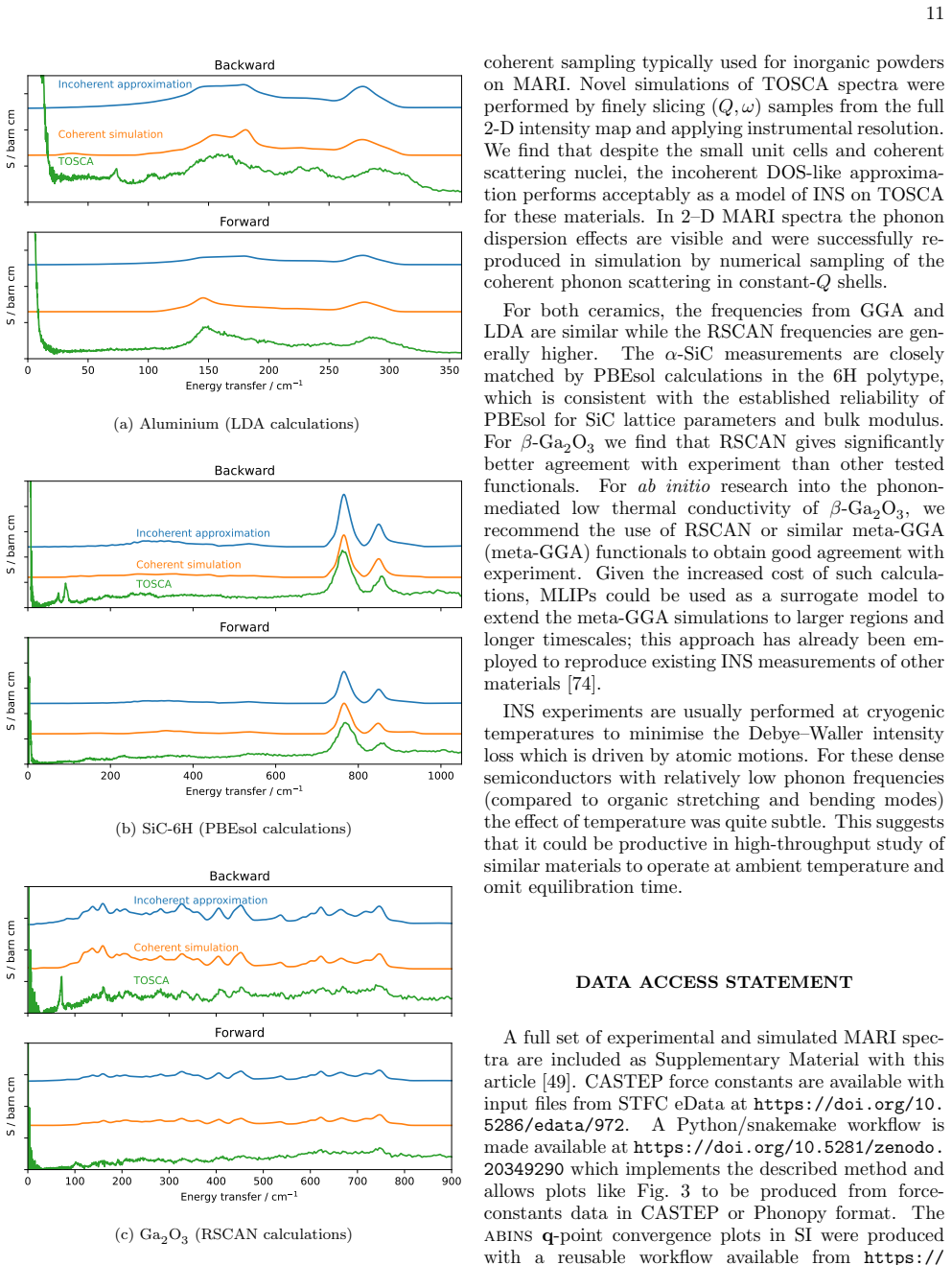
The standard incoherent approximation for neutron spectra matches experiments and exact calculations on two difficult ceramic powders.
A machine-rendered reading of the paper's core claim, the machinery that carries it, and where it could break.
Core claim
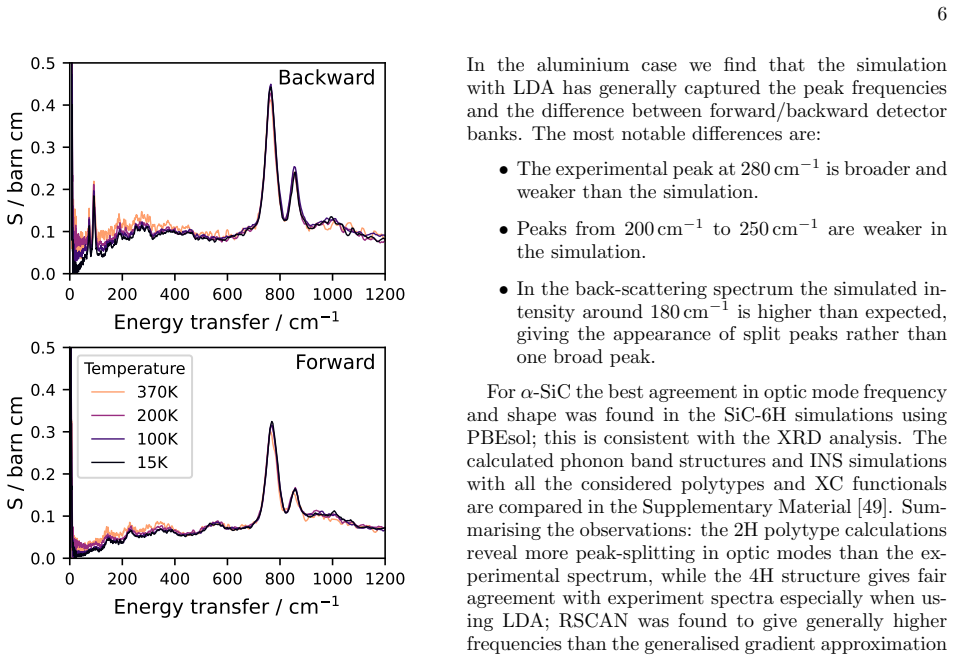
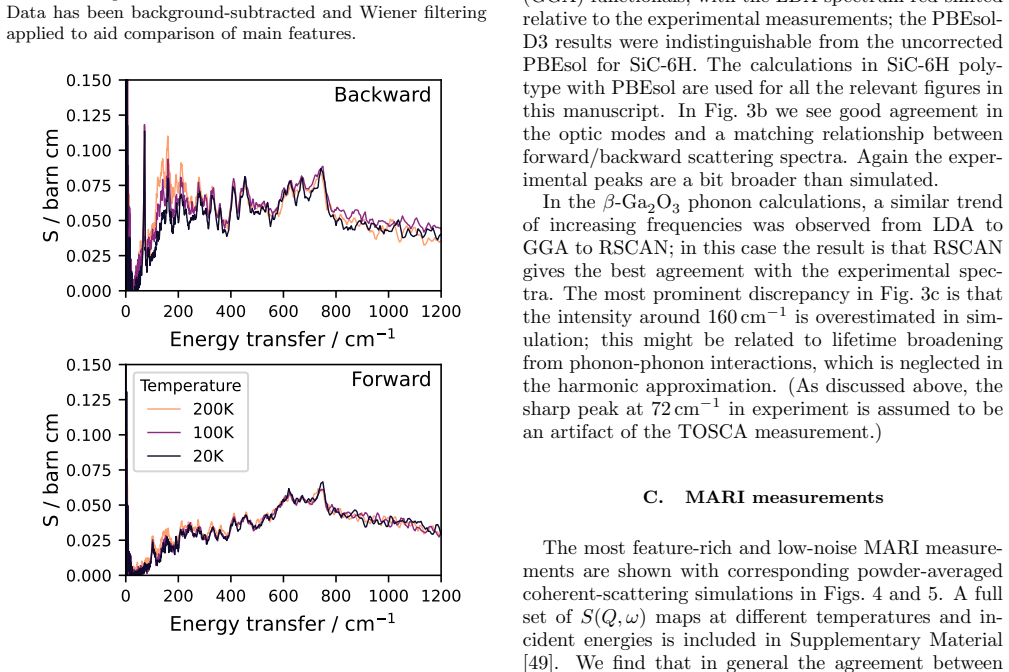
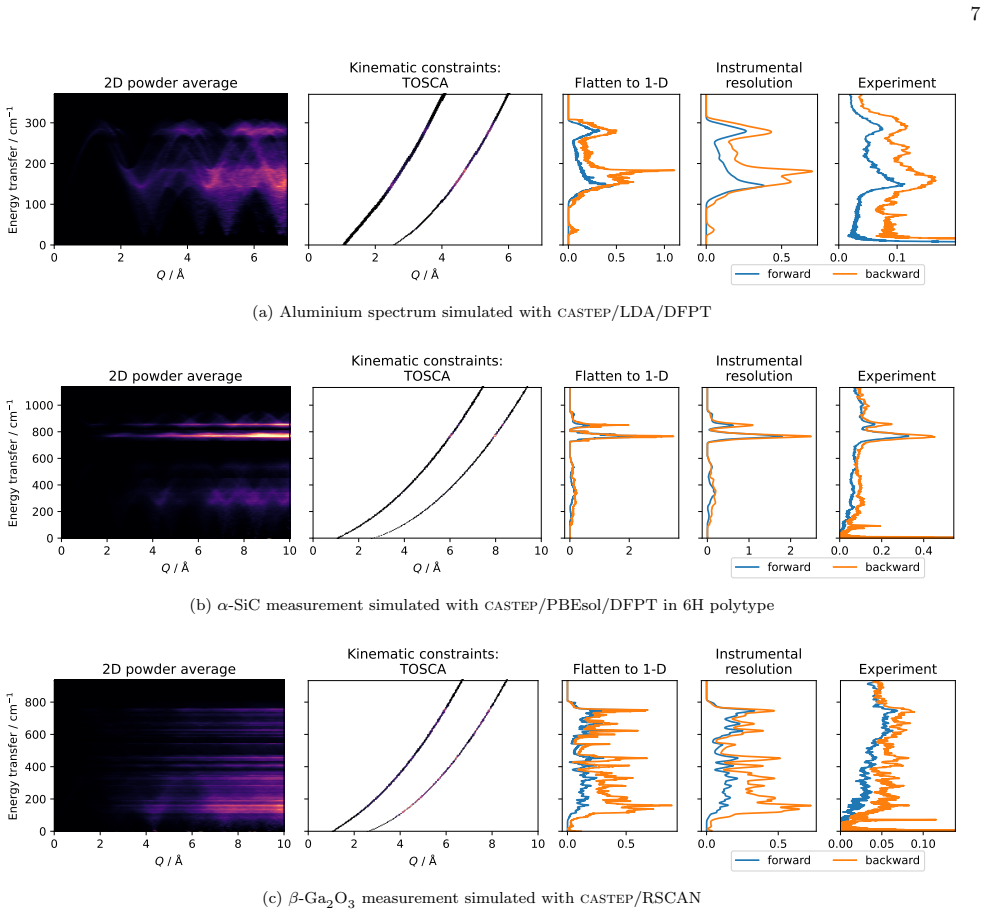
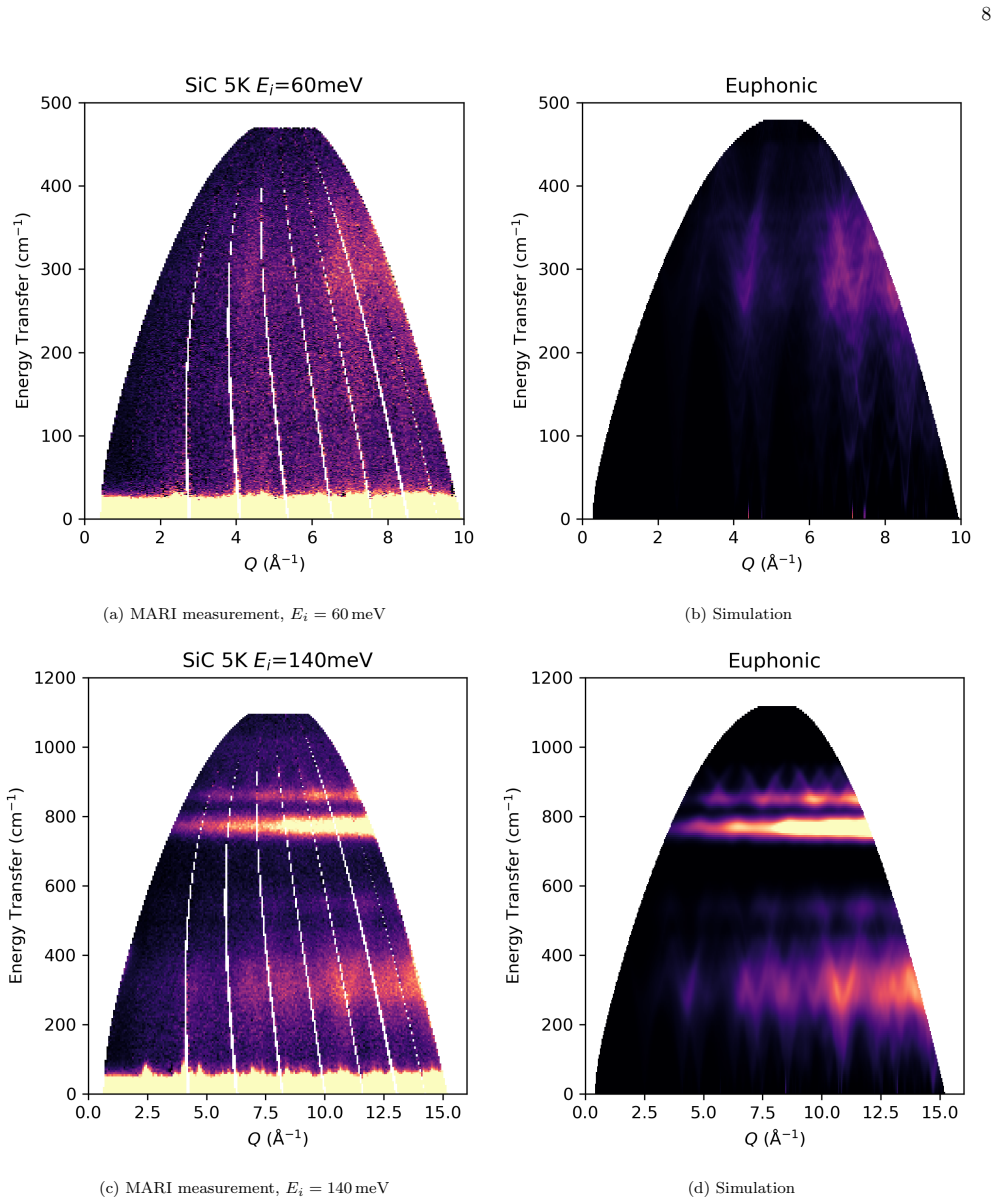
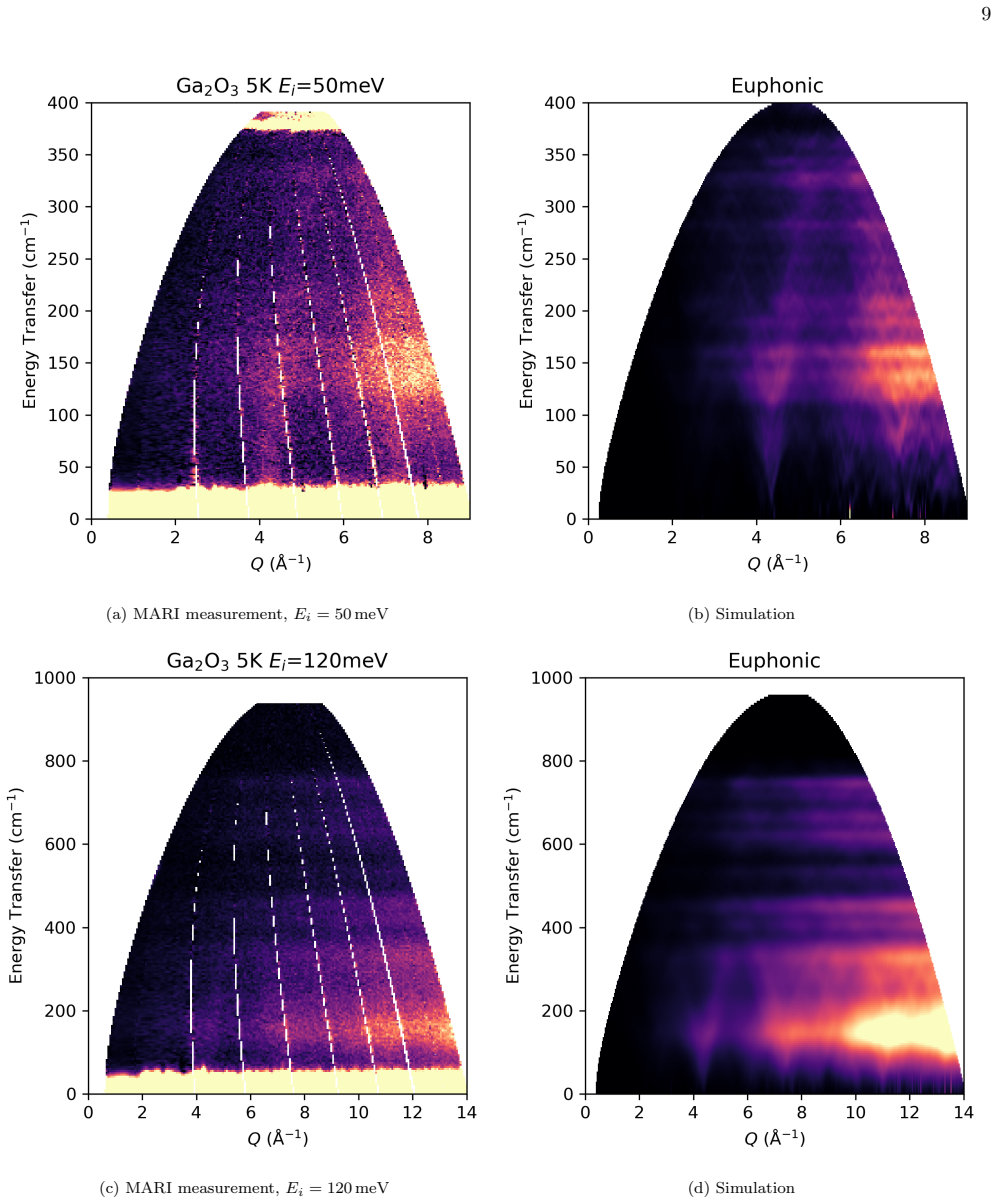
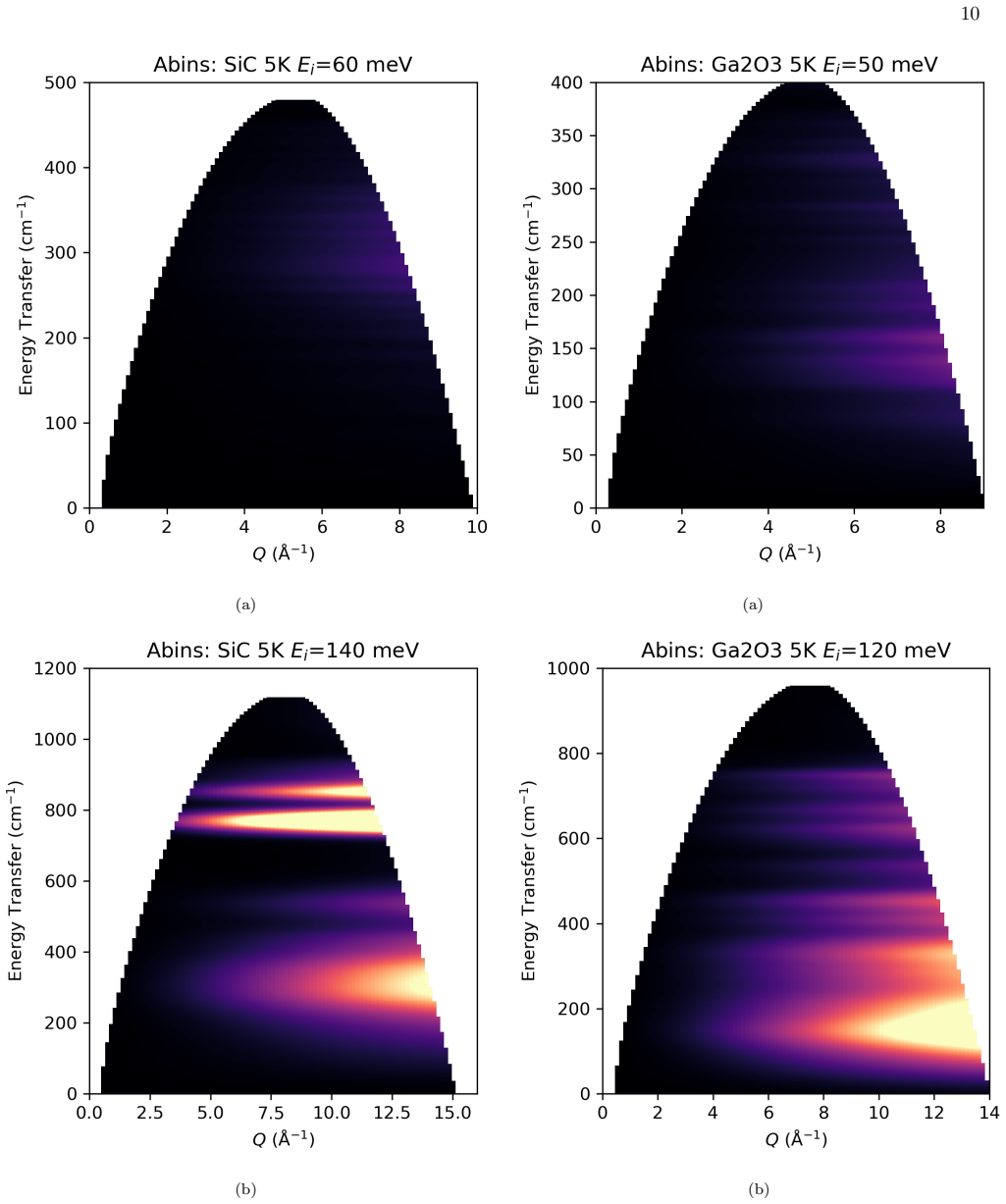
For 1-D powder spectra from a compact instrument, the approximate simulations are easily comparable with experimental spectra and give similar results to a more computationally-intensive numerical sampling of the coherent spectrum. Given the success with these systems, the approximate method appears to be suitable for modelling inelastic neutron scattering by harmonic phonons of almost any powder sample with this technique. When a Q-resolved instrument is used to collect the 2-D dynamical structure factor S(Q,ω), numerical averaging is still required. Simulations of α-SiC using the PBEsol functional agreed with experiment while RSCAN performed best for β-Ga₂O₃.
What carries the argument
The incoherent approximation for computing the one-dimensional dynamical structure factor S(ω) from powder inelastic neutron scattering.
If this is right
- The incoherent approximation can be used for 1-D spectra of almost any powder sample with harmonic phonons.
- It yields results similar to full coherent sampling without the extra computational cost.
- The PBEsol functional gives good agreement for α-SiC in the 6H polytype.
- The RSCAN functional is recommended for lattice-dynamics work on β-Ga₂O₃.
- Numerical averaging over Q is still required to capture features in 2-D S(Q,ω) data.
Where Pith is reading between the lines
- The same validation approach could be applied to other classes of solids to confirm the generalization.
- Material-specific choice of density functional may still need separate checks even when the approximation is adopted.
- Systems with significant anharmonicity could be tested to find where the harmonic assumption breaks down.
- The method might simplify analysis pipelines for industrial ceramics and related materials.
Load-bearing premise
That success on these two ceramics as representative worst-case systems means the approximation works for almost any powder sample.
What would settle it
A powder sample in which the incoherent approximation produces spectra that differ substantially from both the experimental data and a full coherent numerical calculation would disprove the broad suitability claim.
Figures
read the original abstract
Neutron spectroscopy is a powerful technique for determining the vibrational states of matter. Instruments with fixed geometry may measure inelastic scattering at a limited set of angles, producing a 1-D spectrum $S(\omega)$. Such measurements are usually simulated in a DOS-like semi-analytic incoherent approximation, well-established for study of bending/stretching modes in molecular crystals. In this work we empirically test the simulation method for two ceramics with industrial electronic applications that act as "worst-case" systems. The phonon scattering from $\alpha$-SiC and $\beta$-Ga$_2$O$_3$ is coherent, depends on momentum transfer $Q$ and sits in frequencies below the typical "fingerprint" range of molecular spectroscopy. Inelastic neutron-scattering measurements of powders were performed with two contrasting spectrometers at cryogenic and elevated temperatures, and simulations performed using a variety of density-functional approximations. We find that for 1-D powder spectra from a compact instrument, the approximate simulations are easily comparable with experimental spectra and give similar results to a more computationally-intensive numerical sampling of the coherent spectrum. Given the success with these systems, the approximate method appears to be suitable for modelling inelastic neutron scattering by harmonic phonons of almost any powder sample with this technique. When a $Q$-resolved instrument is used to collect the 2-D dynamical structure factor $S(Q,\omega)$, numerical averaging is still required to capture phonon features. Our simulations of inelastic scattering from $\alpha$-SiC in the 6H polytype using the PBEsol functional gave good agreement with the experiments. By contrast, the RSCAN functional gave the best agreement with the measured spectra of $\beta$-Ga$_2$O$_3$ and is recommended for future work on the lattice dynamics of this material.
Editorial analysis
A structured set of objections, weighed in public.
Referee Report
Summary. The manuscript reports inelastic neutron scattering (INS) measurements on powder samples of α-SiC (6H) and β-Ga₂O₃ using two spectrometers at cryogenic and elevated temperatures. It compares experimental 1D S(ω) spectra to simulations based on DFT phonon calculations (PBEsol, rSCAN, etc.), testing a standard DOS-like incoherent approximation against more intensive numerical sampling of the full coherent dynamical structure factor. The paper finds good agreement between the approximation, full calculations, and data for these materials, concludes that the approximation is suitable for modeling harmonic phonon INS in almost any powder sample with compact instruments, and recommends rSCAN for future β-Ga₂O₃ work while noting that Q-resolved 2D S(Q,ω) data still require numerical averaging.
Significance. If the empirical comparisons hold, the work provides concrete validation that a computationally lightweight incoherent approximation yields spectra comparable to full coherent sampling for 1D powder INS, which could streamline analysis for molecular and materials spectroscopy. Credit is due for the use of two independent spectrometers, multiple DFT functionals, and direct approximate-vs-full numerical tests on coherent, low-frequency systems. The broad claim of applicability to nearly all powders, however, rests on the representativeness of only two ceramics without additional bounding cases or arguments.
major comments (2)
- [Abstract] Abstract: The central claim that success on α-SiC and β-Ga₂O₃ implies the approximate method is suitable for 'almost any powder sample' is load-bearing yet unsupported; the manuscript provides no argument, dispersion analysis, or additional test cases showing that the chosen materials bound possible deviations arising from flatter dispersions, stronger zone-boundary effects, or differing nuclear scattering lengths.
- [Abstract] Abstract and introduction: The designation of α-SiC and β-Ga₂O₃ as 'worst-case' systems due to coherent, Q-dependent, low-frequency scattering is asserted without quantitative justification or comparison to other classes of solids that might exhibit larger incoherent-approximation errors.
minor comments (1)
- [Introduction] The title refers to 'molecular neutron spectroscopy techniques' applied to ceramics; a brief clarification in the introduction on how the molecular-crystal approximation extends to these inorganic systems would improve context.
Simulated Author's Rebuttal
We thank the referee for their careful review and for recognizing the value of the empirical comparisons. We address the major comments point by point below.
read point-by-point responses
-
Referee: [Abstract] Abstract: The central claim that success on α-SiC and β-Ga₂O₃ implies the approximate method is suitable for 'almost any powder sample' is load-bearing yet unsupported; the manuscript provides no argument, dispersion analysis, or additional test cases showing that the chosen materials bound possible deviations arising from flatter dispersions, stronger zone-boundary effects, or differing nuclear scattering lengths.
Authors: α-SiC and β-Ga₂O₃ were selected because they combine fully coherent scattering (no dominant hydrogen incoherent cross-section), low-frequency lattice modes, and multiple nuclear scattering lengths, conditions expected to maximize any errors from the incoherent approximation. The manuscript shows that even under these conditions the 1-D powder spectra from the approximation match both experiment and full coherent sampling. While a systematic dispersion analysis or additional materials are not included, the physical motivation and the quantitative agreement obtained provide the supporting argument for the stated applicability to harmonic phonons in most powder samples measured on compact instruments. revision: no
-
Referee: [Abstract] Abstract and introduction: The designation of α-SiC and β-Ga₂O₃ as 'worst-case' systems due to coherent, Q-dependent, low-frequency scattering is asserted without quantitative justification or comparison to other classes of solids that might exhibit larger incoherent-approximation errors.
Authors: The designation follows from the contrast with the molecular systems for which the approximation is already standard: those systems are dominated by incoherent scattering from hydrogen and have localized high-frequency modes, whereas the chosen ceramics have only coherent scatterers and extended low-frequency phonons where Q-dependence and interference effects are more pronounced. The paper demonstrates that the approximation nevertheless reproduces both the measured 1-D spectra and the numerically averaged coherent dynamical structure factor. No direct numerical comparison to other solid classes is provided, but the success in these physically motivated challenging cases underpins the broader conclusion. revision: no
Circularity Check
No circularity: empirical comparisons to experiment and full simulations are independent of inputs
full rationale
The paper's central result rests on direct experimental inelastic neutron scattering data collected on two spectrometers for α-SiC and β-Ga₂O₃, together with side-by-side comparison of the incoherent approximation against both those data and a separate, more expensive numerical sampling of the coherent dynamical structure factor. No equation or claim reduces a prediction to a fitted parameter, self-definition, or self-citation chain; the generalization to 'almost any powder sample' is an explicit extrapolation from the tested cases rather than a definitional identity. The derivation chain is therefore self-contained against external benchmarks.
Axiom & Free-Parameter Ledger
axioms (2)
- domain assumption Vibrational states can be modeled as harmonic phonons
- domain assumption The semi-analytic incoherent approximation is adequate for 1-D powder spectra even in coherent systems
Reference graph
Works this paper leans on
-
[1]
Al Phonons for the aluminium sample container were calculated within the LDA with DFPT/NCP as this has previously shown good agreement with experiment for INS simulations usingeuphonic[5]. The primi- tive cell of FCC Al was used with lattice parameter a= 4.0323 ˚A; this was assumed to be representative at low temperature, as a rough median value between r...
-
[2]
Abins” algorithm) or in an ac- cessible (ω,q) region (for MARI, with the “Abins2D
Incoherent approximation The calculated force constants were analyzed with the abinsroutine included inmantidversion 6.12. This makes an incoherent DOS-like approximation as de- scribed in Section I B: the whole Brillouin zone is sam- pled usingeuphonicto obtain frequencies and eigen- vectors, instrument constraints are considered and the intensity is cal...
-
[3]
2019, APLpy v2.0: The Astronomical Plotting Library in Python, doi: 10.5281/zenodo
Numerical sampling of coherent spectrum A Python/Snakemake workflow has been written, making use of recent improvements to theeuphonic library [5, 72]. The coherent scattering spectrum is cal- culated in “shells” of quasi-randomq-points to obtain a numerical powder-averaged spectrum inS(Q, ω). The S(Q, ω) lines accessible to TOSCA are drawn from this grid...
-
[4]
Recent and future developments on TOSCA at ISIS.Journal of Physics: Conference Series, 554:012003, November 2014
Stewart F Parker, Felix Fernandez-Alonso, Anibal J Ramirez-Cuesta, John Tomkinson, Svemir Rudic, Roberto S Pinna, Giuseppe Gorini, and Javier Fern´ andez Casta˜ non. Recent and future developments on TOSCA at ISIS.Journal of Physics: Conference Series, 554:012003, November 2014
2014
-
[5]
Rasmus Toft-Petersen, Gregory S. Tucker, Liam White- legg, Kristine Marie Løfgren Krighaar, Tamires Gallo, Marton Marko, Rodion Kolevatov, Sylvain Rodrigues, Finn Saxild, Keld Theodor, Jonas Okkels Birk, Mar- tin A. Olsen, Mads Bertelsen, Sonja Holm-Dahlin, Jakob Lass, Nicolai Lindaa Amin, Joakim Hoff-Møller, Ida Skøt Støvring, Peter Kjær Willendrup, Esbe...
2025
-
[6]
R. A. Ewings, J. R. Stewart, T. G. Perring, R. I. Be- wley, M. D. Le, D. Raspino, D. E. Pooley, G. ˇSkoro, S. P. Waller, D. Zacek, C. A. Smith, and R. C. Riehl- Shaw. Upgrade to the MAPS neutron time-of-flight chopper spectrometer.Review of Scientific Instruments, 90(3):035110, March 2019
2019
-
[7]
Parker, Felix Fernandez-Alonso, and Sanghamitra Mukhopadhyay
Krzysztof Dymkowski, Stewart F. Parker, Felix Fernandez-Alonso, and Sanghamitra Mukhopadhyay. AbINS: The modern software for INS interpretation. Physica B: Condensed Matter, 551:443–448, December 2018
2018
-
[8]
Rebecca Fair, Adam Jackson, David Voneshen, Dominik Jochym, Duc Le, Keith Refson, and Toby Perring.Eu- phonic: Inelastic neutron scattering simulations from force constants and visualization tools for phonon prop- erties.Journal of Applied Crystallography, 55(6):1689– 1703, December 2022
2022
-
[9]
First-principles Phonon Calculations with Phonopy and Phono3py.Journal of the Physical Society of Japan, 92(1):012001, January 2023
Atsushi Togo. First-principles Phonon Calculations with Phonopy and Phono3py.Journal of the Physical Society of Japan, 92(1):012001, January 2023
2023
-
[10]
Y. Q. Cheng, L. L. Daemen, A. I. Kolesnikov, and A. J. Ramirez-Cuesta. Simulation of Inelastic Neutron Scat- tering Spectra Using OCLIMAX.Journal of Chemi- cal Theory and Computation, 15(3):1974–1982, March 2019
1974
-
[11]
Y. Q. Cheng and A. J. Ramirez-Cuesta. Calculation of the Thermal Neutron Scattering Cross-Section of Solids Using OCLIMAX.Journal of Chemical Theory and Computation, 16(8):5212–5217, August 2020
2020
-
[12]
Hellman, I
O. Hellman, I. A. Abrikosov, and S. I. Simak. Lat- tice dynamics of anharmonic solids from first principles. Physical Review B, 84(18):180301, November 2011
2011
-
[13]
Florian Knoop, Nina Shulumba, Alo¨ ıs Castellano, J. P. Alvarinhas Batista, Roberta Farris, Matthieu J. Verstraete, Matthew Heine, David Broido, Dennis S. Kim, Johan Klarbring, Igor A. Abrikosov, Sergei I. Simak, and Olle Hellman. TDEP: Temperature De- pendent Effective Potentials.Journal of Open Source Software, 9(94):6150, February 2024
2024
-
[14]
The Hiphive Package for the Extraction of High-Order Force Constants by Machine Learning.Advanced Theory and Simulations, 2(5):1800184, 2019
Fredrik Eriksson, Erik Fransson, and Paul Erhart. The Hiphive Package for the Extraction of High-Order Force Constants by Machine Learning.Advanced Theory and Simulations, 2(5):1800184, 2019
2019
-
[15]
D. S. Kim, O. Hellman, J. Herriman, H. L. Smith, J. Y. Y. Lin, N. Shulumba, J. L. Niedziela, C. W. Li, D. L. Abernathy, and B. Fultz. Nuclear quantum effect with pure anharmonicity and the anomalous thermal ex- pansion of silicon.Proceedings of the National Academy of Sciences, 115(9):1992–1997, February 2018
1992
-
[16]
Anharmonic Eigenvectors and Acoustic Phonon Disappearance in Quantum Paraelectric srtio 3.Physical Review Letters, 124(14):145901, April 2020
Xing He, Dipanshu Bansal, Barry Winn, Songxue Chi, Lynn Boatner, and Olivier Delaire. Anharmonic Eigenvectors and Acoustic Phonon Disappearance in Quantum Paraelectric srtio 3.Physical Review Letters, 124(14):145901, April 2020
2020
-
[17]
Konrad Hinsen, Eric Pellegrini, S lawomir Stachura, and Gerald R. Kneller. nMoldyn 3: Using task farming for a parallel spectroscopy-oriented analysis of molecular dy- namics simulations.Journal of Computational Chem- istry, 33(25):2043–2048, 2012
2043
-
[18]
Goret, B
G. Goret, B. Aoun, and E. Pellegrini. MDANSE: An In- teractive Analysis Environment for Molecular Dynam- ics Simulations.Journal of Chemical Information and Modeling, 57(1):1–5, January 2017
2017
-
[19]
Erik Fransson, Mattias Slabanja, Paul Erhart, and G¨ oran Wahnstr¨ om. Dynasor—A Tool for Extracting Dynamical Structure Factors and Current Correlation Functions from Molecular Dynamics Simulations.Ad- vanced Theory and Simulations, 4(2):2000240, 2021
2021
-
[20]
Dynasor 2: From simulation to experi- ment through correlation functions.Computer Physics Communications, 316:109759, November 2025
Esm´ ee Berger, Erik Fransson, Fredrik Eriksson, Eric Lindgren, G¨ oran Wahnstr¨ om, Thomas Holm Rod, and Paul Erhart. Dynasor 2: From simulation to experi- ment through correlation functions.Computer Physics Communications, 316:109759, November 2025
2025
-
[21]
Y. Q. Cheng, A. I. Kolesnikov, and A. J. Ramirez- Cuesta. Simulation of Inelastic Neutron Scattering Spectra Directly from Molecular Dynamics Trajecto- ries.Journal of Chemical Theory and Computation, 16(12):7702–7708, December 2020
2020
-
[22]
Thomas and R.E
M.W. Thomas and R.E. Ghosh. Incoherent inelastic neutron scattering from hexamethylene-tetramine and adamantane.Molecular Physics, 29(5):1489–1506, May 1975
1975
-
[23]
Waddington, Joseph Howard, Keith P
Thomas C. Waddington, Joseph Howard, Keith P. Brierley, and John Tomkinson. Inelastic neutron scat- tering spectra of alkali metal (Na, K) bifluorides: The harmonic overtone of v3.Chemical Physics, 64(2):193– 13 201, January 1982
1982
-
[24]
S. W. Lovesey.Theory of Neutron Scattering from Condensed Matter. The International Series of Mono- graphs on Physics. Clarendon Press, Oxford [Oxford- shire], 1984
1984
-
[25]
Power Electronics Based on Wide-Bandgap Semiconductors: Opportunities and Challenges.IEEE Access, 9:139446–139456, 2021
Giuseppe Iannaccone, Christian Sbrana, Iacopo Morelli, and Sebastiano Strangio. Power Electronics Based on Wide-Bandgap Semiconductors: Opportunities and Challenges.IEEE Access, 9:139446–139456, 2021
2021
-
[26]
Jos´ e Coutinho, Vitor J. B. Torres, Ivana Capan, Tomis- lav Brodar, Zoran Ereˇ s, Robert Bernat, Vladimir Radulovi´ c, Klemen Ambroˇ ziˇ c, Luka Snoj,ˇZeljko Pas- tuovi´ c, Adam Sarbutt, Takeshi Ohshima, Yuichi Ya- mazaki, and Takahiro Makino. Silicon carbide diodes for neutron detection.Nuclear Instruments and Methods in Physics Research Section A: Acce...
2021
-
[27]
Ruddy, Laurent Ottaviani, Abdallah Lyoussi, Christophe Destouches, Olivier Palais, and Christelle Reynard-Carette
Frank H. Ruddy, Laurent Ottaviani, Abdallah Lyoussi, Christophe Destouches, Olivier Palais, and Christelle Reynard-Carette. Silicon Carbide Neutron Detectors for Harsh Nuclear Environments: A Review of the State of the Art.IEEE Transactions on Nuclear Science, 69(4):792–803, April 2022
2022
-
[28]
Glen A. Slack. Thermal Conductivity of Pure and Im- pure Silicon, Silicon Carbide, and Diamond.Journal of Applied Physics, 35(12):3460–3466, December 1964
1964
-
[29]
Phonon thermal transport in 2H, 4H and 6H silicon carbide from first principles.Materials Today Physics, 1:31–38, June 2017
Nakib Haider Protik, Ankita Katre, Lucas Lindsay, Jes´ us Carrete, Natalio Mingo, and David Broido. Phonon thermal transport in 2H, 4H and 6H silicon carbide from first principles.Materials Today Physics, 1:31–38, June 2017
2017
-
[30]
Hobert, H.H
H. Hobert, H.H. Dunken, G. Peiter, W. Stier, M. Diegel, and H. Stafast. Vibrational spectroscopy of SiC thin films deposited by excimer laser ablation.Applied Physics A, 69(1):69–76, July 1999
1999
-
[31]
D. W. Feldman, James H. Parker, W. J. Choyke, and Lyle Patrick. Phonon Dispersion Curves by Raman Scattering in SiC, Polytypes 3C, 4H, 6H, 15R, and 21R.Physical Review, 173(3):787–793, September 1968
1968
-
[32]
Raman spectroscopy study of heavy-ion- irradiatedα-SiC.Journal of Physics: Condensed Mat- ter, 18(22):5235–5251, June 2006
S Sorieul, J-M Costantini, L Gosmain, L Thom´ e, and J-J Grob. Raman spectroscopy study of heavy-ion- irradiatedα-SiC.Journal of Physics: Condensed Mat- ter, 18(22):5235–5251, June 2006
2006
-
[33]
Dorner, H
B. Dorner, H. Schober, A. Wonhas, M. Schmitt, and D. Strauch. The phonon dispersion in 6H-SiC inves- tigated by inelastic neutron scattering.The European Physical Journal B - Condensed Matter and Complex Systems, 5(4):839–846, November 1998
1998
-
[34]
Rungs 1 to 4 of DFT Jacob’s ladder: Extensive test on the lattice constant, bulk modulus, and cohesive energy of solids
Fabien Tran, Julia Stelzl, and Peter Blaha. Rungs 1 to 4 of DFT Jacob’s ladder: Extensive test on the lattice constant, bulk modulus, and cohesive energy of solids. The Journal of Chemical Physics, 144(20):204120, May 2016
2016
-
[35]
Pizzagalli
L. Pizzagalli. Accurate values of 3C, 2H, 4H, and 6H SiC elastic constants using DFT calculations and heuris- tic errors corrections.Philosophical Magazine Letters, 101(6):242–252, June 2021
2021
-
[36]
Deep learning inter-atomic potential for irradiation damage in 3C-SiC
Yong Liu, Hao Wang, Linxin Guo, Zhanfeng Yan, Jian Zheng, Wei Zhou, and Jianming Xue. Deep learning inter-atomic potential for irradiation damage in 3C-SiC. Computational Materials Science, 233:112693, January 2024
2024
-
[37]
Phonon and Thermal Properties of Silicon Carbide: A Comparison of Empir- ical and Machine Learning Potentials.physica status solidi (b), 261(8):2400070, 2024
Jian Zhang, Haochun Zhang, Yuan Zhang, Xikui Ma, Weifeng Li, and Gang Zhang. Phonon and Thermal Properties of Silicon Carbide: A Comparison of Empir- ical and Machine Learning Potentials.physica status solidi (b), 261(8):2400070, 2024
2024
-
[38]
Ali Hamedani and Andrea E. Sand. SiC-TGAP: A ma- chine learning interatomic potential for radiation dam- age simulations in 3C-SiC, October 2025
2025
-
[39]
Revealing phonon signature of dislocations in silicon carbide using machine-learning interatomic potential.Applied Physics Letters, 127:242102, December 2025
Mo Cheng, Xuanyu Jiang, Haoming Zhang, Xi- aodong Pi, Deren Yang, and Tianqi Deng. Revealing phonon signature of dislocations in silicon carbide using machine-learning interatomic potential.Applied Physics Letters, 127:242102, December 2025
2025
-
[40]
S. J. Pearton, Jiancheng Yang, Patrick H. Cary, IV, F. Ren, Jihyun Kim, Marko J. Tadjer, and Michael A. Mastro. A review of Ga2O3 materials, processing, and devices.Applied Physics Reviews, 5(1):011301, January 2018
2018
-
[41]
Jiaye Zhang, Jueli Shi, Dong-Chen Qi, Lang Chen, and Kelvin H. L. Zhang. Recent progress on the electronic structure, defect, and doping properties of Ga2O3.APL Materials, 8(2):020906, February 2020
2020
-
[42]
Masataka Higashiwaki.β-Ga2O3 material properties, growth technologies, and devices: A review.AAPPS Bulletin, 32(1):3, January 2022
2022
-
[43]
Anisotropic thermal conductivity in single crystalβ- gallium oxide.Applied Physics Letters, 106(11):111909, March 2015
Zhi Guo, Amit Verma, Xufei Wu, Fangyuan Sun, Austin Hickman, Takekazu Masui, Akito Kuramata, Masa- taka Higashiwaki, Debdeep Jena, and Tengfei Luo. Anisotropic thermal conductivity in single crystalβ- gallium oxide.Applied Physics Letters, 106(11):111909, March 2015
2015
-
[44]
Temperature-dependent thermal conductivity in Mg-doped and undopedβ-Ga2O3 bulk-crystals.Semi- conductor Science and Technology, 30(2):024006, Jan- uary 2015
M Handwerg, R Mitdank, Z Galazka, and S F Fis- cher. Temperature-dependent thermal conductivity in Mg-doped and undopedβ-Ga2O3 bulk-crystals.Semi- conductor Science and Technology, 30(2):024006, Jan- uary 2015
2015
-
[45]
D. Dohy, G. Lucazeau, and A. Revcolevschi. Raman spectra and valence force field of single-crystallineβ Ga2O3.Journal of Solid State Chemistry, 45(2):180– 192, 1982
1982
-
[46]
Lattice dynam- ical, dielectric, and thermodynamic properties ofβ- Ga2O3 from first principles.Applied Physics Letters, 91(17):172102, October 2007
Bo Liu, Mu Gu, and Xiaolin Liu. Lattice dynam- ical, dielectric, and thermodynamic properties ofβ- Ga2O3 from first principles.Applied Physics Letters, 91(17):172102, October 2007
2007
-
[47]
Jackson and Aron Walsh
Adam J. Jackson and Aron Walsh. Oxidation of GaN: An ab initio thermodynamic approach.Physical Review B, 88(16):165201, October 2013
2013
-
[48]
Influence of polymorphism on the lattice thermal conductivity of Ga2O3.Jour- nal of Vacuum Science & Technology A, 42(6):062801, November 2024
Haoran Sun and Gang Yang. Influence of polymorphism on the lattice thermal conductivity of Ga2O3.Jour- nal of Vacuum Science & Technology A, 42(6):062801, November 2024
2024
-
[49]
Ab initio cal- culation of electron–phonon coupling in monoclinicβ- Ga2O3 crystal.Applied Physics Letters, 109(7):072102, August 2016
Krishnendu Ghosh and Uttam Singisetti. Ab initio cal- culation of electron–phonon coupling in monoclinicβ- Ga2O3 crystal.Applied Physics Letters, 109(7):072102, August 2016
2016
-
[50]
Xiaonan Wang, Jinfeng Yang, Penghua Ying, Zheyong Fan, Jin Zhang, and Huarui Sun. Dissimilar thermal transport properties inκ-Ga2O3 andβ-Ga2O3 revealed by homogeneous nonequilibrium molecular dynamics simulations using machine-learned potentials.Journal of Applied Physics, 135(6):065104, February 2024
2024
-
[51]
Zagorac, H
D. Zagorac, H. M¨ uller, S. Ruehl, J. Zagorac, and S. Rehme. Recent developments in the Inorganic Crys- tal Structure Database: Theoretical crystal structure 14 data and related features.Journal of Applied Crystal- lography, 52(5):918–925, October 2019
2019
-
[52]
See supplemental material at [url to be inserted by pub- lisher]
-
[53]
Colognesi, M
D. Colognesi, M. Celli, F. Cilloco, R.J. Newport, S.F. Parker, V. Rossi-Albertini, F. Sacchetti, J. Tomkinson, and M. Zoppi. TOSCA neutron spectrometer: The fi- nal configuration.Applied Physics A, 74(1):s64–s66, De- cember 2002
2002
-
[54]
Cryogenic sample environment on TOSCA.Journal of Physics: Conference Series, 554(1):012007, November 2014
Richard B E Down, Anibal J Ramirez-Cuesta, Robert A Major, Jeff Keeping, Svemir Rudi´ c, and Oleg Kirichek. Cryogenic sample environment on TOSCA.Journal of Physics: Conference Series, 554(1):012007, November 2014
2014
-
[55]
M. D. Le, T. Guidi, R. Bewley, J. R. Stewart, E. M. Schooneveld, D. Raspino, D. E. Pooley, J. Boxall, K. F. Gascoyne, N. J. Rhodes, S. R. Moorby, D. J. Temple- man, L. C. Afford, S. P. Waller, D. Zacek, and R. C. R. Shaw. Upgrade of the MARI spectrometer at ISIS.Nu- clear Instruments and Methods in Physics Research Sec- tion A: Accelerators, Spectrometers...
2023
-
[56]
Adamsky and Kenneth M
Robert F. Adamsky and Kenneth M. Merz. Synthe- sis and crystallography of the wurtzite form of silicon carbide.Zeitschrift f ur Kristallographie - Crystalline Materials, 111(1–6):350–361, 1959
1959
-
[57]
Thibault
Newman W. Thibault. Morphological and structural crystallography and optical properties of silicon carbide (SiC)*.American Mineralogist, 29(9-10):327–362, Oc- tober 1944
1944
-
[58]
J. P. Perdew and Alex Zunger. Self-interaction cor- rection to density-functional approximations for many- electron systems.Physical Review B, 23(10):5048–5079, May 1981
1981
-
[59]
Perdew, Kieron Burke, and Matthias Ernzer- hof
John P. Perdew, Kieron Burke, and Matthias Ernzer- hof. Generalized Gradient Approximation Made Sim- ple.Physical Review Letters, 77(18):3865–3868, October 1996
1996
-
[60]
Perdew, Adrienn Ruzsinszky, G´ abor I
John P. Perdew, Adrienn Ruzsinszky, G´ abor I. Csonka, Oleg A. Vydrov, Gustavo E. Scuseria, Lucian A. Con- stantin, Xiaolan Zhou, and Kieron Burke. Restoring the Density-Gradient Expansion for Exchange in Solids and Surfaces.Physical Review Letters, 100(13):136406, April 2008
2008
-
[61]
Bart´ ok and Jonathan R
Albert P. Bart´ ok and Jonathan R. Yates. Regularized SCAN functional.The Journal of Chemical Physics, 150(16):161101, April 2019
2019
-
[62]
McNellis, J¨ org Meyer, and Karsten Reuter
Erik R. McNellis, J¨ org Meyer, and Karsten Reuter. Azobenzene at coinage metal surfaces: Role of disper- sive van der Waals interactions.Physical Review B, 80(20):205414, November 2009
2009
-
[63]
Stefan Grimme, Jens Antony, Stephan Ehrlich, and Helge Krieg. A consistent and accurate ab initio parametrization of density functional dispersion correc- tion (DFT-D) for the 94 elements H-Pu.The Journal of Chemical Physics, 132(15):154104, April 2010
2010
-
[64]
Ef- fect of the damping function in dispersion corrected den- sity functional theory.Journal of Computational Chem- istry, 32(7):1456–1465, 2011
Stefan Grimme, Stephan Ehrlich, and Lars Goerigk. Ef- fect of the damping function in dispersion corrected den- sity functional theory.Journal of Computational Chem- istry, 32(7):1456–1465, 2011
2011
-
[65]
Clark, Matthew D
Stewart J. Clark, Matthew D. Segall, Chris J. Pickard, Phil J. Hasnip, Matt I. J. Probert, Keith Refson, and Mike C. Payne. First principles methods using CASTEP.Zeitschrift f¨ ur Kristallographie - Crystalline Materials, 220(5-6):567–570, May 2005
2005
-
[66]
Tulip, and Stewart J
Keith Refson, Paul R. Tulip, and Stewart J. Clark. Variational density-functional perturbation theory for dielectrics and lattice dynamics.Physical Review B, 73(15):155114, April 2006
2006
-
[67]
Oliphant, Matt Haberland, Tyler Reddy, David Cournapeau, Evgeni Burovski, Pearu Peterson, Warren Weckesser, Jonathan Bright, St´ efan J
Pauli Virtanen, Ralf Gommers, Travis E. Oliphant, Matt Haberland, Tyler Reddy, David Cournapeau, Evgeni Burovski, Pearu Peterson, Warren Weckesser, Jonathan Bright, St´ efan J. van der Walt, Matthew Brett, Joshua Wilson, K. Jarrod Millman, Niko- lay Mayorov, Andrew R. J. Nelson, Eric Jones, Robert Kern, Eric Larson, C J Carey, ˙Ilhan Polat, Yu Feng, Eric ...
2020
-
[68]
Stephen Joe and Frances Y. Kuo. Constructing Sobol Sequences with Better Two-Dimensional Projections. SIAM Journal on Scientific Computing, 30(5):2635– 2654, 2008
2008
-
[69]
Art B. Owen. Scrambling Sobol’ and Niederreiter–Xing Points.Journal of Complexity, 14(4):466–489, Decem- ber 1998
1998
-
[70]
Lloyd-Williams and Bartomeu Monserrat
Jonathan H. Lloyd-Williams and Bartomeu Monserrat. Lattice dynamics and electron-phonon coupling calcula- tions using nondiagonal supercells.Physical Review B, 92(18):184301, November 2015
2015
-
[71]
˚Ahman, G
J. ˚Ahman, G. Svensson, and J. Albertsson. A Reinvesti- gation ofβ-Gallium Oxide.Acta Crystallographica Sec- tion C: Crystal Structure Communications, 52(6):1336– 1338, June 1996
1996
-
[72]
Nguyen and Damien Stehl´ e
Phong Q. Nguyen and Damien Stehl´ e. Low-dimensional lattice basis reduction revisited.ACM Trans. Algo- rithms, 5(4):46:1–46:48, November 2009. 15
2009
-
[73]
The atomic simulation environment—a Python library for working with atoms
Ask Hjorth Larsen, Jens Jørgen Mortensen, Jakob Blomqvist, Ivano E Castelli, Rune Christensen, Marcin Du lak, Jesper Friis, Michael N Groves, Bjørk Hammer, Cory Hargus, Eric D Hermes, Paul C Jennings, Pe- ter Bjerre Jensen, James Kermode, John R Kitchin, Esben Leonhard Kolsbjerg, Joseph Kubal, Kristen Kaasbjerg, Steen Lysgaard, J´ on Bergmann Marons- son,...
2017
-
[74]
M. E. Straumanis and C. L. Woodward. Lattice param- eters and thermal expansion coefficients of Al, Ag and Mo at low temperatures. Comparison with dilatometric data.Acta Crystallographica Section A, 27(6):549–551, November 1971
1971
-
[75]
Hall, Peter C
Felix M¨ older, Kim Philipp Jablonski, Brice Letcher, Michael B. Hall, Peter C. van Dyken, Christopher H. Tomkins-Tinch, Vanessa Sochat, Jan Forster, Fil- ipe G. Vieira, Christian Meesters, Soohyun Lee, Sven O. Twardziok, Alexander Kanitz, Jake VanCam- pen, Venkat Malladi, Andreas Wilm, Manuel Holtgrewe, Sven Rahmann, Sven Nahnsen, and Johannes K¨ oster. ...
2025
-
[76]
Arnold, J
O. Arnold, J. C. Bilheux, J. M. Borreguero, A. Buts, S. I. Campbell, L. Chapon, M. Doucet, N. Draper, R. Ferraz Leal, M. A. Gigg, V. E. Lynch, A. Markvard- sen, D. J. Mikkelson, R. L. Mikkelson, R. Miller, K. Pal- men, P. Parker, G. Passos, T. G. Perring, P. F. Peter- son, S. Ren, M. A. Reuter, A. T. Savici, J. W. Taylor, R. J. Taylor, R. Tolchenov, W. Zh...
2014
-
[77]
Jackson, Erik Fransson, Esm´ ee Berger, Goran ˇSkoro, Svemir Rudi´ c, Rastislav Turanyi, Sanghamitra Mukhopadhyay, and Paul Erhart
Eric Lindgren, Adam J. Jackson, Erik Fransson, Esm´ ee Berger, Goran ˇSkoro, Svemir Rudi´ c, Rastislav Turanyi, Sanghamitra Mukhopadhyay, and Paul Erhart. Predict- ing neutron experiments from first principles: A work- flow powered by machine learning.Journal of Materials Chemistry A, July 2025
2025
discussion (0)
Sign in with ORCID, Apple, or X to comment. Anyone can read and Pith papers without signing in.