Probing the Variation of the Inner Surface-Brightness Profile of Nuclear Star Clusters on the Intermediate-Mass Black Hole Mass Measurements Using Mock Observations of ELT/MICADO and HARMONI
Pith reviewed 2026-06-28 09:12 UTC · model grok-4.3
The pith
Variations in the inner surface-brightness slope of nuclear star clusters change the inferred masses of intermediate-mass black holes from mock ELT observations.
A machine-rendered reading of the paper's core claim, the machinery that carries it, and where it could break.
Core claim
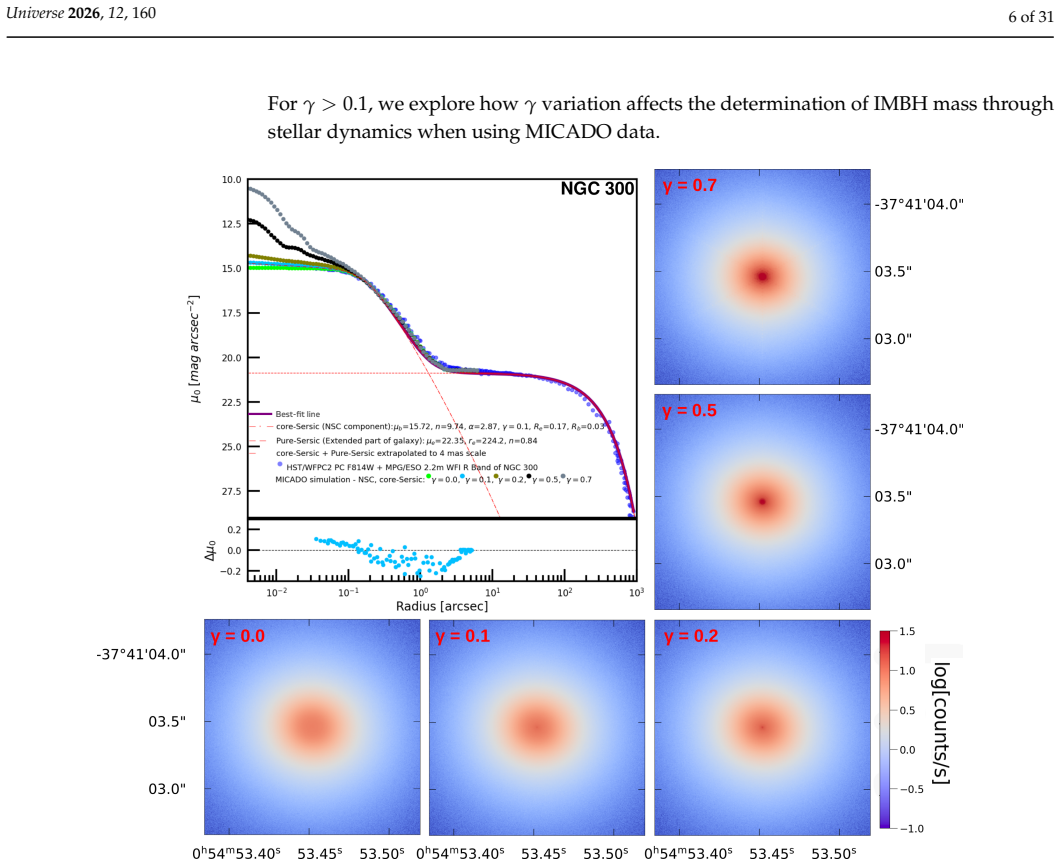
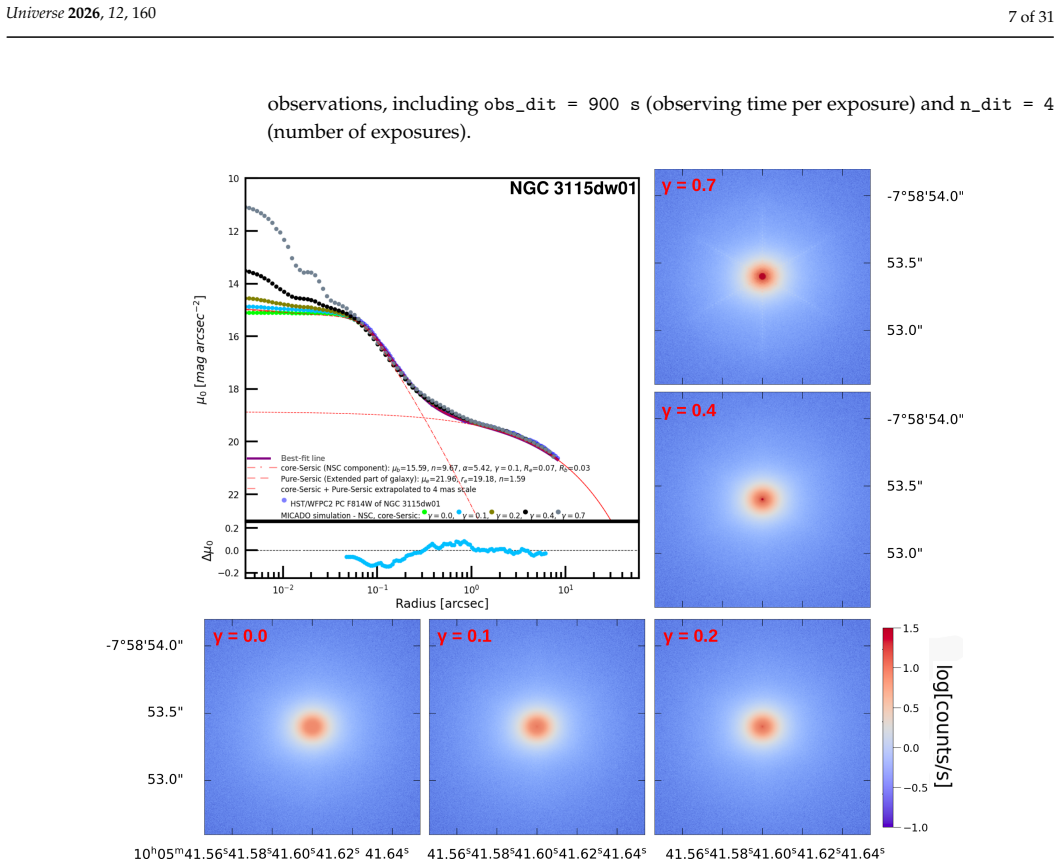
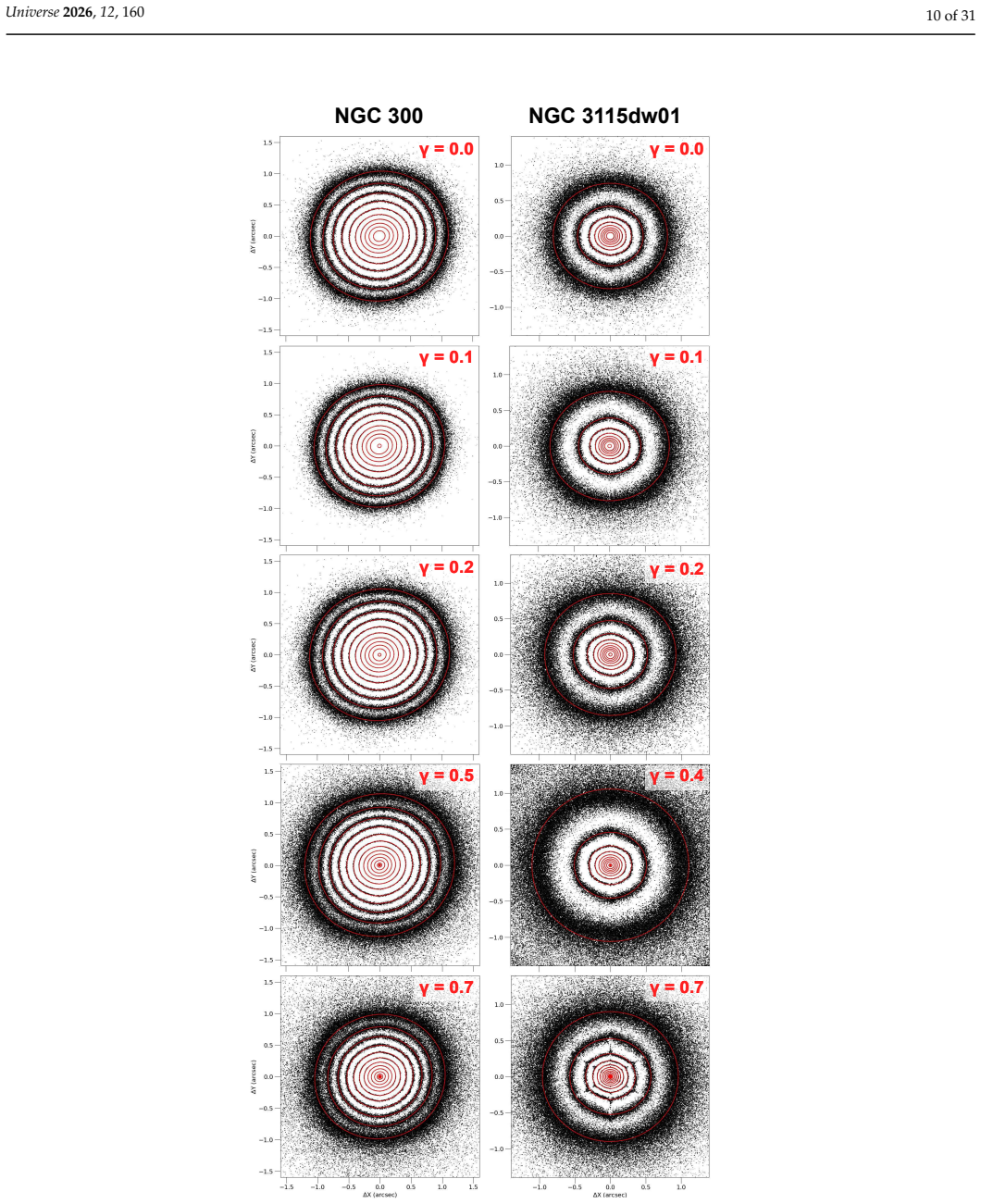
By jointly fitting mock MICADO imaging and HARMONI kinematics with Jeans Anisotropic Modeling, the authors show that different choices for the inner surface-brightness slope of the nuclear star cluster produce measurable changes in the estimated intermediate-mass black hole mass and its uncertainty, down to 0.5 percent of the nuclear star cluster mass.
What carries the argument
Jeans Anisotropic Modeling applied to combined mock data from HSIM (for HARMONI) and SimCADO (for MICADO), built on observed HST surface-brightness profiles and synthetic stellar population spectra.
If this is right
- IMBH masses can be recovered down to 0.5 percent of the nuclear star cluster mass using the joint imaging-plus-kinematics approach.
- Accounting for slope variations supplies tighter constraints on low-mass black holes than kinematics alone.
- The framework advances models for detecting intermediate-mass black holes inside nuclear star clusters of nearby dwarf galaxies.
- The same mock pipeline can be used to optimize observing strategies for future ELT programs targeting black-hole formation in the early universe.
Where Pith is reading between the lines
- High-resolution imaging from MICADO supplies an independent handle on the central density that spectroscopy alone cannot provide.
- If real data confirm the slope dependence seen in mocks, dynamical models will need to treat the inner profile as a free parameter rather than a fixed assumption.
- The method could be extended to galaxies beyond 10 Mpc once adaptive-optics performance is characterized on-sky.
Load-bearing premise
The mock observations generated with the simulators accurately represent the real data and dynamics that will be obtained with the ELT instruments.
What would settle it
Real ELT observations of a nuclear star cluster whose inner slope is independently measured at high resolution yield an IMBH mass that differs from the mock prediction when the slope is varied in the model.
Figures
read the original abstract
Simulations of intermediate-mass black holes (IMBH) in dwarf galaxies within 10 Mpc that host bright nuclear star clusters (NSCs), prime candidates for IMBH formation, using the High Angular Resolution Monolithic Optical and Near-infrared Integral (HARMONI) field spectrograph on the Extremely Large Telescope, probe black hole formation in the early Universe. Our approach combines observed surface brightness profiles from the Hubble Space Telescope (HST), synthetic stellar population spectra, and Jeans Anisotropic Modeling (JAM) for stellar dynamics. Mock HARMONI observations were generated with the HSIM simulator and analyzed in a Bayesian framework to infer IMBH masses down to 0.5% of the NSC mass. In this work, we extend these simulations by constructing improved stellar-mass models using SimCADO to simulate imaging with the Multi-AO Imaging Camera for Deep Observations (MICADO). The MICADO data are jointly analyzed with HARMONI kinematics via JAM to reassess IMBH masses and uncertainties. This combined framework enables us to examine how variations in the NSC inner surface-brightness slope influence IMBH mass estimates, providing tighter constraints on low-mass black holes and advancing models for IMBH detection in NSCs.
Editorial analysis
A structured set of objections, weighed in public.
Referee Report
Summary. The manuscript describes an extended simulation framework that combines mock MICADO imaging observations (generated via SimCADO) with mock HARMONI spectroscopic observations (generated via HSIM), using HST surface-brightness profiles and synthetic stellar population spectra as input. These mocks are analyzed jointly via Jeans Anisotropic Modeling (JAM) in a Bayesian framework to quantify how variations in the inner surface-brightness slope of nuclear star clusters affect intermediate-mass black hole mass estimates, with the goal of achieving tighter constraints down to ~0.5% of the NSC mass.
Significance. If the mocks prove realistic, the framework could help isolate systematic uncertainties arising from NSC profile variations in IMBH measurements for nearby dwarf galaxies, which is relevant for early-Universe black-hole formation models. The reuse of established tools (HST profiles, JAM, HSIM, SimCADO) is a methodological strength, but the absence of any quantitative results, error budgets, or validation tests prevents assessment of whether the claimed improvement in constraints is actually realized.
major comments (3)
- [Abstract] Abstract: the central claim that the combined MICADO+HARMONI framework 'provides tighter constraints on low-mass black holes' is unsupported because no results, mass-recovery statistics, or comparisons (with vs. without MICADO data, or across different inner slopes) are presented anywhere in the manuscript.
- [Methods / mock generation] Mock-observation and JAM sections: the load-bearing assumption that the adopted HST surface-brightness profiles, synthetic spectra, and simulators (HSIM, SimCADO) accurately represent real ELT data and dynamics is stated but never tested with sensitivity runs, recovery tests on known inputs, or comparison to existing observations; this directly undermines the ability to isolate the effect of inner-slope variations.
- [Analysis framework] Joint-analysis description: no explicit statement is given of how the MICADO imaging constraints are folded into the JAM likelihood or Bayesian inference (e.g., whether surface-brightness parameters are jointly fitted or held fixed), which is required to evaluate whether the framework can actually deliver the claimed reduction in IMBH-mass uncertainty.
minor comments (2)
- All acronyms (ELT, NSC, IMBH, JAM, HST, MICADO, HARMONI, HSIM, SimCADO) should be defined at first use.
- The manuscript would benefit from a clear statement of the exact range of inner-slope variations explored and the corresponding NSC mass range.
Simulated Author's Rebuttal
We thank the referee for the constructive feedback on our simulation framework paper. We respond to each major comment below.
read point-by-point responses
-
Referee: [Abstract] Abstract: the central claim that the combined MICADO+HARMONI framework 'provides tighter constraints on low-mass black holes' is unsupported because no results, mass-recovery statistics, or comparisons (with vs. without MICADO data, or across different inner slopes) are presented anywhere in the manuscript.
Authors: We agree that the abstract overstates the manuscript's content. This work describes the methodological extension of the simulation framework using SimCADO for MICADO imaging and its joint use with HARMONI data in JAM; it does not include quantitative mass-recovery statistics or comparisons. We will revise the abstract to state that the framework enables examination of how inner surface-brightness slope variations affect IMBH estimates, without claiming tighter constraints are demonstrated here. revision: yes
-
Referee: [Methods / mock generation] Mock-observation and JAM sections: the load-bearing assumption that the adopted HST surface-brightness profiles, synthetic spectra, and simulators (HSIM, SimCADO) accurately represent real ELT data and dynamics is stated but never tested with sensitivity runs, recovery tests on known inputs, or comparison to existing observations; this directly undermines the ability to isolate the effect of inner-slope variations.
Authors: The input profiles are taken directly from HST observations and the simulators are established community tools, but we acknowledge the lack of explicit validation tests in the current text. We will add a dedicated subsection with recovery tests on known inputs and sensitivity runs to show that the framework can isolate the impact of inner-slope variations. revision: yes
-
Referee: [Analysis framework] Joint-analysis description: no explicit statement is given of how the MICADO imaging constraints are folded into the JAM likelihood or Bayesian inference (e.g., whether surface-brightness parameters are jointly fitted or held fixed), which is required to evaluate whether the framework can actually deliver the claimed reduction in IMBH-mass uncertainty.
Authors: We agree the joint-analysis procedure requires more detail. The revised manuscript will explicitly describe how MICADO surface-brightness constraints enter the JAM likelihood (including whether parameters are fitted jointly or held fixed) and how this propagates into the Bayesian IMBH mass inference. revision: yes
Circularity Check
No significant circularity
full rationale
The paper's derivation is a forward simulation pipeline: HST-observed surface-brightness profiles (external data) are combined with synthetic spectra to build mass models, mocks are generated via HSIM and SimCADO simulators, and JAM is applied to recover IMBH masses while varying the inner slope. No equation or result is defined in terms of itself, no fitted parameter is relabeled as a prediction, and no load-bearing premise rests on self-citation. The central claim (slope variations affect JAM-derived masses) follows directly from the controlled mock setup without reduction to inputs by construction.
Axiom & Free-Parameter Ledger
axioms (2)
- domain assumption Jeans Anisotropic Modeling accurately recovers IMBH masses from the mock kinematic and imaging data.
- domain assumption HSIM and SimCADO produce mock data that faithfully represent real ELT observations.
Reference graph
Works this paper leans on
-
[1]
The Black Hole in the Most Massive Ultracompact Dwarf Galaxy M59-UCD3.Astrophys
Ahn, C.P .; Seth, A.C.; Cappellari, M.; Krajnovi´ c, D.; Strader, J.; Voggel, K.T.; Walsh, J.L.; Bahramian, A.; Baumgardt, H.; Brodie, J.; et al. The Black Hole in the Most Massive Ultracompact Dwarf Galaxy M59-UCD3.Astrophys. J.2018,858, 102. https://doi.org/10.3847/1538-4357/aabc57
-
[2]
Voggel, K.T.; Seth, A.C.; Neumayer, N.; Mieske, S.; Chilingarian, I.; Ahn, C.; Baumgardt, H.; Hilker, M.; Nguyen, D.D.; Romanowsky, A.J.; et al. Upper Limits on the Presence of Central Massive Black Holes in Two Ultra-compact Dwarf Galaxies in Centaurus A.Astrophys. J.2018,858, 20. https://doi.org/10.3847/1538-4357/aabae5
-
[3]
Uncovering the Census of Black Holes in sub-Milky Way Mass Galaxies
Nguyen, D.D. Uncovering the Census of Black Holes in sub-Milky Way Mass Galaxies. In Proceedings of the ALMA2019: Science Results and Cross-Facility Synergies, Cagliari, Italy, 14–18 October 2019; p. 106. https://doi.org/10.5281/zenodo.3585410
-
[4]
Cross-checking SMBH mass estimates in NGC 6958—I
Thater, S.; Krajnovi´ c, D.; Weilbacher, P .M.; Nguyen, D.D.; Bureau, M.; Cappellari, M.; Davis, T.A.; Iguchi, S.; McDermid, R.; Onishi, K.; et al. Cross-checking SMBH mass estimates in NGC 6958—I. Stellar dynamics from adaptive optics-assisted MUSE observations.Mon. Not. R. Astron. Soc.2022,509, 5416–5436. https://doi.org/10.1093/mnras/stab3210
-
[5]
Thater, S.; Lyubenova, M.; Fahrion, K.; Martín-Navarro, I.; Jethwa, P .; Nguyen, D.D.; van de Ven, G. Effect of the initial mass function on the dynamical SMBH mass estimate in the nucleated early-type galaxy FCC 47.Astron. Astrophys.2023,675, A18. https://doi.org/10.1051/0004-6361/202245362
-
[6]
Central Massive Black Holes Are Not Ubiquitous in Local Low-mass Galaxies.Astrophys
Zou, F.; Gallo, E.; Seth, A.C.; Hodges-Kluck, E.; Ohlson, D.; Treu, T.; Baldassare, V .F.; Brandt, W.N.; Greene, J.E.; Madau, P .; et al. Central Massive Black Holes Are Not Ubiquitous in Local Low-mass Galaxies.Astrophys. J.2025,992, 176. https://doi.org/10.3847/1538-4357/ae06a1
-
[7]
The Astrophysical Journal , author =
van den Bosch, R.C.E. Unification of the fundamental plane and Super Massive Black Hole Masses.Astrophys. J.2016,831, 134. https://doi.org/10.3847/0004-637X/831/2/134
-
[8]
Nguyen, D.D.; Cappellari, M.; Pereira-Santaella, M. Simulating supermassive black hole mass measurements for a sample of ultramassive galaxies using ELT/HARMONI high-spatial-resolution integral-field stellar kinematics.Mon. Not. R. Astron. Soc. 2023,526, 3548–3569. https://doi.org/10.1093/mnras/stad2860
-
[9]
Nguyen, D.D.; Ngo, H.N.; Le, T.Q.T.; Graham, A.W.; Soria, R.; Chilingarian, I.V .; Thatte, N.; Phuong, N.T.; Hoang, T.; Pereira- Santaella, M.; et al. Supermassive black hole mass measurement in the spiral galaxy NGC 4736 using JWST/NIRSpec stellar kinematics.Astron. Astrophys.2025,698, L9. https://doi.org/10.1051/0004-6361/202554672
-
[10]
Nguyen, D.D.; Ngo, H.N.; Cappellari, M.; Le, T.Q.T.; Ho, T.H.T.; Le, T.N.; Gallo, E.; Thatte, N.; Zou, F.; Perna, M.; et al. Measuring the Central Dark Mass in NGC 4258 with JWST/NIRSpec Stellar Kinematics.arXiv2025, arXiv:2509.20519. https: //doi.org/10.48550/arXiv.2509.20519
-
[11]
Nguyen, D.D.; Cappellari, M.; Le, T.Q.T.; Ngo, H.N.; Gallo, E.; Thatte, N.; Zou, F.; Ho, T.H.T.; Le, T.N.; Tong, H.G.; et al. Extending the Frontier of Spatially-Resolved Supermassive Black Hole Mass Measurements to at 1 ≲z≲ 2: Simulations with ELT/MICADO High-Resolution Mass Models and HARMONI Integral-Field Stellar Kinematics.arXiv2025, arXiv:2511.10427...
-
[12]
McConnell, N.J.; Ma, C.P . Revisiting the Scaling Relations of Black Hole Masses and Host Galaxy Properties.Astrophys. J.2013, 764, 184. https://doi.org/10.1088/0004-637X/764/2/184
work page internal anchor Pith review doi:10.1088/0004-637x/764/2/184 2013
-
[13]
Saglia, R.P .; Opitsch, M.; Erwin, P .; Thomas, J.; Beifiori, A.; Fabricius, M.; Mazzalay, X.; Nowak, N.; Rusli, S.P .; Bender, R. The SINFONI Black Hole Survey: The Black Hole Fundamental Plane Revisited and the Paths of (Co)evolution of Supermassive Black Holes and Bulges.Astrophys. J.2016,818, 47. https://doi.org/10.3847/0004-637X/818/1/47
-
[14]
2020 d , , 125, 101102, 10.1103/PhysRevLett.125.101102
Abbott, R.; Abbott, T.D.; Abraham, S.; Acernese, F.; Ackley, K.; Adams, C.; Adhikari, R.X.; Adya, V .B.; Affeldt, C.; Agathos, M.; et al. GW190521: A Binary Black Hole Merger with a Total Mass of 150 M ⊙.Phys. Rev. Lett.2020,125, 101102. https: //doi.org/10.1103/PhysRevLett.125.101102
-
[15]
Nguyen, D.D.; Cappellari, M.; Ngo, H.N.; Le, T.Q.T.; Le, T.N.; Ho, K.N.H.; Nguyen, A.K.; On, P .T.; Tong, H.G.; Thatte, N.; et al. Simulating Intermediate Black Hole Mass Measurements for a Sample of Galaxies with Nuclear Star Clusters Using ELT/HARMONI High Spatial Resolution Integral-field Stellar Kinematics.Astron. J.2025,170, 124. https://doi.org/10.3...
work page doi:10.3847/15 2025
-
[16]
Thatte, N. Harmoni. In Proceedings of the EAS2024, Padova, Italy, 1–5 July 2024; p. 2682. Universe2026,12, 160 28 of 31
2024
-
[17]
Observational evidence for intermediate-mass black holes.Int
Mezcua, M. Observational evidence for intermediate-mass black holes.Int. J. Mod. Phys. D2017,26, 1730021. https: //doi.org/10.1142/S021827181730021X
-
[18]
The Cosmic Energy Inventory.Astrophys
Fukugita, M.; Peebles, P .J.E. The Cosmic Energy Inventory.Astrophys. J.2004,616, 643–668. https://doi.org/10.1086/425155
-
[19]
2011, MNRAS, 411, 955, doi: 10.1111/j.1365-2966.2010.17731.x
van Wassenhove, S.; Volonteri, M.; Walker, M.G.; Gair, J.R. Massive black holes lurking in Milky Way satellites.Mon. Not. R. Astron. Soc.2010,408, 1139–1146. https://doi.org/10.1111/j.1365-2966.2010.17189.x
-
[20]
2015, MNRAS, 454, 3150, doi: 10.1093/mnras/stv2162
Giersz, M.; Leigh, N.; Hypki, A.; Lützgendorf, N.; Askar, A. MOCCA code for star cluster simulations - IV . A new scenario for intermediate mass black hole formation in globular clusters.Mon. Not. R. Astron. Soc.2015,454, 3150–3165. https: //doi.org/10.1093/mnras/stv2162
-
[21]
The Formation and Evolution of Massive Black Holes.Science2012,337, 544
Volonteri, M. The Formation and Evolution of Massive Black Holes.Science2012,337, 544. https://doi.org/10.1126/science.1220 843
-
[22]
Bonoli, S.; Mayer, L.; Callegari, S. Massive black hole seeds born via direct gas collapse in galaxy mergers: Their properties, statistics and environment.Mon. Not. R. Astron. Soc.2014,437, 1576–1592. https://doi.org/10.1093/mnras/stt1990
-
[23]
Neumayer, N.; Seth, A.; Böker, T. Nuclear star clusters.Astron. Astrophys. Rev.2020,28, 4. https://doi.org/10.1007/s00159-020 -00125-0
-
[24]
and Strader, Jay and Ho, Luis C
Greene, J.E.; Strader, J.; Ho, L.C. Intermediate-Mass Black Holes.Annu. Rev. Astron. Astrophys.2020,58, 257–312. https: //doi.org/10.1146/annurev-astro-032620-021835
work page internal anchor Pith review doi:10.1146/annurev-astro-032620-021835 2020
-
[25]
Inayoshi, K.; Visbal, E.; Haiman, Z. The Assembly of the First Massive Black Holes.Annu. Rev. Astron. Astrophys.2020,58, 27–97. https://doi.org/10.1146/annurev-astro-120419-014455
-
[26]
A supermassive black hole in an ultra-compact dwarf galaxy.Nature2014,513, 398–400
Seth, A.C.; van den Bosch, R.; Mieske, S.; Baumgardt, H.; Brok, M.D.; Strader, J.; Neumayer, N.; Chilingarian, I.; Hilker, M.; McDermid, R.; et al. A supermassive black hole in an ultra-compact dwarf galaxy.Nature2014,513, 398–400. https: //doi.org/10.1038/nature13762
-
[27]
Astrophysics with the Laser Interferometer Space Antenna.Living Rev
Amaro-Seoane, P .; Andrews, J.; Arca Sedda, M.; Askar, A.; Baghi, Q.; Balasov, R.; Bartos, I.; Bavera, S.S.; Bellovary, J.; Berry, C.P .L.; et al. Astrophysics with the Laser Interferometer Space Antenna.Living Rev. Relativ.2023,26, 2. https://doi.org/10.1007/s41114 -022-00041-y
-
[28]
Merging stellar and intermediate-mass black holes in dense clusters: implications for LIGO, LISA, and the next generation of gravitational wave detectors.Astron
Arca Sedda, M.; Amaro Seoane, P .; Chen, X. Merging stellar and intermediate-mass black holes in dense clusters: implications for LIGO, LISA, and the next generation of gravitational wave detectors.Astron. Astrophys.2021,652, A54. https://doi.org/10.1051/ 0004-6361/202037785
2021
-
[29]
Valluri, M.; Ferrarese, L.; Merritt, D.; Joseph, C.L. The Low End of the Supermassive Black Hole Mass Function: Constraining the Mass of a Nuclear Black Hole in NGC 205 via Stellar Kinematics.Astrophys. J.2005,628, 137–152. https://doi.org/10.1086/430752
-
[30]
Tremou, E.; Strader, J.; Chomiuk, L.; Shishkovsky, L.; Maccarone, T.J.; Miller-Jones, J.C.A.; Tudor, V .; Heinke, C.O.; Sivakoff, G.R.; Seth, A.C.; et al. The MAVERIC Survey: Still No Evidence for Accreting Intermediate-mass Black Holes in Globular Clusters. Astrophys. J.2018,862, 16. https://doi.org/10.3847/1538-4357/aac9b9
-
[31]
, archivePrefix = "arXiv", eprint =
Reines, A.E.; Greene, J.E.; Geha, M. Dwarf Galaxies with Optical Signatures of ACTIVE Massive Black Holes.Astrophys. J.2013, 775, 116. https://doi.org/10.1088/0004-637X/775/2/116
work page internal anchor Pith review doi:10.1088/0004-637x/775/2/116 2013
-
[32]
A 50,000 M⊙ Solar Mass Black Hole in the Nucleus of RGG 118.Astrophys
Baldassare, V .F.; Reines, A.E.; Gallo, E.; Greene, J.E. A 50,000 M⊙ Solar Mass Black Hole in the Nucleus of RGG 118.Astrophys. J. Lett.2015,809, L14. https://doi.org/10.1088/2041-8205/809/1/L14
-
[34]
Refining the mass estimate for the intermediate-mass black hole candidate in NGC 3319.Publ
Davis, B.L.; Graham, A.W. Refining the mass estimate for the intermediate-mass black hole candidate in NGC 3319.Publ. Astron. Soc. Aust.2021,38, e030. https://doi.org/10.1017/pasa.2021.23
-
[35]
Chilingarian, I.V .; Katkov, I.Y.; Zolotukhin, I.Y.; Grishin, K.A.; Beletsky, Y.; Boutsia, K.; Osip, D.J. A Population of Bona Fide Intermediate-mass Black Holes Identified as Low-luminosity Active Galactic Nuclei.Astrophys. J.2018,863, 1. https: //doi.org/10.3847/1538-4357/aad184
-
[36]
POX 52: A Dwarf Seyfert 1 Galaxy with an Intermediate-Mass Black Hole
Barth, A.J.; Ho, L.C.; Rutledge, R.E.; Sargent, W.L.W. POX 52: A Dwarf Seyfert 1 Galaxy with an Intermediate-Mass Black Hole. Astrophys. J.2004,607, 90–102. https://doi.org/10.1086/383302
-
[37]
The Host Galaxy and Central Engine of the Dwarf Active Galactic Nucleus POX 52.Astrophys
Thornton, C.E.; Barth, A.J.; Ho, L.C.; Rutledge, R.E.; Greene, J.E. The Host Galaxy and Central Engine of the Dwarf Active Galactic Nucleus POX 52.Astrophys. J.2008,686, 892–910. https://doi.org/10.1086/591519
-
[38]
den Brok, M.; Seth, A.C.; Barth, A.J.; Carson, D.J.; Neumayer, N.; Cappellari, M.; Debattista, V .P .; Ho, L.C.; Hood, C.E.; McDermid, R.M. Measuring the Mass of the Central Black Hole in the Bulgeless Galaxy NGC 4395 from Gas Dynamical Modeling.Astrophys. J.2015,809, 101. https://doi.org/10.1088/0004-637X/809/1/101
-
[39]
Extended Structure and Fate of the Nucleus in Henize 2-10.Astrophys
Nguyen, D.D.; Seth, A.C.; Reines, A.E.; den Brok, M.; Sand, D.; McLeod, B. Extended Structure and Fate of the Nucleus in Henize 2-10.Astrophys. J.2014,794, 34. https://doi.org/10.1088/0004-637X/794/1/34. Universe2026,12, 160 29 of 31
-
[40]
Improved Dynamical Constraints on the Mass of the Central Black Hole in NGC 404.Astrophys
Nguyen, D.D.; Seth, A.C.; den Brok, M.; Neumayer, N.; Cappellari, M.; Barth, A.J.; Caldwell, N.; Williams, B.F.; Binder, B. Improved Dynamical Constraints on the Mass of the Central Black Hole in NGC 404.Astrophys. J.2017,836, 237. https://doi.org/10.3847/1538-4357/aa5cb4
-
[41]
Nguyen, D.D.; Seth, A.C.; Neumayer, N.; Kamann, S.; Voggel, K.T.; Cappellari, M.; Picotti, A.; Nguyen, P .M.; Böker, T.; Debattista, V .; et al. Nearby Early-type Galactic Nuclei at High Resolution: Dynamical Black Hole and Nuclear Star Cluster Mass Measurements.Astrophys. J.2018,858, 118. https://doi.org/10.3847/1538-4357/aabe28
-
[42]
Nguyen, D.D.; Seth, A.C.; Neumayer, N.; Iguchi, S.; Cappellari, M.; Strader, J.; Chomiuk, L.; Tremou, E.; Pacucci, F.; Nakanishi, K.; et al. Improved Dynamical Constraints on the Masses of the Central Black Holes in Nearby Low-mass Early-type Galactic Nuclei and the First Black Hole Determination for NGC 205.Astrophys. J.2019,872, 104. https://doi.org/10....
-
[43]
Nguyen, D.D.; Bureau, M.; Thater, S.; Nyland, K.; den Brok, M.; Cappellari, M.; Davis, T.A.; Greene, J.E.; Neumayer, N.; Imanishi, M.; et al. The MBHBM ⋆ Project - II. Molecular gas kinematics in the lenticular galaxy NGC 3593 reveal a supermassive black hole. Mon. Not. R. Astron. Soc.2022,509, 2920–2939. https://doi.org/10.1093/mnras/stab3016
-
[44]
Improved dynamical constraints on the mass of the central black hole in NGC 404
Nguyen, D.D. Improved dynamical constraints on the mass of the central black hole in NGC 404.arXiv2017, arXiv:1712.02470. https://doi.org/10.48550/arXiv.1712.02470
work page internal anchor Pith review Pith/arXiv arXiv doi:10.48550/arxiv.1712.02470
-
[45]
Davis, T.A.; Nguyen, D.D.; Seth, A.C.; Greene, J.E.; Nyland, K.; Barth, A.J.; Bureau, M.; Cappellari, M.; den Brok, M.; Iguchi, S.; et al. Revealing the intermediate-mass black hole at the heart of the dwarf galaxy NGC 404 with sub-parsec resolution ALMA observations.Mon. Not. R. Astron. Soc.2020,496, 4061–4078. https://doi.org/10.1093/mnras/staa1567
-
[46]
Noyola, E.; Gebhardt, K.; Bergmann, M. Gemini and Hubble Space Telescope Evidence for an Intermediate-Mass Black Hole in ω Centauri.Astrophys. J.2008,676, 1008–1015. https://doi.org/10.1086/529002
-
[47]
Noyola, E.; Gebhardt, K.; Kissler-Patig, M.; Lützgendorf, N.; Jalali, B.; de Zeeuw, P .T.; Baumgardt, H. Very Large Telescope Kinematics for Omega Centauri: Further Support for a Central Black Hole.Astrophys. J. Lett.2010,719, L60–L64. https: //doi.org/10.1088/2041-8205/719/1/L60
-
[48]
Feldmeier, A.; Lützgendorf, N.; Neumayer, N.; Kissler-Patig, M.; Gebhardt, K.; Baumgardt, H.; Noyola, E.; de Zeeuw, P .T.; Jalali, B. Indication for an intermediate-mass black hole in the globular cluster NGC 5286 from kinematics.Astron. Astrophys.2013, 554, A63. https://doi.org/10.1051/0004-6361/201321168
-
[49]
Kızıltan, B.; Baumgardt, H.; Loeb, A. An intermediate-mass black hole in the centre of the globular cluster 47 Tucanae.Nature 2017,542, 203–205. https://doi.org/10.1038/nature21361
-
[50]
Pechetti, R.; Seth, A.; Kamann, S.; Caldwell, N.; Strader, J.; den Brok, M.; Luetzgendorf, N.; Neumayer, N.; Voggel, K. Detection of a 100,000 M ⊙ black hole in M31’s Most Massive Globular Cluster: A Tidally Stripped Nucleus.Astrophys. J.2022,924, 48. https://doi.org/10.3847/1538-4357/ac339f
-
[51]
Häberle, M.; Neumayer, N.; Seth, A.; Bellini, A.; Libralato, M.; Baumgardt, H.; Whitaker, M.; Dumont, A.; Alfaro Cuello, M.; Anderson, J.; et al. Fast-moving stars around an intermediate-mass black hole in Omega Centauri.arXiv2024, arXiv:2405.06015. https://doi.org/10.48550/arXiv.2405.06015
-
[52]
The Demography of Massive Dark Objects in Galaxy Centers.Astron
Magorrian, J.; Tremaine, S.; Richstone, D.; Bender, R.; Bower, G.; Dressler, A.; Faber, S.M.; Gebhardt, K.; Green, R.; Grillmair, C.; et al. The Demography of Massive Dark Objects in Galaxy Centers.Astron. J.1998,115, 2285–2305. https://doi.org/10.1086/30 0353
work page doi:10.1086/30 1998
-
[53]
, year = 1995, month = jan, volume =
Kormendy, J.; Richstone, D. Inward Bound—The Search For Supermassive Black Holes In Galactic Nuclei.Annu. Rev. Astron. Astrophys.1995,33, 581. https://doi.org/10.1146/annurev.aa.33.090195.003053
-
[54]
A Fundamental Relation Between Supermassive Black Holes and Their Host Galaxies
Ferrarese, L.; Merritt, D. A Fundamental Relation between Supermassive Black Holes and Their Host Galaxies.Astrophys. J. Lett. 2000,539, L9–L12. https://doi.org/10.1086/312838
work page internal anchor Pith review doi:10.1086/312838 2000
-
[55]
Two channels of supermassive black hole growth as seen on the galaxies mass-size plane.Mon
Krajnovi´ c, D.; Cappellari, M.; McDermid, R.M. Two channels of supermassive black hole growth as seen on the galaxies mass-size plane.Mon. Not. R. Astron. Soc.2018,473, 5237–5247. https://doi.org/10.1093/mnras/stx2704
-
[56]
Nguyen, D.D.; den Brok, M.; Seth, A.C.; Davis, T.A.; Greene, J.E.; Cappellari, M.; Jensen, J.B.; Thater, S.; Iguchi, S.; Imanishi, M.; et al. The MBHBM ⋆ Project. I. Measurement of the Central Black Hole Mass in Spiral Galaxy NGC 3504 Using Molecular Gas Kinematics.Astrophys. J.2020,892, 68. https://doi.org/10.3847/1538-4357/ab77aa
-
[57]
Nguyen, D.D.; Izumi, T.; Thater, S.; Imanishi, M.; Kawamuro, T.; Baba, S.; Nakano, S.; Turner, J.L.; Kohno, K.; Matsushita, S.; et al. Black hole mass measurement using ALMA observations of [CI] and CO emissions in the Seyfert 1 galaxy NGC 7469.Mon. Not. R. Astron. Soc.2021,504, 4123–4142. https://doi.org/10.1093/mnras/stab1002
-
[58]
Ngo, H.N.; Nguyen, D.D.; Le, T.Q.T.; Ho, K.N.H.; Ho, T.H.T.; Gallo, E.; Nyland, K.; Imanishi, M.; Nakanishi, K.; Le, Q.T.; et al. Revisiting the Supermassive Black Hole Mass of NGC 7052 Using High Spatial Resolution Molecular Gas Observed with ALMA. Astrophys. J.2025,992, 211. https://doi.org/10.3847/1538-4357/ae0455
-
[59]
Ngo, H.N.; Nguyen, D.D.; Nguyen, T.N.; Dang, T.H.; Ho, T.H.T. Extending the simulations of intermediate-mass black hole mass measurements to Virgo Cluster using ELT/HARMONI high resolution integral-field stellar kinematics.arXiv2025, arXiv:2509.03364. https://doi.org/10.48550/arXiv.2509.03364. Universe2026,12, 160 30 of 31
-
[60]
Ngo, H.N.; Nguyen, D.D.; Le, T.T.Q.; Ho, T.H.T.; Nguyen, T.N.; Dang, T.H. Detecting Intermediate-Mass Black Holes out to 20 Mpc with ELT/HARMONI: The Case of FCC 119.Universe2025,11, 360. https://doi.org/10.3390/universe11110360
-
[61]
Cappellari, M. Measuring the inclination and mass-to-light ratio of axisymmetric galaxies via anisotropic Jeans models of stellar kinematics.Mon. Not. R. Astron. Soc.2008,390, 71–86. https://doi.org/10.1111/j.1365-2966.2008.13754.x
-
[62]
Cappellari, M. Efficient solution of the anisotropic spherically aligned axisymmetric Jeans equations of stellar hydrodynamics for galactic dynamics.Mon. Not. R. Astron. Soc.2020,494, 4819–4837. https://doi.org/10.1093/mnras/staa959
-
[63]
HSIM: A simulation pipeline for the HARMONI integral field spectrograph on the European ELT.Mon
Zieleniewski, S.; Thatte, N.; Kendrew, S.; Houghton, R.C.W.; Swinbank, A.M.; Tecza, M.; Clarke, F.; Fusco, T. HSIM: A simulation pipeline for the HARMONI integral field spectrograph on the European ELT.Mon. Not. R. Astron. Soc.2015,453, 3754–3765. https://doi.org/10.1093/mnras/stv1860
-
[64]
MICADO: The E-ELT adaptive optics imaging camera
Davies, R.; Ageorges, N.; Barl, L.; Bedin, L.R.; Bender, R.; Bernardi, P .; Chapron, F.; Clenet, Y.; Deep, A.; Deul, E.; et al. MICADO: The E-ELT adaptive optics imaging camera. InProceedings of the Ground-Based and Airborne Instrumentation for Astronomy III; Society of Photo-Optical Instrumentation Engineers (SPIE) Conference Series; McLean, I.S., Ramsay...
-
[65]
MICADO: The Multi-Adaptive Optics Camera for Deep Observations.Messenger2021,182, 17–21
Davies, R.; Hörmann, V .; Rabien, S.; Sturm, E.; Alves, J.; Clénet, Y.; Kotilainen, J.; Lang-Bardl, F.; Nicklas, H.; Pott, J.U.; et al. MICADO: The Multi-Adaptive Optics Camera for Deep Observations.Messenger2021,182, 17–21. https://doi.org/10.18727/072 2-6691/5217
-
[66]
MICADO: First light imager for the E-ELT
Davies, R.; Schubert, J.; Hartl, M.; Alves, J.; Clénet, Y.; Lang-Bardl, F.; Nicklas, H.; Pott, J.U.; Ragazzoni, R.; Tolstoy, E.; et al. MICADO: First light imager for the E-ELT. InProceedings of the Ground-Based and Airborne Instrumentation for Astronomy VI; Society of Photo-Optical Instrumentation Engineers (SPIE) Conference Series; Evans, C.J., Simard, ...
-
[67]
SimCADO: An instrument data simulator package for MICADO at the E-ELT
Leschinski, K.; Czoske, O.; Köhler, R.; Mach, M.; Zeilinger, W.; Verdoes Kleijn, G.; Alves, J.; Kausch, W.; Przybilla, N. SimCADO: An instrument data simulator package for MICADO at the E-ELT. InProceedings of the Modeling, Systems Engineering, and Project Management for Astronomy VI; Society of Photo-Optical Instrumentation Engineers (SPIE) Conference Se...
-
[68]
A family of models for spherical stellar systems.Astron
Tremaine, S.; Richstone, D.O.; Byun, Y.I.; Dressler, A.; Faber, S.M.; Grillmair, C.; Kormendy, J.; Lauer, T.R. A family of models for spherical stellar systems.Astron. J.1994,107, 634–644. https://doi.org/10.1086/116883
-
[69]
Graham, A.W.; Erwin, P .; Trujillo, I.; Asensio Ramos, A. A New Empirical Model for the Structural Analysis of Early-Type Galaxies, and A Critical Review of the Nuker Model.Astron. J.2003,125, 2951–2963. https://doi.org/10.1086/375320
-
[70]
Evidence for a New Elliptical-Galaxy Paradigm: Sérsic and Core Galaxies
Trujillo, I.; Erwin, P .; Asensio Ramos, A.; Graham, A.W. Evidence for a New Elliptical-Galaxy Paradigm: Sérsic and Core Galaxies. Astron. J.2004,127, 1917–1942. https://doi.org/10.1086/382712
-
[71]
Sersic, J.L.Atlas de Galaxias Australes; Observatorio Astronómico, Universidad Nacional de Córdoba: Córdoba, Argentina, 1968
1968
-
[72]
Analytical properties of the R^(1/m) luminosity law
Ciotti, L.; Bertin, G. Analytical properties of the R 1/m law.Astron. Astrophys.1999,352, 447–451. https://doi.org/10.48550/arXiv. astro-ph/9911078
work page internal anchor Pith review Pith/arXiv arXiv doi:10.48550/arxiv 1999
-
[73]
Probing quintessence: Reconstruction and parameter es- timation from supernovae
Cappellari, M. Efficient multi-Gaussian expansion of galaxies.Mon. Not. R. Astron. Soc.2002,333, 400–410. https: //doi.org/10.1046/j.1365-8711.2002.05412.x
-
[74]
CCD surface photometry of elliptical galaxies - I
Jedrzejewski, R.I. CCD surface photometry of elliptical galaxies - I. Observations, reduction and results.Mon. Not. R. Astron. Soc. 1987,226, 747–768. https://doi.org/10.1093/mnras/226.4.747
-
[75]
Are Nuclear Star Clusters the Precursors of Massive Black Holes?Adv
Neumayer, N.; Walcher, C.J. Are Nuclear Star Clusters the Precursors of Massive Black Holes?Adv. Astron.2012,2012, 709038. https://doi.org/10.1155/2012/709038
-
[76]
Pechetti, R.; Seth, A.; Neumayer, N.; Georgiev, I.; Kacharov, N.; den Brok, M. Luminosity Models and Density Profiles for Nuclear Star Clusters for a Nearby Volume-limited Sample of 29 Galaxies.Astrophys. J.2020,900, 32. https://doi.org/10.3847/1538-435 7/abaaa7
-
[77]
The radius-dependence of velocity dispersion in elliptical galaxies.Mon
Binney, J. The radius-dependence of velocity dispersion in elliptical galaxies.Mon. Not. R. Astron. Soc.1980,190, 873–880. https://doi.org/10.1093/mnras/190.4.873
-
[78]
An adaptive Metropolis algorithm.Bernoulli2001,7, 223 – 242
Haario, H.; Saksman, E.; Tamminen, J. An adaptive Metropolis algorithm.Bernoulli2001,7, 223 – 242
-
[79]
Cappellari, M.; Scott, N.; Alatalo, K.; Blitz, L.; Bois, M.; Bournaud, F.; Bureau, M.; Crocker, A.F.; Davies, R.L.; Davis, T.A.; et al. The ATLAS 3D project - XV . Benchmark for early-type galaxies scaling relations from 260 dynamical models: Mass- to-light ratio, dark matter, Fundamental Plane and Mass Plane.Mon. Not. R. Astron. Soc.2013,432, 1709–1741. ...
-
[80]
The star distribution around a massive black hole in a globular cluster
Bahcall, J.N.; Wolf, R.A. The star distribution around a massive black hole in a globular cluster. II. Unequal star masses.Astrophys. J.1977,216, 883–907. https://doi.org/10.1086/155534
-
[81]
Van Rossum, G.; Drake, F.L.Python 3 Reference Manual; CreateSpace: Scotts Valley, CA, USA, 2009
2009
discussion (0)
Sign in with ORCID, Apple, or X to comment. Anyone can read and Pith papers without signing in.