REVIEW 1 major objections 1 minor 44 references
Agentic Generation and Evolution of Knowledge Models
T0 review · 1 major / 1 minor · reviewed 2026-06-28 · grok-4.3
Pith's one-line read TrustModel deploys three agentic subsystems to generate and evolve living knowledge models for complex software systems.
desk verdict This is a conceptual vision paper proposing a three-subsystem agentic setup for living knowledge models, but it offers no implementation, data, or detailed comparisons. read the letter →
The pith
A machine-rendered reading of the paper's core claim, the machinery that carries it, and where it could break.
The reading
What carries the argument
TrustModel, an agentic framework of Modeling, Conformance, and Evolution subsystems that construct, assess, and guide the evolution of living knowledge models.
What would settle it
An experiment applying the three TrustModel subsystems to an autonomous vehicle system undergoing documented environmental changes, where the output knowledge models fail to remain aligned with observed system behavior.
Extended reading notes
Core claim
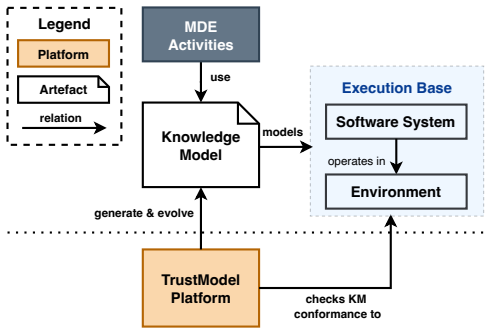
TrustModel comprises three agentic subsystems: Modeling, for constructing and updating KMs; Conformance, for assessing their alignment with the system and its environment; and Evolution, for generating guidance to keep KMs synchronized with emerging changes. TrustModel positions living KMs as a foundation for dependable engineering of continuously evolving software systems, with a demonstration in model-based testing and potential support for requirements monitoring, architectural drift tracking, and change impact assessment.
Load-bearing premise
Agentic AI subsystems can reliably and effectively perform the tasks of constructing, conformance-checking, and evolving knowledge models in complex physical, cyber, and social environments.
Signed reviews
Editorial analysis
A structured set of objections, weighed in public.
Referee Report
Summary. The paper presents TrustModel as a vision for the agentic generation and evolution of living knowledge models (KMs) to support reasoning, maintenance, and safe evolution of complex software systems interacting with dynamic physical, cyber, and social environments. It defines three agentic subsystems—Modeling (for constructing and updating KMs), Conformance (for assessing alignment with the system and environment), and Evolution (for generating guidance to synchronize KMs with changes)—and discusses instantiation for model-based testing along with potential applications to other MDE activities such as requirements monitoring and change impact assessment.
Significance. If the vision can be realized with reliable agentic subsystems, it would position living KMs as a practical foundation for dependable engineering of evolving systems, extending model-driven engineering to handle continuous change through automated conformance and evolution mechanisms.
major comments (1)
- [Abstract] Abstract: The manuscript asserts that 'We demonstrate how TrustModel can be instantiated for model-based testing' but provides no implementation details, concrete examples, results, or evidence of the subsystems' operation; this demonstration is load-bearing for establishing the vision's feasibility beyond pure conceptualization.
minor comments (1)
- [Abstract] Abstract, first sentence: The phrasing 'Complex software systems such as autonomous vehicles, robotics increasingly interact' is grammatically incomplete and should be revised for clarity (e.g., add 'and' before 'robotics').
Simulated Author's Rebuttal
We thank the referee for the detailed review and constructive comment. We address the point regarding the abstract and the nature of the demonstration below.
read point-by-point responses
-
Referee: [Abstract] Abstract: The manuscript asserts that 'We demonstrate how TrustModel can be instantiated for model-based testing' but provides no implementation details, concrete examples, results, or evidence of the subsystems' operation; this demonstration is load-bearing for establishing the vision's feasibility beyond pure conceptualization.
Authors: We agree that the paper is framed as a vision paper and that the instantiation for model-based testing is described at a conceptual level, outlining how the three agentic subsystems would interact in that setting rather than providing executable code, experimental results, or runtime evidence. The term 'demonstrate' in the abstract was intended to refer to this illustrative description. We will revise the abstract to replace 'demonstrate' with 'illustrate' and add a clarifying sentence in the body of the paper to explicitly state the conceptual nature of the example. If the editor permits additional space, we can also include a more detailed walkthrough of one subsystem interaction. revision: yes
Circularity Check
No significant circularity
full rationale
The paper is a vision paper presenting TrustModel as a conceptual architecture with three agentic subsystems (Modeling, Conformance, Evolution) for living knowledge models. It contains no equations, derivations, fitted parameters, proofs, or empirical results. No load-bearing steps reduce by construction to inputs, and there are no self-citations invoked as uniqueness theorems or ansatzes. The contribution is self-contained as an architectural proposal without circular reasoning.
Assumptions & free parameters
assumptions (1)
- domain assumption Knowledge models may become incomplete, inconsistent, or outdated as systems evolve.
invented entities (4)
-
TrustModel
-
Modeling subsystem
-
Conformance subsystem
-
Evolution subsystem
Cite this review
Pith. "Pith review of Agentic Generation and Evolution of Knowledge Models." pith.science (2026). https://pith.science/paper/JSL32NYX
@misc{pith2026260603662,
  author       = {Pith},
  title        = {Pith review of: Agentic Generation and Evolution of Knowledge Models},
  year         = {2026},
  howpublished = {\url{https://pith.science/paper/JSL32NYX}},
  note         = {Machine review of arXiv:2606.03662}
}
read the original abstract
Complex software systems such as autonomous vehicles, robotics increasingly interact with dynamic physical, cyber, and social environments. Reasoning about their behavior, maintaining them under continuous change, and evolving them safely require trustworthy knowledge about the system, its assumptions, and its operating context. Knowledge models (KMs) provide a practical basis for such reasoning, but they may themselves become incomplete, inconsistent, or outdated as systems evolve. This paper presents TrustModel, a vision for the agentic generation and evolution of living KMs. TrustModel comprises three agentic subsystems: Modeling, for constructing and updating KMs; Conformance, for assessing their alignment with the system and its environment; and Evolution, for generating guidance to keep KMs synchronized with emerging changes. We demonstrate how TrustModel can be instantiated for model-based testing and discuss its potential for supporting other MDE activities, such as requirements and assumption monitoring, architectural drift tracking, and change impact assessment. Overall, TrustModel positions living KMs as a foundation for dependable engineering of continuously evolving software systems.
Figures


Figures from the paper (3 more)


Reference graph
Works this paper leans on
-
[1]
Control Software Engineering Approaches for Cyber-Physical Systems: A Systematic Mapping Study
2025. Control Software Engineering Approaches for Cyber-Physical Systems: A Systematic Mapping Study. Comput. Surveys (2025). doi:10.1145/3704737
-
[2]
Anthropic. 2024. Building effective agents.https://www.anthropic.com/engineering/ building-effective-agents
2024
-
[3]
Anthropic. 2025. How we built our multi-agent research system.https://www.anthropic.com/ engineering/multi-agent-research-system
2025
-
[4]
Hugo Araujo, Mohammad Reza Mousavi, and Mahsa Varshosaz. 2023. Testing, validation, and verification of robotic and autonomous systems: a systematic review. ACM Transactions on Software Engineering and Methodology 32, 2 (2023), 1–61
2023
-
[5]
Mohammad Yusaf Azimi and Cemal Yilmaz. 2025. Model-based test execution from high-level natural language instructions using GPT-4. Software Quality Journal 33, 1 (2025), 15
2025
-
[6]
Ilan Beer, Shoham Ben-David, Hana Chockler, Avigail Orni, and Richard Trefler. 2012. Explaining counterexamples using causality. Form. Methods Syst. Des. 40, 1 (Feb. 2012), 20–40. doi:10.1007/ s10703-011-0132-2
2012
-
[7]
Lola Burgue˜ no, Davide Di Ruscio, Houari Sahraoui, and Manuel Wimmer. 2025. Automation in Model- Driven Engineering: A look back, and ahead. ACM Transactions on Software Engineering and Methodology 34, 5 (2025), 1–25
2025
-
[8]
Matteo Camilli, Angelo Gargantini, Patrizia Scandurra, and Catia Trubiani. 2021. Uncertainty-aware exploration in model-based testing. In 2021 14th IEEE Conference on Software Testing, Verification and Validation (ICST). IEEE, 71–81
2021
Show all 44 references
-
[9]
Roberto Casadei, Gianluca Aguzzi, Giorgio Audrito, Ferruccio Damiani, Danilo Pianini, Giordano Scarso, Gianluca Torta, and Mirko Viroli. 2025. Software Engineering for Collective Cyber-Physical Ecosystems. ACM Transactions on Software Engineering and Methodology 34, 5 (2025), ...
2025
-
[10]
Johan Cederbladh, Antonio Cicchetti, and Robbert Jongeling. 2025. A road-map to readily available early validation and verification of system behaviour in model-based systems engineering using software engineering best practices. ACM Transactions on Software Engineering and Me...
2025
-
[11]
Zacharie Chenail-Larcher, Jean Baptiste Minani, and Naouel Moha. 2025. Test generation from use case specifications for IoT systems: Custom, LLM-based, and hybrid approaches. In 2025 IEEE Conference on Software Testing, Verification and Validation (ICST). IEEE, 597–602
2025
-
[12]
Braberman, Diego Garbervetsky, and Sebasti´ an Uchitel
Guido de Caso, V´ ıctor A. Braberman, Diego Garbervetsky, and Sebasti´ an Uchitel. 2013. Enabledness-based program abstractions for behavior validation. ACM Trans. Softw. Eng. Methodol. 22, 3 (2013), 25:1–25:46. doi:10.1145/2491509.2491519 1ModelCopilot: https://www.modelcopil...
2013 doi
-
[13]
Yao Deng, Zhi Tu, Jiaohong Yao, Mengshi Zhang, Tianyi Zhang, and Xi Zheng. 2025. Target: Traffic rule-based test generation for autonomous driving systems. IEEE Transactions on Software Engineering (2025)
2025
-
[14]
Nachum Dershowitz, Ziyad Hanna, and Alexander Nadel. 2006. A Scalable Algorithm for Minimal Unsat- isfiable Core Extraction. In Theory and Applications of Satisfiability Testing - SAT 2006, Armin Biere and Carla P. Gomes (Eds.). Springer Berlin Heidelberg, Berlin, Heidelberg, 36–41
2006
-
[15]
Alexandre Donz´ e. 2013. On signal temporal logic. In International Conference on Runtime Verification. Springer, 382–383
2013
-
[16]
Eclipse Foundation. 2023. Papyrus Moka.https://eclipse.googlesource.com/papyrus/org.eclipse. papyrus-moka/. Accessed: 2026-04-13
2023
-
[17]
Ernst, Jeff H
Michael D. Ernst, Jeff H. Perkins, Philip J. Guo, Stephen McCamant, Carlos Pacheco, Matthew S. Tschantz, and Chen Xiao. 2007. The Daikon system for dynamic detection of likely invariants. Sci. Comput. Program. 69, 1-3 (2007), 35–45. doi:10.1016/J.SCICO.2007.01.015
2007 doi
-
[18]
Robert France and Bernhard Rumpe. 2007. Model-driven development of complex software: A research roadmap. In Future of Software Engineering (FOSE’07). IEEE, 37–54
2007
-
[19]
Junda He, Christoph Treude, and David Lo. 2025. Llm-based multi-agent systems for software engineering: Literature review, vision, and the road ahead.ACM Transactions on Software Engineering and Methodology 34, 5 (2025), 1–30
2025
-
[20]
Regina Hebig, Djamel Eddine Khelladi, and Reda Bendraou. 2017. Approaches to Co-Evolution of Meta- models and Models: A Survey. IEEE Transactions on Software Engineering 43, 5 (2017), 396–414. doi:10.1109/TSE.2016.2610424
2017 doi
-
[21]
Yuan Kong, Nan Zhang, Zhenhua Duan, and Bin Yu. 2025. Collaboration with Generative AI to improve Requirements Change. Computer Standards & Interfaces (2025), 104013
2025
-
[22]
Junwei Liu, Kaixin Wang, Yixuan Chen, Xin Peng, Zhenpeng Chen, Lingming Zhang, and Yiling Lou. 2024. Large language model-based agents for software engineering: A survey. arXiv preprint arXiv:2409.02977 (2024)
2024 arXiv
-
[23]
You Lu, Yifan Tian, Yuyang Bi, Bihuan Chen, and Xin Peng. 2024. Diavio: Llm-empowered diagnosis of safety violations in ads simulation testing. In Proceedings of the 33rd ACM SIGSOFT International Symposium on Software Testing and Analysis. 376–388
2024
-
[24]
K. L. McMillan. 2005. Applications of craig interpolants in model checking. In Proceedings of the 11th International Conference on Tools and Algorithms for the Construction and Analysis of Systems (Edin- burgh, UK) (TACAS’05). Springer-Verlag, Berlin, Heidelberg, 1–12. doi:10....
2005 doi
-
[25]
Judith Michael, Loek Cleophas, Steffen Zschaler, Tony Clark, Benoit Combemale, Thomas Godfrey, Djamel Eddine Khelladi, Vinay Kulkarni, Daniel Lehner, Bernhard Rumpe, et al. 2025. Model-driven engineering for digital twins: opportunities and challenges. Systems Engineering 28, ...
2025
-
[26]
Facundo Molina, Marcelo d’Amorim, and Nazareno Aguirre. 2022. Fuzzing Class Specifications. In 44th IEEE/ACM 44th International Conference on Software Engineering, ICSE 2022, Pittsburgh, PA, USA, May 25-27, 2022. ACM, 1008–1020. doi:10.1145/3510003.3510120
2022 doi
-
[27]
Facundo Molina, Pablo Ponzio, Nazareno Aguirre, and Marcelo F. Frias. 2021. EvoSpex: An Evolu- tionary Algorithm for Learning Postconditions. In 43rd IEEE/ACM International Conference on Software Engineering, ICSE 2021, Madrid, Spain, 22-30 May 2021. IEEE, 1223–1235. doi:10.11...
2021 doi
-
[28]
Lahbib Naimi, El Mahi Bouziane, and Abdeslam Jakimi. 2024. Automating Test Case Generation from Class Diagram Using Generative AI. In International Conference on Smart Medical, IoT & Artificial Intelligence. Springer, 133–140
2024
-
[29]
Lahbib Naimi, Mohamed Manaouch, Abdeslam Jakim, et al. 2024. A new approach for automatic test case generation from use case diagram using LLMs and prompt engineering. In 2024 International Conference on Circuit, Systems and Communication (ICCSC). IEEE, 1–5
2024
-
[30]
No Magic, Inc. 2021. Cameo Simulation Toolkit User Guide. Dassault Syst` emes. Accessed: 2026-04-13. 18
2021
-
[31]
Agust´ ın Nolasco, Facundo Molina, Renzo Degiovanni, Alessandra Gorla, Diego Garbervetsky, Mike Pa- padakis, Sebasti´ an Uchitel, Nazareno Aguirre, and Marcelo F. Frias. 2024. Abstraction-Aware Inference of Metamorphic Relations. Proc. ACM Softw. Eng. 1, FSE (2024), 450–472. d...
2024 doi
-
[32]
Nenad Petrovic, Krzysztof Lebioda, Vahid Zolfaghari, Andr´ e Schamschurko, Sven Kirchner, Nils Purschke, Fengjunjie Pan, and Alois Knoll. 2024. LLM-Driven Testing for Autonomous Driving Scenarios. In 2024 2nd International Conference on Foundation and Large Language Models (FL...
2024
-
[33]
Keisuke Sugawara, Yutaka Komatsu, and Atsushi Wada. 2025. Extracting Information from System Model as Graph Structure by Large Language Model in MBSE. In INCOSE International Symposium, Vol. 35. Wiley Online Library, 496–517
2025
-
[34]
Chao Tan, Tiexin Wang, Man Zhang, and Tao Yue. 2025. Safety behavior abstraction and model evolution in autonomous driving. Software and Systems Modeling 24, 3 (2025), 843–863
2025
-
[35]
Valerio Terragni, Gunel Jahangirova, Paolo Tonella, and Mauro Pezz` e. 2021. GAssert: A Fully Automated Tool to Improve Assertion Oracles. In 43rd IEEE/ACM International Conference on Software Engineering: Companion Proceedings, ICSE Companion 2021, Madrid, Spain, May 25-28, 2...
2021
-
[36]
Uraz Cengiz T¨ urker, Robert M Hierons, Khaled El-Fakih, Mohammad Reza Mousavi, and Ivan Y Tyukin
-
[37]
IEEE Transactions on Software Engineering 50, 3 (2024), 574–597
Accelerating finite state machine-based testing using reinforcement learning. IEEE Transactions on Software Engineering 50, 3 (2024), 574–597
2024
-
[38]
Oliver Von Heissen, Fabian Hanke, Isaac Mpidi Bita, Aschot Hovemann, Roman Dumitrescu, et al. 2024. Toward intelligent generation of system architectures.DS 130: Proceedings of NordDesign 2024, Reykjavik, Iceland, 12th-14th August 2024 (2024), 504–513
2024
-
[39]
Tao Yue and Shaukat Ali. 2023. Evolve the Model Universe of a System Universe . In2023 38th IEEE/ACM International Conference on Automated Software Engineering (ASE). IEEE Computer Society, Los Alami- tos, CA, USA, 1726–1731. doi:10.1109/ASE56229.2023.00022
2023 doi
-
[40]
Man Zhang, Shaukat Ali, and Tao Yue. 2019. Uncertainty-wise test case generation and minimization for Cyber-Physical Systems. Journal of Systems and Software 153 (jul 2019), 1–21. doi:10.1016/j.jss.2019. 03.011
2019 doi
-
[41]
Man Zhang, Shaukat Ali, Tao Yue, and Roland Norgre. 2017. Uncertainty-wise evolution of test ready models. Information and Software Technology 87 (2017), 140–159
2017
-
[42]
Man Zhang, Yunyang Li, and Tao Yue. 2026. LLMs for Model-driven Engineering: A Survey. doi:10.5281/ zenodo.19387475
2026
-
[43]
Weixing Zhang, Regina Hebig, and Daniel Str¨ uber. 2025. Leveraging LLMs to support co-evolution between definitions and instances of textual DSLs. InLLM4SE’25: Large Language Models for Software Engineering Workshop. to appear
2025
-
[44]
Xi Zheng, Aloysius K Mok, Ruzica Piskac, Yong Jae Lee, Bhaskar Krishnamachari, Dakai Zhu, Oleg Sokol- sky, and Insup Lee. 2024. Testing learning-enabled cyber-physical systems with large-language models: A formal approach. In Companion Proceedings of the 32nd ACM International...
2024
Reviewed June 28, 2026 · model on record in the stance chip above.
Discussion (0). Continue with ORCID to comment.