Macroscopic Spin GHZ States with a Levitated Ferromagnet
Pith reviewed 2026-06-28 10:02 UTC · model grok-4.3
The pith
A levitated ferromagnet generates macroscopic spin GHZ states through mechanical control of the collective spin, achieving Heisenberg scaling in quantum Fisher information.
A machine-rendered reading of the paper's core claim, the machinery that carries it, and where it could break.
Core claim
The central claim is that levitating a ferromagnet creates a platform where the locking between collective spin and lattice rotation enables mechanical control, producing a macrospin GHZ superposition whose quantum Fisher information scales with the square of the number of spins rather than linearly.
What carries the argument
The strong locking between the collective spin and the lattice rotation, which transfers mechanical rotation into control of the collective spin direction to form the GHZ superposition.
If this is right
- Heisenberg scaling of the quantum Fisher information is achievable with the macrospin superposition state.
- Symmetry and geometry permit identification of accessible experimental conditions despite gas collision decoherence.
- The macrospin superposition state of a levitated cylindrical ferromagnet can be used to test spin-dependent wavefunction collapse models.
Where Pith is reading between the lines
- If the spin-lattice locking persists at larger particle sizes, the same mechanical protocol could generate GHZ states involving even more spins than the paper explicitly considers.
- The decoherence analysis focused on gas collisions leaves open whether other environmental couplings would impose stricter limits on the achievable state size in a real apparatus.
- This top-down mechanical route might be combined with existing optical or magnetic trapping techniques to reduce the required vacuum level for observing the predicted scaling.
Load-bearing premise
A strong locking between the collective spin and the lattice rotation enables mechanical control of the collective spin, with symmetry and geometry allowing identification of accessible conditions despite gas collision decoherence.
What would settle it
An experiment that measures the quantum Fisher information of the macrospin state while varying the number of participating spins and checks whether the scaling is quadratic (Heisenberg) rather than linear would directly test the central claim.
Figures
read the original abstract
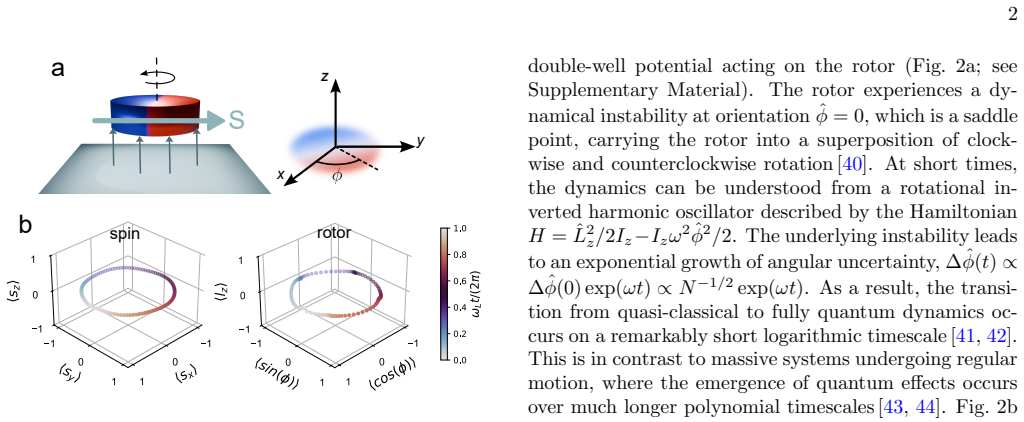
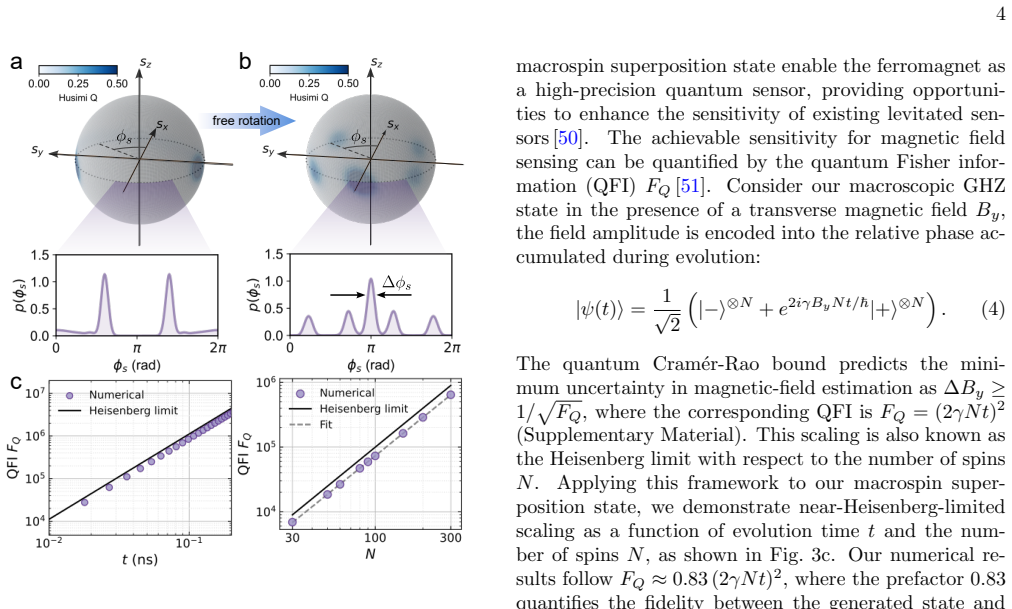
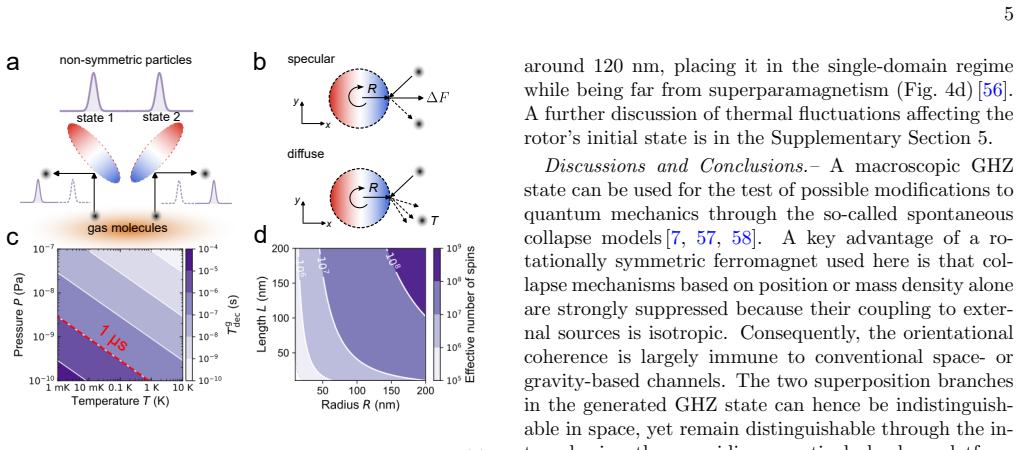
The generation of macroscopic quantum states can drive both fundamental physics and quantum technologies. This work proposes a top-down approach to the generation of macroscopic spin GHZ states using a levitated ferromagnet, where a strong locking between the collective spin and the lattice rotation enables mechanical control of the collective spin. We quantify the metrological advantage of the resulting macrospin superposition state by showing that Heisenberg scaling of the quantum Fisher information is achievable. Roles of symmetry and geometry are analyzed in terms of decoherence due to gas collisions, identifying accessible conditions for experimental realization. The usefulness of a macrospin superposition state of a levitated cylindrical ferromagnet in testing spin-dependent wavefunction collapse models is also discussed.
Editorial analysis
A structured set of objections, weighed in public.
Referee Report
Summary. The manuscript proposes a top-down approach to generating macroscopic spin GHZ states with a levitated ferromagnet. A strong locking between the collective spin and lattice rotation is used to enable mechanical control of the collective spin. The authors claim to show that the resulting macrospin superposition achieves Heisenberg scaling of the quantum Fisher information, analyze the roles of symmetry and geometry in gas-collision decoherence to identify accessible experimental conditions, and discuss the state's utility for testing spin-dependent wavefunction collapse models.
Significance. If the locking mechanism, decoherence analysis, and QFI scaling hold under the stated conditions, the work would provide a novel mechanical route to macroscopic quantum states with potential impact on quantum metrology (Heisenberg-limited sensitivity) and fundamental tests of quantum mechanics. The emphasis on identifying accessible regimes despite decoherence is a constructive element.
major comments (1)
- [Abstract] The provided abstract states that Heisenberg scaling of the quantum Fisher information is shown and that accessible conditions are identified, but contains no equations, derivations, or quantitative results; without the explicit derivation or numerical evidence in the main text, the central metrological claim cannot be assessed for internal consistency or load-bearing assumptions.
Simulated Author's Rebuttal
We thank the referee for their thoughtful review and positive assessment of the potential significance of our work. We address the single major comment below, clarifying the location and nature of the supporting derivations and evidence in the main text. We are prepared to make targeted revisions for clarity if needed.
read point-by-point responses
-
Referee: [Abstract] The provided abstract states that Heisenberg scaling of the quantum Fisher information is shown and that accessible conditions are identified, but contains no equations, derivations, or quantitative results; without the explicit derivation or numerical evidence in the main text, the central metrological claim cannot be assessed for internal consistency or load-bearing assumptions.
Authors: We agree that abstracts are not the appropriate place for equations or detailed derivations. The main text does contain the explicit derivations and quantitative evidence for the central claims. In Section III we derive the quantum Fisher information for the macrospin GHZ state generated via the spin-lattice locking mechanism, explicitly showing the Heisenberg scaling with particle number N under the stated conditions on the locking strength and rotation control. Section IV then provides the decoherence analysis due to gas collisions, including the roles of symmetry and geometry, together with numerical results (Figs. 3 and 4) that identify accessible experimental parameter regimes where the scaling remains observable. These sections allow direct assessment of internal consistency and assumptions. If the referee finds any step insufficiently detailed, we are happy to expand the derivations or add an appendix summarizing the key steps in a revision. revision: partial
Circularity Check
No significant circularity; derivation self-contained
full rationale
The abstract and summary describe a proposal based on spin-lattice locking in a levitated ferromagnet, symmetry/geometry analysis of gas-collision decoherence, and direct computation of quantum Fisher information to demonstrate Heisenberg scaling. No equations, fitted parameters renamed as predictions, self-citations as load-bearing premises, or ansatzes smuggled via prior work are referenced. The QFI scaling claim is presented as a calculable consequence of the prepared state rather than a redefinition or fit to the input assumptions. This matches the default case of a self-contained derivation with no detectable reduction to its own inputs.
Axiom & Free-Parameter Ledger
Reference graph
Works this paper leans on
-
[1]
D. M. Greenberger, M. A. Horne, A. Shimony, and A. Zeilinger, Bell’s theorem without inequalities, American Journal of Physics58, 1131 (1990)
1990
-
[2]
Leibfried, E
D. Leibfried, E. Knill, S. Seidelin, J. Britton, R. B. Blakestad, J. Chiaverini, D. B. Hume, W. M. Itano, J. D. Jost, C. Langer, R. Ozeri, R. Reichle, and D. J. Wineland, 6 Creation of a six-atom ‘Schr¨ odinger cat’ state, Nature438, 639 (2005)
2005
-
[3]
Omran, H
A. Omran, H. Levine, A. Keesling, G. Semeghini, T. T. Wang, S. Ebadi, H. Bernien, A. S. Zibrov, H. Pichler, S. Choi, J. Cui, M. Rossignolo, P. Rembold, S. Montangero, T. Calarco, M. Endres, M. Greiner, V. Vuleti´ c, and M. D. Lukin, Generation and manipulation of Schr¨ odinger cat states in Rydberg atom arrays, Science365, 570 (2019)
2019
-
[4]
Z. Bao, S. Xu, Z. Song, K. Wang, L. Xiang, Z. Zhu, J. Chen, F. Jin, X. Zhu, Y. Gao, Y. Wu, C. Zhang, N. Wang, Y. Zou, Z. Tan, A. Zhang, Z. Cui, F. Shen, J. Zhong, T. Li, J. Deng, X. Zhang, H. Dong, P. Zhang, Y.-R. Liu, L. Zhao, J. Hao, H. Li, Z. Wang, C. Song, Q. Guo, B. Huang, and H. Wang, Creating and controlling global Greenberger-Horne-Zeilinger entan...
2024
-
[5]
Zhang, Z
X. Zhang, Z. Hu, and Y.-C. Liu, Fast Generation of GHZ- like States Using Collective-Spin$\mathrm{XYZ}$Model, Physical Review Letters132, 113402 (2024)
2024
-
[6]
Fr¨ owis, P
F. Fr¨ owis, P. Sekatski, W. D¨ ur, N. Gisin, and N. San- gouard, Macroscopic quantum states: Measures, fragility, and implementations, Reviews of Modern Physics90, 025004 (2018)
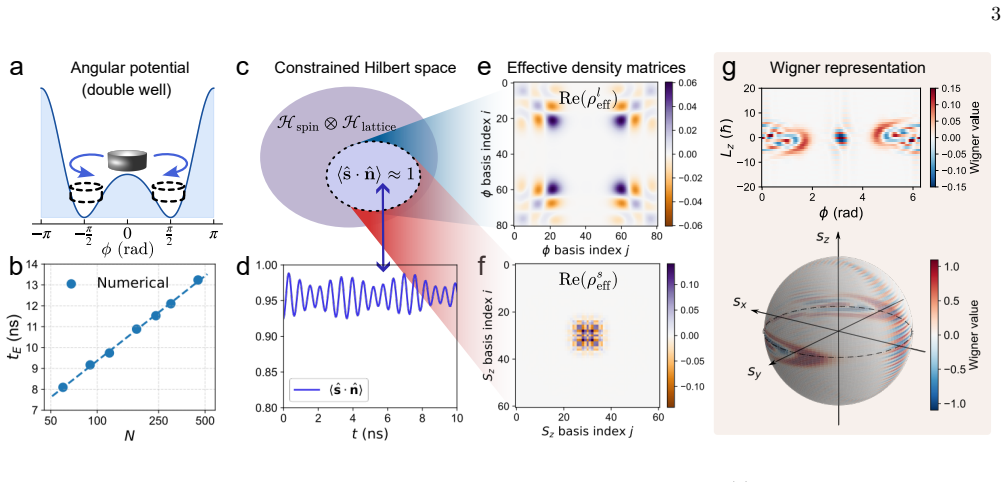
2018
-
[7]
Bassi, K
A. Bassi, K. Lochan, S. Satin, T. P. Singh, and H. Ul- bricht, Models of wave-function collapse, underlying the- ories, and experimental tests, Reviews of Modern Physics 85, 471 (2013)
2013
-
[8]
S. Bose, I. Fuentes, A. A. Geraci, S. M. Khan, S. Qvar- fort, M. Rademacher, M. Rashid, M. Toroˇ s, H. Ulbricht, and C. C. Wanjura, Massive quantum systems as inter- faces of quantum mechanics and gravity, Reviews of Modern Physics97, 015003 (2025)
2025
-
[9]
S. F. Huelga, C. Macchiavello, T. Pellizzari, A. K. Ekert, M. B. Plenio, and J. I. Cirac, Improvement of Frequency Standards with Quantum Entanglement, Physical Review Letters79, 3865 (1997)
1997
-
[10]
J. A. Jones, S. D. Karlen, J. Fitzsimons, A. Ardavan, S. C. Benjamin, G. A. D. Briggs, and J. J. L. Morton, Mag- netic Field Sensing Beyond the Standard Quantum Limit Using 10-Spin NOON States, Science324, 1166 (2009)
2009
-
[11]
Matsuzaki, S
Y. Matsuzaki, S. C. Benjamin, and J. Fitzsimons, Mag- netic field sensing beyond the standard quantum limit un- der the effect of decoherence, Physical Review A84, 012103 (2011)
2011
-
[12]
Montenegro, Heisenberg-limited spin-mechanical gravimetry, Physical Review Research7, 013016 (2025)
V. Montenegro, Heisenberg-limited spin-mechanical gravimetry, Physical Review Research7, 013016 (2025)
2025
-
[13]
J. B. Brask, R. Chaves, and J. Ko lody´ nski, Improved Quantum Magnetometry beyond the Standard Quantum Limit, Physical Review X5, 031010 (2015)
2015
-
[14]
Y. Lv, W. Yang, and Q. Zhi, Supersensitive noise sensing based on high-spin systems, Physical Review A112, 062622 (2025)
2025
-
[15]
Zheng, One-Step Synthesis of Multiatom Greenberger-Horne-Zeilinger States, Physical Review Letters87, 230404 (2001)
S.-B. Zheng, One-Step Synthesis of Multiatom Greenberger-Horne-Zeilinger States, Physical Review Letters87, 230404 (2001)
2001
-
[16]
C. Song, K. Xu, H. Li, Y.-R. Zhang, X. Zhang, W. Liu, Q. Guo, Z. Wang, W. Ren, J. Hao, H. Feng, H. Fan, D. Zheng, D.-W. Wang, H. Wang, and S.-Y. Zhu, Gen- eration of multicomponent atomic Schr¨ odinger cat states of up to 20 qubits, Science365, 574 (2019)
2019
-
[17]
Y. A. Yang, W.-T. Luo, J.-L. Zhang, S.-Z. Wang, C.-L. Zou, T. Xia, and Z.-T. Lu, Minute-scale Schr¨ odinger-cat state of spin-5/2 atoms, Nature Photonics , 1 (2024)
2024
-
[18]
X. Yu, B. Wilhelm, D. Holmes, A. Vaartjes, D. Schwien- bacher, M. Nurizzo, A. Kringhøj, M. R. van Blankenstein, A. M. Jakob, P. Gupta, F. E. Hudson, K. M. Itoh, R. J. Murray, R. Blume-Kohout, T. D. Ladd, N. Anand, A. S. Dzurak, B. C. Sanders, D. N. Jamieson, and A. Morello, Schr¨ odinger cat states of a nuclear spin qudit in silicon, Nature Physics21, 362 (2025)
2025
-
[19]
Gupta, A
P. Gupta, A. Vaartjes, X. Yu, A. Morello, and B. C. Sanders, Robust macroscopic Schr¨ odinger’s cat on a nu- cleus, Physical Review Research6, 013101 (2024)
2024
-
[20]
Heisenberg, Zur theorie des ferromagnetismus, Zeitschrift f¨ ur Physik49, 619 (1928)
W. Heisenberg, Zur theorie des ferromagnetismus, Zeitschrift f¨ ur Physik49, 619 (1928)
1928
-
[21]
J. Xiao, A. Zangwill, and M. D. Stiles, Macrospin models of spin transfer dynamics, Physical Review B72, 014446 (2005)
2005
-
[22]
Sayad, D
M. Sayad, D. G¨ utersloh, and M. Potthoff, Macrospin ap- proximation and quantum effects in models for magneti- zation reversal, The European Physical Journal B85, 125 (2012)
2012
-
[23]
D. F. Jackson Kimball, A. O. Sushkov, and D. Budker, Precessing Ferromagnetic Needle Magnetometer, Physical Review Letters116, 190801 (2016)
2016
-
[24]
X. Ni, Z. Zou, R. Lecamwasam, A. Vinante, D. Budker, P. K. Lam, T. Wang, and J. Gong, Microscopic theory of a precessing ferromagnet for ultrasensitive magnetometry, Phys. Rev. Res.7, 043120 (2025)
2025
-
[25]
Sharma, V
S. Sharma, V. A. S. V. Bittencourt, A. D. Karenowska, and S. V. Kusminskiy, Spin cat states in ferromagnetic in- sulators, Physical Review B103, L100403 (2021)
2021
-
[26]
A. Kani, M. Hatifi, and J. Twamley, Magnomechani- cal rotational Schr¨ odinger’s cat, APL Quantum2, 046104 (2025)
2025
-
[27]
He, Z.-L
S. He, Z.-L. Yang, S. Jin, F.-Y. Zhang, and C. Li, Gen- eration of four-component magnonic Schr¨ odinger cat states via Floquet engineering, Physical Review A113, 013739 (2026)
2026
-
[28]
Gonzalez-Ballestero, M
C. Gonzalez-Ballestero, M. Aspelmeyer, L. Novotny, R. Quidant, and O. Romero-Isart, Levitodynamics: Levita- tion and control of microscopic objects in vacuum, Science 374, eabg3027 (2021)
2021
-
[29]
Sheng, Y
Y. Sheng, Y. Leng, K. Tian, R. Li, Y. Chen, D. Long, S. Chen, X. He, and P. Yin, Levitated milligram-scale fer- romagnetic magnetometer at room temperature, Physical Review Applied25, 024090 (2026)
2026
-
[30]
Hofer, R
J. Hofer, R. Gross, G. Higgins, H. Huebl, O. F. Kieler, R. Kleiner, D. Koelle, P. Schmidt, J. A. Slater, M. Trupke, K. Uhl, T. Weimann, W. Wieczorek, and M. Aspelmeyer, High- Q Magnetic Levitation and Control of Superconduct- ing Microspheres at Millikelvin Temperatures, Physical Re- view Letters131, 043603 (2023)
2023
-
[31]
M. Fuwa, R. Sakagami, and T. Tamegai, Ferromagnetic levitation and harmonic trapping of a milligram-scale yt- trium iron garnet sphere, Physical Review A108, 063511 (2023)
2023
-
[32]
Z.-q. Yin, T. Li, X. Zhang, and L. M. Duan, Large quan- tum superpositions of a levitated nanodiamond through spin-optomechanical coupling, Physical Review A88, 033614 (2013)
2013
-
[33]
Scala, M
M. Scala, M. S. Kim, G. W. Morley, P. F. Barker, and S. Bose, Matter-Wave Interferometry of a Levitated Ther- mal Nano-Oscillator Induced and Probed by a Spin, Phys- ical Review Letters111, 180403 (2013)
2013
-
[34]
Einstein, Experimenteller nachweis der ampereschen molekularstr¨ ome, Naturwissenschaften3, 237 (1915)
A. Einstein, Experimenteller nachweis der ampereschen molekularstr¨ ome, Naturwissenschaften3, 237 (1915)
1915
-
[35]
S. J. Barnett, On magnetization by angular acceleration, Science30, 413 (1909). 7
1909
-
[36]
Nie and D.-X
X. Nie and D.-X. Yao, Einstein-de Haas effect: A bridge linking mechanics, magnetism, and topology, Science Bul- letin70, 301 (2025)
2025
-
[37]
Y. B. Band, Y. Avishai, and A. Shnirman, Dynamics of a Magnetic Needle Magnetometer: Sensitivity to Landau- Lifshitz-Gilbert Damping, Physical Review Letters121, 160801 (2018)
2018
-
[38]
Fadeev, C
P. Fadeev, C. Timberlake, T. Wang, A. Vinante, Y. B. Band, D. Budker, A. O. Sushkov, H. Ulbricht, and D. F. Jackson Kimball, Ferromagnetic gyroscopes for tests of fun- damental physics, Quantum Science and Technology6, 024006 (2021)
2021
-
[39]
Ahrens and A
F. Ahrens and A. Vinante, Observation of gyroscopic cou- pling in a nonspinning levitated ferromagnet, Phys. Rev. Lett.136, 146703 (2026)
2026
-
[40]
J. Ma, Y. Shen, J. Huang, and C. Lee, Quantum metrol- ogy via Floquet-engineered two-axis twisting and turning dynamics, Physical Review A112, L040602 (2025)
2025
-
[41]
Roda-Llordes, A
M. Roda-Llordes, A. Riera-Campeny, D. Candoli, P. T. Grochowski, and O. Romero-Isart, Macroscopic Quantum Superpositions via Dynamics in a Wide Double-Well Po- tential, Physical Review Letters132, 023601 (2024)
2024
-
[42]
R. Zhou, Q. Xiang, and A. Mazumdar, Spin-dependent force and inverted harmonic potential for rapid creation of macroscopic quantum superpositions, Physical Review A 111, 052207 (2025)
2025
-
[43]
M. V. Berry, Evolution of semiclassical quantum states in phase space, Journal of Physics A: Mathematical and General12, 625 (1979)
1979
-
[44]
Berman, A
G. Berman, A. Iomin, and G. Zaslavsky, Method of qua- siclassical approximation for c-number projection in coher- ent states basis, Physica D: Nonlinear Phenomena4, 113 (1981)
1981
-
[45]
Sasaki, T
T. Sasaki, T. Ichikawa, and I. Tsutsui, Entanglement of indistinguishable particles, Physical Review A83, 012113 (2011)
2011
-
[46]
Reusch, J
A. Reusch, J. Sperling, and W. Vogel, Entanglement wit- nesses for indistinguishable particles, Physical Review A 91, 042324 (2015)
2015
-
[47]
H. A. Kastrup, Wigner functions for the pair angle and orbital angular momentum, Physical Review A94, 062113 (2016)
2016
-
[48]
J. Chen, J. Tiong, L. H. Zaw, and V. Scarani, Even- parity precession protocol for detecting nonclassicality and entanglement, Physical Review A110, 062408 (2024)
2024
-
[49]
How often is the coordinate of a harmonic oscillator positive?
B. Tsirelson, How often is the coordinate of a harmonic oscillator positive? (2006), arXiv:quant-ph/0611147
work page internal anchor Pith review Pith/arXiv arXiv 2006
-
[50]
Van Camp, H
M. Van Camp, H. G. Wenzel, P. Schott, P. Vauterin, and O. Francis, Accurate transfer function determination for superconducting gravimeters, Geophysical Research Letters 27, 37 (2000)
2000
-
[51]
Huang, M
J. Huang, M. Zhuang, and C. Lee, Entanglement- enhanced quantum metrology: From standard quantum limit to Heisenberg limit, Applied Physics Reviews11, 031302 (2024)
2024
-
[52]
S. D. Bass and M. Doser, Quantum sensing for particle physics, Nature Reviews Physics6, 329 (2024)
2024
-
[53]
J. Qian, H. Wu, and F. Wang, A generalized Knudsen theory for gas transport with specular and diffuse reflec- tions, Nature Communications14, 7386 (2023)
2023
-
[54]
B. A. Stickler, B. Schrinski, and K. Hornberger, Rota- tional friction and diffusion of quantum rotors, Phys. Rev. Lett.121, 040401 (2018)
2018
-
[55]
Martinetz, K
L. Martinetz, K. Hornberger, and B. A. Stickler, Gas- induced friction and diffusion of rigid rotors, Physical Re- view E97, 052112 (2018)
2018
-
[56]
W. F. Brown Jr., The Fundamental Theorem of the The- ory of Fine Ferromagnetic Particles, Annals of the New York Academy of Sciences147, 463 (1969)
1969
-
[57]
Schrinski, B
B. Schrinski, B. A. Stickler, and K. Hornberger, Collapse- induced orientational localization of rigid rotors [Invited], JOSA B34, C1 (2017)
2017
-
[58]
D. G. A. Altamura, A. Vinante, and M. Carlesso, Im- proved bounds on collapse models from rotational noise of the Laser Interferometer Space Antenna Pathfinder mis- sion, Physical Review A111, L020203 (2025)
2025
-
[59]
Bassi and E
A. Bassi and E. Ippoliti, Numerical analysis of a sponta- neous collapse model for a two-level system, Physical Re- view A69, 012105 (2004)
2004
-
[60]
Pearle, Cosmogenesis and Collapse, Foundations of Physics42, 4 (2012)
P. Pearle, Cosmogenesis and Collapse, Foundations of Physics42, 4 (2012)
2012
-
[61]
Bai and J.-H
S.-Y. Bai and J.-H. An, Floquet Engineering to Over- come No-Go Theorem of Noisy Quantum Metrology, Phys- ical Review Letters131, 050801 (2023)
2023
-
[62]
Wachter, S
V. Wachter, S. V. Kusminskiy, G. H´ etet, and B. A. Stick- ler, Gyroscopically Stabilized Quantum Spin Rotors, Phys- ical Review Letters136, 073604 (2026) Macroscopic Spin GHZ States with a Levitated Ferromagnet: Supplementary Material Xueqi Ni 1,2,∗Zhixing Zou 1,2, Ping Koy Lam 1,2,3, Tao Wang3, and Jiangbin Gong 1,2† 1Department of Physics, National Uni...
2026
-
[63]
Experimental Considerations 2
-
[64]
Dependent Degree of Freedom 3
-
[65]
Derivation of Quantum Fisher Information of a GHZ State 4
-
[66]
Frequency of Interference Fringes 5
-
[67]
Effects of Initial Thermal Fluctuations 6
-
[68]
Classical Spin-Lattice Dynamics 7
-
[69]
Master Equation for a Quantum Rotor 8
-
[70]
Magnetic Noise and Spin Dephasing 12 References 14 2
-
[71]
EXPERIMENT AL CONSIDERA TIONS The crucial part of generating macrospin GHZ state in experiments is the preparation of an angular double-well potential and the control of the levitated objects. In principle, an angular double-well potential can be achieved by breaking the rotational symmetry of the levitation environment, leading to anisotropic coupling, a...
-
[72]
DEPENDENT DEGREE OF FREEDOM The entanglement between the collective spin and the rotor originates from their intrinsic spin-lattice coupling and is therefore fundamentally constrained by the underlying physics. As a consequence, the dynamically accessible Hilbert space is not the full tensor product Hspin⊗Hlattice, but rather a restricted subspace selecte...
-
[73]
DERIV A TION OF QUANTUM FISHER INFORMA TION OF A GHZ ST A TE In estimation theory, the Fisher information sets the fundamental bound on the precision of parameter estimation. For an unbiased estimator, the measurement precision is bounded by the Cram´ er–Rao inequality, ∆θ≥ 1√ FC(θ) , (10) where the classical Fisher information is defined as FC(θ) = ∑ i P...
-
[74]
To quantify the frequency of the fringes, we numerically evaluate the Fourier spectrum of the probability distribution p(ϕs) and extract its dominant frequency component
FREQUENCY OF INTERFERENCE FRINGES In this section, we analyze the interference fringes that emerge after the two orientational branches of the macro- scopic GHZ state are mechanically recombined. To quantify the frequency of the fringes, we numerically evaluate the Fourier spectrum of the probability distribution p(ϕs) and extract its dominant frequency c...
-
[75]
For rotational motion, however, the relevant requirement is less stringent
EFFECTS OF INITIAL THERMAL FLUCTUA TIONS The generation of macroscopic superposition is often discussed in the context of ground-state cooling of the motional degree of freedom. For rotational motion, however, the relevant requirement is less stringent. Since the orientation angle is a periodic variable defined modulo 2 π, thermal fluctuations do not by t...
-
[76]
The classical Hamiltonian takes the same form as the quantum one after replacing operators by classical variables, H = L2 z 2I−C(S·n)2 +V (ϕ), (31) where S·n =Sx cosϕ+Sy sinϕ
CLASSICAL SPIN-LA TTICE DYNAMICS In this section, we derive the classical equations of motion corresponding to the collective spin-lattice dynamics. The classical Hamiltonian takes the same form as the quantum one after replacing operators by classical variables, H = L2 z 2I−C(S·n)2 +V (ϕ), (31) where S·n =Sx cosϕ+Sy sinϕ. The resulting equations of motio...
-
[77]
In the body frame, the particles occupy fixed positions r(0) n =xnex, (41) subject to the center-of-mass condition ∑N n=1mnxn = 0
MASTER EQUA TION FOR A QUANTUM ROTOR To derive the master equation for the rotor, we model the planar rotor as a rigid N-particle assembly with masses mn. In the body frame, the particles occupy fixed positions r(0) n =xnex, (41) subject to the center-of-mass condition ∑N n=1mnxn = 0. If the rotor is restricted to the x-y plane as we considered in the mai...
-
[78]
MAGNETIC NOISE AND SPIN DEPHASING A macrospin GHZ state is far more fragile to magnetic noise than a single spin, which is the direct trade-off of its high phase sensitivity. In experiments, maintaining a macrospin GHZ state therefore requires the ambient magnetic field noise to be sufficiently suppressed through magnetic shielding, and this requirement m...
-
[79]
Perdriat, C
M. Perdriat, C. Pellet-Mary, T. Copie, and G. H´ etet, Planar magnetic Paul traps for ferromagnetic particles, Physical Review Research 5, L032045 (2023)
2023
-
[80]
M. Fuwa, R. Sakagami, and T. Tamegai, Ferromagnetic levitation and harmonic trapping of a milligram-scale yttrium iron garnet sphere, Physical Review A 108, 063511 (2023)
2023
discussion (0)
Sign in with ORCID, Apple, or X to comment. Anyone can read and Pith papers without signing in.