Augmented Roothaan-Hall Hessian Applied to Spin-Restricted Open-Shell Density-Functional Theory
Pith reviewed 2026-06-28 08:06 UTC · model grok-4.3
The pith
Generalizing the augmented Roothaan-Hall Hessian to restricted open-shell DFT produces faster SCF convergence for difficult spin states.
A machine-rendered reading of the paper's core claim, the machinery that carries it, and where it could break.
Core claim
The augmented Roothaan-Hall Hessian is formulated in detail for spin-restricted open-shell SCF and shown to converge reliably because it constructs an effective Hessian directly from the universal energy expression used for grid-based DFT. On iron-sulfur clusters that represent hard convergence problems the method needs substantially fewer RO-SCF iterations than L-BFGS or truncated Newton. In two-determinant calculations it avoids higher-lying stationary points for selected singlet excited states, and the same optimizer is used to trace the spin-crossover mechanism in a Ni(II)-porphyrin complex.
What carries the argument
The augmented Roothaan-Hall (ARH) Hessian constructed systematically from the universal energy formulation for RO wavefunctions.
If this is right
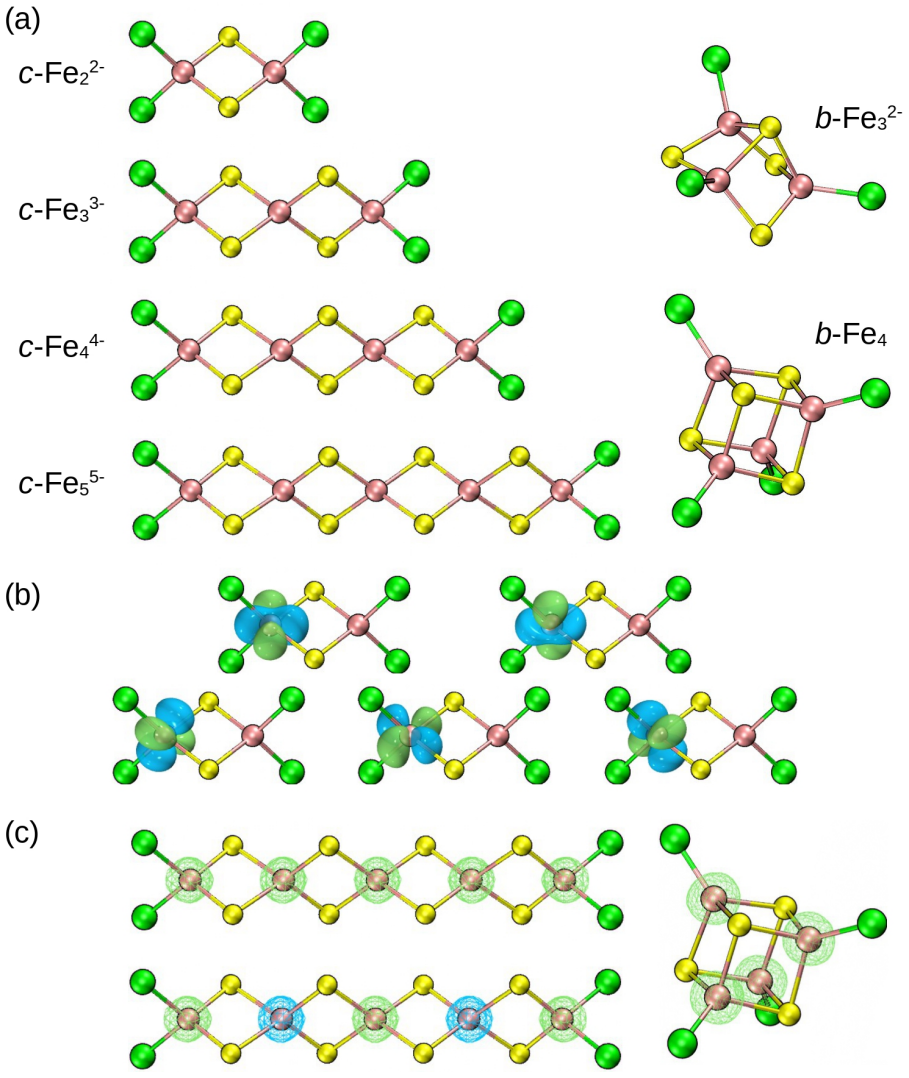
- ARH requires markedly fewer RO-SCF iterations than L-BFGS or truncated Newton on iron-sulfur clusters of varying spin multiplicity.
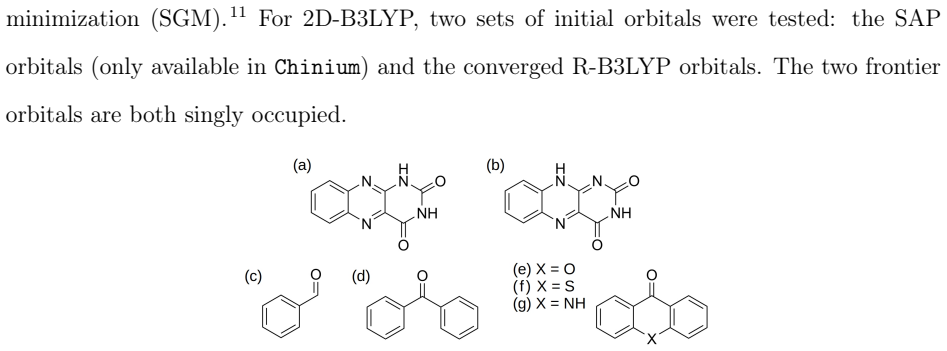
- ARH prevents convergence to higher-energy stationary points in two-determinant RO-SCF calculations for singlet excited states.
- A single code path now handles grid-based integration for closed-shell, unrestricted, and restricted open-shell DFT.
- The optimizer can be applied directly to map spin-crossover pathways in transition-metal complexes.
Where Pith is reading between the lines
- The same Hessian construction could be tested on other open-shell wavefunction methods that already share a common energy expression.
- If the quadratic assumption holds only approximately, the iteration count advantage may shrink for very large basis sets or strong correlation regimes.
- The avoidance of spurious stationary points suggests the method may improve reliability when mapping excited-state potential surfaces.
Load-bearing premise
The ARH Hessian remains effective when the underlying energy surface for RO-DFT deviates from the Euclidean quadratic form assumed in its derivation, particularly for two-determinant states.
What would settle it
A benchmark set of iron-sulfur cluster RO-SCF calculations in which the ARH method requires more iterations than L-BFGS to reach the same energy threshold would falsify the claimed efficiency advantage.
Figures
read the original abstract
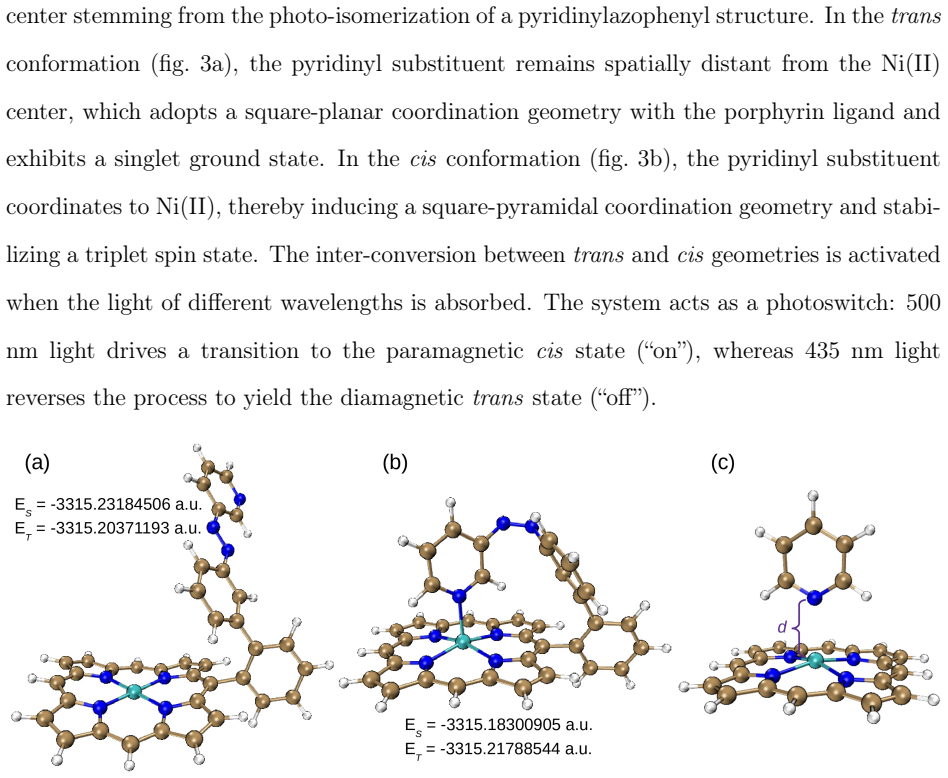
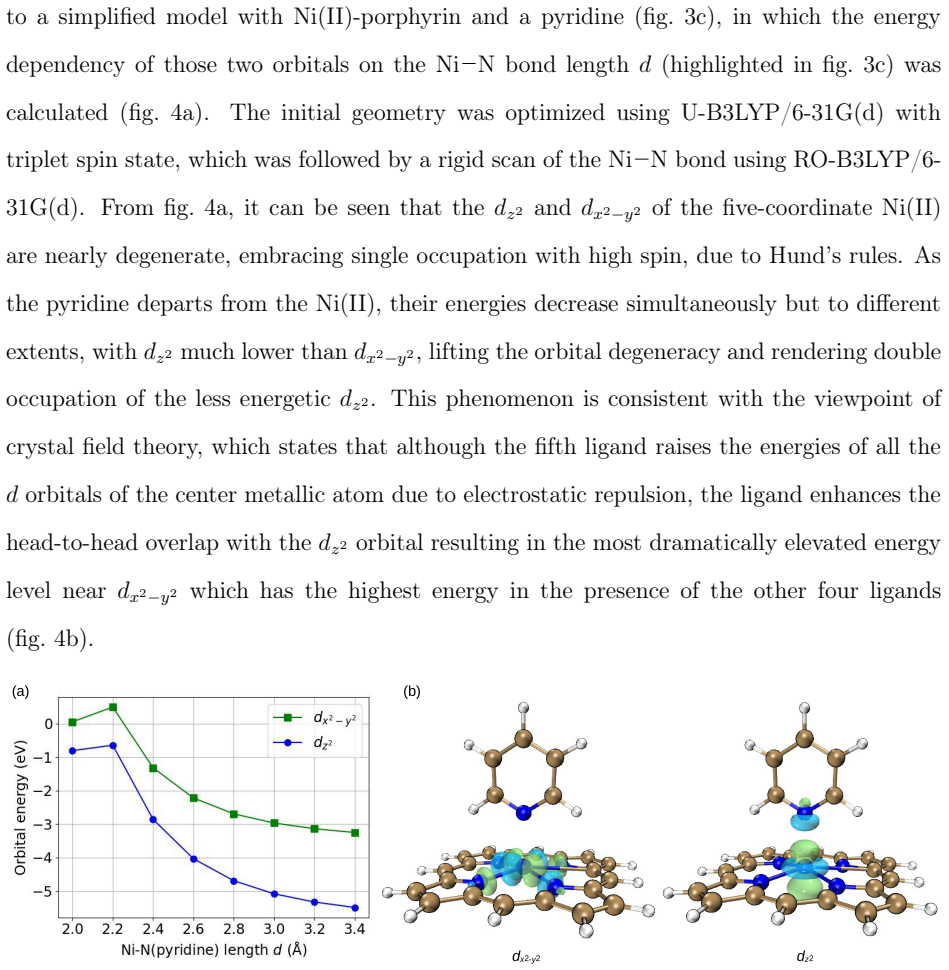
We generalize the augmented Roothaan-Hall (ARH) Hessian formalism to the self-consistent field (SCF) optimization of spin-restricted open-shell (RO) wavefunctions, encompassing high-spin, low-spin, and two-determinant electronic states. A detailed ARH formulation is presented. We demonstrate that ARH is a highly efficient optimization algorithm for rapidly identifying accurate SCF minima, primarily owing to its systematic construction of an effective Hessian, particularly in the case of Euclidean quadratic energy functions. The ARH is built upon a universal energy formulation, including grid-based integration, for spin-restricted closed-shell, spin-unrestricted and RO density functional theory (DFT), thereby unifying and simplifying their numerical implementation. The performance of the present method is evaluated using two benchmarking studies. First, for a series of iron-sulfur clusters exhibiting different spin states, which represent notoriously challenging SCF problems, the ARH algorithm demonstrates superior convergence efficiency relative to L-BFGS and truncated Newton methods, requiring much fewer RO-SCF iterations to achieve convergence. Second, the ARH approach avoids convergence to higher-energy stationary points in two-determinant RO-SCF calculations for singlet excited states of selected photoactive compounds. Finally, an application of the ARH-based RO-SCF is illustrated by an investigation of the mechanistic origin of the spin-crossover phenomenon in Ni(II)-porphyrin complex utilized as a contrast agent.
Editorial analysis
A structured set of objections, weighed in public.
Referee Report
Summary. The manuscript generalizes the augmented Roothaan-Hall (ARH) Hessian to spin-restricted open-shell (RO) SCF optimization in DFT for high-spin, low-spin, and two-determinant states. It presents a detailed ARH formulation built on a universal energy expression that unifies closed-shell, unrestricted, and RO-DFT implementations including grid integration. Benchmarks on iron-sulfur clusters claim ARH requires substantially fewer RO-SCF iterations than L-BFGS or truncated Newton; a second study claims ARH avoids higher-energy stationary points in two-determinant singlet calculations for photoactive compounds; an application to spin-crossover in Ni(II)-porphyrin is shown.
Significance. If the convergence advantages hold, the work would offer a practical advance for notoriously difficult open-shell DFT optimizations. The unification of the energy formulation across DFT variants and the concrete benchmarks on iron-sulfur clusters and two-determinant states are positive features that strengthen the contribution.
major comments (2)
- [Abstract and benchmarking studies] The central efficiency claim rests on the statement that ARH superiority stems from 'its systematic construction of an effective Hessian, particularly in the case of Euclidean quadratic energy functions.' No diagnostics are supplied on the size of higher-order terms or on the agreement between the ARH effective Hessian and the true Hessian within the orbital-rotation subspace for the iron-sulfur or two-determinant test cases, which are known to exhibit near-degeneracies.
- [Abstract] The abstract asserts that ARH 'demonstrates superior convergence efficiency... requiring much fewer RO-SCF iterations,' yet supplies neither numerical iteration counts, convergence thresholds, nor error bars for the iron-sulfur cluster series or the two-determinant singlet calculations.
minor comments (2)
- [Abstract] The abstract would be strengthened by inclusion of at least one quantitative performance metric (e.g., mean iteration count or success rate) from each benchmark set.
- Notation for the RO energy expression and the precise definition of the effective Hessian matrix elements should be cross-referenced to the corresponding equations in the detailed formulation section.
Simulated Author's Rebuttal
We thank the referee for the detailed and constructive report. We address each major comment below and indicate where revisions will be made to strengthen the manuscript.
read point-by-point responses
-
Referee: [Abstract and benchmarking studies] The central efficiency claim rests on the statement that ARH superiority stems from 'its systematic construction of an effective Hessian, particularly in the case of Euclidean quadratic energy functions.' No diagnostics are supplied on the size of higher-order terms or on the agreement between the ARH effective Hessian and the true Hessian within the orbital-rotation subspace for the iron-sulfur or two-determinant test cases, which are known to exhibit near-degeneracies.
Authors: We agree that explicit diagnostics comparing the ARH effective Hessian to the true Hessian (or quantifying higher-order terms) would strengthen the interpretation of the convergence results, especially for systems with near-degeneracies. The manuscript focuses on practical performance rather than such analysis, but we will add a brief discussion in the revised version (with supporting data in the SI if space permits) for at least the smaller iron-sulfur clusters, including a comparison of ARH Hessian eigenvalues to those obtained from finite-difference calculations in the orbital-rotation subspace. revision: yes
-
Referee: [Abstract] The abstract asserts that ARH 'demonstrates superior convergence efficiency... requiring much fewer RO-SCF iterations,' yet supplies neither numerical iteration counts, convergence thresholds, nor error bars for the iron-sulfur cluster series or the two-determinant singlet calculations.
Authors: The detailed iteration counts, convergence thresholds (10^{-8} a.u. on the gradient), and per-system results are provided in the main text (Tables 1-3 and Figures 2-4) and SI. The abstract is intentionally concise, but we accept that it would benefit from greater specificity. In revision we will insert representative numbers (e.g., average iterations for the Fe-S series) and explicitly state the convergence criterion while noting that the optimizations are deterministic and thus do not carry statistical error bars. revision: partial
Circularity Check
No significant circularity in derivation or performance claims
full rationale
The paper generalizes the ARH Hessian to RO-DFT via a stated universal energy formulation that includes grid integration, then reports empirical iteration counts from direct benchmarking on iron-sulfur clusters and two-determinant singlets. These counts are obtained by running the algorithm on concrete systems rather than being derived as predictions that reduce to fitted parameters or prior self-citations by construction. No equations or sections exhibit self-definitional equivalence, fitted-input renaming, or load-bearing self-citation chains; the quadratic-energy assumption is explicit but does not force the reported numerical outcomes. The derivation chain therefore remains self-contained against external benchmarks.
Axiom & Free-Parameter Ledger
axioms (1)
- domain assumption The RO energy expression admits a quadratic approximation whose Hessian can be constructed systematically from the same grid-based integration used for closed-shell and unrestricted cases.
Reference graph
Works this paper leans on
-
[1]
Lee, Seunghoon and Filatov, Michael and Lee, Sangyoub and Choi, Cheol Ho , title =. J. Chem. Phys. , volume =. 2018 , month =. doi:10.1063/1.5044202 , url =
-
[2]
Horbatenko, Yevhen and Sadiq, Saima and Lee, Seunghoon and Filatov, Michael and Choi, Cheol Ho , title =. J. Chem. Theory Comput. , volume =. 2021 , doi =
2021
-
[3]
, title = "
Becke, Axel D. , title = ". J. Chem. Phys. , volume =. 1993 , doi =
1993
-
[4]
The influence of polarization functions on molecular orbital hydrogenation energies , author=. Theor. Chim. Acta , volume=. 1973 , publisher=
1973
-
[5]
Dasgupta, S. and Herbert, J. M. , title =. J. Comput. Chem. , volume =. doi:10.1002/jcc.24761 , year =
-
[6]
Lehtola, Susi , title =. J. Chem. Theory Comput. , volume =. 2019 , doi =
2019
-
[7]
A Riemannian conjugate gradient method for optimization on the Stiefel manifold , author=. Comput. Optim. Appl. , volume=. 2017 , publisher=
2017
-
[8]
Optimization on flag manifolds , author=. Math. Program. , volume=. 2022 , publisher=
2022
-
[9]
Operator-valued formulas for Riemannian gradient and Hessian and families of tractable metrics in Riemannian optimization , author=. J. Optimiz. Theory App. , volume=. 2023 , publisher=
2023
-
[10]
A Grassmann manifold handbook: Basic geometry and computational aspects , author=. Adv. Comput. Math. , volume=. 2024 , publisher=
2024
-
[11]
Absil, P. A. and Mahony, Robert and Trumpf, Jochen. An extrinsic look at the Riemannian hessian. Geometric Science of Information. 2013
2013
-
[12]
Van Voorhis, Troy and Head-Gordon, Martin , title =. Mol. Phys. , volume =. 2002 , publisher =
2002
-
[13]
and van Voorhis, Troy and Head-Gordon, Martin , title =
Dunietz, Barry D. and van Voorhis, Troy and Head-Gordon, Martin , title =. J. Chem. Theory Comput. , volume =. 2002 , doi =
2002
-
[14]
Approximate second-order SCF convergence for spin unrestricted wavefunctions , journal =. 2000 , issn =. doi:https://doi.org/10.1016/S0009-2614(00)00662-X , url =
-
[15]
Thøgersen, Lea and Olsen, Jeppe and Yeager, Danny and Jørgensen, Poul and Sałek, Paweł and Helgaker, Trygve , title =. J. Phys. Chem. , volume =. 2004 , month =. doi:10.1063/1.1755673 , url =
-
[16]
Trust-region methods on Riemannian manifolds , author=. Found. Comput. Math , volume=. 2007 , publisher=
2007
-
[17]
Helmich-Paris, Benjamin , title =. J. Phys. Chem. , volume =. 2021 , month =. doi:10.1063/5.0040798 , url =
-
[18]
2008 , publisher =
Optimization Algorithms on Matrix Manifolds , author =. 2008 , publisher =
2008
-
[19]
An Introduction to Optimization on Smooth Manifolds , publisher =
Boumal, Nicolas , year =. An Introduction to Optimization on Smooth Manifolds , publisher =
-
[20]
Høst, Stinne and Olsen, Jeppe and Jansík, Branislav and Thøgersen, Lea and Jørgensen, Poul and Helgaker, Trygve , title =. J. Phys. Chem. , volume =. 2008 , month =. doi:10.1063/1.2974099 , url =
-
[21]
Feldmann, Robin and Baiardi, Alberto and Reiher, Markus , title =. J. Chem. Theory Comput. , volume =. 2023 , doi =
2023
-
[22]
Zhang, Yichi and Chen, Jiaxin , title =. J. Chem. Theory Comput. , volume =. 2026 , doi =
2026
-
[23]
Huang, Wen and Gallivan, K. A. and Absil, P.-A. , title =. SIAM J. Optim. , volume =. 2015 , doi =
2015
-
[24]
A Riemannian limited-memory BFGS algorithm for computing the matrix geometric mean , journal =. 2016 , issn =. doi:https://doi.org/10.1016/j.procs.2016.05.534 , url =
-
[25]
Asian Conference on Machine Learning , pages=
Vector transport free Riemannian LBFGS for optimization on symmetric positive definite matrix manifolds , author=. Asian Conference on Machine Learning , pages=. 2021 , organization=
2021
-
[26]
Tsuchimochi, Takashi and Scuseria, Gustavo E. , title =. J. Chem. Phys. , volume =. 2010 , month =. doi:10.1063/1.3503173 , url =
-
[27]
Vidal, Laurent and Nottoli, Tommaso and Lipparini, Filippo and Cancès, Eric , title =. J. Phys. Chem. A , volume =. 2024 , doi =
2024
-
[28]
2025 , MONTH = Mar, PDF =
Self-consistent field algorithms in restricted open-shell Hartree-Fock , AUTHOR =. 2025 , MONTH = Mar, PDF =
2025
-
[29]
Burton, Hugh G. A. , title =. J. Chem. Theory Comput. , volume =. 2025 , doi =
2025
-
[30]
Leyser da Costa Gouveia, Tiago and Maganas, Dimitrios and Neese, Frank , title =. J. Phys. Chem. A , volume =. 2024 , doi =
2024
-
[31]
Self-consistent field theory for open shells of electronic systems , author =. Rev. Mod. Phys. , volume =. 1960 , month =. doi:10.1103/RevModPhys.32.179 , url =
-
[32]
The case of
Convergence acceleration of iterative sequences. The case of. Chem. Phys. Lett. , volume =. 1980 , DOI =
1980
-
[33]
Pulay, P. , title =. J. Comput. Chem. , volume =. doi:10.1002/jcc.540030413 , year =
-
[34]
Kohn—Sham density-functional theory within a finite basis set , journal =. 1992 , issn =. doi:https://doi.org/10.1016/0009-2614(92)85009-Y , url =
-
[35]
Johnson, Benny G. and Fisch, Michael J. , title =. J. Chem. Phys. , volume =. 1994 , month =. doi:10.1063/1.466887 , url =
-
[36]
Stratmann, R. Eric and Burant, John C. and Scuseria, Gustavo E. and Frisch, Michael J. , title =. J. Chem. Phys. , volume =. 1997 , month =. doi:10.1063/1.474047 , url =
-
[37]
Molecules , VOLUME =
Lehtola, Susi and Blockhuys, Frank and Van Alsenoy, Christian , TITLE =. Molecules , VOLUME =. 2020 , NUMBER =
2020
-
[38]
2018 , doi =
Recent developments in libxc — A comprehensive library of functionals for density functional theory , journal =. 2018 , doi =
2018
-
[39]
, title =
Ekstr\"om, U. , title =
-
[40]
Sun, Qiming and Zhang, Xing and Banerjee, Samragni and Bao, Peng and Barbry, Marc and Blunt, Nick S. and Bogdanov, Nikolay A. and Booth, George H. and Chen, Jia and Cui, Zhi-Hao and Eriksen, Janus J. and Gao, Yang and Guo, Sheng and Hermann, Jan and Hermes, Matthew R. and Koh, Kevin and Koval, Peter and Lehtola, Susi and Li, Zhendong and Liu, Junzi and Ma...
-
[41]
, title =
Szabo, Attila and Ostlund, Neil S. , title =. 1996 , address =
1996
-
[42]
Parr, R. G. and Yang, W. , title = "
-
[43]
Lu, Tian and Chen, Feiwu , title =. J. Comput. Chem. , volume =. doi:https://doi.org/10.1002/jcc.22885 , url =. https://onlinelibrary.wiley.com/doi/pdf/10.1002/jcc.22885 , year =
-
[44]
Lu, Tian , title =. J. Chem. Phys. , volume =. 2024 , issn =. doi:10.1063/5.0216272 , url =
-
[45]
VMD: Visual molecular dynamics , journal =
William Humphrey and Andrew Dalke and Klaus Schulten , keywords =. VMD: Visual molecular dynamics , journal =. 1996 , issn =. doi:https://doi.org/10.1016/0263-7855(96)00018-5 , url =
-
[46]
A quadrature formula for the sphere of the 131st algebraic order of accuracy , author=. Dokl. Math. , volume=
-
[47]
Low-energy spectrum of iron--sulfur clusters directly from many-particle quantum mechanics , author=. Nat. Chem. , volume=. 2014 , publisher=
2014
-
[48]
S. Venkataramani and U. Jana and M. Dommaschk and F. D. Sönnichsen and F. Tuczek and R. Herges , title =. Science , volume =. 2011 , doi =. https://www.science.org/doi/pdf/10.1126/science.1201180 , abstract =
-
[49]
Dommaschk, M. and Schütt, C. and Venkataramani, S. and Jana, U. and Näther, C. and Sönnichsen, F. D. and Herges, R. Rational design of a room temperature molecular spin switch. The light-driven coordination induced spin state switch (LD-CISSS) approach. Dalton Trans. 2014. doi:10.1039/C4DT03048F
-
[50]
Photoswitchable magnetic resonance imaging contrast by improved light-driven coordination-induced spin state switch , journal =
Dommaschk, Marcel and Peters, Morten and Gutzeit, Florian and Sch. Photoswitchable magnetic resonance imaging contrast by improved light-driven coordination-induced spin state switch , journal =. 2015 , doi =
2015
-
[51]
Solving restricted open-shell equations in excited state molecular dynamics simulations , journal =. 2008 , issn =. doi:https://doi.org/10.1016/j.chemphys.2007.09.035 , url =
-
[52]
Kowalczyk, Tim and Tsuchimochi, Takashi and Chen, Po-Ta and Top, Laken and Van Voorhis, Troy , title =. J. Chem. Phys. , volume =. 2013 , month =
2013
-
[53]
and Van Voorhis, Troy , title =
Hait, Diptarka and Zhu, Tianyu and McMahon, David P. and Van Voorhis, Troy , title =. J. Chem. Theory Comput. , volume =. 2016 , doi =
2016
-
[54]
Hait, Diptarka and Head-Gordon, Martin , title =. J. Phys. Chem. Lett. , volume =. 2020 , doi =
2020
-
[55]
Kunze, Lukas and Hansen, Andreas and Grimme, Stefan and Mewes, Jan-Michael , title =. J. Phys. Chem. Lett. , volume =. 2021 , doi =
2021
-
[56]
Gilbert, Andrew T. B. and Besley, Nicholas A. and Gill, Peter M. W. , title =. J. Phys. Chem. A , volume =. 2008 , doi =
2008
-
[57]
Hait, Diptarka and Head-Gordon, Martin , title =. J. Chem. Theory Comput. , volume =. 2020 , doi =
2020
-
[58]
Ling, Haobo and Shen, Hengyuan and Zhang, Zeyi and Head-Gordon, Martin , title =. J. Chem. Theory Comput. , volume =. 2026 , doi =
2026
-
[59]
Hait, Diptarka and Head-Gordon, Martin , title =. J. Phys. Chem. Lett. , volume =. 2021 , doi =
2021
-
[60]
P., Akshay and Ghosh, Soumen , title =
V., Vigneshwaran and Basumatary, Swrangsar and Beypi, Chitralekha and C. P., Akshay and Ghosh, Soumen , title =. J. Chem. Theory Comput. , volume =. 2026 , doi =
2026
-
[61]
and Alavi, Ali , title =
Dobrautz, Werner and Smart, Simon D. and Alavi, Ali , title =. J. Chem. Phys. , volume =. 2019 , month =
2019
-
[62]
and Shushkov, Philip and Tully, John C
Evangelista, Francesco A. and Shushkov, Philip and Tully, John C. , title =. J. Phys. Chem. A , volume =. 2013 , doi =
2013
-
[63]
M. J. Frisch and G. W. Trucks and H. B. Schlegel and G. E. Scuseria and M. A. Robb and J. R. Cheeseman and G. Scalmani and V. Barone and G. A. Petersson and H. Nakatsuji and X. Li and M. Caricato and A. V. Marenich and J. Bloino and B. G. Janesko and R. Gomperts and B. Mennucci and H. P. Hratchian and J. V. Ortiz and A. F. Izmaylov and J. L. Sonnenberg an...
2016
-
[64]
Gaussian basis sets for use in correlated molecular calculations
Dunning, Thom H., Jr. , title =. J. Chem. Phys. , volume =. 1989 , month =. doi:10.1063/1.456153 , url =
-
[65]
Treatment of electronic excitations within the adiabatic approximation of time dependent density functional theory , journal =. 1996 , issn =. doi:https://doi.org/10.1016/0009-2614(96)00440-X , url =
-
[66]
and Jamorski, Christine and Casida, Kim C
Casida, Mark E. and Jamorski, Christine and Casida, Kim C. and Salahub, Dennis R. , title =. J. Chem. Phys. , volume =. 1998 , month =
1998
-
[67]
Stratmann, R. Eric and Scuseria, Gustavo E. and Frisch, Michael J. , title =. J. Chem. Phys. , volume =. 1998 , month =. doi:10.1063/1.477483 , url =
-
[68]
Koch, Henrik and Jørgensen, Poul , title =. J. Chem. Phys. , volume =. 1990 , month =. doi:10.1063/1.458814 , url =
-
[69]
Stanton, John F. and Bartlett, Rodney J. , title =. J. Chem. Phys. , volume =. 1993 , month =. doi:10.1063/1.464746 , url =
-
[70]
Gilbert and Michael Wormit and Joerg Kussmann and Adrian W
Yihan Shao and Zhengting Gan and Evgeny Epifanovsky and Andrew T.B. Gilbert and Michael Wormit and Joerg Kussmann and Adrian W. Lange and Andrew Behn and Jia Deng and Xintian Feng and Debashree Ghosh and Matthew Goldey and Paul R. Horn and Leif D. Jacobson and Ilya Kaliman and Rustam Z. Khaliullin and Tomasz Kuś and Arie Landau and Jie Liu and Emil I. Pro...
2015
-
[71]
Spectroscopy and photophysics of iso- and alloxazines: experimental and theoretical study , author=. J. Fluoresc. , volume=. 2004 , publisher=
2004
-
[72]
Visser, Antonie J. W. G. and Müller, Franz , title =. Helv. Chim. Acta , volume =. doi:https://doi.org/10.1002/hlca.19790620227 , url =
-
[73]
Vibrational structure of a high-resolution UV absorption spectrum of benzaldehyde in the gas phase , author=. Russ. J. Phys. Chem. A , volume=. 2020 , publisher=
2020
-
[74]
Terenin, A. and Ermolaev, V. Sensitized phosphorescence in organic solutions at low temperature. Energy transfer between triplet states. Trans. Faraday Soc. 1956. doi:10.1039/TF9565201042
-
[75]
Gemayel, R. and Emmelin, C. and Perrier, S. and Tomaz, S. and Baboomian, V. J. and Fishman, D. A. and Nizkorodov, S. A. and Dumas, S. and George, C. Quenching of ketone triplet excited states by atmospheric halides. Environ. Sci.: Atmos. 2021. doi:10.1039/D0EA00011F
-
[76]
Absorption Spectroscopy in the Ultraviolet and Visible Regions
Kl \"o pffer, Walter. Absorption Spectroscopy in the Ultraviolet and Visible Regions. Introduction to Polymer Spectroscopy. 1984. doi:10.1007/978-3-642-69373-1_3
-
[77]
Photoelectric Spectrometry Group England Staff. UV Atlas of Organic Compounds. UV Atlas of Organic Compounds / UV Atlas organischer Verbindungen. 1967. doi:10.1007/978-1-4757-6890-9_1
discussion (0)
Sign in with ORCID, Apple, or X to comment. Anyone can read and Pith papers without signing in.