Nuclear Reaction Data for Fission Products Off Stability
Pith reviewed 2026-06-28 07:53 UTC · model grok-4.3
The pith
Accounting for nuclear deformation and machine-learning constraints improves predictions of neutron cross sections on unstable fission products.
A machine-rendered reading of the paper's core claim, the machinery that carries it, and where it could break.
Core claim
A more realistic reaction modeling approach that accounts for nuclear deformation, combined with machine learning to constrain parameters, can improve predictions of neutron-induced reaction cross sections for fission products off stability compared to usual simplified assumptions.
What carries the argument
Nuclear deformation incorporated into reaction modeling, with machine-learning methods used to constrain uncertain parameters.
If this is right
- Evaluated nuclear data files can be prepared for the most abundant fission products off stability.
- These files can be submitted for inclusion in the next major ENDF/B release.
- Cross-section libraries used in reactor design, burnup analysis, and nonproliferation applications will rest on fewer untested simplifications.
- The same modeling framework can be applied to other neutron-induced reactions on unstable nuclei.
Where Pith is reading between the lines
- The method may reduce the size of uncertainty bands that currently arise from unvalidated shape assumptions in evaluated data.
- It could be tested on a small set of nuclei for which limited experimental anchors already exist before scaling to completely unmeasured cases.
- Similar deformation-plus-machine-learning adjustments might improve predictions for charged-particle reactions on the same nuclei.
- The approach offers a route to quantify how much each modeling choice affects final cross sections for specific applications.
Load-bearing premise
That adding explicit nuclear deformation and machine-learning constraints will produce meaningfully more accurate cross sections without introducing new uncontrolled uncertainties.
What would settle it
New experimental measurements of a neutron-induced cross section on one of the selected unstable fission-product nuclei that can be compared directly with both the simplified and the deformation-plus-machine-learning predictions.
Figures
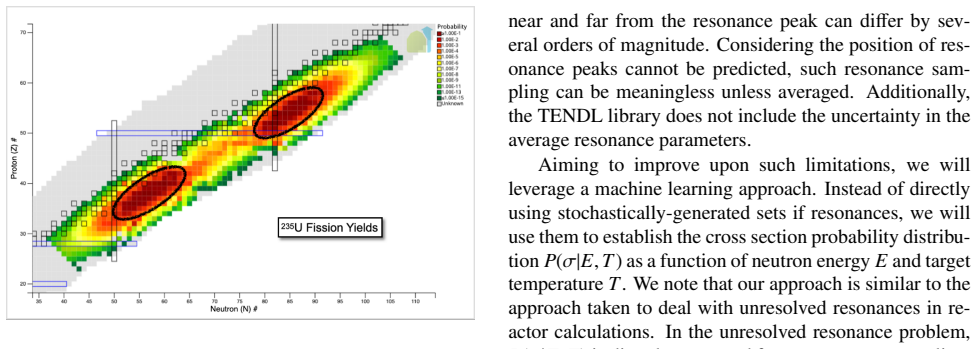
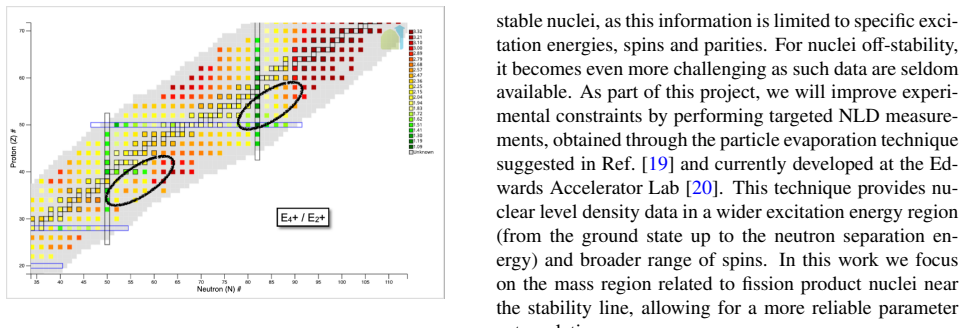
read the original abstract
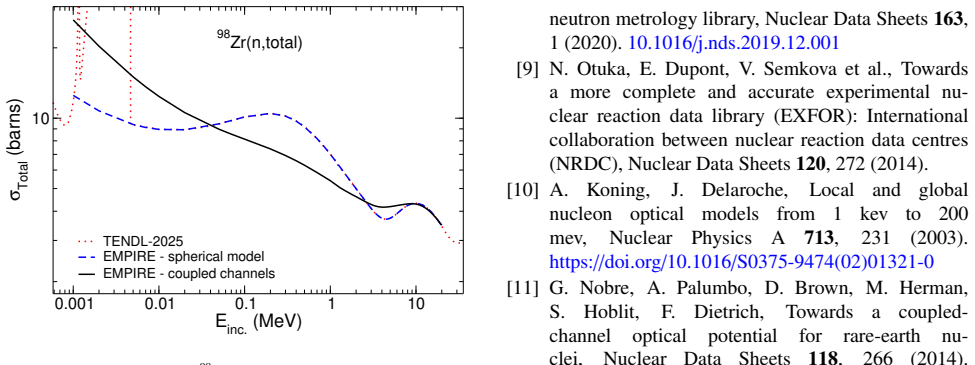
Neutron cross sections on fission products are relevant to a wide range of applications, including nuclear nonproliferation and forensics, spent-fuel assay, reactor burnup and design, as well as astrophysics. Evaluated nuclear data libraries generally fulfill application needs for isotopes on or near stability, however, for unstable fission products, theoretical descriptions of neutron-induced reactions often constitute the only available source of information. These models often make use of simplified assumptions, leading to unquantified impacts on predicted cross sections. In this work, we discuss possible approaches to addressing these issues, particularly by leveraging machine-learning methods, improved predictive reaction modeling, and experimental data to better constrain model parameters. Our goal is to eventually produce evaluated files for the most-produced nuclei off stability in the fission process of $^{235}$U and submit them to the ENDF/B for consideration in the future ENDF/B-IX.0 release. Here we present the methodology and discuss preliminary results comparing usual simplified approaches with a more realistic one accounting for nuclear deformation.
Editorial analysis
A structured set of objections, weighed in public.
Referee Report
Summary. The manuscript describes an approach to improve theoretical modeling of neutron-induced reaction cross sections for unstable fission products by incorporating nuclear deformation and using machine learning methods to constrain model parameters. It presents the methodology and preliminary results comparing this to usual simplified assumptions, with the goal of producing evaluated nuclear data files for the most-produced off-stability nuclei from 235U fission for submission to ENDF/B.
Significance. This work has the potential to fill important gaps in nuclear reaction data for applications in nonproliferation, spent fuel assay, reactor design, and astrophysics. The use of ML for parameter constraint and deformation modeling is a novel direction that, if successful, could lead to more accurate predictions where experimental data is unavailable.
major comments (1)
- [Abstract] The central claim that a more realistic deformation-accounting approach combined with ML yields meaningfully better cross sections rests on preliminary model-to-model comparisons (as described in the abstract). No experimental benchmarks exist for these nuclei, so the manuscript must explicitly discuss how improvement versus uncertainty reduction is established; this is load-bearing for the claim of improved predictions.
Simulated Author's Rebuttal
We thank the referee for the constructive review. The single major comment is addressed below; we agree it requires explicit clarification in the manuscript and will revise accordingly.
read point-by-point responses
-
Referee: [Abstract] The central claim that a more realistic deformation-accounting approach combined with ML yields meaningfully better cross sections rests on preliminary model-to-model comparisons (as described in the abstract). No experimental benchmarks exist for these nuclei, so the manuscript must explicitly discuss how improvement versus uncertainty reduction is established; this is load-bearing for the claim of improved predictions.
Authors: We agree that the distinction between demonstrated improvement and reduced model uncertainty must be stated explicitly, given the absence of experimental benchmarks for these unstable nuclei. In the revised manuscript we will (1) qualify the abstract language to emphasize that the reported comparisons are between modeling frameworks rather than against data, (2) add a dedicated paragraph in the introduction or results section explaining that the deformation-accounting approach reduces systematic bias associated with the spherical approximation while the ML step constrains parameter ranges within each framework, and (3) note that any claim of “better” cross sections remains provisional until future measurements become available. These additions will make the evidential basis of the central claim transparent without overstating the current results. revision: yes
Circularity Check
No circularity: methodology draws on external data and standard models
full rationale
The paper presents a methodology for constraining reaction model parameters via machine learning and experimental data on or near stability, then applies the resulting models to off-stability fission products. No derivation step, equation, or claim reduces a prediction to a fitted input by construction, invokes a self-citation as the sole justification for a uniqueness theorem, or renames a known result. The central comparison is between simplified and deformation-aware modeling approaches, with the goal of producing ENDF files; this chain remains open to external benchmarks and does not collapse into its own inputs.
Axiom & Free-Parameter Ledger
axioms (1)
- domain assumption Standard nuclear reaction models (e.g., Hauser-Feshbach) apply to off-stability fission products.
Reference graph
Works this paper leans on
-
[1]
G.P.A. Nobre, R. Capote, M.T. Pigni, A. Trkov, C.M. Mattoon, D. Neudecker, D.A. Brown, M.B. Chad- 0.001 0.01 0.1 1 10 Einc. (MeV) 10σ Total (barns) TENDL-2025 EMPIRE - spherical model EMPIRE - coupled channels 98 Zr(n,total) Figure 3.Comparison of 98Zr(n,total) cross section between a more realistic couple-channel calculation and a spherical one. TENDL al...
-
[2]
MacFarlane, D
R. MacFarlane, D. Muir, R. Boicourt, A. Kahler, J. Conlin, W. Haeck, Tech. Rep. LA-UR-17-20093, Los Alamos National Laboratory, NM, USA (2017)
2017
-
[3]
C.M. Mattoon, B.R. Beck, G. Gert, Managing and Processing Nuclear Data Libraries with FUDGE, EPJ Web of Conferences284, 14010 (2023). 10.1051/epjconf/202328414010
-
[4]
Wiarda et al., Tech
D. Wiarda et al., Tech. Rep. ORNL/TM-2016/43, Oak Ridge National Laboratory, TN, USA (2016), available from Radiation Safety Information Compu- tational Center asCCC-834
2016
-
[5]
Mughabghab, Atlas of Neutron Resonances (Elsevier, 2018), ISBN 978-0-444-63786- 4,https://linkinghub.elsevier.com/ retrieve/pii/C2015000524X
S.F. Mughabghab, Atlas of Neutron Resonances (Elsevier, 2018), ISBN 978-0-444-63786- 4,https://linkinghub.elsevier.com/ retrieve/pii/C2015000524X
2018
-
[7]
A.J. Koning, D. Rochman, J.C. Sublet, N. Dzy- siuk, M. Fleming, S.v.d. Marck, TENDL: Com- plete nuclear data library for innovative nuclear sci- ence and technology, Nuclear Data Sheets155, 1 (2019), special Issue on Nuclear Reaction Data. https://doi.org/10.1016/j.nds.2019.01.002
-
[8]
A. Trkov, P. Griffin, S. Simakov, L. Greenwood, K. Zolotarev, R. Capote, D. Aldama, V . Chechev, C. Destouches, A. Kahler et al., IRDFF-II: A new neutron metrology library, Nuclear Data Sheets163, 1 (2020). 10.1016/j.nds.2019.12.001
-
[9]
Otuka, E
N. Otuka, E. Dupont, V . Semkova et al., Towards a more complete and accurate experimental nu- clear reaction data library (EXFOR): International collaboration between nuclear reaction data centres (NRDC), Nuclear Data Sheets120, 272 (2014)
2014
-
[10]
A. Koning, J. Delaroche, Local and global nucleon optical models from 1 kev to 200 mev, Nuclear Physics A713, 231 (2003). https://doi.org/10.1016/S0375-9474(02)01321-0
-
[11]
G. Nobre, A. Palumbo, D. Brown, M. Herman, S. Hoblit, F. Dietrich, Towards a coupled- channel optical potential for rare-earth nu- clei, Nuclear Data Sheets118, 266 (2014). https://doi.org/10.1016/j.nds.2014.04.054
-
[12]
G.P.A. Nobre, A. Palumbo, M. Herman, D. Brown, S. Hoblit, F.S. Dietrich, Derivation of an optical po- tential for statically deformed rare-earth nuclei from a global spherical potential, Phys. Rev. C91, 024618 (2015). 10.1103/PhysRevC.91.024618
-
[13]
G.P.A. Nobre, F.S. Dietrich, M. Herman, A. Palumbo, S. Hoblit, D. Brown, Towards an optical potential for rare-earths through coupled channels, AIP Conference Proceedings1625, 45 (2014). 10.1063/1.4901763
-
[14]
Herman, M., Nobre, G. P. A., Palumbo, A., Diet- rich, F. S., Brown, D., Hoblit, S., Coupled chan- nels optical model potential for rare earth nuclei, EPJ Web of Conferences69, 00007 (2014). 10.1051/epj- conf/20136900007
-
[15]
F.S. Dietrich, I.J. Thompson, T. Kawano, Target- state dependence of cross sections for reactions on statically deformed nuclei, Phys. Rev. C85, 044611 (2012). 10.1103/PhysRevC.85.044611
-
[16]
Hilaire, M
S. Hilaire, M. Girod, Large-scale mean-field calcula- tions from proton to neutron drip lines using the D1S gogny force, Eur. Phys. J. A33, 237 (2007)
2007
-
[17]
Herman, R
M. Herman, R. Capote, B. Carlson, P. Obložinský, M. Sin, A. Trkov, H. Wienke, V . Zerkin, EMPIRE: Nuclear reaction model code system for data evalua- tion, Nuclear Data Sheets108, 2655 (2007)
2007
-
[18]
R. Capote, M. Herman, P. Obložinský, P. Young, S. Goriely, T. Belgya, A. Ignatyuk, A. Koning, S. Hi- laire, V . Plujko et al., RIPL - Reference Input Param- eter Library for Calculation of Nuclear Reactions and Nuclear Data Evaluations, Nuclear Data Sheets110, 3107 (2009). 10.1016/j.nds.2009.10.004
-
[19]
V onach, Extraction of level density information from non-resonant reactions, p
H. V onach, Extraction of level density information from non-resonant reactions, p. p. 247–290. (1983)
1983
-
[20]
A.V . V oinov, T. Renstrøm, D.L. Bleuel, S.M. Grimes, M. Guttormsen, A.C. Larsen, S.N. Liddick, G. Perdikakis, A. Spyrou, S. Akhtar et al., Level den- sities of 74,76Ge from compound nuclear reactions, Phys. Rev. C99, 054609 (2019). 10.1103/Phys- RevC.99.054609
discussion (0)
Sign in with ORCID, Apple, or X to comment. Anyone can read and Pith papers without signing in.