Characterizing quantum channels from local-unitary invariants
Pith reviewed 2026-06-28 09:54 UTC · model grok-4.3
The pith
Averaged local-unitary invariants classify how two-qubit channels create, preserve, or destroy entanglement.
A machine-rendered reading of the paper's core claim, the machinery that carries it, and where it could break.
Core claim
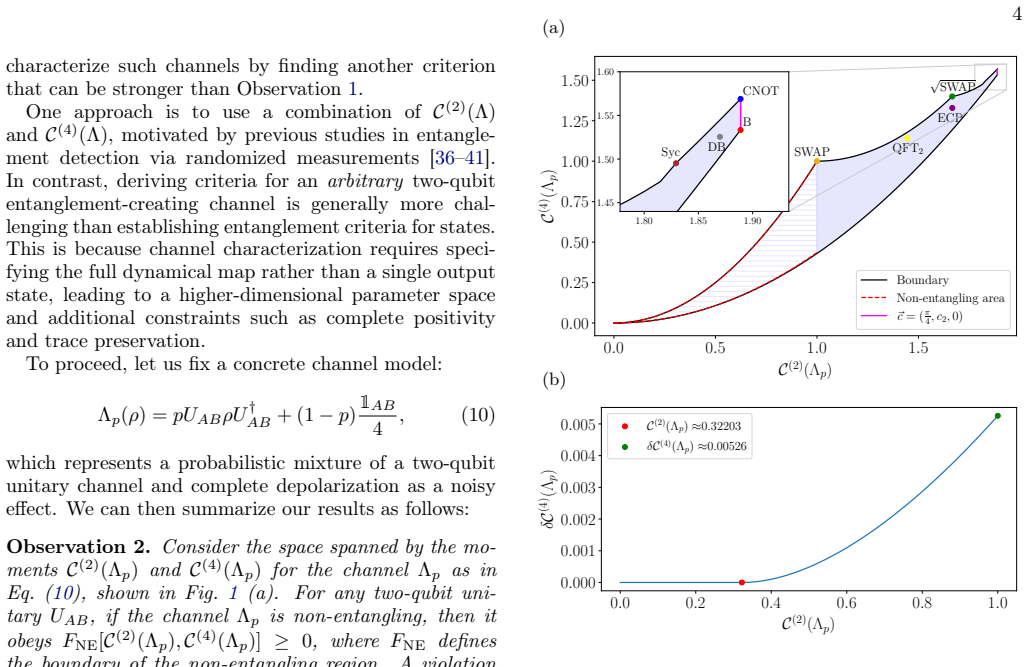
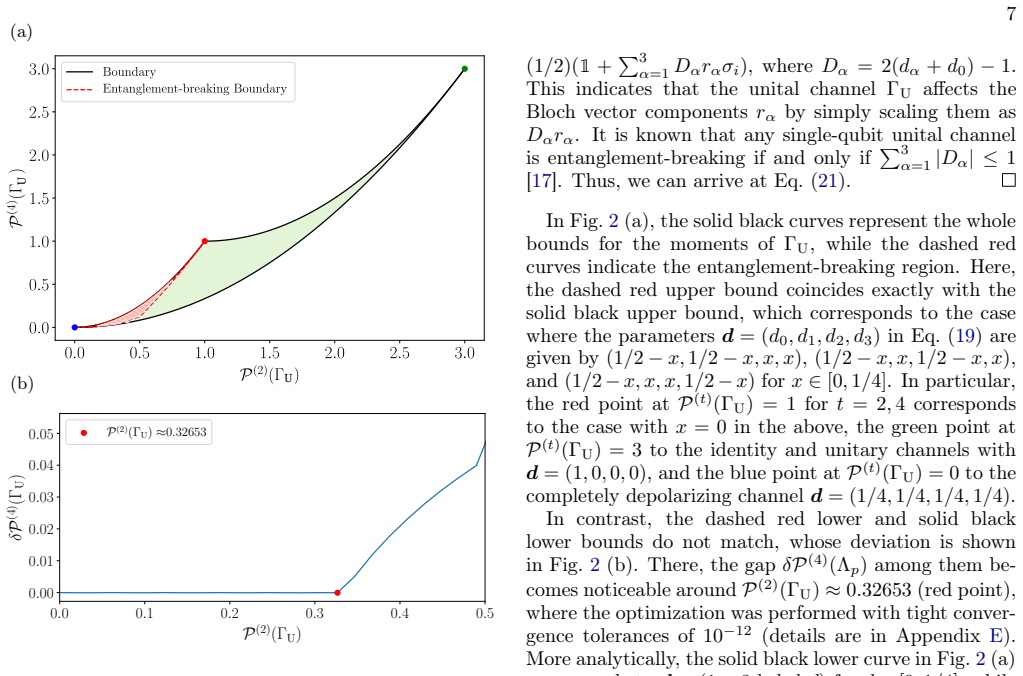
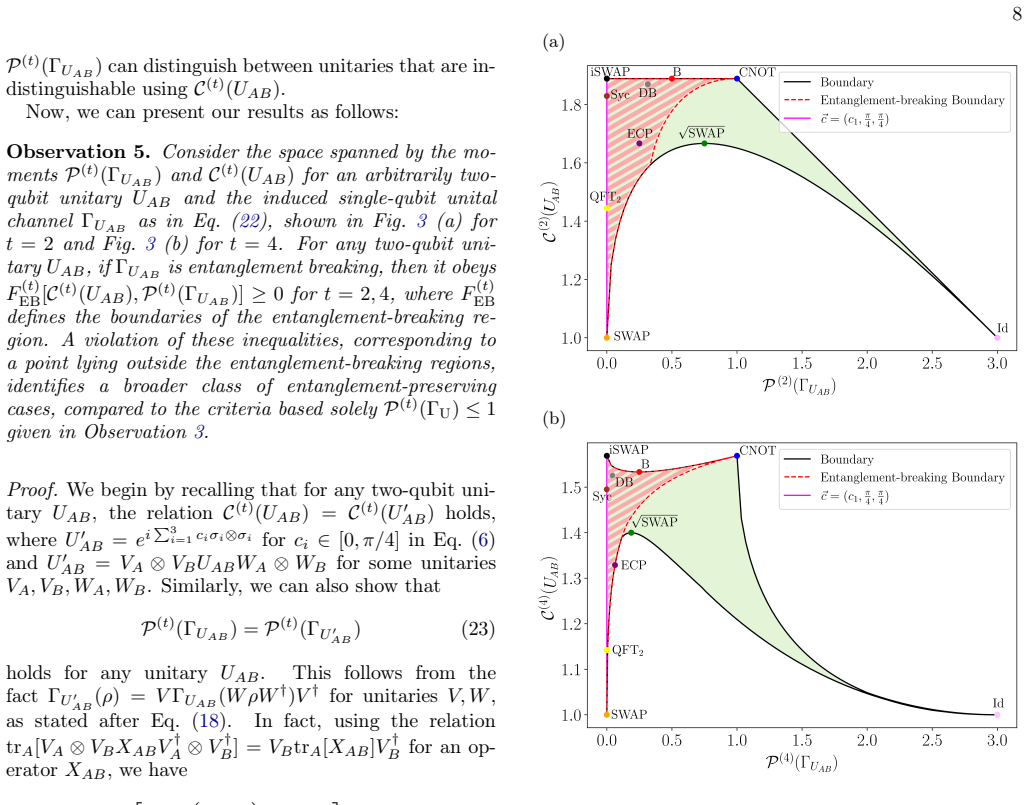
The central claim is that moments formed as Haar averages of local-unitary invariants supply computable criteria for the entanglement properties of two-qubit channels. Second-order moments alone certify non-entangling and entanglement-breaking channels and thereby detect entanglement-creating and entanglement-preserving ones. Higher-order moments capture distinctions beyond the second order, and moment combinations from different channel families separate locally inequivalent unitaries.
What carries the argument
Averaged local-unitary invariants (moments) computed from Haar integrals over input states or unitaries, which quantify a channel's action on bipartite entanglement.
If this is right
- Second-order moments identify non-entangling and entanglement-breaking channels.
- Channels that create or preserve entanglement are thereby detected by the same second-order tests.
- Higher-order moments distinguish channels that second-order moments cannot separate.
- Moment combinations from different families discriminate locally inequivalent two-qubit unitaries.
- The same averaging procedure applies to general non-unitary channels.
Where Pith is reading between the lines
- Practical tests for channel properties could be built from local measurements averaged over a few random inputs.
- The method might extend to channels on larger numbers of qubits by the same averaging construction.
- Similar moment-based invariants could classify operations in other resource theories such as coherence or magic.
Load-bearing premise
The averaged local-unitary invariants obtained from Haar integrals are sufficient to distinguish the entanglement properties of two-qubit channels without further assumptions on channel form.
What would settle it
Two two-qubit channels that agree on all second-order moments yet differ in whether they create entanglement or break it would falsify the proposed criteria.
Figures
read the original abstract
We develop systematic frameworks for characterizing the entanglement properties of two-qubit channels beyond unitary settings. We introduce averaged local-unitary invariants, referred to as moments, obtained from Haar integrals over input states or unitaries. These moments provide computable descriptions of how a quantum channel can create, preserve, or destroy bipartite entanglement. We first show that second-order moments yield criteria for non-entangling and entanglement-breaking channels, which allow us to detect entanglement-creating and entanglement-preserving channels. We then demonstrate that higher-order moments can capture additional information and distinguish channels beyond second-order moments alone. Finally, we show that combinations of moments associated with different channel families improve the discrimination of locally inequivalent two-qubit unitaries.
Editorial analysis
A structured set of objections, weighed in public.
Referee Report
Summary. The paper develops frameworks for characterizing entanglement properties of two-qubit channels using averaged local-unitary invariants (moments) obtained via Haar integrals over input states or unitaries. It claims that second-order moments provide criteria for identifying non-entangling and entanglement-breaking channels (thereby detecting the complementary classes), that higher-order moments capture additional distinguishing information, and that combinations of moments from different channel families improve discrimination of locally inequivalent two-qubit unitaries.
Significance. If the explicit criteria derived from the second-order moments are both necessary and sufficient for general CPTP maps, the approach supplies a computable, Haar-averaged diagnostic for entanglement creation/preservation that avoids full process tomography. The parameter-free construction via integrals is a strength, as is the extension to higher moments and unitary discrimination.
major comments (2)
- [Abstract] Abstract: the claim that second-order moments 'yield criteria for non-entangling and entanglement-breaking channels' is load-bearing for the central contribution, yet the subsequent statement that higher-order moments 'capture additional information' indicates that second-order data alone is incomplete. The manuscript must explicitly demonstrate (via derivation or exhaustive check) that the second-order integrals separate the classes for arbitrary CPTP maps without unstated restrictions such as unitality, covariance, or Kraus-rank bounds; otherwise the detection claim for entanglement-creating/preserving channels does not hold in full generality.
- [Abstract / main claims] The weakest assumption noted in the reader's report—that Haar-averaged invariants suffice to distinguish entanglement properties without further channel restrictions—remains unaddressed if the paper does not provide a counter-example search or a proof that identical second-order moments imply identical entanglement behavior on all entangled inputs.
minor comments (1)
- Notation for the moments (e.g., how the Haar measure is normalized and which input ensembles are used) should be introduced with explicit integral expressions early in the text to improve readability.
Simulated Author's Rebuttal
We thank the referee for the careful reading and constructive comments. We address the major comments point by point below.
read point-by-point responses
-
Referee: [Abstract] Abstract: the claim that second-order moments 'yield criteria for non-entangling and entanglement-breaking channels' is load-bearing for the central contribution, yet the subsequent statement that higher-order moments 'capture additional information' indicates that second-order data alone is incomplete. The manuscript must explicitly demonstrate (via derivation or exhaustive check) that the second-order integrals separate the classes for arbitrary CPTP maps without unstated restrictions such as unitality, covariance, or Kraus-rank bounds; otherwise the detection claim for entanglement-creating/preserving channels does not hold in full generality.
Authors: We agree that the generality of the claim requires explicit demonstration. The second-order moments in the manuscript are obtained from Haar integrals over the full space of two-qubit input states for arbitrary CPTP maps, with no assumptions of unitality, covariance or Kraus-rank bounds. The criteria follow directly from the fact that non-entangling channels map every input to a separable state, which forces the moment to a specific computable value; the same holds for entanglement-breaking channels. We will revise the abstract and add a short subsection with the general integral expression to make this explicit. We also clarify that the criteria are one-sided (necessary conditions for membership in the class) while higher-order moments supply additional distinguishing power. revision: partial
-
Referee: [Abstract / main claims] The weakest assumption noted in the reader's report—that Haar-averaged invariants suffice to distinguish entanglement properties without further channel restrictions—remains unaddressed if the paper does not provide a counter-example search or a proof that identical second-order moments imply identical entanglement behavior on all entangled inputs.
Authors: The manuscript does not assert that equal second-order moments imply identical entanglement behavior on every entangled input; the moments are presented as computable invariants that certify membership in the non-entangling or entanglement-breaking classes. To address the concern we will add a brief discussion of completeness together with a numerical search over a large ensemble of random CPTP maps, checking whether any pair shares the same second-order moments yet differs in entanglement creation or preservation on entangled inputs. The results of this search will be reported in the revised version. revision: yes
Circularity Check
No significant circularity; moments defined directly from Haar integrals
full rationale
The paper defines averaged local-unitary invariants (moments) explicitly via Haar integrals over input states or unitaries, then derives criteria for non-entangling and entanglement-breaking channels from the second-order moments. No self-definitional reductions, fitted inputs renamed as predictions, or load-bearing self-citations appear in the abstract or described derivation chain. Higher-order moments are presented as capturing additional information, confirming the second-order results are not tautological. The central claims rest on independent integral computations rather than circular redefinitions.
Axiom & Free-Parameter Ledger
axioms (1)
- standard math Haar integrals over the unitary group are well-defined and computable for the relevant local-unitary invariants
Reference graph
Works this paper leans on
-
[1]
and multipartite cases [6, 7]. Related studies have yielded a detailed geometric classification of two-qubit unitary gates [8–13], as well as complementary notions such as gate typicality [14] and entangling-power devia- tion [15]. Another research line has characterized the ability of noisy quantum channels that destroy entanglement. Un- like unitary cha...
Pith/arXiv arXiv 2026
-
[2]
+ 4 cos(8c2)−76 cos(4c + 12) + 4 1 + 3 cos(4c− 12) 1 + 3 cos(4c+ 12) cos(8c3) + 9 cos(8c+
-
[3]
The detailed calculation is provided in Appendix B
+ 8 cos(4c1) + cos(4c2) × 6 cos(4c1) cos(4c2)−22 cos(4c3) o ,(7b) wherec + 12 =c 1 +c 2 andc − 12 =c 1 −c 2. The detailed calculation is provided in Appendix B. Third, for unitary channels, the second moment C(2)(UAB)recovers the well-known expression of theen- tangling power[9], up to some factors. This can be seen from the fact that, for any two-qubit s...
-
[4]
+ 4 cos(8c2)−76 cos(4c + 12) + 9 cos(8c+
-
[5]
+ 8 cos(4c1) + cos(4c2) −22 + 6 cos(4c1) cos(4c2) cos(4c3) + 4 1 + 3 cos(4c− 12) 1 + 3 cos(4c+ 12) cos(8c3) o .(B1b) wherec + 12 =c 1 +c 2 andc − 12 =c 1 −c 2. Proof.We begin by writing the following relation: UAB = exp i 3X i=1 ciσA i ⊗σ B i ! = 3X a=0 maσA a ⊗σ B a ,(B2) where we explicitly denoted the superscriptsAandBinσ A i ⊗σ B i and m0 = cos(c1) co...
-
[6]
C. H. Bennett, G. Brassard, C. Crépeau, R. Jozsa, A. Peres, and W. K. Wootters, Physical Review Letters 70, 1895 (1993)
1993
-
[7]
Jozsa and N
R. Jozsa and N. Linden, Proceedings of the Royal So- ciety of London. Series A: Mathematical, Physical and Engineering Sciences459, 2011–2032 (2003). 14
2011
-
[8]
N.Gisin, G.Ribordy, W.Tittel,andH.Zbinden,Reviews of Modern Physics74, 145 (2002)
2002
-
[9]
Zanardi, C
P. Zanardi, C. Zalka, and L. Faoro, Physical Review A 62, 030301 (2000)
2000
-
[10]
Wang and P
X. Wang and P. Zanardi, Physical Review A66, 044303 (2002)
2002
-
[11]
A. J. Scott, Physical Review A69, 052330 (2004)
2004
-
[12]
Linowski, G
T. Linowski, G. Rajchel-Mieldzioć, and K. Życzkowski, Journal of Physics A: Mathematical and Theoretical53, 125303 (2020)
2020
-
[13]
Zhang, J
J. Zhang, J. Vala, S. Sastry, and K. B. Whaley, Physical Review A67, 042313 (2003)
2003
-
[14]
A. T. Rezakhani, Physical Review A70, 052313 (2004)
2004
-
[15]
Watts, M
P. Watts, M. O’Connor, and J. Vala, Entropy15, 1963–1984 (2013)
1963
-
[16]
Balakrishnan and R
S. Balakrishnan and R. Sankaranarayanan, Physical Re- view A79, 052339 (2009)
2009
-
[17]
Balakrishnan and R
S. Balakrishnan and R. Sankaranarayanan, Physical Re- view A82, 034301 (2010)
2010
-
[18]
M. Musz, M. Kuś, and K. Życzkowski, Physical Review A87, 022111 (2013)
2013
-
[19]
Jonnadula, P
B. Jonnadula, P. Mandayam, K. Życzkowski, and A. Lak- shminarayan, Physical Review A95, 040302 (2017)
2017
-
[20]
Cho and J
K. Cho and J. Bang, Physical Review A113, 012442 (2026)
2026
-
[21]
Horodecki, P
M. Horodecki, P. W. Shor, and M. B. Ruskai, Reviews in Mathematical Physics15, 629–641 (2003)
2003
-
[22]
M. B. Ruskai, Reviews in Mathematical Physics15, 643–662 (2003)
2003
-
[23]
He, International Journal of Theoretical Physics52, 1886 (2013)
K. He, International Journal of Theoretical Physics52, 1886 (2013)
2013
-
[24]
B. N. Muoi and N.-S. Sze, Journal of Physics A: Mathe- matical and Theoretical58, 265305 (2025)
2025
-
[25]
De Pasquale and V
A. De Pasquale and V. Giovannetti, Physical Review A 86, 052302 (2012)
2012
-
[26]
Lami and V
L. Lami and V. Giovannetti, Journal of Mathematical Physics57, 032201 (2016)
2016
-
[27]
L. B. Vieira, H.-Y. Ku, and C. Budroni, Physical Review Research7, 043281 (2025)
2025
-
[28]
Grassl, M
M. Grassl, M. Rötteler, and T. Beth, Physical Review A 58, 1833–1839 (1998)
1998
-
[29]
Linden, S
N. Linden, S. Popescu, and A. Sudbery, Physical Review Letters83, 243–247 (1999)
1999
-
[30]
Makhlin, Quantum Information Processing1, 243 (2000)
Y. Makhlin, Quantum Information Processing1, 243 (2000)
2000
-
[31]
Sudbery, Journal of Physics A: Mathematical and General34, 643–652 (2001)
A. Sudbery, Journal of Physics A: Mathematical and General34, 643–652 (2001)
2001
-
[32]
Kraus, Physical Review Letters104, 020504 (2010)
B. Kraus, Physical Review Letters104, 020504 (2010)
2010
-
[33]
Jing, S.-M
N. Jing, S.-M. Fei, M. Li, X. Li-Jost, and T. Zhang, Phys- ical Review A92, 022306 (2015)
2015
-
[34]
de Vicente, Quantum Information and Computation 7, 624–638 (2007)
J. de Vicente, Quantum Information and Computation 7, 624–638 (2007)
2007
-
[35]
J.-L.BrylinskiandR.Brylinski,Universalquantumgates (2001), arXiv:quant-ph/0108062 [quant-ph]
Pith/arXiv arXiv 2001
-
[36]
M. J. Bremner, C. M. Dawson, J. L. Dodd, A. Gilchrist, A. W. Harrow, D. Mortimer, M. A. Nielsen, and T. J. Osborne, Physical Review Letters89, 247902 (2002)
2002
-
[37]
Hulpke, U
F. Hulpke, U. Poulsen, A. Sanpera, A. Sen, U. Sen, and M. Lewenstein, Foundations of Physics36, 477 (2006)
2006
-
[38]
Alfsen and F
E. Alfsen and F. Shultz, Journal of Mathematical Physics 51, 052201 (2010)
2010
-
[39]
Gühne and G
O. Gühne and G. Tóth, Physics Reports474, 1–75 (2009)
2009
-
[40]
A. A. Mele, Quantum8, 1340 (2024)
2024
-
[41]
A.Ketterer, N.Wyderka,andO.Gühne,PhysicalReview Letters122, 120505 (2019)
2019
-
[42]
Ketterer, N
A. Ketterer, N. Wyderka, and O. Gühne, Quantum4, 325 (2020)
2020
-
[43]
Knips, Quantum Views4, 47 (2020)
L. Knips, Quantum Views4, 47 (2020)
2020
-
[44]
Ketterer, S
A. Ketterer, S. Imai, N. Wyderka, and O. Gühne, Phys- ical Review A106, 010402 (2022)
2022
-
[45]
Wyderka, A
N. Wyderka, A. Ketterer, S. Imai, J. L. Bönsel, D. E. Jones, B. T. Kirby, X.-D. Yu, and O. Gühne, Physical Review Letters131, 090201 (2023)
2023
-
[46]
Cieśliński, S
P. Cieśliński, S. Imai, J. Dziewior, O. Gühne, L. Knips, W. Laskowski, J. Meinecke, T. Paterek, and T. Vértesi, Physics Reports1095, 1 (2024)
2024
-
[47]
Zhang, J
J. Zhang, J. Vala, S. Sastry, and K. B. Whaley, Physical Review Letters93, 020502 (2004)
2004
-
[48]
E. C. Peterson, G. E. Crooks, and R. S. Smith, Quantum 4, 247 (2020)
2020
-
[49]
Aruteet al., Nature574, 505–510 (2019)
F. Aruteet al., Nature574, 505–510 (2019)
2019
-
[50]
Peres, Physical Review Letters77, 1413–1415 (1996)
A. Peres, Physical Review Letters77, 1413–1415 (1996)
1996
-
[51]
Horodecki, P
M. Horodecki, P. Horodecki, and R. Horodecki, Physics Letters A223, 1–8 (1996)
1996
-
[52]
Werner, Physical Review A40, 4277 (1989)
R. Werner, Physical Review A40, 4277 (1989)
1989
-
[53]
Bengtsson and K
I. Bengtsson and K. Życzkowski,Geometry of Quan- tum States: An Introduction to Quantum Entanglement (Cambridge University Press, 2006)
2006
-
[54]
R. S. Smith, M. J. Curtis, and W. J. Zeng, A practical quantum instruction set architecture (2017), arXiv:1608.03355 [quant-ph]
Pith/arXiv arXiv 2017
-
[55]
Wyderka and O
N. Wyderka and O. Gühne, Journal of Physics A: Math- ematical and Theoretical53, 345302 (2020)
2020
-
[56]
Eltschka and J
C. Eltschka and J. Siewert, Quantum4, 229 (2020)
2020
-
[57]
S. Imai, N. Wyderka, A. Ketterer, and O. Gühne, Phys- ical Review Letters126, 150501 (2021)
2021
-
[58]
Wyderka and A
N. Wyderka and A. Ketterer, PRX Quantum4, 020325 (2023)
2023
-
[59]
Chitambar and G
E. Chitambar and G. Gour, Reviews of Modern Physics 91, 025001 (2019)
2019
-
[60]
M.Rudziński, G.Tartaglione,andK.Życzkowski,Entan- gling power and fidelity diagnostic for bipartite quantum channels (2026), arXiv:2605.26867 [quant-ph]
Pith/arXiv arXiv 2026
-
[61]
D. A. Roberts and B. Yoshida, Journal of High Energy Physics2017, 10.1007 (2017)
2017
-
[62]
Virtanenet al., Nature Methods17, 261 (2020)
P. Virtanenet al., Nature Methods17, 261 (2020)
2020
-
[63]
html, accessed: 2024
SciPy manual,https://docs.scipy.org/doc/scipy/ reference/generated/scipy.optimize.minimize. html, accessed: 2024
2024
discussion (0)
Sign in with ORCID, Apple, or X to comment. Anyone can read and Pith papers without signing in.