Mott transition of photons: quantum Monte Carlo study of Gross-Neveu criticality in a cavity
Pith reviewed 2026-06-28 08:16 UTC · model grok-4.3
The pith
Cavity photons undergo a Mott transition by coupling their spectral function to the optical conductivity of electrons at Gross-Neveu criticality.
A machine-rendered reading of the paper's core claim, the machinery that carries it, and where it could break.
Core claim
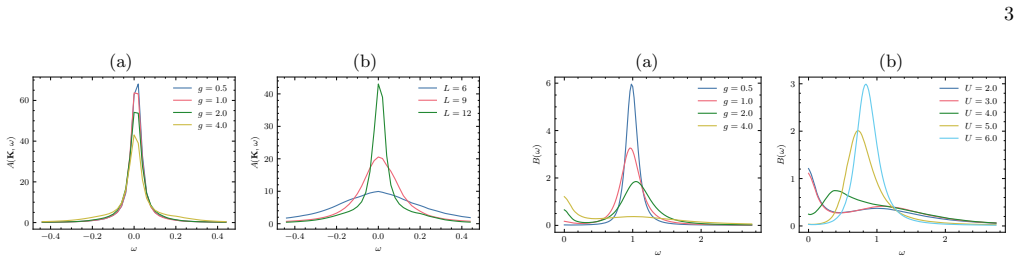
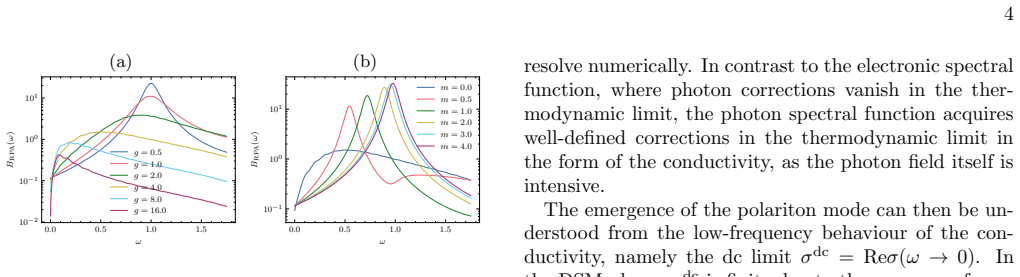
In the cavity-coupled honeycomb Hubbard model the electron-photon interaction is irrelevant at the Gross-Neveu O(3) critical point even for strong coupling, while the photon spectral function couples to the electronic optical conductivity and thereby causes the photons to undergo the same Mott transition as the electrons.
What carries the argument
The photon spectral function, which couples directly to the electronic optical conductivity and thereby transfers the Mott transition to the photons.
If this is right
- The electronic Mott transition can be detected without direct contact by measuring the photon spectrum.
- The Gross-Neveu O(3) universality class remains unchanged by the cavity coupling.
- The sign-free QMC algorithm yields unbiased results for finite-size light-matter systems.
- The photon mode stays irrelevant at criticality independent of coupling strength.
Where Pith is reading between the lines
- Similar cavity couplings could serve as remote probes for other critical points whose conductivity shows power-law behavior.
- The intensive-photon-number condition might be relaxed in future algorithms while preserving sign-free sampling.
- The irrelevance result suggests that cavity QED perturbations generally do not alter the universality of Gross-Neveu-type transitions.
Load-bearing premise
The light-matter coupling is chosen so that the photon number remains an intensive quantity, as in an empty cavity.
What would settle it
A simulation or measurement at the critical point showing that the photon spectral function deviates from the electronic optical conductivity or that critical exponents change when the electron-photon coupling strength is increased.
Figures
read the original abstract
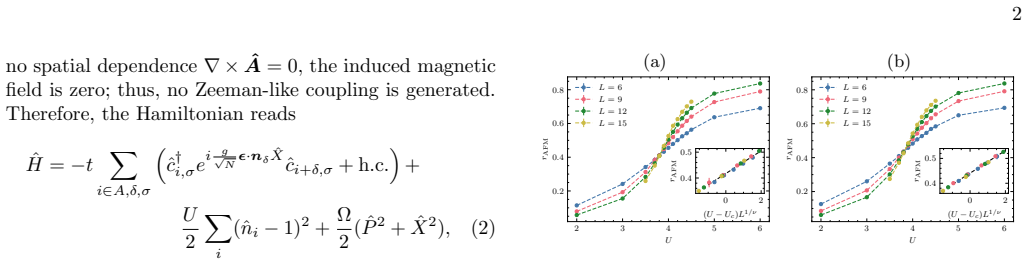
The Hubbard model on the honeycomb lattice is a pristine realisation of a semimetal-to-insulator Mott transition belonging to the Gross-Neveu O(3) universality class. We couple this system to a single linearly polarised cavity photon mode. The light-matter coupling is such that the photon number remains an intensive quantity as is the case for an empty cavity. For this interacting light-matter model, we formulate a negative-sign-free fermion quantum Monte Carlo algorithm that allows for bias-free results on finite system sizes. Our numerical results show that the coupling to the cavity is irrelevant at criticality, even at strong electron-photon coupling. On the other hand, we observe, and show analytically, that the photon spectral function couples to the optical conductivity of the electronic system. The cavity photons thereby undergo a Mott transition, and the photon spectral function acts as a contact-free non-invasive probe for Mott criticality.
Editorial analysis
A structured set of objections, weighed in public.
Referee Report
Summary. The manuscript couples the honeycomb Hubbard model (Gross-Neveu O(3) Mott transition) to a single linearly polarized cavity photon mode under a light-matter interaction chosen so that photon number remains intensive. This choice permits formulation of a sign-free fermion QMC algorithm. Numerical simulations show the cavity coupling is irrelevant at criticality even at strong electron-photon coupling. Analytically, the photon spectral function is linked to the electronic optical conductivity, implying that cavity photons undergo a Mott transition and that the photon spectrum provides a contact-free probe of electronic criticality.
Significance. If the central numerical and analytical results hold under the stated coupling, the work supplies unbiased QMC evidence that cavity coupling remains irrelevant at the Gross-Neveu fixed point and establishes a direct relation between photon spectra and electronic conductivity. The sign-free algorithm and the contact-free probe interpretation are concrete strengths. The result is of interest to both cavity QED and strongly correlated electron communities, though its scope is tied to the specific intensive-photon-number coupling.
major comments (2)
- [Introduction / Model definition] The light-matter coupling is defined such that photon number remains intensive (as in an empty cavity); this is explicitly required both for the sign-free QMC algorithm and for the claim that coupling remains irrelevant at criticality. The manuscript should clarify, with an explicit comparison to standard dipole or Peierls couplings, whether this choice is a technical convenience or a physically generic feature of cavity QED. Without such discussion the generality of the photon Mott-transition conclusion is difficult to assess.
- [Analytical section on photon spectral function] The analytical demonstration that the photon spectral function couples to the electronic optical conductivity is central to the probe interpretation. The derivation should be expanded to show the precise operator mapping and any approximations involved, including the regime of validity for finite photon frequency and system size.
minor comments (2)
- Figure captions should explicitly state the system sizes, boundary conditions, and error-bar conventions used in the QMC data.
- Notation for the photon mode polarization and the electron-photon vertex should be unified between the model Hamiltonian and the QMC update rules.
Simulated Author's Rebuttal
We thank the referee for their careful reading of the manuscript and for the constructive comments. We address each major point below and will incorporate revisions to improve clarity and generality.
read point-by-point responses
-
Referee: [Introduction / Model definition] The light-matter coupling is defined such that photon number remains intensive (as in an empty cavity); this is explicitly required both for the sign-free QMC algorithm and for the claim that coupling remains irrelevant at criticality. The manuscript should clarify, with an explicit comparison to standard dipole or Peierls couplings, whether this choice is a technical convenience or a physically generic feature of cavity QED. Without such discussion the generality of the photon Mott-transition conclusion is difficult to assess.
Authors: We agree that an explicit comparison is needed to assess generality. Our coupling is chosen so that the photon number remains intensive (as in the empty-cavity limit), which simultaneously enables the sign-free QMC formulation and keeps the photon mode from becoming extensive. In the revised manuscript we will add a dedicated paragraph in the model section that contrasts this choice with the standard dipole gauge and Peierls-substitution couplings commonly used in cavity-QED literature. We will note that the intensive-photon-number condition corresponds to a particular scaling of the mode volume with system size and discuss the regime in which our results are expected to carry over to more conventional light-matter Hamiltonians. revision: yes
-
Referee: [Analytical section on photon spectral function] The analytical demonstration that the photon spectral function couples to the electronic optical conductivity is central to the probe interpretation. The derivation should be expanded to show the precise operator mapping and any approximations involved, including the regime of validity for finite photon frequency and system size.
Authors: We will expand the analytical section as requested. The revised text will present the explicit operator mapping between the photon creation/annihilation operators and the electronic current operator, derive the relation between the photon spectral function and the optical conductivity without intermediate approximations, and state the conditions under which the mapping holds for finite photon frequency and finite system size (including the role of the cavity frequency relative to the electronic gap and the thermodynamic limit). We will also add a short discussion of finite-size corrections visible in the QMC data. revision: yes
Circularity Check
No significant circularity; derivation self-contained via explicit model choice and independent numerical/analytical steps
full rationale
The paper states its light-matter coupling choice explicitly to enable sign-free QMC and reports numerical results on irrelevance at criticality plus an analytical demonstration that the photon spectral function couples to electronic optical conductivity. No quoted step reduces a prediction or central claim to a fitted input, self-definition, or self-citation chain by construction. The model restriction is presented as an assumption, not smuggled in; results follow from QMC sampling and the stated analytical link without circular reduction.
Axiom & Free-Parameter Ledger
axioms (1)
- domain assumption The light-matter coupling keeps the photon number an intensive quantity, as in an empty cavity.
Reference graph
Works this paper leans on
-
[1]
F. J. Garcia-Vidal, C. Ciuti, and T. W. Ebbesen, Science 373, eabd0336 (2021)
2021
-
[2]
Schlawin, D
F. Schlawin, D. M. Kennes, and M. A. Sentef, Applied Physics Reviews9, 011312 (2022)
2022
-
[3]
I.-T. Lu, D. Shin, M. K. Svendsen, S. Latini, H. H¨ ubener, M. Ruggenthaler, and A. Rubio, Advances in Optics and Photonics17, 441 (2025), arXiv:2502.03172 [cond-mat]
arXiv 2025
-
[4]
Mivehvar, F
F. Mivehvar, F. Piazza, T. Donner, and H. Ritsch, Ad- vances in Physics70, 1 (2021)
2021
-
[5]
H. M. Bretscher, L. Graziotto, M. H. Michael, A. Mon- tanaro, I.-T. Lu, A. Grankin, J. W. McIver, J. Faist, D. Fausti, M. Eckstein, M. Ruggenthaler, A. Rubio, D. N. Basov, M. Hafezi, M. Claassen, D. M. Kennes, and M. A. Sentef, Fluctuation engineering in cavity quantum mate- rials (2026), arXiv:2604.08666 [cond-mat.mes-hall]
Pith/arXiv arXiv 2026
-
[6]
Landig, L
R. Landig, L. Hruby, N. Dogra, M. Landini, R. Mottl, T. Donner, and T. Esslinger, Nature532, 476 (2016)
2016
-
[7]
Helson, T
V. Helson, T. Zwettler, F. Mivehvar, E. Colella, K. Roux, H. Konishi, H. Ritsch, and J.-P. Brantut, Nature618, 716 (2023)
2023
-
[8]
Zwettler, F
T. Zwettler, F. Marijanovic, T. B¨ uhler, S. Chattopad- hyay, G. Del Pace, L. Skolc, V. Helson, S. Uchino, E. Demler, and J.-P. Brantut, Nature Communications 17, 496 (2025)
2025
-
[9]
Appugliese, J
F. Appugliese, J. Enkner, G. L. Paravicini-Bagliani, M. Beck, C. Reichl, W. Wegscheider, G. Scalari, C. Ciuti, and J. Faist, Science375, 1030 (2022)
2022
-
[10]
Enkner, L
J. Enkner, L. Graziotto, F. Appugliese, V. Rokaj, J. Wang, M. Ruggenthaler, C. Reichl, W. Wegscheider, A. Rubio, and J. Faist, Physical Review X14, 021038 (2024)
2024
-
[11]
Enkner, L
J. Enkner, L. Graziotto, D. Borici, F. Appugliese, C. Re- ichl, G. Scalari, N. Regnault, W. Wegscheider, C. Ciuti, and J. Faist, Nature641, 884 (2025)
2025
-
[12]
Engel, M
M. Engel, M. Steiner, A. Lombardo, A. C. Ferrari, H. v L¨ ohneysen, P. Avouris, and R. Krupke, Nature Com- 6 munications3, 906 (2012)
2012
-
[13]
J. W. McIver, B. Schulte, F.-U. Stein, T. Matsuyama, G. Jotzu, G. Meier, and A. Cavalleri, Nature Physics16, 38 (2020)
2020
-
[14]
Merboldt, M
M. Merboldt, M. Sch¨ uler, D. Schmitt, J. P. Bange, W. Bennecke, K. Gadge, K. Pierz, H. W. Schumacher, D. Momeni, D. Steil, S. R. Manmana, M. A. Sentef, M. Reutzel, and S. Mathias, Nature Physics21, 1093 (2025)
2025
-
[15]
D. Choi, M. Mogi, U. De Giovannini, D. Azoury, B. Lv, Y. Su, H. H¨ ubener, A. Rubio, and N. Gedik, Nature Physics21, 1100 (2025)
2025
-
[16]
Helmrich, H
F. Helmrich, H. S. Adlong, M. Kroner, I. Khanonkin, G. Scalari, J. Faist, A.˙Imamo˘ glu, and T. F. Nova, Nature , 1 (2026)
2026
-
[17]
Keren, T
I. Keren, T. A. Webb, S. Zhang, J. Xu, D. Sun, B. S. Y. Kim, D. Shin, S. S. Zhang, J. Zhang, G. Pereira, J. Yao, T. Okugawa, M. H. Michael, E. Vi˜ nas Bostr¨ om, J. H. Edgar, S. Wolf, M. Julian, R. P. Prasankumar, K. Miya- gawa, K. Kanoda, G. Gu, M. Cothrine, D. Mandrus, M. Buzzi, A. Cavalleri, C. R. Dean, D. M. Kennes, A. J. Millis, Q. Li, M. A. Sentef, ...
2026
-
[18]
G. Jarc, S. Y. Mathengattil, A. Montanaro, F. Giusti, E. M. Rigoni, R. Sergo, F. Fassioli, S. Winnerl, S. Dal Zilio, D. Mihailovic, P. Prelovˇ sek, M. Eckstein, and D. Fausti, Nature622, 487 (2023)
2023
-
[19]
Dmytruk and M
O. Dmytruk and M. Schir´ o, Physical Review B103, 075131 (2021)
2021
-
[20]
J. Li, L. Schamriß, and M. Eckstein, Physical Review B 105, 165121 (2022)
2022
-
[21]
Fadler, K
P. Fadler, K. P. Schmidt, J. Li, and M. Eckstein, Physical Review B109, 085149 (2024)
2024
-
[22]
X. Wang, D. Jaksch, and F. Schlawin, Physical Review B109, 115137 (2024)
2024
-
[23]
Nakamoto, K
T. Nakamoto, K. Takasan, and N. Tsuji, Physical Review B112, 155150 (2025)
2025
-
[24]
B. Kass, S. Talkington, A. Srivastava, and M. Claassen, Many-Body Photon Blockade and Quantum Light Generation from Cavity Quantum Materials (2024), arXiv:2411.08964 [cond-mat.str-el]
arXiv 2024
-
[25]
Grunwald, E
L. Grunwald, E. V. Bostr¨ om, M. K. Svendsen, D. M. Kennes, and A. Rubio, Physical Review Letters134, 246901 (2025)
2025
-
[26]
S. Sur, Y. Wang, M. Mahankali, S. Paschen, and Q. Si, Amplified response of cavity-coupled quantum-critical systems (2025), arXiv:2509.26620 [cond-mat.str-el]
Pith/arXiv arXiv 2025
-
[27]
Passetti, C
G. Passetti, C. J. Eckhardt, M. A. Sentef, and D. M. Kennes, Physical Review Letters131, 023601 (2023)
2023
-
[28]
F. F. Assaad, M. Bercx, F. Goth, A. G¨ otz, J. Hofmann, E. Huffman, Z. Liu, F. Parisen Toldin, J. Portela, and J. Schwab, SciPost Physics Codebases , 001 (2025)
2025
-
[29]
Blankenbecler, D
R. Blankenbecler, D. J. Scalapino, and R. L. Sugar, Phys- ical Review D24, 2278 (1981)
1981
-
[30]
S. R. White, D. J. Scalapino, R. L. Sugar, E. Y. Loh, J. E. Gubernatis, and R. T. Scalettar, Physical Review B40, 506 (1989)
1989
-
[31]
F. F. Assaad and H. G. Evertz, Computational Many- Particle Physics739, 277 (2008)
2008
-
[32]
A. W. Sandvik, Physical Review B57, 10287 (1998)
1998
-
[33]
K. S. D. Beach, Identifying the maximum entropy method as a special limit of stochastic analytic continu- ation (2004), arXiv:cond-mat/0403055
Pith/arXiv arXiv 2004
-
[34]
Shao and A
H. Shao and A. W. Sandvik, Physics Reports Progress on Stochastic Analytic Continuation of Quantum Monte Carlo Data,1003, 1 (2023)
2023
-
[35]
I. F. Herbut, Physical Review Letters97, 146401 (2006)
2006
-
[36]
F. F. Assaad and I. F. Herbut, Physical Review X3, 031010 (2013)
2013
-
[37]
F.-H. Wang, F. Sun, C. He, and X. Y. Xu, Resolving Quantum Criticality in the Honeycomb Hubbard Model (2026), arXiv:2602.03656 [cond-mat.str-el]
arXiv 2026
-
[38]
the center of the second Brillouin zone
Note that in the unfolded Brillouin zone the antiferro- magnetic ordering wave vector corresponds to theΓ ′ point, i.e. the center of the second Brillouin zone
-
[39]
Zoubi and H
H. Zoubi and H. Ritsch, Physical Review A76, 013817 (2007)
2007
-
[40]
I. B. Mekhov, C. Maschler, and H. Ritsch, Nature Physics 3, 319 (2007)
2007
-
[41]
Surpassing the en- ergy resolution limit with ferromagnetic torque sensors,
M. Dendzik, Physical Review Letters125, 10.1103/Phys- RevLett.125.096401 (2020)
-
[42]
G. M. Andolina, F. M. D. Pellegrino, V. Giovannetti, A. H. MacDonald, and M. Polini, Physical Review B100, 121109 (2019)
2019
-
[43]
G. M. Andolina, F. M. D. Pellegrino, A. Mercurio, O. D. Stefano, M. Polini, and S. Savasta, No-go theorem for photon condensation: A non-perturbative extension to first-order phase transitions (2021), arXiv:2104.09468 [cond-mat]
arXiv 2021
-
[44]
Kiffner, J
M. Kiffner, J. Coulthard, F. Schlawin, A. Ardavan, and D. Jaksch, New Journal of Physics21, 073066 (2019)
2019
-
[45]
Imada, A
M. Imada, A. Fujimori, and Y. Tokura, Rev. Mod. Phys. 70, 1039 (1998)
1998
-
[46]
Vojta, J
M. Vojta, J. Low Temp. Phys.161, 203 (2010)
2010
-
[47]
B. Danu, M. Vojta, F. F. Assaad, and T. Grover, Physical Review Letters125, 206602 (2020)
2020
-
[48]
Raczkowski, B
M. Raczkowski, B. Danu, and F. F. Assaad, Physical Review B106, L161115 (2022)
2022
- [49]
-
[50]
Q. Si, S. Rabello, K. Ingersent, and J. Smith, Nature 413, 804 (2001)
2001
-
[51]
Senthil, S
T. Senthil, S. Sachdev, and M. Vojta, Phys. Rev. Lett. 90, 216403 (2003)
2003
-
[52]
Paschen and Q
S. Paschen and Q. Si, Nature Reviews Physics3, 9 (2021)
2021
-
[53]
Zhang and S
Y.-H. Zhang and S. Sachdev, Phys. Rev. Res.2, 023172 (2020)
2020
-
[54]
C. J. Eckhardt, A. Grankin, D. M. Kennes, M. Ruggen- thaler, A. Rubio, M. A. Sentef, M. Hafezi, and M. H. Michael, Physical Review Letters135, 156902 (2025)
2025
-
[55]
Schwab, L
J. Schwab, L. Janssen, K. Sun, Z. Y. Meng, I. F. Herbut, M. Vojta, and F. F. Assaad, Physical Review Letters128, 157203 (2022). 7 End Matter C3v point group symmetry- In this section, we show that the electron-photon coupling breaks all of the point groupC 3v symmetries of the honeycomb lattice. To this end, we consider the coupling gδ = g√ N ϵ·n δ,(A.1) ...
2022
-
[56]
(A.2) The point groupC 3v has 6 elements: 3 2nπ/3 rotations Rn 3 (n= 1,2,3); 3 mirror symmetriesσ 1 : (x, y)→ (−x, y),σ 2 =R 3 3σ1 andσ 3 =R 3σ1
and the nearest neighbour (NN) vectors as n1 = 1 3(0, √ 3),n 2 = 1 6(−3,− √ 3),n 3 = 1 6(3,− √ 3). (A.2) The point groupC 3v has 6 elements: 3 2nπ/3 rotations Rn 3 (n= 1,2,3); 3 mirror symmetriesσ 1 : (x, y)→ (−x, y),σ 2 =R 3 3σ1 andσ 3 =R 3σ1. Under these op- erations, the NN vectors transform as Rn 3 nδ →n mod (δ+n,3) ,(A.3) σnnδ →δ n,δnδ + (1−δ n,δ)nδ′...
2000
-
[57]
ˆJq=0,δ(τ)−sin(g δ(ˆa(τ) + ˆa†(τ))/ √
-
[58]
The spinor is defined as ˆψk,σ = (ˆck,A,σˆck,B,σ)T and the matrix elements are given by nk,δ = (Reγk,δ,−Imγ k,δ,0), withγ k,δ =−te −iq·nδ andv k,δ =∂ knk,δ
ˆKq=0,δ(τ) −Ωˆa(τ),(S15) where ˆKq,δ(τ) = P k,σ ˆψ† k+q,σ(τ) (nk,δ ·τ)ψ k,σ(τ) and ˆJq,δ(τ) = P k,σ ˆψ† k+q,σ(τ) (vk,δ ·τ)ψ k,σ(τ) is the kinetic en- ergy and current, respectively. The spinor is defined as ˆψk,σ = (ˆck,A,σˆck,B,σ)T and the matrix elements are given by nk,δ = (Reγk,δ,−Imγ k,δ,0), withγ k,δ =−te −iq·nδ andv k,δ =∂ knk,δ. Equation (S15), sh...
-
[59]
Then in the coherent state path integral, the partition function is given byZ=R D{ψ†, ψ, a, a∗}e−S, with S= Z β 0 dτ X k ψ† k(τ)G −1(k, τ, a, a∗)ψk(τ) +a ∗(τ)D −1 0 (τ)a(τ) ! ,(S17) withD −1 0 (τ) =∂ τ + Ω andG −1(k, τ, a, a∗) =∂ τ +H k(a, a∗). Since the action is bilinear in the fermions, we can integrate them out to obtain an effective action S= Z β 0 d...
discussion (0)
Sign in with ORCID, Apple, or X to comment. Anyone can read and Pith papers without signing in.