Demonstrating magnetic memory in iron-rhodium structures using a quantum diamond microscope
Pith reviewed 2026-06-28 09:14 UTC · model grok-4.3
The pith
Magnetic orientation in iron-rhodium is preserved across antiferromagnetic to ferromagnetic phase transitions.
A machine-rendered reading of the paper's core claim, the machinery that carries it, and where it could break.
Core claim
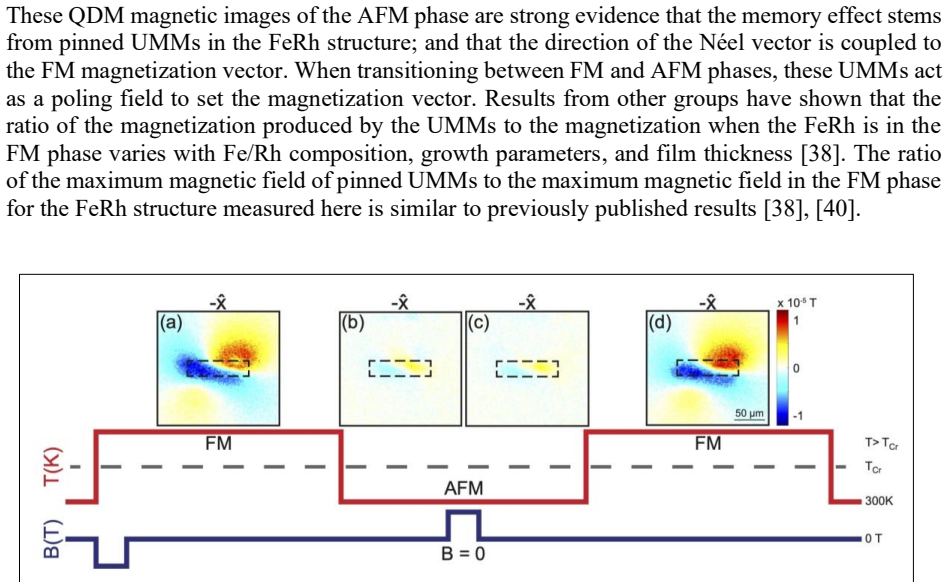
The magnetic orientation of the FM phase uniquely determines the Néel vector in the AFM phase, due to pinned uncompensated magnetic moments (UMMs) in the FeRh structure. Thus, the magnetic orientation is maintained when the system is cycled between AFM and FM phases.
What carries the argument
Pinned uncompensated magnetic moments that lock the FM magnetization direction to the AFM Néel vector.
If this is right
- A reliable and robust magnetic recording technique exists for patterned FeRh thin films.
- AFM-based magnetic memory using FeRh is now experimentally supported.
- The material offers a sharper phase transition and lower writing temperature than alternatives, reducing thermal constraints on heads.
Where Pith is reading between the lines
- The same pinned-moment mechanism could be engineered into other first-order phase-transition films to create additional memory platforms.
- Quantum diamond microscopy provides a practical route to characterize stray-field memory states in any thin-film system that undergoes magnetic phase changes.
Load-bearing premise
The observed coupling between Néel and magnetization directions is produced by pinned uncompensated moments rather than other interface or strain effects, and the microscope images accurately represent the internal vectors.
What would settle it
Finding that the AFM Néel vector after a cycle no longer matches the preceding FM magnetization direction once the uncompensated moments are removed or disordered.
Figures
read the original abstract
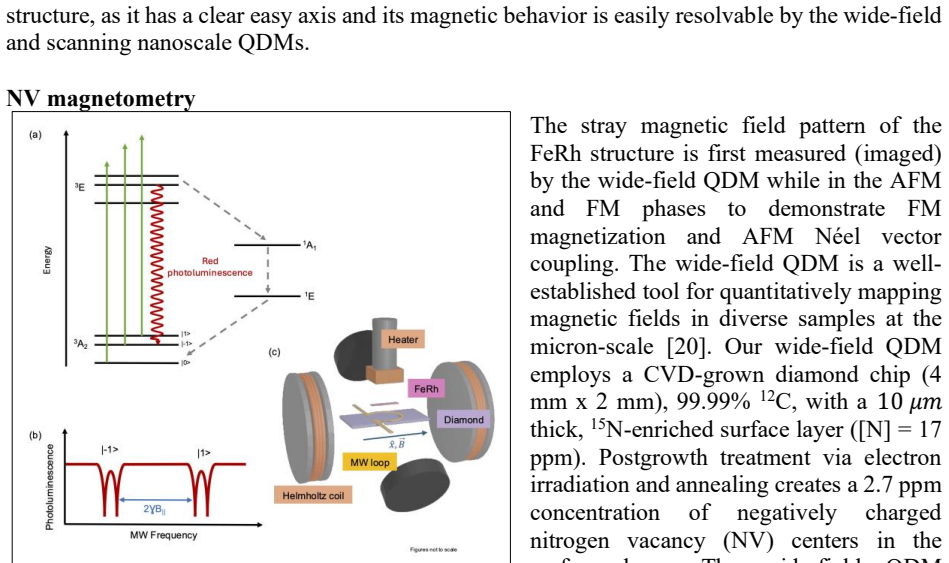
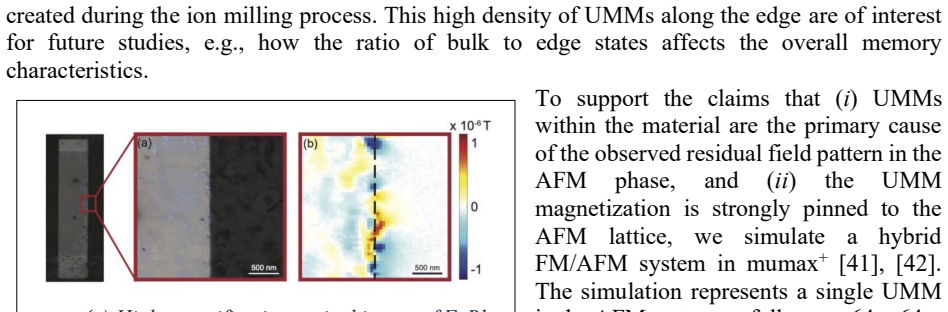
Iron-rhodium (FeRh) has a first-order phase transition near room temperature between antiferromagnetic (AFM) and ferromagnetic (FM) phases, making it a promising material for magnetic memory technologies like heat-assisted magnetic recording (HAMR). It has a comparatively sharper phase transition and lower writing temperature than alternative materials, implying less thermal engineering constraints and an increase in write/read head lifetime. Despite great effort, however, AFM-based magnetic memory using FeRh has not yet been realized. Here, we employ both wide-field and scanning nanoscale quantum diamond microscopes (QDMs) to image directly the magnetic field of a patterned FeRh thin film structure under ambient conditions, demonstrating a magnetic recording technique that is reliable and robust. We experimentally identify coupling between the N\'eel and magnetization vector directions; and also, that the magnetic orientation of the FM phase uniquely determines the N\'eel vector in the AFM phase, due to pinned uncompensated magnetic moments (UMMs) in the FeRh structure. Thus, the magnetic orientation is maintained when the system is cycled between AFM and FM phases, providing the foundation for a practical, AFM-based magnetic memory.
Editorial analysis
A structured set of objections, weighed in public.
Referee Report
Summary. The manuscript reports the use of wide-field and scanning quantum diamond microscopes (QDMs) to image magnetic fields in patterned FeRh thin-film structures under ambient conditions. It claims to experimentally identify coupling between the FM magnetization and AFM Néel vectors, with the FM orientation uniquely determining the AFM Néel vector due to pinned uncompensated magnetic moments (UMMs), such that magnetic orientation is retained across thermal cycling between the AFM and FM phases, providing a foundation for AFM-based magnetic memory.
Significance. If the central experimental observations hold, the work would supply direct nanoscale evidence of vector locking across the FeRh phase transition, supporting the feasibility of heat-assisted AFM memory devices that exploit the material's sharp near-room-temperature transition. The ambient-condition QDM imaging itself constitutes a technical capability of interest for magnetic materials characterization.
major comments (2)
- [Abstract] Abstract: the central claim that coupling and memory retention were experimentally identified rests on interpretation of QDM images, yet the abstract (and by extension the manuscript) provides no quantitative measures of field strength, correlation coefficients, error bars, or explicit exclusion criteria for alternative image interpretations; this makes the fidelity of the reported vector locking impossible to assess from the given text.
- [Abstract] Abstract, final paragraph: the assertion that the FM orientation 'uniquely determines' the AFM Néel vector 'due to pinned uncompensated magnetic moments (UMMs)' is load-bearing for the memory claim, but no measurements isolating UMM pinning (e.g., thickness series, interface-specific probes, or comparisons on lattice-matched vs. mismatched substrates) are described; alternative mechanisms such as magnetoelastic coupling from the ~1% volume change or fixed interface anisotropy can produce equivalent vector locking without requiring UMMs.
Simulated Author's Rebuttal
We thank the referee for their careful reading and constructive comments, which have helped us improve the clarity of the manuscript. We respond to each major comment below.
read point-by-point responses
-
Referee: [Abstract] Abstract: the central claim that coupling and memory retention were experimentally identified rests on interpretation of QDM images, yet the abstract (and by extension the manuscript) provides no quantitative measures of field strength, correlation coefficients, error bars, or explicit exclusion criteria for alternative image interpretations; this makes the fidelity of the reported vector locking impossible to assess from the given text.
Authors: We agree that the abstract would benefit from quantitative anchors. The main text and figures already report stray-field magnitudes extracted from the QDM images (typically 10–50 µT range above the patterned structures) together with pixel-wise correlation coefficients between successive FM and AFM states. In the revised manuscript we have added these representative values, along with a brief statement on error estimation from repeated thermal cycles, directly into the abstract. We have also expanded the results section to include explicit discussion of how alternative image interpretations (e.g., topographic artifacts or stray fields from edges) were ruled out by control measurements on non-magnetic reference samples. revision: yes
-
Referee: [Abstract] Abstract, final paragraph: the assertion that the FM orientation 'uniquely determines' the AFM Néel vector 'due to pinned uncompensated magnetic moments (UMMs)' is load-bearing for the memory claim, but no measurements isolating UMM pinning (e.g., thickness series, interface-specific probes, or comparisons on lattice-matched vs. mismatched substrates) are described; alternative mechanisms such as magnetoelastic coupling from the ~1% volume change or fixed interface anisotropy can produce equivalent vector locking without requiring UMMs.
Authors: The manuscript’s central experimental observation is the reproducible retention of magnetic orientation across the AFM–FM transition, as directly imaged by QDM. We attribute this to pinned UMMs on the basis of consistency with earlier FeRh literature, but we acknowledge that the present data set does not contain thickness-series or substrate-mismatch experiments that would isolate the microscopic pinning mechanism. Alternative contributions from magnetoelastic coupling or interface anisotropy are therefore possible. In the revised discussion we have added an explicit paragraph that (i) states the observational result stands independently of the precise pinning origin and (ii) notes that distinguishing these mechanisms would require additional sample series not included in the current study. revision: partial
Circularity Check
No circularity: purely experimental demonstration with no derivations or fits
full rationale
The manuscript reports direct QDM imaging of magnetic fields in patterned FeRh films during AFM-FM thermal cycling. The central observation (correlation between FM magnetization direction and subsequent AFM Néel vector) is presented as an empirical result under stated conditions, without equations, parameter fitting, or a derivation chain. The attribution to pinned UMMs is an interpretive hypothesis, not a self-referential definition or prediction derived from the data by construction. No self-citation load-bearing steps, ansatzes, or renamings of known results appear in the provided text. The result is therefore self-contained against external benchmarks and receives the default non-circularity finding.
Axiom & Free-Parameter Ledger
axioms (2)
- domain assumption FeRh undergoes a first-order AFM-FM phase transition near room temperature.
- domain assumption Quantum diamond microscopy can image magnetic fields of thin-film structures under ambient conditions with sufficient resolution to distinguish FM and AFM states.
Reference graph
Works this paper leans on
-
[1]
Review Article: FePt heat assisted magnetic recording media,
D. Weller et al., “Review Article: FePt heat assisted magnetic recording media,” J. Vac. Sci. Technol. B, vol. 34, no. 6, p. 060801, Oct. 2016, doi: 10.1116/1.4965980
-
[2]
Temperature- Induced Near-Field Transducer Failure in Heat-Assisted Magnetic Recording,
T. D. Trinh, S. Rajauria, R. Smith, E. Schreck, Q. Dai, and F. E. Talke, “Temperature- Induced Near-Field Transducer Failure in Heat-Assisted Magnetic Recording,” IEEE Trans. Magn., vol. 56, no. 6, pp. 1–4, Jun. 2020, doi: 10.1109/TMAG.2020.2986987
-
[3]
Heat-assisted magnetic recording by a near-field transducer with efficient optical energy transfer,
W. A. Challener et al., “Heat-assisted magnetic recording by a near-field transducer with efficient optical energy transfer,” Nat. Photonics, vol. 3, no. 4, pp. 220–224, Apr. 2009, doi: 10.1038/nphoton.2009.26
-
[4]
Lowering HAMR Near-Field Transducer Temperature via Inverse Electromagnetic Design,
S. Bhargava and E. Yablonovitch, “Lowering HAMR Near-Field Transducer Temperature via Inverse Electromagnetic Design,” IEEE Trans. Magn., vol. 51, no. 4, pp. 1–7, Apr. 2015, doi: 10.1109/TMAG.2014.2355215
-
[5]
Experimental study of smear formation and removal in heat- assisted magnetic recording,
Q. Cheng and D. B. Bogy, “Experimental study of smear formation and removal in heat- assisted magnetic recording,” Tribol. Int., vol. 165, p. 107258, Jan. 2022, doi: 10.1016/j.triboint.2021.107258
-
[6]
N. Tagawa, H. Tani, S. Koganezawa, and R. Lu, “Experimental Study on Smear Characteristics Upon Laser Heating in Air and Helium in Heat-Assisted Magnetic Recording,” IEEE Trans. Magn., vol. 57, no. 2, pp. 1–5, Feb. 2021, doi: 10.1109/TMAG.2020.3012979
-
[7]
I. A. Dolgikh et al., “Ultrafast emergence of ferromagnetism in antiferromagnetic FeRh in high magnetic fields,” Npj Spintron., vol. 3, no. 1, p. 5, Feb. 2025, doi: 10.1038/s44306-024- 00069-6
-
[8]
Effects of Mechanical and Thermal Treatment on the Structure and Magnetic Transitions in FeRh,
J. M. Lommel and J. S. Kouvel, “Effects of Mechanical and Thermal Treatment on the Structure and Magnetic Transitions in FeRh,” J. Appl. Phys., vol. 38, no. 3, pp. 1263–1264, Mar. 1967, doi: 10.1063/1.1709570
-
[9]
Coupled magnetic, structural, and electronic phase transitions in FeRh,
L. H. Lewis, C. H. Marrows, and S. Langridge, “Coupled magnetic, structural, and electronic phase transitions in FeRh,” J. Phys. Appl. Phys., vol. 49, no. 32, p. 323002, Jul. 2016, doi: 10.1088/0022-3727/49/32/323002. 10
-
[10]
C. Le Graët et al., “Temperature controlled motion of an antiferromagnet- ferromagnet interface within a dopant-graded FeRh epilayer,” APL Mater., vol. 3, no. 4, p. 041802, Feb. 2015, doi: 10.1063/1.4907282
-
[11]
Electric-Field Control of Magnetic Order: From FeRh to Topological Antiferromagnetic Spintronics,
Z. Feng, H. Yan, and Z. Liu, “Electric-Field Control of Magnetic Order: From FeRh to Topological Antiferromagnetic Spintronics,” Adv. Electron. Mater., vol. 5, no. 1, p. 1800466, 2019, doi: 10.1002/aelm.201800466
-
[12]
Y. Xie et al., “Effect of epitaxial strain and lattice mismatch on magnetic and transport behaviors in metamagnetic FeRh thin films,” AIP Adv., vol. 7, no. 5, p. 056314, Feb. 2017, doi: 10.1063/1.4976301
-
[13]
Tuning the magnetostructural phase transition in FeRh nanocomposites,
R. Barua, X. Jiang, F. Jimenez-Villacorta, J. E. Shield, D. Heiman, and L. H. Lewis, “Tuning the magnetostructural phase transition in FeRh nanocomposites,” J. Appl. Phys., vol. 113, no. 2, p. 023910, Jan. 2013, doi: 10.1063/1.4774282
-
[14]
Magnetic patterning of FeRh thin films by energetic light ion microbeam irradiation,
T. Koide et al., “Magnetic patterning of FeRh thin films by energetic light ion microbeam irradiation,” Jpn. J. Appl. Phys., vol. 53, no. 5S1, p. 05FC06, Apr. 2014, doi: 10.7567/JJAP.53.05FC06
-
[15]
J. W. Choi et al., “Abnormal Magnetic Phase Transition in Mixed-Phase (110)-Oriented FeRh Films on Al2O3 Substrates via the Anomalous Nernst Effect,” Small, vol. 20, no. 43, p. 2403315, 2024, doi: 10.1002/smll.202403315
-
[16]
Colossal magnetic phase transition asymmetry in mesoscale FeRh stripes,
V. Uhlíř, J. A. Arregi, and E. E. Fullerton, “Colossal magnetic phase transition asymmetry in mesoscale FeRh stripes,” Nat. Commun., vol. 7, no. 1, p. 13113, Oct. 2016, doi: 10.1038/ncomms13113
-
[17]
Local manipulation of metamagnetism by strain nanopatterning,
M. Foerster et al., “Local manipulation of metamagnetism by strain nanopatterning,” Mater. Horiz., vol. 7, no. 8, pp. 2056–2062, 2020, doi: 10.1039/D0MH00601G
-
[19]
Magnetic order multilayering in FeRh thin films by He-Ion irradiation,
S. P. Bennett et al., “Magnetic order multilayering in FeRh thin films by He-Ion irradiation,” Mater. Res. Lett., vol. 6, no. 1, pp. 106–112, Jan. 2018, doi: 10.1080/21663831.2017.1402098
-
[20]
Giant Controllable Magnetization Changes Induced by Structural Phase Transitions in a Metamagnetic Artificial Multiferroic | Scientific Reports
“Giant Controllable Magnetization Changes Induced by Structural Phase Transitions in a Metamagnetic Artificial Multiferroic | Scientific Reports.” Accessed: Apr. 06, 2026. [Online]. Available: https://www.nature.com/articles/srep22708
2026
-
[21]
Direct-Write of Nanoscale Domains with Tunable Metamagnetic Order in FeRh Thin Films,
C. D. Cress et al., “Direct-Write of Nanoscale Domains with Tunable Metamagnetic Order in FeRh Thin Films,” ACS Appl. Mater. Interfaces, vol. 13, no. 1, pp. 836–847, Jan. 2021, doi: 10.1021/acsami.0c13565
-
[22]
HAMR switching dynamics and the magnetic recording quadrilemma,
M. Strungaru et al., “HAMR switching dynamics and the magnetic recording quadrilemma,” J. Magn. Magn. Mater., vol. 564, p. 170041, Dec. 2022, doi: 10.1016/j.jmmm.2022.170041
-
[23]
The multiple directions of antiferromagnetic spintronics,
T. Jungwirth, J. Sinova, A. Manchon, X. Marti, J. Wunderlich, and C. Felser, “The multiple directions of antiferromagnetic spintronics,” Nat. Phys., vol. 14, no. 3, pp. 200–203, Mar. 2018, doi: 10.1038/s41567-018-0063-6
-
[24]
Antiferromagnetic opto- spintronics,
P. Němec, M. Fiebig, T. Kampfrath, and A. V. Kimel, “Antiferromagnetic opto- spintronics,” Nat. Phys., vol. 14, no. 3, pp. 229–241, Mar. 2018, doi: 10.1038/s41567-018- 0051-x
-
[25]
Full Electroresistance Modulation in a Mixed-Phase Metallic Alloy,
Z. Q. Liu, “Full Electroresistance Modulation in a Mixed-Phase Metallic Alloy,” Phys. Rev. Lett., vol. 116, no. 9, 2016, doi: 10.1103/PhysRevLett.116.097203. 11
-
[26]
Deterministic switching of ferromagnetism at room temperature using an electric field,
J. T. Heron et al., “Deterministic switching of ferromagnetism at room temperature using an electric field,” Nature, vol. 516, no. 7531, pp. 370–373, Dec. 2014, doi: 10.1038/nature14004
-
[27]
Evidence for spin reorientation transition in antiferromagnetic FeRh,
W. Won et al., “Evidence for spin reorientation transition in antiferromagnetic FeRh,” J. Magn. Magn. Mater., vol. 609, p. 172485, Nov. 2024, doi: 10.1016/j.jmmm.2024.172485
-
[28]
High-speed metamagnetic switching of FeRh through Joule heating,
N. A. Blumenschein et al., “High-speed metamagnetic switching of FeRh through Joule heating,” Sci. Rep., vol. 12, no. 1, p. 22061, Dec. 2022, doi: 10.1038/s41598-022-26587-z
-
[29]
Principles and techniques of the quantum diamond microscope,
E. V. Levine et al., “Principles and techniques of the quantum diamond microscope,” Nanophotonics, vol. 8, no. 11, pp. 1945–1973, Nov. 2019, doi: 10.1515/nanoph-2019-0209
-
[30]
Room-temperature operation of a radiofrequency diamond magnetometer near the shot-noise limit,
C. S. Shin et al., “Room-temperature operation of a radiofrequency diamond magnetometer near the shot-noise limit,” J. Appl. Phys., vol. 112, no. 12, p. 124519, Dec. 2012, doi: 10.1063/1.4771924
-
[31]
Single-cell magnetic imaging using a quantum diamond microscope,
D. R. Glenn et al., “Single-cell magnetic imaging using a quantum diamond microscope,” Nat. Methods, vol. 12, no. 8, pp. 736–738, Aug. 2015, doi: 10.1038/nmeth.3449
-
[32]
Optical magnetic imaging of living cells,
D. Le Sage et al., “Optical magnetic imaging of living cells,” Nature, vol. 496, no. 7446, pp. 486–489, Apr. 2013, doi: 10.1038/nature12072
-
[33]
Scanning Confocal Optical Microscopy and Magnetic Resonance on Single Defect Centers,
A. Gruber, A. Dräbenstedt, C. Tietz, L. Fleury, J. Wrachtrup, and C. von Borczyskowski, “Scanning Confocal Optical Microscopy and Magnetic Resonance on Single Defect Centers,” Science, vol. 276, no. 5321, pp. 2012–2014, Jun. 1997, doi: 10.1126/science.276.5321.2012
-
[34]
QDM lab : A MATLAB toolbox for analyzing quantum diamond microscope (QDM) magnetic field maps,
M. W. R. Volk, R. R. Fu, R. Trubko, P. Kehayias, D. R. Glenn, and E. A. Lima, “QDM lab : A MATLAB toolbox for analyzing quantum diamond microscope (QDM) magnetic field maps,” Comput. Geosci., vol. 167, p. 105198, Oct. 2022, doi: 10.1016/j.cageo.2022.105198
-
[35]
Uncompensated Moments in the $\mathrm{MnPd}/\mathrm{Fe}$ Exchange Bias System,
S. Brück, G. Schütz, E. Goering, X. Ji, and K. M. Krishnan, “Uncompensated Moments in the $\mathrm{MnPd}/\mathrm{Fe}$ Exchange Bias System,” Phys. Rev. Lett., vol. 101, no. 12, p. 126402, Sep. 2008, doi: 10.1103/PhysRevLett.101.126402
-
[36]
Solution-processable, crystalline material for quantitative singlet fission,
R. D. Pensack et al., “Solution-processable, crystalline material for quantitative singlet fission,” Mater. Horiz., vol. 4, no. 5, pp. 915–923, Aug. 2017, doi: 10.1039/C7MH00303J
-
[37]
Domain state exchange bias in a single layer FeRh thin film formed via low energy ion implantation,
C. D. Cress et al., “Domain state exchange bias in a single layer FeRh thin film formed via low energy ion implantation,” J. Mater. Chem. C, vol. 11, no. 3, pp. 903–909, Jan. 2023, doi: 10.1039/D2TC04014J
-
[38]
Suppression of low-temperature ferromagnetic phase in ultrathin FeRh films,
G. C. Han et al., “Suppression of low-temperature ferromagnetic phase in ultrathin FeRh films,” J. Appl. Phys., vol. 113, no. 12, p. 123909, Mar. 2013, doi: 10.1063/1.4798275
-
[39]
Imaging uncompensated moments and exchange-biased emergent ferromagnetism in FeRh thin films,
I. Gray et al., “Imaging uncompensated moments and exchange-biased emergent ferromagnetism in FeRh thin films,” Phys. Rev. Mater., vol. 3, no. 12, p. 124407, Dec. 2019, doi: 10.1103/PhysRevMaterials.3.124407
-
[40]
Phase ordering and its effect on magnetic and structural properties of FeRh ultrathin films,
Q. J. Yap et al., “Phase ordering and its effect on magnetic and structural properties of FeRh ultrathin films,” J. Appl. Phys., vol. 116, no. 4, p. 043902, Jul. 2014, doi: 10.1063/1.4890032
-
[41]
mumax+: extensible GPU-accelerated micromagnetics and beyond,
L. Moreels et al., “mumax+: extensible GPU-accelerated micromagnetics and beyond,” Aug. 19, 2025, arXiv: arXiv:2411.18194. doi: 10.48550/arXiv.2411.18194
-
[42]
mumax+: extensible GPU-accelerated micromagnetics and beyond,
L. Moreels et al., “mumax+: extensible GPU-accelerated micromagnetics and beyond,” Npj Comput. Mater., vol. 12, no. 1, p. 71, Feb. 2026, doi: 10.1038/s41524-025-01893-y. 12
-
[43]
Phase diagrams for magnetic field and temperature induced ferromagnetism in antiferromagnetic FeRh,
A. G. Buzdakov et al., “Phase diagrams for magnetic field and temperature induced ferromagnetism in antiferromagnetic FeRh,” Phys. Rev. B, vol. 108, no. 18, p. 184420, Nov. 2023, doi: 10.1103/PhysRevB.108.184420
discussion (0)
Sign in with ORCID, Apple, or X to comment. Anyone can read and Pith papers without signing in.