RamanGPT: Bidirectional Mapping Between Crystal Structures and Raman Spectra with Graph Neural Networks and Generative Transformers
Pith reviewed 2026-06-28 09:11 UTC · model grok-4.3
The pith
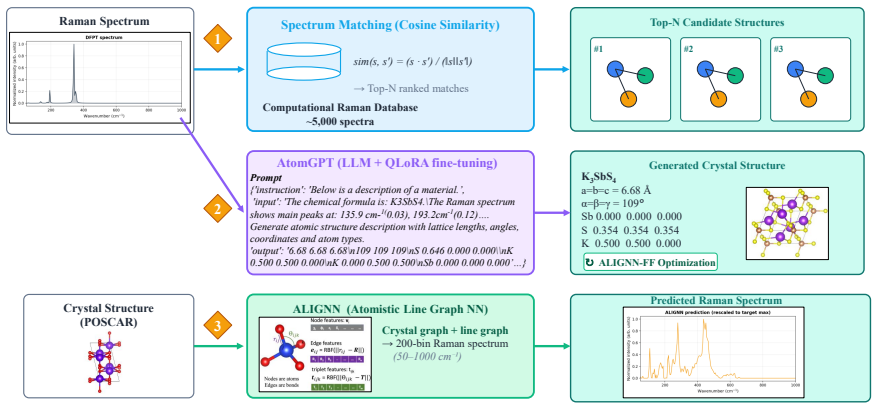
RamanGPT maps crystal structures to Raman spectra and back using ALIGNN and a fine-tuned language model.
A machine-rendered reading of the paper's core claim, the machinery that carries it, and where it could break.
Core claim
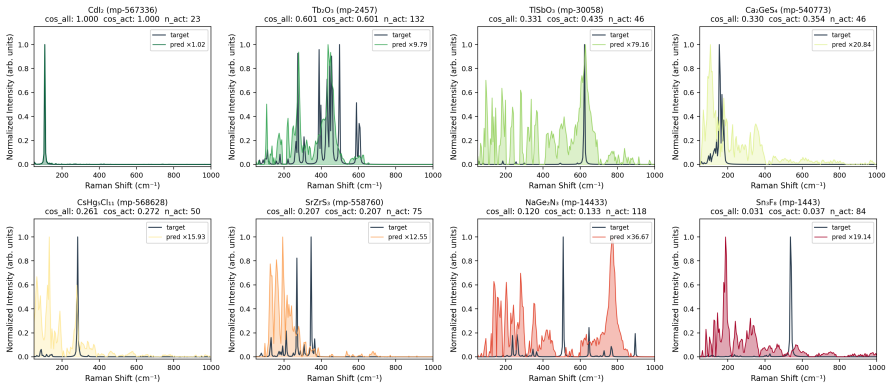
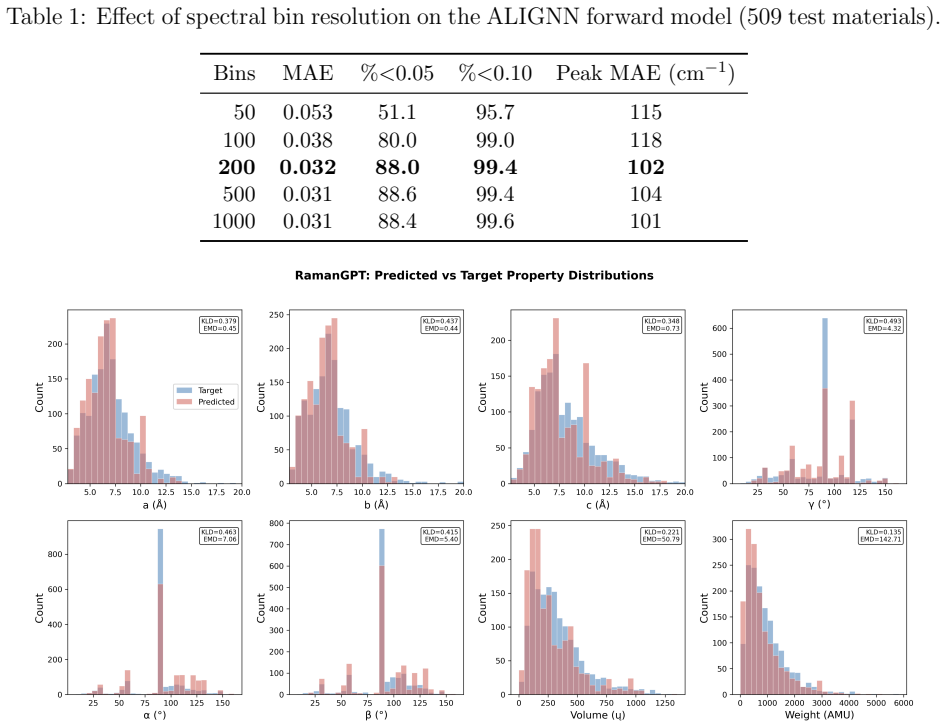
RamanGPT establishes bidirectional mapping in which an Atomistic Line Graph Neural Network predicts 200-bin Raman spectra over 50-1000 cm^{-1} from atomic structures with performance indicating capture of qualitative features, while a Quantized Low-Rank Adaptation fine-tuned language model recovers lattice parameters and reduced formulas from combined Raman and formula inputs at the reported error levels on held-out data.
What carries the argument
The bidirectional framework that pairs an ALIGNN graph neural network for structure-to-spectrum prediction with a fine-tuned generative transformer for spectrum-to-structure recovery.
If this is right
- Raman spectra for new materials can be generated without separate density functional perturbation theory calculations.
- Lattice parameters can be recovered from spectra with mean absolute errors between 1.14 and 2.16 Å together with high reduced-formula consistency.
- Qualitative spectral features can be matched even for materials not seen during training.
- A combined matcher and consistency loop can be applied to candidate structures generated from spectra.
Where Pith is reading between the lines
- The approach could be tested on spectra that include temperature broadening or defect-induced peaks to check generalization beyond the computational database.
- Similar bidirectional models might be constructed for other spectroscopies such as infrared or neutron scattering if comparable databases exist.
- Routine use would reduce dependence on exhaustive experimental reference libraries for structure identification from spectra.
Load-bearing premise
Performance measured on computationally generated spectra will translate to experimental spectra that include effects from defects, temperature, or instrument resolution absent from the training database.
What would settle it
Direct comparison of predicted versus measured cosine similarity and lattice-parameter recovery accuracy on a set of experimental Raman spectra from materials containing defects or measured at multiple temperatures.
Figures
read the original abstract
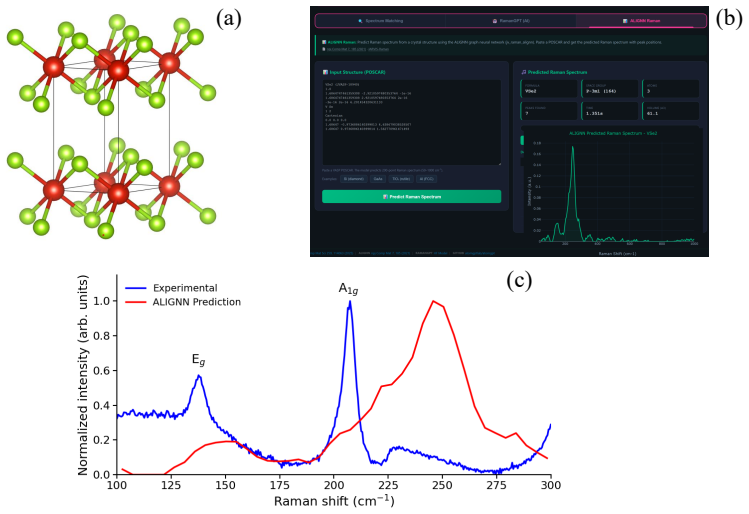
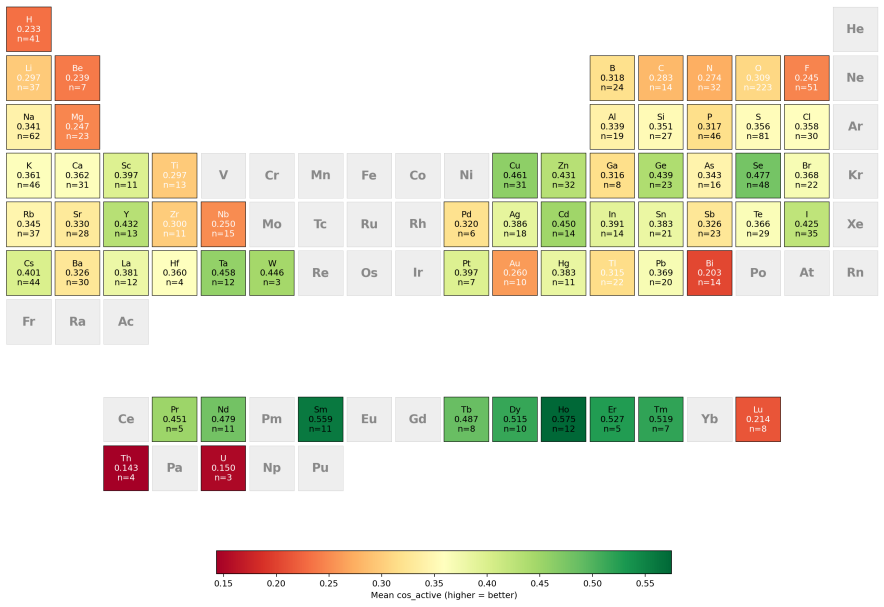
Raman spectroscopy is one of the most accessible vibrational probes in materials laboratories, but its forward problem (structure to spectrum) is bottlenecked by the cost of density functional perturbation theory, and its inverse problem (spectrum to structure) typically relies on retrieval against curated references. We introduce RamanGPT, a deep-learning framework that addresses both directions for crystalline inorganic materials. The forward model, an Atomistic Line Graph Neural Network (ALIGNN), is trained on the 5{,}099-material Computational Raman Database and predicts 200-bin spectra over 50-1000~cm$^{-1}$ with 42.5\% having a cosine similarity greater than or equal to 0.354 suggesting qualitative features of the target spectrum. The model also shows some qualitative agreement with the approximate features and appearance of similar relative intensity of the modes to an experimental measurement of metallic 1T VSe$_{2}$, a system absent from the training set. The inverse model fine-tunes a large language model via Quantized Low-Rank Adaptation on Raman-plus-formula prompts, recovering lattice parameters with mean absolute errors of 1.14-2.16~\AA{} and reduced-formula consistency of 86.8\% on 508 held-out materials. A cosine-similarity matcher and an inverse$\rightarrow$relax$\rightarrow$forward consistency loop are deployed at https://atomgpt.org/raman.
Editorial analysis
A structured set of objections, weighed in public.
Referee Report
Summary. The manuscript introduces RamanGPT, a bidirectional framework for mapping between crystal structures and Raman spectra in inorganic materials. An ALIGNN model is trained on the 5099-material Computational Raman Database to predict 200-bin spectra (50-1000 cm⁻¹) from structures, reporting that 42.5% of held-out predictions achieve cosine similarity ≥0.354 and showing qualitative agreement with an experimental spectrum of 1T VSe₂. An inverse model fine-tunes an LLM (via QLoRA) on Raman-plus-formula prompts to recover lattice parameters (MAE 1.14-2.16 Å) and reduced formulas (86.8% consistency) on 508 held-out materials. A cosine matcher and consistency loop are deployed at atomgpt.org/raman.
Significance. If the reported metrics hold under broader validation, the work could offer a practical computational aid for Raman-based materials screening, lowering the barrier to DFPT-level spectra and enabling spectrum-to-structure retrieval without exhaustive database search. The public web deployment and use of established architectures (ALIGNN, QLoRA) are positive features. The primary limitation is that all quantitative results derive from computational spectra; the single experimental contact point does not yet establish robustness for laboratory data.
major comments (3)
- [Abstract] Abstract: The forward-model claim that 42.5% of predictions reach cosine similarity ≥0.354 is presented without any baseline (e.g., random spectra, mean-spectrum predictor, or simpler GNN), without the full similarity histogram, and without explicit train/validation/test split sizes or stratification criteria. These omissions make it impossible to judge whether the threshold reflects genuine predictive power or merely the breadth of the 200-bin representation.
- [Abstract] Abstract: The inverse-model performance (MAE 1.14-2.16 Å, 86.8% formula consistency) is reported on 508 held-out materials, yet no information is given on how the 5099-material database was partitioned, whether the held-out set overlaps with the forward-model test set, or what the corresponding metrics are for a retrieval baseline that simply returns the nearest database entry by cosine similarity.
- [Abstract] Abstract: The assertion of applicability to experimental spectra rests on a single qualitative comparison to 1T VSe₂. No quantitative test is described for spectra that include defect-induced peaks, thermal broadening, or instrument resolution effects absent from the DFPT training distribution; if such shifts push cosine similarity below 0.354, both the 42.5% success rate and the inverse consistency figure lose direct relevance to laboratory use.
minor comments (2)
- [Methods] The 200-bin spectral representation and the precise definition of the cosine-similarity threshold (0.354) should be justified or compared to alternative binning schemes in the methods section.
- [Methods] The manuscript should clarify whether the inverse model receives only the 200-bin spectrum or also the chemical formula as explicit input, and how formula consistency is scored (exact match vs. reduced-formula match).
Simulated Author's Rebuttal
We thank the referee for their constructive and detailed comments. We address each major comment point by point below. We agree that the abstract would benefit from additional context on splits, baselines, and limitations, and we will revise the manuscript accordingly while preserving its core contributions.
read point-by-point responses
-
Referee: [Abstract] Abstract: The forward-model claim that 42.5% of predictions reach cosine similarity ≥0.354 is presented without any baseline (e.g., random spectra, mean-spectrum predictor, or simpler GNN), without the full similarity histogram, and without explicit train/validation/test split sizes or stratification criteria. These omissions make it impossible to judge whether the threshold reflects genuine predictive power or merely the breadth of the 200-bin representation.
Authors: We agree that the abstract omits these supporting details. The full manuscript describes an 80/10/10 split (stratified by space group and composition) and includes the cosine similarity distribution in the results section, but we will revise the abstract to state the split sizes explicitly and add a sentence noting that the 0.354 threshold was calibrated against visual similarity of peak positions. In the revised version we will also include a baseline comparison (mean-spectrum predictor and a simpler GNN without line-graph features) and the full histogram to allow direct assessment of predictive power. revision: yes
-
Referee: [Abstract] Abstract: The inverse-model performance (MAE 1.14-2.16 Å, 86.8% formula consistency) is reported on 508 held-out materials, yet no information is given on how the 5099-material database was partitioned, whether the held-out set overlaps with the forward-model test set, or what the corresponding metrics are for a retrieval baseline that simply returns the nearest database entry by cosine similarity.
Authors: The Methods section of the manuscript specifies that the inverse-model held-out set of 508 materials was drawn from the remaining portion of the database after the forward-model test split, with no overlap. We will revise the abstract to include a brief statement on the partitioning and will add, in the results, a direct comparison of the inverse model against a retrieval baseline that returns the nearest database entry by cosine similarity on the input spectrum. revision: yes
-
Referee: [Abstract] Abstract: The assertion of applicability to experimental spectra rests on a single qualitative comparison to 1T VSe₂. No quantitative test is described for spectra that include defect-induced peaks, thermal broadening, or instrument resolution effects absent from the DFPT training distribution; if such shifts push cosine similarity below 0.354, both the 42.5% success rate and the inverse consistency figure lose direct relevance to laboratory use.
Authors: We acknowledge that the experimental demonstration is limited to one qualitative example and that the quantitative metrics are computed exclusively on computational DFPT spectra. The manuscript already notes this distinction and presents the VSe₂ case as an initial out-of-distribution check rather than comprehensive validation. In the revision we will expand the discussion to explicitly address the potential impact of experimental broadening, defects, and resolution on cosine similarity and will qualify the reported percentages as applying to computational data. revision: partial
- A larger-scale quantitative benchmark on experimental spectra that include defects, thermal effects, and instrument resolution is not feasible with currently available data and would require new experimental measurements or simulated perturbations beyond the scope of the present study.
Circularity Check
No circularity: standard ML training and held-out evaluation on external database
full rationale
The forward ALIGNN and inverse LLM models are trained on the external 5099-material Computational Raman Database (DFPT spectra) and evaluated via standard held-out splits plus one qualitative experimental match. Reported metrics (cosine similarity, MAE, formula consistency) are empirical outcomes of training/testing, not algebraic reductions or self-definitional mappings. No load-bearing self-citations, fitted-input-as-prediction, or ansatz smuggling appear in the derivation chain. The work is self-contained against external benchmarks.
Axiom & Free-Parameter Ledger
axioms (2)
- domain assumption The 5099-material Computational Raman Database is sufficiently representative of inorganic crystals for both forward and inverse tasks.
- domain assumption Cosine similarity on 200-bin spectra and lattice-parameter MAE are appropriate proxies for practical utility.
Reference graph
Works this paper leans on
-
[1]
Nature , volume=
A new type of secondary radiation , author=. Nature , volume=. 1928 , publisher=
1928
-
[2]
(No Title) , year=
The Raman Effect: A Unified Treatment of the Theory of Raman Scattering by Molecules , author=. (No Title) , year=
-
[3]
2008 , publisher=
Infrared and Raman spectroscopy: methods and applications , author=. 2008 , publisher=
2008
-
[4]
Physical Review B , volume=
Infrared intensities and Raman-scattering activities within density-functional theory , author=. Physical Review B , volume=. 1996 , publisher=
1996
-
[5]
Reviews of modern Physics , volume=
Phonons and related crystal properties from density-functional perturbation theory , author=. Reviews of modern Physics , volume=. 2001 , publisher=
2001
-
[6]
Physical Review B , volume=
Theory of resonant Raman scattering: Towards a comprehensive ab initio description , author=. Physical Review B , volume=. 2019 , publisher=
2019
-
[7]
Nature materials , volume=
Fundamentals of inorganic solid-state electrolytes for batteries , author=. Nature materials , volume=. 2019 , publisher=
2019
-
[8]
Revealing the CO coverage-driven C--C coupling mechanism for electrochemical
Zhan, Chao and Dattila, Federico and Rettenmaier, Clara and Bergmann, Arno and Kuhl, Stefanie and Garcia-Muelas, Rodrigo and L. Revealing the CO coverage-driven C--C coupling mechanism for electrochemical. ACS catalysis , volume=. 2021 , publisher=
2021
-
[9]
Nature nanotechnology , volume=
Raman spectroscopy as a versatile tool for studying the properties of graphene , author=. Nature nanotechnology , volume=. 2013 , publisher=
2013
-
[10]
Diagnosis and treatment of breast cancer , author=
Raman imaging in biochemical and biomedical applications. Diagnosis and treatment of breast cancer , author=. Chemical reviews , volume=. 2013 , publisher=
2013
-
[11]
Nanoscale , volume=
Review on the Raman spectroscopy of different types of layered materials , author=. Nanoscale , volume=. 2016 , publisher=
2016
-
[12]
2015 IEEE aerospace conference , pages=
SHERLOC: Scanning habitable environments with Raman & luminescence for organics & chemicals , author=. 2015 IEEE aerospace conference , pages=. 2015 , organization=
2015
-
[13]
Journal of Chemometrics , volume =
Veneranda, Marco and Manrique, Jose Antonio and Sanz-Arranz, Aurelio and Julve Gonzalez, Sofia and Prieto Garcia, Clara and Pascual Sanchez, Elena and Konstantinidis, Menelaos and Charro, Elena and Lopez, Jose Manuel and Gonzalez, Manuel Angel and Rull, Fernando and Lopez-Reyes, Guillermo , title =. Journal of Chemometrics , volume =. doi:https://doi.org/...
-
[14]
Scientific Data , volume=
High-throughput computation of Raman spectra from first principles , author=. Scientific Data , volume=. 2023 , publisher=
2023
-
[15]
Scientific data , volume=
High-throughput computation and evaluation of raman spectra , author=. Scientific data , volume=. 2019 , publisher=
2019
-
[16]
Scripta materialia , volume=
First principles phonon calculations in materials science , author=. Scripta materialia , volume=. 2015 , publisher=
2015
-
[17]
APL materials , volume=
Commentary: The Materials Project: A materials genome approach to accelerating materials innovation , author=. APL materials , volume=. 2013 , publisher=
2013
-
[18]
Scientific Data , volume=
A database of computed Raman spectra of inorganic compounds with accurate hybrid functionals , author=. Scientific Data , volume=. 2024 , publisher=
2024
-
[19]
Nature communications , volume=
A library of ab initio Raman spectra for automated identification of 2D materials , author=. Nature communications , volume=. 2020 , publisher=
2020
-
[20]
Scientific data , volume=
High-throughput computation of ab initio Raman spectra for two-dimensional materials , author=. Scientific data , volume=. 2025 , publisher=
2025
-
[21]
American Mineralogist , volume=
The WURM project—a freely available web-based repository of computed physical data for minerals , author=. American Mineralogist , volume=. 2011 , publisher=
2011
-
[22]
Highlights in mineralogical crystallography , pages=
The power of databases: The RRUFF project , author=. Highlights in mineralogical crystallography , pages=. 2015 , publisher=
2015
-
[23]
Applied Crystallography , volume=
Raman Open Database: first interconnected Raman--X-ray diffraction open-access resource for material identification , author=. Applied Crystallography , volume=. 2019 , publisher=
2019
-
[24]
European Journal of Mineralogy , volume=
Analysis of the scientific capabilities of the ExoMars Raman Laser Spectrometer instrument , author=. European Journal of Mineralogy , volume=. 2013 , publisher=
2013
-
[25]
European Planetary Science Congress , volume=
Raman spectra processing algorithms and database for RLS-ExoMars , author=. European Planetary Science Congress , volume=
-
[26]
Physical review letters , volume=
Crystal graph convolutional neural networks for an accurate and interpretable prediction of material properties , author=. Physical review letters , volume=. 2018 , publisher=
2018
-
[27]
The Journal of Chemical Physics , volume=
Schnet--a deep learning architecture for molecules and materials , author=. The Journal of Chemical Physics , volume=. 2018 , publisher=
2018
-
[28]
Nature Communications , volume=
E(3)-equivariant graph neural networks for data-efficient and accurate interatomic potentials , author=. Nature Communications , volume=. 2022 , publisher=
2022
-
[29]
npj Computational Materials , volume=
Atomistic line graph neural network for improved materials property predictions , author=. npj Computational Materials , volume=. 2021 , publisher=
2021
-
[30]
Digital Discovery , volume=
Unified graph neural network force-field for the periodic table: solid state applications , author=. Digital Discovery , volume=. 2023 , publisher=
2023
-
[31]
npj Computational Materials , volume=
Recent advances and applications of deep learning methods in materials science , author=. npj Computational Materials , volume=. 2022 , publisher=
2022
-
[32]
npj computational materials , volume=
Recent advances and applications of machine learning in solid-state materials science , author=. npj computational materials , volume=. 2019 , publisher=
2019
-
[33]
Physical Review Materials , volume=
Rapid prediction of phonon structure and properties using the atomistic line graph neural network (ALIGNN) , author=. Physical Review Materials , volume=. 2023 , publisher=
2023
-
[34]
Nature Communications , volume=
Density of states prediction for materials discovery via contrastive learning from probabilistic embeddings , author=. Nature Communications , volume=. 2022 , publisher=
2022
-
[35]
Advanced Science , volume=
Direct prediction of phonon density of states with Euclidean neural networks , author=. Advanced Science , volume=. 2021 , publisher=
2021
-
[36]
Jom , volume=
Prediction of the electron density of states for crystalline compounds with Atomistic Line Graph Neural Networks (ALIGNN) , author=. Jom , volume=. 2022 , publisher=
2022
-
[37]
The Journal of Physical Chemistry A , volume=
A deep neural network for the rapid prediction of X-ray absorption spectra , author=. The Journal of Physical Chemistry A , volume=. 2020 , publisher=
2020
-
[38]
Physical review letters , volume=
Machine-learning X-ray absorption spectra to quantitative accuracy , author=. Physical review letters , volume=. 2020 , publisher=
2020
-
[39]
Physical Review Materials , volume=
Efficient method for calculating Raman spectra of solids with impurities and alloys and its application to two-dimensional transition metal dichalcogenides , author=. Physical Review Materials , volume=. 2019 , publisher=
2019
-
[40]
Analyst , volume=
Deep convolutional neural networks for Raman spectrum recognition: a unified solution , author=. Analyst , volume=. 2017 , publisher=
2017
-
[41]
Neural Processing Letters , volume=
One-dimensional deep convolutional neural network for mineral classification from Raman spectroscopy , author=. Neural Processing Letters , volume=. 2022 , publisher=
2022
-
[42]
Earth and Space Science , volume=
Convolutional neural networks as a tool for Raman spectral mineral classification under low signal, dusty Mars conditions , author=. Earth and Space Science , volume=. 2022 , publisher=
2022
-
[43]
Neural Computing and Applications , volume=
RamanNet: a generalized neural network architecture for Raman spectrum analysis , author=. Neural Computing and Applications , volume=. 2023 , publisher=
2023
-
[44]
arXiv preprint arXiv:2312.03687 , year=
Mattergen: a generative model for inorganic materials design , author =. arXiv preprint arXiv:2312.03687 , year=
-
[45]
arXiv preprint arXiv:2305.05708 , year=
Language models can generate molecules, materials, and protein binding sites directly in three dimensions as xyz, cif, and pdb files , author=. arXiv preprint arXiv:2305.05708 , year=
-
[46]
International conference on learning representations , volume=
Fine-tuned language models generate stable inorganic materials as text , author=. International conference on learning representations , volume=
-
[47]
Nature Communications , volume=
Crystal structure generation with autoregressive large language modeling , author=. Nature Communications , volume=. 2024 , publisher=
2024
-
[48]
arXiv preprint arXiv:2310.14029 , year=
LLM-prop: Predicting physical and electronic properties of crystalline solids from their text descriptions , author=. arXiv preprint arXiv:2310.14029 , year=
-
[49]
The Journal of Physical Chemistry Letters , volume=
Atomgpt: Atomistic generative pretrained transformer for forward and inverse materials design , author=. The Journal of Physical Chemistry Letters , volume=. 2024 , publisher=
2024
-
[50]
The Journal of Physical Chemistry Letters , volume=
DiffractGPT: Atomic structure determination from x-ray diffraction patterns using a generative pretrained transformer , author=. The Journal of Physical Chemistry Letters , volume=. 2025 , publisher=
2025
-
[51]
The Journal of Physical Chemistry Letters , volume=
MicroscopyGPT: generating atomic-structure captions from microscopy images of 2D materials with vision-language transformers , author=. The Journal of Physical Chemistry Letters , volume=. 2025 , publisher=
2025
-
[52]
2023 , eprint=
Mistral 7B , author=. 2023 , eprint=
2023
-
[53]
Hu and Yelong Shen and Phillip Wallis and Zeyuan Allen
Edward J. Hu and Yelong Shen and Phillip Wallis and Zeyuan Allen. LoRA: Low-Rank Adaptation of Large Language Models , journal =. 2021 , url =. 2106.09685 , timestamp =
Pith/arXiv arXiv 2021
-
[54]
Advances in neural information processing systems , volume=
Qlora: Efficient finetuning of quantized LLMs , author=. Advances in neural information processing systems , volume=
-
[55]
Physical review B , volume=
Efficient iterative schemes for ab initio total-energy calculations using a plane-wave basis set , author=. Physical review B , volume=. 1996 , publisher=
1996
-
[56]
Science and Technology of Advanced Materials: Methods , volume=
Spglib: a software library for crystal symmetry search , author=. Science and Technology of Advanced Materials: Methods , volume=. 2024 , publisher=
2024
-
[57]
Nature nanotechnology , volume=
Strong room-temperature ferromagnetism in VSe2 monolayers on van der Waals substrates , author=. Nature nanotechnology , volume=. 2018 , publisher=
2018
-
[58]
ACS nano , volume=
Quantum Monte Carlo and density functional theory study of strain and magnetism in 2D 1T-VSe2 with charge density wave states , author=. ACS nano , volume=. 2025 , publisher=
2025
discussion (0)
Sign in with ORCID, Apple, or X to comment. Anyone can read and Pith papers without signing in.