Targeting black holes from metal-poor progenitors with next-generation gravitational-wave detectors
Pith reviewed 2026-06-28 09:05 UTC · model grok-4.3
The pith
Next-generation gravitational-wave detectors can isolate binary black-hole mergers from metal-poor progenitors by comparing rates at a target redshift to local rates.
A machine-rendered reading of the paper's core claim, the machinery that carries it, and where it could break.
Core claim
By defining a target redshift z_t as the epoch at which more than 90 percent of stars form with Z less than 0.1 Z_sun, mergers from metal-poor progenitors can be isolated. The paper presents a statistical framework that compares the binary black-hole merger-rate density at this z_t to the local Universe, mapping evolutionary trends and determining the number of detections needed to distinguish astrophysical signals from statistical noise with next-generation detectors.
What carries the argument
The target redshift z_t, the cosmic epoch at which more than 90 percent of star formation occurs at metallicity Z less than 0.1 Z_sun, which isolates the contribution from metal-poor progenitors.
If this is right
- Merger-rate density variations between z_t and the local universe directly trace evolutionary trends in black-hole formation across parameter space.
- The framework calculates the detection statistics required to distinguish genuine astrophysical variations from statistical fluctuations.
- Rapid tests of astrophysical predictions become possible against forecasted observations from detectors such as the Einstein Telescope and Cosmic Explorer.
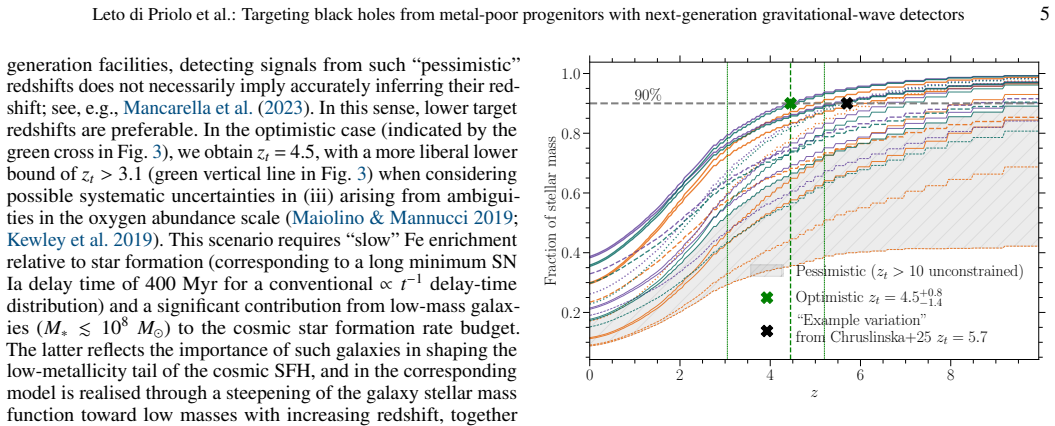
- z_t ranges from approximately 4 to greater than 10 depending on the adopted model for star-formation rate density versus iron abundance.
Where Pith is reading between the lines
- If z_t turns out high, a large fraction of local mergers would originate from the early universe, complicating direct interpretation of current catalogs.
- The isolation method could be generalized to other metallicity thresholds or combined with mass and spin distributions to refine progenitor tagging.
- Observing strategies for next-generation detectors might need to prioritize high-redshift event collection to reach the required statistics in reasonable time.
Load-bearing premise
The cosmic star-formation rate density can be reconstructed as a function of iron abundance using empirical scaling relations in a manner that defines a meaningful target redshift separating metallicity regimes.
What would settle it
Future observations from Einstein Telescope or Cosmic Explorer showing merger-rate densities at the calculated z_t that remain statistically consistent with local rates after hundreds of events would indicate that z_t does not effectively isolate metal-poor progenitor populations.
Figures
read the original abstract
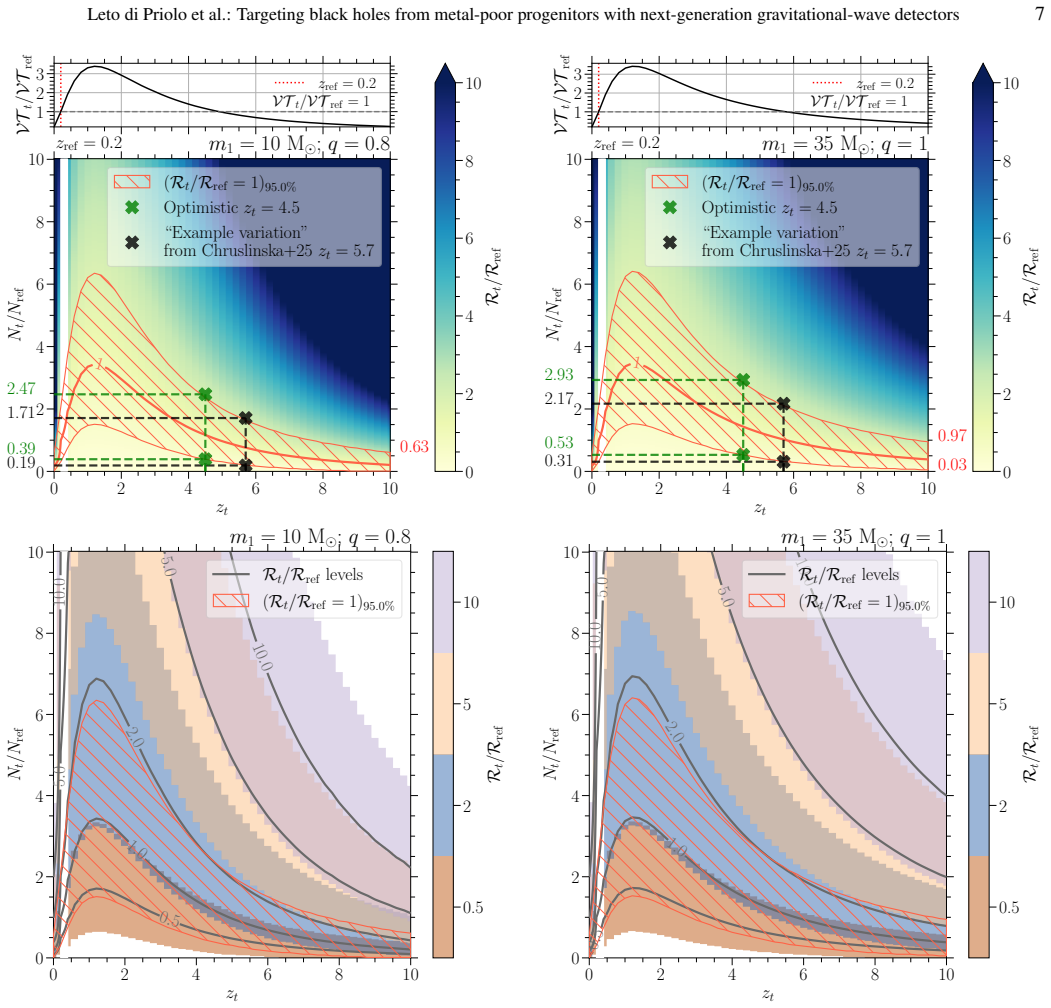
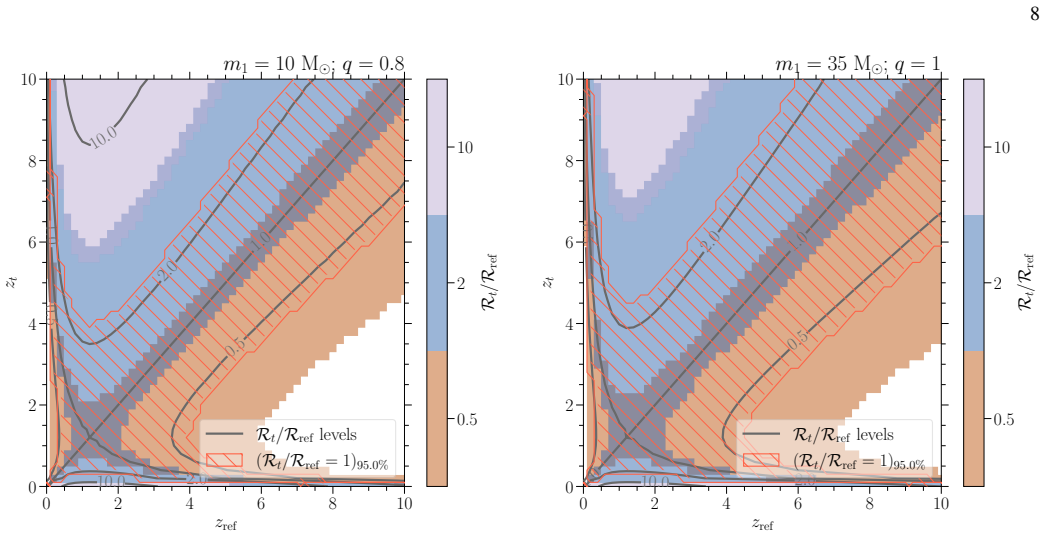
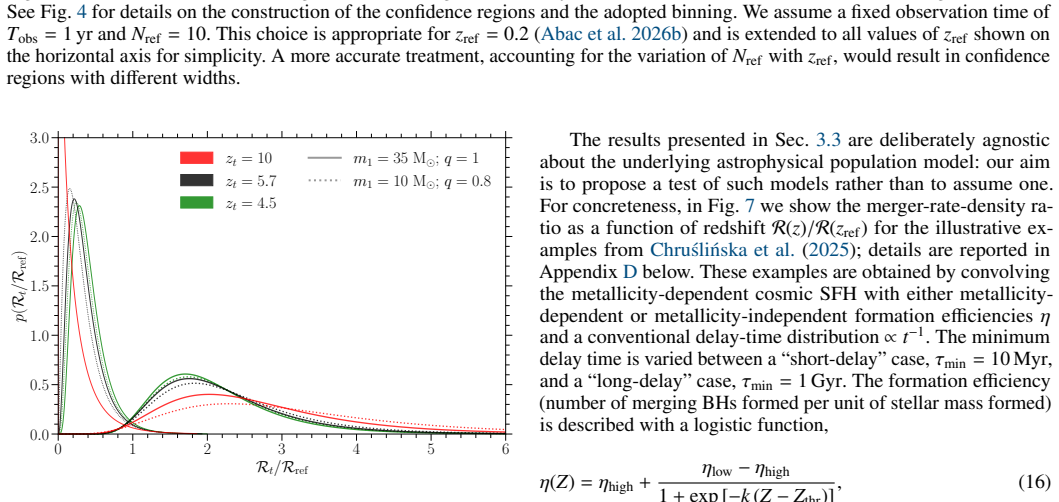
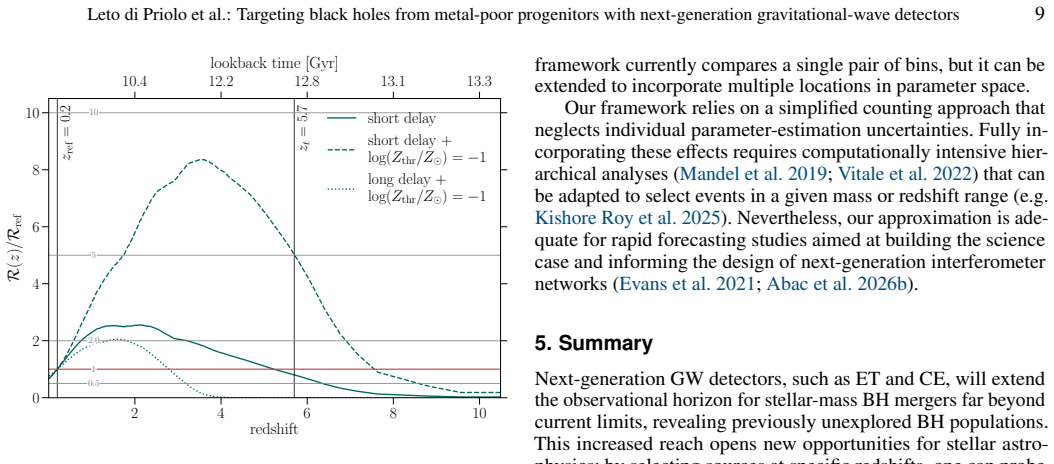
Next-generation gravitational-wave detectors such as the Einstein Telescope and Cosmic Explorer will be able to detect binary black-hole mergers out to the cosmic dawn. Mergers observed in the local Universe represent a mixture of systems formed across the entire cosmic history, spanning a wide range of astrophysical environments. Iron-group elements govern metallicity effects on stellar evolution, making metallicity a key tracer that leaves a strong imprint on the black-hole population. We introduce the concept of a "target" redshift, $z_t$, defined as the epoch at which more than 90% of stars form with metallicity $Z < 0.1\,Z_\odot$. This provides a straightforward way to isolate mergers originating from metal-poor environments. The determination of $z_t$ relies on the reconstruction of the cosmic star-formation rate density as a function of iron abundance. This reconstruction is not unique, as it depends on the combination of different empirical scaling relations. Consequently, $z_t$ spans a broad range, from $z_t \sim 4$ to $z_t > 10$, depending on the adopted model variation. We present a statistical framework that enables rapid tests of astrophysical predictions against forecasted observations from next-generation gravitational-wave detectors. By quantifying variations in the binary black-hole merger-rate density between the target redshift and the local Universe, our approach maps evolutionary trends across parameter space and estimates the detection statistics required to distinguish genuine astrophysical variations from statistical fluctuations.
Editorial analysis
A structured set of objections, weighed in public.
Referee Report
Summary. The manuscript introduces a target redshift z_t, defined as the epoch at which >90% of stars form with Z < 0.1 Z_⊙, obtained by reconstructing the cosmic star-formation rate density versus iron abundance. It notes that this reconstruction is non-unique due to different empirical scaling relations, yielding z_t ranging from ~4 to >10. The authors present a statistical framework that quantifies variations in the binary black-hole merger-rate density between z_t and the local Universe to map evolutionary trends and estimate the number of detections needed to distinguish astrophysical signals from fluctuations, using forecasts for next-generation detectors such as Einstein Telescope and Cosmic Explorer.
Significance. If the framework can be made robust against the model dependence in z_t, it would offer a practical statistical tool for connecting future high-redshift gravitational-wave observations to metallicity-dependent black-hole formation channels. The explicit recognition that z_t is not unique is a positive feature, but the absence of any propagation or marginalization of this uncertainty into the forecasted detection statistics limits the immediate utility of the quantitative claims.
major comments (1)
- [Abstract] Abstract: the statistical framework is built around comparisons 'between the target redshift and the local Universe,' yet z_t itself spans ~4 to >10 depending on the adopted scaling relations. No procedure is described for marginalizing over this range or for propagating the resulting variation into the estimated detection numbers required to distinguish trends from Poisson fluctuations.
minor comments (1)
- [Abstract] The abstract refers to 'maps evolutionary trends across parameter space' without identifying the specific parameters (e.g., metallicity threshold, star-formation fraction) that are varied in the framework.
Simulated Author's Rebuttal
We thank the referee for their constructive comments on the manuscript. We address the single major comment below.
read point-by-point responses
-
Referee: [Abstract] Abstract: the statistical framework is built around comparisons 'between the target redshift and the local Universe,' yet z_t itself spans ~4 to >10 depending on the adopted scaling relations. No procedure is described for marginalizing over this range or for propagating the resulting variation into the estimated detection numbers required to distinguish trends from Poisson fluctuations.
Authors: We agree that the manuscript does not provide an explicit procedure for marginalizing over the model-dependent range of z_t (~4 to >10) or for propagating this uncertainty into the forecasted detection statistics. The text already notes the non-uniqueness of z_t arising from different empirical scaling relations, and the framework is constructed to be applied for any chosen z_t. To address the referee's point, we will revise the manuscript by adding a dedicated paragraph (likely in Section 3 or the discussion) that (i) illustrates how the required number of detections varies across the reported z_t range and (ii) outlines a simple procedure for users to bracket results by evaluating the framework at the bounding values of z_t. This will make the quantitative forecasts more transparent without altering the core statistical approach. revision: yes
Circularity Check
No circularity: statistical framework is independent of z_t reconstruction
full rationale
The paper defines z_t externally via reconstruction of cosmic SFRD(Z) from empirical scaling relations (explicitly noted as non-unique), then introduces a separate statistical framework to quantify merger-rate density variations between that z_t and the local Universe for testing astrophysical predictions. No equation or claim reduces a reported variation or detection statistic to a fitted input inside the same model, nor relies on self-citation for a load-bearing uniqueness result. The derivation chain remains self-contained against external benchmarks.
Axiom & Free-Parameter Ledger
free parameters (2)
- Metallicity threshold 0.1 Z_⊙
- 90% star-formation fraction
axioms (1)
- domain assumption Iron-group elements govern metallicity effects on stellar evolution, making metallicity a key tracer that leaves a strong imprint on the black-hole population.
invented entities (1)
-
Target redshift z_t
no independent evidence
Reference graph
Works this paper leans on
-
[1]
Abac, A. G. et al. 2025 [arXiv:2508.18083]
Pith/arXiv arXiv 2025
-
[2]
Abac, A. G. et al. 2026a [arXiv:2605.27226]
-
[3]
Abac, A. G. et al. 2026b, J. Cosmology Astropart. Phys., 2026, 081 [arXiv:2503.12263]
Pith/arXiv arXiv 2026
-
[4]
Abbott, B. P., Abbott, R., Abbott, T. D., et al. 2016, Astrophys. J. Lett., 833, L1 [arXiv:1602.03842]
Pith/arXiv arXiv 2016
-
[5]
Abbott, R., Abbott, T. D., Acernese, F., et al. 2023, Phys. Rev. X, 13, 011048 [arXiv:2111.03634]
Pith/arXiv arXiv 2023
-
[6]
Aghanim, N. et al. 2020, Astron. Astrophys., 641, A6 [arXiv:1807.06209]
Pith/arXiv arXiv 2020
-
[7]
Banagiri, S., Thrane, E., & Lasky, P. D. 2025 [arXiv:2509.15646]
Pith/arXiv arXiv 2025
-
[8]
Barber, J. & Antonini, F. 2025, Mon. Not. R. Astron. Soc., 538, 639 [arXiv:2410.03832]
arXiv 2025
-
[9]
Belczynski, K., Bulik, T., Fryer, C. L., et al. 2010a, Astrophys. J., 714, 1217 [arXiv:0904.2784]
-
[10]
Belczynski, K., Dominik, M., Bulik, T., et al. 2010b, Astrophys. J. Lett., 715, L138 [arXiv:1004.0386]
-
[11]
Boesky, A. P., Broekgaarden, F. S., & Berger, E. 2024, Astrophys. J., 976, 23 [arXiv:2405.01623]
arXiv 2024
- [12]
-
[13]
Branchesi, M., Maggiore, M., Alonso, D., et al. 2023, J. Cosmology Astropart. Phys., 2023, 068 [arXiv:2303.15923]
Pith/arXiv arXiv 2023
-
[14]
S., Berger, E., Stevenson, S., et al
Broekgaarden, F. S., Berger, E., Stevenson, S., et al. 2022, Mon. Not. R. Astron. Soc., 516, 5737 [arXiv:2112.05763]
arXiv 2022
-
[15]
Callister, T., Fishbach, M., Holz, D. E., & Farr, W. M. 2020, Astrophys. J. Lett., 896, L32 [arXiv:2003.12152]
arXiv 2020
-
[16]
Chen, H.-Y ., Holz, D. E., Miller, J., et al. 2021, Class. Quantum Grav., 38, 055010 [arXiv:1709.08079]
arXiv 2021
-
[17]
Chowdhury, S. R. & Santra, D. 2024 [arXiv:2411.11902] Chru´sli´nska, M. 2024, Annalen der Physik, 536, 2200170 [arXiv:2206.10622] Chru´sli´nska, M., Curti, M., Pakmor, R., et al. 2025 [arXiv:2511.15782]
arXiv 2024
-
[18]
Chruslinska, M. & Nelemans, G. 2019, Mon. Not. R. Astron. Soc., 488, 5300 [arXiv:1907.11243]
Pith/arXiv arXiv 2019
-
[19]
Chruslinska, M., Nelemans, G., & Belczynski, K. 2019, Mon. Not. R. Astron. Soc., 482, 5012 [arXiv:1811.03565] Chru´sli´nska, M., Nelemans, G., Boco, L., & Lapi, A. 2021, Mon. Not. R. Astron. Soc., 508, 4994 [arXiv:2109.06187] Chru´sli´nska, M., Pakmor, R., Matthee, J., & Matsuno, T. 2024, Astron. Astrophys., 686, A186 [arXiv:2308.00023]
Pith/arXiv arXiv 2019
-
[20]
Corelli, A., Gerosa, D., Mould, M., & Fabbri, C. M. 2026 [arXiv:2603.00239] de Mink, S. E. & Mandel, I. 2016, Mon. Not. R. Astron. Soc., 460, 3545 [arXiv:1603.02291] Di Carlo, U. N., Mapelli, M., Giacobbo, N., et al. 2020, Mon. Not. R. Astron. Soc., 498, 495 [arXiv:2004.09525]
arXiv 2026
-
[21]
Dominik, M., Belczynski, K., Fryer, C., et al. 2012, Astrophys. J., 759, 52 [arXiv:1202.4901] du Buisson, L., Marchant, P., Podsiadlowski, P., et al. 2020, Mon. Not. R. Astron. Soc., 499, 5941 [arXiv:2002.11630]
Pith/arXiv arXiv 2012
-
[22]
Eldridge, J. J., Stanway, E. R., & Tang, P. N. 2019, Mon. Not. R. Astron. Soc., 482, 870 [arXiv:1807.07659]
Pith/arXiv arXiv 2019
-
[23]
Evans, M., Adhikari, R. X., Afle, C., et al. 2021 [arXiv:2109.09882]
Pith/arXiv arXiv 2021
-
[24]
Farah, A. M., Fishbach, M., & Holz, D. E. 2024, Astrophys. J., 962, 69 [arXiv:2308.05102]
arXiv 2024
-
[25]
Farrell, E., Groh, J. H., Meynet, G., & Eldridge, J. J. 2022, Mon. Not. R. Astron. Soc., 512, 4116 [arXiv:2109.02488]
arXiv 2022
-
[26]
1997, A Compendium of Conjugate Priors, www.johndcook.com/CompendiumOfConjugatePriors.pdf
Fink, D. 1997, A Compendium of Conjugate Priors, www.johndcook.com/CompendiumOfConjugatePriors.pdf
1997
-
[27]
Fishbach, M., Holz, D. E., & Farr, W. M. 2018, Astrophys. J. Lett., 863, L41 [arXiv:1805.10270]
Pith/arXiv arXiv 2018
-
[28]
L., Belczynski, K., Wiktorowicz, G., et al
Fryer, C. L., Belczynski, K., Wiktorowicz, G., et al. 2012, Astrophys. J., 749, 91 [arXiv:1110.1726]
Pith/arXiv arXiv 2012
-
[29]
Gallegos-Garcia, M., Berry, C. P. L., Marchant, P., & Kalogera, V . 2021, Astro- phys. J., 922, 110 [arXiv:2107.05702] García-Quirós, C., Colleoni, M., Husa, S., et al. 2020, Phys. Rev. D, 102, 064002 [arXiv:2001.10914]
arXiv 2021
-
[30]
Gerosa, D., Berti, E., O’Shaughnessy, R., et al. 2018, Phys. Rev. D, 98, 084036 [arXiv:1808.02491]
Pith/arXiv arXiv 2018
-
[31]
Gerosa, D., Pratten, G., & Vecchio, A. 2020, Phys. Rev. D, 102, 103020 [arXiv:2007.06585]
arXiv 2020
-
[32]
Giacobbo, N. & Mapelli, M. 2018, Mon. Not. R. Astron. Soc., 480, 2011 [arXiv:1806.00001]
Pith/arXiv arXiv 2018
-
[33]
Giacobbo, N., Mapelli, M., & Spera, M. 2018, Mon. Not. R. Astron. Soc., 474, 2959 [arXiv:1711.03556]
Pith/arXiv arXiv 2018
-
[34]
Greggio, L. 2005, Astron. Astrophys., 441, 1055 [arXiv:astro-ph/0504376]
Pith/arXiv arXiv 2005
-
[35]
Guttman, N., Payne, E., Lasky, P. D., & Thrane, E. 2026, Astrophys. J., 996, 144 [arXiv:2509.09876]
arXiv 2026
-
[36]
Heger, A., Fryer, C. L., Woosley, S. E., Langer, N., & Hartmann, D. H. 2003, Astrophys. J., 591, 288 [arXiv:astro-ph/0212469]
Pith/arXiv arXiv 2003
-
[37]
Heinzel, J., Mould, M., Álvarez-López, S., & Vitale, S. 2025a, Phys. Rev. D, 111, 063043 [arXiv:2406.16813]
-
[38]
Heinzel, J., Mould, M., & Vitale, S. 2025b, Phys. Rev. D, 111, L061305 [arXiv:2406.16844]
-
[39]
Hendriks, D. D., van Son, L. A. C., Renzo, M., Izzard, R. G., & Farmer, R. 2023, Mon. Not. R. Astron. Soc., 526, 4130 [arXiv:2309.09339]
arXiv 2023
- [40]
-
[41]
Iacovelli, F. & Maggiore, M. 2024, Primordial Black Holes (Springer) [arXiv:2407.21442]
arXiv 2024
-
[42]
Iglesias, C. A. & Rogers, F. J. 1996, Astrophys. J., 464, 943
1996
- [43]
-
[44]
L., Kotz, S., & Balakrishnan, N
Johnson, N. L., Kotz, S., & Balakrishnan, N. 1994, Continuous univariate distri- butions (Wiley)
1994
-
[45]
Kapadia, S. J., Caudill, S., Creighton, J. D. E., et al. 2020, Class. Quantum Grav., 37, 045007 [arXiv:1903.06881]
arXiv 2020
-
[46]
Kewley, L. J., Nicholls, D. C., & Sutherland, R. S. 2019, Annu. Rev. Astron. Astrophys., 57, 511 [arXiv:1910.09730] Kishore Roy, S., van Son, L. A. C., & Farr, W. M. 2025, Class. Quantum Grav., 42, 225008 [arXiv:2507.01086]
arXiv 2019
-
[47]
Klencki, J., Moe, M., Gladysz, W., et al. 2018, Astron. Astrophys., 619, A77 [arXiv:1808.07889]
Pith/arXiv arXiv 2018
-
[48]
Klencki, J., Nelemans, G., Istrate, A. G., & Chruslinska, M. 2021, Astron. Astro- phys., 645, A54 [arXiv:2006.11286]
arXiv 2021
-
[49]
Klencki, J., Nelemans, G., Istrate, A. G., & Pols, O. 2020, Astron. Astrophys., 638, A55 [arXiv:2004.00628]
arXiv 2020
-
[50]
Klencki, J., Podsiadlowski, P., Langer, N., et al. 2026, Astron. Astrophys., 706, A296 [arXiv:2505.08860]
arXiv 2026
-
[51]
1988, Parameter estimation and hypothesis testing in linear models (Springer-Verlag)
Koch, K.-R. 1988, Parameter estimation and hypothesis testing in linear models (Springer-Verlag)
1988
-
[52]
P., Pauldrach, A., & Puls, J
Kudritzki, R. P., Pauldrach, A., & Puls, J. 1987, Astron. Astrophys., 173, 293
1987
-
[53]
2024, Cosmic Ex- plorer Strain and Displacement Sensitivity, dcc.cosmicexplorer.org/cgi- bin/DocDB/ShowDocument?docid=T2000017
Kuns, K., Fulda, P., Barsotti, L., & Matthew, E. 2024, Cosmic Ex- plorer Strain and Displacement Sensitivity, dcc.cosmicexplorer.org/cgi- bin/DocDB/ShowDocument?docid=T2000017
2024
-
[54]
Lalleman, M., Turbang, K., Callister, T., & van Remortel, N. 2025, Astron. Astrophys., 698, A85 [arXiv:2501.10295]
arXiv 2025
-
[55]
Lamberts, A., Garrison-Kimmel, S., Clausen, D. R., & Hopkins, P. F. 2016, Mon. Not. R. Astron. Soc., 463, L31 [arXiv:1605.08783]
Pith/arXiv arXiv 2016
-
[56]
Langer, N. & Norman, C. A. 2006, Astrophys. J. Lett., 638, L63 [arXiv:astro- ph/0512271]
arXiv 2006
-
[57]
Madau, P. & Dickinson, M. 2014, Annu. Rev. Astron. Astrophys., 52, 415 [arXiv:1403.0007]
Pith/arXiv arXiv 2014
-
[58]
Maiolino, R. & Mannucci, F. 2019, Astron. Astrophys. Rev., 27, 3 [arXiv:1811.09642]
Pith/arXiv arXiv 2019
-
[59]
Mancarella, M., Iacovelli, F., & Gerosa, D. 2023, Phys. Rev. D, 107, L101302 [arXiv:2303.16323]
arXiv 2023
-
[60]
Mandel, I. & de Mink, S. E. 2016, Mon. Not. R. Astron. Soc., 458, 2634 [arXiv:1601.00007]
Pith/arXiv arXiv 2016
- [61]
-
[62]
Mandel, I., Farr, W. M., & Gair, J. R. 2019, Mon. Not. R. Astron. Soc., 486, 1086 [arXiv:1809.02063]
Pith/arXiv arXiv 2019
-
[63]
Mapelli, M. 2016, Mon. Not. R. Astron. Soc., 459, 3432 [arXiv:1604.03559]
Pith/arXiv arXiv 2016
-
[64]
2021, Handbook of Gravitational Wave Astronomy (Springer), 16
Mapelli, M. 2021, Handbook of Gravitational Wave Astronomy (Springer), 16
2021
-
[65]
Mapelli, M., Colpi, M., & Zampieri, L. 2009, Mon. Not. R. Astron. Soc., 395, L71 [arXiv:0902.3540]
Pith/arXiv arXiv 2009
-
[66]
Mapelli, M., Spera, M., Montanari, E., et al. 2020, Astrophys. J., 888, 76 [arXiv:1909.01371]
arXiv 2020
-
[67]
Mapelli, M., Zampieri, L., Ripamonti, E., & Bressan, A. 2013, Mon. Not. R. Astron. Soc., 429, 2298 [arXiv:1211.6441]
Pith/arXiv arXiv 2013
-
[68]
Marchant, P., Pappas, K. M. W., Gallegos-Garcia, M., et al. 2021, Astron. Astro- phys., 650, A107 [arXiv:2103.09243]
arXiv 2021
-
[69]
Marchant, P., Renzo, M., Farmer, R., et al. 2019, Astrophys. J., 882, 36 [arXiv:1810.13412] 12
arXiv 2019
-
[70]
Merritt, J., Stevenson, S., Sander, A., et al. 2025 [arXiv:2507.17052]
Pith/arXiv arXiv 2025
-
[71]
Moriya, T. J. & Langer, N. 2015, Astron. Astrophys., 573, A18 [arXiv:1410.4557]
Pith/arXiv arXiv 2015
-
[72]
J., Vigna-Gómez, A., Stevenson, S., et al
Neijssel, C. J., Vigna-Gómez, A., Stevenson, S., et al. 2019, Mon. Not. R. Astron. Soc., 490, 3740 [arXiv:1906.08136]
arXiv 2019
-
[73]
Ng, K. K. Y ., Chen, S., Goncharov, B., et al. 2022, Astrophys. J. Lett., 931, L12 [arXiv:2108.07276] O’Shaughnessy, R., Kalogera, V ., & Belczynski, K. 2010, Astrophys. J., 716, 615 [arXiv:0908.3635]
arXiv 2022
-
[74]
Pauli, D., Oskinova, L. M., Hamann, W.-R., et al. 2025, Astron. Astrophys., 697, A114 [arXiv:2504.07073]
arXiv 2025
-
[75]
Perley, D. A., Tanvir, N. R., Hjorth, J., et al. 2016, Astrophys. J., 817, 8 [arXiv:1504.02479]
Pith/arXiv arXiv 2016
- [76]
-
[77]
Rinaldi, S., Del Pozzo, W., Mapelli, M., Lorenzo-Medina, A., & Dent, T. 2024, Astron. Astrophys., 684, A204 [arXiv:2310.03074]
arXiv 2024
- [78]
-
[79]
Romagnolo, A., Gormaz-Matamala, A. C., & Belczynski, K. 2024, Astrophys. J. Lett., 964, L23 [arXiv:2311.18841]
arXiv 2024
-
[80]
Safarzadeh, M., Biscoveanu, S., & Loeb, A. 2020, Astrophys. J., 901, 137 [arXiv:2004.12999]
arXiv 2020
discussion (0)
Sign in with ORCID, Apple, or X to comment. Anyone can read and Pith papers without signing in.