Fracture energy of 6H-SiC at the microscale: effects of testing geometry and notch preparation
Pith reviewed 2026-06-28 09:08 UTC · model grok-4.3
The pith
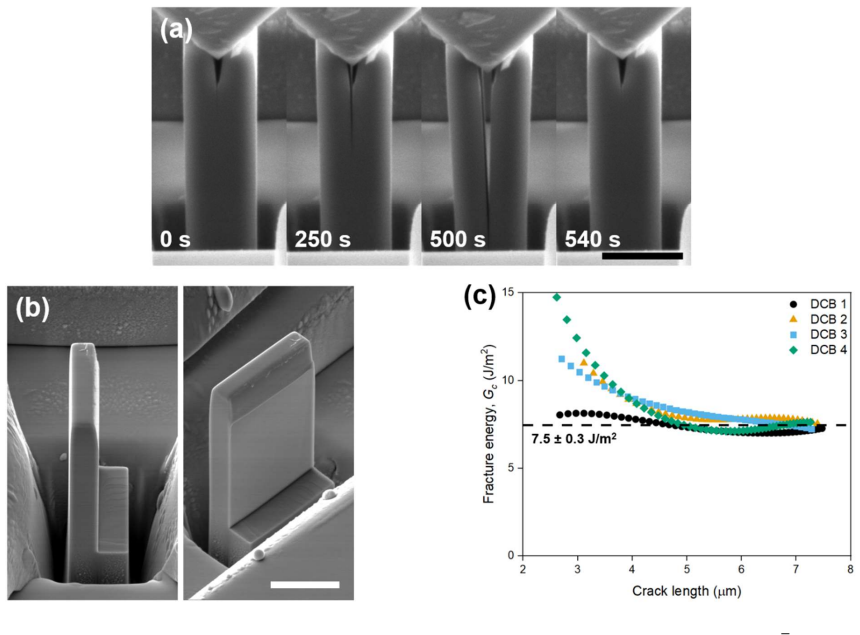
Double cantilever beam tests measure 7.5 J/m² fracture energy for the 6H-SiC {10-10} plane while gallium FIB-notched single cantilever beams give more than twice that value.
A machine-rendered reading of the paper's core claim, the machinery that carries it, and where it could break.
Core claim
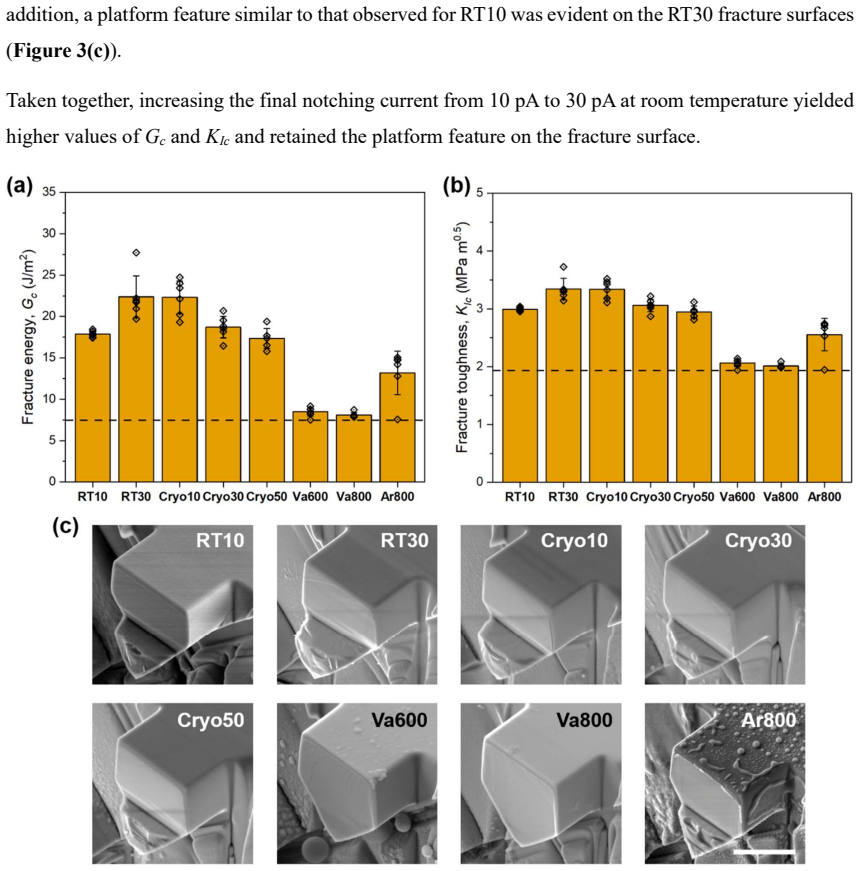
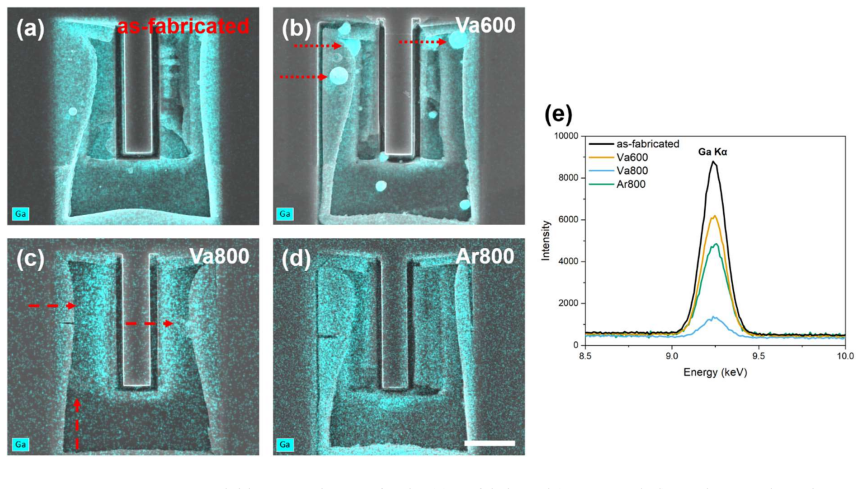
DCB tests on 6H-SiC yield a fracture energy of 7.5 ± 0.3 J/m² for the {10-10} plane with stable crack growth; SCB tests notched by Ga FIB produce values over twice as high due to implantation and residual stresses, and vacuum annealing brings the SCB results into agreement with DCB while near-cryogenic notching and argon annealing do not.
What carries the argument
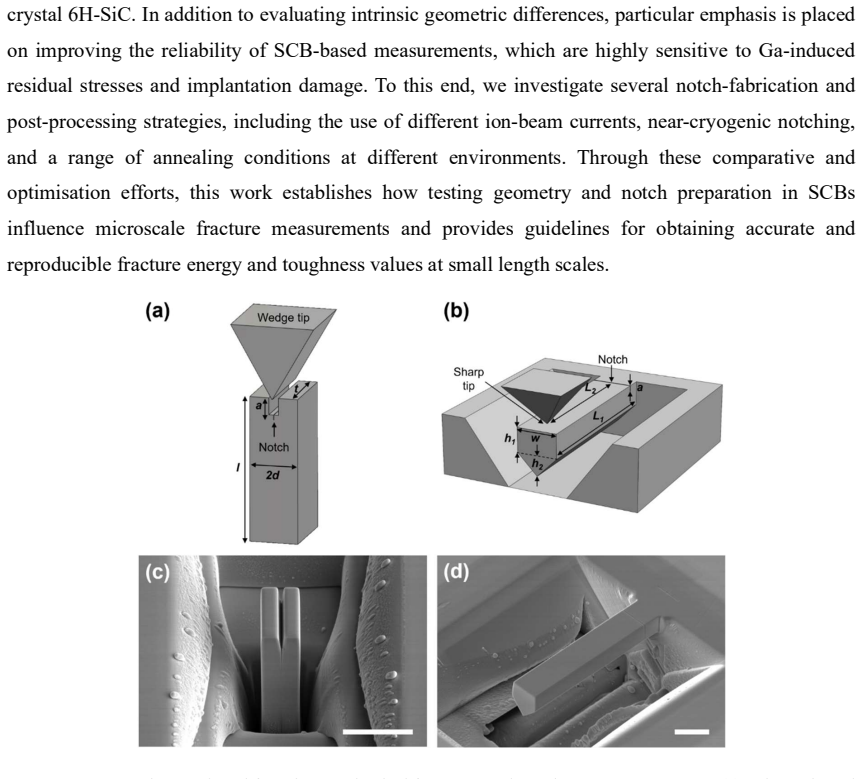
Comparison of double cantilever beam (DCB) and single cantilever beam (SCB) microscale geometries combined with gallium focused ion beam notching at varying currents and subsequent vacuum or argon annealing.
If this is right
- Stable crack growth under displacement control in DCB geometry enables reliable extraction of intrinsic fracture energy.
- Ga FIB notching at higher currents further increases the apparent fracture energy in SCB tests.
- Near-cryogenic FIB notching does not eliminate the elevation in measured energy.
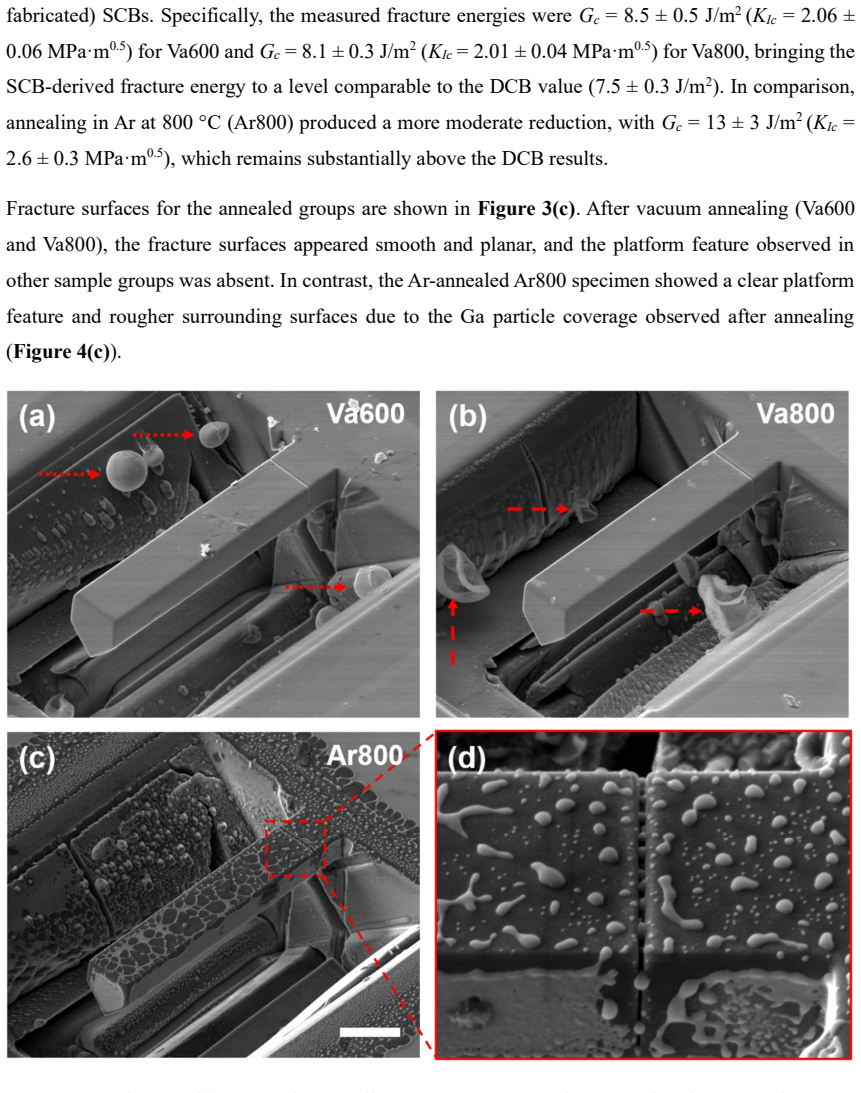
- Vacuum annealing after FIB notching reduces SCB values to match DCB results.
- Argon annealing is less effective than vacuum annealing at removing the preparation-induced elevation.
Where Pith is reading between the lines
- Microscale fracture measurements on other brittle ceramics are likely to show similar sensitivity to FIB preparation.
- DCB geometry may be the more robust choice when the goal is to obtain preparation-independent values.
- Standard post-FIB vacuum annealing protocols could improve reproducibility across FIB-based fracture studies.
- The 7.5 J/m² benchmark can be used to test atomistic models of cleavage on the {10-10} plane in SiC.
Load-bearing premise
The DCB result is the intrinsic fracture energy of the {10-10} plane and all differences seen in SCB tests come only from gallium implantation and residual stresses rather than from unaccounted differences in geometry or loading.
What would settle it
A direct measurement showing identical crack-initiation loads in DCB and SCB specimens when both are prepared without gallium ion exposure or when residual stress is removed from FIB-notched SCB specimens.
Figures
read the original abstract
Micromechanical testing enables small-scale fracture energy measurements, but values depend strongly on geometry and specimen preparation. Here, the fracture energy of the single-crystal 6H-SiC {10-10} plane was measured using microscale double cantilever beam (DCB) and single cantilever beam (SCB) geometries. DCBs showed stable crack growth under displacement control and obtained 7.5 +- 0.3 J/m2. In contrast, SCBs notched by a Ga focused ion beam gave fracture energies over twice this value, indicating Ga implantation and near-notch residual stresses. Increasing the final notching current increased the measured fracture energy further. Although near-cryogenic notching limited ion-beam-induced damage, it did not reconcile SCB-derived values with DCB test results. Vacuum annealing substantially lowered the fracture energy and brought SCB results into close agreement with DCB measurements, whereas annealing in argon was less effective. Our findings highlight the importance of careful sample preparation and testing geometry selection for reliable fracture property measurement in ceramic materials.
Editorial analysis
A structured set of objections, weighed in public.
Referee Report
Summary. The manuscript reports microscale fracture toughness measurements on the {10-10} cleavage plane of single-crystal 6H-SiC. Double-cantilever-beam (DCB) specimens tested under displacement control exhibit stable crack growth and yield a fracture energy of 7.5 ± 0.3 J/m². Single-cantilever-beam (SCB) specimens notched by Ga focused-ion-beam milling return values more than twice as large; the elevation is ascribed to Ga implantation and near-notch residual stresses. Increasing the final FIB current further raises the measured energy, while near-cryogenic milling does not eliminate the discrepancy. Vacuum annealing of the SCBs lowers the fracture energy into close agreement with the DCB result, whereas argon annealing is less effective. The work concludes that both testing geometry and notch preparation must be chosen carefully for reliable ceramic fracture data.
Significance. If the DCB value is confirmed to be free of preparation artifacts, the result supplies a much-needed microscale benchmark for the intrinsic fracture energy of 6H-SiC, a material central to high-temperature power electronics and structural applications. The demonstration that vacuum annealing can largely remove FIB-induced elevation offers a concrete protocol that other groups can adopt. The geometry comparison also supplies a cautionary data set for the growing field of micromechanical fracture testing.
major comments (2)
- [Results] The central claim that the DCB result (7.5 ± 0.3 J/m²) represents the intrinsic {10-10} fracture energy while the SCB elevation is caused solely by Ga implantation and residual stresses requires that the two cantilever geometries return identical values on a preparation-free specimen. No finite-element validation or control experiment (identical notch preparation on both geometries, or FIB-free notching on DCBs) is presented to establish this equivalence. Differences in moment arm, crack-front constraint, or the compliance-based data-reduction formulas could therefore contribute to the observed factor-of-two discrepancy (Results section, Fig. 5 and associated text).
- [Methods] Error propagation and statistical treatment of the reported uncertainties are not described. The DCB value is given as 7.5 ± 0.3 J/m², yet the number of independent specimens, the scatter within each geometry, and the propagation of load, displacement, and dimensional uncertainties into G are not stated (Methods and Results sections).
minor comments (3)
- [Abstract] The abstract states that “increasing the final notching current increased the measured fracture energy further,” but the corresponding data are not shown in a figure or table; a supplementary plot or table would strengthen the claim.
- [Throughout] Notation for the fracture energy (G or Γ) is used inconsistently between the abstract and the main text; a single symbol should be adopted throughout.
- [Methods] The orientation of the {10-10} plane relative to the cantilever axes is stated only in the abstract; a schematic in the Methods section would clarify the loading configuration.
Simulated Author's Rebuttal
We thank the referee for the constructive comments, which help clarify the interpretation of our results. We respond to each major comment below.
read point-by-point responses
-
Referee: [Results] The central claim that the DCB result (7.5 ± 0.3 J/m²) represents the intrinsic {10-10} fracture energy while the SCB elevation is caused solely by Ga implantation and residual stresses requires that the two cantilever geometries return identical values on a preparation-free specimen. No finite-element validation or control experiment (identical notch preparation on both geometries, or FIB-free notching on DCBs) is presented to establish this equivalence. Differences in moment arm, crack-front constraint, or the compliance-based data-reduction formulas could therefore contribute to the observed factor-of-two discrepancy (Results section, Fig. 5 and associated text).
Authors: We acknowledge that an ideal validation would involve identical notch preparation across geometries or FIB-free notching on DCBs. Such controls are experimentally challenging at the microscale, as FIB-free notching of DCB specimens risks introducing other damage modes. Our primary evidence that preparation (rather than geometry) drives the discrepancy is the vacuum-annealing result, which brings SCB values into agreement with DCB. The compliance formulas are geometry-specific, and DCB stable growth provides an independent consistency check. We will add a discussion paragraph addressing potential geometric contributions and why they are unlikely to explain the full factor-of-two difference. revision: partial
-
Referee: [Methods] Error propagation and statistical treatment of the reported uncertainties are not described. The DCB value is given as 7.5 ± 0.3 J/m², yet the number of independent specimens, the scatter within each geometry, and the propagation of load, displacement, and dimensional uncertainties into G are not stated (Methods and Results sections).
Authors: We agree the statistical details should be explicit. The ±0.3 J/m² is the standard deviation across five independent DCB specimens. We will revise the Methods section to state the number of specimens per geometry, report the observed scatter, and describe the error-propagation procedure (standard formulas combining uncertainties in load, displacement, and dimensions). revision: yes
Circularity Check
No circularity: pure experimental reporting of measured fracture energies
full rationale
The paper reports direct experimental measurements of fracture energy (7.5 ± 0.3 J/m² from DCB tests) and compares values across geometries and preparation methods, attributing differences to Ga implantation and residual stresses based on observed trends (e.g., annealing effects). No derivations, fitted parameters, equations, or self-citations are present that reduce any claim to its own inputs by construction. The central comparison relies on empirical data rather than any modeled or self-referential chain.
Axiom & Free-Parameter Ledger
axioms (1)
- domain assumption Linear elastic fracture mechanics applies at the microscale for these specimens
Reference graph
Works this paper leans on
-
[1]
Jayaram, Small-scale mechanical testing, Annual Review of Materials Research 52(1) (2022) 473-523
V . Jayaram, Small-scale mechanical testing, Annual Review of Materials Research 52(1) (2022) 473-523
2022
-
[2]
Emmanuel, O
M. Emmanuel, O. Gavalda-Diaz, G. Sernicola, R. M’saoubi, T. Persson, S. Norgren, K. Marquardt, T.B. Britton, F. Giuliani, Fracture energy measurement of prismatic plane and Σ2 boundary in cemented carbide, JOM 73(6) (2021) 1589-1596
2021
-
[3]
Casellas, J
D. Casellas, J. Caro, S. Molas, J.M. Prado, I. Valls, Fracture toughness of carbides in tool steels evaluated by nanoindentation, Acta Materialia 55(13) (2007) 4277-4286
2007
-
[4]
Schiffmann, Determination of fracture toughness of bulk materials and thin films by nanoindentation: comparison of different models, Philosophical Magazine 91(7-9) (2011) 1163-1178
K.I. Schiffmann, Determination of fracture toughness of bulk materials and thin films by nanoindentation: comparison of different models, Philosophical Magazine 91(7-9) (2011) 1163-1178
2011
-
[5]
Pharr, D
G. Pharr, D. Harding, W. Oliver, Measurement of fracture toughness in thin films and small volumes using nanoindentation methods, Mechanical properties and deformation behavior of materials having ultra-fine microstructures, Springer1993, pp. 449-461
-
[6]
Harding, W
D. Harding, W. Oliver, G. Pharr, Cracking during nanoindentation and its use in the measurement of fracture toughness, MRS Online Proceedings Library (OPL) 356 (1994) 663
1994
-
[7]
Sebastiani, K.E
M. Sebastiani, K.E. Johanns, E.G. Herbert, G.M. Pharr, Measurement of fracture toughness by nanoindentation methods: Recent advances and future challenges, Current Opinion in Solid State and Materials Science 19(6) (2015) 324-333
2015
-
[8]
Lauener, L
C.M. Lauener, L. Petho, M. Chen, Y . Xiao, J. Michler, J.M. Wheeler, Fracture of Silicon: Influence of rate, positioning accuracy, FIB machining, and elevated temperatures on toughness measured by pillar indentation splitting, Materials & Design 142 (2018) 340-349
2018
-
[9]
Mughal, H.-Y
M.Z. Mughal, H.-Y . Amanieu, R. Moscatelli, M. Sebastiani, A Comparison of Microscale Techniques for Determining Fracture Toughness of LiMn2O4 Particles, Materials 10(4) (2017) 403
2017
-
[10]
J.P. Best, J. Zechner, J.M. Wheeler, R. Schoeppner, M. Morstein, J. Michler, Small-scale fracture toughness of ceramic thin films: the effects of specimen geometry, ion beam notching and high temperature on chromium nitride toughness evaluation, Philosophical Magazine 96(32-34) (2016) 3552-3569
2016
-
[11]
J. Ast, M. Ghidelli, K. Durst, M. Göken, M. Sebastiani, A.M. Korsunsky, A review of experimental approaches to fracture toughness evaluation at the micro-scale, Materials & Design 173 (2019) 107762
2019
-
[12]
Sebastiani, K.E
M. Sebastiani, K.E. Johanns, E.G. Herbert, F. Carassiti, G.M. Pharr, A novel pillar indentation splitting test for measuring fracture toughness of thin ceramic coatings, Philosophical Magazine 95(16-18) (2015) 1928-1944
2015
-
[13]
B.N. Jaya, C. Kirchlechner, G. Dehm, Can microscale fracture tests provide reliable fracture toughness values? A case study in silicon, Journal of Materials Research 30(5) (2015) 686-698
2015
-
[14]
B.N. Jaya, S. Bhowmick, S.A.S. Asif, O.L. Warren, V . Jayaram, Optimization of clamped beam geometry for fracture toughness testing of micron-scale samples, Philosophical Magazine 95(16-18) (2015) 1945-1966
2015
-
[15]
Venkatraman, V
K. Venkatraman, V . Jayaram, Stiffness based technique to probe cyclic damage accumulation in micro- structurally graded bond coats via micro-beam bending tests, Philosophical Magazine 99(16) (2019) 2016-2050
2019
-
[16]
Jaya B, V
N. Jaya B, V . Jayaram, S.K. Biswas, A new method for fracture toughness determination of graded (Pt,Ni)Al bond coats by microbeam bend tests, Philosophical Magazine 92(25-27) (2012) 3326-3345
2012
-
[17]
Jiang, S
J. Jiang, S. Falco, S. Wang, F. Giuliani, R.I. Todd, Microcantilever investigation of slow crack growth and crack healing in aluminium oxide, Acta Materialia 273 (2024) 119914. 21
2024
-
[18]
Tatami, M
J. Tatami, M. Katayama, M. Ohnishi, T. Yahagi, T. Takahashi, T. Horiuchi, M. Y okouchi, K. Yasuda, D.K. Kim, T. Wakihara, K. Komeya, Local Fracture Toughness of Si3N4 Ceramics Measured using Single-Edge Notched Microcantilever Beam Specimens, Journal of the American Ceramic Society 98(3) (2015) 965-971
2015
-
[19]
Armstrong, A.S.M.A
D.E.J. Armstrong, A.S.M.A. Haseeb, S.G. Roberts, A.J. Wilkinson, K. Bade, Nanoindentation and micro- mechanical fracture toughness of electrodeposited nanocrystalline Ni–W alloy films, Thin Solid Films 520(13) (2012) 4369-4372
2012
-
[20]
Armstrong, A.J
D.E.J. Armstrong, A.J. Wilkinson, S.G. Roberts, Micro-mechanical measurements of fracture toughness of bismuth embrittled copper grain boundaries, Philosophical Magazine Letters 91(6) (2011) 394-400
2011
-
[21]
Armstrong, A.J
D.E.J. Armstrong, A.J. Wilkinson, S.G. Roberts, Measuring Local Mechanical Properties using FIB Machined Microcantilevers, MRS Online Proceedings Library 1185(1) (2009) 13-19
2009
-
[22]
Mansfield, D.E.J
B.R. Mansfield, D.E.J. Armstrong, P.R. Wilshaw, J.D. Murphy, An Investigation into Fracture of Multi- Crystalline Silicon, Solid State Phenomena 156-158 (2010) 55-60
2010
-
[23]
Armstrong, A
D. Armstrong, A. Haseeb, A. Wilkinson, S. Roberts, Micro-Fracture testing of Ni-W Microbeams Produced by Electrodeposition and FIB Machining, MRS Proceedings 983 (2006) 0983-LL08-07
2006
-
[24]
Dickens, F.W
S.M. Dickens, F.W. DelRio, S.J. Grutzik, W.M. Mook, B.L. Boyce, E. Hintsala, D. Stauffer, R.F. Cook, In- situ Fracture Toughness of Single Crystal Silicon Double-Cantilever Beams, Microscopy and Microanalysis 28(S1) (2022) 14-15
2022
-
[25]
Y . Piao, S. Wang, D.S. Balint, F. Giuliani, E. Saiz, O. Gavalda-Diaz, Deformation and toughening of graphite at the micron scale, Acta Materialia 299 (2025) 121428
2025
-
[26]
DelRio, S.J
F.W. DelRio, S.J. Grutzik, W.M. Mook, S.M. Dickens, P.G. Kotula, E.D. Hintsala, D.D. Stauffer, B.L. Boyce, Eliciting stable nanoscale fracture in single-crystal silicon, Materials Research Letters 10(11) (2022) 728-735
2022
-
[27]
Gavalda-Diaz, J
O. Gavalda-Diaz, J. Lyons, S. Wang, M. Emmanuel, K. Marquardt, E. Saiz, F. Giuliani, Basal plane delamination energy measurement in a Ti3SiC2 MAX phase, Jom 73(6) (2021) 1582-1588
2021
-
[28]
Gavalda-Diaz, R
O. Gavalda-Diaz, R. Manno, A. Melro, G. Allegri, S.R. Hallett, L. Vandeperre, E. Saiz, F. Giuliani, Mode I and Mode II interfacial fracture energy of SiC/BN/SiC CMCs, Acta Materialia 215 (2021) 117125
2021
-
[29]
Sernicola, T
G. Sernicola, T. Giovannini, P. Patel, J.R. Kermode, D.S. Balint, T.B. Britton, F. Giuliani, In situ stable crack growth at the micron scale, Nature communications 8(1) (2017) 108
2017
-
[30]
Di Maio, S
D. Di Maio, S. Roberts, Measuring fracture toughness of coatings using focused-ion-beam-machined microbeams, Journal of materials research 20(2) (2005) 299-302
2005
-
[31]
Stratulat, D.E
A. Stratulat, D.E. Armstrong, S.G. Roberts, Micro-mechanical measurement of fracture behaviour of individual grain boundaries in Ni alloy 600 exposed to a pressurized water reactor environment, Corrosion Science 104 (2016) 9-16
2016
-
[32]
S. Liu, J. Wheeler, P. Howie, X. Zeng, J. Michler, W. Clegg, Measuring the fracture resistance of hard coatings, Applied Physics Letters 102(17) (2013)
2013
-
[33]
Borasi, A
L. Borasi, A. Slagter, A. Mortensen, C. Kirchlechner, On the preparation and mechanical testing of nano to micron-scale specimens, Acta Materialia 283 (2025) 120394
2025
-
[34]
Y . Chen, X. Zhang, X. Zhao, N. Markocsan, P. Nylén, P . Xiao, Measurements of elastic modulus and fracture toughness of an air plasma sprayed thermal barrier coating using micro-cantilever bending, Surface and Coatings Technology 374 (2019) 12-20. 22
2019
-
[35]
Norton, S
A. Norton, S. Falco, N. Young, J. Severs, R. Todd, Microcantilever investigation of fracture toughness and subcritical crack growth on the scale of the microstructure in Al2O3, Journal of the European Ceramic Society 35(16) (2015) 4521-4533
2015
-
[36]
J.P. Best, J. Zechner, I. Shorubalko, J.V . Oboňa, J. Wehrs, M. Morstein, J. Michler, A comparison of three different notching ions for small-scale fracture toughness measurement, Scripta Materialia 112 (2016) 71-74
2016
-
[37]
Okotete, S
E. Okotete, S. Mueck, S. Lee, C. Kirchlechner, Evaluating neon ions as an alternative to gallium in micro cantilevers fracture testing, Scripta Materialia 258 (2025) 116509
2025
-
[38]
Estivill, G
R. Estivill, G. Audoit, J.-P. Barnes, A. Grenier, D. Blavette, Preparation and Analysis of Atom Probe Tips by Xenon Focused Ion Beam Milling, Microscopy and Microanalysis 22(3) (2016) 576-582
2016
-
[39]
Chang, W
Y . Chang, W. Lu, J. Guénolé, L.T. Stephenson, A. Szczpaniak, P. Kontis, A.K. Ackerman, F.F. Dear, I. Mouton, X. Zhong, S. Zhang, D. Dye, C.H. Liebscher, D. Ponge, S. Korte-Kerzel, D. Raabe, B. Gault, Ti and its alloys as examples of cryogenic focused ion beam milling of environmentally-sensitive materials, Nature Communications 10(1) (2019) 942
2019
-
[40]
Lilensten, B
L. Lilensten, B. Gault, New approach for FIB-preparation of atom probe specimens for aluminum alloys, PLOS ONE 15(4) (2020) e0231179
2020
-
[41]
Williams, End corrections for orthotropic DCB specimens, Composites Science and Technology 35(4) (1989) 367-376
J. Williams, End corrections for orthotropic DCB specimens, Composites Science and Technology 35(4) (1989) 367-376
1989
-
[42]
S. Wang, O. Gavalda-Diaz, J. Lyons, F. Giuliani, Shear and delamination behaviour of basal planes in Zr3AlC2 MAX phase studied by micromechanical testing, Scripta Materialia 240 (2024) 115829
2024
-
[43]
Aldegaither, G
N. Aldegaither, G. Sernicola, A. Mesgarnejad, A. Karma, D. Balint, J. Wang, E. Saiz, S.J. Shefelbine, A.E. Porter, F. Giuliani, Fracture toughness of bone at the microscale, Acta Biomaterialia 121 (2021) 475-483
2021
-
[44]
Kamitani, M
K. Kamitani, M. Grimsditch, J. Nipko, C.-K. Loong, M. Okada, I. Kimura, The elastic constants of silicon carbide: A Brillouin-scattering study of 4H and 6H SiC single crystals, Journal of applied physics 82(6) (1997) 3152-3154
1997
-
[45]
Iqbal, J
F. Iqbal, J. Ast, M. Göken, K. Durst, In situ micro-cantilever tests to study fracture properties of NiAl single crystals, Acta Materialia 60(3) (2012) 1193-1200
2012
-
[46]
Zhang, J.R.G
Y . Zhang, J.R.G. Evans, S. Yang, Corrected Values for Boiling Points and Enthalpies of Vaporization of Elements in Handbooks, Journal of Chemical & Engineering Data 56(2) (2011) 328-337
2011
-
[47]
Velasco, F
S. Velasco, F. Román, J. White, On the Clausius–Clapeyron vapor pressure equation, Journal of Chemical Education 86(1) (2009) 106
2009
-
[48]
Rauls, Z
E. Rauls, Z. Hajnal, P. Deak, T. Frauenheim, Theoretical study of the nonpolar surfaces and their oxygen passivation in 4 H-and 6 H-SiC, Physical Review B 64(24) (2001) 245323
2001
-
[49]
Kitahara, Y
H. Kitahara, Y . Noda, F. Yoshida, H. Nakashima, N. Shinohara, H. Abe, Mechanical behavior of single crystalline and polycrystalline silicon carbides evaluated by Vickers indentation, Journal of the Ceramic Society of Japan 109(1271) (2001) 602-606
2001
-
[50]
Ramakers, A
S. Ramakers, A. Marusczyk, M. Amsler, T. Eckl, M. Mrovec, T. Hammerschmidt, R. Drautz, Effects of thermal, elastic, and surface properties on the stability of SiC polytypes, Physical Review B 106(7) (2022) 075201
2022
-
[51]
Kishida, Y
K. Kishida, Y . Shinkai, H. Inui, Room temperature deformation of 6H–SiC single crystals investigated by micropillar compression, Acta Materialia 187 (2020) 19-28. 23
2020
-
[52]
B. Meng, C. Li, Effect of anisotropy on deformation and crack formation under the brittle removal of 6H- SiC during SPDT process, Journal of Advanced Research 56 (2024) 103-112
2024
-
[53]
V . Lam, E. Villa, Practical Approaches for Cryo-FIB Milling and Applications for Cellular Cryo-Electron Tomography, in: T. Gonen, B.L. Nannenga (Eds.), cryoEM: Methods and Protocols, Springer US, New York, NY , 2021, pp. 49-82
2021
-
[54]
Steve, P
R. Steve, P. Robert, A review of focused ion beam applications in microsystem technology, Journal of Micromechanics and Microengineering 11(4) (2001) 287
2001
-
[55]
Ziegler, J.P
J.F. Ziegler, J.P . Biersack, The Stopping and Range of Ions in Matter, in: D.A. Bromley (Ed.), Treatise on Heavy-Ion Science: V olume 6: Astrophysics, Chemistry, and Condensed Matter, Springer US, Boston, MA, 1985, pp. 93-129
1985
-
[56]
Jaya, J.M
B.N. Jaya, J.M. Wheeler, J. Wehrs, J.P. Best, R. Soler, J. Michler, C. Kirchlechner, G. Dehm, Microscale Fracture Behavior of Single Crystal Silicon Beams at Elevated Temperatures, Nano Letters 16(12) (2016) 7597- 7603
2016
-
[57]
Gu, J.-H
J.-J. Gu, J.-H. Zhao, M.-Y . Bu, S.-M. Wang, L. Fan, Q. Huang, S. Li, Q.-Y . Yue, X.-L. Wang, Z.-X. Wei, Y . Liu, Study on the damage evolution of 6H-SiC under different phosphorus ion implantation conditions and annealing temperatures, Results in Physics 43 (2022) 106127
2022
-
[58]
Erdogan, G.C
F. Erdogan, G.C. Sih, On the Crack Extension in Plates Under Plane Loading and Transverse Shear, Journal of Basic Engineering 85(4) (1963) 519-525
1963
-
[59]
Cotterell, J.R
B. Cotterell, J.R. Rice, Slightly curved or kinked cracks, International Journal of Fracture 16(2) (1980) 155- 169
1980
-
[60]
Zhang, M
Y . Zhang, M. Bartosik, S. Brinckmann, S. Lee, C. Kirchlechner, Direct observation of crack arrest after bridge notch failure: A strategy to increase statistics and reduce FIB-artifacts in micro-cantilever testing, Materials & Design 233 (2023) 112188
2023
-
[61]
Mueller, G
M.G. Mueller, G. Žagar, A. Mortensen, Stable room-temperature micron-scale crack growth in single- crystalline silicon, Journal of Materials Research 32(19) (2017) 3617-3626
2017
-
[62]
B.S. Li, T.J. Marrow, S.G. Roberts, D.E.J. Armstrong, Evaluation of Fracture Toughness Measurements Using Chevron-Notched Silicon and Tungsten Microcantilevers, JOM 71(10) (2019) 3378-3389
2019
-
[63]
Mathews, A.K
N.G. Mathews, A.K. Mishra, B.N. Jaya, Mode dependent evaluation of fracture behaviour using cantilever bending, Theoretical and Applied Fracture Mechanics 115 (2021) 103069
2021
-
[64]
Okotete, A
E. Okotete, A. Muslija, J.K. Hohmann, M. Kohl, S. Brinckmann, S. Lee, C. Kirchlechner, Enhanced crack stability in micro scale fracture testing via optimized bridge notches, Materials Science and Engineering: A 939 (2025) 148479
2025
discussion (0)
Sign in with ORCID, Apple, or X to comment. Anyone can read and Pith papers without signing in.