Quantitative Detection of Molecular Oxygen in the Gas Phase with Fluorescent Nanodiamonds
Pith reviewed 2026-06-28 09:05 UTC · model grok-4.3
The pith
Fluorescent nanodiamonds can quantitatively detect molecular oxygen in gas mixtures by measuring decreases in their ODMR contrast.
A machine-rendered reading of the paper's core claim, the machinery that carries it, and where it could break.
Core claim
Negatively charged nitrogen-vacancy centers in fluorescent nanodiamonds exhibit an ODMR contrast that decreases linearly with oxygen partial pressure in gas mixtures at ambient pressure. Using a double-modulation detection scheme in a microfluidic setup, the contrast changes by approximately -10.1 × 10^{-4} percent for each mmHg of oxygen, allowing quantitative detection down to about 8 mmHg with some hysteresis in repeated measurements.
What carries the argument
The ODMR contrast of NV- centers, which is quenched by the presence of paramagnetic oxygen molecules likely through physisorption on the nanodiamond surface.
If this is right
- The sensor responds to oxygen bursts from the catalase-mediated decomposition of hydrogen peroxide.
- Cycling between 0 and 5 percent oxygen shows repeatability of 0.006 in the ODMR contrast percentage.
- Response times range from several to tens of minutes, attributed to surface adsorption dynamics.
- The method works across the full range from 0 to 100 percent oxygen at ambient pressure.
Where Pith is reading between the lines
- This technique could be adapted for monitoring oxygen in microfluidic chemical reactors or biological assays.
- Surface modifications on the nanodiamonds might reduce the response time by altering adsorption kinetics.
- Integration with other quantum sensors could enable multi-parameter gas analysis on a single chip.
Load-bearing premise
The measured ODMR contrast changes are due only to oxygen concentration and are not significantly affected by other experimental variables such as gas flow or temperature.
What would settle it
An experiment that varies gas flow rate or temperature while holding oxygen partial pressure fixed and observes comparable changes in ODMR contrast would indicate that the contrast shift is not uniquely attributable to oxygen.
Figures
read the original abstract
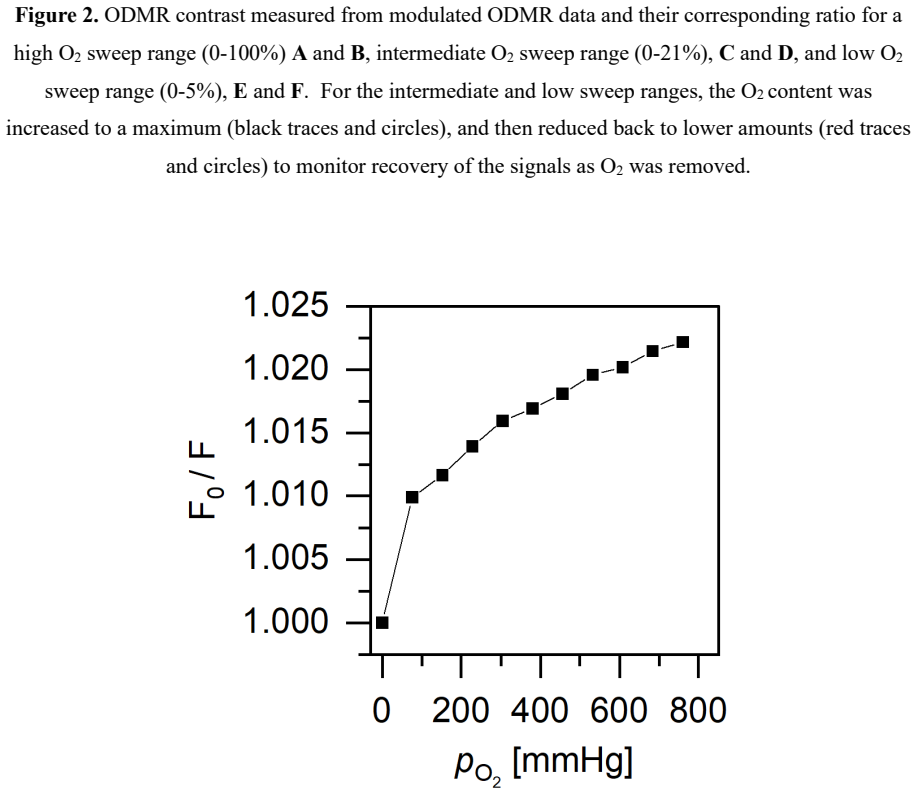
The quantitative detection of paramagnetic molecular oxygen (O2) in gas mixtures using optically detected magnetic resonance (ODMR) from negatively charged nitrogen-vacancy (NV-) centers in fluorescent nanodiamonds is described. Fluorescent nanodiamonds approximately 70 nm in diameter were deposited on the glass surface of a microfluidic channel, and the oxygen concentration varied from 0 to 100% (0 to 760 mmHg O2 partial pressure) by mixing O2 and N2 gases at ambient pressure. Continuous-wave (CW) ODMR contrast was measured using a double-modulation (lock-in) detection scheme applied to both optical excitation and microwave drives. The ODMR contrast decreases linearly with oxygen partial pressure, with a sensitivity coefficient k of (-10.1 +/- 0.3) x 10^-4 % mmHg^-1. The oxygen detection limit of the experimental setup was estimated to be approximately 8 mmHg O2 partial pressure (corresponding to about 1% O2 in the gas mixture). Cycling of the content of O2 in the gas mixture in the range of 0-5% revealed slight hysteresis and corresponding repeatability of 0.006 in percent ODMR contrast. The observed fluorescence quenching and relatively slow response (ranging from several to tens of minutes) upon changes in oxygen concentration suggest that physisorption of gas molecules on the nanodiamond surfaces contributes to equilibration dynamics. The applicability of the nanodiamond-based oxygen quantum sensor was further demonstrated by detecting transient bursts of molecular oxygen generated by enzyme-catalyzed decomposition of hydrogen peroxide.
Editorial analysis
A structured set of objections, weighed in public.
Referee Report
Summary. The manuscript reports an experimental demonstration of quantitative molecular oxygen detection in gas mixtures using CW ODMR contrast from NV- centers in ~70 nm fluorescent nanodiamonds deposited in a microfluidic channel. O2/N2 mixtures are varied at ambient pressure from 0-100% (0-760 mmHg), yielding a linear decrease in ODMR contrast with sensitivity coefficient k = (-10.1 ± 0.3) × 10^{-4} % mmHg^{-1} and an estimated detection limit of ~8 mmHg (~1% O2). The setup employs double-modulation lock-in detection; response is slow (minutes to tens of minutes) with slight hysteresis and repeatability of 0.006, attributed to physisorption. Applicability is shown via transient O2 bursts from enzymatic H2O2 decomposition.
Significance. If the measured contrast changes are attributable solely to O2 partial pressure, the work establishes a nanodiamond-based quantum sensor for gas-phase O2 with reported linearity, sensitivity, and a practical demonstration in a microfluidic/enzymatic context. This could enable integrated, spatially resolved O2 sensing in materials or bio-related applications where conventional methods are less compatible.
major comments (2)
- [Experimental Methods / Setup description] The experimental procedure section does not describe temperature monitoring or active stabilization during gas composition changes, nor does it report flow-rate constancy or pressure equilibration protocols in the microfluidic channel. Given the slow response dynamics and hysteresis explicitly linked to physisorption, unaccounted temperature drifts or flow-induced effects could independently modulate NV charge state, fluorescence, or relaxation rates, undermining the central attribution of contrast change exclusively to O2.
- [Results (linear fit and detection limit paragraph)] The detection limit of ~8 mmHg is stated without an explicit derivation from the linear fit uncertainty, noise floor, or signal-to-noise criteria (e.g., 3σ). The repeatability value of 0.006 is given but not connected quantitatively to the slope k or to the 0-5% cycling data, leaving the quantitative performance claim incompletely supported.
minor comments (2)
- [Abstract] Notation in the abstract for the sensitivity coefficient uses 'x 10^-4' rather than proper scientific formatting (×10^{-4}); this should be standardized throughout.
- [Methods] The double-modulation (lock-in) scheme is mentioned but lacks a schematic or parameter table (modulation frequencies, depths, lock-in time constants), which would aid reproducibility.
Simulated Author's Rebuttal
We are grateful to the referee for their insightful comments, which have helped us identify areas for improvement in our manuscript. Below, we provide point-by-point responses to the major comments and outline the revisions we intend to make.
read point-by-point responses
-
Referee: [Experimental Methods / Setup description] The experimental procedure section does not describe temperature monitoring or active stabilization during gas composition changes, nor does it report flow-rate constancy or pressure equilibration protocols in the microfluidic channel. Given the slow response dynamics and hysteresis explicitly linked to physisorption, unaccounted temperature drifts or flow-induced effects could independently modulate NV charge state, fluorescence, or relaxation rates, undermining the central attribution of contrast change exclusively to O2.
Authors: We acknowledge the need for more detailed description of the experimental conditions to rule out potential confounding factors. In the revised manuscript, we will expand the methods section to specify that all measurements were performed at ambient laboratory temperature without active stabilization or monitoring beyond initial setup, with gas flow rates controlled by mass flow controllers at constant settings and the microfluidic channel equilibrated to ambient pressure. We will also include a brief discussion on why temperature or flow effects are not expected to dominate the observed signal, citing the consistency of the linear response and the specific demonstration with enzymatic O2 generation. This will help strengthen the attribution to O2 partial pressure. revision: yes
-
Referee: [Results (linear fit and detection limit paragraph)] The detection limit of ~8 mmHg is stated without an explicit derivation from the linear fit uncertainty, noise floor, or signal-to-noise criteria (e.g., 3σ). The repeatability value of 0.006 is given but not connected quantitatively to the slope k or to the 0-5% cycling data, leaving the quantitative performance claim incompletely supported.
Authors: We agree that providing an explicit derivation will improve the rigor of our quantitative claims. The detection limit was estimated using the noise level in the ODMR contrast (standard deviation at 0% O2) divided by the sensitivity |k|, yielding approximately 8 mmHg for a 3σ threshold. In the revised manuscript, we will explicitly state this calculation, including the relevant noise floor and fit uncertainty. Additionally, we will connect the repeatability of 0.006 to the sensitivity by deriving the corresponding pressure uncertainty (approximately 6 mmHg) and discuss its relation to the variations observed in the 0-5% O2 cycling experiments. revision: yes
Circularity Check
No circularity: direct experimental measurements of ODMR contrast vs. O2 pressure
full rationale
The paper reports empirical measurements of CW-ODMR contrast in nanodiamonds as a function of O2 partial pressure in a microfluidic gas-mixing setup. The linear sensitivity coefficient k is obtained by direct regression to the observed data points; it is not presented as a first-principles prediction or as a quantity derived from any prior equation. No self-citations, uniqueness theorems, or ansatzes are invoked to justify the central quantitative claims. The detection-limit estimate follows from the fitted slope and noise floor of the same dataset. Because the work contains no derivation chain that reduces to its own inputs, the circularity score is zero.
Axiom & Free-Parameter Ledger
free parameters (1)
- sensitivity coefficient k =
-10.1 x 10^-4
axioms (1)
- domain assumption Paramagnetic O2 quenches the ODMR contrast of NV- centers in nanodiamonds
Reference graph
Works this paper leans on
-
[1]
Theoretical microfluidics; Oxford university press, 2007
(1) Bruus, H. Theoretical microfluidics; Oxford university press, 2007
2007
discussion (0)
Sign in with ORCID, Apple, or X to comment. Anyone can read and Pith papers without signing in.