A Previously Underexplored Regime in TESS: Minute-Scale Eclipses Reveal Ten White Dwarf-Cool M-Dwarf Binaries
Pith reviewed 2026-06-28 08:10 UTC · model grok-4.3
The pith
A targeted search of TESS data uncovers ten new eclipsing white dwarf plus cool M-dwarf binaries missed by standard pipelines.
A machine-rendered reading of the paper's core claim, the machinery that carries it, and where it could break.
Core claim
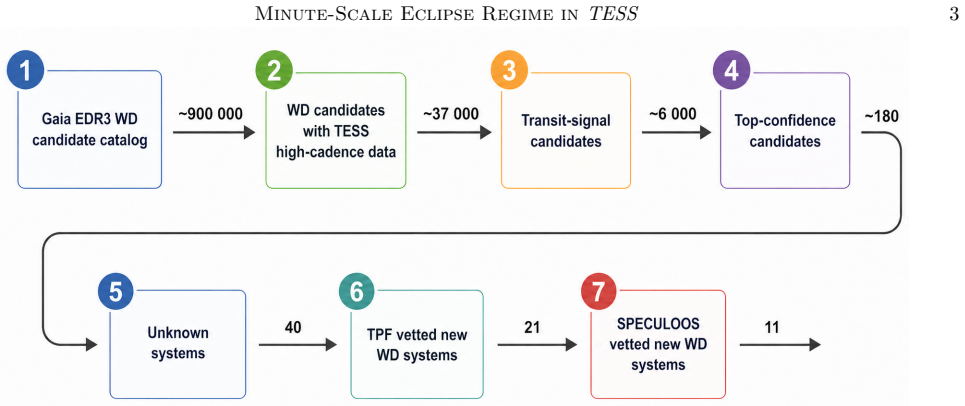
A pilot search of roughly 37,000 Gaia white-dwarf candidates in TESS data identifies ten new fully eclipsing short-period white-dwarf plus cool M-dwarf binaries with orbital periods of a few hours and companion effective temperatures of 2700-3400 K. SPECULOOS multi-band photometry confirms the eclipses occur on the targets and distinguishes stellar from substellar companions through chromatic dilution. When combined with Bayesian spectral-energy-distribution modeling, the photometry yields self-consistent parameters for both components. These ten systems increase the TESS-discovered sample of such binaries by an order of magnitude and double the number known in the temperature regimes of M4
What carries the argument
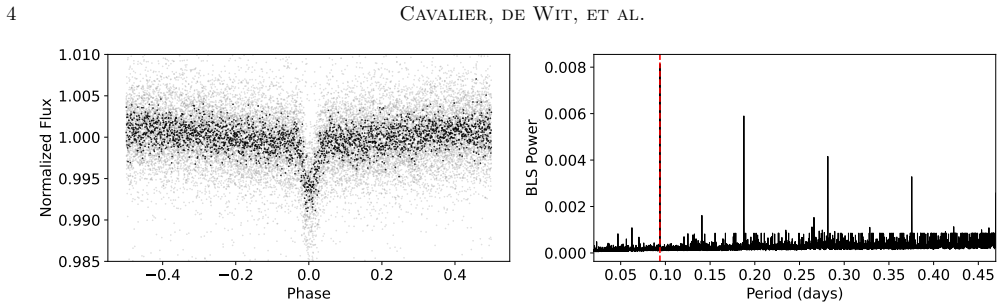
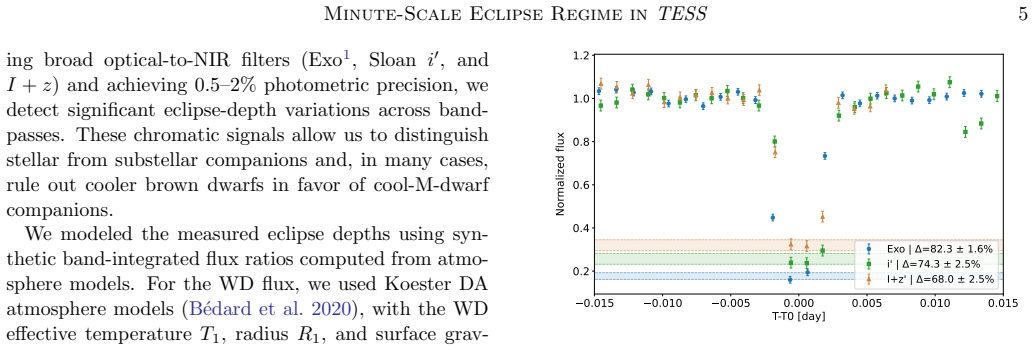
Tailored search for minute-scale eclipses in TESS high-cadence photometry of white-dwarf candidates, followed by multi-band photometry that measures chromatic eclipse dilution to confirm the events occur on the target and establish companion type.
If this is right
- The TESS-discovered sample of eclipsing white-dwarf plus M-dwarf binaries increases from one to eleven systems.
- The number of known systems with M4 and M7 companions roughly doubles.
- The custom search method provides a scalable framework that can be applied to the full Gaia catalog of about 1.3 million white-dwarf candidates.
- A larger population assembled this way would allow statistical constraints on post-common-envelope orbital shrinkage and the survival of low-mass companions.
Where Pith is reading between the lines
- The detection approach could be adapted to other wide-field time-domain surveys to locate similar populations of compact binaries that current pipelines miss.
- A statistically large sample would enable direct comparison of observed orbital-period distributions against theoretical predictions for common-envelope ejection efficiency.
- Precise eclipse modeling of these systems could yield independent measurements of white-dwarf radii that test cooling models at different temperatures.
Load-bearing premise
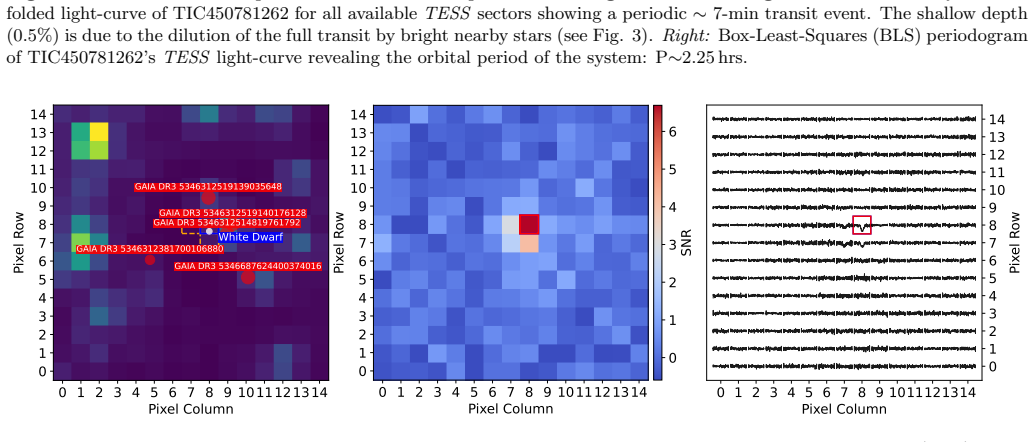
The minute-scale signals detected in TESS data are genuine eclipses of the target white dwarfs by bound cool M-dwarf companions rather than background variables or instrumental artifacts.
What would settle it
High-resolution spectroscopy of any of the ten white dwarfs that fails to detect radial-velocity variations with the same period as the photometric eclipses would disprove the bound-binary interpretation.
Figures
read the original abstract
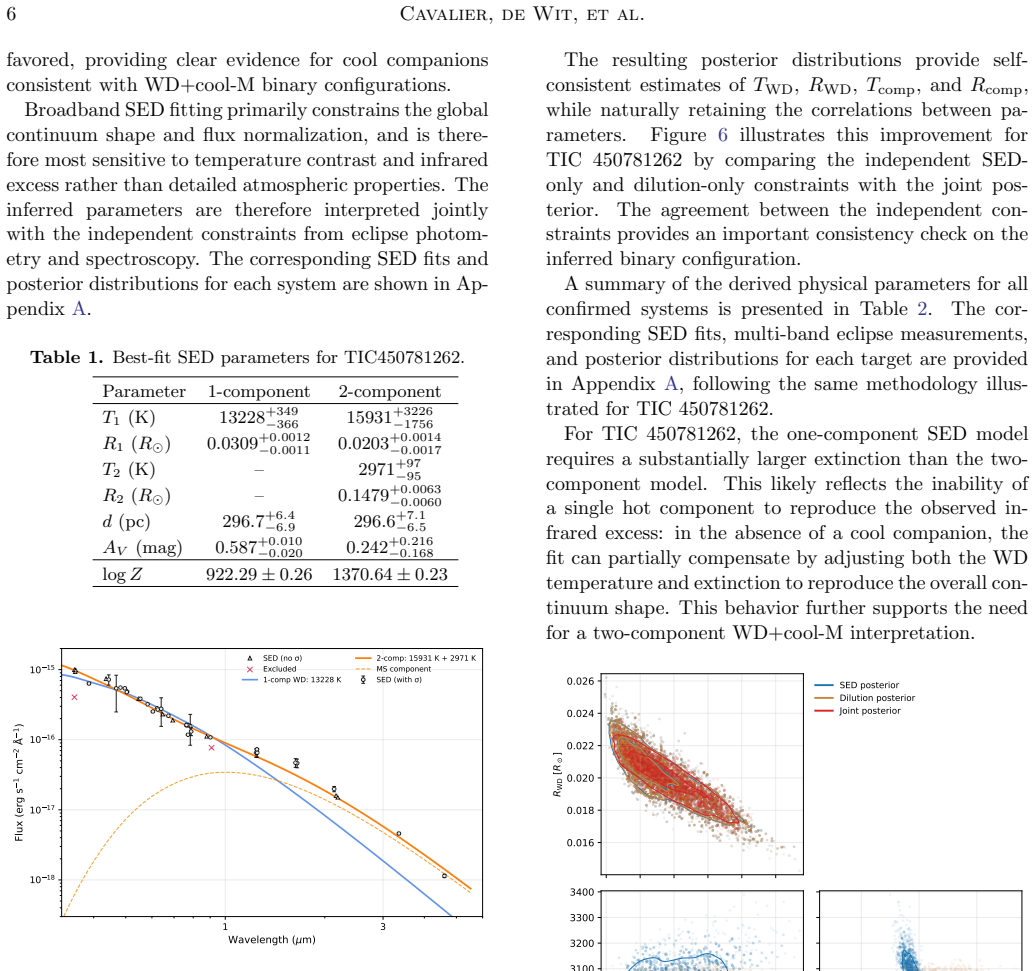
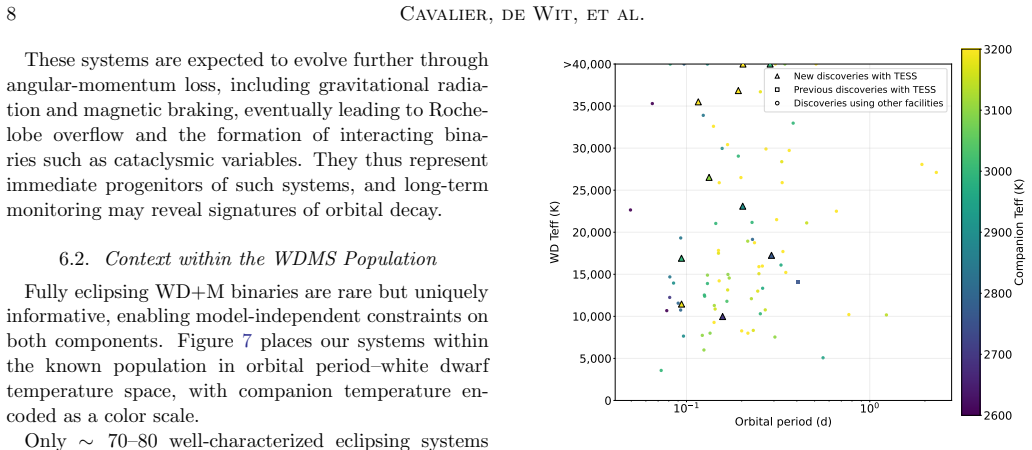
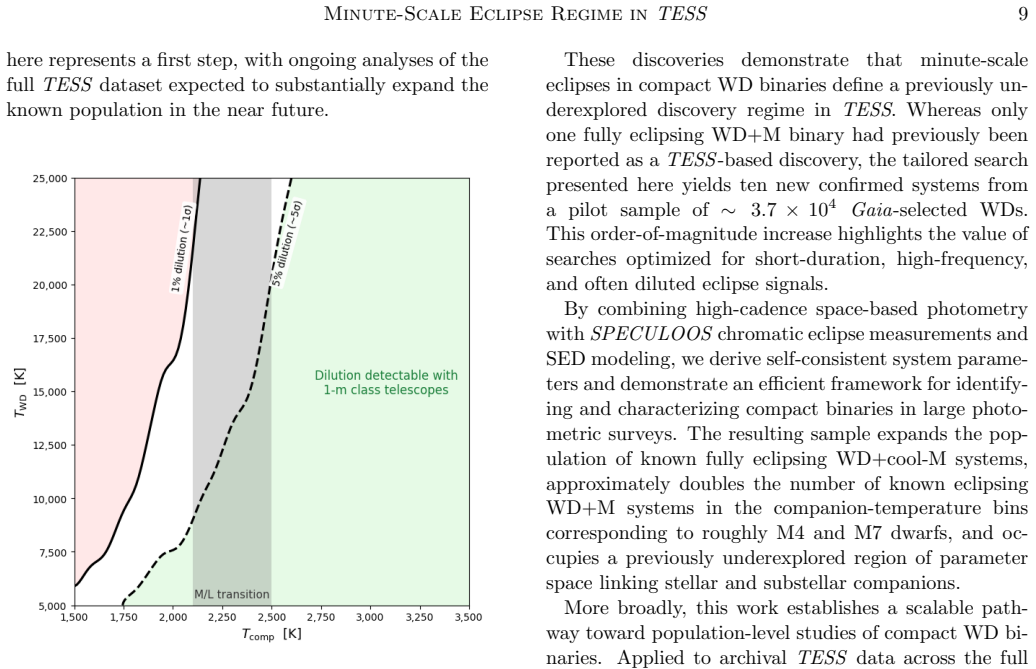
Short-period white-dwarf (WD) binaries are post-common-envelope systems that constrain orbital shrinkage, envelope evolution, and the survival of low-mass companions. We report the discovery and confirmation of ten fully eclipsing short-period WD + cool M-dwarf binaries identified through a tailored search for minute-scale eclipses in Transiting Exoplanet Survey Satellite (TESS) high-cadence data and validated with SPECULOOS multi-band photometry. The systems have orbital periods of a few hours and companions with effective temperatures of 2700-3400 K. These discoveries demonstrate that TESS contains a previously underexplored population of compact WD binaries whose short-duration, high-frequency, and often diluted eclipse signals are not efficiently recovered by standard transit-search pipelines. Whereas the literature contained only one eclipsing WD+M binary reported as a TESS-based discovery, our pilot search of $\sim3.7\times10^4$ Gaia-selected WDs yields ten new confirmed systems, increasing the TESS-discovered sample by an order of magnitude. SPECULOOS follow-up confirms the eclipses occur on target and uses chromatic eclipse dilution to distinguish stellar from substellar companions. We combine multi-band eclipse photometry with Bayesian spectral energy distribution modeling to derive self-consistent WD and companion parameters. The resulting systems expand the known population of fully eclipsing WD+M binaries and notably double the number of systems in temperature regimes corresponding to M4 and M7 companions. This work establishes a scalable framework for identifying compact WD binaries in time-domain photometric surveys. Applied to TESS archival data across the full Gaia WD-candidate catalog ($\sim1.3\times10^6$ sources), this approach opens the prospect of assembling a population large enough to constrain post-common-envelope evolution and the stellar-substellar transition.
Editorial analysis
A structured set of objections, weighed in public.
Referee Report
Summary. The manuscript reports the discovery of ten new fully eclipsing short-period white dwarf + cool M-dwarf binaries found via a targeted search for minute-scale eclipses in TESS high-cadence photometry of ~3.7e4 Gaia-selected white dwarfs. The systems are validated as on-target using SPECULOOS multi-band photometry (with chromatic dilution to distinguish stellar vs. substellar companions) and Bayesian SED modeling, yielding orbital periods of a few hours and companion Teff of 2700-3400 K. This increases the TESS-discovered sample by an order of magnitude and doubles the known systems in the M4/M7 temperature regimes.
Significance. If the ten systems are robustly confirmed as genuine WD+M eclipses, the result materially expands the known population of post-common-envelope binaries and demonstrates a scalable search technique applicable to the full ~1.3e6 Gaia WD catalog. The work leverages public TESS and Gaia data plus targeted follow-up, providing a concrete path to larger samples for constraining common-envelope evolution and the stellar-substellar transition.
major comments (2)
- [Abstract and validation section] Abstract and validation section: The headline claim of ten confirmed new systems (and the order-of-magnitude increase in the TESS sample) rests on the assumption that all detected minute-scale signals are genuine on-target eclipses of the Gaia-selected WDs by cool companions. However, the SPECULOOS chromatic dilution analysis is presented without a quantified false-positive rate, completeness estimate, or simulation of sensitivity to background eclipsing variables, TESS pixel blending, or instrumental artifacts at minute cadence. This is load-bearing; even 2-3 misclassifications would materially weaken both the population increase and the reported doubling in M4/M7 regimes.
- [Results section] Results section (description of the ten systems): The Bayesian SED modeling inherits the classifications from the SPECULOOS analysis; without an explicit false-positive assessment or exclusion criteria for the initial TESS search (e.g., how many candidates were rejected and why), it is not possible to evaluate whether post-hoc selections affect the final count of ten.
minor comments (2)
- [Abstract] The abstract states the search was performed on ~3.7e4 Gaia-selected WDs but does not specify the exact selection criteria or magnitude limits applied to this pilot sample.
- Figure captions and text should explicitly state the TESS sector(s) and cadence used for each of the ten systems to allow reproducibility.
Simulated Author's Rebuttal
We thank the referee for their careful and constructive review. The major comments correctly identify that the current manuscript lacks a quantified false-positive assessment for the TESS search and explicit details on candidate rejection criteria. We will revise the paper to address these points.
read point-by-point responses
-
Referee: [Abstract and validation section] Abstract and validation section: The headline claim of ten confirmed new systems (and the order-of-magnitude increase in the TESS sample) rests on the assumption that all detected minute-scale signals are genuine on-target eclipses of the Gaia-selected WDs by cool companions. However, the SPECULOOS chromatic dilution analysis is presented without a quantified false-positive rate, completeness estimate, or simulation of sensitivity to background eclipsing variables, TESS pixel blending, or instrumental artifacts at minute cadence. This is load-bearing; even 2-3 misclassifications would materially weaken both the population increase and the reported doubling in M4/M7 regimes.
Authors: We agree that the manuscript would be strengthened by a quantified false-positive rate, completeness estimate, and simulations of background eclipsing variables, blending, and artifacts. The SPECULOOS multi-band photometry and chromatic dilution provide on-target confirmation and companion-type discrimination for the ten reported systems, but the initial TESS search description does not include end-to-end false-positive simulations. In revision we will add a new subsection with Monte Carlo simulations of these effects, an estimate of the false-positive probability for the final sample, and the number of candidates rejected at each stage of the TESS search pipeline. revision: yes
-
Referee: [Results section] Results section (description of the ten systems): The Bayesian SED modeling inherits the classifications from the SPECULOOS analysis; without an explicit false-positive assessment or exclusion criteria for the initial TESS search (e.g., how many candidates were rejected and why), it is not possible to evaluate whether post-hoc selections affect the final count of ten.
Authors: We will revise the results and methods sections to explicitly list the exclusion criteria applied to the TESS detections (e.g., signal-to-noise thresholds, eclipse shape requirements, and rejection of known artifacts) together with the number of candidates at each stage. This will demonstrate that the final sample of ten follows from the predefined validation steps rather than post-hoc adjustments. The Bayesian SED modeling section will reference these criteria for transparency. revision: yes
Circularity Check
Observational discovery report with no derivations or fitted predictions
full rationale
This is a pure observational paper reporting a search in public TESS data for minute-scale eclipses around Gaia-selected white dwarfs, followed by SPECULOOS multi-band photometry for on-target confirmation and chromatic dilution analysis, plus standard Bayesian SED modeling for parameter estimation. No equations, uniqueness theorems, ansatzes, or predictions are presented that reduce to the inputs by construction. The headline result (ten new systems) is a direct count of validated detections, not a derived quantity. Self-citations, if present, are not load-bearing for any central claim. The analysis is self-contained against external benchmarks.
Axiom & Free-Parameter Ledger
axioms (1)
- domain assumption Standard assumptions in stellar photometry and spectral energy distribution modeling hold for white dwarfs and M-dwarfs, including the applicability of model atmospheres and the interpretation of chromatic eclipse dilution.
Reference graph
Works this paper leans on
-
[1]
The Wide Field Infrared Survey Telescope: 100 Hubbles for the 2020s
Akeson, R., Armus, L., Bachelet, E., et al. 2019, arXiv e-prints, arXiv:1902.05569, doi: 10.48550/arXiv.1902.05569
work page internal anchor Pith review Pith/arXiv arXiv doi:10.48550/arxiv.1902.05569 2019
-
[2]
doi:10.1051/0004-6361/201425481 , keywords =
Baraffe, I., Homeier, D., Allard, F., & Chabrier, G. 2015, A&A, 577, A42, doi: 10.1051/0004-6361/201425481 B´ edard, A., Bergeron, P., Brassard, P., & Fontaine, G. 2020, ApJ, 901, 93, doi: 10.3847/1538-4357/abafbe
work page internal anchor Pith review doi:10.1051/0004-6361/201425481 2015
-
[3]
doi:10.1088/1538-3873/aaecbe , eprint =
Bellm, E. C., Kulkarni, S. R., Graham, M. J., et al. 2019, PASP, 131, 018002, doi: 10.1088/1538-3873/aaecbe
-
[4]
Bronner, V. A., Schneider, F. R. N., Podsiadlowski, P., & R¨ opke, F. K. 2024, A&A, 683, A65, doi: 10.1051/0004-6361/202347397
-
[5]
The Journal of Open Source Software , keywords =
Buchner, J. 2021, Journal of Open Source Software, 6, 3001, doi: 10.21105/joss.03001
-
[6]
Y., de Wit, J., Gillon, M., et al
Burdanov, A. Y., de Wit, J., Gillon, M., et al. 2022, PASP, 134, 105001, doi: 10.1088/1538-3873/ac92a6
-
[7]
Chambers, K. C., Magnier, E. A., Metcalfe, N., et al. 2016, arXiv e-prints, arXiv:1612.05560, doi: 10.48550/arXiv.1612.05560
work page internal anchor Pith review Pith/arXiv arXiv doi:10.48550/arxiv.1612.05560 2016
-
[8]
2024, A&A, 687, A256, doi: 10.1051/0004-6361/202348870
Chen, Z., Chen, Y., Chen, C., Ge, H., & Ma, B. 2024, A&A, 687, A256, doi: 10.1051/0004-6361/202348870
-
[9]
Cutri, R. M., Wright, E. L., Conrow, T., et al. 2021, VizieR Online Data Catalog: AllWISE Data Release (Cutri+ 2013), VizieR On-line Data Catalog: II/328. Originally published in: IPAC/Caltech (2013) de Wit, J., Alonso, R., Rackham, B. V., et al. 2025, Research Notes of the American Astronomical Society, 9, 270, doi: 10.3847/2515-5172/ae1228
-
[10]
2018, in Society of Photo-Optical Instrumentation Engineers (SPIE) Conference Series, Vol
Delrez, L., Gillon, M., Queloz, D., et al. 2018, in Society of Photo-Optical Instrumentation Engineers (SPIE) Conference Series, Vol. 10700, Ground-based and Airborne Telescopes VII, ed. H. K. Marshall & J. Spyromilio, 107001I, doi: 10.1117/12.2312475
-
[11]
Drake, A. J., Djorgovski, S. G., Mahabal, A., et al. 2009, ApJ, 696, 870, doi: 10.1088/0004-637X/696/1/870 Gaia Collaboration, Vallenari, A., Brown, A. G. A., et al. 2023, A&A, 674, A1, doi: 10.1051/0004-6361/202243940 Gentile Fusillo, N. P., Tremblay, P.-E., Cukanovaite, E., et al. 2021, MNRAS, 508, 3877, doi: 10.1093/mnras/stab2672
-
[12]
J., van Roestel, J., & Wong, T
Green, M. J., van Roestel, J., & Wong, T. L. S. 2025, A&A, 700, A107, doi: 10.1051/0004-6361/202554925
-
[13]
Grether, D., & Lineweaver, C. H. 2006, ApJ, 640, 1051, doi: 10.1086/500161
-
[14]
O., Wende-von Berg, S., Dreizler, S., et al
Husser, T.-O., Wende-von Berg, S., Dreizler, S., et al. 2013, Astronomy & Astrophysics, 553, A6, doi: 10.1051/0004-6361/201219058
work page internal anchor Pith review doi:10.1051/0004-6361/201219058 2013
-
[15]
2020, Nature Astronomy, 4, 592
Ivanova, N. 2020, Nature Astronomy, 4, 592
2020
-
[16]
Ivanova, N., Justham, S., Chen, X., et al. 2013, A&A Rv, 21, 59, doi: 10.1007/s00159-013-0059-2
-
[17]
Jenkins, J. M., Twicken, J. D., McCauliff, S., et al. 2016, in Society of Photo-Optical Instrumentation Engineers (SPIE) Conference Series, Vol. 9913, Software and Cyberinfrastructure for Astronomy IV, ed. G. Chiozzi & J. C. Guzman, 99133E, doi: 10.1117/12.2233418
-
[18]
Kesseli, A. Y., Muirhead, P. S., Mann, A. W., & Mace, G. 2018, AJ, 155, 225, doi: 10.3847/1538-3881/aabccb
-
[19]
2022, MNRAS, 516, 720, doi: 10.1093/mnras/stac1146 Kov´ acs, G., Zucker, S., & Mazeh, T
Kupfer, T. 2022, MNRAS, 516, 720, doi: 10.1093/mnras/stac1146 Kov´ acs, G., Zucker, S., & Mazeh, T. 2002, A&A, 391, 369, doi: 10.1051/0004-6361:20020802
-
[20]
2020, MNRAS, 493, 5208, doi: 10.1093/mnras/staa547
Krushinsky, V., Benni, P., Burdanov, A., et al. 2020, MNRAS, 493, 5208, doi: 10.1093/mnras/staa547
-
[21]
Moe, M., & Di Stefano, R. 2017, ApJS, 230, 15, doi: 10.3847/1538-4365/aa6fb6
work page internal anchor Pith review doi:10.3847/1538-4365/aa6fb6 2017
-
[22]
Moreno, M. M., Schneider, F. R. N., R¨ opke, F. K., et al. 2022, A&A, 667, A72, doi: 10.1051/0004-6361/202142731
-
[23]
2000, A&AS, 143, 23, doi: 10.1051/aas:2000169
Ochsenbein, F., Bauer, P., & Marcout, J. 2000, A&AS, 143, 23, doi: 10.1051/aas:2000169
-
[24]
1976, IAU Symposium, Vol
Paczynski, Eggleton, P., Mitton, S., & Whelan, J., eds. 1976, IAU Symposium, Vol. 73, Structure and evolution of close binary systems : symposium no. 73 held in
1976
-
[25]
Cambridge, England, 28 July-1 August, 1975
1975
-
[26]
G., Agurto-Gangas, C., G¨ ansicke, B
Parsons, S. G., Agurto-Gangas, C., G¨ ansicke, B. T., et al. 2015, MNRAS, 449, 2194, doi: 10.1093/mnras/stv382
-
[27]
Parsons, S. G., G¨ ansicke, B. T., Marsh, T. R., et al. 2018, MNRAS, 481, 1083, doi: 10.1093/mnras/sty2345
-
[28]
Buckley, D. A. H. 2022, MNRAS, 516, 1183, doi: 10.1093/mnras/stac2197
-
[29]
Rackham, B. V. 2023, speclib, 0.0-beta.0, Zenodo, doi: 10.5281/zenodo.7868050
-
[30]
Rackham, B. V., & de Wit, J. 2024, AJ, 168, 82, doi: 10.3847/1538-3881/ad5833
-
[31]
2014, Experimental Astronomy, 38, page range, doi: 10.1007/s10686-014-9383-4
Rauer, H., Catala, C., Aerts, C., et al. 2014, Experimental Astronomy, 38, 249, doi: 10.1007/s10686-014-9383-4
-
[32]
Rebassa-Mansergas, A., Solano, E., Jim´ enez-Esteban, F. M., et al. 2021, MNRAS, 506, 5201, doi: 10.1093/mnras/stab2039
-
[33]
Rebassa-Mansergas, A., Solano, E., Brown, A. J., et al. 2025, A&A, 699, A153, doi: 10.1051/0004-6361/202554700
-
[34]
The Transiting Exoplanet Survey Satellite
Ricker, G. R., Winn, J. N., Vanderspek, R., et al. 2015, Journal of Astronomical Telescopes, Instruments, and Systems, 1, 014003, doi: 10.1117/1.JATIS.1.1.014003 Minute-Scale Eclipse Regime inTESS11
work page internal anchor Pith review doi:10.1117/1.jatis.1.1.014003 2015
-
[35]
2021, Astronomy & Astrophysics, 645, A100, doi: 10.1051/0004-6361/202038827
Sebastian, D., Delrez, L., Gillon, M., et al. 2021, Astronomy & Astrophysics, 645, A100, doi: 10.1051/0004-6361/202038827
-
[36]
2026, arXiv e-prints, arXiv:2601.00439, doi: 10.48550/arXiv.2601.00439
Shariat, C., & El-Badry, K. 2026, arXiv e-prints, arXiv:2601.00439, doi: 10.48550/arXiv.2601.00439
-
[37]
Skrutskie, M. F., Cutri, R. M., Stiening, R., et al. 2006, AJ, 131, 1163, doi: 10.1086/498708
-
[38]
Stassun, K. G., Oelkers, R. J., Paegert, M., et al. 2019, AJ, 158, 138, doi: 10.3847/1538-3881/ab3467 van Roestel, J., Kupfer, T., Bell, K. J., et al. 2021, ApJL, 919, L26, doi: 10.3847/2041-8213/ac22b7 van Roestel, J., Rodriguez, A. C., Szkody, P., et al. 2025, A&A, 696, A242, doi: 10.1051/0004-6361/202451945
-
[39]
Vanderburg, A., Rappaport, S. A., Xu, S., et al. 2020, Nature, 585, 363, doi: 10.1038/s41586-020-2713-y
-
[40]
G., Adelman , J., Anderson , Jr., J
York, D. G., Adelman, J., Anderson, Jr., J. E., et al. 2000a, AJ, 120, 1579, doi: 10.1086/301513 —. 2000b, AJ, 120, 1579, doi: 10.1086/301513 12Cavalier, de Wit, et al. APPENDIX A.SUPPLEMENTARY DIAGNOSTIC PLOTS This appendix presents the diagnostic plots (i.e., data and posterior probability distributions) used to derive the parameter values reported in T...
discussion (0)
Sign in with ORCID, Apple, or X to comment. Anyone can read and Pith papers without signing in.